
Monthly Archives: May 2013
First Name and then Act
If we cannot even name the reality we claim we want to change, then we will never change that reality.
—–
There are two points that I make in my scholarship and public writing that are certain to prompt reactions from both friends and foes that suggest I may have just run down someone’s grandmother with a bus:
Let me try once again to clarify both that these claims are true and necessary to name in order to change.
“Poverty is destiny” is a normative [1] fact of the United States. For most children, the social class they are born into predicts the trajectory of their lives, independent of their self-worth, effort, and all sorts of other factors we are more likely to associate with the individual child.
That this is a normative statement includes a concession that outliers exist (some people fall out of and rise above the social class of their births), but outliers do not discredit a normative statement just as we must caution against making an outlier status the rubric for normalized behavior. In other words, that African American men have scaled to the presidency and supreme court stands as outliers against the disproportionate number of AA men incarcerated in our country:
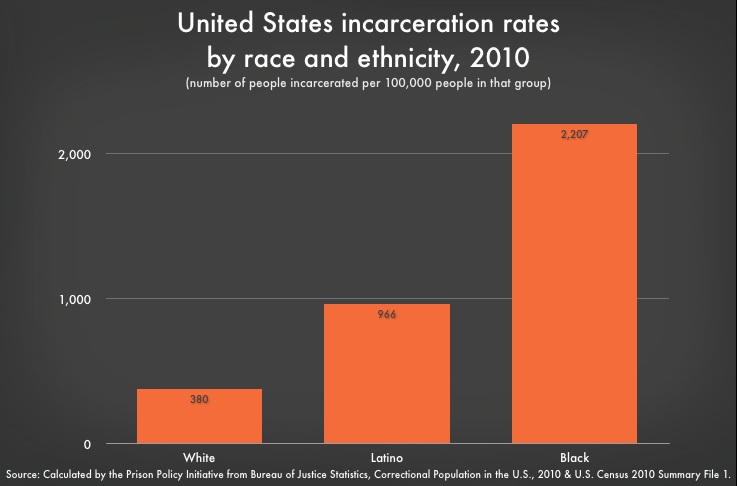
Michelle Alexander has embodied the need to name in order to change by confronting the normative facts of mass incarceration as well as the indisputable fact that mass incarceration is the New Jim Crow, thus racist.
And Sean Reardon has now offered a powerful case that “poverty and affluence are destiny”:
Here’s a fact that may not surprise you: the children of the rich perform better in school, on average, than children from middle-class or poor families. Students growing up in richer families have better grades and higher standardized test scores, on average, than poorer students; they also have higher rates of participation in extracurricular activities and school leadership positions, higher graduation rates and higher rates of college enrollment and completion….
In the 1980s, on an 800-point SAT-type test scale, the average difference in test scores between two such children would have been about 90 points; today it is 125 points. This is almost twice as large as the 70-point test score gap between white and black children. Family income is now a better predictor of children’s success in school than race….
We are still talking about this despite decades of clucking about the crisis in American education and wave after wave of school reform.Whatever we’ve been doing in our schools, it hasn’t reduced educational inequality between children from upper- and lower-income families….
The income gap in academic achievement is not growing because the test scores of poor students are dropping or because our schools are in decline….
It may seem counterintuitive, but schools don’t seem to produce much of the disparity in test scores between high- and low-income students. We know this because children from rich and poor families score very differently on school readiness tests when they enter kindergarten, and this gap grows by less than 10 percent between kindergarten and high school. There is some evidence that achievement gaps between high- and low-income students actually narrow during the nine-month school year, but they widen again in the summer months….
The more we do to ensure that all children have similar cognitively stimulating early childhood experiences, the less we will have to worry about failing schools. This in turn will enable us to let our schools focus on teaching the skills — how to solve complex problems, how to think critically and how to collaborate — essential to a growing economy and a lively democracy.
Alexander and Reardon are naming normative facts—ones that many all along the ideological spectrum not only refuse to do themselves, but rush to silence others who do name in order to change.
If the patterns of mass incarceration and “no excuses”/”zero tolerance” schools and policies even impacted privileged white males proportionately in the U.S., the outcry would be deafening.
The current and historical racially disproportionate and negative patterns of the U.S. penal and judicial systems and the rise of highly segregated “no excuses” charter schools and “zero tolerance” urban public schools must be named and then we must act t change that which is racist, that which is classist, that which is sexist.
Refusing to name, refusing to act guarantees poverty will remain destiny and the current education reform movement will continue to mirror the New Jim Crow of mass incarceration.
If you are uncertain about the messages our culture sends about race, view the video below:
This Is The Worst Thing I Have Ever Heard A Child Say
[1] “Normative” is being expressed as “typical,” that which can fairly be called “normal” in the sense of mode and/or more than half of a population exists in that condition.
Education Reform in the New Jim Crow Era
Education Reform in the New Jim Crow Era.
There are significant parallels between the war on drugs and market-oriented education reform, and both create an underclass – especially among African American males, according to Thomas, who traces the history.
Please read by clicking ABOVE on title.
“Eager to Recreate the Same Old Nightmare”: Revisiting Vonnegut’s Player Piano
Few people could have imagined the acceleration of corporate influence that has occurred in the last two years despite the economic downturn associated with those corporations and the election of Barak Obama, who was repeatedly demonized as a socialist. *
More shocking, possibly, has been the corporate influence on the public discourse about universal public education, driven by Secretary of Education Arne Duncan and promoted through celebrity tours by billionaire Bill Gates, ex-chancellor Michelle Rhee, and “Superman” Geoffrey Canada.
Adam Bessie has speculated about the logical progression of the current accountability era built on tests and destined to hold teachers accountable for their students’ test scores (despite the evidence that teachers account for only about 10-20% of achievement)—hologram teachers. And Krashen believes that the corporate takeover of schools is at the center of the new reformers’ misinformation tour. For Anthony Cody, the future is a disturbing dystopia.
While Bessie’s, Krashen’s, and Cody’s commentaries may sound like alarmist stances–possibly even the stuff of fiction—I believe we all should have been seeing this coming for decades.
The science fiction (SF) genre has always been one of my favorites, and within that genre, I am particularly found of dystopian fiction, such as Margaret Atwood’s brilliant The Handmaid’s Tale, Oryx and Crake, and The Year of the Flood. Like Atwood, Kurt Vonnegut spoke and wrote often about rejecting the SF label for his work (See Chapter 1 of Wampeters, Foma & Granfalloons), but Vonnegut’s genius includes his gift for delivering social commentary and satire wrapped in narratives that seemed to be set in the future, seemed to be a distorted world that we could never possibly experience.
In 1952, Kurt Vonnegut published Player Piano, offering what most believed was a biting satire of corporate American from his own experience working at GE. A review of the novel describes Vonnegut’s vision of our brave new world:
The important difference lies in the fact that Mr. Vonnegut’s oligarchs are not capitalists but engineers. In the future as he envisages it, the machines have completed their triumph, dispossessing not only the manual laborers but the white collar workers as well. Consequently the carefully selected, highly trained individuals who design and control the machines are the only people who have anything to do. Other people, the great majority, can either go into the Reconstruction and Reclamation Corps, which is devoted to boondoggling, or join the army, which has no real function in a machine-dominated world-society.
Yes, in Vonnegut’s dystopia, computers are at the center of a society run itself like a machine, with everyone labeled with his or her IQ and designated for what career he or she can pursue (although we should note that women’s roles were even more constrained than men’s, reflecting the mid-twentieth century sexism in the U.S.). Where corporations end and the government begins is difficult in this society that is simply a slightly exaggerated of the life Vonnegut had witnessed while working at GE before abandoning corporate America to be a full-time writer.
For me, however, Vonnegut’s Player Piano is as much a warning about the role of testing and labeling people in our education system as it is a red flag about the dangers of the oligarchy that we have become.
Today, with billionaire Bill Gates speaking for not only corporate America but also for reforming public education, how far off was Vonnegut’s vision?
In the first decade of the twenty-first century, how different is Vonnegut’s world to what we have today, as income inequity and the pooling of wealth accelerates?
We have witnessed where political loyalty lies during the bailouts as corporate America collapsed at the end of George W. Bush’s presidency. With corporate America saved, and most Americans ignored, the next logical step is to transform public education by increasing the corporate model that has been crippling the system since the misinformation out of Ronald Reagan’s presidency grabbed headlines with the release of A Nation at Risk.
If Vonnegut had written this storyline, at least we could have been guaranteed some laughter. But this brave new world of public education is more grim—like George Orwell’s 1984.
Our artists can see and understand when many of the rest of us are simply overwhelmed by our lives. In Player Piano, we see how successfully corporate life disorients and overwhelms workers in order to keep those workers under control. And in the relationship between the main character Paul and his wife Anita, we watch the power of corporate life—and the weight of testing and reducing humans to numbers—being magnified by the rise of computers when Paul makes a plea to his wife:
“No, no. You’ve got something the tests and machines will never be able to measure: you’re artistic. That’s one of the tragedies of our times, that no machine has ever been built that can recognize that quality, appreciate it, foster it, sympathize with it.” (p. 178)
In the novel, Paul’s quest and the momentary rise of a few rebels appear to be no match for corporate control. Today, I have to say I am no more optimistic than Vonnegut.
When Secretary Duncan offers misleading claims about international test scores and bemoans the state of public schools for failing to provide us with a world-class workforce, and almost no one raises a voice in protest (except those of us within the field of education, only to be demonized for protesting), I am tempted to think that we are simply getting what we deserve—like Paul at the end of Player Piano: “And that left Paul. ‘To a better world,’ he started to say, but he cut the toast short, thinking of the people of Ilium, already eager to recreate the same old nightmare” (p. 340).
* Slightly revised reposting from OpEdNews (1/3/2011)
See Also
Engineers Own The Future, And Maybe Even Us, Jamie Condliffe
Adrienne Rich: Artist of the Possible and Life among the Ruins
I. Adrienne Rich: Artist of the Possible*
In late November of 2003, I sat on the floor in a crowded luncheon just a few feet and slightly behind Adrienne Rich, speaking and reading her poetry at the annual convention of the National Council of Teachers of English, held that year in San Francisco.
Appropriately, Rich was reading from her upcoming collection, The School among the Ruins, and talking about teaching, teachers, and education. I was struck by many things that day, and eventually I wrote a poem to capture the moment (see below).
As a poet, teacher, reader, and human, I have been deeply and permanently moved and changed by the poetry and essays of Rich, from the genius of “Diving into the Wreck” and “Aunt Jennifer’s Tigers” to the reconsideration of Emily Dickinson in “Vesuvius at Home: The Power of Emily Dickinson” (see On Lies, Secrets, and Silence) to her remarkable and soaring Arts of the Possible, that includes one of the most cited passages in my scholarly works:
Universal public education has two possible—and contradictory—missions. One is the development of a literate, articulate, and well-informed citizenry so that the democratic process can continue to evolve and the promise of radical equality can be brought closer to realization. The other is the perpetuation of a class system dividing an elite, nominally “gifted” few, tracked from an early age, from a very large underclass essentially to be written off as alienated from language and science, from poetry and politics, from history and hope—toward low-wage temporary jobs. The second is the direction our society has taken. The results are devastating in terms of the betrayal of a generation of youth. The loss to the whole of society is incalculable. (p. 162)
For Rich, the human condition is a fact of what is spoken and unspoken:
The study of silence has long engrossed me. The matrix of a poet’s work consists not only of what is there to be absorbed and worked on, but also of what is missing, desaparecido, rendered unspeakable, thus unthinkable. (p. 150)
When I discovered that Rich had passed, I recognized that while she would no longer speak again to us, she would never be unspoken. With her work, Rich remains the artist of the possible.
Woman as Poet: Possibilities
The life and writing of Rich are testaments to and challenges against the hegemonies of gender, marriage, sexuality, and human agency. She lived many lives in her one life, a fact common for women trapped in the expectations of gender that often create burdens that are nearly impossible to carry.
Her early life included marriage and three sons, and then she lived a much different life after separating from her husband, a life often characterized by a sort of radical feminism that celebrated her lesbianism. Her life as a poet/writer paralleled this personal transformation, with Rich acknowledging that her early success as a poet was built on her embracing modernist traditions, leading to her “Aunt Jennifer’s Tigers” being both, according to her, a rejection (somewhat unconsciously) and model of those traditions. The poet Rich, however, became a radical as well, resulting in canon czars such as Harold Bloom marginalizing Rich as merely political—missing entirely Rich’s powerful argument that political is all that poetry and a poet can be: “I take it that poetry—if it is poetry—is liberatory at its core” (Arts of the Possible, p. 116).
Rich’s poetry and her critical work on Dickinson were central parts of my teaching during my nearly two decades as an ELA high school teacher. In fact, one of the most important and influential units I eventually included in the quarter we explored poetry included Rich’s work paired with the poetry of Sylvia Plath and Anne Sexton. Along with these poets, we viewed the film Pleasantville, framing the lives and poetry of Rich (1929-2012), Plath (1932-1963), and Sexton (1928-1974) against the Betty Parker (Joan Allen) character in the film, the TV mother trapped in the norms of 1950s American.
This unit asked students to consider the suicides of Plath and Sexton against the life and poetic transformations of Rich; we also discussed how the film portrayed Betty Parker, both as a model of the norms of 1950s America and the real person trapped under her make up and the oppressive roles of wife and mother (dramatizing the poetry of Rich’s “Aunt Jennifer’s Tigers”: “The massive weight of Uncle’s wedding band/ Sits heavily upon Aunt Jennifer’s hand”).
And for the words Rich brought to my classroom and my life, I am forever in her debt. She validated things I had dared to think but feared to speak. She reminds me daily of the humility that should be at my core, a paradoxical radical humility, a commitment to human dignity and agency that are both threatened by the mere fact of my being a man in a world and society that allows the norm of manhood to oppress and silence.
It is deeply sad to lose Adrienne Rich, and profoundly uplifting to know all that remains forever from her words and her life:
The possibilities that exist between two people, or among a group of people, are a kind of alchemy. They are the most interesting thing in life. The liar is someone who keeps losing sight of these possibilities….
It isn’t that to have an honorable relationship with you, I have to understand everything, or tell you everything at once, or that I can know, beforehand, everything I need to tell you. It means that most of the time I am eager, longing for the possibility of telling you. That these possibilities may seem frightening, but not destructive, to me. That I feel strong enough to hear your tentative and groping words. That we both know we are trying, all the time, to extend the possibilities of truth between us.
The possibility of life between us. (Arts of the Possible, pp. 39-40)
It cannot be coincidence that just a few days before Rich’s death I sat in my office talking with one of my students; I pulled four books of Rich’s from the shelf and recommended her to the student.
The morning after Rich’s passing that student walked into my office with a New York Times article on Rich.
No, this could not be a coincidence, and yes, it must be the bittersweet symmetry of the universe that reminded me during my moments of sadness of the possibilities.
II. Life among the Ruins
Adrienne Rich’s The School Among the Ruins ** confronts the intersection of school and violence, poems written in the time designated as the turn of a century:
Rich cited another catalyst for ‘The School Among the Ruins’ in an e-mail interview from her Santa Cruz home — the school, in Brooklyn, where her son teaches.
“I knew his love for the school, for those children,” she said.
[The volume is s]et during a nonspecific wartime in which children and their teachers are hostages to horror.
We are now faced again with the incomprehensible intersection of children, teachers, schools, and unspeakable violence. It is ours to honor those taken from us by seeking the rational among the irrational.
Seeking the Rational among the Irrational
Let us commit ourselves to a vigilance, to protecting this moment against the petty, against the call to heap irrational upon irrational, against allowing the needed confrontations and discussions to become too narrow.
We must confront our culture of violence and the fetish with guns within that culture of violence, and not just gun control.
We must confront health care access and mental health care access, and not just mental illness.
We must confront our negative national discourse about teachers and schools—that misrepresents the sacred duties of those teachers and schools that are now memorialized in the names of innocent lives lost in an elementary school.
We must admit that we have been too quick to police children, and too slow to protect, cherish, and serve those children—particularly some children, too often “other people’s children.”
To allow the gaze of blame to be focused too narrowly absolves the larger root causes to remain, to thrive, to perpetuate further the ruins.
Words matter, yes, but actions speak louder than words.
How children matter, whose children matter—our commitments daily send messages.
The world we have created is the world we want, or at least the world we allow; as Kingsolver notes:
In the United States, where people like to think that anyone can grow up to be President, we parents are left very much on our own when it comes to the little Presidents-in-training. Our social programs for children are the hands-down worst in the industrialized world, but apparently that is just what we want.
In a poem of mine, I end with the following: “the world was exactly as they expected/ exactly as they knew it to be/ and mostly not as it could have been/ or should have been.”
To build that world out of the ruins requires action, action built on principles, to build monuments of peace and love against violence and destruction.
“What’s Going On,” Marvin Gaye
“…Don’t punish me with brutality
Talk to me
So you can see
What’s going on…”
Recommended
Adrienne Rich @ Poetry Foundation
Anne Sexton: A Biography, Diane Wood Middlebrook
Anne Sexton @ Poetry Foundation
Sylvia Plath: A Biography, Linda Wagner-Martin
Sylvia Plath @ Poetry Foundation
—-
“upon hearing adrienne rich speak and read her poetry”
P. L. Thomas, 2003
i cannot shake the rush
of my own grandmother—
hair cropped short—
rush over me whenever
i see adrienne rich—
this time—in person—
i felt the hunger to cry
as i watched her—
cane in hand—shuffle on stage
like but not my grandmother—
my chest and eyes welled
again and again from her words—
speaking about teaching
the frailty of teaching
in America—America—
because she knows—
if “knows” means “tastes in the air”
if “knows” means “feels with her blood”—
because she knows
what no one can teach
this mother of us teachers
who lives that which cannot be taught—
the doubling over in pain
from other people’s suffering
that is surely not of this America—
and if i told her
“adrienne, my lives have split
me into pieces, pieces”
she might cry right there
her eyes welled as mine
because it is that knowing
that makes us cry
at the slightest suffering
of any anyone who hurts
and struggles against this whip
called “living”
* Reposted pieces from 2012—Adrienne Rich: Artist of the Possible (March 29, 2012) and Life among the Ruins (December 16, 2012)
** The title of this blog is intended as an allusion to Rich’s work.
Lessons from Finland and Wisconsin – @ THE CHALK FACE knows SCHOOLS MATTER
The Bully Politics of Education Reform
America is a bully nation.
America is the embodiment of might-makes-right. When another country (USSR) invades Afghanistan, America is filled with righteous indignation, but when America invades Afghanistan, well, all is right with the world.
America has bred the bully tactic of vigilantism in the sanctified Petri dish of law (Stand Your Ground), and the result is the person with the gun is the law while the victim’s innocence is extinguished along with the person’s life.
To mask the bully culture of the U.S., bullying is confronted as a school-based problem among children (note the distraction of the R rating in the documentary on bullying addressed by Nancy Flanagan and Douglas Storm). Yet, the exact ruling class who denounces bullying among children are themselves bullies.
So there is no surprise that the current education reform movement is characterized by bully politics.
NCTQ: Teaching Teachers a Lesson
In the mid-1800s, public education was called a “’dragon. . .devouring the hope of the country as well as religion. [It dispenses] ‘Socialism, Red Republicanism, Universalism, Infidelity, Deism, Atheism, and Pantheism—anything, everything, except religion and patriotism,’” explains Jacoby (2004, pp. 257-258). Bullying public education, then, has long roots, at least stretching back to the threat of universal public schooling detracting from the Catholic church’s control of education in the nineteenth century.
From there, the bullying of public schools continued, judging the quality of our public schools based on drop-out rates (Get adjusted, 1947). We must recognize that the demonizing of public schools and the condemnation of school quality are the way we talk about and view schools in the U. S. as popular discourse and understanding, but this historical badgering of schools has evolved recently into a more direct and personal attack on teachers.
While it appears we cringe when children bully each other, we have no qualms about inexpert, inexperienced, and self-proclaimed education reformers bullying an entire profession.
While the bullying can be witnessed in the discourse coming from Secretary of Education Arne Duncan, former-chancellor Michelle Rhee, and billionaire-reformer Bill Gates, one of the most corrosive and powerful dynamics embracing bully politics is the rise of self-appointed think-tank entities claiming to evaluate and rank teacher education programs. A key player in bully politics is the National Council on Teacher Quality (NCTQ).
NCTQ represents, first, the rise of think tanks and the ability of those think tanks to mask their ideologies while receiving disproportionate and unchallenged support from the media.
Think tanks have adopted the format and pose of scholarship, producing well crafted documents filled with citations and language that frame ideology as “fair and balanced” conclusions drawn from the evidence.
Nothing could be farther from the truth.
NCTQ grew out of the Thomas B. Fordham Foundation and the Education Leaders Council (ELC), which is associated with the Center for Education Reform, securing in the process unsolicited federal funds (over $9 million under George W. Bush).
In short, NCTQ is not an unbiased and scholarly enterprise to evaluate and reform teacher education. NCTQ is a right-wing, agenda-driven think tank entity determined to marginalize and discredit teacher education in order to promote a wide range of market-based ideologies related specifically to public education.
Further, and powerfully connected to the bully politics of NCTQ, is the association between NCTQ and U.S. News & World Report. In other words, NCTQ lacks educational and scholarly credentials and credibility, but gains its influence and power through direct and indirect endorsements from government, the media, and entrepreneurs (re: Gates foundation and funding).
NCTQ has released one report on student teaching. and a self-proclaimed national review of teacher preparation programs is scheduled for June 2013.
How, then, is this bully politics?
In both reports, NCTQ contacts departments and colleges of education with a simple but blunt request: Cooperate with us or we’ll evaluate you however we can, and publish our report regardless. These requests demand extensive data from the departments and colleges, and then subject these programs to standards and expectations designed by NCTQ completely decontextualized from the departments and colleges being “evaluated” against those standards. In other words, the basis for NCTQ’s evaluations have not been vetted by anyone for being credible. A department or college could very well be rated high or low and that rating mean little since the department or college may or may not consider the criteria of any value.
In fact, the first report by NCTQ has been reviewed (most think tank reports receive tremendous and uncritical coverage without review, and when reviewed, those reviews tend to receive almost no media coverage), confirming that NCTQ produces biased and careless work. Benner’s review concludes, in part:
The NCTQ review of student teaching is based upon the assumption that it is not only possible, but also worthwhile and informative to isolate student teaching from the totality of a teacher preparation program. This notion is in direct conflict with the perspective that effective teacher education programs avoid the isolation of pedagogy and classroom management content, offering such knowledge and skills within a learning environment centered upon a clinical experience.
The sample of programs cannot be characterized as representative based on any statistical standard or recognized sampling technique. The problems include disproportionate samples, artificial restrictions, selection bias toward the weakest programs within universities, lack of clarity regarding sample size, and unsound selection procedures for the sample-within-sample. The problems with data collection include how the ratings were derived, how site visit destinations were selected and how the site visits were used in the data analysis, and how principals were surveyed and/or interviewed.
Limitations in the development and interpretation of the standards, sampling techniques, methodology, and data analysis unfortunately negate any guidance the work could have offered the field and policy makers. However, the fact that this particular review is ill-conceived and poorly executed does not mean that all is well in teacher education. The education of future teachers can be greatly improved by increased selectivity of the students admitted into teacher preparation programs, strengthened clinical experiences woven into the study of teaching and learning, increased demand for teachers to have strong content knowledge and understanding of content-specific instructional strategies, and stricter enforcement of program approval standards.
NCTQ, espcially in its relationship with the media, appears more concerned about creating an appearance of failure within tecaher education than with genuinely addressing in a scholarly way what works, what doesn’t work, and how to reform teacher education.
The bully depends on status—the weight of appointment, designation—and the threat of wielding that power regardless of credibility. The bully depends on repetition and volume of claims over the confirmation of evidence or logic.
The current education reform movement is in the hands of bullies and in the vortex of bully politics. Left unchecked, bullying is incredibly effective for the benefit of the bullies and detrimental to everyone else.
Calling out the bullies, however, is possible and even relatively simple since the bully has nothing genuine to stand on.
In the long run, truth trumps bullying, but truth cannot win in the cloak of silence and inaction.
The States: More Bully Politics of Education Reform
From South Carolina to New Jersey to Wisconsin—and all across the U.S.—universal public education is under assault by the bully politics of education reform.
In my home state of South Carolina, Governor Haley and Superintendent Zais, neither of whom have experience or expertise in education, are seeking to attack unions (although SC is a non-union, right-to-work state), increase education testing through adopting Common Core State Standards (CCSS), deprofessionalize teachers through new accountability and merit-pay schemes, and cripple public schools by endorsing expanded choice initiatives.
Tractenberg details a similar pattern in New Jersey:
Gov. Chris Christie wastes no opportunity to trash Newark’s public schools. His assaults continued recently at a national school choice conference, where he and odd-couple partner Mayor Cory Booker were featured speakers.
Aside from Christie’s well-known penchant for confrontation, there are two big problems with his attacks.
First, he insists on citing “facts” that are either flat-out wrong or cherry-picked to emphasize the worst in Newark’s schools. An education expert recently questioned why those promoting school choice often use the best charter schools to characterize all charter schools and the worst regular public schools to characterize all those schools.
The situation is even more grim in Wisconsin, home of the relentless Governor Walker:
Walker is the archetypical bully. He has plenty of insecurities as a possible suspect in a John Doe case and as a college dropout–which necessitates his attacks on the ‘liberal’ academics. Self-esteem issues explain his need to repeatedly remind us how ‘courageous’ he has been and how he is like Ronald Reagan. Walker, like most bullies, yearns for status—which explains his national speaking tour. Most blatantly bullying is Walker’s ‘divide and conquer’ management style (openly advertised to one of his billionaire campaign donors).
No group is better skilled at handling bullies, like Walker, than public educators. Teachers have much experience managing bullies in schools. We are trained in anti-bullying tactics. We have intervened in bullying situations and we advise our students on how to counter bullying. It is now time for Wisconsin’s teachers to embrace what we teach our students.
Steve Strieker, then, calls for a response in Wisconsin that every educator should heed: “Public educators must not be bystanders to Walker’s bullying.” Part of the action educators must take is to identify the hypocrisy and lack of credibility coming from the current leaders in the call to reform schools along “no excuses” and corporate ideologies.
Bully Bravado Masks Inexperience, No Expertise, and Hypocrisy
Presidents, Secretaries of Education, Governors, and State Superintendents of Education historically and currently have used their bully pulpits to speak to and directly influence public education in the U.S. and in each state. In the twenty-first century, billionaires, millionaires, athletes, and celebrities have increasingly joined those political leaders by adopting education as their hobby. Among all of these elites, several patterns expose their combined failure to understand the problems facing and solutions needed for education—despite their elitist status that allows them power and prestige in the education debate. Those patterns expose these leaders’ hypocrisy and lack of credibility and include the following:
• Most of these leaders experienced educational advantages unlike the schools they hope to create by dismantling public schools. Bill Gates, Arne Duncan, and Mitt Romney, for example, enjoyed the luxury of low student-teacher ratios, but claim class size doesn’t matter (although class size does matter). The hypocrisy of the “no excuses” reformers reveals that these people living in privilege have a different standard for other people’s children.
• Most of these leaders have never taught a day in their lives, and have no background in education other than their appointments and self-proclamations as educators. Sal Khan—like Duncan, Gates, and the governors across the nation—for example, has been anointed “educator” and “innovator” without having ever taught, without holding any degrees in education.
• Most of these leaders have either a weak or nonexistent grasp on the current knowledge and research-base for teaching and learning. Further, like Christie, when these reformers call on evidence, they either cherry-pick, distort, or misrepresent the data. Recently, Superintendent Zais (SC) discounted paying teachers for years of experience or advanced degrees since, as he claimed, those two characteristic do not correlate positively with higher student test scores. But Zais does endorse merit pay, value-added methods of teacher evaluation, charter schools, and vouchers/tuition tax credits—all of which have the same correlation with higher student test scores as his claim about experience and advanced degrees.
With these patterns in mind, educators must consider directly the situation in Wisconsin, where a recall highlights the power of action, and possibly highlights yet again the negative influence of passive educators.
Wisconsin, along with SC and New Jersey, is not just one state in the union, but a very real crucible of democracy. Educators and citizens across the U.S. must not ignore that an attack on public schools, public school teachers, and public school students is an attack on democracy.
Democracy is not just an ideal, it is an act of the individual fully committed to the community.
References
Get adjusted. (1947, December 15). Time.
Jacoby, S. (2004). Freethinkers: A history of American secularism. New York: Henry Holt and Company.
Note
Reposting of two separate blogs from 2012—The Bully Politics of Education Reform and The States: More Bully Politics of Education Reform
remnant 18: gifted or overexcitable? | DISCOURSE as quilting
The (Lingering) Bill Gates Problem in School Reform
In his Washington Post Op-Ed (28 February 2011), Bill Gates builds to this solution to education reform*:
“What should policymakers do? One approach is to get more students in front of top teachers by identifying the top 25 percent of teachers and asking them to take on four or five more students. Part of the savings could then be used to give the top teachers a raise. (In a 2008 survey funded by the Gates Foundation, 83 percent of teachers said they would be happy to teach more students for more pay.) The rest of the savings could go toward improving teacher support and evaluation systems, to help more teachers become great.”
Gates also includes his own foundation’s survey to give his claims the appearance of evidence-based reform (although he misrepresents even that), but this claim, as well as the continuing free pass Gates and other education hobbyists and celebrities receive from the media and the public (see the softballs tossed to Gates in an interview at Newsweek, for example), proves to reveal several ironic lessons in education reform:
Wealth and celebrity do not equal expertise. The United States is a celebrity culture, and we revere wealth because we aspire to wealth. Why do we listen to Dr. Phil and Dr. Oz? Because Oprah endorsed them—not because they offered the public credible expertise in their fields. The current education reform debate is being driven by wealth, celebrity, and life-long bureaucrats—not by the expertise and experience of millions of teachers, scholars, and researchers who have credible evidence about the problems that face our public education system and the likely solutions that would move us closer to the promise of that system in our democracy.
Calls for accountability tend to come from those outside and above that accountability. As I will discuss later, the role of evidence is interesting and disturbing in the claims made by the new reformers, including Gates. A central part of the push to hold teachers accountable is tying teacher pay to evidence, but when these claims are made, Gates and others are never required to show any evidence themselves about their claims. As well, billionaires, millionaires, celebrities, and politicians all exist in lives in which they are less often held accountable for their actions when compared to the vast majority of Americans.
Teaching and learning are not the simple transmission of a set body of knowledge from an authoritarian teacher and to a passive classroom of students. The smoldering charges that our schools are overburdened by “bad” teachers, and thus we need to improve our teaching core, has distracted us from considering first exactly what the teaching/learning process should look like in universal public education system built to support a free people and a democracy.
The new reformers have framed teaching as both the most important element in educational outcomes (although evidence refutes that simplistic claim) and a simple act of transmitting knowledge to a large group of students to raise test scores linked to national standards.
If we need the best and the brightest and if teachers alone can overcome the weight of poverty, then reducing teaching to a service industry contradicts internally an argument that is also easily disproved since both initial claims are false. Teaching and learning are messy, idiosyncratic, and nearly impossible to measure or trace to single points of causation.
The political and corporate elite as well as the general U.S. public simply do not respect teachers and do not value education. The United States, as the wealthiest and most powerful country in the history of humanity, has and can make anything happen we want. We move forward with wars when we decide we should, we bail out failing banks when we feel we should, we make a whole host of celebrities wealthy when we want (and we never hold them accountable for their egregious lack of respect for anything), and we could eradicate childhood poverty and support fully a vibrant and world-class education system–if we wanted to. But we don’t.
Evidence doesn’t matter, but it should. As the first point above suggests, the public seems content with celebrity and wealth, but skeptical of evidence. I have had dozens of experiences offering public commentary on education, citing extensively why I hold the positions I do, but one of the most common replies I receive is, “Anybody can make research say whatever they want.” While I empathize with the sentiment, this belief is flawed because it oversimplifies the research debate in the same way that the new reformers oversimplify the education reform debate. The truth about research is that one study is interesting, but that one study proves little.
Once research has been peer-reviewed, while no guarantee, that study gains credibility. Then, as research builds to a body of peer-reviewed research with clear patterns, we reach safe ground for public claims and policy (see this about charter schools, for example). Neither cherry-picking studies to advance an agenda nor being cavalier and cynical about research is conducive to advancing humanity through our greatest gifts as human — our minds.
Poverty is the unspoken and ignored weight on education outcomes, and while U.S. public education needs significant reforms, education reform will never succeed without the support of social reforms addressing childhood poverty and income equity.
This final ironic lesson from a billionaire holding forth repeatedly on education reveals its problem by the obvious complexity of the statement itself. The sentence is too much for our sound-bite culture that politicians feel compelled to appease. While we revel in making international comparisons to demonize our schools (falsely), we fail to acknowledge international evidence of how to address school reform.
Let me suggest two international approaches we should be considering, both from the Joseph Rowntree Foundation (UK)—a compilation of evidence on the impact of poverty on educational success and adetailed consideration of wide-scale social and education reform.
In 2013, again, U.S. political leaders and the public appear disgusted with a public education system, but this sentiment has been with us since the Committee of Ten declared education inadequate in the 1890s. We must, then, come to terms with two facts: (1) We must drop Utopian claims about education because education is not the sole key to overcoming social failures, but a single element in the larger working of our society, (2) claims of crisis in education are misleading since the problems we are considering (student outcomes and drop-out rates, for example) are patterns that have existed for over a century.
Many are arguing that the new reformers must be valued since they are creating a debate about education and rattling the cage of an entrenched status quo that is failing. I find this argument weak since we have no evidence that inexpert celebrity claims are resulting in a close consideration of what is truly wrong with our schools and what should be pursued to create the world-class schools we claim we want.
In fact, this current round of school bashing and calls for accountability and reform are an intensifying of the exact same failed solutions we have tried for three decades–all the while ignoring the genuine problems and the weight of evidence for what reforms would work
And this leads to a question I have: If Bill Gates had no money, who would listen to him about education reform? No one–the same as who should listen to him now.
* Reposting of original piece from The Answer Sheet (March 2, 2011). See why Gates remains a lingering problem at Jersey Jazzman.
A Call for Non-Cooperation: So that Teachers Are Not Foreigners in Their Own Profession
Gandhi’s views on enhancing the vernaculars…so that Indians are “not foreigners in their own land” are directly tied to his opinions on developing communities (for “the poorest of the poor” ) and making community service an integral part of any education. (Ramanathan, 2006, pp. 235-236)
Standing in the middle of the road offers some statistical advantage to avoiding being run over since you aren’t in the prescribed lanes of traffic, but standing in the middle of the road can never assure the safety that refusing to walk into the road to begin with does.
Writing about a call for a moratorium on implementing and testing Common Core State Standards (CCSS) from union leadership, Anthony Cody ends his blog post with three questions:
What do you think? Should we join Randi Weingarten in pushing for one year’s delay in the harsh consequences attached to Common Core assessments? Will this year put the project on sound footing?
These questions about CCSS have been joined by two other calls for compromise and civility—Matthew Di Carlo challenging charges that value-added methods (VAM) of teacher evaluation are “junk science” and Jennifer Jennings penning an apology to Secretary of Education Arne Duncan for protests at his 2013 talk at American Educational Research Association (AERA). [1]
Weingarten, Di Carlo [2], and Jennings share a call for standing in the middle of the road, a quest for ways to compromise, and these all appear reasonable positions. Ultimately, however, moratoriums, compromise, and civility are all concessions to the current education reform movement and the policies at the center of those reforms, specifically CCSS and VAM.
Teachers as Foreigners in Their Own Profession
Briefly, I want to identify how arguments about a CCSS moratorium, implementing VAM properly and cautiously, and the need for civility are concessions that render teachers foreigners in their own profession.
As long as the debate about CCSS and VAM remain how best to implement them, the essential questions remain unasked, and the agenda behind both are assured success. While I want to address the civility argument next, let me note here that calls for CCSS and VAM are inherently civil and derogatory, exposing the myopic concern for the civility of those rejecting Duncan’s discourse and policies.
The implied and stated messages of calls for CCSS and more high-stakes testing include the following: (1) Teachers do not know what to teach, or how, and (2) teachers are unlikely to perform at the needed levels of effort in their profession unless they are held accountable by external and bureaucratic means.
The implied and stated messages of calls for VAM and merit pay include the following: (1) The most urgent problem at the core of educational outcomes is teacher quality, and (2) teachers are unlikely to perform at the needed levels of effort in their profession unless they are held accountable by external and bureaucratic means.
Calls for CCSS and VAM also share another implied and stated message: Failed educational outcomes are the result of in-school deficiencies; in effect, out-of-school factors are irrelevant in the pursuit of education reform.
These messages are factually false and, despite the civility of the language, irrevocably offensive.
Standing in the middle of the road of bureaucratic, accountability-based school reform, then, may decrease the likelihood of being run over, but it concedes the road itself to those who have built it, to those who govern the laws of transportation.
To answer Cody’s second and third questions, then, No. And now to his first.
Civility: Standing in the Middle of the Road of Accountability
The call for civility exposes a foundational problem with the current education reform debate because, for all practical purposes, there is no debate.
Civility, CCSS, and VAM may all have some appeal in theory, but all of them fall apart in reality, in their implementation.
Civility is the last recourse of the powerful, those who can afford to appear civil because they hold all the power.
Through the lens of history, we must recognize that CCSS will become “what is testing is what is taught,” as all standards movements have shown.
VAM also sits in a long history of the corrosive consequences of stack ranking, merit pay, and competition.
And this brings us back to standing in the middle of someone else’s road.
Education reform and policy have been historically and are currently under the control of political and corporate leadership who are not educators—many of whom did not even attend public schools, many of whom send their own children to schools unlike the environments they promote and implement.
The locus of power in education is catastrophically inverted; thus, we do not need more or different mechanisms for accountability-based education reform, but we do need a new era of non-cooperation.
The goal of non-cooperation must include seeking ways in which to shift the priorities of the locus of power:
- First, the central locus of power in education is the student, situated in her/his home and community.
- Next in importance is the locus of power afforded the teacher in her/his unique classrooms.
- These must then merge for a locus of power generated within the community of the school.
- Finally, the locus of power in this school-based community must radiate outward.
A Call for Non-Cooperation
Non-cooperation, as found in the philosophy and actions of Gandhi, represents another inversion—away from in-school only education reform and toward, as Ramanathan explains, “communal and educational change”:
As is evident, the take on “education” presented here is not the usual one—of teaching and learning in formal contexts of classrooms and institutions—but one that is intended to move us toward becoming collectively open to realizing that very valuable “education” often goes on outside the constraints of classrooms: in ashrams, in madrassas, in extracurricular programs, by local, politically minded youth, all drawing on local vernacular ways of healing rifts. Indeed, “education” in both these institutions is civic and community education that seems to assume Gandhian ideals of “Non-Cooperation” (and nonformal education) and that is aimed at primarily effecting changes in the community, sometimes before addressing issues relevant to formal education. (p. 230)
Non-cooperation, then, moves beyond a call for teacher autonomy; instead, non-cooperation is the act of the autonomy by “people directly involved” (Ramanathan, p. 231):
Not only do they have Gandhi’s larger philosophy of Non-Cooperation against political hegemonies [emphasis added] at their core…, but they also opened up for me a way of understanding both how Gandhianism is situated and how particular dimensions of the identities of participants (Kanno, 2003; Menard-Warwick, 2005; Norton, 2000; Pavlenko & Blackledge, 2004) get laminated. I was able to see how Gandhianism is first collaboratively interpreted in workshops, then applied and translated on the ground in most local of contexts, and then recast and reinterpreted by individuals and groups as they regroup. (Ramanathan, p. 232)
Non-cooperation is a new paradigm that begins with those most directly impacted by the institution (here, education)—parents, students, teachers. In other words, the people most directly impacted ask the foundational questions: Do we need formal education? And if so, what does that include and how should that be implemented?
This is not about seeking compromise at someone else’s table, not about standing still in the middle of someone else’s road.
The purposes of universal public education, then, is refocused in the ways that address the needs of the least among us, as Gandhi envisioned:
[Nonformal education] … will check the progressive decay of our villages and lay the foundation for a juster social order in which there is no unnatural division between the “haves” and the “have nots” and everybody is assured a living wage and the rights to freedom.…It will provide a healthy and a moral basis of relationship between the city and village and will go a long way towards eradicating some of the worst evils of the present social insecurity and poisoned relationship between the classes. (Harijan, 9-10-37, cited in Prasad, 1924…). (qtd. in Ramanathan, p. 236)
Bureaucratic accountability-based reform is ill equipped to address inequity, mismatched with goals of social justice since the paradigm is authoritarian, the locus of power exclusively with the “haves.”
Non-cooperation seeks instead, as Ramanathan explains:
[an orientation] toward viewing education in broader, community-oriented terms to draw out “the best in children,” to build a “healthy and moral” base for both “the city and the village,” to be entirely secular in its orientation (with “no room … for sectional religious training,” and to eventually transform the “homes of the pupils”[)]. (p. 237)
As well, this call for non-cooperation reframes the civility debate, as Gandhi recognized: “We must welcome them to our political platforms [emphasis added] as honoured guests. We must meet them on neutral platforms as comrades” (qtd. in Ramanathan, p. 237). Civility then follows the re-imagining of the locus of power: “Non-Cooperation…emerges as a deeply historicized awareness committed to doing the opposite of repressive, silencing ills. The quiet way in which both projects bridge perceived gulfs are reminiscent of Gandhi’s insistence on responding to tyranny by searching for nonviolent, quiet alternatives that tap the moral instincts of humans” (Ramanathan, p. 238).
Currently, since calls for CCSS, VAM, and civility all work as “repressive,” “silencing,” and “tyranny,” non-cooperation is the only alternative remaining.
The results must be “interpreting all education as ‘civic education’ and on attending to the most basic of human needs—food, clothing, shelter—before addressing any issues related to formal learning” (Ramanathan, pp. 241-242) as direct action refusing to compromise on in-school only education reform that drives arguments for how best to implement CCSS and VAM:
This close attention to “educating oneself,” of figuring out and questioning one’s own default assumptions, has echoes of Gandhi’s Non-Cooperation, and finds interesting articulation in the idea that we each need to “not cooperate” with our default views but attempt to step outside them by “educating ourselves” by learning from others. (Ramanathan, pp. 244)
In the West, specifically in the United States, we are deeply entrenched in our “default views,” most of which are tinted by commitments to competition, authoritarian structures, and the sanctity of the individual. This call, however, is a call to recognize the importance of community and social justice in our national pursuit of democracy.
Arundhati Roy confronts the tensions at the core of why compromise, moratoriums, and civility fail the narrow education debate as well as the broader democracy:
Fascism is about the slow, steady infiltration of all the instruments of state power. It’s about the slow erosion of civil liberties, about unspectacular, day-to-day injustices.…It means keeping an eagle eye on public institutions and demanding accountability. It means putting your ear to the ground and listening to the whispering of the truly powerless. It means giving a forum to the myriad voices from the hundreds of resistance movements across the country that are speaking about real issues….It means fighting displacement and dispossession and the relentless, every violence of abject poverty. (Roy, 2002; qtd. Ramanathan, pp. 246)
Now is the time for non-cooperation, not moratoriums, not compromise, and not civility on other people’s terms.
Now is the time for non-cooperation so that teachers are not foreigners in their own profession and students are not foreigners in their own classrooms.
[1] See also Jeff Bryant.
[2] Of the three calls for moderation, I do not place Di Carlo’s position as essentially equal to those by Weingarten and Jennings. Di Carlo’s nuanced and detailed discussion of VAM contributes a credible position that I find compelling to a point (such as Di Carlo conceding: “Now, I personally am not opposed to using these estimates in evaluations and other personnel policies”); however, Weingarten and Jennings present far more problems and suffer from a much greater degree of lacking credibility.
 dr. p.l. (paul) thomas