James Baldwin on PBS

From James Baldwin: Film Excerpt: Writer, Teacher, Preacher

An encore of James Baldwin: The Price of the Ticket (original broadcast August 14, 1989) is scheduled for Friday, August 23 at 9pm on PBS in honor of the 50th anniversary of the March on Washington (8/28/1963). This broadcast also coincides with the 25th anniversary of James Baldwin’s death (12/1/1987) and the 150th anniversary of the Emancipation Proclamation (1/1/1863).

Also, James Baldwin: Film: James Baldwin: The Price of the Ticket

—–

James Baldwin (Aug. 2, 1924 – Dec. 1, 1987)

To Jimmy (and Jose), with Love: I Walk Freely Among Racism

What We Know Now (and How It Doesn’t Matter)

Randy Olson’s Flock of Dodos (2006) explores the evolution and Intelligent Design (ID) debate that represents the newest attack on teaching evolution in U.S. public schools. The documentary is engaging, enlightening, and nearly too fair considering Olson admits upfront that he stands with scientists who support evolution as credible science and reject ID as something outside the realm of science.

Olson’s film, however, offers a powerful message that rises above the evolution debate. Particularly in the scenes depicting scientists discussing (during a poker game) why evolution remains a target of political and public interests, the documentary shows that evidence-based expertise often fails against clear and compelling messages (such as “teach the controversy”)—even when those clear and compelling messages are inaccurate.

In other words, ID advocacy has often won in the courts of political and public opinion despite having no credibility within the discipline it claims to inform—evolutionary biology.

With that sobering reality in mind, please identify what XYZ represents in the following statement about “What We Know Now”:

Is there a bottom line to all of this? If there is one, it would appear to be this: Despite media coverage, which has been exceedingly selective and misrepresentative, and despite the anecdotal meanderings of politicians, community members, educators, board members, parents, and students, XYZ have not been effective in achieving the outcomes they were assumed to aid….

This analysis is addressing school uniform policies, conducted by sociologist David L. Brunsma who examined evidence on school uniform effectiveness (did school uniform policies achieve stated goals of those policies) “from a variety of data gathered during eight years of rigorous research into this issue.”

This comprehensive analysis of research from Brunsma replicates the message in Flock of Dodos—political, public, and media messaging continues to trump evidence in the education reform debate. Making that reality more troubling is that a central element of No Child Left Behind was a call to usher in an era of scientifically based education research. As Sasha Zucker notes in a 2004 policy report for Pearson, “A significant aspect of the No Child Left Behind Act of 2001 (NCLB) is the use of the phrase ‘scientifically based research’ well over 100 times throughout the text of the law.”

Brunsma’s conclusion about school uniform policies, I regret to note, is not an outlier in education reform but a typical representation of education reform policy. Let’s consider what we know now about the major education reform agendas currently impacting out schools:

Well into the second decade of the twenty-first century, then, education reform continues a failed tradition of honoring messaging over evidence. Neither the claims made about educational failures, nor the solutions for education reform policy today are supported by large bodies of compelling research.

As the fate of NCLB continues to be debated, the evidence shows not only that NCLB has failed its stated goals, but also that politicians, the media, and the public have failed to embrace the one element of the legislation that held the most promise—scientifically based research—suggesting that dodos may in fact not be extinct.

* Santelices, M. V., & Wilson, M. (2010, Spring). Unfair treatment? The case of Freedle, the SAT, and the standardization approach to differential item functioning. Harvard Educational Review, 80(1), 106-133.; Spelke, E. S. (2005, December). Sex differences in intrinsic aptitude for mathematics and science? American Psychologist, 60(9), 950-958; See page 4 for 2012 SAT data: http://media.collegeboard.com/digitalServices/pdf/research/TotalGroup-2012.pdf

The Unintended Lessons from Florida: Class Grades, pt. 2

After recognizing the excellent analysis by Michael Vasquez and David Smiley of Florida’s school grades being strongly correlated with out-of-school factors associated with the students*, I have received several important related points from Vasquez about the unintended lessons coming from one of the most often cited reform states in the U.S.

First, Vasquez pointed me to Matthew DiCarlo’s What Florida’s School Grades Measure, And What They Don’t, in which DiCarlo explains:

A while back, I argued that Florida’s school grading system, due mostly to its choice of measures, does a poor job of gauging school performance per se. The short version is that the ratings are, to a degree unsurpassed by most other states’ systems, driven by absolute performance measures (how highly students score), rather than growth (whether students make progress). Since more advantaged students tend to score more highly on tests when they enter the school system, schools are largely being judged not on the quality of instruction they provide, but rather on the characteristics of the students they serve.

New results were released a couple of weeks ago. This was highly anticipated, as the state had made controversial changes to the system, most notably the inclusion of non-native English speakers and special education students, which officials claimed they did to increase standards and expectations. In a limited sense, that’s true – grades were, on average, lower this year. The problem is that the system uses the same measures as before (including a growth component that is largely redundant with proficiency). All that has changed is the students that are included in them. Thus, to whatever degree the system now reflects higher expectations, it is still for outcomes that schools mostly cannot control.

The really important aspect of DiCarlo’s analysis is that Florida’s accountability system has likely caused harmed instead of attaining the lofty goals often associated with accountability policies, as DiCarlo concludes:

In other words, there are many Florida schools with lower-performing students that are actually very effective in accelerating student performance (at least insofar as tests can measure it). This particular ratings system, however, is so heavily driven by absolute performance – how highly students score, rather than how much progress they have made – that it really cannot detect much of this variation.

Closing or reconstituting these schools is misguided policy; their replacements are unlikely to do better and are very likely to do worse. Yet this is what will happen if such decisions are made based on the state’s ratings.

Florida will have to do a lot more than make tweaks to truly improve the high-stakes utility of this system. In the meantime, one can only hope that state and district officials exercise discretion in how it is applied.

Both Vasquez and Smiley’s 2013 analysis and DiCarlo’s 2012 analysis, however, are even more troubling in light of a St. Petersburg Times (Florida) March 21, 1999, article, “A lesson in grading schools,” by Kent Fischer and Geoff Dougherty:

Bush believes the grades, A through F, will make it easier for parents to compare schools and assess how they are doing. A noble goal.

But a St. Petersburg Times analysis indicates his school-grading system may be fundamentally flawed.

It takes no account of the impact poverty has on student achievement, though many studies have proven that children from wealthy families generally outscore children whose parents are poor. So Bush’s grades are more apt to reflect the relative wealth of a school’s student body rather than the competency of its teachers, the newspaper’s analysis shows.

Fourteen years ago, then, Fischer and Dougherty accurately identified the flawed Florida school grading plan, but also acknowledged the key ignored hurdle facing education, poverty:

If there’s one thing that has been firmly established by research, it is the impact social factors have on student achievement. This does not mean poor kids can’t achieve. Many do. But poor children often lead transient lives, may suffer from malnutrition and endure higher rates of abuse and neglect than other children. They also tend not to be exposed to books, music and other cultural influences that help ready young minds for school.

Research – and the Times’ analysis – shows that when large numbers of students are considered, poverty reliably predicts test scores. The Times’ analysis found that depending on which test is given, from 69 to 79 percent of the difference in test scores among schools is explained by poverty.

That seems to ignore several significant demographic factors, like single-parent homes and student mobility. But many of those factors have an extremely high correlation to poverty and thus are effectively included in the analysis.

The bottom line, according to many experts: Any grading system that fails to take poverty into account is flawed.

Ultimately, Fischer and Dougherty offered Florida parents a message still relevant today: “There’s more to a school than good test scores. When trying to gauge school quality, educators suggest parents do some investigating.”

* See below a graphic (click to open and then click again to enlarge) related to Vasquez and Smiley’s article they were unable to include in the online article:

gradeschart copy

Class Grades

Since I am quick to criticize the media for its role in the failures of the current education reform movement—such as PBS, The Charleston Post and Courier, and Education Week—I must also recognize when a media outlet provides much needed insight into education policy that has clearly run off the tracks, such as the so-called Florida miracle and the enduring practice of assigning letter grades to schools.

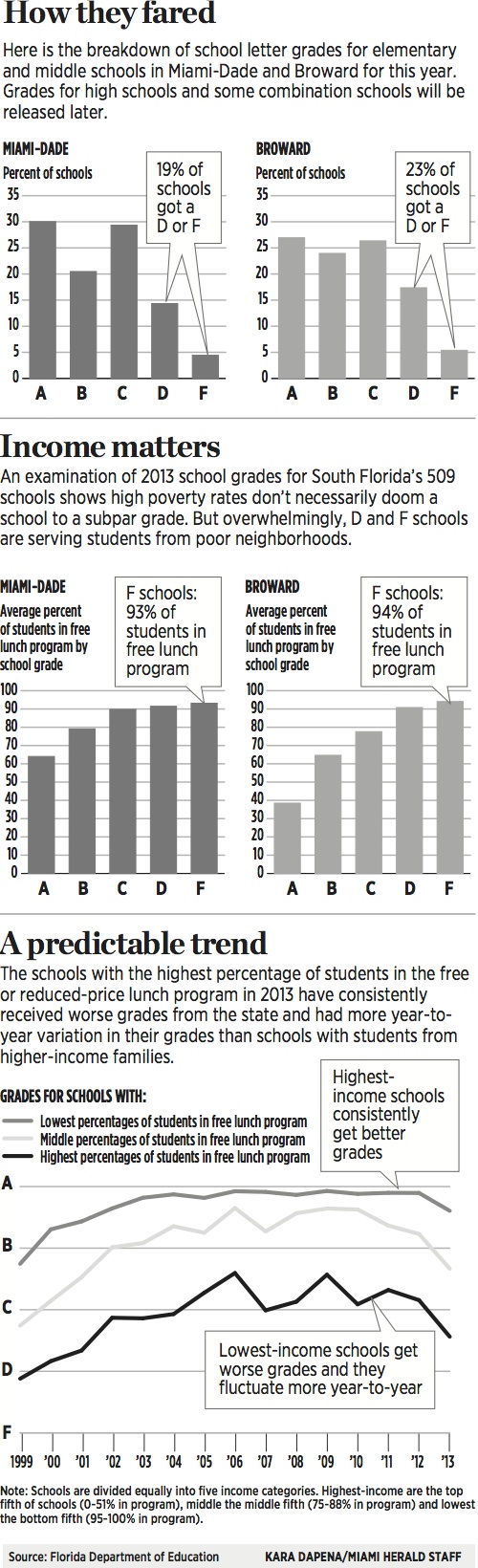
In “Low-income schools struggle under state’s grading system” (Miami Herald, August 10, 2013), Michael Vasquez and David Smiley offer a clear but disturbing picture of accountability in Florida:

With dozens of changes in just the past three years, the formula behind Florida’s A-to-F school grading system has been criticized as a confusing mess. But there’s been at least one constant in Miami-Dade and Broward results: The wealthiest schools never get Fs, and schools with high populations of poor students face an uphill battle to even get a C.

The trend is visible through a decade-plus of school grade results, dating back to the first grades issued in 1999.

Vasquez and Smiley, along with the Miami Herald, represent a needed aspect of journalism addressing education reform: Recognizing large and compelling patterns, and thus the consequences of education policy.

The analysis of assigning letter grades to schools in Florida exposes some important conclusions:

•  Although high poverty rates don’t necessarily doom a school to a subpar grade, D and F schools are overwhelmingly serving students from poor neighborhoods, and the few schools that do overcome poverty to achieve an A are outliers. (There were nine such schools this year, all in Miami-Dade).

•  Of the 209 schools in Miami-Dade and Broward with at least 90 percent of students receiving free or reduced lunch, 78 percent received a grade of C or worse. Roughly 39 percent of these high-poverty schools received a D or F.

•  Of the 43 local schools with much lower poverty rates (30 percent or fewer students receiving free or reduced lunch), 86 percent received an A, and none received a D or F.

Despite efforts to identify educational quality among schools by focusing on growth models, data used in accountability policies remain primarily a reflection of out-of-school factors. Further, the schools that sit outside the typical patterns are rightfully identified by Vasquez and Smiley as “outliers.”

This analytical report on letter grades for schools in Florida is a strong example of quality journalism that seeks out and presents complex and detailed evidence, placing that data in the broader context of the many factors that impact not only the evidence we gather on our schools but also what conclusions we draw as well as how we draw those conclusions.

In the article, Miami-Dade Superintendent Alberto Carvalho explains, “‘Just as much as poverty can’t be an excuse, the exclusion of poverty as a factor is immoral.'”

Rare is the news article that allows a perspective this complex.

No Child Left Behind (NCLB) ushered in several grand promises in 2001, such as closing the achievement gap, but one of the central requirements of the legislation—the use of scientifically based research—is now poised to dismantle the entire accountability movement, including policies such as labeling schools with letter grades based primarily on test scores.

The evidence is clear that thirty years of accountability built on standards and high-stakes testing has failed. The next step is composing and sharing a unified message of that fact, while also building a coalition to reset the reform agenda so that we address poverty, equity, and opportunity in the lives of children and their families as well as in the schools those children attend.

SPECIAL CALL: Speaking Truth to Power (English Journal)

SPECIAL CALL

For my January 15, 2014, CALL for my English Journal column, Speaking Truth to Power, I am seeking a column that combines the column focus with the special issue, with guest editors Alan Brown and Chris Crowe and focusing on the theme “A Whole New Ballgame: Sports and Culture in the English Classroom.”

Please contact me with a query or draft that combines these elements as detailed below.

Speaking Truth to Power

Editor: P. L. Thomas

“If education cannot do everything, there is something fundamental that it can do. In other words, if education is not the key to social transformation, neither is it simply meant to reproduce the dominant ideology. . . . The freedom that moves us, that makes us take risks, is being subjugated to a process of standardization of formulas, models against which we are evaluated. . . . We are speaking of that invisible power of alienating domestication, which attains a degree of extraordinary efficiency in what I have been calling the bureaucratizing of the mind” (110–11). (Freire, 1998, Pedagogy of Freedom: Ethics, Democracy, and Civic Courage)
This column seeks to explore the experiences and possibilities that arise when educators speak Truth to power. It is also intended to be an avenue for teachers to speak Truth to power through teacher narratives about the “the bureaucratizing of the mind,” about best practice in critical literacy against scripted and tested literacy, and about creating classrooms that invite students to discover, embrace, and develop their own voices and empowerment.
Submit an electronic Word file attached to your email to the column editor, P. L. Thomas, atpaul.thomas@furman.edu.

A Whole New Ballgame: Sports and Culture in the English Classroom

Deadline: January 15, 2014

Publication Date: September 2014

Guest Editors: Alan Brown and Chris Crowe

Love sports or hate them, it’s hard to deny their prominence in American society and their popularity with 21st-century adolescents. Interscholastic athletics in particular can play a significant role in the overall culture of a school and have a substantial impact on students’ daily lives. Despite this influence, the topic of sports in society is often absent from the professional conversations of English teachers, an exclusion that could prove to be a missed opportunity. This issue will examine the possibilities for both utilizing and critiquing the culture of sports as a means of increasing student engagement and promoting student learning in the English classroom. Within this context, we seek manuscripts that explore the intersection of literacy, sport, culture, and society, and we encourage column submissions devoted to this same theme.

A number of important questions guide this issue: What connections or disconnections exist between the perceived physical nature of athletics and the mental nature of academics? What real-world associations have you made between sports and the English curriculum? How can sports-related texts (e.g., young adult literature, canonical literature, graphic novels, poetry, nonfiction, magazines, newspapers) be integrated into the academic culture of an English class? How have you promoted the teaching of 21st-century skills through the use of sports-related media, film, and technology? What possibilities exist for interdisciplinary (e.g., historical, political, scientific, social) connections to sports across content areas? How have you engaged students in critical dialogue about our societal emphasis on sports? How can we extend the definition of sport to be more inclusive for students of diverse cultures, races, genders, ethnicities, and abilities? How can an examination of sports culture open the door to discussions of other cultures that exist in school and society?

New Media, New Public Intellectuals

At the beginning of January 2010, I received an email prompting me to watch a video of Diane Ravitch making a speech. My knee-jerk reaction was to delete the email because I had long rejected Ravitch’s work, associating her with the standards/testing movement and a traditional view of literacy that I firmly refuted.

Instead I clicked the link and was quickly puzzled, wondering who this Diane Ravitch was and what had happened to the Ravitch I had walked out on at a National Council of Teachers of English session several years before. Ravitch’s talk was so compelling I sought out her email, sent her an apology, and within the hour received a reply.

Diane and I exchanged a few emails; she was gracious and open about her recent change in stances related to public education reform (all detailed in her popular and influential book, The Death and Life of the Great American School System: How Testing and Choice Are Undermining Education). This event has since grown into a virtual friendship and collegiality that I would have never predicted, but the intervening years have also revealed more than Ravitch’s new positions on accountability and preserving the promise of public education. Those months and years have also highlighted the role of the new media (Twitter, Facebook, blogging, google+, and the ever-growing virtual world of social media and communication) in the rise of the new public intellectual.

By most any definition of public intellectual (see Possner, Jacoby, and Fish, among many careful looks at public intellectuals), Ravitch had established herself as a respected academic, a popular public intellectual, and even a public servant, having held political appointments in the U.S. Department of Education. When Ravitch was closely associated with conservative and traditional ideology and policy, her scholarly books sold well, and she also garnered invitations to speak widely on issues related to education.

What is particularly interesting about Ravitch 2.0, however, is that once she expressed considerable and distinct changes in her stances on education reform and policy—again, all presented in traditional format, a book—Ravicth also embraced the new media by establishing herself on Twitter (where she is approaching 60,000 followers) and eventually committing to regular (often multiple times a day) blogging on her own site.

While Ravitch’s recent journey from traditional and conservative scholar and public intellectual to Ravitch 2.0 is itself interesting, and even inspiring, I believe it warrants some consideration as a harbinger of the new public intellectual.

Primarily motivated by Ravitch’s use of Twitter, I joined Twitter more than a year ago, and fairly recently shifted my public work away from blogging at The Daily Kos and The Daily Censored and toward original blogging at my own WordPress site. While my impact and influence are dwarfed by Ravitch’s, I believe I have joined a new frontier for educators, academics, and scholars—a door opening to the life of the public intellectual that was often closed or at least hard to open in the recent past.

Before the new media exploded, public intellectuals depended on the traditional media—newspapers, magazines, and TV—for access to the public. Educators and academics had to find time to submit Op-Eds or public writing (and then that work had to be accepted and published) or had to wait for invitations to participate in that traditional media. As scholars have shown (see above), public intellectuals thrived in the twentieth century, but many were “rock star” public intellectuals, creating a narrow avenue for educators, academics, and scholars to form public voices.

As Ravitch has shown, however, Twitter and blogging can be powerful mechanisms for creating a public presence, mechanisms that circumvent traditional barriers to becoming a public intellectual.

The new public intellectual thriving in the new media, however, still faces tremendous hurdles and daunting negative consequences.

Professors with tenure and emeriti professors (such as Ravitch, Stephen Krashen, and me) are notably emboldened by the new media since those barriers and consequences are greatly subdued. Certainly academic and scholarly public intellectuals must navigate challenges to their credibility and traditional biases against public work, but in general, those threats are minor for tenured and emeriti professors.

More problematic are K-12 teachers (some unionized and many not) and junior tenure-track professors. For these educators and academics, public work itself poses great dangers, some of which jeopardize their jobs and routes to tenure.

For both K-12 education and universities, I think, a challenge now stands before administrative and academic leaders in charge of retention, evaluation, and promotion. Some of the changes that need to occur include the following:

  • Recognizing and honoring public intellectual work in ways that do not marginalize that work and that do not subordinate that work to more traditional forms of scholarship (peer-reviewed print publications, for example).
  • Recognizing and honoring the new media presentation of that public work.
  • Incorporating public work and new media formats into hiring, retaining, evaluating, and promoting processes.
  • Creating and insuring professional cultures that recognize and honor public and new media work by educators, academics, and scholars.

These transformations, then, will not only address the rise of new public intellectuals and the new media but also help reconcile the lingering disjuncture between most mission statements of schools and universities (nearly all expressing some social function of the school or university) and policies that remain somewhat or strongly hostile to educators and academics who are actively engaged with the public or with activism.

Despite the enduring arguments for the dispassionate and neutral educator/professor, the school and its educators are ultimately important only in the ways in which they engage with and change the world.

At least in the world we now inhabit, that may be happening one Tweet at a time, and we need to embrace this new frontier before that too is a relic of the past and the public intellectual 3.0 is upon us.