The U.S. Formula for Children and the Choices We Refuse to Make

The formula for children in the U.S. can be summed up in one word, I think: “harsh.” And the response we should have to this formula is “inexcusable.”

Let’s consider the U.S. formula for children:

If children in the U.S. can survive the gauntlet that is the national formula for children, as young adults they can look forward to crushing debt to attend college so that they can enter a nearly non-existent workforce.

But there is a caveat to this formula: The U.S. formula for children above is for “other people’s children,” that new majority in U.S. public schools and those children living in homes of the working poor, the working class, and the dwindling middle class.

Children of the privileged are exempt.

And what are the choices we refuse to make?

The Joseph Rowntree Foundation (UK) has released “Does money affect children’s outcomes?”—based in part on “many studies…from the US.” The key points include:

  • This review identified 34 studies with strong evidence about whether money affects children’s outcomes. Children in lower-income families have worse cognitive, social-behavioural and health outcomes in part because they are poorer, not just because low income is correlated with other household and parental characteristics.
  • The evidence was strongest for cognitive development and school achievement, followed by social-behavioural development. Income also affects outcomes indirectly impacting on children, including maternal mental health, parenting and home environment.
  • The impact of increases in income on cognitive development appears roughly comparable with that of spending similar amounts on school or early education programmes. Increasing household income could substantially reduce differences in schooling outcomes, while also improving wider aspects of children’s well-being.
  • A given sum of money makes significantly more difference to children in low-income than better-off households (but still helps better-off children).
  • Money in early childhood makes most difference to cognitive outcomes, while in later childhood and adolescence it makes more difference to social and behavioural outcomes.
  • Longer-term poverty affects children’s outcomes more severely than short-term poverty. Although many studies were from the US, the mechanisms through which money appears to affect children’s outcomes, including parental stress, anxiety and material deprivation, are equally relevant in the UK.

The third bullet point should not be ignored: The key to eradicating poverty and the negative consequences of poverty for children is to address poverty directly in the lives of children—money—and to address inequity directly in the education of children.

There is no either/or, then, in the education reform debate. It is imperative that we do both.

Ultimately, the U.S. formula for children is based on flawed assumptions. Before we can change that formula, we must change our views of poverty as well as people and children trapped in poverty.

Scarcity and abundance are powerful forces; in the U.S., both are allowed to exist as an ugly game of chance.

The choice of abundance for all is there to be embraced, however, if compassion and community are genuinely a part of the American character.

Beyond Doing the Wrong Thing the Right Way

My nephew is in elementary school, and my parents drive him to school each morning and arrive at his school an hour or two before school lets out each afternoon. This is a rural community in the South where many family members do the same—surrounding the school well before dismissal and often socializing.

Recently, my mother told me about parents of a child at that school who are refusing to allow their son to be placed in a test-prep class (and removed from his normal class) because of his low score on a MAP test. The parents are adamant that his test grades in class are high 90s, and they see no reason for his being out of that class to prepare for a test. [1]

Over the past year, I have also been a part of or observed two situations with education policy: one involving a compromise about reading legislation linked to retaining 3rd graders and another about language in the state’s science standards.

In both cases, good pedagogy and foundational aspects of the fields have been sacrificed for political expediency.

The situation at my nephew’s school and both of these education policy developments represent for me the central problem with the Common Core and high-stakes testing arguments: We are content to find the right ways to do the wrong things.

For example, a new report Data-Driven Improvement and Accountability by Andy Hargreaves, Henry Braun, and Kathleen Gebhardt for NEPC is excellent work that confronts how accountability has failed as well as how data should be used more effectively.

However, despite the high quality of this report, it doesn’t allow us to move a few steps further back and consider not using the accountability paradigm at all.

While there are certainly some outrageous claims made against the Common Core (the Tea Party railings against Obama and big government that often play loose with facts) and some passionate arguments against CC that are credible but tarnished by that passion (concerns about Gates money and its influence as well as the role of David Coleman), the dominant narratives about CC and the high-stakes testing connected with the new standards are about how critics are focusing on bad implementation, and not flaws in the standards or the tests. From that, the arguments are how to implement CC and the tests right.

And here is where we are failing.

Setting aside the impassioned arguments against CC and more high-stakes testing, a good deal of evidence shows that most of our educational problems have nothing to do with either the presence or quality of standards or tests (see Mathis, 2012, for example).

As well, we have considerable reason to be concerned about accountability based on high-stakes tests—Campbell’s Law and Gerald Bracey’s caution about what is tested is what is taught.

Simply put, there is no right way to implement standards and high-stakes tests in an accountability framework because neither the goals/purposes nor problems of U.S. public education call for that paradigm; schools are not failing due to a lack or poor quality of accountability.

And that leads to the next typical response: All critics do is criticize. Where is your alternative?

Let’s consider that, then.

Is there any value in a cohesive body of knowledge associated with the major disciplines (what we typically call standards)? Yes.

So what is wrong with Common Core? CC is a bureaucratic, top-down mandate. In all fields, there exists a cohesive body of agreed upon knowledge, a set of contemporary debates, and a set of enduring debates. Public school standards fail because they are primarily bureaucratic and essentially partisan political documents.

Building on that essential problem, then, a cohesive body of knowledge identified for a field of study that is a resource for an autonomous teacher—this should be the starting point of education reform.

However, even if we address re-tooling how we view standards, even if we drop high-stakes testing (and we should), and even if we afford teachers the professional autonomy they deserve, schools will still ultimately fail unless we address equity and opportunity both in the lives and in the education of all children.

We now face a tremendous wake-up call since—despite the increasingly influential and pervasive accountability movement in our schools—the majority of students in U.S. public schools in the South and urban schools live in poverty.

That fact itself calls into question our social policy and the likelihood that schools alone can overcome social dynamics.

There are no right ways to do the wrong things. CC, new high-stakes testing, and more accountability are simply the wrong things.

[1] Evidence from the SAT seems to support these parents’ wishes since GPA remains a better predictor of college success than SAT scores. Despite claims to the contrary, teachers’ subjective grading is quite powerful, and more powerful than a so-called objective measure.

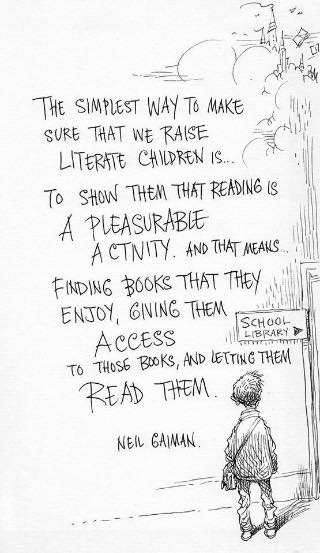
Gaiman, Prisons, Literacy, and the Problems with Satire

Regarding my recent blog about Neil Gaiman for Secretary of Education (and the edited version at The Answer Sheet), Ken Libby took me to task on Twitter for, among other things, Gaiman’s comment about prisons and literacy:

I was once in New York, and I listened to a talk about the building of private prisons – a huge growth industry in America. The prison industry needs to plan its future growth – how many cells are they going to need? How many prisoners are there going to be, 15 years from now? And they found they could predict it very easily, using a pretty simple algorithm, based on asking what percentage of 10 and 11-year-olds couldn’t read. And certainly couldn’t read for pleasure.

It’s not one to one: you can’t say that a literate society has no criminality. But there are very real correlations.

My immediate point after quoting Gaiman was: “Gaiman even understands the difference between causation and correlation—a dramatic advantage over Secretaries of Education in the past two administrations.”

I have also received a friendly and much appreciated email from Chris Boynick addressing the same issue, noting that it is an urban legend that prisons use child literacy to predict prison needs. See “Prisons don’t use reading scores to predict future inmate populations” and “Kathleen Ford says private prisons use third-grade data to plan for prison beds.”

Boynick sent that same information to Neil Gaiman who responded on Twitter with: “@CBoynick Interesting. The person who told me that was head of education for New York city.”

So let me make a few clarifications addressing all this:

  1. My Gaiman piece is satire (and to be honest, that should put all this to rest). I don’t really endorse or want Gaiman as Secretary of Education, although I think Gaiman is brilliant (as one Gaiman fan noted, we don’t want to detract from his life as a writer!). My real point is the calamity that is those who have served at Secretaries of Education—especially in the George W. Bush and Barack Obama administrations.
  2. Nonetheless, Gaiman only relays a fact: He did hear this stated as a truth. So maybe we can level some blame at his believing this, but apparently a person with some authority who should have known the truth did state this in front of Gaiman.
  3. Has Gaiman, then, been a victim (like many of us) of an urban legend? It appears so.
  4. But, does Gaiman then make some outlandish or flawed claim based on misinformation? Not at all. In fact, I highlighted that Gaiman immediately made a nuanced claim: “It’s not one to one: you can’t say that a literate society has no criminality. But there are very real correlations.” And that claim helps him move into a series of powerful and valid points. I should emphasize that most politicians and political appointees start with misinformation and then make ridiculous and flawed proposals. On that comparison, Gaiman wins.

And for good measure, I suggest “Do prisons use third grade reading scores to predict the number of prison beds they’ll need?” by Joe Ventura, which addresses the urban legend, concluding with an important point relevant to this non-issue about Gaiman’s speech and my blog:

Perhaps it’s best to call this a distortion of the truth. While there isn’t evidence of State Departments of Corrections using third- (or second- or fourth-) grade reading scores to predict the number of prison beds they’ll need in the next decade (one spokesperson called the claim “crap”), there is an undeniable connection between literacy skills and incarceration rates.

You see, a student not reading at his or her grade level by the end of the third grade is four times less likely to graduate high school on time–six times less likely for students from low-income families. Take that and add to it a 2009 study by researchers at Northwestern University that found that high school dropouts were 63 times (!) more likely to be incarcerated than high school grads and you can start to see how many arrive at this conclusion.

But once incarcerated, not all hope is lost. In fact, literacy instruction can help on both ends of the correctional system; studies have shown that inmates enrolled in literacy and other education programs can substantially reduce recidivism rates. One study of 3,000 inmates in Virginia found that 20% of those receiving support in an education program were reincarcerated, while 49% not receiving additional support returned to prison after being released.

So, while prison planners do not use third grade reading scores to determine the number of prison beds they’ll need in the decade to come, there is a connection between literacy rates, high school dropout rates, and crime. While we should file this claim as an urban legend, let’s recognize why it resonates with us: it speaks to the important ways that poor reading skills are connected with unfavorable life outcomes [his emphasis].

With that, I rest my case: Gaiman’s speech is overwhelming on target, moving, and brilliant, and he deserves a bit of space for a small error of fact, and the current Secretary of Education is incompetent.

This leads me to wonder why so much concern about one detail in an author’s speech and my satirical blog, but so little concern for the incompetence of the Secretary of Education and the entire education agenda at the USDOE.

Pop Culture and the Mutant Narrative: X-Men Endure

The late 1930s and early 1940s birthed the superhero comic book fascination that despite several bumps along the way has endured into the twenty-first century where superhero films are huge box-office successes and pop culture gold mines.

In both the comic book and film universes, superhero reboots are common: Batman, Superman, and Spider-Man have all experienced revised origins in the pages of their comics as well as multiple cycles of films dedicated to the superheroes. The X-Men films from 2000 to 2006 may have had as much to do with the adaptation success of comic books to film as Batman, Superman, and Spider-Man.

X-Men: First Class in 2011 was one such re-boot and enough of a success that X-Men: Days of Future Past is slated for 2014.

Alexander Abad-Santos discusses how the mutant aspect of X-Men narratives can be found nearly universally in pop culture:

In about seven months, I along with a lot of X-Men fans will be getting to the theater an hour early, lining up, and then watching to see if Days of Future Past is what I’ve imagined it would be. What’s kinda great for an X-Men fans, though, is that we don’t have to wait until then to get an X-Men story. Pop culture is filled with them.

Recently, I was interviewed by a local journalist about zombie culture; the journalist was investigating why zombies are so popular. I tried to explain that pop culture has all sorts of cycles. Some periods when vampires are hot, some periods when something else is hot. But I also conceded that certain elements of pop culture trends are enduring; for example, something about zombies certainly remains captivating with the public.

I believe the same case can be made for mutants: mutant narratives are compelling and ripe for making important social commentary. And to that I wrote about X-Men and the Hunger Games trilogy as they speak to wider issues, such as education:

Separate, Unequal…and Distracted*

When research, history, and allegory all converge to tell us the same story, we must pause to ask why we have ignored the message for so long and why are we likely to continue missing the essential thing before us.

The New York Times and Education Week reveal two important lessons in both the message they present and the distinct difference in their framing of that message:

“Black Students Face More Discipline, Data Suggests [sic]” headlines the NYT’s article with the lead:

Black students, especially boys, face much harsher discipline in public schools than other students, according to new data from the Department of Education.

And EdWeek announces “Civil Rights Data Show Retention Disparities,” opening with:

New nationwide data collected by the U.S. Department of Education’s civil rights office reveal stark racial and ethnic disparities in student retentions, with black and Hispanic students far more likely than white students to repeat a grade, especially in elementary and middle school.

One has to wonder if this is truly news in the sense that this research is revealing something we don’t already know—because we should already know this fact:

America’s public schools and prisons are stark images of the fact of racial, gender, and socioeconomic inequity in our society—inequity that is both perpetuated by and necessary for the ruling elite to maintain their artificial status as that elite.

The research, coming from the U.S. Department of Education, and the media coverage are not evidence we are confronting that reality or that we will address it any time soon. The research and the media coverage are proof we’ll spend energy on the research and the coverage in order to mask the racism lingering corrosively in our free state while continuing to blame the students who fail for their failure and the prisoners for their transgressions.

X-Men and The Hunger Games: Allegory as Unmasking

Science fiction allows an artist to pose worlds that appears to be “other worlds” in order for the readers to come to see our own existence more clearly.

In the re-boot film version of Marvel Comics superhero team, X-Men: First Class, the powerful allegory of this comic book universe portrays the isolation felt by the mutants—one by one they begin to discover each other and share a common sentiment: “I thought I was the only one.”

These mutants feel not only isolation, but also shame—shame for their looks, those things that are not their choices, not within their direct power to control. While this newest film installment reveals the coming together of the mutants, this narrative ends with the inevitable division of the mutants into factions: Professor X’s assimilationists and Magneto’s radicals.

It takes only a little imagination to see this allegory in the historical factionalism that rose along with the Civil Rights movement between Martin Luther King Jr. and Malcolm X.

In whose interest is this in-fighting?

Although written as young adult literature, The Hunger Games trilogy is beginning to spread into mainstream popular consciousness. The savage reality show that pits children against children to the death gives the first book in the series its title, but as with the research on racial inequity in our schools, I fear we fail to look at either the purpose of these Hunger Games in that other world of the novel or how it speaks to us now.

In Catching Fire, Katniss Everdeen, the narrator, confronts directly that her country, Panem, has created stability by factionalizing the people into Districts, ruled by the Capitol.

Panem exists because of the competition among the Districts, daily for resources and once a year personified by two lottery losers, children form each district.

In this second book, Katniss learns something horrifying but true when the winners of the most recent Games, Katniss and Peeta, visit District 11—home of Katniss’s friend killed in the Games, Rue: During the celebration, the people of District 11 repeat Katniss’s act of rebellion:

What happens next is not an accident. It is too well executed to be spontaneous, because it happens in complete unison. Every person in the crowd presses the three middle fingers of their left hand against their lips and extends them to me. It’s our sign from District 12, the last good-bye I gave Rue in the arena. (p. 61)

Then as Katniss and Peeta are rushed from the stage, they witness Peacekeepers executing people in the District 11 crowd. As President Snow has warned Katniss about the possibility of uprisings:

“But they’ll follow if the course of things doesn’t change. And uprisings have been known to lead to revolution….Do you have any idea what that would mean? How many people would die? What conditions those left would have to face? Whatever problems anyone may have with the Capitol, believe me when I say that if it released its grip on the districts for even a short time, the entire system would collapse.” (p. 21)

What maintains the stability of Panem? Competition, division, and fear.

What threatens the stability of Panem and the inequity it maintains? Solidarity, compassion, cooperation, and rebellion.

Separate, Unequal…and Distracted

U.S. public education has always been and remains, again like our prisons, a map of who Americans are and what we are willing to tolerate.

Children of color and children speaking home languages other than English are disproportionately likely to be punished and expelled (especially the boys), disproportionately likely to be retained to suffer the same grade again, disproportionately likely to be in the lowest level classes with the highest student-teacher ratios (while affluent and white children sit in advanced classes with low student-teacher ratios) in order to prepare them for state testing, and disproportionately likely to be taught by un- and under-certified teachers with the least experience.

And many of these patterns are distinct in pre-kindergarten.

We don’t really need any more research, or history lessons, or sci-fi allegory, or comic books brought to the silver screen.

We need to see the world that our children live in and recognize themselves (just ask an African American young man), and then look in the mirror ourselves.

Why do those in power remain committed to testing children in order to label, sort, and punish them?

Who does the labeling, sorting, and punishing benefit? And what are the reasons behind these facts, the disproportionate inequity in our schools and in our prisons?

We only need each minute of every day to confront what the recent data from the USDOE reveal, but it is always worth noting that this sentiment is often ignored despite its value:

…I recognized my kinship with all living beings, and I made up my mind that I was not one bit better than the meanest on earth. I said then, and I say now, that while there is a lower class, I am in it, and while there is a criminal element I am of it, and while there is a soul in prison, I am not free. (Eugene V. Debs: Statement September 18, 1918)

How and why?

Eugene V. Debs is marginalized as a socialist, a communist so no one listens to the solidarity of his words. Because this sentiment is dangerous for the Capitol.

If we persist in being shocked by the research or enamored by the exciting story of Katniss, we will remain divided and conquered.

Katniss in Catching Fire responds to the president with: “‘It [Panem] must be very fragile, if a handful of berries can bring it down.'”

To which the president replies, “‘It is fragile, but not in the way that you suppose'” (p. 22).

The fragility is masked by the 99% as separate, unequal, and distracted—fighting among ourselves in fear of what we might lose otherwise.

It is time to suppose otherwise.

Reference

Atwood, M. (2011). In other worlds: SF and the human imagination. New York: Nan A. Talese/ Doubleday.

* Originally posted at Daily Kos March 6, 2012

Medicating ADHD in the Brave New World of High-Stakes Accountability

Miranda: O wonder!
How many goodly creatures are there here!
How beauteous mankind is! O brave new world,
That has such people in’t.

—William Shakespeare, The Tempest, Act V, Scene I, ll. 203–206

—–

Utopias seem much more attainable than one may have previously thought. And we are now faced with a much more frightening thought: how do we prevent their permanent fulfillment?…Utopias are attainable. The way of life points towards them. But perhaps a new century will begin, a century in which intellectuals and the educated class will find means of preventing utopias, and we will return to a non-utopian society, which may be less perfect, but will offer more freedom.

—Nicolas Berdiaeff

My love of science fiction (SF) has its roots firmly in Marvel comic books from the 1970s and the SF novels of Arthur C. Clarke and Niven/Pournelle. When I became acquainted with what teachers called “good” and “real” literature, I was immediately drawn to George Orwell and Aldous Huxley as anointed SF writers.

As an adult, I am the sort of SF reader who treasures Kurt Vonnegut and Margaret Atwood, and if I am pushed, I have to admit I value Orwell more as an essayist than novelist and always enjoyed Huxley’s Brave New World over 1984—believing both works are brilliant, but preferring BNW as a reader.

The opening passages are two foundational quotes behind the message of BNW, the Shakespeare the source of the title and the Berdiaeff a nod to Huxley’s parody of utopian fiction.

In his Foreword to the Perennial Classic edition of BNW, Huxley explains:

But Brave New World is a book about the future and, whatever its artistic or philosophical qualities, a book about the future can interest us only if its prophesies look as though they might conceivably come true….The theme of Brave New World is not the advancement of science as such; it is the advancement of science as it affects human individuals. (p. ix)

Beyond purpose, Huxley continues, speculating about “A really efficient totalitarian state”

would be one in which the all-powerful executive of political bosses and their army of managers control a population of slaves who do not have to be coerced, because they love their servitude. To make them love it is the task assigned, in present-day totalitarian states, to ministries of propaganda, newspaper editors and schoolteachers….The great triumphs of of propaganda have been accomplished, not by doing something, but by refraining from doing. Great is truth, but still greater, from a practical point of view, is silence about the truth. (p. xii)

SF, at its best, however, is not predictive, but cautionary; as Neil Gaiman has reminded us, “The world doesn’t have to be like this. Things can be different.” Thus, Huxley warns:

Round pegs in square holes tend to have dangerous thoughts about the social system and to infect others with their discontents….In conjunction with the freedom to daydream under the influence of dope and movies and the radio, it will help to reconcile his subjects to the servitude which is their fate….Indeed, unless we choose to decentralize and to use applied science [1], not as the end to which human beings are to be made the means, but as the means to producing a race of free individuals, we have only two alternatives to choose from: either a number of national, militarized totalitarianisms…or else one supra-national totalitarian. (pp. xiii, xiv)

And then, Huxley conclude: “You pays your money and you takes you choice” (p. xiv).

The speculative and cautionary possibilities found in SF rarely come to fruition in the real world in the dramatic ways of novels or films (or in the somewhat looney ways political factions rant and rave in public discourse). So it seems likely that we are apt never to listen or to act in ways that we should and could.

Huxley, I think, was in many ways speaking to this—“The Not-So-Hidden Cause Behind the A.D.H.D. Epidemic”:

Between the fall of 2011 and the spring of 2012, people across the United States suddenly found themselves unable to get their hands on A.D.H.D. medication. Low-dose generics were particularly in short supply. There were several factors contributing to the shortage, but the main cause was that supply was suddenly being outpaced by demand.

The number of diagnoses of Attention Deficit Hyperactivity Disorder has ballooned over the past few decades. Before the early 1990s, fewer than 5 percent of school-age kids were thought to have A.D.H.D. Earlier this year, data from the Centers for Disease Control and Prevention showed that 11 percent of children ages 4 to 17 had at some point received the diagnosis — and that doesn’t even include first-time diagnoses in adults. (Full disclosure: I’m one of them.)

That amounts to millions of extra people receiving regular doses of stimulant drugs to keep neurological symptoms in check. For a lot of us, the diagnosis and subsequent treatments — both behavioral and pharmaceutical — have proved helpful. But still: Where did we all come from? Were that many Americans always pathologically hyperactive and unable to focus, and only now are getting the treatment they need?

Probably not. Of the 6.4 million kids who have been given diagnoses of A.D.H.D., a large percentage are unlikely to have any kind of physiological difference that would make them more distractible than the average non-A.D.H.D. kid. It’s also doubtful that biological or environmental changes are making physiological differences more prevalent. Instead, the rapid increase in people with A.D.H.D. probably has more to do with sociological factors — changes in the way we school our children, in the way we interact with doctors and in what we expect from our kids.

As disturbing as this is, the final paragraph of this article may be the most significant:

Today many sociologists and neuroscientists believe that regardless of A.D.H.D.’s biological basis, the explosion in rates of diagnosis is caused by sociological factors — especially ones related to education and the changing expectations we have for kids. During the same 30 years when A.D.H.D. diagnoses increased, American childhood drastically changed. Even at the grade-school level, kids now have more homework, less recess and a lot less unstructured free time to relax and play [emphasis added]. It’s easy to look at that situation and speculate how “A.D.H.D.” might have become a convenient societal catchall for what happens when kids are expected to be miniature adults. High-stakes standardized testing, increased competition for slots in top colleges [emphasis added], a less-and-less accommodating economy for those who don’t get into colleges but can no longer depend on the existence of blue-collar jobs — all of these are expressed through policy changes and cultural expectations, but they may also manifest themselves in more troubling ways — in the rising number of kids whose behavior has become pathologized.

The rise of ADHD diagnoses and medications has run concurrent to the accountability era in education, sharing the same thirty-year history. O brave new world of high-stakes accountability and the ADHD medication needed to make the students love their servitude to the tests…

[1] Paul Boyle, “A U.K. View on the U.S. Attack on Social Sciences,” Science, 341 (August 16, 2013), p. 719.

Scarcity: A Few Thoughts While Reading

Scarcity: Why Having Too Little Means So Much, Sendhil Mullainathan and Eldar Shafir

Having bought Scarcity several weeks ago, I have finally begun reading, and while I anticipate using this work in my scholarship and blogging once I have finished, I feel compelled to offer some evolving thoughts as I read.

My interest in the book is grounded in my own work on the relationship between poverty/affluence and education, particularly in terms of how public and political perceptions of poverty/affluence impact public/political discourse and ultimately policy.

Thus, a few thoughts while reading:

  • Mullainathan and Shafir offer a compelling and readable Introduction. I trust the scholarship of the work, and appreciate that it begins as an engaging narrative.
  • “By scarcity, we mean having less than you feel you need” (p. 4). Here is a important point, I believe, related to the cultural assumptions about people living in poverty. In the U.S., poverty is associated with individual choices and weaknesses, ignoring, I think, the more powerful impact of social norms. In a consumer culture that shows citizens that their self-worth is directly related to the possessions, people living in poverty are profoundly impacted by “having less than you feel you need.” That sense, then, directly drives the behavior of people living in poverty. The privileged in the U.S. typically discount people living in poverty as lazy and/or careless based on people in poverty owning flat-screen TVs, iPhones, or new cars. I anticipate this book contributing powerfully to that misguided and hypocritical way of thinking about poverty and people in poverty.
  • “Scarcity captures the mind. Just as the starving subjects had food on their mind, when we experience scarcity of any kind, we become absorbed by it….Scarcity is more than just the displeasure of having very little. It changes how we think. It imposes itself on our minds” (p. 7). The consequences of thoughts and actions driven by scarcity, then, are important for understanding poverty. As Mullainathan and Shafir explain later, “So when the hungry recognize CAKE [in an experiment detailed in the Introduction] more quickly, it is not because they choose to focus more on this word. It happens faster than they could choose to do anything. This is why we use the word capture when describing how scarcity focuses the mind” (pp. 8-9). This discussion reminds me of Gladwell’s arguments posed in Blink related to racism (with the caveat that Gladwell poses some real problems related to his allegiances and work).
  • “But we suggest that while physical scarcity is ubiquitous, the feeling of scarcity is not” (p. 11). Attitudes about poverty in the U.S. tend to refuse to acknowledge the power of relative wealth—how the culture imposes views of poverty/affluence onto people. To pretend poverty and behavior related to poverty are somehow not socially constructed is at the center of why and how U.S. attitudes about poverty are deforming (see Freire).
  • “Being poor, for example, reduces a person’s cognitive capacity more than going one full night without sleep. It is not that the poor have less bandwidth [We can directly measure mental capacity or, as we call it, bandwidth] as individuals. Rather, it is that the experience of poverty reduces anyone’s bandwidth” (p. 13). This directly calls into question “no excuses” policies that suggest schools alone can overcome the impact of poverty.
  • “There is one particularly important consequence [of scarcity]: it further perpetuates scarcity….Scarcity creates its own traps” (p. 14). The so-called cycle of poverty may be a cycle of scarcity—beyond the power of individuals to create or change. According to Mullainathan and Shafir, “Scarcity forces all choices. Abstractions become concrete” (p. 20).
  • “In the real world, the poor and rich differ in so many ways” (p. 26).
  • “Focusing on on thing means neglecting other things….Instead of saying that scarcity ‘focuses,’ we could just as easily say that scarcity causes us to tunnel: to focus single-mindedly on managing the scarcity at hand….Tunneling is not [a positive]: scarcity leads us to tunnel and neglect other, possibly more important, things” (p. 29). There is a luxury of time and focus found in affluence, but not in poverty. The rules of life change within both affluence and poverty. To judge behavior of the impoverished by the rules of the affluent, then, is a fatal flaw of understanding poverty.