King’s Next Shining Novel: More “True History of the Torrance Family”

Stephen King’s career reminds me of the career of Kurt Vonnegut in three ways: (1) they suffered the negative consequences of being associated with writing genre fiction, (2) they are often devalued as being too popular to be credible “literary” authors, and (3) as many popular writers are, they are often associated with one work—King with The Shining and Vonnegut with Slaughterhouse-Five. King, as well, has been further marginalized by the stigma that being prolific means a writer can’t possibly be high quality.

Doctor Sleep, Stephen King

With Doctor Sleep, then, King takes on some monumental challenges since this 2013 novel is a sequel of possibly his most treasured work, The Shining, from 1977. King confronts the task of writing a sequel, as well as the weight of the popular film adaptation, in a concluding Author’s Note:

Did I approach the book with trepidation? You better believe it. The Shining is one of those novels people always mention…when they talk about which of my books really scared the bejeezus out of them….

I like to think I’m still pretty good at what I do, but nothing can live up to the memory of a good scare, and I mean nothing, especially if administered to one who is young and impressionable….

And people change. The man who wrote Doctor Sleep is very different from the well meaning alcoholic who wrote The Shining, but both remain interested in the same thing: telling a kick-ass story. (pp. 529-530)

Like many people, I was first drawn to King’s The Shining after seeing the 1980 film adaptation made popular by Jack Nicholson’s role. While I am certain I read the novel, I also realize I tend to recall more vividly the film version (the culturally iconic “Here’s Johnny!” and “Redrum”), which King warns about in a parenthetical comment in his Author’s Note: “If you have seen the movie but not read the novel, you should note that Doctor Sleep follows the latter, which is, in my opinion, the True History of the Torrance Family.”

I should also add that I am no fan of King’s primary genres, such as horror, and have not been an avid reader of King over the years. During a couple summers in the early 2000s when I was an instructor in a regional National Writing Project institute, we assigned King’s On Writing, solidifying my argument that King remains a writing treasure as well as a writer’s writer, one who informs what we know and understand about the craft of narrative.

In 2013, I had bought several King novels, deciding once and for all to spend more time with his work because an avid reader I trust deeply is a devoted King fan, but had yet to find one that grabbed me. Then I came across Adam Roberts’s Best science fiction books of 2013, in which he praised Doctor Sleep along with Margaret Atwood’s MaddAddam.

Although not intended as a book review, I want to offer first that Doctor Sleep delivers on King’s stated goal, “telling a kick-ass story.”

Dan Torrance is a fully developed and compelling character as a haunted adult, and his new shining companion, Abra Stone, is equally engaging as a child character replicating but also expanding some of the power found in Danny as a child in The Shining. If you are looking for a novel worthy of your commitment as a “ling-distance reader,” this is more than worthy of your time and investment.

But there are two aspects of the work I want to highlight beyond a recommendation.

First, as a regular and enthusiastic beer drinker who knows the horrors of alcoholism among men on my mother’s side of the family, the most haunting aspect of the novel is the examination of alcoholism and the personal yet not idealistic dramatization of Alcoholics Anonymous. At over 500 pages in hardback, the book took several days to read and it bore into my thoughts deeply and pervasively, making me contemplative about even raising a pint of beer with a meal.

The weight and terror associated with the life of alcoholism are rendered far more frightening in this work than the vampire-like threat of the True Knot. For readers, the damage done by alcoholism is real, and the damage done to humans in its wake, including children, haunts Dan and the reader as powerfully as the apparitions expected in a King work of horror.

Many so-called types of genre fiction—such as science fiction, fantasy, and horror—incorporate social commentary through allegory. In Doctor Sleep, King does not hide his examination of alcoholism, however, beneath a metaphorical veneer; instead he pairs the twin demons of alcoholism and the supernatural—resulting in a work that may be more disturbing in the real rather than the imagined.

The second powerful aspect of the work involves the relationship between being a child and also being vulnerable because of that mere status as well as because of nearly debilitating fears that you are alone because you are different.

Much of Doctor Sleep for me is about childhood, itself a scary thing. When Dan as a struggling adult crosses paths with Abra, their shared shining creates a compelling look at how any child and all humans must come to terms with the Self, even or especially when that Self feels or is dramatically unlike social norms or what appears to be normal: “’I’m okay,’ [Abra] said. ‘Really. I’m just glad not to be alone with this inside my head’” (p. 236). You don’t have to have the shining to understand Abra’s relief.

Even as Abra finds solace in her connection with Dan—and their shared shining—she remains a victim of her own anxieties, especially as she feels compelled to hide her differences from her parents in order to protect them.

Abra also has a terrifying connection with a murdered boy—again speaking to both the fragility of being a child in a harsh adult world and the weight of isolation and bonds that are beyond any person’s control. This connection is stunning and, like the focus on alcoholism, haunts the reader:

They cut him up and licked his blood and then they did something even worse to him [emphasis in original]. In a world where something like that could happen, mooning over a boy band seemed worse than wrong. (p. 209)

Abra’s story is more than the narrative of a paranormal girl; it is the story of the collision between childhood and adulthood, and the potential of that childhood and even children being left in the wake. Again, this very real element is somehow much more terrifying than the supernatural.

King’s noting he is a different man than the one who wrote The Shining informs the big picture about Doctor Sleep since this novel of horror has a compassionate and soothing narration to it—the gift of a master storyteller—that keeps the reader somewhere between Abra’s anxiety and the eternal drift into slumber—both the daily ritual of sleep and the inevitable exit from this mortal coil.

Yes, Doctor Sleep is “a kick-ass story,” but it also much more; it will not soon leave you once you’ve returned to, or entered for the first time, the Torrance Family Album.

Capitalism, Silencing Women, Silencing Teachers

A central aspect of my blog about Classroom Teaching Experience and Whose Voice Matters highlights that the silencing of teachers is a subset of the silencing of women. That post followed my claim that teaching is an invisible profession.

Since posting that blog, I have read A Feminist Critique of Marx by Silvia Federici, which in part asserts the invisibility of women in Marx’s analysis of capitalism:

At the center of this critique is the argument that Marx’s analysis of capitalism has been hampered by his inability to conceive of value-producing work other than in the form of commodity production and his consequent blindness to the significance of women’s unpaid reproductive work [her emphasis] in the process of capitalist accumulation. Ignoring this work has limited Marx’s understanding of the true extent of the capitalist exploitation of labor and the function of the wage in the creation of divisions within the working class, starting with the relation between women and men.

And then:

Federici

[click above to enlarge]

From the above, Federici’s first point about scarcity invites a reading of Scarcity (Sendhil Mullainathan and Eldar Shafir) as well as considering how scarcity in the lives of people trapped in poverty as a consequence of a market economy that pools wealth in a small number of people at the top impacts every aspect of their lives, including their ability to learn.

Seeking gender, race, and class equity cannot be separated from the need for wholesale workers’ solidarity—a solidarity that requires teachers to envision themselves as workers and to embrace the status of worker as a noble possibility for free people.

Trickle-Down Administration: Education Reform in a Culture of Distracting Outrage

“One of the strange things about our politics is the disconnect between what sorts of things lead us, collectively, to express outrage and what sorts of things we don’t notice,” David Kaib begins in an examination of outrage centering on a marijuana Op-Ed by David Brooks, adding:

I’m thinking specifically of how a statement can set off outrage while the background behaviors, activities or policies that the statement expresses or seeks to justify do not….

I think this dynamic is a product of two things.  First, a great deal of our politics concerns people’s motives and character, which are largely unknowable, as opposed to assessing their actions on their own terms.  So when someone says something, potentially revealing their intentions, it seems powerful.  Second, and I suspect more importantly, it’s hard to get upset about long-standing, entrenched conditions.  We do better trying to oppose some deviation from the norm, or at least, things that are understood that way.

Kaib, I think, is confronting a socio-political and popular tendency to express outrage only at outliers and mistakenly within a cult of personality—all of which offers a powerful lens for reconsidering how teachers, scholars, academics, and public school advocates can better respond to the education reform movement.

For example, Anthony Cody shared a school memo that details how a school is instituting restroom policies “[i]n order to maximize student learning and reduce the loss of instructional time”—including justifying the policies in part by connecting the restroom guidelines to Common Core standards:

Have students fill in the “time out” and “time in” and then turn the pass in to the teacher when finished. This will help them practice the CCS of telling time with both digital and analog clocks.

First, restroom policies are a nearly universal norm of traditional schooling; thus, the likelihood that this memo will spur outrage is greatly reduced, per Kaib’s point above. However, one aspect of the policy does achieve outlier status (connecting the practices to CC) so we may anticipate outrage focusing primarily if not exclusively on that—reinforcing Kaib’s central argument that the norm of institutional and hierarchical control will remain mostly unchallenged.

Now, let me illuminate this further with an anecdote from my own career as a high school teacher. While I believe the memo above is a powerful artifact of many elements found in traditional schooling worthy of our outrage, I also think we must continue to see how policies manifest themselves in the day-to-day lives of students, teachers, and administrators.

I grew up in a small and deeply conservative (read: racism, classism, and sexism were norms and thus unexamined) Southern town in rural upstate South Carolina. After attending high school in my home town and completing college fewer than thirty minutes away, I returned to my alma mater to teach high school English for 18 years.

That school had when I was a student and continued while I was a teacher incredibly rigid and authoritarian policies for student behavior and dress. Many stereotypically strict private schools paled in comparison.

Included in those school rules (by the way, students had to pass a school handbook test at the beginning of each year) were restroom policies that mandated automatic demerits for any restroom visit during class (implicit in such rules were arguments similar to the new policies in the memo shared by Cody—protecting instructional time). The school had a demerit system connected to an in-school suspension structure governing these rules.

One year, I taught a young man who was an elite student and athlete (athletes were under a double set of extremely rigid and harsh guidelines, meaning any school infractions tended to be replicated and intensified by their coaches). During class one morning, this young man stood up quietly, walked to the trash can near the door, and then vomited (almost noiselessly) in the trash can before returning to his seat.

Once I realized what had happened, I calmly told him he needed to go to the restroom. He very politely explained he couldn’t risk the demerits.

And so let me stress here that while the new restroom policy shared by Cody and the student’s behavior in my class may appear to be outlier examples within perfectly normal and reasonable in-school policies, I must contend that they are neither outliers nor reasonable.

A comment, I believe, at Cody’s blog post helps make my case. Sarah Puglisi posted this response to the restroom policy: “Said Admin will no doubt pee as needed.”

For classroom teachers, and all workers under hierarchical structures, Puglisi’s comment is a succinct and powerful point. Let me return to my student who felt compelled to vomit in my trash can and remain in class to avoid the automatic (and I’d add “no excuses” and zero tolerance) punishment he was to receive for a situation beyond his control: The principal who sat as the personification of authority over this policy chain had his own bathroom in his office.

In the context of Kaib’s examination of distracting outrage and Cody’s exposing new restroom policies connected with CC, I want to stress several important points related to the central threads of the education reform debate:

  • We must be willing to highlight and then confront the norms of traditional schooling within which education reforms are being implemented. To continue to argue that CC is separate from high-stakes testing or simply a matter of implementation fails to acknowledge the growing evidence that adopting new standards and requiring different tests have never changed and continue not to disrupt many powerful ways in which schools function. The restroom memo is not an outlier; it is yet another artifact of how normal practices and new policies do not disrupt each other but inform and maintain the status quo.
  • Beware the hypocrisy of authoritarian and hierarchical structures, particularly as they include children. I think it is no exaggeration to compare how adults are allowed a different level of dignity in their restroom needs compared to the restrictions controlling the children under those adults’ care with the lack of accountability experienced by those imposing intensifying accountability mandates on schools, teachers, and students. The norm of accountability being inversely proportional to the hierarchical chain must be confronted in the education reform debate—not as a series of disconnected moments of outrage, but as a measured recognition that this norm is dehumanizing and incompatible with democratic ideals.
  • We must elevate the voices of teachers and students as we consider the claims and policies promoted by a social and political structure that is driven by leadership without public school teaching experience—not simply because that leadership lacks that experience but because the claims and policies are contradicted by the real world of teaching and learning.
  • We cannot afford to address social and educational issues as unrelated. Race, class, and gender inequity exists in society and is replicated in traditional schooling (for example, school discipline inequity as that mirrors the continuing era of mass incarceration). Our outrage must be at systemic policies and practices, and not diluted by targeted outrage at isolated events only, allowing an outlier mentality to suggest racism, classism, and sexism no longer exist, or can be easily overcome by in-school-only reform.

A pattern of education crisis and outrage has characterized the education reform debate for nearly 150 years. The result has been that education reform looks like the conditions of an overcrowded Emergency Room. While ERs often achieve laudable outcomes under stressful conditions, medicine is certainly better administered within a preventative care model.

The conditions of an ER are likely beyond our control to eradicate; people will continue to experience traumatic injury.

Our schools, however, need not be ERs. If we are willing to step back from crisis/outrage and then change the larger norms that tend to go unnoticed, starting with norms that are dehumanizing, as Kaib explains, we can reform our schools in ways that respect the basic dignity of children as well as honoring larger social commitments.

Civil Rights Issue of Our Time?

While the credibility of challenges leveled at the current education reform agenda—such as commitments to Common Core or the rise of “no excuses” charter schools—is often called into question throughout social and mainstream media, I see little to no questioning of political mantras of education crisis, utopian expectations for schools, and the consistent refrain of education reform being the civil rights issue of our time.

In fact, even reports coming from the USDOE show that if education reform is the civil rights issue of our time, the policies are certainly not doing what is needed to combat the demonstrable failures of the public school system.

Problem #1: Discipline in schools remains incredibly inequitable by race:

Disparate Discipline Rates and Arrests and Referrals to Law Enforcement

[click to enlarge]

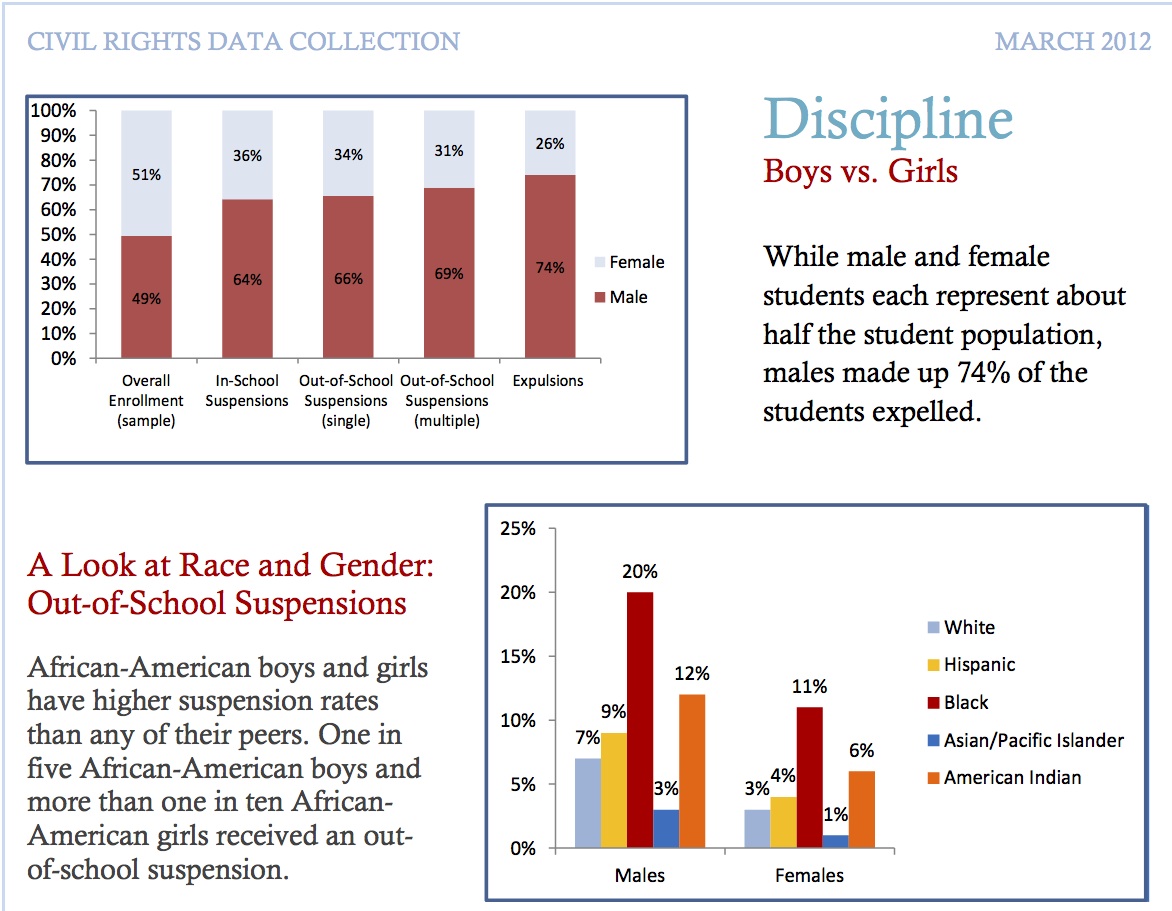
Problem #2: Discipline in schools is inequitable by gender, complicating inequity by race:

Discipline Boys vs. Girls and A Look at Race and Gender: Out-of-School Suspensions

[click to enlarge]

Problem #3: Access to advanced courses and retention rates are inequitable by race:

GandT.suspension
Access to Gifted and Talented Education (GATE) Programs and Retention Rates

[click to enlarge]

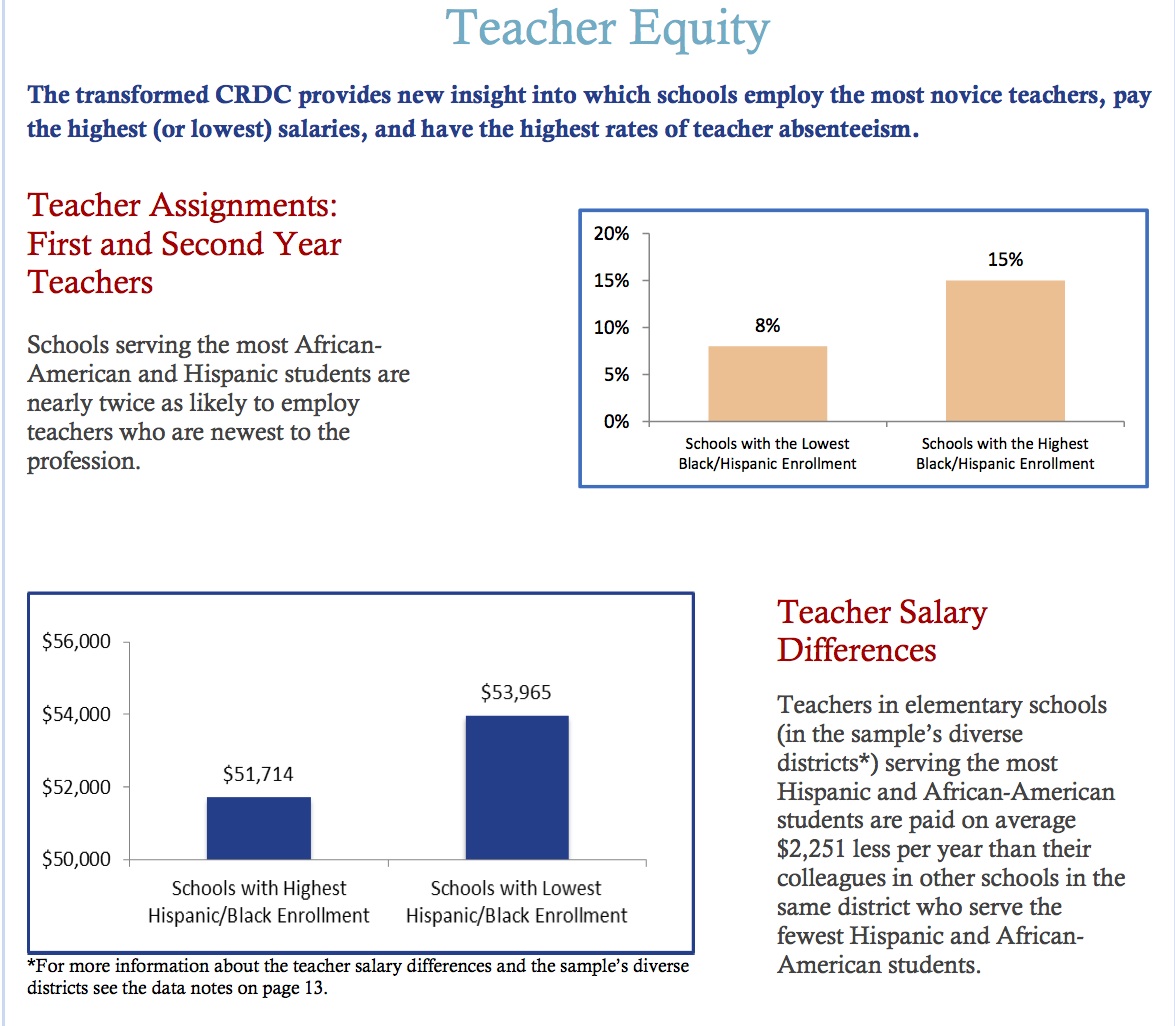
Problem #4: Teacher assignment and compensation are inequitable by race:

Teacher Assignments: First and Second Year Teachers and Teacher Salary Differences

[click to enlarge]

Problem #5: School discipline policies such as zero tolerance policies are racially inequitable and parallel to the current era of mass incarceration disproportionately impacting African American males:

There is abundant evidence that zero tolerance policies disproportionately affect youth of color. Nationally, black and Latino students are suspended and expelled at much higher rates than white students. Among middle school students, black youth are suspended nearly four times more often than white youth, and Latino youth are roughly twice as likely to be suspended or expelled than white youth. And because boys are twice as likely as girls to receive these punishments, the proportion of black and Latino boys who are suspended or expelled is especially large.  Nationally, nearly a third (31 percent) of black boys in middle school were suspended at least once during the 2009–10 school year. Part of this dynamic is that under-resourced urban schools with higher populations of black and Latino students are generally more likely to respond harshly to misbehavior. (p. 3)

As I have stated before, if education reform is the civil rights issue of our time, federal and state reform agendas would end zero tolerance policies, eradicate “no excuses” ideologies, and stop retention practices—as well as address the measurable inequities by race, class, and gender marring public schools in the U.S.

Conditions of Teaching Are Conditions of Learning: On Students

I’m not prone to New Year’s resolutions, but I have decided that with the arbitrary designation of a new calendar year, I have a way to focus on new commitments, specifically in how I interact in the virtual world. So when I read a derogatory comment on one of my blog posts (describing my post with “stupidest” and then making a word choice error or typo), I resisted the urge to comment, but posted how painful it was not to do so on Facebook.

Many of my wonderful former students commented, leading to two threads and many comments that genuinely made my day and evening—justifying my decision not to interact with the person leaving the comment.

From that exchange, I wrote Classroom Teaching Experience and Whose Voice Matters because I began to think about my 18 years teaching high school English as well as how I both failed my students and served them well (by the way, my former students tend to be stunningly kind and recall our days and years together with a fondness that makes my heart enlarge like the final scene of How the Grinch Stole Christmas).

The reason my exchange with former students spurred a blog about teacher autonomy and classroom experience is that, upon reflection, I believe when I was at my best as a high school teacher, I was functioning at an autonomous level—doing what I knew to be best for what any one of my students needed (especially when that meant listening to them while they struggled under the weight of crying about a boyfriend or girlfriend)—and when I was at my worst, I was complying with mandates I felt were at least misguided.

So as I blogged about the need for listening to teachers’ voices, for honoring classroom experiences not solely but initially, I was making a case about the conditions of teaching—a case that I failed to connect to the conditions of learning and how teacher autonomy is inextricable from student autonomy.

While I remain, frankly, stunned at the antagonism expressed when I call for teacher autonomy and voice, I am equally dismayed that we tend to render both teachers and students essentially invisible and mute.

Two comments on pieces of mine, then, need to be highlighted.

On my teacher invisibility post included at The Answer Sheet, StudentsLast added: “If teachers are invisible to policy makers, what then are students? Non-existent?”

To which I must respond, yes.

And responding to Classroom Teaching Experience and Whose Voice Matters, Martha Kennedy highlighted:

Something I have never seen brought into this conversation is the fact that many people look at teachers through the lens of their own experience in school. I don’t think most people liked school. Judging from my university students, the teacher is viewed as an adversary, classes are obstacles, it’s all just “hoops to jump.” I think as long as this is true, teachers will have a hard time with “the public.” There’s also the fallacy that if a kid hasn’t learned, the teacher hasn’t taught. Judging from my students, many don’t even really understand WHAT the teacher is teaching. This is a larger problem since the advent of NCLB where students are taught to pass exams. Students are conditioned to find a discrete answer to every question. This pretty much steals from questions their intrinsic interest.

The first point above is extremely important: How often are the actions of teachers inculcating in students negative associations with not only school but also teachers? How often are those actions the result of misguided mandates imposed on those teachers? How might all teachers embrace their autonomy so as to avoid these conditions in the classroom?

So as I return to my blog post about honoring teacher voice and classroom experience, I must emphasize that calling for a reconsideration of how we view teachers, how we honor (or don’t) teacher autonomy, and whose voice matters, I must stress that the conditions of teaching are the conditions of learning.

And how teachers feel as well as how students feel about those conditions matters in ways that must not be ignored, must not be marginalized against a normalized rational view of the world.

As we become more and more entrenched in “an age of infinite examination” where teachers and students are “never finished with anything,” we must begin to ask new questions and then seek different answers. And as we seek ways in which teachers and workers can embrace a new solidarity, let’s not forget our solidarity with the students in our care.

Classroom Teaching Experience and Whose Voice Matters

For about two decades from my early 20s into my early 40s, my first (and I believed only) career was public high school English teacher. Around 2002, I moved to higher education where I am primarily a teacher educator but also maintain in part a role as a teacher/director of writing in our first year seminar program—meaning I have been a teacher now for 31 years.

Throughout my time as a K-12 public school teacher, I was most of those years a department chair, a position for which I received no stipend and no release time. Along with being a full-time doctoral student for 3 years and adjunct instructor at local colleges while remaining a full-time high school English teacher in the mid-1990s, I spent the last third of my K-12 teaching career also coaching soccer (at first, as head coach of both the girls and boys teams, and then as boys head coach). My coaching stipend, by the way, after taxes, added about $70 a month to my check, and I remained an uncompensated department chair throughout those years.

My first years teaching high school included five courses in a six-class-period school day (with a planning period and including my role as faculty sponsor/teacher of the journalism class) of about 30 (occasionally 35) students per class; each class required a separate prep (different courses with different textbooks for each class, totaling about 15 vocabulary, grammar, and literature textbooks I had to juggle along with learning to teach). From my first day teaching English, as well, I considered my primary responsibility to be the teaching of writing.

Since I kept a record of my work as a teacher of writing, I can attest that over those 18 years, I read and responded to about 4000 original multiple-draft essays as well as about 6000 journal-type single-draft writing assignments each academic year.

While teaching and coaching, my day went something like this:

I’d arrive at school between 7 and 7:30 a.m., rushing into the athletic offices to put my teams’ uniforms in the washing machine. After my first period class (class change time was five minutes), I would run down the hall, back to the athletic offices to move those uniforms into the dryer. Between second and third periods, I’d run back to the athletic offices to take the uniforms out of the dryer. My planning period was spent folding and sorting the uniforms, placing them in the players’ cubbies for the next match.

On more than one occasion, I was reprimanded by administration because I wasn’t stationed at my door, shirking my hall duties.

My lunch period was about 20 minutes; I ate in my room, responding to essays essentially every day.

During soccer season, I rushed directly to practice or matches as soon as the school day ended—my work day concluding around 6 p.m. when we practiced and 10 or 11 p.m. on match days.

What’s my point? My point is that this is a typical day for K-12 public school teachers. We almost never pause, and we are being watched by students and administrators virtually non-stop (there is a psychological weight to this that few people other than teachers understand). And along with our responsibilities to know our content and to teach our students, we are also responsible as adults for the safety of other people’s children.

My atypical days, by the way, included coming home with my clothes splattered with the blood of two young men I separated fighting in study hall when I was passing by on my way to the restroom. My atypical days included walking out of my room and bumping into a student gunman (someone I was teaching). My atypical days included receiving a call that the school building in which I was teaching (and where I had attended high school) had burned to the ground.

My point, however, is not that my story is some herculean feat worthy of praise. Again, my story is replicated and exceeded daily by thousands and thousands of K-12 public school teachers—many doing so three and four decades, not just my two.

Over about 150 years, the more-or-less modern public school teacher has worked in ways I describe above, and mostly, they have done so without having much voice in how their profession is administered and what policies mandate their practices.

Since public schools are government agencies, policies are mostly designed by elected officials (and in unionized states, influenced by unions, but that influence has dwindled while many teachers work in right-to-work states, where we have almost no power or voice), with virtually none having classroom teaching experience. Historically, even school-based administrators rise to their positions with minimal time teaching day-to-day; administrators (mostly men) teach and coach 3 or so years, and then become assistant principals, and then principals, district office officials, and superintendents.

Teaching as a mostly voiceless and powerless profession must not be separated from the reality that teaching has disproportionately been the work of women. Where educators have had the most power (and highest salaries), you find, again disproportionately, men.

So, now, let me raise my larger point: I continue to see a number of people weighing in on the education reform debate bristle at classroom teachers calling for their voices being heard and at the recognition that education debates and policies are being driven by people with no or very little K-12 classroom experience (such as Secretary of Education Arne Duncan, Bill Gates, and Michelle Rhee).

Although not a simple argument, it is an essential argument: Classroom teaching experience and teachers’ voice should matter, by driving the education reform debate as well as informing education policy. Let me explain how that should look.

Classroom Teaching Experience and Whose Voice Matters

Let me state clearly here that I am not saying—and I believe no one else is either—people without classroom experience should have no voice in the education reform debate. My primary argument about professional autonomy and education policy is that the initial and primary voices that matter should be classroom teachers and people with significant classroom teaching experience (this is also a problem in teacher education where education professors can and do hold positions with little or no classroom experience).

Historically and currently for the field of education, the public voice and policy paradigms are greatly flipped since those without classroom experience hold most of the public voices and almost all of the power to create and impose policy on schools.

As an illustration, consider the influence of education historian Diane Ravitch, whom I have characterized as Ravitch 1.0, Ravitch 2.0, and Ravitch 3.0. Ravitch serves my point here because many who reject criticisms of educational reformers without classroom experience point out that few people raise any concern about Ravitch, who openly admits that she has no K-12 classroom experience (in fact, when Ravitch spoke at my university, this is the first point she raised at her pre-speech talk to our education students).

Ravitch 1.0 was a strong advocate for standards and high-stakes testing, and during those high-profile years, she wasn’t often championed by classroom teachers (she may have in fact been considered one of the enemies); I argue she wasn’t even known by many classroom teachers.

Ravitch 2.0 and 3.0, however, has become if not the at least one of the most high-profile education faces and voices embraced by classroom teachers—a phenomenon that is at least ironic, if not puzzling. So what gives?

The evolution of Ravitch has included not only changes in her positions related to education but also a willingness to listen to as well as honor the experiences and voices of classroom teachers.

This means that if you decide to hold forth on education and have no classroom experience, you should not be surprised if you are held accountable when your claims do not ring true among those who teach every day under the policies that you endorse or have implemented.

Ravitch 1.0—coincidentally without K-12 classroom experience—supported policy that did not ring true to those of us in the classroom (notably the first two decades of high-stakes accountability throughout the 1980s and 1990s).

Ravitch 2.0 and 3.0—coincidentally without K-12 classroom experience—supports, echoes, and endorses policy that rings true to those teaching in K-12 classrooms day-in and day-out.

If you have never taught in K-12 classrooms, you are unlikely to understand what it is like to spend your entire weekend writing lesson plans for the next week, meticulously correlating every thing you and your students will do, minute-by-minute, to the required standards and then having your principal or assistant principal drop in and ask for those plans, only to reprimand you for not being where you said you’d be. Or calling you in to tell you your students’ test scores on high-stakes tests correlated with those standards are not adequate.

As a result, if you have never taught in K-12 classrooms, you may offer a cavalier claim that Common Core is no big deal; you may trivialize the passion and even hyperbole coming from the mouths of teachers who live the reality of high-stakes accountability aligned with CC.

And it is there that your credibility correlated to not having classroom experience comes into question. When we call you on this, we are not attacking you, we are not failing the debate with our tone, we are not over-reacting. And when you follow up with any of those charges, you are stepping into an ugly tradition that includes, as I noted above, the silencing and marginalizing of teachers, what tends to be associated with women’s professions, and women—as explained on this Feminist Legal Theory blog post:

Similar to “bitch,” the word “crazy” demeans women. But, instead of negatively characterizing women, “crazy” marginalizes and dismisses them. When discussing emotional responses, our culture often describes women as “crazy,” “oversensitive,” and “hysterical”—contrast to men as “sane” and “rational.” These words reduce a woman’s response to irrational behavior. Consequently, she believes that her feelings are not normal and are thus ultimately worthless. This behavior is similar to what is known as gaslighting: “psychological abuse in which false information is presented with the intent of making a victim doubt his or her own memory and perception.”

Classroom teachers are almost entirely powerless, disproportionately accountable for mandates they did not create and outcomes over which they have little or no control, and working every day in high-pressure, frantic (and tenuous) working environments. When you discount their emotional responses, their efforts to express the inexpressible through metaphor, their insistence that someone listen to them, you have failed the debate, and you have exposed the flaw of people without classroom experience driving the education debate.

There is a paternalism and oppression of the rational in the education debate that must not, as well, be discounted, ignored, as teachers and their experiences and expertise routinely are.

And the CC debate is just one example. I could spend many more paragraphs detailing this same disconnect about value-added methods for teacher evaluation, high-stakes testing, merit pay, charter schools, and the primary elements of education reform now being proposed and implemented.

Classroom teachers aren’t perfect, or universally “right.” I’ve struggled with classroom teachers over grade retention, corporal punishment, isolated grammar instruction, and such. I once taught a graduate class that included a colleague from my own English department who flippantly said in class, “O, you can make research say anything you want.”

So don’t accuse me of offering some romantic tribute to the infallible classroom teacher. I’m not.

What I am saying is that education is a field rich in experience and expertise and bankrupt by the unwillingness not to tap into that goldmine.

If you wish to be a part of the discussion and you have no experience in the field, your solidarity needs to start with you listening, really listening, before making claims yourself—your solidarity needs to include the same level of passion we teachers feel, to recognize that those feelings matter as much as the rationality you believe you are offering.

“A Question of Power”—Of Accountability and Teaching by Numbers

Almost three years ago (March 12, 2011, at OpEdNews), I posted the piece below and then adapted it as a section of Ignoring Poverty in the U.S. (IAP, 2012; see Chapter Five: The Teaching Profession as a Service Industry). Below I am posting the draft version from Ignoring (with a few added hyperlinks), and feel that the key point about the misuse of accountability—drawing on a scene from Ralph Ellison’s Invisible Man—highlights how teaching is an invisible profession. If not the whole piece, please consider my examination of the scene between the novel’s narrator and Kimbro below.

“A Question of Power”—Of Accountability and Teaching by Numbers[i] 

The speaker in Adrienne Rich’s “Diving into the Wreck” confronts the contrast between land and sea—”the sea is another story/ the sea is not a question of power”—leaving the clear message that our world is “a question of power.” Over the past thirty years, the education reform debate and the rising calls for education reform have exposed themselves as a question of power. The education reform debate is a mask for the powerful to maintain their power at the expense of marginalized groups, primarily people trapped in poverty. The first three years of the Obama administration have evolved into intense clashes about policy and commitments in the field of education, exposing that the education reform debate is about more than our schools; it is a question of power. Unless the sleeping giant—the voice of educators—is awakened, the power will remain in the hands of the inexpert.

As many ignored or marginalized the rallies in Wisconsin about teachers’ rights and the role of unions in our public education system, a role that is not nearly as unified as the public believes since many states are non-union (Larkin, 2011), the corporate and political elite continued to speak from positions of celebrity and authority that lack expertise and fly above the accountability that they champion:

“Well, it’s a dereliction of duty on behalf of the Democrat state senators in Wisconsin,” Bachmann said. “There was an election in 2010. The people spoke clearly in Wisconsin. They elected a new senator, Ron Johnson to replace Russ Feingold, a new governor, Scott Walker. And then they elected Republicans to run both the House and the Senate. This was a change election in Wisconsin. People wanted to get their fiscal house in order. That’s exactly what Gov. Walker and the House and Senate are trying to do, and now the Democrats are trying to thwart the will of the people by leaving the state? This is outrageous. And, plus, we have the president of the United States also weighing in with his campaign organization busing 25,000 protesters into Madison? It’s outrageous.” (Poor, 2011)

During the rising calls for bureaucratic education reform, revamping teacher evaluations and pay, and the Wisconsin teacher protests, former Secretary of Education Margaret Spellings (2011) weighed in about reauthorizing NCLB: “However, any new law must be a step toward stronger, more precise accountability.” And her audacity here is even bolder than what the new reformers have been perpetuating through film and popular media.

During President George W. Bush’s tenure, NCLB was a corner stone of his agenda, and when then-Secretary Spellings announced that test scores were proving NCLB a success, Gerald Bracey and Stephen Krashen(2006) exposed one of two possible problems with the data. Spellings either did not understand basic statistics or was misleading for political gain. Krashen detailed the deception or ineptitude by showing that the gain Spellings noted did occur from 1999 to 2005, a change of seven points. But he also revealed that the scores rose as follows: 1999 = 212; 2000 = 213; 2002 = 219; 2003 = 218; 2005 = 219. The jump Spellings used to promote NCLB and Reading First occurred from 2000 to 2002, before the implementation of Reading First. Krashen notes even more problems with claiming success for NCLB and Reading First, including:

Bracey (2006) also notes that it is very unlikely that many Reading First children were included in the NAEP assessments in 2004 (and even 2005). NAEP is given to nine year olds, but RF is directed at grade three and lower. Many RF programs did not begin until late in 2003; in fact, Bracey notes that the application package for RF was not available until April, 2002.

And for this, how was Spellings held accountable? Not at all, as the contradiction and misinformation were primarily ignored by the mainstream media.

And herein lies the problem with the accountability demands coming from the new reformers and not being challenged by the media or the public. The premise that our schools are failing is a distortion, especially when based on further misuse of data such as international comparisons (Riddile, 2010), but the claim that education is failing because of “bad” teachers and powerful teachers’ unions is more disturbing since no one ever offers any evidence, even manipulated evidence, to show that the most pressing education reform needed is teacher quality and disbanding unions. In fact, the entire course of the current accountability era has been destined to fail because the reforms are never couched in clearly defined problems. Instead, solutions are driven by ideology and cultural myths.

Calls for higher standards and greater accountability suggest that educational failure grows from a lack of standards and accountability—but where is the evidence those are the sources? Calls for changing teacher pay scales and implementing merit pay suggest that current pay scales and a lack of a merit pay system are somehow causing educational failures—but where is the evidence those are the sources? Charges against union influence and claimed protection of “bad” teachers also suggest that unionization of teachers has caused educational failure—but where is the evidence those are the sources?

The truth is that the new reformers are attacking teachers and unions because this is a question of power—maintaining power with the corporate and political elite at the expense of the ever-widening gap between them and the swelling workforce that is losing ground in wages and rights (Noah, 2010). De-professionalized teachers stripped of the collective bargaining are the path to a cheap and compliant workforce, paralleling the allure of Teach for America (TFA) as a cheap, recycling teacher pool—an essential element in replacing the universal public education system with a corporate charter school and privatized education system. From the perspective of the new reformers’ corporate lens for education, there is money to be made, of course, but better yet, the corporate takeover of education helps solidify the use of schools to generate compliant and minimally skilled workers.

In Ralph Ellison’s (1952) Invisible Man, the unnamed main character finds himself in a hellish nightmare after being kicked out of college and sent on a cruel quest for work in New York. He then turns to a paint manufacturing plant for employment:

KEEP AMERICA PURE

WITH

LIBERTY PAINTS. (p. 196)

The exchange between the main character and his supervisor, Kimbro, when the main character is first learning his job is important at this moment in the history of U.S. public education and the rising tide against unions:

“Now get this straight,” Kimbro said gruffily. “This is a busy department and I don’t have time to repeat things. You have to follow instructions and you’re going to do things you don’t understand, so get your orders the first time and get them right! I won’t have time to stop and explain everything. You have to catch on by doing exactly what I tell you. You got that?” (p. 199)

What follows is the main character being told by Kimbro that Liberty Paints’ prize item, white paint, requires ten drops of black. The process makes no sense on many levels to the main character, but he is chastised for questioning doing his job as told: “‘That’s it. That’s all you have to do,’ [Kimbro] said. ‘Never mind how it looks. That’s my worry. You just do what you’re told and don’t try to think about it'” (p. 200).

The scenes that follow include the main character being reprimanded for a decision although the compared paint samples look identical—the only difference being one is the result of his choice and the other is the work of the supervisor. (Later, Ellison examines the role of unions at the plant, also sections valuable to the debates today.) But here, I want to emphasize that this scene from Invisible Man is little different from the accountability dynamic begun in the early 1980s. For nearly three decades, teachers have been mandated to implement standards and to prepare students for tests that those teachers did not create and often do not endorse. Like the main character in Invisible Man, they are told daily, “’You just do what you’re told and don’t try to think about it’” (Ellison, 1952, p. 200).

And like the main character above, they are now being held accountable for the results—disregarding the power structure that mandates the standards and the tests, disregarding the weight of evidence that shows test scores are more strongly aligned with poverty than teacher or school quality. The question of power in the U.S. is that voice, thus power, comes from wealth and status. As I considered earlier, would anyone listen to Bill Gates about education if he had no money? (Thomas, 2011, March 1).

At the end of his ordeal, the main character in Invisible Man has been rendered not only silent but also invisible. He hibernates and fights a covert battle with the Monopolated Light & Power company by living surrounded by 1369 lights. His story is a question of power, a struggle to bring the truth to light. In the second decade of the twenty-first century, teachers, educators, scholars, and everyone concerned about democracy and freedom must reject the urge to hibernate and wage silent battles. Instead, voices must be raised against the powerful who have now set their sights on teachers, schools, students, and ultimately the majority of us standing on the other side of the widening gap between the haves (who have their voices amplified) and the have nots (who are silenced, invisible).

The focus on teacher quality is a political struggle over power, one that benefits the corporate and political elite as long as the public remains blind to social inequity and poverty.

References

Ellison, R. (1952). Invisible man. 30th anniversary ed. New York, NY: Vintage Books.

Krashen, S. (2006, October 2). Did Reading First work? The Pulse. Retrieved from  http://www.sdkrashen.com/content/articles/krashen_reading_first.pdf

Larkin, J. (2011, February 18). 14 Democratic senators flee Wisconsin, teachers strike for second day in a rowBallot News. Retrieved 27 June 2011 from http://ballotnews.org/2011/02/18/14-democratic-senators-flee-wisconsin-teachers-strike-for-second-day-in-a-row/

Noah, T. (2010, September 3). The United States of inequality. Slate. Retrieved from http://www.slate.com/id/2266025/entry/2266026

Poor, J. (2011, February 18). Michele Bachmann weighs in on Wisconsin teacher sick-out strike: ‘It’s a dereliction of duty.’ The Daily Caller. Retrieved 27 June 2011 from http://dailycaller.com/2011/02/18/michele-bachmann-weighs-in-on-wisconsin-teacher-sick-out-strike-its-a-dereliction-of-duty/

Riddile, M. (2010, December 15). PISA: It’s poverty not stupid. The Principal Difference [Web log]. Retrieved from http://nasspblogs.org/principaldifference/2010/12/pisa_its_poverty_not_stupid_1.html

Spellings, M. (2011, February 22). It’s an outrage. Huffington Post. Retrieved from http://www.huffingtonpost.com/margaret-spellings/its-an-outrage_b_826525.html

Thomas, P. L. (2011, March 1). Ironic lessons in education reform from Bill Gates. OpEdNews.comhttp://www.opednews.com/articles/Ironic-Lessons-in-Educatio-by-Paul-Thomas-110301-979.htm. Reposted at The Answer Sheet, March 3, 2011, The Bill Gates problem in school reform


[i] —–. (2011, March 13). “A question of power”: Of accountability and teaching by numbers. OpEdNews.comhttp://www.opednews.com/articles/A-Question-of-Power–Of-by-Paul-Thomas-110311-481.html