South Carolina and Common Core: A Next Step?

Oran P. Smith, a senior fellow at Palmetto Policy Forum, introduces in The State a new report on Common Core from the conservative think tank:

After the hearing, I concluded that John Hill of the Alabama Policy Institute had it right when he wrote: “Although both sides of the Common Core debate make arguments worth consideration, both the potential benefits and pitfalls related to Common Core have been the subject of exaggeration and error.”

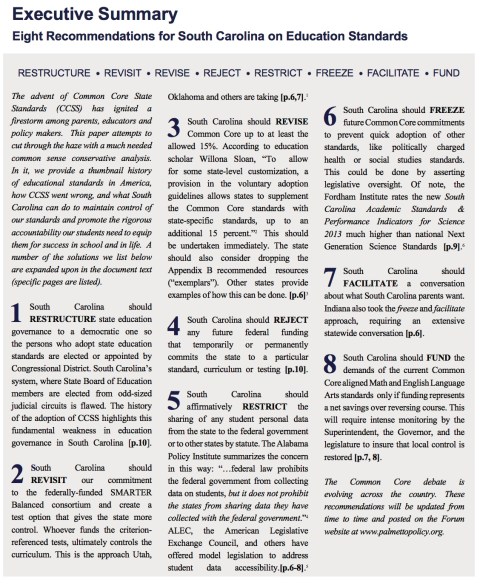
This is why Palmetto Policy Forum recently released a paper we believe cuts through the Common Core fog, outlining an eight-point plan to return unquestioned control of education standards to S.C. parents.

Several points can be taken from the release of this report on CC.

First, the report fails as many ideological think tank reports do because it speaks uncritically to its ideological base (this report has glowing images and commentary on Ronald Reagan and Jeb Bush, for example).

Second, the report also fails by offering an incomplete consideration of the extensive research base on CC and the entire standards movement.

And third, despite these weaknesses, it seems only fair to highlight that the eight recommendations have much to applaud:

8 recs SC copy

[click to see full report; 8 recommendations on page 1]

These recommendations hold some promise but with caveats.

The report must be viewed through the lens of a detailed history of how CC developed as well as the entire standards movement begun under Reagan; see for example:

Whatever Happened to Scientifically Based Research in Education Policy?

Corporations Are Behind The Common Core State Standards — And That’s Why They’ll Never Work

The research base on CC must be examined, noting that CC is unlikely to create outcomes any different than the standards movements preceding the new standards (notably about three different waves in SC); see for example:

What We Know (and Ignore) about Standards, Achievement, and Equity

On Public Schools and Common Core: Graff’s Critique of Ravitch

Should SC Ditch Common Core?

Please note the research base:

  • Hout and Elliott (2011), Incentives and Test-Based Accountability in Education: Most recent decades of high-stakes accountability reform hasn’t work.
  • French, Guisbond, and Jehlen (2013), Twenty Years after Education Reform: High-stakes accountability in Massachusetts has not worked.
  • Loveless (2012), How Well Are American Students Learning?: “Despite all the money and effort devoted to developing the Common Core State Standards—not to mention the simmering controversy over their adoption in several states—the study foresees little to no impact on student learning” (p. 3).
  • Mathis (2012): Existence and/or quality of standards not positively correlated with NAEP or international benchmark test data; “Further, the wave of high-stakes testing associated with No Child Left Behind (NCLB) has resulted in the ‘dumbing down’ and narrowing of the curriculum” (2 of 5).
  • Whitehurst (2009), Don’t Forget Curriculum: “The lack of evidence that better content standards enhance student achievement is remarkable given the level of investment in this policy and high hopes attached to it. There is a rational argument to be made for good content standards being a precondition for other desirable reforms, but it is currently just that – an argument.”
  • Kohn (2010), Debunking the Case for National Standards: CC nothing new, and has never worked before.
  • Victor Bandeira de Mello, Charles Blankenship, Don McLaughlin (2009), Mapping State Proficiency Standards Onto NAEP Scales: 2005-2007: Why does research from the USDOE not show high-quality standards result in higher NAEP scores?
  • Horn (2013): “The 2012 NAEP Long-Term Trends are out, and there is a good deal that we may learn from forty years of choking children and teachers with more tests with higher stakes: IT DOESN’T WORK!”

Smith argues at the end of his Op-Ed, “This is not a time for mutual destruction,” and I agree.

I remain skeptical, but I wonder if this report suggests the possibility that SC is moving toward a reasonable reaction to CC.

I hope so because SC remains a high-poverty state stratified by wealth and poverty; no one in the state, especially the children in our schools, can afford more partisan political grandstanding over education policy.

I am willing to set aside the misleading nods to Reagan and Jeb Bush (both key causes of this problem) in order to enact the 8 recommendations above because at least then we will have a space within which to confront the issues left unaddressed—notably the inordinate cost of yet more commitments to new standards and tests that will, I guarantee, fail our children in SC.

A Brief Meditation on Choice

Deborah Meier reminds us that “one can’t  ‘choose’ to be the children of the wealthy,” adding later:

You and I—or some other somebodies—are deciding the future of “other people’s children” [hyperlink added] unless we provide ways for “them” to have a voice, a vote, and the resources to decide their own future.   We need to restore a better balance between local communal life (with its power to effect some immediate changes like we did at the small self-governing schools I love) and distant, “objective” moneyed power.  It’s our democracy that rests on our rebuilding strength at the bottom.  If we don’t, we induce a passivity that surely cannot be in the self-interest of the least powerful, but might (just might) be in the self-interest of others.  And then we blame them for being passive?

Without consciously deciding to do so, I have just finished reading the novels of Jeffrey Eugenides in reverse chronological order, ending just yesterday with The Virgin Suicides.

In his first novel, the story of five sisters who all commit suicide, the reader is pulled into a collective recollection that feels invasive and obsessive. We are left with many questions about these lost lives. But central to the narrative is the role of the girls’ parents.

One moment in the novel involves the mother forcing one daughter to destroy in a fire and then throw away the girl’s treasured record albums.

This and other scenes in The Virgin Suicides reminded me of the many situations like the one above that my students experienced in their homes—conflicts that hurt and even scarred young people in ways that almost no one would ever recognize.

My daughter is now 24, expecting a child, and if I have learned anything as a teacher, a son, and a parent, it is that parents are apt to make poor choices for their own children—even out of love, but also out of sheer flaws in their own character.

I have parents who gave me an almost idyllic childhood, but they also chose to smoke in the car with my sister and me in the back seat.

A few years ago, I wrote Parental Choice?: A Critical Reconsideration of Choice and the Debate about Choice, a book that approaches the school choice debate from a critical perspective. And I very purposefully did not use “school” in the title since I believe at the root of the school choice movement is the powerful and idealized view of parental choice as a subset of the larger myth in the U.S. about individual choice.

Also during my 18 years teaching public school in the rural Upstate of South Carolina, I was approached every year by students who were preparing to drop out of high school as soon as they reached 16 years of age. They would explain to me that the decision had been prompted by their parents, who explained that either they had dropped out and were doing fine (they often quoted the hourly rate of their parents’ salaries as evidence) or that they now saw no value in what high school graduation gave them.

When choice advocates discuss the primary importance of parental choice, they tend never to mention that dropping out of school is a form of parental choice.

Just as workers in the impoverished South have been manipulated into voting for and embracing ideologies against their own self-interests—where “right to work” resonates even though the law allows employers the right to fire at will—a populist/libertarian refrain that idealizes “choice,” in fact, serves as a mask for maintaining an imbalance of individual freedom in the U.S.

“Poor and minority parents should have the same choices as affluent and white parents” is a compelling refrain.

But it is ultimately a lie.

Idealizing and prioritizing choice renders choice meaningless—but those arguments do insure that the 1% always wins.

Yes, individual choice is an important part of the human condition as well as a central right of a free people in a democracy.

For choice to matter, though, the Commons, the public good must be established first.

Just as Meier notes that no child chooses her or his parents, home, community, or socioeconomic status, we must acknowledge that no one should be required to choose the basics of human existence.

No one should have to choose a good police force.

No one should have to choose a good military.

No one should have to choose good medical care.

And no one should have to choose a good school.

The implication of having to choose the essentials that should be a part of the Commons is that bad alternatives exist—and they must not.

The only way to honor choice as a free people is to first insure the Commons that allow choice to exist in equitable and ethical ways.

Idealizing choice as a primary and universal good is a lie like “right to work.”

The first choice of a free people, ironically, is to insure those conditions that should require no choice—and public education is one of those foundational contracts among a free people that must be guaranteed regardless of to whom or where a child is born.

“Hunting Scapegoats”: WWII Literacy Crisis and Current Education Reform

[Header Photo by Christian Chomiak on Unsplash]

“Historians often mention World War II as a time when expectations for schooling and literacy really took off,” explains Deborah Brandt [1], “when what was considered an adequate level of education moved from fourth grade to twelfth grade in a matter of a few years” (p. 485).

National concerns about literacy can be traced to literacy tests for soldiers in WWI, when 25% of recruits were deemed illiterate. While this data appear to have prompted a greater focus on literacy in U.S. public schools, WWII data on literacy again suggested far too many people in the U.S. struggled with basic literacy. As Brandt notes:

Even more profoundly, though, World War II changed the rationale for mass literacy. Literacy was irrevocably transformed from a nineteenth-century moral imperative into a twentieth-century production imperative—transformed from an attribute of a “good” individual into an individual “good,” a resource or raw material vital to national security and global competition. In the process, literacy was turned into something extractable, something measurable, some-thing rentable, and thereby something worthy of rational investment. (p. 485)

From the early to mid-twentieth century, then, a powerful dynamic was created among racial integration, military-based measurement of IQ and literacy, and changing expectations for public education.

Brandt sees those relationships in current education reform ideologies and claims:

We can find eerie parallels between the selective service system of the mid-twentieth century and the public educational system of the early twenty-first century. There is the atmosphere of high anxiety around literacy, rapidly changing standards, an imposition of those standards onto more and more people, a search (largely futile) for reliable testing, a context of quick technological development, a heightened concern for world dominance, and a linking of literacy with national security, productivity, and total quality control. This is what happens when literacy links up with competition, with the need to win the war. It is this competition that justifies the strip mining of literacy, the ranking of skill, the expendability of human potential, and the production of just-in-time literacy. It is the blueprint for the Knowledge Economy. (p. 499)

Calls of a literacy crisis during WWII are roots of similar cries of education crisis spanning from the early 1980s until today. And throughout either era, the complexities of the problems are ignored in order to force agendas that have less to do with education than with serving larger social and political goals—often ones benefitting the privileged at the expense of the impoverished and marginalized.

In 1942, Lou LaBrant confronted the misleading conclusions drawn about low literacy rates among WWII draftees:

The induction of American youth into the armed forces, and the attendant examinations and classifications have called attention to a matter long of concern to those who teach reading or who are devoted to the cause of democracy: the fact that in a land which purports to offer universal education we have a considerable number of youth who cannot read intelligently. We are disturbed now because we want these men to be able to read military directions, and they cannot. A greater tragedy is that they are and have been unable to read with sufficient understanding to be constructive peace-time citizens.

As is to be expected, immediate explanations have been forthcoming, and immediate pointing-of-fingers has begun. Most of the explanations and pointing have come from those who have had least to do with teaching reading, and who are least conversant with the real problem. Moreover, as is again to be expected, the diagnosis is frequently in terms of prejudice or pet complaint, and could be used in other situations as logically. Many are hunting scapegoats; there are scores of “I-told-you-so’s.” It is best to look at the situation critically. (p. 240)

LaBrant recognized, as a teacher and scholar of literacy, that public blame for the low literacy rates suffered from both a lack of expertise about literacy and a number of complicating factors. For example, the standard for literacy changed from generation to generation, and WWII experienced an expanded pool of recruits due to integration, which of course included African Americans and impoverished men who had been systematically denied educational opportunities.

The political and public response to low literacy rates among the military in WWII included blaming progressive education and calling for a back-to-basics focus, as LaBrant addressed:

Within the past ten years we have made great strides in the teaching of purposeful reading, reading for understanding (the kind of reading, incidentally, which the army and navy want) . Nevertheless, we hear many persons saying that the present group of near-illiterates are results of “new methods,” “progressive schools,” or any deviation from the old mechanical procedures. They say we must return to drill and formal reciting from a text book. (p. 240)

The pattern identified by LaBrant foreshadows the rise of high-quality writing instruction in the 1970s-1980s that was blunted by the accountability era’s focus on standards and high-stakes testing.

But, as LaBrant outlined, public and political blame placed on progressivism was misguided, and ultimately misleading:

Before we jump to such an absurd conclusion, let’s take a minute to think of a few things:

1. Not many men in the army now have been taught by these newer methods. Those few come for the most part from private or highly privileged schools, are among those who have completed high school or college, and have no difficulty with reading.

2. While so-called “progressive” schools may have their limitations, and certainly do allow their pupils to progress at varied rates, above the second grade their pupils consistently show superior ability in reading. Indeed, the most eager critics have complained that these children read everything they can find, and consequently do not concentrate on a few facts. Abundant data now testify to the superior results of purposeful, individualized reading programs.

3. The reading skills required by the military leaders are relatively simple, and cause no problem for normal persons who have remained in school until they are fourteen or fifteen. Unfortunately the large group of non-readers are drop-outs, who have not completed elementary school, come from poorly taught and poorly equipped schools, and actually represent the most conservative and back- ward teaching in the United States. (pp. 240-241)

Again, consider the pattern: Implement new and developing tests (literacy tests during WWII), identify a problem related to education, create a scapegoat, and then call for a return to traditional drill-based education. Does this sound familiar?

Now add what was not being addressed in 1942, as detailed by LaBrant:

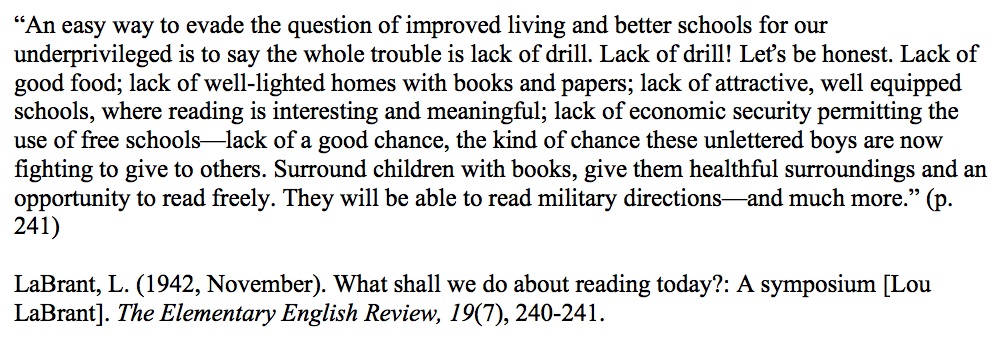
An easy way to evade the question of improved living and better schools for our underprivileged is to say the whole trouble is lack of drill. Lack of drill! Leťs be honest. Lack of good food; lack of well-lighted homes with books and papers; lack of attractive, well equipped schools, where reading is interesting and meaningful; lack of economic security permitting the use of free schools—lack of a good chance, the kind of chance these unlettered boys are now fighting to give to others. Surround children with books, give them healthful surroundings and an opportunity to read freely. They will be able to read military directions—and much more. (p. 241)

Seven-plus decades ago, public and political outrage was willing to attack a straw man, a scapegoat—progressive education—but was unwilling to confront inequity, poverty, and the linger scar of racial segregation.

Again, sound familiar?

Note

[1] Brandt, D. (2004). Drafting U.S. Literacy. College English, 66(5), 485–502. https://doi.org/10.2307/4140731 [https://www.jstor.org/stable/4140731]

Lack 1942

Ralph Ellison, a Century: From Unseen to Misseen

With his Invisible Man, Ralph Ellison’s narrator announced on the first page: “I am invisible, understand, simply because people refuse to see me.”

And with this novel, the ironies become so layered that “irony” likely isn’t sufficient.

Many see only Invisible Man when they hear Ellison’s name. And Ellison’s entry into the exclusive and mostly white and male world of the American literature canon is not without controversy since that entry has much to do with modernist (and thus a certain type of traditional, a certain level of normative) expectations for what makes literature high-quality.

Invisible Man, Ralph Ellison

As Ellison was being embraced by the mainstream world of literary fiction at mid-twentieth century, he was also creating tensions among the more left-leaning African American arts and civil rights movement—especially among the radicals.

Now at one hundred years since Ellison’s birth and more than fifty years since Invisible Man was published, the rich paradox of the invisible black man in the U.S. at mid-twentieth century must be viewed through the lens of Martin Luther King Jr.’s and Malcolm X’s assassinations.

And the more recent trials surrounding the shootings of Trayvon Martin and Jordan Davis as well as the controversies surrounding Richard Sherman and Marcus Smart.

Ellison’s invisible man recognized that mainstream (and white) America refused to see him, but African American males in the second decade of the twenty-first century are now faced with another reality of being misseen as “thugs”—criminals by their very existence.

African American males know this reality of being misseen as soon as they enter school.

Maybe one hundred years after Ellison’s birth, we have in the U.S. moved away from refusing to see African Americans, but I fear that our gained sight is not what Ellison envisioned.

There is much still to be mined in the words of Ellison, and on the occasion of his 100th birthday, I offer some places to read—and urge that we all use such occasions to close our eyes in order to open them anew and to re-vision the world.

For Further Reading

Books

Thomas, P.L. (2008). Reading, learning, teaching Ralph Ellison. New York: Peter Lang USA.

Ralph Ellison: An American Journey (PBS)

Ralph Ellison, The Art of Fiction No. 8 (The Paris Review)

Ellison at 100

“What These Children Are Like”: Rejecting Deficit Views of Poverty and Language

“The Deliberately Silenced, or the Preferably Unheard”

To Jimmy (and Jose), with Love: I Walk Freely among Racism

Education: The Invisible Profession

“What These Children Are Like,” Ralph Ellison

The Collected Essays of Ralph Ellison (Modern Library Classics)

A Historical Guide to Ralph Ellison (Historical Guides to American Authors), Steven C. Tracy  (Editor)

The Cambridge Companion to Ralph Ellison (Cambridge Companions to Literature), Ross Posnock (Editor)

Ralph Ellison: Emergence of Genius, Lawrence Jackson

Ralph Ellison: A Biography, Arnold Rampersad

True Detective: It’s Still a Man’s (Hostile) World, pt. 2

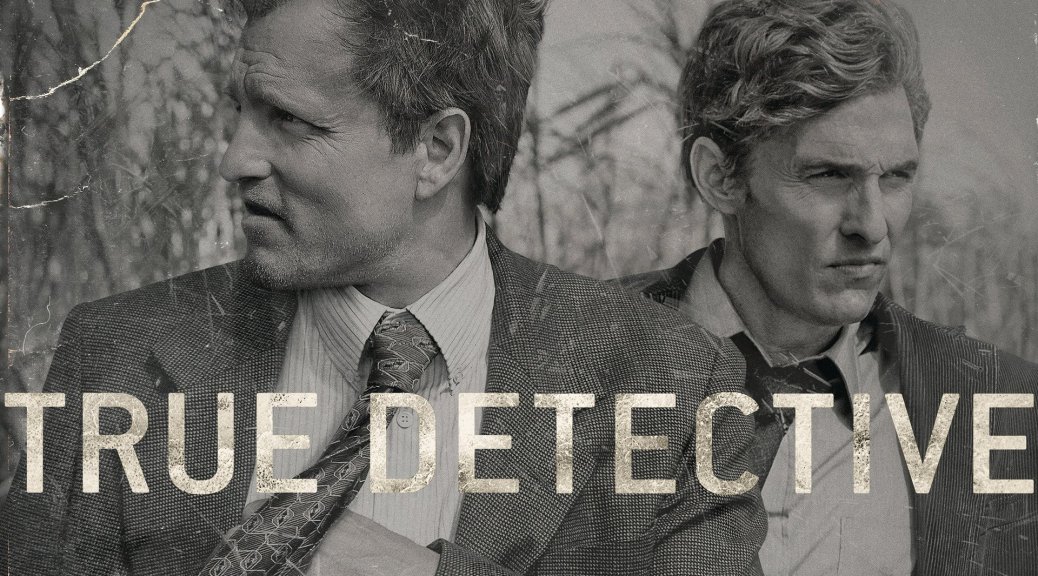
I started to say True Detective (HBO original series) is gold ore and then to pursue a metaphor of finding something of value in an impure original form.

But one of the two main characters is named Rust Cohle (Matthew McConaughey) so I will say instead, True Detective is iron ore and we can find something of value—something tarnished, yes—in an impure original form.

I want to start with the tarnished, the rust, that few people have confronted.

Emily Nussbaum sees True Detective through the lens of all that it fails to achieve:

Like many critics, I was initially charmed by the show’s anthology structure (eight episodes and out; next season a fresh story) and its witty chronology, which chops and dices a serial-killer investigation, using two time lines…

On the other hand, you might take a close look at the show’s opening credits, which suggest a simpler tale: one about heroic male outlines and closeups of female asses. The more episodes that go by, the more I’m starting to suspect that those asses tell the real story.

The women in the episodes, Nussbaum explains, are “paper-thin”; they serve as women often do in art made by men—as props, as symbols, as embodiments rendered meaningful only in the context of the men who gain most of the attention when the camera isn’t focused on the bared curves of women titillating and pleasing those men (and the audience, mostly men, we may assume). “Wives and sluts and daughters—none with any interior life,” she recognizes.

I think Nussbaum’s explication is important, not to set True Detective aside, but to mine that rust from the ore. I think there is much here of value—even conceding the entrenched failures of men making art as if women truly and inevitably are “paper-thin,” “a simple prop to occupy [their] time.”

Many people have noted that about 5% of pop culture is brilliant and the remaining 95% is trash. From production value to acting, True Detective aspires to that 5%, and I think it is often successful.

Even (maybe especially) with the mind disengaged in rational ways, each episode is mesmerizing for the senses.

But if we approach the series as a work of collaborative art (director, write, actors) that necessarily involves the viewer as yet another collaborator, we may find that True Detective is a tale possibly subtitled “It’s Still a Man’s (Hostile) World.”

Yes, women are cheated in (and cheated on) this narrative from HBO, but women are cheated in (and cheated on) the real world also. Children too are central in the series, often as the victims they are in real life also.

And if we are to decide whether to applaud True Detective for its often soaring craft or to denounce the series for its cliched and tone deaf paternalism, misogyny, and chauvinism, I think we must also start with genre—not just what the series is about but what form this series is taking to shape that tale.

Taken for its commitment to form, True Detective is noir fiction, a genre itself both illuminating the sexism of the human condition and flawed because of the sexism of the human condition entrenched in the genre.

“Noir fiction has attracted some of the best writers in the United States (mostly) and many of its aficionados are among the most sophisticated readers in the crime genre,” explains Otto Penzler. “Having said that, I am constantly baffled by the fact that a huge number of those readers don’t seem to know what noir fiction is,” adding:

Look, noir is about losers. The characters in these existential, nihilistic tales are doomed. They may not die, but they probably should, as the life that awaits them is certain to be so ugly, so lost and lonely, that they’d be better off just curling up and getting it over with. And, let’s face it, they deserve it.

Pretty much everyone in a noir story (or film) is driven by greed, lust, jealousy or alienation, a path that inevitably sucks them into a downward spiral from which they cannot escape. They couldn’t find the exit from their personal highway to hell if flashing neon lights pointed to a town named Hope. It is their own lack of morality that blindly drives them to ruin.

And there is Rust Cohle and his partner Marty Hart—deeply flawed men blinded by their lusts and trapped between justice and injustice.

Are there better ways to do that story? There was Andy Sipowicz in NYPD Blue, and Bruce Wayne/Batman endures—both of which are examinations of that exact dynamic of justice/injustice and flawed men.

Either these are archetypal characters and narratives or evidence that the paternalism of film and literature have imposed these characters and narratives onto the world by sheer force.

But as I watch the series (as of this writing, the sixth episode), I have been reminded of John Gardner’s The Sunlight Dialogues, a literary and complex novel that searches the human soul as well as the landscape of justice and injustice, as this excerpt shows:

His watchmen are blind: they are all ignorant, they are all dumb dogs, they cannot bark.

-Isaiah 56:10

In late August, 1966, the city jail in Batavia, New York, held four regular prisoners, that is, four prisoners who were being kept on something more than an overnight basis. Three had been bound over for trial; the fourth was being held, by order of the court, until the County could administer a psychiatric examination. The identity of this fourth prisoner was not yet known. He seemed to be about forty. He’d been arrested on August 23rd for painting the word love in large, white, official-looking letters across two lanes of Oak Street, just short of the New York State Thruway. As the police were in the act of arresting him he had managed to burn all the papers in his billfold (dancing up and down, shaking like a leaf), and he refused to say now a halfway sensible word about himself, except that he was “an anarchist, a student.” His face was slightly disfigured by what looked like a phosphor burn — the kind men get in wars. Whether he was actually a student (he was an anarchist, all right) there was no way of telling. He seemed too old for that, and there was no college in Batavia; but the town was not large and they knew he was not from there.

The Sunlight Dialogues is hard; it demands a great deal of the reader in terms of time as well as concentration.

I think the same of True Detective in the sense that we must not take the work on face value only, we must not allow ourselves to be mesmerized, and we must not see the “paper-thin” women as endorsements, but mirrors of the very real ways life remains a man’s (hostile) world.

And I remain committed to mining the rust from the ore in this show because we remain faced with much the same in the real world we fail to excavate and then re-imagine each day.

True Detective is flawed as is the human condition. We can do better in both, but not by giving in to the nihilism of the noir that is both creation and mirror.

It’s still a man’s (hostile) world, but it doesn’t have to be.

Knowledge: Not If, but How (and Who Decides)

As I have posted before, progressivism and whole language have a long history of being blamed for failure when in reality neither has been practiced in any substantial way by teachers. While school policies and classroom practices have remained committed to traditional approaches and behavioral groundings, it is likely more accurate to describe schooling in the U.S. as dominantly bureaucratic—often failing any ideology whether or not, as Harry Webb notes, schools and colleges of education are almost exclusively progressive.

And thus, education remains mired among some in a constant tension between so-called traditional and progressive commitments; as Webb explains, that tension is itself reductive and misleading:

The differences between educational progressives and traditionalists, although often defined in terms of how they go about teaching, are really more fundamental even than that. Progressives and traditionalists actually have different goals. They are trying to achieve different ends. To progressives, traditionalists are trying to fill children’s heads up with rote, disconnected facts. To traditionalists, progressives are trying to ‘facilitate’ the development of nebulous skills; skills that often cannot be defined and certainly not assessed. Of course, there are always those who are quick to cry, ‘False choice! You can have both nebulous skills and rote, disconnected facts.’ Of course there are.

There is a continuum here: on the far right, rote memorization, and on the left, touchy-feely “do your own thing” playtime. While as a critical educator I have serious problems with positivism, behaviorism, and the cultural knowledge concepts promoted by E.D. Hirsch, I agree with Webb, a traditionalist, that both extremes fall well short of what most thoughtful educators are pursuing regardless of their pedagogical commitments or educational philosophies.

So let me enter this debate with a few examples of what critical educators see as the foundational problems with how schools treat the pursuit of knowledge—with the full disclosure here that how the real world of teaching happens is often out of focus when compared to the more complex theories and philosophies identified. In other words, when a school or teacher claims to be implementing essential questions, it is unlikely that is the case. The same can be said of direct instruction, cooperative learning, authentic assessment, and so forth.

If there are educators who say content doesn’t matter, I don’t know any. It is a provocative claim, none the less. Of course content matters, but for critical educators, authoritarian static knowledge is the problem because of the “authoritarian” and “static”—not the knowledge.

Whether directly or indirectly, when a teacher prescribes that all children learn X without consideration for the needs or interests of the students and without any opportunity to examine whether or not that content should be accepted  uncritically, education has failed.

Another issue for critical and even progressive educators is the concept of when knowledge is acquired, when (and how) content becomes automatic.

Treating content as value-free, discrete, linear, and sequential is the problem; not the knowledge itself.

Assuming that the human mind is essentially analytic—learning from part to whole—and that most knowledge must be acquired before real thinking, maybe critical thinking, can occur are the problems.

So I want two offer to examples of what I mean.

First, I happen to know a huge amount of content in a fairly wide range of disciplines. Some is very useful on Jeopardy! and a great deal is incredibly useful for my roles as scholar, teacher, and writer.

For example, if I see a panel from a Silver Age Marvel comic book, I am able most of the time to tell you who pencilled and inked the artwork. I also regularly cite research aloud when I am teaching, often identifying the author, year, and even page of the research.

None of this happened by rote memorization that is all too common in traditional schooling. I did not have any of this assigned, I did not study any of this for a multiple choice or true/false exam.

Throughout the 1970s, while wearing a back brace for scoliosis, I retreated into the world of collecting comic books—amassing about 7000 comics that I read, re-read, and carefully catalogued before storing them all in plastic bags.

In the mid- to late 1990s, I wrote a dissertation on Lou LaBrant, meticulously gathering everything she wrote and everything others wrote or said about here before writing a book-length biography of her life and career.

What are notable about these experiences and how I have come to gain and retain so much knowledge?

  • Both grew from my choice—one as a teenager and the other as a grown man in my mid-30s. (My point: Let’s not assume that children have no ability to make real and substantial choices, just as, see below, let’s not romanticize childhood as a time when all children’s choices are good for them and that all adult imposition is oppressive.)
  • Both were experiences with rich and complex content. Nothing was easy about either experience (despite what people misunderstand about comic books). This is about challenging content (and not the misused and misleading concept of rigor)—in the two sense of the content is complex and thus challenging and that learners should challenge the content in order to learn it.
  • Both required that I engaged in a great deal of synthesis, and thus re-creation—resulting in experiencing, re-experiencing, and thus coming to acquire an evolving memorization that has context.
  • Both were aided substantially by my having access to authorities on the content I was pursuing.

Yes, knowledge matters, but who decides what knowledge matters is essential to address and how that knowledge is acquired is also central. It fails our goals of acquiring knowledge, then, if we only honor the acquisition of knowledge before any real engagement occurs on a complex level.

Each discipline needs to take a step back from linear, discrete, and analytical assumptions about acquiring knowledge in order to identify when that approach is genuinely essential. (And I suspect it is far less often than is traditionally practiced.)

Next, let me return to the continuum noted about, adding that to the far right we fall into the trap of cynicism (no child knows what is good for her/him) and that to the far left, the trap of romanticism (just leave children alone and allow their natural curiosity to work).

Just as knowledge acquisition may come after deep and rich engagement with experiences (as I detailed above), students may come to “choose” and recognize value in knowledge after being asked to learn it. And so a final example.

Too often traditional approaches to teaching and learning have been (and are) reduced (and more often with students identified as “weak”) to isolated and rote experiences with knowledge. (This can be traced to the failure of the cult of efficiency found in the bureaucracy of schooling [1].)

For example, what has counted (and counts) for “learning about the presidents” in social studies or history class is memorizing the presidents in order to be recited on a test. This is the sort of real-world traditionalism that progressive and critical educators balk at—and recognize as all too common, again, especially for certain students. And there is a cynicism and deficit view of children embedded in that sort of teaching.

However, a romantic view of children may seek to leave whether or not children learn about the presidents up to the students (again, making the mistake of ignoring context), and traditionalists are rightly concerned that many children would find little initial interest in the presidency—despite that core knowledge being quite important for each child as a member of a democracy and to the wider democracy itself.

Instead, then, asking students—either individually or in groups—to choose one president as a research project and to use that example to identify and examine the powers of presidents in the U.S. is the sort of assignment a critical educator would embrace.

Many students are likely to come to appreciate the need to understand the presidency after this experience, and we are failing students by the fault of romanticism if we allow them only to pursue what they initially believe is important.

For critical educators, our concern is with authoritarian education, but not with authoritative teachers. And our goal is a classroom with a teacher/student among students/teachers [2]. Teaching and learning are collaborative, but the ultimate authority is still the teacher.

From his traditional commitments (ones Webb strives to advocate for in real and complex ways), Webb asserts: “By contrast, progressive education is a mirage.”

I would argue that the ways in which both progressive and traditional practices are found in schools are mirages—in the sense that they fail our goals of knowledge acquisition as a vehicle for human and social agency. In fact, those failures, I think, have little to do with progressivism and traditionalism, but much to do with the romanticism and cynicism I have examined above.

[1] Callahan, R. E. (1962). Education and the cult of efficiency: A study of the social forces that have shaped the administration of the public schools. Chicago: The University of Chicago Press.

[2] Freire, P. (2005). Teachers as cultural workers: Letters to those who dare to teach. Trans. D. Macedo, D., Koike, & A., Oliveira. Boulder, CO: Westview Press.

——— . (1998). Pedagogy of freedom: Ethics, democracy, and civic courage. Trans. P. Clarke. Lanham, MD: Rowman and Littlefield Publishers, Inc.

——— . (1993). Pedagogy of the oppressed. New York: Continuum.