
remnant 56: “thus I, for example, in the midst of my unhappiness”.
Monthly Archives: February 2014
Nina Simone on the Role of the Artist
James Baldwin in the Spring of 1963
remnant 55: “your eyes are burning holes through me”
Retain to Impede: When Reading Legislation Fails (Again)
I remember vividly during one of Bill Clinton’s State of the Union addresses watching the president state that he was seeking education policy that would ensure that all third graders would be able to read; he did the emphatic fist with thumb slightly extended to prove he was serious.
I also remember thinking—and possibly saying aloud to the TV—”No, they won’t.”
It is a silly political thing to pretend that the teaching of reading is somehow determined by political policy. It is a ridiculous thing to think that naming that political policy something clever matters as well.
But it also a silly and ridiculous thing that seemingly will never end.
In South Carolina, the state senate is considering Read to Succeed, a reading policy built in part on the Florida formula (Just Read, Florida!) that has a great deal of political support but has been unmasked as yet another misleading education “miracle” that wasn’t.
The most flawed aspect of Read to Succeed is that it mimics Florida’s third-grade retention policy that will retain third graders based on standardized test scores.
The Education Oversight Committee (EOC) has examined the Read to Succeed act, and offers an At a Glance on retention and lessons learned from Florida.
While the At a Glance appears research-based and comprehensive, the Read to Succeed act and the EOC support actually represent what Matthew DiCarlo has identified as a central problem with policy built on a misuse of data:
The recent release of the National Assessment of Educational Progress (NAEP) and the companion Trial Urban District Assessment (TUDA) was predictably exploited by advocates to argue for their policy preferences. This is a blatant misuse of the data for many reasons that I have discussed here many times before, and I will not repeat them….
But they are not policy evidence. Period….
But, as I’ve said before, there’s a very large group of us out here who are willing to applaud any high-level leader who refuses to misuse evidence, whether or not we happen to agree with their substantive policy positions. I’m sure there are leaders like that out there, and I wish they were more visible.
In the exact same way as DiCarlo details above about misusing NAEP data for political gain, the EOC is failing in its support of Read to Succeed directly and third-grade retention inclusive.
The EOC’s At a Glance cites only four sources, one of which, Greene and Winters, has been reviewed, concluding:
The report reviewed here concludes that Florida’s recently instituted policy of test-based retention has helped academically struggling elementary school students improve their reading. According to the review, the report overstates the effect of retention on student achievement.
Further, the At a Glance fails to identify a strong body of research that refutes the claims made about the Florida formula and a four-decades body of research that rejects grade retention (See Sources below).
Reading problems are not primarily in our schools. Reading and all literacy problems are overwhelmingly reflections of larger social problems related to inequity and poverty.
Reading and literacy solutions, then, are not to be found in legislation and clever program names—especially when those policies are built on partial and politically manipulated evidence, and especially when those name serve to mislead.
SC is considering using partial evidence a reading policy better named Retain to Impede.
—
Recommended
Commentary: When our students are living in a book desert:
But Xavier wanted a different life; he wanted to be a doctor. He wanted to write about his experiences. What should he read?
I compiled a list of my favorite books, making sure to include teen favorites, books about the medical profession and topics that might speak to a kid growing up in a high-poverty neighborhood. When I gave him the list, he contemplated it with his usual care, made a small check mark next to the books that looked interesting, and looked up. “Where can I get them?” he asked.
And that’s where our story stalls out. Because that’s when I realized that Xavier was living in a book desert.
SOURCES
“Florida Miracle”
Review of Closing the Racial Achievement Gap, Madhabi Chatterji
Water into Wine?, Julian Vasquez Heilig
Lurking in the Bushes, Julian Vasquez Heilig
Parsing the Florida “Miracle,” Diane Ravitch
The Test-Based Evidence on the “Florida Formula,” Matthew Di Carlo
Editorial: Florida needs no advice from Jeb Bush on education policy, Jac Versteeg
Review of Getting Farther Ahead by Staying Behind, Derek C. Briggs
Grade Retention
Hold Back to Move Forward? Early Grade Retention and Student Misbehavior, Umut Özek
Test-based accountability has become the new norm in public education over the last decade. In many states and school districts nation-wide, student performance in standardized tests plays an important role in high-stakes decisions such as grade retention. This study examines the effects of grade retention on student misbehavior in Florida, which requires students with reading skills below grade level to be retained in the 3rd grade. The regression discontinuity estimates suggest that grade retention increases the likelihood of disciplinary incidents and suspensions in the years that follow. The findings also suggest that these adverse effects are concentrated among economically disadvantaged students
Retaining Students in Grade A Literature Review of the Effects of Retention on Students’ Academic and Nonacademic Outcomes, Nailing Xia, Sheila Nataraj Kirby (2009)
Our review of these 91 studies indicates that grade retention is associated with gender, race, SES, age for grade, student mobility, family and parental characteristics, prior academic achievement, prior behavioral and socioemotional development, and student health. Converging evidence suggests that grade retention alone is not an effective intervention strategy for improving academic and longer-term life outcomes. In general, retention does not appear to benefit students academically. Although some studies have found academic improvement in the immediate years after retention, these gains are usually short-lived and tend to fade over time. Past research has consistently shown that retained students are at significantly increased risk of dropping out of school. Although only a few studies have examined the effects of retention on postsecondary outcomes, the available evidence suggests negative effects on enrollment in postsecondary education and on employment outcomes in adulthood. Overall, the literature indicates mixed findings on attitudinal, socioemotional, and behavioral outcomes among the retained students….Our review found fruitful avenues of research, most notably the impact of supportive interventions (such as early identification of at-risk students, academic instructional services provided in and out of school, and different types of intervention strategies) on proximal and future student outcomes.
The Spillover Effects of Grade-Retained Classmates: Evidence from Urban Elementary Schools, Michael A. Gottfired, American Journal of Education 119 (May 2013)
Retention, Social Promotion, and Academic Redshirting: What Do We Know and Need to Know?, Nancy Frey, Remedial and Special Education, volume 26, number 6, November/December 2005, pages 332-346
The evidence gathered in the last 30 years on the practice of retention suggests that it is academically ineffective and is potentially detrimental to children’s social and emotional health. The seeds of failure may be sown early for students who are retained, as they are significantly more likely to drop out of high school. Furthermore, the trajectory of adverse outcomes appears to continue into young adulthood, when wages and postsecondary educational opportunities are depressed.
Dropout Rates after High-Stakes Testing in Elementary School: A Study of the Contradictory Effects of Chicago’s Efforts to End Social Promotion, Elaine M. Allensworth, Educational Evaluation and Policy Analysis, Vol. 27, No. 4 (Winter, 2005), pp. 341-364
Alternative to Grade Retention, Jimerson, Pletcher, and Kerr (2005)
Given the accumulating evidence that grade retention is an ineffective and possibly harmful intervention, it is imperative that school administrators advocate for “promotion plus” policies that depend on effective, evidence-based interventions. The issue for secondary school educators is twofold. Not only must educators determine whether retention is appropriate for a given student, they also need to address the negative academic, social, and emotional consequences for students who were retained in earlier grades. Very often the student’s original difficulties persist, or more likely worsen, as their school career progresses.
Winning the Battle and Losing the War, Jimerson, Anderson, and Whipple (Psychology in the Schools, Vol. 39(4), 2002)
Considering the results of this review of research examining the association between grade retention and high school dropout and other reviews of research addressing the efficacy of grade retention (Holmes, 1989; Jimerson, 2001a, 2001b; Smith & Shepard, 1987, 1988), we must move beyond the use of grade retention as an intervention strategy and attempt to implement those strategies research has demonstrated to be effective (Jimerson, 2001a). Educational professionals, researchers, parents, and policymakers would be remiss to overlook the implications of research that demonstrate the association between grade retention and school dropout. Furthermore, a new imperative has emerged, where the onus is on programs training future educational professionals to disseminate the results of the recent research presented in this review. It is crucial that we transcend limited solutions and begin to consider student developmental and achievement trajectories in order to reinforce and strengthen pathways that promote social and cognitive competence and lead to academic success.
Does Retention (Repeating a Grade) Help Struggling Learners?
Some stakeholders in Florida believe that the “hard line in the sand” created by mandatory, test-based retention created a motivational difference in teachers and parents…, since it is thought that many of the same learning supports were being provided to struggling students prior to the policy. This may be the case for test score gains close to the retention year, but given the well-known longer-term negative effect of retention on drop-out rates (e.g., Allensworth, 2005) as well as the assured delayed entry into the workforce, Florida’s evidence falls far short of even suggesting that retention is the only or best way to motivate a real positive difference for struggling students, nor has it contradicted the overwhelming evidence against retention prior and since.
What Doesn’t Work, Smith and Shepard (Phi Delta Kappan, October 1987)
The Lesson of the Cupcakes: Fixing Schools by Resisting Gimmicks and Heeding Evidence, Kevin Welner
Exploring the Association Between Grade Retention and Dropout, Jimerson, et al. (The California School Psychologist, Vol. 7, pp. 51-62, 2002)
Ultimately, the research is unequivocal in identifying that grade retention does not appear to address the needs of these students at risk of academic failure. Findings from this study should not be misinterpreted as an indication that retention was an effective intervention strategy for the retained students who did not drop out of high school. There is a need for further research comparing the retained students who completed high school with matched comparison groups of similarly low achieving but socially promoted students. This study highlights the association of early socio-emotional and behavioral adjustment and high school dropout among a group of retained students. These findings have direct implications for school psychologists and other educational professionals. In particular, rather than focusing on the unsupported academic intervention of grade retention, it is time to implement prevention and intervention programs that have been empirically demonstrated to meet the needs of these students in facilitating both positive academic success and socio-emotional adjustment.
Grade Retention: A Flawed Education Strategy, Xia and Glennia (part 1)
Decades of research suggest that grade retention does not work as a panacea for poor student performance. The majority of research fails to find compelling evidence that retention improves long-term student achievement. An overwhelmingly large body of studies have consistently demonstrated negative academic effects of retention. Contrary to popular belief, researchers have almost unanimously found that early retention during kindergarten to grade three is harmful, both academically and emotionally. [1] Many studies find that retention does not necessarily lead to increased work effort among students as predicted.
Cost-Benefit Analysis of Grade Retention, Xia and Glennia (part 2)
Grade Retention: The Gap Between Research and Practice, Xia and Glennia (part 3)
The majority of published studies and decades of research indicate that there is usually little to be gained, and much harm that may be done through retaining students in grade. Yet, many educators continue to use retention as a way to improve student achievement and claim that it produces positive results. The consequence is while a growing body of studies show that retention does not improve academic performance and has a number of negative side effects, more and more states and school districts have adopted retention policy in an effort to enhance the educational accountability.
Synthesis of Research on Grade Retention, Shepard and Smith (Educational Leadership, May 1990)
Grade Retention [a synthesis]
Social Promotion – In Comparison to Grade Retention, Advantages and Disadvantages, Different Perspectives, Jere Brophy
Meta-analysis of Grade Retention Research: Implications for Practice in the 21st Century, Shane R. Jimerson (School Psychology Review, 2001, Volume 30, No. 3, pp. 420-437)
A Synthesis of Grade Retention Research: Looking Backward and Moving Forward, Shane R. Jimerson (The California School Psychologist, Vol. 6, pp. 47-59, 2001)
In looking backwards at the retention research and previous reviews and meta-analyses, a consistent theme emerges—grade retention is not an empirically supported intervention. As reflected in the results of the three meta-analyses described above, the confluence of results from research during the past century fails to demonstrate achievement, socioemotional, or behavioral advantages of retaining students. Moreover, the research consistently demonstrates that students who are retained are more likely to drop out of high school.
Evaluating Kindergarten Retention Policy, Hong and Raudenbush (September 2006)
First, Do No Harm, Jay P. Heubert (Educational Leadership, December 2002/January 2003)
The Facts on Education: Should Students Be Allowed to Fail Grades?
[1] See Krashen, S. (2013, May). Need Children Read ‘Proficiently’ by Grade Three? Language Magazine; Deborah A. Byrnes, and Kaoru Yamamoto, 1985, “Academic Retention of Elementary Pupils: An Inside Look,” Education, 106(2), 208-14; Peg Dawson, 1998, “A Primer on Student Grade Retention: What the Research Says,” NASP Communique, 26(8); Shane R. Jimerson et al., 1997, “A Prospective, Longitudinal Study of the Correlates and Consequences of Early Grade Retention,” Journal of School Psychology, 35(1), 3-25; Panayota Y. Mantzicopoulos, 1997, “Do Certain Groups of Children Profit from Early Retention? A Follow-Up Study of Kindergartners with Attention Problems,” Psychology in the Schools, 34(2), 115-27; Samuel J. Meisels and Fong-Ruey Liaw, 1993, “Failure in Grade: Do Retained Students Catch Up?” Journal of Educational Research, 87(2), 69-77; Judy Temple, Arthur Reynolds and Suh-Ruu Ou, 2001, “Grade Retention and School Dropout: Another Look at the Evidence,” The CEIC Review, 10(5), 5-6 & 21; Charles L. Thompson and Elizabeth K. Cunningham, 2000, “Retention and Social Promotion: Research and Implications for Policy,” Eric Clearinghouse on Urban Education Digest, 161, 1-5; Deneen M. Walters and Sherry B. Borgers, 1995, “Student Retention: Is It Effective?” School Counselor, 42(4).
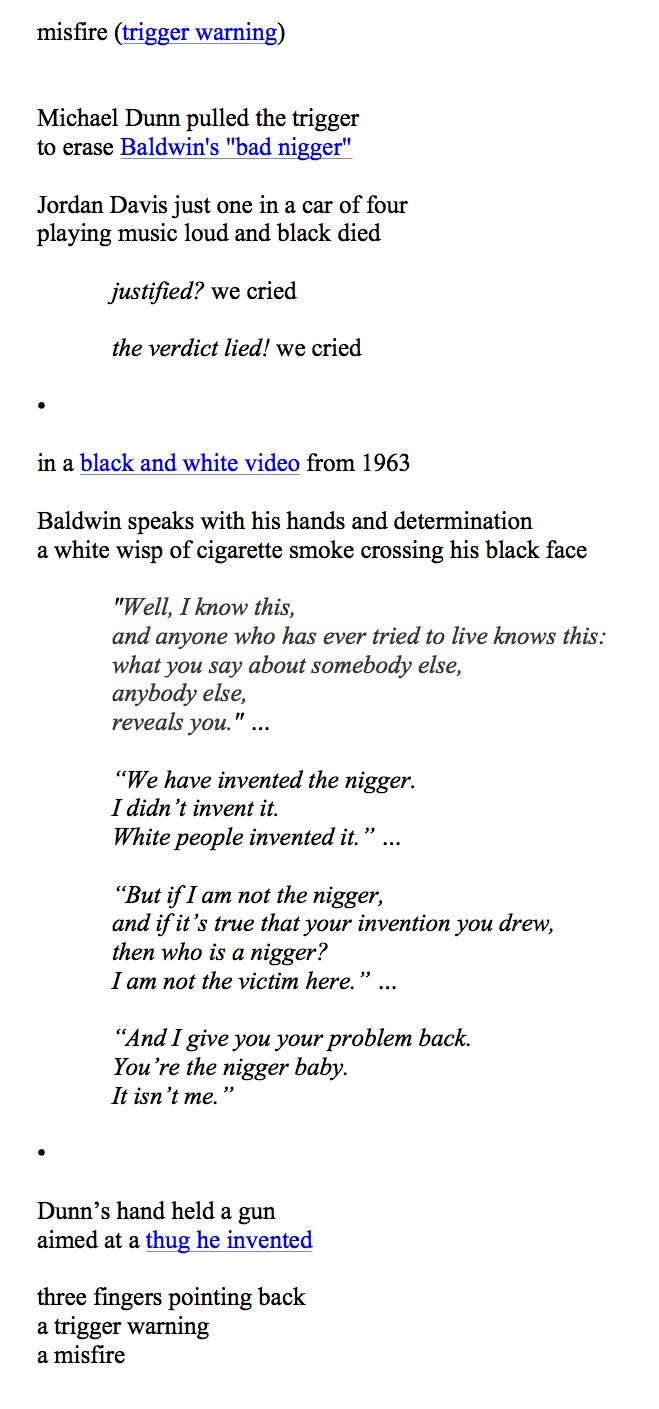
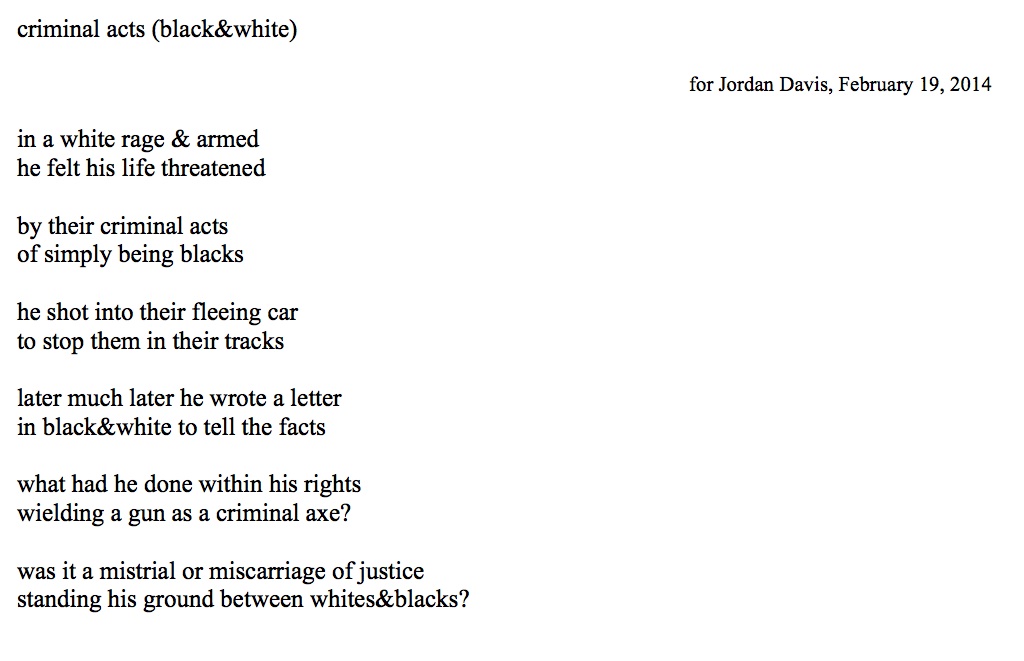
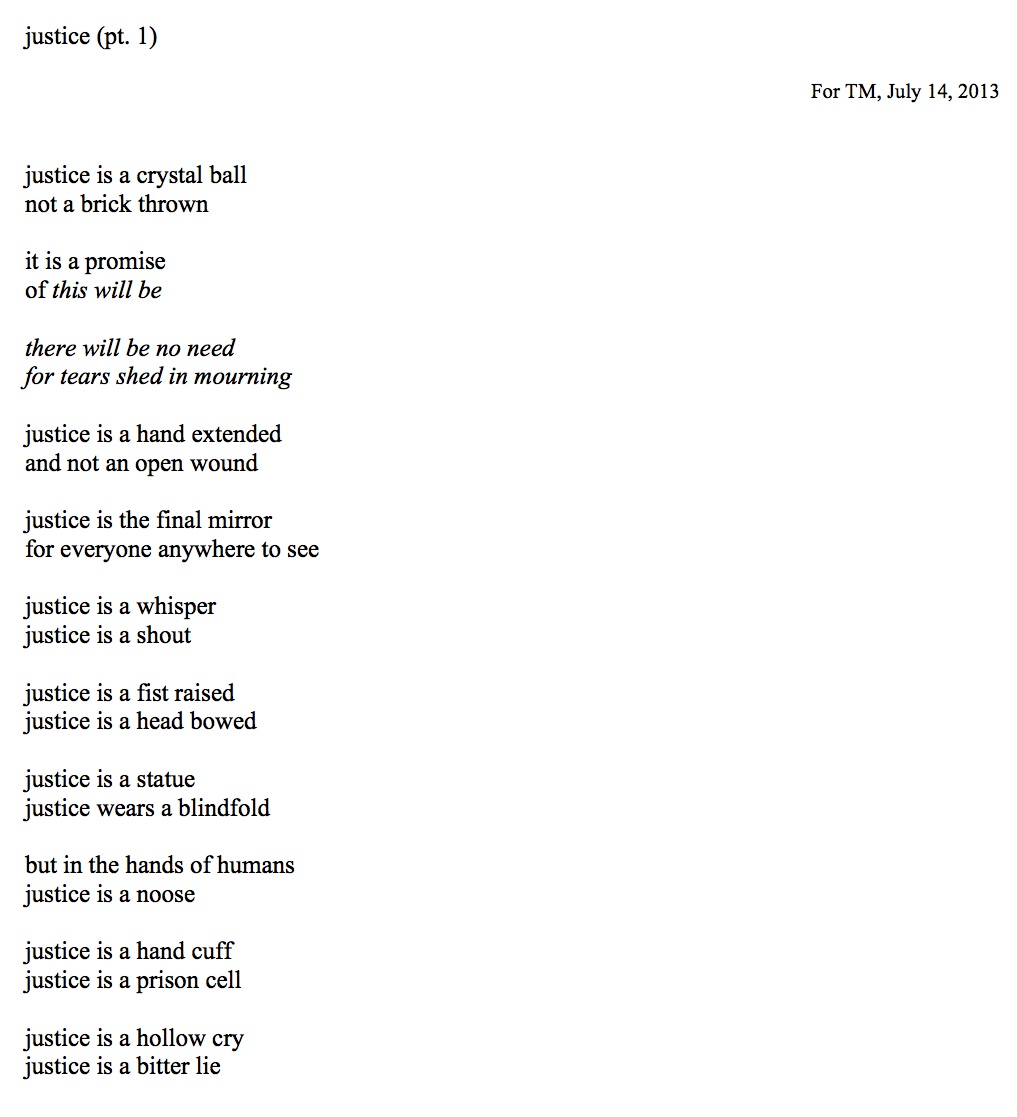
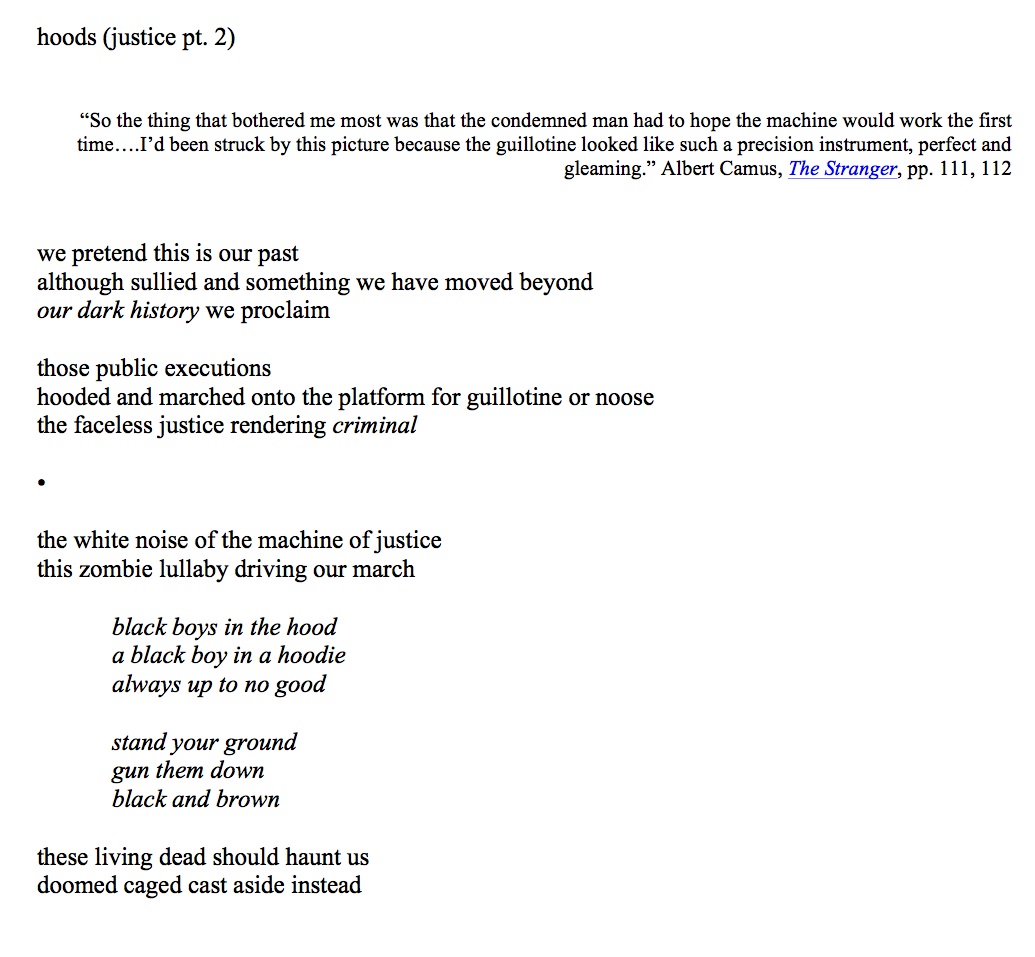
Four Poems: For Jordan Davis and Trayvon Martin
The Analogy, Hyperbole Problem: “With explanation kind” (Tone, pt. 5)
Prologue
I am a child of literature, more specifically of science fiction.
As a result, I am also a child of allegory, metaphor, and the richness of layered language.
Smitten as a reader, I eventually—and predictably—looked in the mirror and saw a writer. For almost four decades now, I have been chasing that image in the mirror, that writer I hope to be.
So when I write—mostly non-fiction, mostly essays addressing issues related to education, poverty, race, and class—I am channeling the science fiction novelist I long(ed) to be. Some Vonnegut, some Atwood, some Bradbury—laced with Ellison and cummings and Dickinson as well as Salinger and a relentless pursuit of Baldwin’s passion, bravery, and incisiveness.
So in my blogging and scholarship, I am apt to confront the conditions of teachers as worker in the context of Cloud Atlas‘s thematic exploration of slavery, calling the current state of workers in the U.S. “wage-slavery.”
I write as I live—with anger and passion.
But I also write as I live—in a constant state of critical reflection. My anxieties are many, but one constant is the anxiety that I have failed the ultimate goal in some small or even significant way.
The road to hell is paved with good intentions. [1]
•
Nancy Flanagan has recently blogged about Monstrous Labels (see Part I and Part II), raising hard questions about the sorts of analogies and hyperbole that exist in the education reform debate. Flanagan is confronting another aspect of the tone debate I have been wrestling with for some time [2]:
Clearly, everyone who writes about the existence and meaning of cultural holocausts–including The Holocaust–must bow to the experience of the ones who lived it. Our only possible ethical response, however, is to try to take the sacrifices made in humanity’s historical tragedies and make them sacred, through remembrance and honor.
That’s an enormously difficult thing to do, fraught with false equivalencies and cultural misappropriation. But is it wrong? When you’re faced with what Jeff Bryant–correctly, in my opinion–labels an “existential threat” to an essential cornerstone of democratic equality, public education, is it immoral to call up the spirit of other existential threats to democracy, other weapons of human destruction?
On Twitter, Flanagan engaged Jose Vilson about the problems with misappropriations, further emphasizing how efforts to stress the importance of education reform issues to a lay public is fraught with substantive dangers and unintended consequences—ones that often serve to work against the good intentions of those making their cases.
If I have learned anything from committing to my own blog space and actively participating on Twitter and in the public sphere, my resistance to bowing to tone complaints and my effort to engage the public effectively are often now at odds because of the rising and stringent misinformed voices that too often are indistinguishable from informed voices (and I am pointing a finger here at me).
To put it briefly, if I can be mistaken by the public as little different in substance and tone for Glenn Beck or Michelle Malkin, I have failed miserably. That failure rests on my belief that expertise and experience are often lacking in deciding education policy, and therefore, I want to offer a voice of expertise and experience clearly distinguishable from the Beck/Malkin populism and libertarian fear-mongering.
So Flanagan’s question and Vilson’s warnings about misappropriations are important and powerful—and ultimately troubling.
All along the ideological spectrum, education reform commentary includes direct and indirect references to the Holocaust (and even Hitler), U.S. slavery, child abuse, and prisons—just to name a few analogies and uses of hyperbole.
In my 30+ years of teaching, I have heard numerous students call school prison; that may be one of the most common analogies uttered by students (even those not in schools with armed police and metal detectors).
In light of Flanagan’s question and Vilson’s warning, then, when I confront my own work—in blogs and scholarly publications—I must begin to examine more closely the very thin line between illuminating analogy and misappropriation. Here, then, are some guiding ideas and questions for keeping the discourse from failing our goals despite our good intentions:
- Invoking or comparing a contemporary situation to a historical scar of the magnitude of the Holocaust or U.S. slavery (just to note two) likely fails both that magnitude and the importance of the contemporary situation.
- When tone complaints come from people of privilege, I will not allow the conversation to start with tone. When tone and misappropriation concerns are raised by marginalized and oppressed groups, the concern must be addressed.
- That said, it is not the responsibility of marginalized and oppressed groups to police inappropriate tone or misappropriations. That is the responsibility of everyone making public claims and commentary. For me, this is my responsibility—one I have stumbled over, I am sure, but one that I can make amends for from this moment forward.
- Hindsight is 20/20 so the power of analogy and hyperbole is to force people to take off contemporary blinders in order to see (this is the power of Atwood’s The Handmaid’s Tale and George Orwell’s 1984—and Arthur Miller’s The Crucible). But we must always ask: At what cost this analogy, this hyperbole? In short, if the contemporary situation is as dire as we recognize, we must seek ways in which to demand attention for that in its own right.
- The road to hell is paved with good intentions.
•
Epilogue
Is the use of high-stakes testing in kindergarten child abuse?
Are zero tolerance policies, police in the hallways, and metal detectors creating schools as prisons?
Is mass incarceration the New Jim Crow?
Have U.S. workers been reduced to wage-slaves?
I think we must all ask ourselves at what cost are we making these claims, and we must be able to see and hear these claims through the eyes and ears of those who may not immediately see the difference between what we hope to accomplish and those who hold up posters of George W. Bush or Barack Obama as Hitler.
When people see no difference, we have lost something very important, and something precious.
When we offend the marginalized and oppressed as if they do not exist, we certainly have little room to criticize anyone about anything.
The privilege of having a voice must be tempered with humility, by honoring the dignity of everyone and by having the empathy to walk in someone else’s shoes, to live in someone else’s skin, to honor someone else’s past.
It may be best when we seek the truth that we also include “With explanation kind.”
•
Tell all the truth but tell it slant — (1263)
Tell all the truth but tell it slant —
Success in Circuit lies
Too bright for our infirm Delight
The Truth’s superb surprise
As Lightning to the Children eased
With explanation kind
The Truth must dazzle gradually
Or every man be blind —
—
[1] Possibly one of the best passages from a novel is “‘Road to hell paved with unbought stuffed dogs'” from Ernest Hemingway’s The Sun Also Rises.
[2] See for example:
Tone, pt. 1: Does Tone Matter in the Education Reform Debate?
Tone, pt. 2: On “Hostile Rhetoric,” Laziness, and the Education Debate
Tone, pt. 4: Dystopian Fiction, Passion, and the Education Reform Debate
Scholars Speak Out: On Leaders and Teacher Responsibility

Professors as Public Intellectuals: A Reader [UPDATED]
With Professors, We Need You!, Nicholas Kristof makes a case for professors as public intellectuals:
Professors today have a growing number of tools available to educate the public, from online courses to blogs to social media. Yet academics have been slow to cast pearls through Twitter and Facebook. Likewise, it was TED Talks by nonscholars that made lectures fun to watch (but I owe a shout-out to the Teaching Company’s lectures, which have enlivened our family’s car rides).
I write this in sorrow, for I considered an academic career and deeply admire the wisdom found on university campuses. So, professors, don’t cloister yourselves like medieval monks — we need you!
While Kristof’s plea stumbles in many places (for example, left-leaning academics appear to be discounted out of hand, suggesting that society can somehow be changed only by academics who hold ideologies similar to that public), Daniel Willingham’s follow up presents a strong case as well, notably targeting the role of professors as public intellectuals in the education debate:
Kristof did not distinguish between faculty in Arts & Sciences and those in professional schools such as law, medicine, education, and engineering. These latter have practical application embedded in their mission and I think are therefore more vulnerable to his charges….
But again, I think Kristof’s blade is much sharper when applied to university schools that claim a mission which includes practical application. Schools of Ed., I’m looking at you.
Also important is a comment from Stwriley at Willingham’s The Answer Sheet post, which reads in part:
The reason is that there are far fewer professors who don’t have to worry that what they say in public will cost them their jobs and that have the time to spend on non-teaching and non-research duties. At this time, 3 out of 4 university faculty are adjuncts or other contingent faculty. It is only those in tenured or tenure-track positions, with the far better pay, guarantees of due process and academic freedom, and personal time for outside activity who can take up the role of public intellectual….
This is the real reason for the decline in professors as public intellectuals: the destruction of their profession for the bottom line of others.
The closing point in this comment must not be ignored: The dismantling of academic tenure at university and K-12 levels includes a silencing of academics—something Kristof and Willingham appear to be lamenting.
Neither Kristof nor Willingham acknowledge that high-profile cases have shown that even tenured professors risk everything by being public voices. And when professors shift into the world of blogging, the stakes often are high.
If professors as public intellectuals are needed, then, some time must be spent addressing the many ways in which institutional and public policies are working against that possibility.
Ultimately, calls for professors as public intellectuals confront a number of problems, including:
- Traditional university mechanisms for promotion and tenure either disregard or marginalize public work.
- A social norm of professors and teachers as “not political” remains powerful.
- In the U.S., political leaders and the public are committed to beliefs over evidence, expertise, or experience.
- Academics are often not well equipped to interact with a lay public, including being unfamiliar with the value and dynamics in the New Media as well as social media (Twitter, blogging platforms, Facebook).
Since I have made a conscious shift in how much energy I commit to traditional scholarly work versus public work, I have addressed these issues in a number of ways. Here, then, is a reader on the issues above as they relate to professors as public intellectuals:
- New Media, New Public Intellectuals
- Graphic Journalism and Graphic Scholarship: The New Public Intellectual?
- Should Universities Reward Academics for Public Influence?
- Safe Spaces for Teachers’ Professional Voices in a Public Sphere
- What, Me Blog?
- The Rise of the Dogmatic Scholar: “A Cult of Ignorance” pt. 2
- The Politics of Calling for No Politics
- Education as “Politically Contested Spaces”
See Also
What Academics Misunderstand About ‘Public Writing,’ Irina Dumitrescu
The difficulties scholars have writing for a broad audience, Christopher Schaberg and Ian Bogost
Academic Self-Marginalization Not the Problem, James Kwak
Why Is Academic Writing So Academic?, Joshua Rothman
Why Is Academic Writing So Beautiful? Notes on Black Feminist Scholarship, Emily Lordi
The responsibility of adjunct intellectuals, Corey Robin
Scabs: Academics and Others Who Write for Free, Yasmin Nair
The war on black intellectuals: What (mostly) white men keep getting wrong about public scholarship, Brittney Cooper
Columbia University Fired Two Eminent Public Intellectuals. Here’s Why It Matters. Michelle Goldberg
Roundup of Responses to Kristof’s Call for Professors in the Public Sphere, Jessie Daniels
Educating the Public on the Public’s Terms: An Open Letter to Academics, Peter Smagorinsky
In Defense of Public Writing, David Leonard
academic influence on Twitter: the findings
What’s Wrong With Public Intellectuals?, Mark Greif
How Scientists Engage the Public, Lee Rainie, Cary Funk, and Monica Anderson
The Dangerous Silence of Academic Researchers, Y. Claire Wang
‘But Does It Count?’, David M. Perry
Twitter and Tenure, David M. Perry
Prof, no one is reading you, Asit K. Biswas and Julian Kirchherr
The Perils of Being a Public Intellectual, Henry Giroux
From Tweet to Blog Post to Peer-Reviewed Article: How to be a Scholar Now, Jessie Daniels
Here’s why academics should write for the public, Jonathan Wal and David Miller
Faculty trained to speak about systems of oppression should not be required to be neutral in the classroom (opinion), Nicole Truesdell
Many people call for an end to politics in the classroom, as this is seen as the source of the problem. Rather than address systemic and structural oppression and discrimination, faculty are being asked to take “neutral” stances and just teach our disciplines, leaving politics to social media and in-person conversation. Yet for many scholars, this is our work. Many of us are trained to see and then speak on institutional and structural systems of oppression. I have been trained specifically to see and call out institutional racism through an intersectional lens. If we are being told to just do our job, then we are. So the real question becomes, is society ready to accept the true point of an education, which is to develop a group of critically thinking, conscious citizens? Is higher education ready and capable of taking on this work?
That is the true point of education, what James Baldwin meant when he said in 1963, “The paradox of education is precisely this — that as one begins to become conscious, one begins to examine the society in which he is being educated.” As educators, it is our job to teach students how to think critically so that they can engage with larger social issues. That is not confined to just the social sciences, but has an impact on all academic disciplines and departments. Yet as Baldwin also said, society is not always that anxious to have a mass of critically thinking and engaged people, because “what societies really, ideally, want is a citizenry which will simply obey the rules of society. If a society succeeds in this, that society is about to perish.” That is why education matters more so now than ever as a location that should be unapologetically committed to developing students to become true critically engaged thinkers who learn how to apply those knowledges, methodologies and skills to locations outside spaces like this.
The Mistrial of Jordan Davis: More Evidence Problems for Denying Racism
In On the Killing of Jordan Davis by Michael Dunn, Ta-Nehisi Coates confronts the injustice of simply being born an African American son:
Jordan Davis had a mother and a father. It did not save him. Trayvon Martin had a mother and a father. They could not save him. My son has a father and mother. We cannot protect him from our country, which is our aegis and our assailant. We cannot protect our children because racism in America is not merely a belief system but a heritage, and the inability of black parents to protect their children is an ancient tradition.
These words—”We cannot protect him from our country, which is our aegis and our assailant”—echo James Baldwin writing in 1966:
This is why those pious calls to “respect the law,” always to be heard from prominent citizens each time the ghetto explodes, are so obscene. The law is meant to be my servant and not my master, still less my torturer and my murderer. To respect the law, in the context in which the American Negro finds himself, is simply to surrender his self-respect.
In this essay, Baldwin lays bare the scar of racism in the U.S.:
These things happen, in all our Harlems, every single day. If we ignore this fact, and our common responsibility to change this fact, we are sealing our doom. Here is the boy, Daniel Hamm, speaking—speaking of his country, which has sworn to bung peace and freedom to so many millions. “They don’t want us here. They don’t want us—period! All they want us to do is work on these penny-ante jobs for them—and that’s it. And beat our heads in whenever they feel like it. They don’t want us on the street ’cause the World’s Fair is coming. And they figure that all black people are hoodlums anyway, or bums, with no character of our own. So they put us off the streets, so their friends from Europe, Paris or Vietnam—wherever they come from—can come and see this supposed-to-be great city.”
There is a very bitter prescience in what this boy—this “bad nigger”—is saying, and he was not born knowing it. We taught it to him in seventeen years. He is draft age now, and if he were not in jail, would very probably be on his way to Southeast Asia. Many of his contemporaries are there, and the American Government and the American press are extremely proud of them. They are dying there like flies; they are dying in the streets of all our Harlems far more hideously than flies. A member of my family said to me when we learned of the bombing of the four little girls in the Birmingham Sunday school, “Well, they don’t need us for work no more. Where are they building the gas ovens?” Many Negroes feel this; there is no way not to feel it. Alas, we know our countrymen, municipalities, judges, politicians, policemen and draft boards very well. There is more than one way to skin a cat, and more than one way to get bad niggers off the streets. No one in Harlem will ever believe that The Harlem Six are guilty—God knows their guilt has certainly not been proved. Harlem knows, though, that they have been abused and possibly destroyed, and Harlem knows why—we have lived with it since our eyes opened on the world. One is in the impossible position of being unable to believe a word one’s countrymen say. “I can’t believe what you say,” the song goes, “because I see what you do”—and one is also under the necessity of escaping the jungle of one’s situation into any other jungle whatever. It is the bitterest possible comment on our situation now that the suspicion is alive in so many breasts that America has at last found a way of dealing with the Negro problem. “They don’t want us—period!” The meek shall inherit the earth, it is said. This presents a very bleak image to those who live in occupied territory. The meek Southeast Asians, those who remain, shall have their free elections, and the meek American Negroes—those who survive—shall enter the Great Society.
Post-racial discourse offers make-up, seeks a bit of cosmetic surgery for that scar, but denying racism doesn’t erase racism. The Michael Dunn verdict as partially a “mistrial” is a bitter but apt term for the lack of justice when the victim is an African American young man.
Failing to convict Dunn is more of the evidence problem facing those who seek to deny racism in the U.S.
Baldwin’s essay from 1966 simply remains a chilling echo behind Coates’s final words:
I will not respect the lie. I would rather be thought crazy.
I insist that the irrelevance of black life has been drilled into this country since its infancy, and shall not be extricated through the latest innovations in Negro Finishing School. I insist that racism is our heritage, that Thomas Jefferson’s genius is no more important than his plundering of the body of Sally Hemmings, that George Washington’s abdication is no more significant than his wild pursuit of Oney Judge, that the G.I Bill’s accolades are somehow inseparable from its racist heritage. I will not respect the lie. I insist that racism must be properly understood as an Intelligence, as a sentience, as a default setting which, likely to the end of our days, we shall unerringly return.
For young African American men in the U.S., the options appear incredibly narrow between the mass incarceration machine rightly called The New Jim Crow and victimization that can never find justice as Baldwin warned: “The law is meant to be my servant and not my master, still less my torturer and my murderer.”
Jordan Davis, like Trayvon Martin, joins a growing list of casualties for whom we cannot even sigh rest in peace.
—
See also:
Black Boy Interrupted, Ta-Nehisi Coates
Fight With Us Too, Damnit (Educators and Jordan Davis), Jose Vilson
 dr. p.l. (paul) thomas