Everywhere I am is just another thing without you in it
“Fashion Coat,” The National
EXTENDED to JUNE 15, 2014
CALL FOR BOOK CHAPTER PROPOSALS – (now Under Contract with Peter Lang)
Inside Stories: Teach For America Corps Members Speak Up and Speak Out
Founded in 1989, Teach For America (TFA) has grown into a massive organization with a presence in thirty states and twenty-six countries, financially supported by a host of philanthropic foundations and other organizations with considerable influence. Additionally, TFA constitutes an integral part of the larger neoliberal goal of privatizing education and teacher training. Though a number of narratives from corps members exist, the vast majority of them are controlled or suppressed by TFA. Moreover, as the organization uses supportive narratives to further its rhetoric of educational reform, the large body of corps member and alumni voices that desire to express discontent, discouragement, frustration, and even anger associated with their experiences with TFA has, until now, been largely silenced. Following the lead of a critique of TFA by academics over the last few years, slowly TFA corps members and alumni have offered narratives to challenge the official rhetoric of TFA and the supposed “prestigious” position of being a TFA teacher.
In an effort to highlight and continue this counter-narrative, this volume will provide a collection of stories from current and former TFA corps members. We would also consider narratives of parents of TFA corps members. While the most effective tool of promoting TFA as a righteous and prestigious organization are the narratives from supportive corps members who tend to parrot approved talking points, this volume will provide a necessary counter-narrative that should be heard.
Proposals could highlight overall experiences, specific experiences with recruitment/application into TFA, summer Institute experiences, placement experiences, leaving TFA, etc. The finished narratives should be between 5 and 10 double-spaced pages in APA format. Alternative formats such as poetry or other arts-based representations are also welcome.
Audience
Given the broad audience interested in TFA, we anticipate the audience to include researchers, school board members, principals, parents, and teachers and pre-service teachers.
Schedule
1) Proposals due by JUNE 15, 2014. Include the following to Jameson Brewer at tbrewer2@illinois.edu:
a) Proposed title of chapter
b) Author(s) name, with complete addresses and 150-word biography for each author
c) 500-word abstract of proposed chapter
2) Confirmation of selected chapters by June 17, 2014;
3) Contributors will have their first drafts completed by August 15, 2014.
4) The editors will review these first drafts, and provide detailed comments and suggestions by September 17, 2014.
5) The contributors will make all of the necessary edits, and send the final chapters to the editors by October 17, 2014.
6) The editors will draft a comprehensive introductory chapter and have the foreword written by a well-known scholar in the field, which will be ready along with the index and other editorial issues by November 17, 2014.
7) Once the publisher’s Editor has approved the text, the finalized, formatted volume will be submitted to the publisher shortly after November 17, 2014 which should allow for copy-editing and other related matters to be completed for a publishing date sometime mid 2015.
For questions or queries, contact Jameson Brewer at tbrewer2@illinois.edu and/or Kathleen deMarrais at kathleen@uga.edu
I have lived and worked always in the state of South Carolina.
SC is a high-poverty state (see here and here) with a racially diverse population (ranked 12th highest). And, like many comparable states across the Deep South, SC is a right to work state.
Combined, these characteristics of my home state confirm, I think, my claim about the self-defeating South. However, when it comes to the Great American Worker, the entire U.S. shares that self-defeating nature.
Often that self-defeating quality is represented by political and public attitudes—antagonistic and aggressive—toward workers’ unions.
Current SC governor, Nikki Haley, who is now running for re-election, has taken a seemingly unnecessary stand against unions:
South Carolina Gov. Nikki Haley didn’t mince words when she spoke about unions at an automotive conference in Greenville this week. The state loves its manufacturing jobs from BMW, Michelin and Boeing and welcomes more, she explained, but not if they’re bringing a unionized workforce with them.
“It’s not something we want to see happen,” she told The Greenville News.“ We discourage any companies that have unions from wanting to come to South Carolina because we don’t want to taint the water.”…
She also warned auto industry executives at the conference to keep their guards up. “They’re coming into South Carolina. They’re trying,” Haley said. “We’re hearing it. The good news is it’s not working.”
“You’ve heard me say many times I wear heels. It’s not for a fashion statement,” she continued. “It’s because we’re kicking them every day, and we’ll continue to kick them.”
And a reader’s letter in The Greenville News represents how the public in SC feels about unions as well as Haley’s stance, arguing in part:
What would happen if unions made an inroad into the Upstate? They would start organizing like mad to try to increase their strength. As more and more employers started having to deal with union demands by raising wages and adding costly benefits, they would need to increase the costs of their products and services. The cost of living would go up for everybody.
I think Gov. Nikki Haley has the right idea.
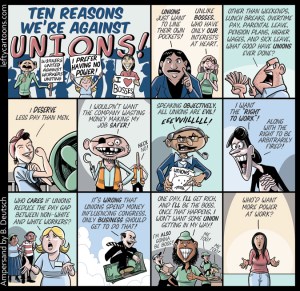
This reader’s letter as well as the apparent lack of awareness about its self-defeating perspective is perfectly satirized in this cartoon:

A regional director of the National Labor Relations Board ruled Wednesday that a group of Northwestern football players were employees of the university and have the right to form a union and bargain collectively.
For decades, the major college sports have functioned on the bedrock principle of the student-athlete, with players receiving scholarships to pay for their education in exchange for their hours of practicing and competing for their university. But Peter Ohr, the regional N.L.R.B. director, tore down that familiar construct in a 24-page decision.
He ruled that Northwestern’s scholarship football players should be eligible to form a union based on a number of factors, including the time they devote to football (as many as 50 hours some weeks), the control exerted by coaches and their scholarships, which Mr. Ohr deemed a contract for compensation.
“It cannot be said that the employer’s scholarship players are ‘primarily students,’ ” the decision said.
How the public responds across the U.S. to college athletes unionizing must be framed against patterns over the last decade that include a disturbing cultural attitude toward workers, notably against teachers’ unions, tenure, and striking (see the 2012 Chicago strike for example).
Examining how workers are portrayed in the media, how workers are valued (or not) in the U.S., and the prospect of becoming a worker for graduate students, I have framed being a worker within the rise of disaster capitalism and concluded:
Finally, in the wake of disaster capitalism in New Orleans and Oregon, pop culture, specifically The Big Bang Theory, is a crucible of not only the role of workers in the U.S. but also the attitudes about the worker that series highlights. Penny, the stereotypical “girl next door,” is the object of an on-going, clichéd joke of a waitress who longs to be an actress. The larger and central jokes of the series, however, are the four academics living across the hall from Penny. It seems in this TV world, all work is funny.
What a TV sit-com never addresses, however, is that in the real world, the gap between Penny as waitress and college professors is shrinking, or better phrased, merging. The state of the American worker is beginning to share with waitressing some disturbing characteristics that cheapen all workers. As Greider (2013) details about the restaurant industry, workers of all types are becoming less often protected by unions, receiving fewer or no benefits (paid sick days, vacation days, health insurance, retirement) with their positions, being paid less than previous generations, and generally suffering under a dynamic whereby the businesses have more or all of the power in the business-worker relationship.
In the real world, Penny and one of the academics, Leonard, would not be wrestling over the education gap between them, but would be sharing the consequences of part-time work in a hostile economy toward workers regardless of those workers’ qualifications since Leonard would be an adjunct (like Professor Beth) while Penny would remain a waitress—and both would be unsatisfied as workers because their situations do not live up to their ideals.
Yet, most Americans will always be workers, and to be a worker should be an honorable thing worthy of poetic speeches and artistic black-and-white film tributes. Being an American worker doesn’t need to be a condition tolerated on the way to something better, and it shouldn’t be twenty-first century wage-slavery that is a reality echoed in the allegory of SF: “one fine day, a purely predatory world shall consume itself.” As the last paragraphs of Cloud Atlas express, however, the wage-slavery of workers in the context of assembly-line and disaster capitalism is a condition Americans have chosen (or at least been conditioned to choose), but it is also a condition workers can change—if workers believe it is wrong, “such a world will come to pass.” (Academia and the American Worker: Right to Work in an Era of Disaster Capitalism?, pp. 21-22)
A question that remained with me as I drafted the piece above is just why the majority state of people in the U.S.—being a worker—does not inform the pervasive antagonistic attitude toward workers. The public in the U.S. appears just as self-defeating as the South when we are confronted with workers’ rights and collective workers’ voices.
The opportunity before us with the possibility that college athletes may unionize and transform not only their circumstances but also all of college athletics has a less appealing parallel for me, however: The tension between the NFL players’ union and NFL owners in 2011 and how the public responded to that unionization when compared to the rising calls to end teachers’ unions and tenure.
American disdain for unions is grounded in a traditional faith in rugged individualism, but it also seems linked to a good degree of self-loathing informed by a cultural worshipping of the wealthy and famous.
Stated directly and without the political baggage of the term “union,” what are the problems with due process and academic freedom (the central elements of tenure for teachers secured by unionization)? Who prospers from workers without full benefits, strong wages, and safe working conditions? Who maintains control when workers do not have equitable voices in their work and compensation?
Writing about the term “totalitarian,” Ta-Nehisi Coates confronts the power of words (to which I would add “union”):
Words exist within the realm of politics. In politics, words are sometimes perverted by the speaker. It’s worth considering which words come under attack for perversion (“racist,” “homophobe,” “bigot”) and which do not (“democratic,” “bipartisan,” “anti-American”). I am always skeptical of people who seek to curtail their use, instead of interrogating their specific usage. Some people really are racists, and other people really are misogynists, and others still actually are homophobes. Instead of prohibiting words, I’d rather better understand their meaning.
Some people demonizing unions and unionization really are being self-serving, really are seeking ways that workers can be treated as interchangeable widgets (not unlike college athletes) while the owners reap a disproportionate profit on their backs, sweat, and labor (consider how Walmart has sought to bust unions and reduce their workforce to part-time without benefits, resulting in those workers often being on welfare).
Ultimately, Coates comes to workers in the totalitarian state:
But the central idea—that the communist party, and thus the central committee, and thus the politburo was the sole representative of workers—has a chilling moral closure. Who could be against the workers? And if the party is the true representative of the workers, why do we need other parties?
I must echo: Who could be against the workers?
That haunts me, baffles me, leaves me cynical because of all the qualities that divide people in the U.S.—race, class, religion, sexuality, gender—that almost all of us are and always will be workers—a state that should be something of honor and dignity—is the one quality that should unite us.
College athletics stand before the entire U.S. as the crucible of a few benefitting on the backs of many—many without a voice. And that crucible also reveals to us the potential power of a collective voice, an acknowledged voice among the majority who do the labor that generates the profits.
As Coates warns, “words are sometimes perverted by the speaker.”
“Union” is one such word, and when it is spoken by those in power, be certain the motivation is not in the best interests of the workers.
There would be no billionaires today without workers. In fact, powerless workers are nearly essential for maintaining the inequitable state of the U.S. in which billionaires thrive while more and more workers become trapped in multiple part-time jobs, absent benefits or job security.
The Northwestern college football players have my solidarity, but I also wonder why we all are not seeking that same solidarity among every worker in the U.S., a solidarity that could attain the American Dream that has been perverted into an American Winter:
In case it’s not clear, “American Winter” comes from a specifc, biased and unapologetic viewpoint, but it’s also the kind of argument that’s needed right now. Watching the 50 year old John, 3 years unemployed and father to a young son with Down’s Syndrome, weep on camera because he had to borrow money from his parents to pay the electric bill, it’s bracing and raw. When Paula goes to the food bank for the first time, and is overwhelmed by the fact that her situation has forced her to take such measures or when single mom Jeanette tries make a promise to her young son Gunner that they will find a place to live, it puts a new perspective on those who are traditionally associated/stereotyped as being on social services. Everyone in “American Winter” has been working, are raising families, and doing everything they can (Dierdre gives blood and goes scrapping on weekends just for extra money) to make ends meet. They are not the vultures of the system that certain political segments like to paint as living on taxpayer money. (Review: ‘American Winter’ A Devastating Portrait Of The Erosion Of The Middle Class)
That recovered American Dream could be built on workers unionized for the right to work—the right to work for wages that dignify their work and their lives, the right to work as a part of their right to live fully and freely, the right to work in a physically and psychologically safe environment, the “right to work” not perverted by a political elite bragging about using high-heeled shoes as the boot on the throat of the Great American Worker.
See Related
Remembering Howard Zinn by Meditating on Teacher Unions and Tenure?
[NOTE: The title is an allusion to a line from Blazing Saddles.]
Margaret Atwood’s narrator, June/Offred, characterizes her situation in the dystopian speculative world of The Handmaid’s Tale:
Apart from the details, this could be a college guest room, for the less distinguished visitors; or a room in a rooming house, of former times, for ladies in reduced circumstances. This is what we are now. The circumstances have been reduced; for those of us who still have circumstances….
In reduced circumstances you have to believe all kinds of things. I believe in thought transference now, vibrations in the ether, that sort of junk. I never used to….
In reduced circumstances the desire to live attaches itself to strange objects. I would like a pet: a bird, say, or a cat. A familiar. Anything at all familiar. A rat would do, in a pinch, but there’s no chance of that. (pp. 8, 105, 111)
In her reduced circumstances as a handmaid—her entire existence focusing on becoming pregnant by a Commander to whom she is assigned, potentially a series of three before she is cast aside as infertile, thus useless—June/Offred’s fantasies about her Commander turn murderous:
I think about how I could take the back of the toilet apart, the toilet in my own bathroom, on a bath night, quickly and quietly, so Cora outside on the chair would not hear me. I could get the sharp lever out and hide it in my sleeve, and smuggle it into the Commander’s study, the next time, because after a request like that there’s always a next time, whether you say yes or no. I think about how I could approach the Commander, to kiss him, here alone, and take off his jacket, as if to allow or invite something further, some approach to true love, and put my arms around him and slip the lever out from the sleeve and drive the sharp end into him suddenly, between his ribs. I think about the blood coming out of him, hot as soup, sexual, over my hand. (pp. 139-140)
The novel reveals no evidence that June in her life in “former times” has been anything other than a relatively typical young woman with a family and a normal life. Atwood asks readers to consider her reduced circumstances (ones she does not create, ones she has no power to change alone) and how they shape the individuals in this disturbing Brave New World.
Atwood’s “reduced circumstances” are a narrative and fictional examination through a novelist’s perspective—a thought experiment replicated in the graphic novels and TV series The Walking Dead, as the comic book creator Robert Kirkman explains: “I want to explore how people deal with the extreme situations and how these events change [emphasis in original] them. I’m in this for the long haul.”
Research on human behavior has revealed, as well, that the same human behaves differently as the situations around change, what Sendhil Mullainathan and Eldar Shafir in Scarcity: Why Having Too Little Means So Much define as “scarcity” and “slack.” The “reduced circumstances” of The Handmaid’s Tale, then, is a state of “scarcity,” and poverty is one of the most common types of scarcity:
One cannot take a vacation from poverty [emphasis added]. Simply deciding not to be poor—even for a bit—is never an option….
Still, one prevailing view explains the strong correlation between poverty and failure by saying failure causes poverty.
Our data suggest causality runs at least as strongly in the other direction [emphasis added]: that poverty—the scarcity mindset—causes failure.(pp. 148, 155)
Given that we hold highly negative stereotypes about the poor, essentially defined by a failure (they are poor!), it is natural to attribute personal failure to them….Accidents of birth—such as what continent you are born on—have a large effect on your chance of being poor….The failures of the poor are part and parcel of the misfortune of being poor in the first place. Under these conditions, we all would have (and have!) failed. (pp. 154, 155, 161)
We are faced with a perplexing problem that sets up a clash between a powerful cultural ideal (the rugged individual and the allure of individual accountability) against a compelling research base that, as Mullainathan and Shafir offer, suggests individual behavior is at least as likely to represent systemic conditions, and not individual qualities (either those that are fixed or those can be learned, such as “grit”).
•
Although they may seem unrelated narrowly, two academic cheating phenomena are ideal examples of this perplexing problem—attempting to tease out individual culpability from systemic forces.
One consequence of the high-stakes era of accountability in public education has been the seemingly endless accounts of cheating on high-stakes testing; the most notorious being the DC eraser-gate under the reign of Michelle Rhee but also scandals such as the one in Georgia.
Academic cheating by college athletes has also been exposed recently, notably associated with the University of North Carolina. But college athletes cheating to remain eligible is not anything new; for example, Florida State University has received similar criticism for ignoring or covering up the academic deficiencies of athletes in the past.
It is at this point—the academic cheating and dodging of college athletes—that I want to focus on the concept of “reduced circumstances” and “scarcity” in order to consider where the source of these outcomes lie.
A few additional points inform this consideration.
First, college athletes at Northwestern University are seeking to form a union so that they can gain some degree of autonomy over their circumstances as college athletes—circumstances dictated by the NCAA. This move by athletes themselves appears to match a call by Andre Perry, his being specifically about graduation rates:
Black athletes have no choice but to play a major role in their own success. They must take full advantage of the scholarships afforded to them in spite of the climate. But some athletes have to pay a political price to force institutions to cater to black males’ academic talents. Graduation is a team effort, but black athletes must flex their political muscle to pave a way from the stadiums in January to the graduation stages in May.
Perry’s argument is one that focuses on individual agency and the athletes’ ability to rise above “the climate.”
However, David Zirin, discussing a Meet the Press examination of the NCAA and the circumstances of college athletes, seeks a systemic focus:
Yet far more glaring than the content of the discussion was what the discussion was missing. This is not surprising given the parties sitting around the table, but there was zero discussion about how institutionalized racism animates the amassed wealth of the NCAA, the top college coaches and the power conferences. It does not take Cornel West to point out that the revenue producing sports of basketball and football are overwhelmingly populated by African-American athletes. The population of the United States that is most desperate for an escape out of poverty is the population that has gotten the rawest possible deal from an NCAA, which is actively benefiting from this state of affairs….
The issue of the NCAA is a racial justice issue.
The public and the media, I believe, have already sided with blaming the athletes as well as blaming a failure of leadership and accountability among coaches and university administration, including presidents.
For example, the media has rushed to identify a student paper (a bare paragraph) as an example of the cheating at UNC, a claim now refuted by the whistleblower in the scandal, Mary Willingham. That rush and misrepresentation highlight, however, where the accusatory gaze is likely to remain—on the student athlete as culpable, on the coaches, professors, and universities.
As Zirin asks, what will be missing?
Few will consider that the academic scandal among student athletes at UNC—like the cheating scandals on high-stakes tests in public schools—is powerful evidence of a flawed system, one that places young people in “reduced circumstances” and then their behavior is changed.
As I have argued before [*see the entire post included below] (from a position of my own experiences as a teacher and scholastic coach and as someone who advocates for student athletes), school-based athletics in the U.S. corrupts both sport and academics. The entire scholastic sports dynamic is the essential problem.
There simply is no natural relationship between athletics and academics, and by creating a context in which young people are coerced into academics by linking their participation in athletics to their classroom achievement, we are devaluing both athletics and academics.
So I see a solution to the tension between Perry’s call for athlete agency and Zirin’s call for confronting systemic racism: We must address the conditions first so that we can clearly see to what extent individuals can and should be held accountable.
It seems simple enough, but if student athletes were not required to achieve certain academic outcomes (attendance, grades, graduation), then there would be no need to cheat. Hold athletes accountable for that which is athletic, and then hold students accountable for that which is academic. But don’t continue to conflate the two artificially because we want to create the appearance that we believe academics matter more than athletics (we don’t and they aren’t).
In conditions of scarcity—demanding of anyone outcomes over which that person has no control or no hope of accomplishing without a change in systemic conditions (such as academic outcomes an athlete is not prepared or able to accomplish or closing an achievement gap between populations of students)—the same person behaves differently than if that person were in a condition of abundance or privilege, “slack” as Mullainathan and Shafir call it.
•
Let’s turn to The Walking Dead, a world created by Kirkman, as he explains, in which “extreme situations…change” people.
In season 4 episode 14, “Look at the Flowers,” Carol, who has already demonstrated her ability to take extreme measures in “reduced circumstances” (season 4 episode 2, “Under My Skin”), offers another example paralleling June/Offred, as Dalton Ross explains:
If you thought Carol had a zero-tolerance attitude when she killed and burned two bodies back at the prison to stop the spread of a deadly virus, tonight she went truly sub-zero. The insanity began when little Lizzie stabbed and killed her sister Mika to prove that she would come back to life, leaving Carol to knife Mika’s brain to stop her from coming back as a zombie. She and Tyreese then had to decide what to do with Lizzie, with Carol saying that, “We can’t sleep with her and Judith under the same roof. She can’t be around other people.” And with that, Carol walked Lizzie outside, told her to “look at the flowers,” and then put a bullet in her brain.
Two children die, one at the hands of Carol, and that scene reminded me immediately of John Steinbeck’s Of Mice and Men, when George shoots his best friend Lenny.
After Lenny has killed Curley’s wife and run away to the hiding spot he and George have already designated, George finds Lenny:
George had been listening to the distant sounds. For a moment he was business-like. “Look acrost the river, Lennie, an’ I’ll tell you so you can almost see it.” (p. 103)
George and Lenny are hired hands, workers, pursuing their own American Dream. That pursuit has been difficult, including George trying to overcome Lenny having the mind of a child guiding the powerful and large body of a man. And it is in this final scene that George, like Carol, finds himself in “reduced circumstances.” While Lenny gazes across the river, George tells the same story he’s told hundreds of times, about the farm they will buy and the rabbits Lenny will tend as his own, and then:
And George raised the gun and steadied it, and he brought the muzzle of it close to the back of Lennie’s head. The hand shook violently, but his face set and his hand steadied. He pulled the trigger. The crash of the shot rolled up the hills and rolled down again. Lennie jarred, and then settled slowly forward to the sand, and he lay without quivering. (p. 105)
•
Cultural assumptions are powerful lenses for judging outcomes.
If we assume the “dumb jock” stereotype to be true, we point our fingers at the student athletes as cheaters and allow our gaze never to consider that the entire system is failing those student athletes.
If we assume people in poverty are lazy (and use that as a mask for lingering racist stereotypes of African American and Latino/a students and people), we point our fingers and say they simply aren’t trying hard enough; they need “grit.” And we fail to recognize and confront the pervasive racism, classism, and sexism that constitute the “reduced circumstances” of their lives.
Of course, college athletes should not be cheating to maintain their access to participating in sports, but it may be important to consider who is responsible for putting them in that situation to begin with—and who benefits most from maintaining that system.
***
*An Honest Proposal: End Scholastic Sport in the U.S. (originally posted at Daily Kos 14 August 2011)
While teaching the introductory education course at my university, I have taught many of our athletes, and they often immediately make an extra effort to engage with me once I explain to them that I was a high school English teacher for 18 years, including many years as the head soccer coach for the boys and girls teams. I also tell them that my wife is a P.E. teacher as well as a varsity/junior varsity volleyball coach and varsity assistant/junior varsity head soccer coach.
My daughter was an elite high school and club soccer player throughout her academic life as well.
One semester, a young man from England sat in my class as a member of the university’s soccer team. He was a popular and thoughtful young man whose British accent garnered him a good deal of attention, but I was most struck by his willingness to discuss how the U.S. and his native England approached education and sport differently.
Soccer is an interesting sport through which to view those differences since, as this young man personified, many soccer athletes come to the U.S. for their education after they have come to terms with their not attaining the professional career they had been striving to achieve.
Yes, this young man was older than his peers and viewed sport in the U.S. as a ticket to education, but he was quick to note that he thought the direct connection between education and sport in the U.S. is ridiculous; no such connection exists in many countries outside the U.S. where sport is a club, not scholastic, activity.
And when I saw a recent story at Education Week titled “NCAA Approves Higher Academic Standards for Athletes,” I immediately thought about my soccer student from England, and I have been mulling this for some time: It is time we stop not only the charade that is “higher standards for student-athletes,” but also the corrosive connection between education and team sport.
The education reform we should address and never even mention is ending scholastic sports entirely in the U.S.
•
First, at the philosophical level, by creating an artificial relationship between academics and athletics (consider the unique leverage we use athletics for to coerce children to engage in their academics), we are devaluing both.
If academics truly matter, then why are we spending so much energy bribing and manipulating students to take their studies seriously?
And if athletics are truly less important than academics (along with band, chorus, art, drama, etc.), then why are so many professional lives spent in fields connected to athletics?
The truth is that academics and athletics are valuable in and of themselves, and that no real relationship exists between the two. Children and adults should be allowed and encouraged to engage in either without being held hostage to artificial guidelines—such as grade and graduation requirements for student-athletes in K-12 or college athletics.
In my life and career as an educator, I have witnessed hundreds of young people with gifts and passions that are daily trivialized and dampened because the adult world has fabricated coercive and dishonest mechanisms to shape children in ways that conform to false cultural narratives (high school algebra matters more than basketball, for example).
I have taught students gifted in art, who suffered in real ways taking required math courses; I have taught gifted athletes who were banished from sport teams due to grades, withering in classes and filled with resentment instead of being inspired to turn to their books because their sport was taken away; and I could make a list like this that goes on for pages.
It is both dehumanizing and dishonest to use sport to coerce children and young adults to suffer through the academics that we have deemed essential for them.
Now, on a practical level, athletic teams associated with schools and colleges are at the heart of the culture in the U.S.—parallel to the love and affection for local soccer clubs in England, for example.
I think that cultural aspect of scholastic sport matters and can and should be preserved, but that this is also corrupted by the dishonest and manipulative political game of claiming to have high standards for student-athletes when we know that at all levels these claims are little more than wink-wink, nod-nod.
My solution, then, is to end all scholastic sport in education throughout the U.S. and replace that with a club system that includes schools and colleges fielding club teams.
At the K-12 levels, club teams could be sponsored by any school that wishes to sponsor a team, and these teams would be delineated by age groups—common in club sport—but the schools would not be required to monitor their athletes’ grades or anything related to their schooling (just as we do not require any businesses to monitor their teen employees). In fact, the club associated with the schools would not have to include only students from that school.
K-12 schools would likely focus on community athletes, many of which will be in their schools, but the removal of the false connection between any student’s ability and desire for either schooling or sport would eliminate huge and tedious bureaucracy; corrosive tension among students, coaches, and educators; and superficial and erroneous cultural messages about “what matters.”
Here is also another important and practical matter related to scholastic sport—the inordinate amount of funding and time spent on managing athletics and athletic facilities at the school level. When we alleviate schools of scholastic sport, we also shift facilities to the club level, where public and private entities who wish to preserve sport can step in and assume these responsibilities.
At the college levels, colleges and universities would also field club teams—which could continue to be monitored by the NCAA—but their players would be drawn into those clubs for athletic purposes only, likely as a stepping stone to professional teams. Colleges and universities would be free to offer scholarships to those athletes wishing to attend college, but this would be purely within the purview of the colleges/universities and the athletes who wish to gain an education.
The end of scholastic sport is an end to hypocrisy, it is an acknowledgement that sport and academics both matter, and it is an education reform we never mention but could implement immediately with positive outcomes for everyone involved.
So-called high academic standards for student-athletes are not about students, athletes, or any sort of respect for the academic life. So-called high academic standards for student-athletes are more political pontificating and, worst of all, more of the tremendous coercion practices at the heart of a misguided American culture that claims one thing—the pursuit of individual freedom and democracy—while instituting another—the codifying of indoctrinating and manipulating the country’s children through our foundational institutions.
Ending scholastic sport is the first step toward honoring sport, academics, and the humanity of the youth of our free society.

With Waiting for excuses for the inexcusable, Leonard Pitts Jr. offers us all a watershed moment—one that involves reclaiming the language and the narratives in order to take direct action against the one thing we refuse to acknowledge or change in the U.S., racism.
“What excuses will they make this time?” Pitts begins, emphasizing:
Meaning that cadre of letters-to-the-editor writers and conservative pundits who so reliably say such stupid things whenever the subject is race. Indeed, race is the third rail of American conscience; to touch it is to be zapped by rationalizations, justifications and lies that defy reason, but that some must embrace to preserve for themselves the fiction of liberty and justice for all. Otherwise, they’d have to face the fact that advantage and disadvantage, health and sickness, wealth and poverty, life and death, are still parceled out according to melanin content of skin.
And then Pitts makes a case that must stand as a model for any and all who seek the sort of equity and dignity that political leaders pay lip service to while ensuring nothing of the kind: Pitts presents evidence in the face of ideological claims with no basis in evidence:
One waits, then, with morbid fascination to see what excuse those folks will make as federal data released last week reveal that African-American children are significantly more likely to be suspended – from preschool. Repeating for emphasis: public preschool, that phase of education where the curriculum encompasses colors, shapes, finger painting and counting to 10. Apparently, our capacity for bias extends even there. According to the Department of Education, while black kids make up about 18 percent of those attending preschool, they account for 42 percent of those who are suspended once – and nearly half of those suspended more than once.
Let us then all confront The Undeniables:
As I have been arguing repeatedly because the evidence is overwhelming: Anyone denying racism in the U.S. has an evidence problem (See Denying Racism Has an Evidence Problem, The Mistrial of Jordan Davis: More Evidence Problems for Denying Racism, From Baldwin to Coates: Denying Racism, Ignoring Evidence).
Yes, it is time for “grit” (often defined as “perseverance and passion for long-term goals”). We must not waver from demanding an end to inequity in the form of racism, classism, and sexism.
Yes, it is time for “no excuses.” As Pitts explains, there are no excuses for the “made up facts,” the dodges, and the fabricated fairy tales designed to maintain the current imbalance of opportunity in the U.S. (see the Gritty White Hope lesson on Steve Jobs presented by NPR without any criticism).
Yes, it is time for “zero tolerance.” We must have zero tolerance for the false narratives (see the roots of seeking ideological narratives to prop up capitalistic goals) perpetuated by the privileged to keep most everyone else in a state of the compliant worker.
And thus, a reader:
Waiting for excuses for the inexcusable, Leonard Pitts Jr.
The Secret Lives of Inner-City Black Males, Ta-Nehisi Coates
Black Pathology and the Closing of the Progressive Mind, Ta-Nehisi Coates
The New Jim Crow, Michelle Alexander
Prekindergarteners Left Behind: Expulsion Rates in State Prekindergarten Programs, Walter S. Gilliam (2005)
Implementing Policies to Reduce the Likelihood of Preschool Expulsion, Walter S. Gilliam (2008)
Police in the Hallways: Discipline in an Urban High School, Kathleen Nolan
Denying Racism Has an Evidence Problem
The Mistrial of Jordan Davis: More Evidence Problems for Denying Racism
End Zero-Tolerance Policies: A Reader
Civil Rights Issue of Our Time?
Beyond “Doubly Disadvantaged”: Race, Class, and Gender in U.S. Schools and Society
What is wrong with the following claims?
Before I examine the answer, consider this enduring claim:
And how about this blast from the past:

Gallup brought science to that process. Richard Smith tells how, by the time Landon challenged Roosevelt, the prestigious Literary Digestmagazine was America’s leading pollster. The Digest featured a regular poll called “America Speaks.” It drew samples from phone books and auto registrations. Gallup knew that such samples were biased toward people with means….
Then, in 1948, Gallup blew the Truman-Dewey prediction. How? His mistake was to quit polling two weeks before the election with fourteen percent of the electorate still undecided. After that humiliation, Gallup went back to analyze his error. He emerged with the maxim, “Undecided voters side with the incumbent.”
By 2012, then, you’d think polling would have reached some higher and clearer process for predicting presidential outcomes, but instead, we had the Nate Silver element, yet another case about how the science of polling has flaws, human flaws.
Even, it seems, as science inspects itself—acknowledging and addressing confirmation bias, for example—we are always “trapped in the amber of this moment,” since the human condition is itself necessarily a subjective experience.
And now, in order to answer my initial question, I want to turn to history; while history as a discipline is distinct from the hard sciences, both are dependent on evidence and then the conclusions drawn from that evidence—conclusions I call narratives (more on that below). Consider Howard Zinn on Christopher Columbus:
My viewpoint, in telling the history of the United States, is different: that we must not accept the memory of states as our own. Nations are not communities and never have been, The history of any country, presented as the history of a family, conceals fierce conflicts of interest (sometimes exploding, most often repressed) between conquerors and conquered, masters and slaves, capitalists and workers, dominators and dominated in race and sex. And in such a world of conflict, a world of victims and executioners, it is the job of thinking people, as Albert Camus suggested, not to be on the side of the executioners.
Thus, in that inevitable taking of sides which comes from selection and emphasis in history, I prefer to try to tell the story of the discovery of America from the viewpoint of the Arawaks, of the Constitution from the standpoint of the slaves, of Andrew Jackson as seen by the Cherokees, of the Civil War as seen by the New York Irish, of the Mexican war as seen by the deserting soldiers of Scott’s army, of the rise of industrialism as seen by the young women in the Lowell textile mills, of the Spanish-American war as seen by the Cubans, the conquest of the Philippines as seen by black soldiers on Luzon, the Gilded Age as seen by southern farmers, the First World War as seen by socialists, the Second World War as seen by pacifists, the New Deal as seen by blacks in Harlem, the postwar American empire as seen by peons in Latin America. And so on, to the limited extent that any one person, however he or she strains, can “see” history from the standpoint of others.
In other words, shaping narratives bound by evidence does not insure that those narratives are pure and certainly does not insure that those narratives are above bias or absent the urge to mold them in order to secure someone’s agenda (likely someone in power). [1]
Snow Blind
Misleading narratives around Columbus or “I cannot tell a lie” George Washington—and the whitewashing of Steve Jobs to promote the “grit” narrative (compare the Jobs lesson to the original 1492 poem about Columbus)—are not problematic because of the evidence, but because of the lens through which the narratives are shaped and by whom those narratives are created and in whose interest.
Consider Billy Pilgrim in a telepathic conversation with a Tralfamadorian in Kurt Vonnegut’s Slaughterhouse Five:
“Welcome aboard, Mr. Pilgrim,” said the loudspeaker. “Any questions?”
Billy licked his lips, thought a while, inquired at last: “Why me?”
“That is a very Earthling question to ask, Mr. Pilgrim. Why you? Why us for that matter? Why anything? Because this moment simply is. Have you ever seen bugs trapped in amber?”
“Yes.” Billy, in fact, had a paperweight in his office which was a blob of polished amber with three ladybugs embedded in it.
“Well, here we are, Mr. Pilgrim, trapped in the amber of this moment. There is no why.”
And that brings me to the “grit” debate, one in which advocates point to scientific research and prestigious grants. From that evidence, we have three contexts of narratives: disciplinary narratives (Angela Duckworth, Carolyn Dweck), popular narratives (Paul Tough, Jay Mathews), political narratives (Arne Duncan, Michelle Rhee)—all of which are trapped like bugs in amber, or as I prefer to suggest, that “grit” narrative advocacy is snow blind.
If evidence and the narratives surrounding the evidence appear to support a privileged agenda, and since the privileged have a larger megaphone in a culture, then that evidence and narrative are disproportionately likely to gain momentum—regardless of how accurate they are in the context of the oppressed or marginalized (consider again history and the Zinn points above).
And that inability by the privileged to see beyond their privilege is, I think, a state of being snow blind.
Thus, my answer to the initial question at the beginning is that those claims as narratives built on evidence are ideological distortions of the evidence. The “grit” narrative is similar to the education = income argument that falls apart when analyzed: Education is a marker for privilege (since privilege leads to advanced education) just as “grit” qualities are markers for privilege.
Systemic Inequity v. Rugged Individualism
In Slaughterhouse Five, the work of Howard W. Campbell (previously the main character in Vonnegut’s Mother Night) is quoted:
America is the wealthiest nation on Earth, but its people are mainly poor, and poor Americans are urged to hate themselves….
Americans, like human beings everywhere, believe many things that are obviously untrue….The most destructive untruth is that it is very easy for any American to make money. They will not acknowledge how in fact hard money is to come by, and, therefore, those who have no money blame an blame and blame themselves. This inward blame has been a treasure for the rich and powerful, who have had to do less for their poor, publicly and privately, than any other ruling class since, say, Napoleonic times. (pp. 164, 165)
Snow blind and bugs trapped in amber, the privileged by their privilege and the impoverished by the blinding but misleading promise of the American Dream—the narratives become the product of those who shape them and for whose benefit, regardless of the evidence, the artifacts, the data.
Let me end, then, with a couple of points to consider, one from the 1973 satire Sleeper [2] and the other from Vonnegut’s Cat’s Cradle.
First, a scene from the film:
And then, John and Mona in Cat’s Cradle discuss Boko-maru (a sacred foot ceremony) and their culturally-bound and conflicting perceptions of love:
“Mona?”
“Yes?”
“Is—is there anyone else in your life?”
She was puzzled. “Many,” she said at last.
“That you love?”
“I love everyone.”
“As—as much as me?”
“Yes.” She seemed to have no idea that this might bother me….
“I suppose you—you perform—you do what we just did—with other people?’
“Boko-maru?”
“Boko-maru.”
“Of course.”
“I don’t want you to do it with anybody but me from now on,” I declared.
Tears filled her eyes. She adored her promiscuity; was angered that I should try to make her feel shame. “I make people happy. Love is good, not bad.”
“As your husband, I’ll want all your love for myself.”
She stared at me with widening eyes. “A sin-wat!”
“What was that?
“A sin-wat!” she cried. “A man who wants all of somebody’s love. That’s very bad.” (pp. 207-208)
John is trapped in the amber of the moment, his patriarchal and possessive love leaves him snow blind to Mona’s perspective. He either cannot see, or refuses to see.
So I have made a decision—one shared by Zinn, expressed by Eugene V. Debbs, and reflected in the research of Sendhil Mullainathan and Eldar Shafir—that the perspectives of the marginalized must be honored in the context of systemic inequities.
This is a position of humility and a recognition that any human arrogance—whether it be scientific or not—is likely to lead to the sort of pettiness captured in the Sleeper clip: both the satire aimed at the foolish dietary beliefs of the past and the incredulity of the scientists in the film’s present (“You mean there was no deep fat…?” exposes that despite the scientists recognizing the misguided stances of the past, they remain trapped in their own certainty).
Both the “grit” narrative and the “grit” research fail that litmus test. They both speak from and to a cultural norm that privileges individual characteristics (rugged individualism) as if they are indistinguishable from the systemic context of privilege (again, a claim refuted by Mullainathan and Shafir, but that narrative doesn’t serve the privileged, and thus, isn’t embraced as the “grit” narrative is).
“Many novelties have come from America,” the cited monograph from Campbell notes, adding:
The most startling of these, a thing without precedent, is a mass of undignified poor. They do not love one another because they do not love themselves. (p. 165)
The human intellect is a wonderful thing, and thus, we must pursue our efforts to understand the world and the human condition—a thing we call science. But as humans, it is not ours to somehow remove our basic humanity from that process (the folly of objectivity), but to choose carefully just how we shape the narratives from the evidence we gather.
I am then compelled to manipulate Einstein once again. His “Science without religion is lame, religion without science is blind,” I think, is a call for the necessity of human kindness, decency, and compassion in the shaping of our narratives. The “grit” narrative does no such thing. It is a snow blind story that is also deaf to the basic human dignity shared among all people.
Your Honor, years ago I recognized my kinship with all living beings, and I made up my mind that I was not one bit better than the meanest on earth. I said then, and I say now, that while there is a lower class, I am in it, and while there is a criminal element I am of it, and while there is a soul in prison, I am not free.
Eugene V. Debs: Statement September 18, 1918
[1] See Robert Pondiscio’s citing of Kurt Vonnegut’s “Harrison Bergeron,” a misleading use of Vonnegut in the name of choice that is well outside Vonnegut’s ideological leanings; see my posted comment.
[2] While citing a Woody Allen work is problematic, I am in no way endorsing Allen or any efforts to absolve him of guilt or responsibility in the ongoing controversy surrounding him.
The teacher quality and teacher education debates have been absent a fundamental acknowledgement of race in the same way that school quality and education reform have mostly ignored race.
Some are taking the recent Office of Civil Rights reports on inequitable discipline policies and access to quality teachers and courses as evidence that education reform may soon confront the race problem in education.
In Educating today’s kids requires different skills, Lewis W. Diuguid accomplishes two notable things: the piece is a rare mainstream media article getting education commentary right, and Diuguid confronts the race problem and the related deficit perspective problem that tarnish education policy and reform:
We’re repeatedly told of an achievement gap, with students of color trailing their white classmates. But that casts the blame on minority students, parents and teachers.
Central to the power of Diuguid’s commentary is that it is informed by the work of Gloria Ladson-Billings, University of Wisconsin-Madison:
Ladson-Billings referred to the gap as “an education debt.” She defines it in historical, economic, social, political and moral inequities affecting communities of color. The debt includes it being illegal to teach slaves followed by 100 years of unequal education for black children.
While the mainstream press and education reform agenda remain distracted by the whitewashed “achievement gap”—a metric not only identified by but created by standardized testing—many critical researchers and educators have called for examining the wider systemic inequities grounded in racism, classism, and sexism that create gaps reflected in and perpetuated by schools.
Ladson-Billings offers ways in which we must begin to examine racial inequities not only in discipline and academics in the schools, but also in the racial make-up of the teacher workforce and the barriers to candidates of color in current teacher education models.
For example, Ladson-Billings examines “the demographic and cultural mismatch that makes it difficult for teachers to be successful with K-12 students and makes it difficult for teacher educators to be successful with prospective teachers” (“Is the Team All Right?, p. 229):
Our teacher education programs are filled with White, middle-class, monolingual female students who will have the responsibility of teaching in school communities serving students who are culturally, linguistically, ethnically, racially, and economically different from them. Our teacher education literature is replete with this reality (see, e.g., Cochran-Smith, 1995; Grant & Secada, 1990; Ladson-Billings, 1999; Zeichner, 1992). However, much of the literature on diversity and teacher education is silent on the cultural homogeneity of the teacher education faculty. Teacher educators are overwhelmingly White (Grant & Gillette, 1987), and their positions as college- and university-level faculty place them much further away from the realities of urban classrooms and communities serving students and families of color. Despite verbal pronouncements about commitments to equity and diversity, many teacher educators never have to seriously act on these commitments because they are rarely in situations that make such a demand on them. (“Is the Team All Right?,” p. 230)
Ladson-Billings identifies a parallel problem in teacher education and the teaching workforce that faces the wider U.S. society and its public institutions, such as public education: Race is either addressed in trivializing or marginalizing ways or not at all.
Just as the racial inequity in school-based discipline, teacher assignment, and course access must be exposed and reformed, teacher education has several race-related issues that Ladson-Billings and others have been raising for years:
Searches of the literature base indicate that when one uses the descriptor, “Black education,” one is directed to see, “culturally deprived” and “culturally disadvantaged.” Thus, the educational research literature, when it considers African American learners at all, has constructed all African American children, regardless of economic or social circumstance, within the deficit paradigm (Bettleheim, 1965; Bloom, Davis, & Hess, 1965; Ornstein & Viaro, 1968). (“Fighting for Our Lives,” p. 206)
Toward the end of his commentary, Diuguid highlights a key point from Ladson-Billings about deficit perspectives and children of color:
“This is a new way of thinking about culture and thinking about students,” she said. “Young people are not slackers.”
And from this, Diuguid explains Ladson-Billings remains hopeful.
Let’s hope, then, that Diuguid’s commentary is the beginning—like the Obama administration’s concerns about racial inequities in discipline—of something about which we can all be hopeful.
Ladson-Billings Articles Referenced [click HERE for access]
Is the Team All Right?: Diversity and Teacher Education. Journal of Teacher Education, May/Jun2005, Vol. 56 Issue 3, pp. 229-234.
It’s Your World, I’m Just Trying to Explain It: Understanding Our Epistemological and Methodological Challenges. Qualitative Inquiry, February 2003, Vol. 9 Issue 1, pp. 5-12.
Fighting for Our Lives: Preparing Teachers To Teach African American Students. Journal of Teacher Education, May-June 2000, Vol. 51(3). pp. 206-214.
The evolving role of critical race theory in educational scholarship. Race, Ethnicity & Education, March 2005, Vol. 8 Issue 1, pp. 115-119.
Just Showing Up: Supporting Early Literacy through Teachers’ Professional Communities (with Gomez, Mary Louise). Phi Delta Kappan, May 2001, Vol. 82 Issue 9, pp. 675-680.
For Related Reading
Smagorinsky on Authentic Teacher Evaluation
What’s Wrong with Teacher Education?
Conditions v. Outcomes: More on What’s Wrong with Teacher Education (and Accountability)? pt. 2
“We Brought It Upon Ourselves”: University-Based Teacher Education and the Emergence of Boot-Camp-Style Routes to Teacher Certification, Daniel Friedrich
Linguistics of White Racism: Racist discourse strategy in US politics, Kathryn McCafferty
After posting What’s Wrong with Teacher Education?, I received comments and responses that are fairly represented in the comments at the original post from Peter Smyth and psmagorinsky (Peter Smagorinsky). For full disclosure, these two Peters are acquaintances that I respect a great deal, and thus, take their comments quite seriously.
To Peter Smyth’s concern (voiced by a few others offering feedback), I can clarify that my original post is a rejection of certification and a call for the need for rich and deep education degrees; thus, my argument in no way endorses Teach for America or other alternative certification programs that inherently avoid and marginalize education degrees (which are in fact the antithesis of my argument).
Peter Smagorinsky’s comment—notably “At the same time, I think that if we are constructed as being against being accountable for our teaching, we not only lose the PR battle, we are dodging responsibility for the end result of our teacher education”—requires a bit more explanation so I ask that you allow me to offer a series of personal anecdotes to make my case.
•
The summer of 1975 was traumatic for me and my family since I was diagnosed with scoliosis, requiring my parents to pay for and me to wear an elaborate and expensive back brace. This ordeal lasted from my 9th through my 12th grades.
Setting aside the personal angst from wearing a large back brace during my gangly and painfully self-conscious teen years, I have detailed that this experience with scoliosis became the breeding ground for my extensive comic book collection as well as many hours and years spent teaching myself to draw.
Since the brace made sitting nearly impossible, I began to stand at the end of the long bar that separated my family’s kitchen and living room. There I at first traced my favorite comic book superheroes from my collection; soon I began drawing freehand. Eventually, I was drawing large portraits of entire comic book panels and dramatic scenes—first carefully creating the artwork in pencil and then inking the works reflecting the comic book process (I even did some coloring over the years, again mimicking the comic book industry).
Over about 5 or 6 years, I became a fairly accomplished artist, branching our beyond comic book artwork to realistic pencil drawings (often from photography). For the purposes of this blog post, I want to emphasize that at no point did I ever have any formal courses, no teacher of any kind related to being a visual artist.
I read and studied comic books, I researched how comic book art was created, and I bought a few art books, mostly large books of sketches to use as practice.
•
Overlapping my teenage years spent collecting comic books, teaching myself to draw, and contemplating a career as a comic book artist, I grew up on a golf course, where I worked (both in the club house as an assistant and at the pool as a lifeguard). I also spent many hours of my life hitting range balls (often 300 at a time) and playing 18-27 holes of golf many days each week.
Yes, I also contemplated the life of the professional golfer.
While in college, I secured an assistant pro job at a different golf course, where I spent a good deal of time talking with two professional golf instructors. These men gave golf lessons on the course driving range and sometimes on the course itself.
One golf pro had never had a career as a touring pro, and I was able to shoot scores similar to his. The other had briefly played on the tour in the Ben Hogan era, but his promise of a tour career was cut short by a car accident.
From talking with these two golf instructors and watching their work and their students, I recognized something incredibly important: Most of the people taking the lessons essentially stayed about the same in their ability to score on the golf course. The older golf instructor often said directly to me that he could teach anyone the proper grip and motions in a golf swing, but that beyond that, the outcomes of how any person played golf was really not something he could teach or control.
With learning to play golf, technique, physical aptitude, practice, and such were all intricately intertwined. Few people practiced or played as much golf as I did in those years, and I was never going to be a touring professional. Never. (Likely too, I was never going to be a professional comic book artist.)
•
About twenty years after those teen and early 20s years, I had become a public school English teacher; my life was steeped in reading and writing (now traceable to those comic books I was also reading voraciously along with science fiction).
A few years after receiving my EdD, I was fortunate to be the lead instructor for the Spartanburg Writing Project in their summer institutes for teachers. In that first summer, a beginning teacher, Dawn Mitchell (who would go on to teach and work for SWP as well as adjunct where I now work in teacher education), and I began working on her efforts to write poetry. Dawn was a wonderful teacher, a gifted writer of prose, and an eager as well as frequent reader.
When I read her poem drafts, however, I felt she had not attained the same genre/form awareness about poetry that she displayed about prose.
I had been writing poetry since my freshman year of college, had published a fair number of poems (see “horea,” “Mary (sea of bitterness),” and “quilting”), and had been teaching high school students to write poetry for almost twenty years. Four of my high school students’ poems were included in one of my earliest articles in English Journal, in fact (see Ashley Mason and Leigh Hix here; Lauren Caldwell and Kris Harrill here).
The summer institute workshop format allowed Dawn and me an ideal opportunity for examining how to develop poetic sensibilities. And Dawn’s work as a poet soon rose to the fine level of her prose.
While Dawn was growing as a writer and poet, I too was learning to hone my craft not as a poet, but as a teacher of writing poetry—developing the ability to mine craft from reading poetry and helping writers transfer those craft lessons into their original work.
Of the many things I teach, I remain convinced teaching someone to write poetry is possibly my most refined skill.
That said, I cannot claim ever that I can produce a poet from that teaching as acts themselves that must be viewed as their own evidence of quality.
•
What does all this have to do with what’s wrong with teacher education, broadly, and Smagorinsky’s concern, narrowly?
First, teachers and formal teaching are important, but not necessary or easily defined, aspects of learning, especially as that learning manifests itself in some observable outcomes—as my learning to draw is but one example.
Thus, seeking to identify direct, isolated, and causational relationships among teachers, teaching, learning, and observable learning outcomes is simplistic and a fundamental misrepresentation of each of these.
No teacher can be involved when a learner produces outstanding outcomes. A poor teacher can be involved when a learner produces outstanding outcomes. And a brilliant teacher can be involved when a learner produces weak outcomes.
Why?
Because a teacher of anything has control only over the conditions of the learning experience—as my second and third example are offered as evidence.
Golf instructors and teachers of writing poetry can never promise skilled golfers or brilliant poets. Many other elements besides the teachers or the teaching are involved—and such is the case with all teaching and learning.
And therein lies my essential disagreement with continuing to focus on learner outcomes when seeking accountability for teachers and teaching.
How did I teach myself to draw? All of the conditions necessary were provided or occurred—incredibly supportive parents who bought the comic books and art supplies, my own unfortunate situation with scoliosis, my fortuitous discovery of a proclivity for visual art, and my own intrinsic motivation that fueled my hours and hours of practice. (By the way, I think I would have benefited greatly from a professional teacher, but the conditions in which I taught myself are evidence of how important conditions are in contrast to a teacher.)
In the larger picture, however, elite golfers, visual artists, and poets cannot be taught to be elite. A substantial number of unpredictable elements are involved, and direct teaching and teachers are important but not even necessary.
Learner outcomes are simply not credible artifacts for teacher or teaching quality.
Teacher education (and teaching accountability) must set aside that paradigm of accountability, and begin to focus on the conditions of teaching instead.
Admitting that teacher education cannot guarantee teacher quality from their programs is not a cop-out. It is the same as the golf instructor who despite his best efforts cannot guarantee golfer quality, the teacher of poetry who cannot guarantee a poet.
By continuing to pretend that teacher quality is the most important element in student learning, we are in fact devaluing and misrepresenting the importance of teachers and teaching.
While writing about Black Pathology and the Closing of the Progressive Mind, Ta-Nehisi Coates concludes his piece with a resounding rejection of the “grit” narrative: