Shiny Happy People: NPR, “Grit,” and “Myths that Deform” pt. 2

hagiography (n.) ha·gi·og·ra·phy \-gē-ˈä-grə-fē, -jē-\ (1) a book about someone’s life that makes it seem better than it really is or was, (2) a biography that praises someone too much

[A]s we put into practice an education that critically provokes the learner’s consciousness, we are necessarily working against myths that deform us. As we confront such myths, we also face the dominant power because those myths are nothing but the expression of this power, of its ideology. (Freire, 2005, p. 75)

For most people in 2014, that children were taught for many years in U.S. public schools that George Washington could not tell a lie (the old cherry tree myth) may seem quaint, and to others, a remnant of the distant past.

But the whole truth about this mythologizing of a Founding Father is that much of the knowledge imparted to students through formal schooling remains more propaganda than fact.

From Hellen Keller to Martin Luther King Jr. to Nelson Mandela, children are spoon-fed passive radical myths and distortions of selected exceptional people in order not to capture who those people were but to perpetuate cherished cultural myths (regardless of their veracity).

So if we return to NPR’s whitewashing of the “grit” narrative, we can see how corrosive “myths that deform us” are. The “grit” narrative is itself false, and thus, personal narratives must be manufactured to reinforce that foundational but false narrative.

All of this works, of course, among the shiny happy people who push the “grit” narrative.

Everyone is very happy.

But about those “myths that deform us”; recall the grit lesson in the NPR piece concerning Steve Jobs:

That message underlies every lesson at the Lenox Academy for Gifted Middle School Students in Brooklyn, N.Y., a public school that has been trying to make kids grittier for the past three years. On a recent day, in a typical lesson, a social studies class is studying Steve Jobs. Kids raise their hands to offer examples of Jobs’ grit.

“He had failed one of the Mac projects he was creating,” says one student.

“He used his mistakes to help him along his journey,” says another.

I wonder if students will be told the full story?:

One thing he wasn’t, though, was perfect. Indeed there were things Jobs did while at Apple that were deeply disturbing. Rude, dismissive, hostile, spiteful: Apple employees—the ones not bound by confidentiality agreements—have had a different story to tell over the years about Jobs and the bullying, manipulation and fear that followed him around Apple. Jobs contributed to global problems, too. Apple’s success has been built literally on the backs of Chinese workers, many of them children and all of them enduring long shifts and the specter of brutal penalties for mistakes. And, for all his talk of enabling individual expression, Jobs imposed paranoid rules that centralized control of who could say what on his devices and in his company.

Just as we conveniently ignore the full story about other shiny happy billionaires filled with grit.

There might be some problems with that story too:

Eichenwald’s conversations reveal that a management system known as “stack ranking”—a program that forces every unit to declare a certain percentage of employees as top performers, good performers, average, and poor—effectively crippled Microsoft’s ability to innovate. “Every current and former Microsoft employee I interviewed—every one—cited stack ranking as the most destructive process inside of Microsoft, something that drove out untold numbers of employees,” Eichenwald writes. “If you were on a team of 10 people, you walked in the first day knowing that, no matter how good everyone was, 2 people were going to get a great review, 7 were going to get mediocre reviews, and 1 was going to get a terrible review,” says a former software developer. “It leads to employees focusing on competing with each other rather than competing with other companies.”

And despite what valid criticisms we can offer about Malcolm Gladwell, he makes a pretty compelling case that Gates’s success is the result of as much good fortune as it is talent and effort.

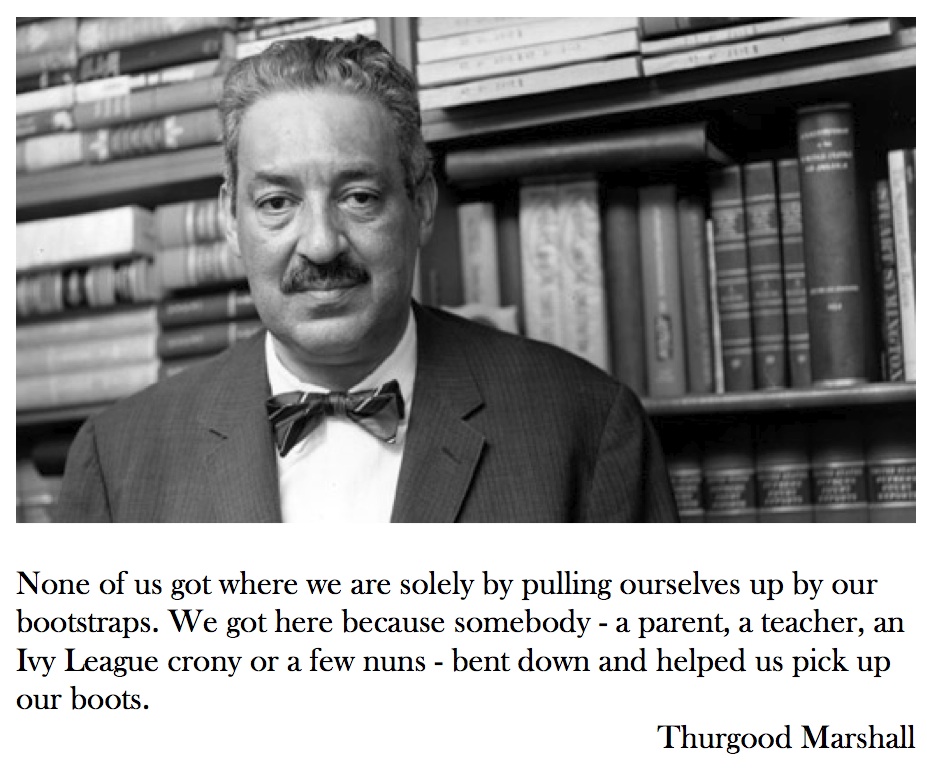
The truth is that “grit,” or effort, is at best a secondary quality (and even then it is likely overemphasized as a key element in success) because the most powerful element at the causational level for most success (and failure) is the context in which any person finds her/himself.

Privilege and slack are conducive to excelling while scarcity tends to breed failure.

The root cause is systemic, not personal. The same person in a condition of slack and a condition of scarcity performs differently and experiences different outcomes.

The lesson, then, is if your primary message for children requires that you make up stories (or cherry-picking, if you will) to prove the myth is accurate, you are likely telling children “myths that deform us” (and that isn’t very hagiography-George-Washington of you).

And in no case is that justifiable.

Reference

Freire, P. (2005). Teachers as cultural workers: Letters to those who dare to teach (D. Macedo, D. Koike, & A. Oliveira, Trans.). Boulder, CO: Westview Press.
bootstraps

NPR Whitewashes “Grit” Narrative

Albeit from different ideologies, NPR and Fox News have something really disturbing in common: Bias masked as, to use the Fox slogan, “fair and balanced.” In fact, the breezy tone of NPR makes its uncritical bias potentially more dangerous* than Fox’s essentially cartoonish balance.

And thus, when NPR discovers “grit,” we get this: Does Teaching Kids To Get ‘Gritty’ Help Them Get Ahead?

While the story does acknowledge critics, the piece clearly forefronts “grit” research as well as the credibility of “Angela Duckworth, a psychology professor at the University of Pennsylvania who coined the term ‘grit’ — and won a MacArthur ‘genius grant’ for it.”

How can any criticism of “grit,” and thus indirectly Duckworth, hold up to that?

Despite the framing bias of the story—and that breezy tone that suggests everything is fine—I do recommend examining Alfie Kohn’s work challenging the “grit” narrative:

But the greatest failure of the NPR look into “grit” is what, once again, is missing: Not a single mentioning of race, of the strong critical rejection of the “grit” narrative as a not-so-thinly masked appeal to racism.

“Grit” is a mask, a marker for privilege and slack that suggests people who succeed do so because of their effort (and not their privilege and the slack of their lives) and that people who fail do so because of a failure of character (and not due to the scarcity that overburdens them).

The “grit” narrative is essentially a whitewashing of the power of privilege as that is a product of lingering racism. And thus, the “grit” narrative is primarily aimed at children of color and they are routinely encouraged to honor Gritty White Hopes like (as the NPR story reveals) Steve Jobs:

That message underlies every lesson at the Lenox Academy for Gifted Middle School Students in Brooklyn, N.Y., a public school that has been trying to make kids grittier for the past three years. On a recent day, in a typical lesson, a social studies class is studying Steve Jobs. Kids raise their hands to offer examples of Jobs’ grit.

“He had failed one of the Mac projects he was creating,” says one student.

“He used his mistakes to help him along his journey,” says another.

And thus, let me suggest the following:

My posts on “grit”:

The Poverty Trap: Slack, Not Grit, Creates Achievement

The “Grit” Narrative, “Grit” Research, and Codes that Blind

Misreading “Grit”: On Treating Children Better than Salmon or Sea Turtles

Kids Count on Public Education, Not Grit or “No Excuses”

Learning and Teaching in Scarcity: How High-Stakes ‘Accountability’ Cultivates Failure

An Open Apology, with Explanations: Math, Behaviorism, and “Grit”

Snow Blind: “Trapped in the Amber of This Moment”

From Ira Socol:

Paul Tough v. Peter Høeg – or – the Advantages and Limits of “Research”

“Grit” Part 2 – Is “Slack” What Kids Need?

“Grit” – Part 3: Is it “an abundance of possibility” our kids need?

Grit Part 4: Abundance, Authenticity, and the Multi-Year Mentor

Angela Duckworth’s Eugenics – the University of Pennsylvania and the MacArthur Foundation

From Katie Osgood:

Ignoring Mental Health in the Grit Debate

And (please see the discussion thread):

Does “Grit” Need Deeper Discussion?

Note Living in Dialogue post from Lauren Anderson, EdWeek Editor’s Note, and comments:

Lauren Anderson: Grit, Galton, and Eugenics

And a consideration of Anderson:

Grit and Galton; Is psychological research into traits inherently problematic? Cedar Rienar

Also

I Think a MacArthur Genius Is Wrong About ‘Grit,’ John Warner

* Revised for tone from previous version.

The Self-Defeating South, Words Not Spoken: Racism as a Scar and Cancer

Born and raised in a very small rural town in upstate South Carolina, I have lived my entire 53 years in the South. Most of that life has been spent teaching, and a large span of that career was in the high school I attended, among children mostly just like me, where we explored literature.

A key text for me each year was William Faulkner’s “A Rose for Emily,” and if you are not from the South, and you want to come close to understanding the South, read the story carefully. The shocking revelation at the end of the story—behind the locked door, the pillow and the bed, the “iron-gray hair”—is as close as you can come to understanding the South if you are not from here. (If you want to make a unit of this project to examine the South, read also Alice Walker’s “Everyday Use” and Flannery O’Connor’s “A Good Man Is Hard to Find.”)

We are a self-defeating people, we Southerners, a sort of ignorant pride, a blind faith in tradition and a steely determination to do as we damn well please. We’d rather cling to our ignorance (a long-standing tradition) than do the right thing—especially if someone else is telling us to do the right thing. The South, you see, is stuck in a perpetual arrested development, a fixed childhood/adolescence: We’re going to smoke, drink, and make out in our own car and there is nothing you can say or do to stop us.

That “we,” however, is the white South (both literally and its controlling psyche), and that is the problem. (One element of “A Rose for Emily” that is important here is the “we” narration of the town. “When Miss Emily Grierson died, our whole town went to her funeral,” it begins.)

So if you think 8 disturbing trends that reveal the South’s battered psyche—which asks, “So what is it that perpetuates decades of poverty in the Deep South?”—helps you understand the South, you need to consider carefully what is absent in the 8 trends:

1. Southern states have the most poor people….

2. Deep South states have no minimum wage….

3. Deep South has lowest economic mobility….

4. South has lowest per capita spending [b]y state government….

5. Forget about decent preventative healthcare….

6. One result: people self-medicate in response….

7. Forget the lottery, just pray to Jesus….

8. And hold onto that gun!

What is essentially absent in this piece, an examination of trends that confuses markers for root causes?

Race, and more directly, racism.

Notably, the piece mentions race in only one place, and then only “white,” with blacks reduced to a negation, not white:

As you would expect, the vast majority of people falling under the poverty line in the poorest states do not have white faces—although there are poor whites. The Henry J. Kaiser Family Foundation compiles state poverty rates by race. In the poorest states, whites account for 15 percent to 20 percent of the poor.

Yes, the piece is examining poverty, but that may be the problem.

“Poverty” is the convenient term in the U.S. that can be uttered as a device for ignoring poverty and denying racism.

Mention the disturbing racial imbalance of drug arrests (whites and blacks use marijuana at the same rates, but blacks suffer the brunt of arrests) or mass incarceration (white males outnumber black males 6 to 1 in society, but black males outnumber white males 6 to 1 in prisons), and the response will invariably turn to the suggestion that poverty is the cause, not racism.

Of course, if mass incarceration were a function of poverty and not racism, since twice as many whites as blacks are in poverty, the prison populations would be two white males to every black male.

So in order to answer why the 8 trends noted above exist, why they are tolerated, we must name and then confront the reason: racism. Racism as a historical scar. Racism as a contemporary and undiagnosed, untreated cancer.

The self-defeating South is the function of right-wing political leadership that campaigns with coded language and images (the infamous Jesse Helms “hands” commercial in his run against Harvey Gantt, for example) and then implements policy along racial lines—even when the consequences of that policy also negatively impacts the large white poverty populations in the South: right-to-work laws, limited social program funding, shrinking funding for public institutions, resisting universal healthcare, lingering calls for breaking the wall between church and state, supporting school choice, ignoring the re-segregation of schools (public, charter, and private), and doubling down on gun access and ownership.

If we are seeking root causes to answer “So what is it that perpetuates decades of poverty in the Deep South?,” we must acknowledge the lingering power of racism and then we must also confront how rurality in the South allows that racism to remain powerful, even though it now is mostly coded (although blatant expressions of racism remain common in the South).

In 2014, we must not discuss inequity and poverty, especially in the context of the South, without also naming the historical and contemporary racism driving many of the consequences of social dynamics and public policy.

“The violence of breaking down the door seemed to fill this room with pervading dust”—Faulkner’s collective narration of “A Rose for Emily” describes the climax of an entire community finally facing the truth.

For the U.S., I would argue, the South is our Emily and we remain unwilling, possibly unable, to break down the door, look at the hair on the pillow and admit that we have skeletons in our closet—racism, both a scar and a cancer we refuse to treat.

Recommended Documentaries

The Loving Story

Little Rock Central: 50 Years Later

Beyond “Doubly Disadvantaged”: Race, Class, and Gender in U.S. Schools and Society

The U.S. Department of Housing and Urban Development (HUD) established the Moving to Opportunity (MTO) for Fair Housing program in the mid-1990:

MTO recruited more than 4,600 families with children living in severely distressed public housing projects in five cities (Baltimore, Boston, Chicago, Los Angeles, and New York City). HUD offered some MTO families the opportunity to use a housing voucher to move into private-market housing in lower poverty neighborhoods and did not make the same offer to others.

“The Long-Term Effects of Moving to Opportunity on Youth Outcomes” (2012) reveals the following from that program:

These patterns [school dropout, low test scores, and delinquency] have led to a longstanding concern that neighborhood environments may exert an independent causal effect on the life chances of young people. Because low-income individuals comprise nearly one-half of the 8.7 million people living in census tracts with poverty levels of 40 percent or higher (Kneebone, Nadeau, and Berube, 2011), poor children growing up in neighborhoods of concentrated poverty may be “doubly disadvantaged”—they face potential risks from growing up in a low-income household and in an economically poor neighborhood. (See a full discussion HERE)

The disadvantages of being born poor and then attending public schools in impoverished neighborhoods are far greater than doubled, however. The disadvantages are exponential and involve race, class, and gender.

NPR has presented two brief looks at new analyses from MTO—one directly about Study: Boys Report PTSD When Moved Out Of Poverty, and the other a related story, ‘Prep School Negro’ Shows Struggle Between Poverty And Plenty.

David Green reports on the MTO research:

Now a new study in the Journal of the American Medical Association finds that boys from these families did not thrive. They found that the move took a toll on their emotional well being, a toll not experienced by girls….

Professor at Harvard Medical School, Ronald Kessler explains about the research findings:

Well, the hope was originally that the educational opportunities for the kids would increase because of better schools, that the opportunities for the parents finding jobs would increase because they moved to places where there were higher employment rates so that in the long run the kids, as they moved out, would have better socioeconomic achievement than they would have otherwise….

Well, we found something that we hadn’t expected, which was the effect of the intervention was quite positive for girls, but boys had the opposite effect. Boys were more depressed. They were more likely to have post traumatic stress disorder. They were more likely to have conduct problems if they were in families that were offered vouchers than in the control group that wasn’t involved in any kind of move.

Although not part of the WTO experimental group, Andre Robert Lee represents that alienation felt by African American and poor males and identified by Kessler and his team:

I kind of feel like when you’re black, sometimes you have to be twice as good. I was kind of, you know, sad by it, you know. I’m a people person and to go to a school where you can’t be yourself – I was being myself, but people not to embrace you is just – it kind of sucked.

This research and personal experience must be placed in several social and educational contexts.

First, the unique and negative experiences of impoverished males, including impoverished African American males, are complicated by the research on how people view African American children:

Asked to identify the age of a young boy that committed a felony, participants in a study routinely overestimated the age of black children far more than they did white kids. Worse: Cops did it, too.

The study, published in the Journal of Personality and Social Psychology, aimed at figuring out the extent to which black children were likely to be treated differently than their white peers solely based on race. More specifically, the authors wanted to figure out the extent to which black kids were dehumanized. “Children in most societies are considered to be in a distinct group with characteristics such as innocence and the need for protection,” author Phillip Atiba Goff of UCLA told the American Psychological Association. “Our research found that black boys can be seen as responsible for their actions at an age when white boys still benefit from the assumption that children are essentially innocent.”

Second, the more specific context of how society sees and treats African American young men is captured in the controversies surrounding the shootings of Trayvon Martin and Jordan Davis as well as the controversies surrounding Richard Sherman (and the coded use of “thug”) and Marcus Smart.

Third, the Office for Civil Rights (USDOE) has detailed that in-school discipline policies and retention are disproportional by gender and race, and that access to high-quality courses and experienced teachers is also inequitable. “No excuses” practices and zero tolerance policies tend to target high-poverty and racial minority students as well:

There is abundant evidence that zero tolerance policies disproportionately affect youth of color. Nationally, black and Latino students are suspended and expelled at much higher rates than white students. Among middle school students, black youth are suspended nearly four times more often than white youth, and Latino youth are roughly twice as likely to be suspended or expelled than white youth. And because boys are twice as likely as girls to receive these punishments, the proportion of black and Latino boys who are suspended or expelled is especially large.  Nationally, nearly a third (31 percent) of black boys in middle school were suspended at least once during the 2009–10 school year. Part of this dynamic is that under-resourced urban schools with higher populations of black and Latino students are generally more likely to respond harshly to misbehavior. (p. 3)

Fourth, the race, class, and gender inequity found in school discipline is replicated and intensified in the mass incarceration of African American males in the U.S.

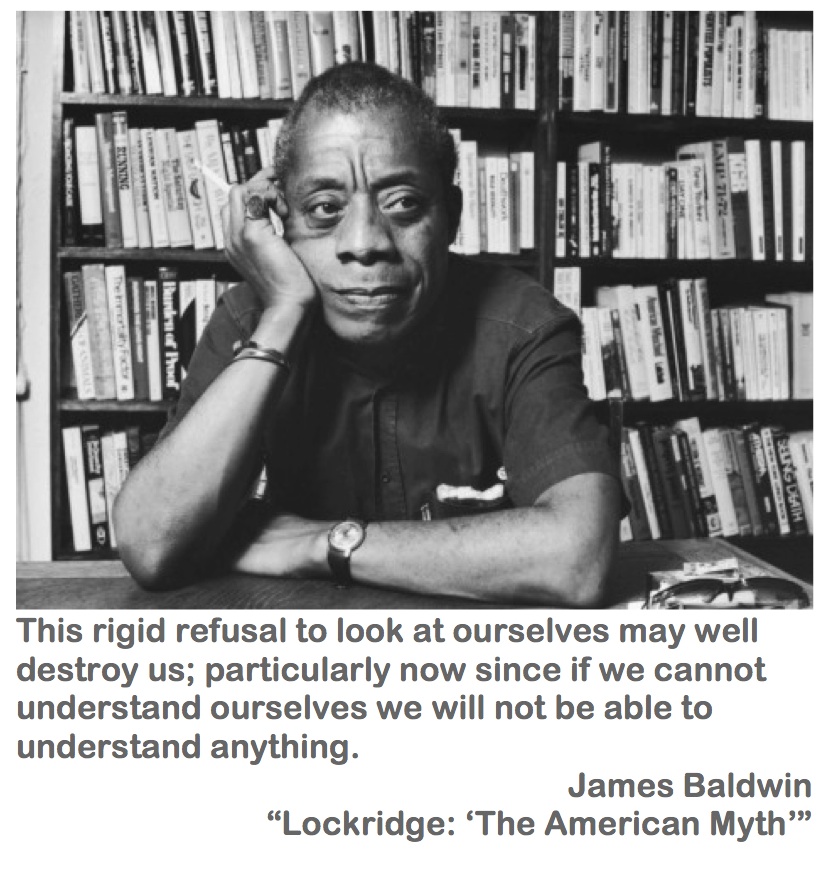
Finally, and possibly most importantly, the historical context must be addressed. Consider first James Baldwin speaking in 1963, Take This Hammer:

And also, consider Baldwin writing in 1966, A Report from Occupied Territory:

Here is the boy, Daniel Hamm, speaking—speaking of his country, which has sworn to bung peace and freedom to so many millions. “They don’t want us here. They don’t want us—period! All they want us to do is work on these penny-ante jobs for them—and that’s it. And beat our heads in whenever they feel like it. They don’t want us on the street ’cause the World’s Fair is coming. And they figure that all black people are hoodlums anyway, or bums, with no character of our own. So they put us off the streets, so their friends from Europe, Paris or Vietnam—wherever they come from—can come and see this supposed-to-be great city.”

There is a very bitter prescience in what this boy—this “bad nigger”—is saying, and he was not born knowing it. We taught it to him in seventeen years. He is draft age now, and if he were not in jail, would very probably be on his way to Southeast Asia. Many of his contemporaries are there, and the American Government and the American press are extremely proud of them. They are dying there like flies; they are dying in the streets of all our Harlems far more hideously than flies.

How much different, then, is our world when we listen carefully to Lee:

Yeah, it’s hard. And when a kid walks in and they’re immediately seen as a delinquent, that perception and notion is thrust upon a person immediately. Despite the fact that I’m quote-unquote successful and have a career and have a graduate degree, you know, I still have a darn hard time getting a cab, and this is even if I’m in a suit or not.

If you’re not a really strong person, it can destroy you ’cause it’s constant chipping away at your psyche, you know, and I realized this in 9th grade. I thought there’s inequity in the world and it’s not going to change. What am I going to do?

The conclusions about impoverished males drawn from the WTO experiment and Lee’s personal story suggest that Baldwin’s warnings remain disturbingly true:

This rigid refusal to look at ourselves may well destroy us; particularly now since if we cannot understand ourselves we will not be able to understand anything. (“Lockridge: ‘The American Myth’”; Baldwin, 1998, p. 593)

The truth is that the country does not know what to do with its black population now that the blacks are no longer a source of wealth, are no longer to be bought and sold and bred, like cattle; and they especially do not know what to do with young black men, who pose as devastating a threat to the economy as they do to the morals of young white cheerleaders. It is not at all accidental that the jails and the army and the needle claim so many, but there are still too many prancing around for the public comfort. Americans, of course, will deny, with horror, that they are dreaming of anything like “the final solution”—those Americans, that is, who are likely to be asked: what goes on in the vast, private hinterland of the American heart can only be guessed at, by observing the way the country goes these days. (No Name in the Street; Baldwin, 1998, pp. 432-433)

The disadvantage of being impoverished, African American, and male remains powerfully staggering, far beyond “doubly” and something we seem unable to confront much less address.

Segregation and Charter Schools: A Reader

In The link between charter school expansion and increasing segregation, Iris C. Rotberg highlights that problems exist in both re-segregation of schools in the U.S. and the rise of charter schools as separate and interrelated forces.

Schools in the U.S. are re-segregating, regardless of type—public, private, and charter.

And charter schools are not creating the education reform charter advocates claim, with one failure of the charter movement being segregating students by race and class.

Thus, it is important to focus on the evidence that shows the need to reconsider how to address segregation and the flawed support continuing for expanding charter schools.

Let me offer below a reader for such evidence:

Some key points from Rotberg include the following:

#1. There is a strong link between school choice programs and an increase in student segregation by race, ethnicity, and income….

#2. The risk of segregation is a direct reflection of the design of the school choice program….

#3. Even beyond race, ethnicity, and income, school choice programs result in increased segregation for special education and language-minority students, as well as in increased segregation of students based on religion and culture….

I am not under the illusion that by modifying federal policy on charter schools we would solve the basic problem of segregation. But we could at least eliminate one factor exacerbating it: the federal pressure on states and school districts to proliferate charter schools, even in situations that might lend themselves to increased segregation. Instead of serving as a cheerleader for charter schools, the federal government might instead support diversity in schools and, at the same time, publicize the risks of increased student stratification.

Even apart from the negative effect of increased segregation, justifying federal advocacy of charter school expansion is difficult when there’s no evidence that charter schools, on average, are academically superior to traditional public schools or even that they can be more innovative given the Common Core State Standards and the testing associated with them.

Revisiting “Cliches and Abstractions” in the Context of Race, 2014

Writing in 1949 in the wake of World War II, Lou LaBrant opens a consideration of cliche and abstractions by focusing on a student essay, in which the student discussed her assumptions instead of the text she was examining:

Only after inch-by-inch progress was she able to see that from “orphan,” for which the novelist was undoubtedly responsible, my student had jumped to the whole cliche “poor, defenseless orphan” and consequent accusations against at least three other characters in the story.

…But of serious account is her tendency or that of any reader to accept a cliche and so permit it to stand between himself and a fact or understanding. (p. 275)

In 1987, the College Board included Sylvia Plath’s “Sow” on the Advanced Placement Literature exam; the prompt read:

1987 Poem: “Sow” (Sylvia Plath)
Prompt: Read the poem. Then write an essay in which you analyze the presentation of the sow. Consider particularly how the language of the poem reflects both the neighbor’s and the narrator’s perceptions of the sow and how the language determines the reader’s perceptions. Be certain to discuss how the portrayal of the sow is enhanced by such features as diction, devices of sound, images, and allusions.

Typical of A.P. literature prompts, the focus of the response is on three sets of perceptions. Scores for that written section in 1987 were notoriously low. Students, it seemed, experienced something very similar to what LaBrant identified in her students: “to accept a cliche and so permit it to stand between himself and a fact or understanding.”

I used that prompt for students to practice for the exam when I taught A.P. Lit, and we always discussed how students struggled against their own perceptions of “sow,” or pigs.

Let me offer, now, three further points in the context above.

First, consider our assumptions about language. When I teach ELA methods, I often raise the issue of how people respond to the so-called non-standard use of “aks” (instead of the standard “ask”)—highlighting that the non-standard “aks” is immediately and almost universally associated with African Americans, and then if not simultaneously, consequentially, with being uneducated or unintelligent.

However, when placed in historical and cultural context, those simplistic assumptions fall apart. And, “aks” is but one of many words in the English language that demonstrates “metathesis”:

Wasp used to be wapsbird used to be brid and horse used to be hros. Remember this when the next time you hear someone complaining about aks for ask or nucular for nuclear, or even perscription. It’s called metathesis, and it’s a very common, perfectly natural process.

And while “aks” carries both racial and intelligence baggage, President George W. Bush experienced the brunt of intelligence jokes because of “nucular.”

Second, consider the assumptions bound in not the words we hear or use, but what we see:

Asked to identify the age of a young boy that committed a felony, participants in a study routinely overestimated the age of black children far more than they did white kids. Worse: Cops did it, too.

The study, published in the Journal of Personality and Social Psychology, aimed at figuring out the extent to which black children were likely to be treated differently than their white peers solely based on race. More specifically, the authors wanted to figure out the extent to which black kids were dehumanized. “Children in most societies are considered to be in a distinct group with characteristics such as innocence and the need for protection,” author Phillip Atiba Goff of UCLA told the American Psychological Association. “Our research found that black boys can be seen as responsible for their actions at an age when white boys still benefit from the assumption that children are essentially innocent.”

Third, consider Glenn Ford:

A Louisiana man who has spent nearly three decades on death row walked free on Tuesday, after prosecutors asked a judge to set aside his first-degree murder conviction and death sentence, citing new evidence in the case that exonerated him.

Glenn Ford, 64, a black man, was convicted by an all-white jury in the 1983 robbery and murder of Isadore Rozeman, a 56-year-old Shreveport watchmaker, who was found shot to death behind the counter of his jewelry shop.

Acting on new information that exonerated Ford, a judge in Shreveport ordered him released from Louisiana State Penitentiary in Angola, where he has been held on death row since March 1985.

As I have stated before, denying racism has an evidence problemone that is recurring and recurring.

As LaBrant warns in her examination of cliches and abstractions, humans are predisposed to read texts and the world in ways that are shaded, and thus distorted, by their assumptions, the codes they have embraced uncritically.

The line between cliches and abstractions in careless student writing, and prejudices and bigotry in the way people live their lives is razor thin, and possibly the only things between a young person and crossing that line are the sorts of experiences in their formal schooling that ask students to reconsider assumptions, reconsider abstractions and generalizations.

Teaching English, teaching reading and writing, is about more than the 1987 prompt on the A.P. exam above—a prompt grounded in New Criticism and little different than what students will be bound to do under the new regime of “close reading” in the Common Core (a strategy designed to ask students not to consider context beyond the text itself).

How students read and re-read the world, how students write and re-write the world, then, must be framed differently. Students require context and they require some basis in their own realm of understanding in order to move beyond their provincialism:

It should be noted that such analysis is made much more easily when the writer is dealing with a problem in which he has some stake and for which he has assumed the initiative in writing. If the statement comes from a workbook or from the teacher’s assignment, it is impossible to hold the writer to an understanding of meaning. Sometimes we ourselves deliver definitions (generalizations) meaningless to children.

…We assign topics for writing, well knowing that they are beyond the real understanding of our pupils and that consequently these young writers must fall back on vague and meaningless generalizations. (p. 277)

It is not just about the words and people we see around us; it is about what we assume we see in the words and people around us—often despite evidence to the contrary.

That fact of the power of bias, assumption, prejudice, and bigotry has powerful consequences:

The less the black kids were seen as human, the less they were granted “the assumption that children are essentially innocent.” And those officers who were more likely to dehumanize black suspects overlapped with those who used more force against them.

In 2014, systemic racism in the discipline systems of our schools feed and then are magnified in the systemic racism in our era of mass incarceration.

What cliches-as-prejudice persist that keep political leaders, the media, and the public from reading that reality?