Guest Post by Peter Smagorinsky, The University of Georgia
NCTQ’s announcement of its new edition of its Teacher Prep Review predictably exalts its own role in improving public education by requiring colleges of education to raise students’ test scores through the instruction of its teacher candidates once they are members of school faculties. I will briefly respond to a few of the claims that they make, which rely on rhetorical characterizations about “success” and “achievement” that spuriously elevate their belief that standardized tests reflect the whole of learning, a claim that few teachers or teacher educators endorse. In contrast, most teachers and teacher educators believe that the NCTQ’s narrow focus on standardized “achievement” tests undermine an authentic education that prepares students for work or life.
The report claims that “The training that teachers receive has to set them up for success.” Well, who doesn’t want successful teachers and students? The question that many of us within the profession ask is this: How is success defined here? For NCTQ, teacher educators are successful when graduates of their programs teach students who do well on standardize tests. But it’s pretty well documented that the best way to have students get good test results is to teach kids from affluent families. The best way to be a successful teacher educator, then, is to encourage teacher candidates to teach the wealthiest kids possible, rather than those residing in impoverished communities. Given that social justice is inscribed in the mission statement of just about every college of education in the nation, being successful according to NCTQ means betraying the values to which we are committed as educators.
The recent judicial decision to eliminate teacher tenure in California may well negate the claim that tenure decisions will now include data from “student achievement.” NCTQ overlooks the fact that in many “Right to Work” states do not have tenure, collective bargaining, unions, or other job protection rights. In any case, the idea that the only measure of “student achievement” is standardized tests overlooks other ways in which students may achieve in school.
The report further claims that “new teachers don’t feel like they can even get to the business of teaching and learning because they haven’t been taught the most basic classroom management techniques.” They are right in that many colleges of education have eliminated classes in classroom management, in many cases because without unruly students present to illustrate procedures, the abstraction of management textbooks are of little value in learning how to manage increasingly large classes of kids who are subjected to a deadly dull curriculum oriented to multiple choice assessments. The NCTQ appears to have little understanding of the relation between an engaging curriculum and student engagement. Rather, colleges of education should train teacher candidates how to prepare kids for standardized tests and manage (i.e., punish) those who find the experience despicable. It’s easy to see why an intelligent, dedicated teacher educator would find that prospect both unappealing and educationally bankrupt.
Accordingly, with admirable, though misdirected intentions, they very seriously and very sentimentally set themselves to the task of remedying the evils that they see. But their remedies do not cure the disease: they merely prolong it. Indeed, their remedies are part of the disease.
And so: NCTQ releases yet another think tank faux-report that will spur yet more press-release journalism.
In the wake of the Vergara ruling in California, which is one intended consequence of maintaining the distracting drum beat about “bad teachers,” I am convinced that NCTQ is implementing a strategy dramatized in the (regretfully) ignored film In Time: Keep everyone so frantic and thus distracted that no one can confront, as Oscar Wilde so wonderfully states, that NCTQ’s “remedies are part of the disease.”
I cannot and see no need to speak directly to new reports from NCTQ because, as I have stated before:
NCTQ offers no credible agenda or scholarship worthy of reforming teacher education. But this ideological think tank is a disturbing example of all that is wrong with the current education reform movement that has allowed people without experience or expertise as educators to perpetuate an education reform agenda through the weight of money, political influence, and media compliance.
Here, however, I will gather my previous posts on NCTQ as well as the expected responses to come—keeping in mind that we can feel safe even before looking at the report that NCTQ remains a think tank without credibility.
It appears that Raj Chetty, of the very famous and mostly hypothetical Chetty et al. study addressing teacher quality’s impact on students’ lifetime earning potential, had a big influence on the Vergara case in California:
Testimony in Vergara by Harvard profs. Does anybody–other than Judge Treu–really believe these guys?! Amazing! pic.twitter.com/MvHVCEiUuj
But one has to wonder how much impact that testimony would have had if the judge had considered that most reviews of the study find it to be poppy-cock (see Baker on the Chetty et al. molehill and Di Carlo) or if we simply displayed the numbers differently.
A 40-year “lifetime earnings” of $50,000 is only about $1250 a year, or about, after taxes, $75-80 per month, or about 1.5 to 2 tanks of gas a month.
Hmmmm. Compared to the $50,000 of hypothetical life-time earning or that insane $1.4 million for a class of 28, 1.5-2 tanks of gas a month appears to be much ado about nothing.
Chetty also fails to make a very important point about the economics of investing in measuring teacher quality: It will cost billions of dollars in public funding to create and implement a significant increase in high-stakes testing in order to hypothetically raise the monthly earning income of students enough for them to buy 1.5-2 tanks a gas each month.
A much more effective strategy would be to take those billions of dollars needed to create and implement VAM and give every worker in the U.S. $75 per month tax free. Simple, direct, and guaranteed.
Setting aside that this is all hypothetical, seems a ridiculously inefficient cost/benefit analysis of addressing a teacher quality issue that already is only about 10-15% of measurable student learning.
As a high school English teacher for nearly two decades, I came to embrace a need to offer students a wide range of lenses for interacting with and learning from many different texts, but I also learned that coming to read and re-read, to write and re-write the world is both a powerful and disorienting experience for young people. So a strategy I now use and encourage other teachers to implement is reading and discussing children’s literature, picture books, while expanding the critical lenses readers have in their toolbox.
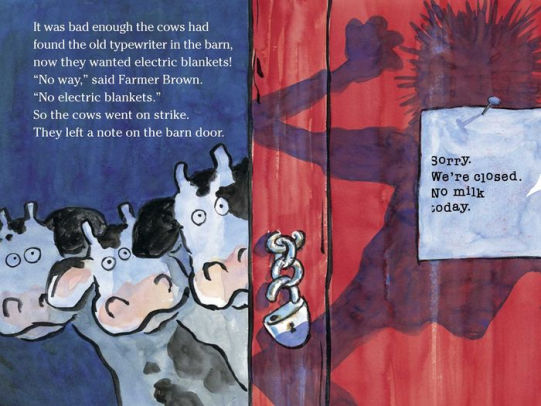
My favorite book for this activity is Click, Clack, Moo: Cows that Type. This work by Doreen Cronin with art by Betsy Lewin (view a read-aloud here) presents a clever and humorous narrative about Farmer Brown and his suddenly recalcitrant cows who, having acquired a rickety typewriter, establish a strike that inspires the chickens to join and ends with the neutral ducks aiding the revolt.
Click, Clack, Moo: Cows that Type
This story is ideal for asking teachers to consider the traditional approach to text in schools, New Criticism (a focus on text in isolation and on the craft in any story, such as characterization, plot, and theme), against Feminist and Marxist criticism, for example.
One fall, while doing the activity with a young adult literature class, I came against yet a new reading of Cronin and Lewin’s work: Why the 1% always wins.
The U.S. Public Likes Farmer Brown
As we explored Click, Clack, Moo recently, the adult members of the class told me they like Farmer Brown, with one student characterizing the striking farm animals as “mean.” And here is where I felt the need to consider how this children’s book helps us all confront the Occupy Wall Street movement or the rise in antagonism toward teachers, tenure, and unions as well as why the 1% continues to own the 99%.
One important element of the story is that the cows and chickens are female workers under the authority of the male Farmer Brown. These female workers produce for the farmer and remain compliant until the cows acquire the typewriter—both a powerful tool of literacy (the cows and chickens cannot effectively strike until they gain access to language) and a representation of access to technology (readers should note that the cows and chickens produce typewritten notes that show they find an old manual typewriter unlike the cleaner type produced by Farmer Brown on an electric typewriter, a representation of the inequity of access to technology among classes).
The cows and chickens, in effect, unionize and strike. Here, members of my classes often fail to notice the unionization, but tend to side with the farmer even when we acknowledge the protest as unionizing—particularly bristling at the duck, as a neutral party, using its access to the negotiation to acquire a diving board for the duck pond.
Like the 1%, Farmer Brown is incensed that the cows and chickens demand basic necessities for comfort, electric blankets, but he eventually secures a compromise, agreeing to give the barn animals the requested electric blankets for the return of the typewriter (the story ends with the obvious next step that the duck uses the typewriter to trade for the diving board).
The 1% have the 99% right where Farmer Brown has the barn animals—mesmerized by the pursuit of materialism and entertainment. Consider the eager hordes of consumers lined up to buy the then-new iPhone 4S, released on the cusp of the passing of Steve Jobs, heralded as a genius for his contribution to our consumer culture.
Just give us our iPhones and we’ll be quiet, we’ll work longer and harder for the opportunity to buy what the 1% tells us we want.
And when the 1% and their compliant media inform us that the top 20% pays 64% of taxes, we slip back to our barns with our tails between our legs, shamed.
We, the 99% who tend to remain silent and compliant, wait patiently for the next generation of technology to occupy our time, our lives reduced to work and amassing the ever-changing and out-dated things that become passe as the next-thing lures us further and further into our sheep lives.
Yes, if we remain eager to trade our voices for things, the 1% will always be the winners.
When we learn to treasure voice over things, however, the chickens may come home to roost.
The stories themselves, literally, are powerful and engaging or George Orwell’s 1984 and Arthur Miller’s The Crucible would not have endured as they have as literature people read again and again—and possibly should read again and again.
However, ultimately, 1984 is not about the future (especially since we have long since passed the future Orwell may have envisioned), and The Crucible is not about the past (although Miller built his play on the very real and troubling history of Puritan witchcraft hysteria). These works are about the complicated present of both authors’ worlds as that speaks to the enduring realities of the human condition.
All of that may seem weighty stuff to step into a look at what appears to be a children’s book, but the paragraphs above should be more than a hint that looks can be deceiving—and enlightening.
“Ever had a burr in your sock?” sets the story in motion—one sentence centered on the page over a giant question mark. It is an opening worthy of a child and all of us who cling to the wonder of childhood.
While Le Guin is often described as a science fiction writer, in her work I recognize the blurring of genres that joins science fiction, speculative fiction, and fantasy; it is that “other world” about which Le Guin and Margaret Atwood appear to argue, and it a stark but rich other world Saunders conjures and Lane pictures.
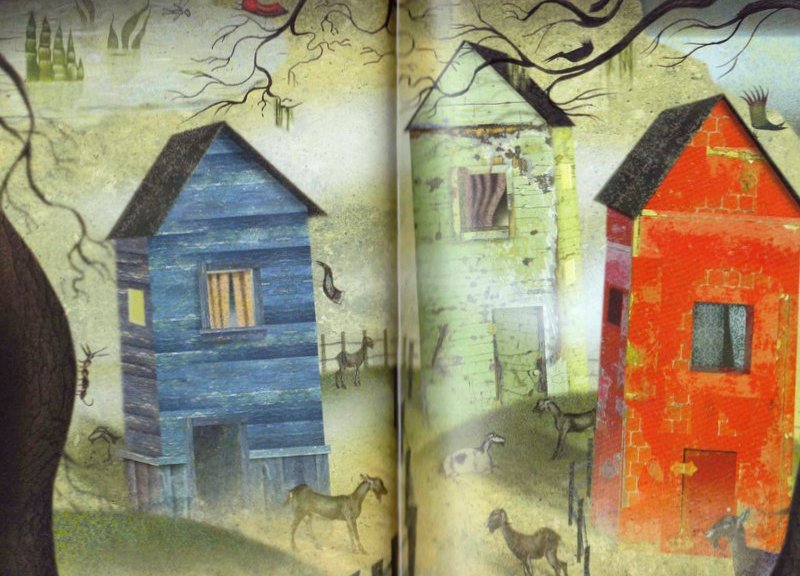
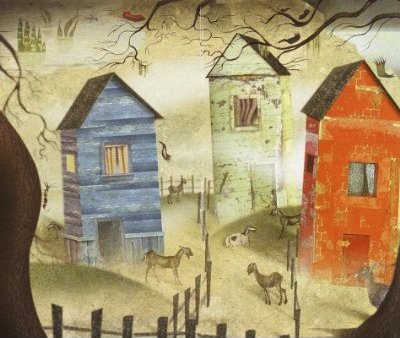
The story of Frip involves three houses for three families, all with children at the center. The houses are distinguished with primary colors—child-like blue, green, and red—but Lane’s artwork adds the ominous to Saunders’ seemingly simple narrative tinged with more than a bite of satire. The illustrations echo the haunting works about and for children found in Neil Gaiman and Tim Burton.
“Frip was three leaning shacks by the sea.” (p. 6) Artwork by Lane Smith
A child standing precariously close to the end of a slanted cliff over an angry ocean catches the eye on page 7 and then the crux of the story pulls you back to the text on page 6:
Frip was three leaning shacks by the sea. Frip was three tiny goat-yards into which eight times a day the children of the shacks would trudge with gapper-brushes and cloth gapper-sacks that tied at the top. After brushing the gappers off the goats, the children would walk to the cliff at the edge of town and empty their gapper-sacks into the sea. (p. 6)
Gappers, orange burr-like creatures with many eyes and the size of a baseball, come to represent throughout the story the power of the systemic inevitable: The presence of the gappers determines the lot of the families (and their goats), but most of the people in the tale remain unable to see beyond their own fixed and mostly misguided worldviews.
“A gapper’s like that, only bigger, about the size of a baseball, bright orange, with multiple eyes like the eyes of a potato.” (p. 2) Artwork by Lane Smith
When the gappers cling to the goats of all three families, there is an ironic appearance of equality among them. But when the fortune of one family shifts, the gappers fulfill their name by creating the gap:
So that night, instead of splitting into three groups, the gappers moved into one very large and impressive shrieking group directly into Capable’s yard. (p. 12)
Before this shift in how the gappers behave, of course, the three families are not equal because Capable is an only child living with her father and who has lost her mother. Capable works as all the children are expected to work (removing gappers in a daily Sisyphean nightmare of chores) and seeks to serve the needs of her grieving father, who along with his grief is a prisoner of nostalgia:
“I myself was once an exhausted child brushing off gappers. It was lovely! The best years of my life. The way they fell to the sea from our bags! And anyway, what would you do with your time if there were no gappers?” (p. 11)
This nostalgia masking an unnecessarily burdensome childhood, however, is but one ideology weighing on Capable because as soon as the other two families are relieved of gappers on their goats, those families reveal themselves to be very much like the people of Le Guin’s Omelas:
“It’s a miracle!” Mrs. Romo shouted next morning, when she came out and discovered that her yard was free of gappers. “This is wonderful! Capable, dear, you poor thing. The miracle didn’t happen to you, did it? I feel so sorry for you. God has been good to us, by taking our gappers away. Why? I can’t say. God knows what God is doing, I guess! I suppose we must somehow deserve it!” (p. 17)
Capable becomes the sacrificed child, and despite her misfortune, the relieved families read the events as their merit (and of course the ugly implication that Capable and her father deserve the burden of the gappers).
What follows from this shift in fate is the central story of Frip with Capable as our main character. The message becomes clear, and Saunders and Lane make the ride one you’ll want to visit again and again. If you are lucky, the book could become one of those read alouds requested by son or daughter, or by a classroom of children.
And while I will leave the rest of the story to you, I think it is necessary to note here that this allegory is both a cautionary tale about how we view children and childhood as well as a brilliant call to reconsider how we view education and education reform.
George Saunders’s Allegory of Scarcity and Slack
The U.S., like the characters (except for Capable) in Saunders’s story, is tragically blinded by a belief in cultural myths that have little basis in evidence: That we live and work in a meritocracy, that competition creates equity, that children need to be “taught a lesson” about the cold cruel world lest they become soft, and such.
As a result of these beliefs, schools often reflect and perpetuate rather harsh environments for children—or to be more accurate, schools often reflect and perpetuate rather harsh environments for other people’s children, as Capable personifies.
Here, then, I want to make the case that The Very Persistent Gappers of Frip is a powerful allegory of scarcity and slack as examined by Sendhil Mullainathan and Eldar Shafir in their Scarcity: Why Having Too Little Means So Much.
Mullainathan and Shafir detail that the conditions of poverty, scarcity, so overburden people psychologically, mentally, and physically that their behavior is often misread (poor people are lazy, poor people make bad decisions, etc.). In Saunders’s story, scarcity and its burden are portrayed by the gappers, and readers witness how the coincidence of the onslaught of the gappers changes the families involved. In other words, the behavior of people is determined by the environment, and not by the inherent goodness or deficiencies of any individual.
The Very Persistent Gappers of Frip goes further, however, by showing that one person’s scarcity (Capable) allows other person slack: privilege is built on the back of others, and those conditions are mostly arbitrary. While Mullainathan and Shafir argue that the slack enjoyed by those living in relative privilege provides the sort of cognitive space needed to excel, Saunders speaks to more than the slack enjoyed by the two families relieved of gappers and the compounding scarcity suffered by Capable (her lot in life and the addition of the gappers):
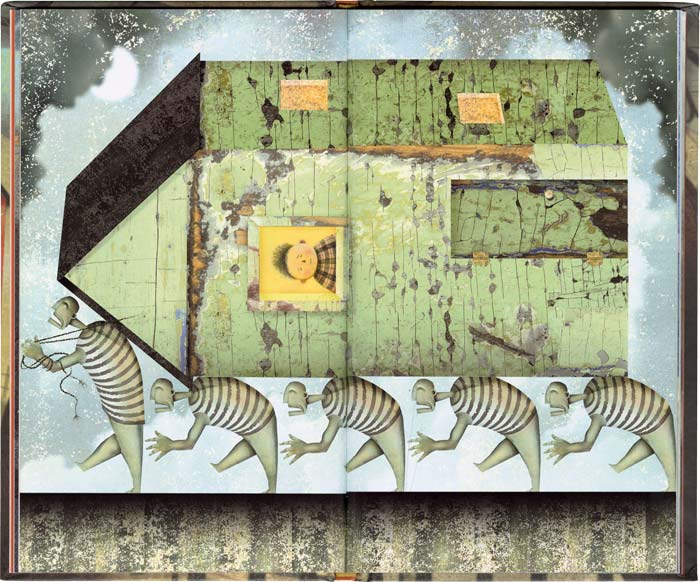
“And the men succeeded in lifting the house and moving it very very close to the third and final house in Frip, which belonged to Sid and Carol Ronsen, who stood in their yard with looks of dismay on their nearly identical frowning faces.” (p. 23) Artwork by Lane Smith
Capable represents a counter-narrative to claims that impoverished children lack “grit.” As her name suggests, this child is more than capable, but the world appears determined to defeat her.
Capable also embodies Lisa Delpit’s confrontation of “other people’s children”—that those with privilege (slack) are willing to allow one set of standards for other people’s children (often living and learning in scarcity), standards they will not tolerate for their own.
As I stated in the opening, allegory seeks to open our eyes by diversion, creating an other world that helps us see both the flaws with our now and the enduring failures of humans to embrace our basic humanity, a failure Capable teeters on the edge of making herself but cannot:
And [Capable] soon found that it was not all that much fun being the sort of person who eats a big dinner in a warm house while others shiver on their roofs in the dark.
That is, it was fun at first, but then got gradually less fun, until it was really no fun at all. (p. 70).
While I highly recommend a careful reading of Oscar Wilde’s The Soul of Man under Socialism, I also urge you to consider that this examination of the consequences of private property and how that perpetuates poverty is stunningly similar to the current education reform movement, notably: “But their remedies do not cure the disease: they merely prolong it. Indeed, their remedies are part of the disease.”
If anyone is wondering why the “bad” teacher crisis remains central to what political leaders want the public to hear, South Carolina offers a heaping dose of why: Political leaders are enormously incompetent and need us all to remain distracted from that fact.
Case in point: SC has now been officially vamboozled, passing a new teacher evaluation system that includes the new sham word “growth” nearly 50 times in a little over 30 pages—notably (in part):
The changes described in this document will result in a support and evaluation system that is valid, reliable, and fair and that will
…use multiple valid measures (including but not limited to observations, professional practice, and student growth) in determining performance levels, with data on student growth for all students (including English Language Learners and students with disabilities) being a significant factor in the calculation of the overall effectiveness score (growth measure for teachers of tested grades and subjects include growth based on statewide assessments as a component)….
Of course, the most important point here is that VAM (teacher evaluations based on student test scores, or now euphemistically “student growth”) has been proven again and again to fail against the measures of “valid, reliable, and fair.”
SC political leadership has emphasized that their hands are tied because of federal mandates linked to opting out of NCLB and the lure of “filthy lucre” promised therein—a baffling stance taken by a state infamous for taking the most preposterous stances just to shun the federal government.
It is well past time to stop listening to political leaders who have no credibility (hint: If you hear a politician or read a politician, you are in the presence of one who has no clue) and to turn our gazes away from the distractions (hint: “bad” teachers are not the problem).
It is time to invoke the Oliver Rule about claims about and policies including VAM; thus, here is the enormous body of evidence so far refuting VAM (see related research cited within the following):
Gary Rubinstein’s Advice to the 2014 TFA Corps Members is, I assume, intended for TFA recruits directly and about specifically TFA as a reform agenda.
Thus, I do first recommend that those drawn to TFA should read carefully, and then heed Rubinstein’s words, notably this:
But I am compelled to go further and note that Rubinstein’s central point is also applicable to the entire education reform agenda built on accountability (standards and high-stakes tests), value added methods for evaluating teachers, and charter schools.
The loudest and most frequent advocates of these policies thrive on greed, deception, and fear. Period.
So everyone should listen to Rubinstein, and not just about TFA, but about everything Arne Duncan, Bill Gates, and their ilk stand for.
Two of the best teachers and education advocates I respect and listen to carefully, Nancy Flanagan and Susan Ohanian, had an important exchange on Twitter recently:
“Vergara ruling rhetoric stern & memorable stuff, directly frm playbook of deep-pocket advocacy groups bankrolling it” http://t.co/apY9PRKXD8
@nancyflanagan I don’t like Goldstein’s embrace of truthy that “best” teachers don’t work in poverty schools. How is “best” determined? — Susan Ohanian (@susanoha) June 12, 2014
@susanoha Don’t like it, either–contrary to my experience working w/ Detroit teachers. Still, appreciate MSM journo mentioning bankrolling.
Before examining the issue of teacher quality raised above, please take note of a Big Picture problem at the heart of the Vergara ruling: All professions, including teaching, have elite, solid, and weak practitioners, but to suggest that teacher quality is the or one of the primary causes of educational problems is simply false, a manufactured scapegoat to keep the public view off the real problems facing us—mostly social and educational inequity.
Let’s look carefully, now, at how the complex issue of teacher quality is further complicated by high-poverty schools:
Teacher quality represents only about 10-15% of measurable student outcomes (test scores); thus, since high-poverty students are disproportionately likely to produce low test scores, it is a mistake to read raw tests scores as a reflection of teacher quality (or even student learning) since those test scores are primarily a reflection of out-of-school influences. (Also note that outliers to that dynamic do not disprove a generalization and do not suggest what the norm should be; as well, all claims of such “miracle” schools have been discredited.)
High-poverty students and their parents value education as much as more affluent students and parents, but living in poverty is existing in a state of scarcity that taxes adults and children physically, psychologically, and mentally—often leaving them less capable of advocating for education and benefitting for learning opportunities. Conversely, students and parents from relative affluence are afforded the slack necessary to advocate for education and fully engage with learning experiences. The important point here is that teaching, parenting, and learning in conditions influenced by poverty negatively impact nearly everyone involved, but by changing those conditions (and not the people), those same people would perform differently. (This contradicts claims that we need to rid schools of “bad” teachers and instill poor students with “grit”—both of which focus the problems in the people and not the system.)
Flanagan and Ohanian, then, are right that high-poverty schools are not overburdened by “bad” teachers; many wonderful teachers work in high-poverty schools (but some genuinely weak teachers are protected by the mask of affluent students, affluent schools, and affluent communities)—and high-poverty students are potentially as capable of learning as their more affluent peers (impoverished students don’t need to be “fixed” and don’t need to be taught “grit”).
What do the data show, then, when we look at teacher characteristics (interpreted as “quality”) in high-poverty schools along with student test scores as that contrasts with teacher characteristics and student test scores in affluent public and private schools?
As a society, we tolerate the worst possible conditions for the students with the most need (teacher characteristics, school conditions and funding, and high percentage of children living in poverty are the failure of adequate public response and policy) while students living in relative affluence have the advocacy of their parents demanding that they do not suffer the same conditions experienced by children in poverty (disproportionately children of color): high student-teacher ratios, inexperienced and un-/under-certified teachers, underfunded schools, facilities in disrepair, and worksheet and rote instructional practices aimed at test-prep.
The cruel reality is that high-poverty and high-minority schools are not staffed by “bad” teachers forced to teach “bad” students, but that those teachers and students have the most challenging conditions in their lives and schools to overcome while affluent students have slack in their lives and the best conditions in their schools.
No child should be taught by un-/under-certified teachers.
No child should have new or early career teachers for several years in a row.
Teacher quality must be re-imagined as an effective matching of teachers with students and not reduced to measurable outcomes.
Student achievement must no longer be reduced to measurable outcomes.
As with much of the flawed education reform agenda, the teacher quality issue reflects the overuse and misuse of test scores.
Until we address the scarcity in children’s lives and schools, addressing teacher quality is a futile distraction, just as continuing to change standards and tests is a futile distraction.
Instead of labeling, ranking, and then firing teachers, our first best step would be to end the cult of high-stakes testing because the problems of education are mostly systemic (social and educational) and not the adults who choose to teach or the children we seek to serve.
educator, public scholar, poet&writer – academic freedom isn't free






 dr. p.l. (paul) thomas