SC’s Zais Mistake

Public education has been under assault and misrepresented by political leaders, the media, and the public since (at least) the mid-1800’s.

Over the past couple of years, I have documented numerous times the key role mainstream media have played in the failure of accountability-based education reform driven by (ever-new) standards and (ever-new) high-stakes tests. So I am putting aside my skepticism (on the edge of cynicism) about the possibilities afforded by a critical free press, and wondering here if Cindi Scoppe’s (The State, Columbia, SC) Boy, did I ever misjudge this candidate is a sign of a turning point, as she admits:

It seems nearly pointless to kick Education Superintendent Mick Zais on his way out the door, particularly since it seems unlikely that he could actually succeed in his plan to sabotage our state’s education standards — any changes have to be approved by two state boards whose chairmen reject his interpretation of the law.

But the fact is that his parting mission to purge the state education standards of any vestiges of Common Core will waste yet more money and time, and so something needs to be said.

Which is this: I’m sorry.

I’m sorry I endorsed Mick Zais in the 2010 general election. I was clearly wrong.

Scoppe offers a rare public apology from the media, but many have pointed out that political educational leadership across the U.S. tends to be inept because we rarely demand expertise and experience in education from those elected and appointed to educational positions (note Arne Duncan as the poster boy for such ineptitude, an appointee-by-connections and not expertise and experience).

Scoppe’s initial endorsement simply failed to start with requiring that a candidate for superintendent of education should have qualifications related to public education (and no one in the media ever asked Zais, a former general, if he would support a military leader with no experience in the military).

This apology must be accepted and supported; however, it also should serve as a foundation upon which we move forward—notably in that Scoppe misrepresents the key and extremely complicated issue at the center of the Zais Mistake, the Common Core.

SC adopted Common Core (a mistake) against the (misguided) wishes of Zais, and then after the Tea Party/libertarian public resistance to Common Core emerged across SC, the state dumped Common Core, which has provided Zais with a parting shot during his lame-duck status.

The Zais Mistake parallels the Common Core mistake in one key way: Both are mistakes of a fundamental nature and not simply about the specific person or set of standards. Electing Zais is no different than appointing Duncan since neither is credible in the field of public education. Adopting Common Core is not a mistake of standards type or quality but a continuation of committing to standards, high-stakes testing, and accountability that have never worked and never will because the essential problems of education in SC have nothing to do with standards, high-stakes testing, or accountability.

As I have noted numerous times, political leadership ignores the evidence on standards, but we must also admit that the media ignore the evidence as well:

  • Hout and Elliott (2011), Incentives and Test-Based Accountability in Education: Most recent decades of high-stakes accountability reform hasn’t work.
  • French, Guisbond, and Jehlen (2013), Twenty Years after Education Reform: High-stakes accountability in Massachusetts has not worked.
  • Loveless (2012), How Well Are American Students Learning?: “Despite all the money and effort devoted to developing the Common Core State Standards—not to mention the simmering controversy over their adoption in several states—the study foresees little to no impact on student learning” (p. 3).
  • Mathis (2012): Existence and/or quality of standards not positively correlated with NAEP or international benchmark test data; “Further, the wave of high-stakes testing associated with No Child Left Behind (NCLB) has resulted in the ‘dumbing down’ and narrowing of the curriculum” (2 of 5).
  • Whitehurst (2009), Don’t Forget Curriculum: “The lack of evidence that better content standards enhance student achievement is remarkable given the level of investment in this policy and high hopes attached to it. There is a rational argument to be made for good content standards being a precondition for other desirable reforms, but it is currently just that – an argument.”
  • Kohn (2010), Debunking the Case for National Standards: CC nothing new, and has never worked before.
  • Victor Bandeira de Mello, Charles Blankenship, and Don McLaughlin (2009), Mapping State Proficiency Standards Onto NAEP Scales: 2005-2007: Why does research from the USDOE not show high-quality standards result in higher NAEP scores?
  • Horn (2013): “The 2012 NAEP Long-Term Trends are out, and there is a good deal that we may learn from forty years of choking children and teachers with more tests with higher stakes: IT DOESN’T WORK!”

It was slow and painful in being unmasked, but the Zais Mistake is powerful evidence of the folly inherent in partisan politics mixed with a foundational public good, the public school system.

But that is only Step 1 because the Common Core debate is even more evidence of the folly inherent in the standards Marry-Go-Round that distorts the important work that needs to be done about the crippling inequity found in SC and its public schools. SC has a poverty and inequity problem about which no set of standards can address. Standards may somehow create equality, but the evidence clearly shows that standards-based reform cannot and will not address equity.

We need mainstream media to take Step 2 now and call out the entire accountability era for the mistake it is so that we can start an alternative path to education reform based on the pursuit of social and educational equity. And as well end the long era of allowing educational elected positions to be stepping stones for political careers and bloated egos.

The Zais Mistake: A Reader

Test-Based Teacher Evaluation Earns F, Again

Misleading the State of Education: Zais Plays Partisan with School Praise

The Politics of Misinformation in Education Reform

VAMboozled by Empty-Suit Leadership in SC

Open Letter to the Media, Politicians, Reformers, B/Millionaires, and Celebrities

The Bully Politics of Education Reform

Just Say No to Just Read, Florida, South Carolina

The Assault on Public Education in SC Continues: More Innovation!

The Relentless Bully Politics Continues in SC

Don’t Delay Retention Policy, Reject Retention

Argue with Some of the Logic?: The Expertise Gap

The Disturbing State of Education: SC to Follow Template from LA and TN

Janus: God of Politics?

The Teaching Profession?: Of License, Compulsion, and Autonomy

The Tragedy of Education Transformation: Leadership without Expertise

In SC (and across US), don’t jump from NCLB to more of the same

NCLB: Strange Bedfellows Sprung from Opting Out

“Students Today…”: On Writing, Plagiarism, and Teaching

Posted at Maureen Downey’s Get Schooled, college instructor Rick Diguette offers a grim picture of first year college writing:

Once upon a time I taught college English at a local community college, but not any more.  Don’t get me wrong, I’m still on faculty and scheduled to cover three sections of freshman composition this fall.  But it has become obvious to me that I am no longer teaching “college” English.

Every semester many students in my freshman English classes submit work that is inadequate in almost every respect. Their sentences are thickets of misplaced modifiers, vague pronoun references, conflicting tenses, and subjects and verbs that don’t agree―when they remember, that is, that sentences need subjects.  If that were not bad enough, the only mark of punctuation they seem capable of using with any consistency is the period.

I read this just after I had been mulling Jessica Lahey’s What a 12 Year Old Has in Common With a Plagiarizing U.S. Senator, and I recognize in both pieces several overlapping concerns that deserve greater consideration as well as some warranted push back.

“Students Today…”

Let me first frame my response by noting that I taught high school English for 18 years in rural upstate South Carolina—where I focused heavily on student writing—and now have been in teacher education for an additional 13 years. My primary role is to prepare future English teachers, but I also serve as the university Faculty Director for First Year Seminars, and thus support the teaching of writing at my university.

In both Diguette’s and Lahey’s pieces, we must confront a problematic although enduring sense that “students today” are somehow fundamentally different than students in the past, and that difference is always that “students today” are worse. Students today can’t even write a complete sentence (Diguette), and students today are cheating like there is no tomorrow (Lahey).

This sort of “students today” crisis discourse fails us, I believe, because it is fundamentally skewed by our tendency to be nostalgic about the past as well as by shifting far too much focus on lamenting conditions instead of addressing them.

I offer, then, a broad response to both Diguette’s and Lahey’s central points: Let’s not address student writing and plagiarism/cheating as if these are unique or fundamentally worse concerns for teachers and education in 2014 than at any other point in modern U.S. education.

And for context, especially regarding students as writers, I offer the work of Lou LaBrant on teaching writing (see sources below) and my own examination of teaching writing built on LaBrant’s work; in short:

In “Writing Is More than Structure,” LaBrant (1957) says that “an inherent quality in writing is responsibility for what is said. There is therefore a moral quality in the composition of any piece” (p. 256). For LaBrant, the integrity of the content of a student’s writing outweighs considerably any surface features. In that same article, she offers a metaphor that captures precisely her view of the debate surrounding the teaching of writing—a debate that has persisted in the English field throughout this century: “Knowing about writing and its parts does not bring it about, just as owning a blueprint does not give you a house” (p. 256)….

…LaBrant sought ultimately through writing instruction the self-actualized literate adult, the sophisticated thinker. She never wavered in her demand that writing instruction was primarily concerned with making sincere and valuable meaning—not as a means to inculcate a set of arbitrary and misleading rules, rules that were static yet being imposed on a language in flux.

Lou LaBrant remained paradoxically rigid in her stance: The writing curriculum had to be open-ended and child-centered; the content of writing came first, followed by conforming to the conventions; and English teachers had to be master writers, master descriptive grammarians, and historians of the language. It all seemed quite obvious to her, since she personified those qualities that she demanded. LaBrant was one of many who embodied the debates that surround the field of teaching English, and she left writing teachers with one lingering question: Do we want our students drawing blueprints or building houses? The answer is obvious. (pp. 85, 89)

Instead of framing student writing and plagiarism, then, within crisis discourse, we must view the teaching of writing and the need to instill scholarly ethics in our students as fundamental and enduring aspects of teaching at every level of formal schooling. In other words, the problems in student work we encounter as teachers—such as garbled claims; shoddy grammar, mechanics, and usage; improperly cited sources; plagiarism—are simply the foundations upon which we teach.

Along with the essential flaw of viewing “students today” as inferior to students of the past, the urge to lament that students come to any of us poorly prepared by those who taught them before is also misleading and more distraction.

We certainly could and should do a better job moving students along through formal education (see my discussion of common experiences versus standards), but the simple fact is that each teacher must take every student where she/he is and then move that student forward as well as possible. Formal standards and implied expectations about where all students should be mean little in the real world where our job as teachers is bound to each student’s background, proclivities, and all the contexts that support or impede that student’s ability to grow and learn.

Now, before moving on, let me introduce another point about our perceptions of how and when students “learn” literacy. Consider the common view of children learning to read by third grade, for example. As reported at NPR, this widespread assumption that students acquire reading by third (or any) grade is flawed because children and adults continue to evolve as readers (and writers) in ways that defy neat linear categories.

As educator professor and scholar Peter Smagorinsky notes in his response to Diguette, “Education is very complex, and it’s rare that one problem has a single cause.”

On Writing, Plagiarism, and Teaching

None of what I have offered so far relieves teachers of this truth: All students need (deserve) writing instruction and that must include serious considerations of proper citations as well as focusing on the ethical implications of being a scholar and a writer (and citizen, of course).

And while I disagree with claims that “students today” are fundamentally worse writers or more prone to plagiarism than students in the past, I do recognize that we can expose why students perform as they do as writers and why students plagiarize and settle for shoddy citation.

Whether we are concerned about the claims or organization in a student writing sample, the surface features (grammar, mechanics, and usage), faulty attribution of citations, or outright plagiarism, a central root cause of those issues can be traced to the current thirty-years cycle of public school accountability built on standards and high-stakes testing.

As Smagorinsky does, I want to urge anyone concerned about student writing to consider the conclusions drawn by Applebee and Langer regarding the teaching of writing in middle and high school (see my review at Teachers College Record).

Applebee and Langer present a truly disheartening examination of the consequences related to the accountability era as they impact student writing: Although teachers are more aware than ever of best practices in the teaching of writing (due in no small part to the rise of the National Writing Project in the 1970s and 1980s), throughout middle and high school, students are not writing in ways that foster their abilities to generate original ideas; establish, support, and elaborate on credible claims; and polish writing that conforms to traditional conventions for language.

The primary reasons behind this failure are not “bad” teachers or lazy/stupid students, but the demands linked to high-stakes accountability. Just as one example, please consider Thomas Newkirk’s challenge to the unintended and corrosive consequences of writing being added to the SAT in 2005.

The writing section of the SAT has negatively impacted the teaching of writing in the following ways, all of which can be found in contexts related to preparing students for other high-stakes testing situations related to state-based accountability (although NCTE warned about these consequences from the beginning):

  • Writing (composition) is reduced to what can be tested in multiple-choice format. In other words, students are being taught and assessed for writing in ways that are not composing. Here we have the central failure of allowing testing formats to correlate with holistic performances, and thus, students are not invited or allowed to spend the needed time for developing those holistic performances (composing). See LaBrant (1953) “Writing Is Learned by Writing.”
  • Students write primarily or exclusively from detailed prompts and rubrics assigned by teachers or formulated by test designers. Ultimately, by college, few students have extended experiences with confronting the wide range of decisions that writers make in order to form credible and coherent ideas into a final written form. If many college students cannot write as well as professors would like, the reason is likely that many of those students have never had the opportunity to write in ways that we expect for college students. Students have been drilled in writing for the Advanced Placement tests, the SAT, and state accountability tests, but those are not the types of thinking and writing needed by young scholars.
  • Students have not experienced extended opportunities to draft original essays over a long period of time while receiving feedback from their teachers and peers; in other words, students have rarely experienced workshop opportunities because teachers do not have the time for such practices in a high-stakes environment that is complicated by budget cut-backs resulting in enormous class sizes that are not conducive to effective writing instruction.

The more productive and credible approach to considering why students write poorly or drift into plagiarism, then, is to confront the commitments we have made to education broadly. The accountability era put a halt to best practice in writing for our teachers and students so we should not be shocked about what college professors see when first year students enter their classes.

But another source of shoddy student writing must not be ignored.

Within that larger context of accountability, student writing that is prompted tends to have much weaker characteristics (content as well as surface features including proper citation) than writing for which students have genuine engagement (see the work of George Hillocks, for example). In other words, while students are not composing nearly enough in their K-12 experiences (and not receiving adequate direct instruction of writing at any formal level), when students do write, the assignments tend to foster the worst sorts of weaknesses highlighted by Diguette and Lahey.

Shoddy ideas and careless editing as well as plagiarism are often the consequences of assigned writing about which students do not care and often do not understand. (Higher quality writing and reducing plagiarism [Thomas, 2007] can be accomplished by student choice and drafting original essays over extended time with close monitoring by the teacher, by the way.)

And this leads back to my main argument about how to respond to both Diguette and Lahey: As teachers in K-12 and higher education, we have a moral obligation to teach students to be writers and to be ethical. Period.

To be blunt, it doesn’t matter why students struggle with writing or plagiarism at any level of formal education because we must address those issues when students enter our rooms, and we must set aside the expectation that students come to us “fixed.”

In other words, like most of education, learning to write and polishing ones sense of proper citation as well as the ethical demands of expression are life-long journeys, not goals anyone ever finishes.

However, in the current high-stakes accountability era of K-12 education—and the likelihood this is spreading to higher education—I must concur with Smagorinsky:

If you want kids to learn how to write, then put your money to work to provide teachers the kinds of conditions that enable the time to plan effective instruction, guide students through the process, and assess their work thoughtfully and considerately.

Otherwise, you may as well add yourself to the list of reasons that kids these days can’t write.

And I will add that if college professors want students who write well and ethically, they (we) must commit to continuing to teach writing throughout any students formal education—instead of lamenting when those students don’t come to us already “fixed.”

Writing and ethical expression have never been addressed in formal schooling in the ways they deserve; both have been mostly about technical details and domains of punishment. The current accountability era has reinforced those traditional failures.

I find Diguette’s and Lahey’s pieces both very important and seriously dangerous because they are likely to result in more misguided “blaming the victims” in that too many of the conclusions drawn about why students write poorly and often plagiarize remain focused on labeling teachers and students as flawed.

That students write poorly and often plagiarize is evidence of systemic failures, first and foremost. In order for the outcomes—effective and ethical student writers—to occur, then, we all must change the conditions and expectations of formal education, including understanding that all teachers are obligated to identify our students strengths and needs in order to start there and see how far we can go.

Final Thoughts: Adult Hypocrisy

Many of you may want to stop now. The above is my sanitized response, but it isn’t what I really want to say so here goes.

If you wonder why students write poorly and too often plagiarize, I suggest you stroll into whatever room has the biggest mirror and look for a moment.

As someone who is a writer and editor, I work daily with scholars and other writers who submit work far more shoddy than my students submit.

And as an increasingly old man, I witness the adult world that is nothing like the idealized and ridiculous expectations we level moment by moment on children.

Plagiarism? You too can become vice president of the U.S.!

Lazy student? You can become president of the U.S.!

Now, I absolutely believe we must have high expectations for our students, including a nuanced and powerful expectation for ethical behavior, but many of the reasons that children fail at their pursuit of ethical lives must be placed at our feet. The adults in the U.S. (especially if you are white, if you are wealthy, if you are a man) play a much different ethical game than what we tell children.

Children see through such bunkum and that teaches a much different lesson that doesn’t do any of us any good.

For Further Reading

The New Writing Assessments: Where Are They Leading Us?, Thomas Newkirk

On Children and Childhood

Advice to Students and Authors: Submitting Your Work

High and Reasonable Expectations for Student Writing

What do College Professors Want from Incoming High School Graduates?

References

LaBrant, L. (1949, May). Analysis of clichés and abstractions. English Journal, 38(5), 275-278.

LaBrant, L.L. (1934, March). The changing sentence structure of children. The Elementary English Review, 11(3),  59-65, 86

LaBrant, L. (1945, November). [Comment]. Our Readers Think: About IntegrationThe English Journal, 34(9), 497-502.

LaBrant, L. (1950, April). The individual and his writingElementary English27(4), 261-265.

LaBrant, L. (1955). Inducing students to write. English Journal, 44(2), 70-74, 116.

LaBrant, L. (1943). Language teaching in a changing world. The Elementary English Review, 20(3), 93–97.

LaBrant, L. (1936, April). The psychological basis for creative writingThe English Journal, 25(4), 292-301.

LaBrant, L. (1946). Teaching high-school students to write. English Journal, 35(3), 123–128.

LaBrant, L. (1953). Writing is learned by writing. Elementary English, 30(7), 417-420.

LaBrant, L. (1957). Writing is more than structure. English Journal, 46(5), 252–256, 293.

Thomas, P. L. (2000, January). Blueprints or houses?—Looking back at Lou LaBrant and the writing debate. English Journal, 89(3), pp. 85-89.

Thomas, P. L. (2007, May). Of flattery and thievery: Reconsidering plagiarism in a time of virtual information. English Journal, 96(5), 81-84.

Kristof, How Much Inequity Is the Right Balance?

I started simply to ignore Nicholas Kristof’s An Idiot’s Guide to Inequality, but I was pulled back into it by Russ Walsh’s Hope, Poverty, and Grit.

First, the rush to celebrate Kristof’s acknowledgement of Thomas Picketty, inequality, and (gasp) the implication that capitalism is failing seems easy to accept. But that urge to pat Kristof on the back feels too much like the concurrent eagerness to praise John Merrow for (finally) unmasking Michelle Rhee, despite his repeated refusal to listen to valid criticism over the past few years.

But, I cannot praise Kristof [or Merrow especially (see HERE and HERE)] because there is a late-to-the-party and trivial quality to Kritof’s oversimplification of the problems raised by Picketty, a framing that allows considerations of inequity and poverty to remain comfortably within the exact free market/competition ideologies perpetuating all the ways in which we are failing life, liberty, and the pursuit of happiness.

If Kristof’s initial premise is true—many in the U.S. do not have the sustained interest needed to consider fully Picketty’s work—then that may be what Kristof and others should to be addressing. Those likely to buy and then (not) read Picketty are disproportionately among the privileged for whom the current imbalance works in their favor.

A passing and brief interest in inequity (let’s drop the “inequality,” please) is evidence that many in the U.S. remain committed to the Social Darwinism that drives capitalism’s role in creating social inequity—”I’m going to get mine, others be damned”—and equally unaware that this selfish view of the world is in fact self-defeating.

And this leads me to the real problem I have with Kristof’s mostly flippant short-cut to Picketty:

Second, inequality in America is destabilizing. Some inequality is essential to create incentives, but we seem to have reached the point where inequality actually becomes an impediment to economic growth.

And while Kristof appears completely oblivious to what he is admitting here, that second claim is the essential problem with capitalism: The ideology that humans should seek the right balance of affluence and poverty, which is the essence of capitalism and the ugly truth that the market creates and needs poverty.

So I do not find Kristof’s idiot’s guide satisfying in any way, but I do have some questions.

In the U.S., where white males outnumber black males 6 to 1 and then black males outnumber white males 6 to 1 in prisons, what is the right balance of inequity we should have?

In the U.S. where blacks and white use illegal recreational drugs at the same rates but blacks are disproportionately targeted and charged with drug possession/use, what is the right balance of inequity we should have?

In the U.S. where women earn about 3/4s what men earn (for the same work), what is the right balance of inequity we should have?

In the U.S. where people born in poverty who complete college have a lower earning potential than people born in affluence who haven’t completed college, what is the right balance of inequity we should have?

In the U.S. where blacks with some college have the same earning potential as white high-school drop-outs, what is the right balance of inequity we should have?

Kristof’s guide may be intended for idiots, but it fails because his analysis remains trapped inside a market view of the world, a view that seeks an ugly and inhumane balance of inequity that values poverty, that needs the poor and thus creates the exact inequity we continue to trivialize in our political leadership and mainstream media.

Evidence Must Trump Idealism: A Reader

Many of us are compelled by idealism, and I certainly entered education as a career over 30 years ago because of my faith in the power of learning (specifically literacy), especially as it has enriched my own life.

But evidence must trump idealism, or we are destined to remain trapped in the corrosive patterns of inequity that keep us from achieving the American Dream.

As disheartening as the facts are, poverty is destiny, education is not the great equalizer, and the U.S. is not a post-racial society.

I’m sorry, but these are the realities as we have them in the U.S. as of 2014.

Before you shoot the messenger, however, let me encourage you to spend some time with the following:

Once we face what the evidence shows, then we become equipped with the foundation upon which we can work to build toward those ideals that must matter among a free people.

The Charter Sham Formula: Billionaires + Flawed “Reports” + Press Release Media = Misled Public

Late in 2013, I shared my own experience with the disaster capitalism tactics employed by the Walton-funded Department of Education Reform (University of Arkansas), asking: For the Record: Should We Trust Advocates of “No Excuses”?

I detailed reasons why the answer is clearly “No”: the funding determines the claims in the so-called reports (see Pulling a Greene: Why Advocacy and Market Forces Fail Education Reform [Redux]), the nasty and unmerited swipes misrepresenting my view of children and parents in poverty (swipes I directly refuted but were allowed to remain in print; see For the Record noted above), and the racist/classist underpinnings of the practices practiced among “no excuses” charters (see Criticizing KIPP Critics).

But billionaires buying the appearance of credible scholarly research on education reform would not go very far without the blind allegiance of press release journalism (see HERE, HERE, HERE and HERE).

And all of those factors combined reveal the Charter Sham Formula: Billionaires + Flawed “Reports” + Press Release Media = Misled Public.

That formula is business as usual, regretfully, and one of the most recent and egregious examples can be found at The Post and Courier (Charleston), a frequent contributor to misinforming the public due to a failure to examine the credibility of reports: A bigger bang for school bucks:

An increasing number of parents who shop around before choosing a school for their children are opting for charter schools because they like the academic environment. But they might not be aware that those same schools also are giving the public a bigger bang for their buck than traditional schools.

Research at the University of Arkansas shows that charter schools in 30 states are neck-and-neck with traditional schools on eighth grade standardized tests. But they achieve those scores for significantly less money.

Imagine what they might do if charter schools were funded equitably.

Or better yet, imagine what we could do in our public schools if the mainstream media didn’t continue to follow blindly the lead of billionaires determined to dismantle those schools.

About that “Research at the University of Arkansas,” which the P&C could have easily found by just googling, let’s consider a critique by Bruce Baker, Professor in the Graduate School of Education at Rutgers, who first notes the flaws in similar claims found in an earlier report about charter schools from the same source:

The University of Arkansas Department of Education Reform has just produced a follow up to their previous analysis in which they proclaimed boldly that charter schools are desperately uniformly everywhere and anywhere deprived of thousands of dollars per pupil when compared with their bloated overfunded public district counterparts (yes… that’s a bit of a mis-characterization of their claims… but closer than their bizarre characterization of my critique).

I wrote a critique of that report pointing out how they had made numerous bogus assumptions and ill-conceived, technically inept comparisons which in most cases dramatically overstated their predetermined, handsomely paid for, but shamelessly wrong claims.

That critique is here: http://nepc.colorado.edu/files/ttruarkcharterfunding.pdf

The previous report proclaiming dreadful underfunding of charter schools leads to the low hanging fruit opportunity to point out that even if charter schools have close to the same test scores as district schools – and do so for so00000 much less money – they are therefore far more efficient. And thus, the nifty new follow up report on charter school productivity – or on how it’s plainly obvious that policymakers get far more for the buck from charters than from those bloated, inefficient public bureaucracies – district schools.

After detailing the repeated flaws in the report cited as credible by the P&C, Baker concludes:

Yes – that’s right – either this is an egregious display of complete ignorance and methodological ineptitude, or this new report is a blatant and intentional misrepresentation of data. So which is it? I’m inclined to believe the latter, but I guess either is possible.

Oh… and separately, in this earlier report, Kevin Welner and I discuss appropriate methods for evaluating relative efficiency (the appropriate framework for such comparisons)…. And to no surprise the methods in this new UARK report regarding relative efficiency are also complete junk. Put simply, and perhaps I’ll get to more detail at a later point, a simple “dollars per NAEP score” comparison, or the silly ROI method used in their report are entirely insufficient (especially as some state aggregate endeavor???).

And it doesn’t take too much of a literature search to turn up the rather large body of literature on relative efficiency analysis in education – and the methodological difficulties in estimating relative efficiency. So, even setting aside the fact that the spending measures in this study are complete junk, the cost effectiveness and ROI approaches used are intellectually flaccid and methodologically ham-fisted.

But if the measures of inputs suck to begin with, then the methods applied to those measures really don’t matter so much.

To say this new UARK charter productivity study is built on a foundation of sand would be offensive… to sand.

And I like sand.

No, charter schools are not offering a bigger bang for school bucks. In fact, charter schools are often nearly identical to public schools in both strengths and weaknesses (including the return of resegregation in both).

What is getting a bigger bang for the bucks? The Walton family and a wide assortment of other billionaire/edu-reformers.

What is providing that bang? The mainstream media that have chosen press release journalism because googling* is simply too much to expect, I suppose.

* Or just follow Bruce Baker (@SchlFinance101), Shanker Institute (@shankerinst), and NEPC (@NEPCtweet) on Twitter.

NOTE: See how corrosive these reports are as they become part of how the public responds to critical examinations of education and education reform: comment at AlterNet.

teleportation, time travel, & dreams (the empiricists have no clothes)

teleportation, time travel, & dreams (the empiricists have no clothes)
only two weeks on this planet
my granddaughter appears again in a dream
me now 1500 miles away from her
in my absence she laughs for the first time
in my dream i am holding her and she laughs
teleportation and time travel are not whimsy
resigned to our science fictions and fantasies
but the devices of our dreams reaching always
i drop into sleep and then into REM
where time and distance disappear
because the heart is a powerful engine
there i return to you again and again
to relive in order to live and breath awake
discovering in those unconscious recreations
the empiricists have no clothes

The Real “Low Expectations” Problem

I have asked this about the U.S. Secretary of Education: Why Is Arne Duncan Still Pushing the Dangerous Myth of Low Expectations?

And a large part of the answer may be because the uncritical mainstream media not only buy that message, but actively perpetuate it. For example, David Leonhardt beats that drum in Principals in U.S. Are More Likely to Consider Their Students Poor:

The phrase “soft bigotry of low expectations” is inevitably associated with George W. Bush, who used it frequently. But whatever your politics, the idea has undeniable merit: If schools don’t expect much from their students, the students are not likely to accomplish much.

A new international study, set to be released Tuesday, argues that the United States has an expectation problem.

The U.S. does, in fact, have a low expectations problem, but it isn’t where Duncan and the media claim. Political leaders and journalists need to heed the old adage about pointing a finger (three are aiming back at you).

Just as another example, see Colleen Flaherty’s Dropping the Ball?—a call for higher education to jump on the Common Core bandwagon:

The Common Core State Standards Initiative is supposed to prepare K-12 students for higher education — but college and university faculty members and administrators remain largely removed from planning and rolling out these new assessments and standards. So argues a new paper from the New American Foundation, which urges colleges and universities to get involved in the Common Core to ensure the program ends up doing what it was supposed to do.

Both of these pieces suffer from the press release approach to journalism that insures presenting both sides as a mask for endorsing a solid status quo (and thus, not evidence-based) position: the “low expectations” myth and the standards-driven reform paradigm, both of which fail against significant bodies of research and scholarship.

So here are my responses sent to Leonhardt and Flaherty, as my commitment to speaking against the low expectations for U.S. media:

To Leonhardt (slightly edited):

This is evidence of the problem: Principals in U.S. Are More Likely to Consider Their Students Poor

But our only low expectations in the US are for political leadership (especially in education) and the media:

Why Is Arne Duncan Still Pushing the Dangerous Myth of Low Expectations?

U.S. and Education Reform Need a Critical Free Press

My Open Letter to Journalists: A Critical Free Press, pt. 2

I have been an educator for 31 years, 18 of which as a high school teacher in rural SC. I know poverty, lived among it all my life. The claims in this study and in your piece are more of the blame the victim attitude that is corrosive in the US. We must do better.

To Flaherty*:

Higher ed, in fact, needs to lead the evidence-based resistance to Common Core and the entire accountability movement built on standards and high-stakes testing.

As Mathis (2012) shows from an analysis of the standards movement, there is no correlation between the existence or quality of standards and student achievement; as well, standards in no way address equity, but have increased inequity.

See:

William Mathis (2012), NEPC

Standards May Achieve Equality, But Not Equity

The problem is more than CC as well: Paul Thomas: The Problem Isn’t Just Common Core, but the Entire Reform Agenda

The corrosive impact of accountability/standards/testing has already negatively impacted student learning, as Applebee and Langer have shown in relation to writing (see TCR: REVIEW: Writing Instruction That Works), but higher ed must recognize that this movement is also aimed at higher ed.

We should have been leading the resistance all along, but now we have even more vested interests in joining those who have unmasked the standards movement for what it is: not about teaching or learning, but testing in order to rank and sort (see Common Core Movement Never about Teaching and Learning, Always about Testing).

Yes, the U.S. as a society and through our public institutions—notably public education—must do a better job; we have too often failed.

But our low expectations problem rests solidly with what we are settling for in our political leaders and our mainstream media.

* I want to add that Colleen Flaherty responded to my email and plans to follow up. This is a rare positive response to my concerns, and I believe she should be commended for it.

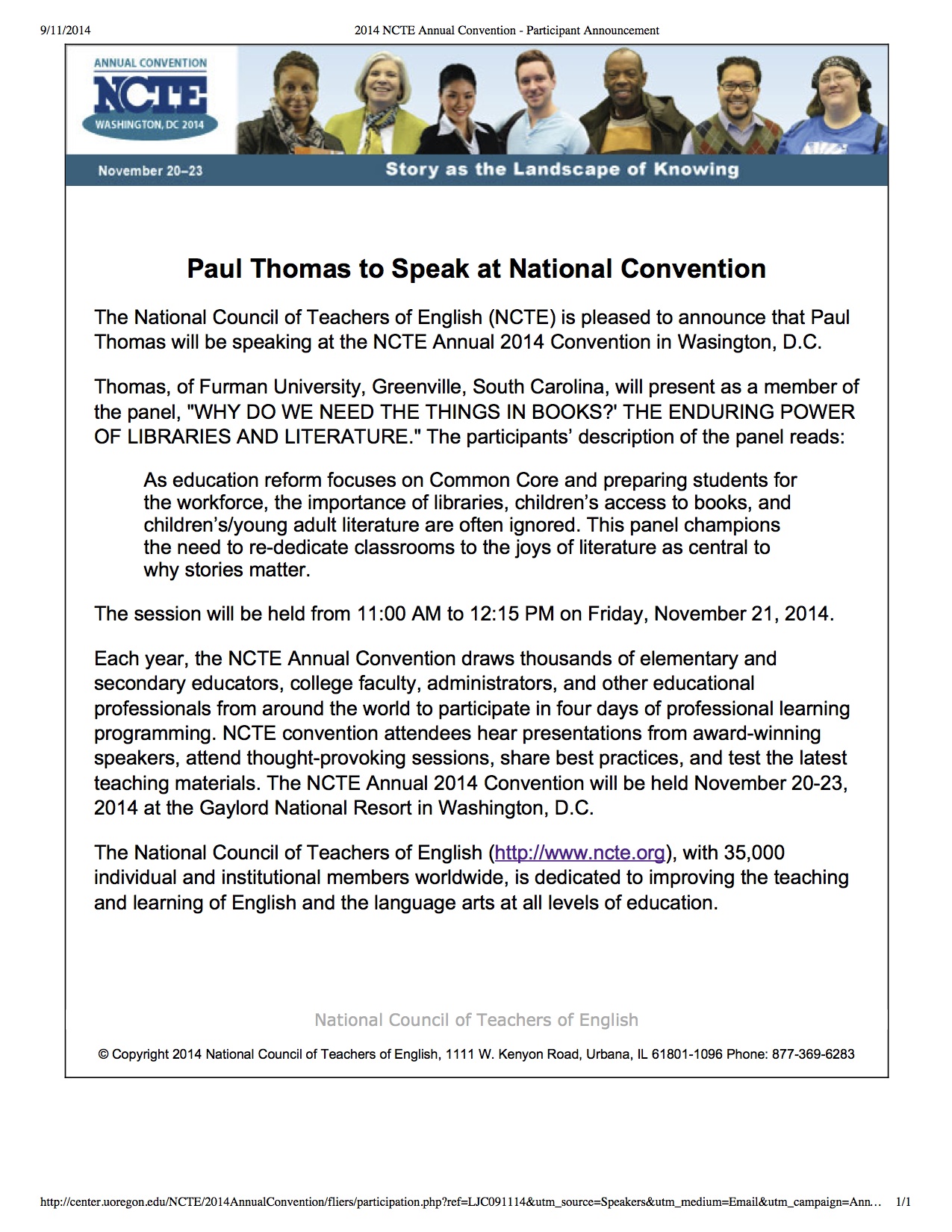
NCTE 2014: “Why do we need the things in books?”: The Enduring Power of Libraries and Literature

[At the 2014 National Council of Teachers of English Annual convention—themed Story As the Landscape of Knowing and held November 20-23, 2014, in Washington DC—Renita Schmidt (University of Iowa), Sean Connors (University of Arkansas), and I will be presenting as detailed below; I offer our proposal as a preview and hope you can join us as we need to raise our voices for both libraries and literature.]

“Why do we need the things in books?”: The Enduring Power of Libraries and Literature

Panel presentation, 75 mins

2014 NCTE Annual Convention - Participant Announcement copy

Teaching Reading and Children: Reading Programs as “Costume Parties”*

P. L. Thomas, Furman University

“[L]anguage behavior can not be reduced to formula,” Lou LaBrant (1947) argued (p. 20)—emphasizing that literacy growth was complicated but flourished when it was child-centered and practical (for example, in the ways many privileged children experience in their homes because one or more of the parents are afforded the conditions within which to foster their children’s literacy). Also, LaBrant (1949) identified the central failure of teaching reading: “Our language programs have been set up as costume parties and not anything more basic than that” (p. 16). This opening talk of the panel will focus on the importance of access to books and libraries as an antidote to “costume parties”—highlighting the work of LaBrant and Stephen Krashen as well as the speeches and writings of Neil Gaiman and Ray Bradbury as life-long proponents of libraries.

The More Books the Better!: Library Books as Boundary Objects To Build Strong Girls

Nita Schmidt, University of Iowa

Libraries provide stories for helping us understand who we are and who we might become. Sometimes, those stories take us to places we cannot imagine and we need more stories to resolve the tension. Libraries provide the books that become boundary objects or, as Akkerman and Baker (2011) describe, artifacts that work as mediators during times of discontinuity. Drawing on sociocultural theories of learning (Gee, 1996; Wenger, 1998; Vygotsky, 1978), this paper will discuss the ways an after school book club works with 4th – 6th grade girls to consider new perspectives. Book club members visit the library every month, read books with strong female protagonists, discuss topics in the books that relate to the real lives of the girls, and help the girls start their own personal libraries to encourage girls to begin to see themselves as successful young women in a complex global world. A bibliography will be provided.

Speaking Back to Power: Teaching YA Literature in an Age of CCSS

Sean Connors, University of Arkansas

If, as the narrator of John Green’s (2009) Paper Towns suggests, imagination is the machine that kills fascists, then literature, as English teachers and librarians know, is the engine that drives it. Despite the current education reform movement’s insistence on reducing the study of literature to a set of narrowly defined, measurable skills, and arguments which associate “close reading” and “textual complexity” with canonical literature, educators who value Young Adult fiction know that, like literature for adults, it is capable of creating a space for readers to examine complex issues related to race, class, gender, etc. This presentation calls on educators to recast arguments for teaching YA fiction in an age of CCSS by foregrounding its ability to encourage critical thinking. The presenter will share examples of (and guidelines for producing) student created digital book trailers that, rather than promoting books, instead “speak back” to oppressive ideologies featured in them.

*Portions adapted from the following blog posts:

Teaching Reading and Children: Reading Programs as “Costume Parties”

Common Core in the Real World: Destroying Literacy through Standardization (Again)

“Fahrenheit 451” 60 Years Later: “Why do we need the things in books?”

Neil Gaiman Should Be U.S. Secretary of Education: “Things can be different”

References

Akkerman, S.F. & Baker, A. (2011). Boundary crossing and boundary objects. Review of Educational Research, 81(2), 132-169.

Bradbury, R.  Fahrenheit 451, 60th anniversary edition.

Fahrenheit 451: 60th Anniversary Edition

Neil Gaiman lecture in full: Reading and obligation — http://readingagency.org.uk/news/blog/neil-gaiman-lecture-in-full.html

Gee, J.P. (1996). Social linguistics and literacies: Ideology in discourse. New York: Routledge.

Green, J. (2009). Paper towns. New York: Speak.

Krashen, S. (2014, January 4). The Spectacular Role of Libraries in Protecting Students from the Effects of Poverty. http://skrashen.blogspot.com/2014/01/the-spectacular-role-of-libraries-in.html?m=1

LaBrant, L. (1949). A genetic approach to language. Unpublished manuscript, Institute of General Semantics, Lakeville, CT.

LaBrant, L. (1947). Um-brel-la has syllables three. The Packet, 2(1), 20-25.

LaBrant, L. (1944, November). The words they know. The English Journal, 33(9), 475-480.

LaBrant, L. (1940, February). Library teacher or classroom teacher? The Phi Delta Kappan, 22(6), pp. 289-291.

LaBrant, L. (1931, March). Masquerading. The English Journal, 20(3), pp. 244-246.

Wenger, E. (1998). Communities of practice, learning, meaning and identity. Cambridge: Cambridge University Press.

Vygotsky, L. (1978). Mind and Society: The development of higher psychological processes. Cambridge, MA: President and Fellows of Harvard College.

Papa

As Steve Paul explains, July is an important month for Ernest Hemingway:

The month of July brings the anniversary of three defining Hemingway moments: He was born on July 21, 1899, in Oak Park, Illinois; he took his own life on July 2, 1961, in Ketchum, Idaho. And on July 8, 1918, while he was serving in the Red Cross ambulance service attached to the Italian army, he was wounded by the explosion of an Austro-Hungarian trench mortar shell. The blast sliced 227 pieces of metal fragments into his body, gave him what felt like a near-death experience and ultimately shaped one persistent subtext of Hemingway’s literary career.

For me, 21 July 2014 sits just a few weeks after the birth of my first granddaughter by my only daughter—and with that event the never-ending question posed to me: What is she going to call you?

My first urge has always been “Whatever she calls me,” to leave this to this wonderful new child who will have an inordinate amount of her life decided for her as we are wont to do with children, sadly.

I named by maternal grandfather Tu-daddy, and so there is some nostalgia in that desire to leave this to my granddaughter.

But if I must choose a name, it will be Papa for Papa Hemingway. Hemingway’s first wife Hadley explains in an audio clip how Hemingway became Papa:

In this clip, Alice Sokoloff asks Hadley if she remembers how the name “Papa” began, which was sometime during their years in Paris. As we know, Hemingway was wonderful at assigning nicknames to almost everyone he knew. Throughout the tapes, Hadley enjoys remembering affectionate names between them such as “Bumby” and “Bumili”, “Hemingstein”, “Tattie”, “Hash”, “Feather Kitty”, “Wax Puppy”, and “Tiny”.

“You did a lot of playing with words,” Alice observes, later in the tape. “We both loved words”, Hadley agrees, “I loved words as much as he did but I wasn’t a magician.”

As a writer, one who loves wordplay, and someone who nicknames (I am also a name clipper: Sky for Skylar, Jess for Jessica), I have much in common with Hemingway, who poses a tremendous problem for me.

Yes, I know there is much wrong with and in Hemingway’s writing and life. And I struggle with my technical attraction to his economy of language—his craft—against those issues of misogyny and complicated glorification of the very violent man’s world.

The world is complicated—as I grow to understand better every day—so I have a special, although conflicted, place in my writer’s heart for Hemingway, and if my granddaughter takes to Papa, well, so much the better for this world, a world I want to be kinder and more gracious because she is now here as another part of the lineage begun with my daughter.

As Hadley notes above, there is a magic to words, and magic rises above this world we fumble all too often. Words, then, are hope, the sort of hope we embrace when we conjure yet more of us on this planet.

Yes, Papa is fine by me.

Blogs Using Hemingway

Gates Moratorium Another Scam: Beware the Roadbuilders pt. 2

The Analogy, Hyperbole Problem: “With explanation kind” (Tone, pt. 5)

From Failing to Killing Writing: Computer-Based Grading

Our Dystopia Is Now: The Circle (Eggers) and Feed (Anderson)

Common Core in the Real World: Destroying Literacy through Standardization (Again)

Poetry

the archeology of white people