“Education as Great Equalizer” Deforming Myth, Not Reality

In the Seinfeld episode “The Hamptons,” viewers watch yet another clash between the essentially soulless main characters as they interact with the very white and privileged “real world” surrounding them in the sitcom. The crux of this episode revolves around one couple having a baby, and then what occurs when reality clashes with civility:

Jerry: Is it me or was that the ugliest baby you have ever seen?

Elaine: Uh, I couldn’t look. It was like the Pekinese.

Jerry: Boy, a little too much chlorine in that gene pool. (They sit) And, you know, the thing is, they’re never gonna know, no one’s ever gonna tell them. (See transcript here.)

Setting aside what this scene (again) reveals about Jerry and Elaine, an important message we can draw from this tension is that most people genuinely do not want to face the harsh truth, especially when that harsh truth contradicts their beliefs.

As I have examined before, the U.S. is overwhelmingly a belief culture, committed to our cultural myths even and especially when those myths have no basis in evidence.

When I have approached the overwhelming evidence that poverty is destiny, I receive angry challenges from people all along the spectrum of ideologies Right and Left, but I also have people who align themselves with me send pleas that I stop such nonsense: Rejecting hard truths has no ideological boundary.

However, in the U.S. both poverty and affluence are destiny, and those who shudder at that reality are confusing verbs: Yes, poverty should not be destiny, but false claims will never allow us to achieve that ideal.

So this leads me to a parallel harsh truth: Education is not the great equalizer (and, again, education should be the great equalizer, but making that claim when it isn’t a reality is inexcusable.)

As I have highlighted numerous times, Matt Bruenig, using “data from Pew’s Economic Mobility Project about social mobility (I,II),” presents a stark reality and draws a disturbing conclusion:

One convenient way to describe what’s going on is that rich kids are more likely to get a better education, which translates into being richer and wealthier as adults. It is certainly the case that richer kids are more likely to get a college degree, and it is certainly the case that getting a college degree leaves you much better off on average than not getting one. But this does not explain the full picture of social immobility. Take a look at this super-complicated chart, which I will describe below….

So, you are 2.5x more likely to be a rich adult if you were born rich and never bothered to go to college than if you were born poor and, against all odds, went to college and graduated. The disparity in the outcomes of rich and poor kids persists, not only when you control for college attainment, but even when you compare non-degreed rich kids to degreed poor kids!

Therefore, the answer to the question in the title is that you are better off being born rich regardless of whether you go to college than being born poor and getting a college degree.

In the U.S., powerful mythologies drive a faith in social mobility (connected to working hard, being well educated, and achievement coming to those who merit that success), but also foster counter-narratives that are essentially ugly and unwarranted: those who are poor or fail are lazy, underserving (read Scarcity for a powerful and evidence-based look at how poverty overwhelms people instead of poverty results from flawed individuals).

The evidence is overwhelming and growing, however, that education is not the great equalizer and that poverty/affluence remain essentially destiny, as reported by Juana Summers at NPR:

Education is historically considered to be the thing that levels the playing field, capable of lifting up the less advantaged and improving their chances for success.

“Play by the rules, work hard, apply yourself and do well in school, and that will open doors for you,” is how Karl Alexander, a Johns Hopkins University sociologist, puts it.

But a study published in June suggests that the things that really make the difference — between prison and college, success and failure, sometimes even life and death — are money and family.

In The Long Shadow, Alexander, Entwistle, and Olson “followed nearly 800 Baltimore schoolchildren for a quarter of a century, and discovered that their fates were substantially determined by the family they were born into,” Rosen explains, discovering:

  • Almost none of the children from low-income families made it through college. Of the children from low-income families, only 4 percent had a college degree at age 28, compared to 45 percent of the children from higher-income backgrounds. “That’s a shocking tenfold difference across social lines,” Alexander said.
  • Among those who did not attend college, white men from low-income backgrounds found the best-paying jobs. Although they had the lowest rate of college attendance and completion, white men from low-income backgrounds found high-paying jobs in what remained of Baltimore’s industrial economy. At age 28, 45 percent of them were working in construction trades and industrial crafts, compared with 15 percent of black men from similar backgrounds and virtually no women. In those trades, whites earned, on average, more than twice what blacks made. Those well-paying blue collar jobs are not as abundant as during the years after World War II, but they still exist, and a large issue today is who gets them: Among high school dropouts, at age 22, 89 percent of white dropouts were working compared with 40 percent of black dropouts.
  • White women from low-income backgrounds benefit financially from marriage and stable live-in partnerships. Though both white and black women who grew up in lower-income households earned less than white men, when you consider household income, white women reached parity with white men—because they were married to them. Black women not only had low earnings, they were less likely than whites to be in stable family unions and so were less likely to benefit from a spouse’s earnings. White and black women from low-income households also had similar teen birth rates, but white women more often had a spouse or partner, a relationship that helped mitigate the challenges. “It is access to good paying work that perpetuates the privilege of working class white men over working class black men,” Alexander said. “By partnering with these men, white working class women share in that privilege.”
  • Better-off white men were most likely to abuse drugs. Better-off white men had the highest self-reported rates of drug use, binge drinking, and chronic smoking, followed in each instance by white men of disadvantaged families; in addition, all these men reported high levels of arrest. At age 28, 41 percent of white men—and 49 percent of black men—from low-income backgrounds had a criminal conviction, but the white employment rate was much higher. The reason, Alexander says, is that blacks don’t have the social networks whites do to help them find jobs despite these roadblocks.

The realities of class and race in the U.S. are far removed from simplistic slogans.

In the U.S., African Americans with some college have the same economic power as white high school drop-outs.

And the relationship between education and opportunity proves to be again and again, misleading. The SAT remains a powerful gatekeeper for college, despite SAT scores being less effective than GPA (actual merit) for determining who attends college.

More disturbing, however, is that access to education provides cover for the what truly matters in the U.S.: as The Long Shadow and Bruenig document, the coincidences of birth—money and family (and not merit).

While I maintain that hollow slogans (“education is the great equalizer”) prove to be “myths that deform,” [1] and thus work against our ideals, I am not calling for some sort of callous fatalism.

The first step toward “poverty is not destiny” and “education is the great equalizer” is naming the current failures in order to establish actions and policies that would shift the existing, and ugly, realities: poverty and affluence are destiny and wealth/family trump merit (such as education)—all of which are magnified by lingering racism.

Next, we must confront our assumptions about who is wealthy and who is impoverished, coupled with ending cultural demands that the impoverished work twice as hard and that the disadvantaged conform to higher moral and ethical standards. As Oscar Wilde eloquently argued:

The majority of people spoil their lives by an unhealthy and exaggerated altruism – are forced, indeed, so to spoil them. They find themselves surrounded by hideous poverty, by hideous ugliness, by hideous starvation. It is inevitable that they should be strongly moved by all this….[I]t is much more easy to have sympathy with suffering than it is to have sympathy with thought. Accordingly, with admirable, though misdirected intentions, they very seriously and very sentimentally set themselves to the task of remedying the evils that they see. But their remedies do not cure the disease: they merely prolong it. Indeed, their remedies are part of the disease….

And in this recognition, Wilde rejects those “remedies”:

They try to solve the problem of poverty, for instance, by keeping the poor alive; or, in the case of a very advanced school, by amusing the poor….

It is immoral to use private property in order to alleviate the horrible evils that result from the institution of private property. It is both immoral and unfair….

Sometimes the poor are praised for being thrifty. But to recommend thrift to the poor is both grotesque and insulting. It is like advising a man who is starving to eat less. For a town or country labourer to practise thrift would be absolutely immoral. Man should not be ready to show that he can live like a badly-fed animal.

It is, then, ours to reject both “exaggerated altruism” and base fatalism; instead, we must commit to the following:

  • Name and recognize inequity without stooping to demonizing people. In our current commitments to meritocracy myths, we demonize the poor; but it does no one any good to simply shift who we demonize. Our enemy is inequity, and solutions to inequity rest in changing powerful social dynamics and not with “fixing” flawed (or promoting idealized and false portraits of “successful”) individuals.
  • Stop promoting false myths to children because as they grow up, they come to see the myth as a lie, and thus, the entire promise of the American Dream is tarnished.
  • Commit to social and education policy grounded in equity, and not in competition or market forces.

We need a new way to speak to our children. And we must begin here: “We have not yet created the country we want, and we must admit life continues to be too often unfair. But things can be better, and we are here to help because you can live in a world more fair than the one we have given you.”

Success in the U.S. is not the result of “grit,” not the consequence of some people being more determined (“better”) than others. Many people worker harder than others, but remain impoverished, have less access to opportunities. None of this should be true, but it is.

Ultimately, however, we must put our money and actions where our words take us. Otherwise, as John Gardner warned, equity, fairness, and justice become “cheap streamers in the rain.”

[1] “[A]s we put into practice an education that critically provokes the learner’s consciousness, we are necessarily working against myths that deform us. As we confront such myths, we also face the dominant power because those myths are nothing but the expression of this power, of its ideology.” (Freire, 2005, p. 75)

Freire, P. (2005). Teachers as cultural workers: Letters to those who dare to teach (D. Macedo, D. Koike, & A. Oliveira, Trans.). Boulder, CO: Westview Press.
Florida Retention Policy a Blight on Literacy, Children across US

The New York Times headline suggests we are finally poised to read a positive story about education: A Summer of Extra Reading and Hope for Fourth Grade.

But education reporter Motoko Rich’s examination of third-grade retention policies based on the Florida model and sweeping across the U.S. is not about “hope,” but about a disturbing resistance by political leaders, the media, and the public to confront the overwhelming evidence that grade-retention is a harmful policy and that the Florida model has been discredited.

Rich opens with one of the misleading Urban Legends driving flawed reading policies: “Educators like to say that third grade is the year when students go from ‘learning to read’ to ‘reading to learn.'”

However, as Anya Kamenetz reports for NPR:

“The theory of the fourth-grade shift had been based on behavioral data,” says the lead author of the study, Donna Coch. She heads the Reading Brains Lab at Dartmouth College.

The assumption teachers make: “In a nutshell,” Coch says, “by fourth grade you stop learning to read and start reading to learn. We’re done teaching the basic skills in third grade, and you go use them starting in the fourth.”

But, Coch’s team found, that assumption may not be true. The study involved 96 participants, divided among third-, fourth-, and fifth-graders as well as college students. All average readers, the subjects wore noninvasive electrode caps that could swiftly pick up electrical activity in the brain.

Narrow and distorted assumptions about reading (and literacy broadly) have plagued reading instruction for over a century in the U.S. (review the work of Lou LaBrant to see how this has played out over much of the 20th century). A superficial view of reading and writing (often reduced to phonics, or simple pronunciation, and grammar, or “correctness”) is compounded by our testing culture that further skews how we teach and perceive reading and writing; how we test reading and writing (disproportionately multiple-choice formats seeking the “right” answers or correct “rules”) becomes what counts as reading and writing.

Rich’s article doesn’t present hope for students struggling to read, but does provide a a picture of how the Florida model is sweeping the U.S.:

Fourteen states in 2012 enacted policies either mandating or strongly recommending that schools hold back students who could not read properly by third grade. Districts in Arizona and Colorado also offered summer school for struggling third-grade readers for the first time this year, then will consider whether to hold back some of them before the new school year begins.

While the summer courses are likely to make some difference, teachers here and around the country say the third-grade laws are another example of lofty educational goals paired with insufficient resources. A six-week course, they say, cannot possibly make up for what Anthony and the others need: the extra help and focus should start in preschool.

Is the problem with 3rd-grade retention policies based on high-stakes reading tests simply “insufficient resources”?

While too often policy is crippled by a failure to provide resources matching the rhetoric, the problem here is that both grade retention and the Florida model have been refuted by 40 years of research (grade retention) and reviews of the Florida model (see HERE and HERE).

The rise of grade retention policies is further evidence of the failures associated with accountability based on high-stakes testing, another subset of the entire accountability model that we persist to re-package despite the growing record of its failure (see HERE and HERE).

Instead of building reading (and all literacy) policies and practices on accountability models, we must make the following changes to achieve the hope mislabeled in the opening headline:

  • Grade retention and extended school days/years are likely to be viewed by students as punishment as well as markers for their own failures. Measurable reading achievement and high-stakes test scores are primarily markers for the relative affluence or poverty of children; thus, punitive policies are punishing children for the accidents of their birth. Let’s instead seek policies that address directly the poverty that deny our children hope in the first place. As Stephen Krashen has shown, access to books in a child’s home is one of the most powerful ways to support childhood literacy development. Shifting from the punitive (grade retention, extended days/years) to a restorative model (providing books for children) is a powerful first step toward real hope.
  • Literacy is a life-long journey, and not a sequential/linear human behavior that can be “finished.” We must set aside reductive views of reading and writing, embracing instead policies and practices that provide all students extended opportunities to read and write daily in school. Children need to read and write by choice and with expert direct guidance for hundreds and thousands of hours over many, many years. Literacy has no shortcut, in fact, and we continue to misread strong literacy among affluent children as something other than the rich experiences they are afforded by the accidents of the births. That misreading results in a corrosive deficit view of children in poverty. All children need and deserve rich experiences, extended rich experiences with literacy; grade-retention and high-stakes tests are not rich experiences with texts.
  • Childhood literacy is strongly associated with the literacy of the adults in children’s lives—their parents, siblings, and teachers. Investing in a wide-range of policies addressing adult and family literacy, then, is investing in each child’s literacy: well-funded public libraries, well-funded and staffed school libraries, community reading initiatives, book drives and free books for families, rich teacher and librarian staffing and in-service related to literacy growth.

In Louise DeSalvo’s memoir, Vertigo, the Virginia Wolff scholar details how as a child and teenager she finds solace in the library and relationships with kind teachers (notably a physics teacher who chooses to honor her love of reading while encouraging the young DeSalvo to stop ignoring his course; see pp. 168-169), while coming to recognize the power of her passion for reading. DeSalvo’s life story—as with Ray Bradbury, Neil Gaiman, and Margaret Atwood—is a vivid narrative about the hope found in reading, and a stark antidote to reading policy driven by misreading literacy and research, misreading our children and childhood.

Rich documents a failure of credible literacy policy trapped in political ideology:

In Florida, one of the pioneers in holding back third graders because of inadequate reading skills, all teachers are required to assess children’s reading levels starting in kindergarten and to offer extra support for children who have trouble learning to read.

But this is not reason to celebrate, but a call to change course.

A Call for the Next Phase in the Resistance

Teachers at every level of schooling have struggled against two powerful social claims: (i) education has always been labeled a failure by political leaders and the media (notably in the context of international comparisons and despite such claims being at least misleading if not completely false) and (ii) that K-12 teachers must not be political while university professors should also focus on their scholarship and not drift into public intellectual work.

The consequences of these dynamics include an essentially passive teacher workforce and an increasingly dysfunctional bureaucracy driving how schools (K-12 and universities) are run, that dysfunction primarily grounded in that non-educators make most of the structural educational decisions and thus the education system is done to (and not by) the professionals themselves.

Over the past thirty years, this process has become more clearly codified and federalized, the seeds of which were planted in the early 1980s commitment to the accountability paradigm based on standards and high-stakes testing, and then expanded through NCLB in 2001 as well as copy-cat initiatives under the Obama administration.

Most of those accountability years, I would classify as Phase 1, a period characterized by a political monopoly on both public discourse and policy addressing primarily public K-12 education.

We are now in Phase 2, a time in which (in many ways aided by the rise in social media—Twitter, blogging, Facebook—and the alternative press—AlterNet and Truthout) teachers, professors, and educational scholars have begun to create a resistance to the political, media, and public commitments to recycling false charges of educational failure in order to continue the same failed approaches to education reform again and again.

In Phase 1, educators were subjected to the role of the child; we were asked to be seen but not heard.

In Phase 2, adolescence kicked in, and we quite frankly began to experiment with our rebellious selves. In many instances, we have been pitching a fit—a completely warranted tantrum, I believe, but a tantrum nonetheless.

And now that there are some cracks in the education reform machine, now that we have committed ourselves to being that resistance, the voice and action of those who are the professionals, I am making a call for Phase 3, something like moving into our young adulthood as a resistance.

Having taught high school for 18 years and having raised a daughter into her mid-20s (so far), I am one who both loves and recognizes the power and danger of the passion driving adolescents. I am often jealous that adolescents can care so deeply and so loudly, and often with the ability to hold their pitch high endlessly.

The power of adolescent passion is that it breeds passion and it draws attention. The danger of adolescent passion is that it must result in something substantial or all that exponential passion and attention wither.

Now that we as the resistance have fostered passion beyond the choir and now that we have begun to garner the attention of a few politicians, a few journalists, and many parents as well as interested members of the public, I sense a need to make a shift in strategies that include the following:

  • While I remain committed to my many arguments defending tone, the resistance now must lead our claims with substance and take care not to create opportunities for our central messages to be overshadowed by either credible or unwarranted complaints about tone. I am reminded of the evolution of Michael Stipe’s lyrics for the alternative rock group R.E.M.; Stipe admitted during what can now be called the mid-period of the band that he had moved on from being always ironic and sarcastic about topics such as love (note the early “The One I Love”) in order to consider them seriously (note “At My Most Beautiful”). I am not saying we should no longer be angry (we should) or sarcastic and biting, but I believe we have come to a time in which our primary driving tone must be above the possibility of having our central mission undermined.
  • A related shift must be avoiding the trap of maintaining too much energy on putting out fires set by education reformers, notably in that we as the resistance are embroiled in refuting the person of the moment (from Bill Gates, Michelle Rhee, and Arne Duncan to the current Campbell Brown and Whoopi Goldberg). This is a very difficult bind for the resistance because education reform is rich not only in funding but also in celebrities of the moment. And my argument here is not that we do not refute edu-reformers without credibility, but that we maintain as we discredit a focus on the larger evidence and claims instead of suggesting that this person or that person is the problem. For example, I have offered that the Common Core debate is not about the specific standards, but about the failure of the accountability paradigm itself. With Duncan, Gates, Rhee, Brown, and others, our concern is that these people lack experience and expertise in our field, and thus, their claims and policies are the problems—not them as people. If we must write about Whoopi Goldberg’s comments on teacher tenure, we need to focus on what tenure is and how her characterization is misinformed—but not on that Goldberg said it (she isn’t alone, by the way, and by highlighting her, we suggest she has more credibility than dozens of other people saying the same misinformation).
  • As I have noted before (in the context of the John Oliver Rule), we must use the incredible platform that Diane Ravitch has built for teachers, professors, and scholars in order to build a movement of many faces, many voices, and many experts. The mainstream media have reduced the resistance to Ravitch in much the same way that the media have reduced climate change to Bill Nye. The resistance is and must be promoted as a rich and varied body of professionals, both unified and driven by the tensions of our field. Race, gender, sexuality, ideology—the rainbow of our resistance must be prominent and we cannot allow it to be reduced, oversimplified, or marginalized.

In short, as I have argued about the Common Core debate, the resistance has reached a point when we must forefront rational and evidence-based alternatives to a crumbling education reform disaster.

We must be the adults in the room, the calm in the storm. It won’t be easy, but it is time for the resistance to grow up and take our next step.

Denying Impact of Poverty Has an Evidence Problem

As I have noted, denying racism has an evidence problem. But those who persist in denying the impact of poverty also have an evidence problem; thus, they have to manufacture evidence.

But manufacture evidence they will—as evidenced by Hanushek, Peterson and Woessmann (2014). However, David Berliner and Stephen Krashen have now unmasked that effort:

David Berliner Responds to Economists Who Discount Role of Child Poverty

Do American Rich Kids do Worse on International Tests than Rich Kids from Other Countries?

I also recommend this, related:

3 Facts that Poverty-Deniers Don’t Want to Hear

Rational and Evidence-Based Responses to Standards Advocates and Critics

Because the education agendas and discourse by Democrats and Republicans are essentially indistinguishable, as I have argued before, educators have no political party.

Educators are similarly trapped, however, in the Common Core debate between standards advocates and standards critics, who are also indistinguishable for two prominent reasons: the failure to start the consideration of standards on either a rational or an evidence-based foundation.

Political leaders, the mainstream, media, and education reform advocates with the highest profiles represent the most distinct and influential evidence of this dynamic. Typically, the better considerations of standards broadly and Common Core narrowly are left to bloggers—for example, Rachel Levy’s The Common Condescension and Peter Greene’s Petrilli Reports on Common Core Wars.

While Levy and Greene offer critiques with much greater credibility than the Common Core commentaries they refute, the wider public is likely to be left with having seen only the original, and flawed, claims. We edu-bloggers who have both experience and expertise in education are more or less left to preach to the choir.

But since the most recent trend concerning Common Core is for advocates and critics to discuss and analyze the Common Core debate itself—again, evidence that Common Core advocates have in fact won—I want to offer one more time the two foundational reasons that pursuing standards is a failed structure for education reform, two reasons that standards/Common Core advocates have been successful at removing from the table entirely.

Let’s start with basic logic problems for basing education reform on standards (especially the perpetual pursuit of new and better standards).

In order for new standards to be a major or significant solution to education problems, we would need to establish that current standards (or a lack of standards) are the source of those problems. This may surprise some, but I have never seen a single careful examination of whether or not standards are the problem (see below for the evidence on what we do know about standards as a part of the reform agenda); thus, standards are unlikely to be the solution.

A practical logic problem also exists for those advocating or criticizing standards: If I am teaching, my job is to identify where any student is in her/his learning and then to take that student farther, both in terms of direct teaching and by motivating that student to learn. That fact of real-world teaching renders detailed standards irrelevant because it doesn’t matter what a standard deems any student should know and when since the reality of that student supersedes those mandates.

Calculating something such as 8th-grade reading level (a spurious venture at best) and then crafting standards to hold all teachers of 8th-graders and all 8th-graders to that goal remain mostly theory, achievable in the abstract maybe, but, again, prove pointless in the real world where any classroom of 8th-graders has reading experiences and abilities all along a wide spectrum that each teacher must work with and from.

My 8th-grader reading above grade level and my 8th-grader reading below grade level both deserve my teaching them, and not that I try to accomplish the state-mandated standards. (And to suggest that I need someone to mandate my standards lest I know not what to teach is a truly offensive claim for a professional.)

A rational and ethical approach to teaching begins with where students are, not with standard calls for where every student should be.

However, if the rational approaches to considering standards-based reform aren’t enough (and they should be enough to show that the debate itself is fruitless, that we should be pursuing something else), let’s now turn to what we know about standards-based reform.

Modern education in U.S. has existed from and through a series of broad eras: From the 1890s and into mid-twentieth century (the foundational years of establishing standards as well as a factory, and thus standard, approach to public schooling), the volatile 1950s and 1960s with Supreme Court rulings and federal legislation establishing racial equity, and then the current accountability era begun in the 1980s, reinforced in 2001 with NCLB and later expanded under President Obama (again, the Bush and Obama agendas are indistinguishable from each other).

To be blunt, in fact, U.S. public education has never been absent arguments about what should be taught (both standards and curriculum) and how that should be taught, but the past thirty years have provided a solid research base on how accountability driven by standards and high-stakes testing impacts education reform.

And that brings us to the second problem with both advocates and critics of Common Core: They never address what we know about standards-based education reform.

A significant research base along a wide range of political ideologies has been essentially ignored, primarily because Common Core advocates have successfully established a debate about Common Core itself and thus never allowed the necessary initial debate to occur: Are standards the problem, and thus, are better standards the solution?

The bad news for both standards critics and advocates is (i) the presence or quality of standards have no correlation with student achievement, (ii) standards-based reform fails to address equity, and (iii) standards-based reform linked to high-stakes accountability has asked less of students and teachers (Hout & Elliot, 2011French, Guisbond, & Jehlen, 2013; Loveless, 2012; Mathis, 2012; Whitehurst, 2009; Kohn, 2010de Mello, Blankenship, & McLaughlin, 2009; Horn, 2013).

Educators and those who value universal public education are left with two difficult positions. One is that we have no political party, and the other is that we find ourselves outside the Common Core debate—demanding in both instances that we try something else, notably that we start by first identifying the causes of our problems so that our solutions have a chance of succeeding.

We re left with being rational, with calling upon evidence in the wider public debates, and to be honest, those are significant uphill battles in the U.S. where the irrational and unmerited thrive.

Common Core will not save our schools and our children, and neither will Common Core destroy our schools and our children—except that continuing either the pursuit of new standards or debating standards endlessly is a distraction guaranteeing we will never get to the work needed.

James Baldwin at 90: “‘I can’t believe what you say,’ the song goes, ‘because I see what you do’”

January 1, 2000, exposed a truly baffling phenomenon about most humans: A silly fascination with numbers that end in zero that completely renders those humans irrational. In the land of the arbitrary where people fear that arbitrary dates can spawn the Apocalypse, the irrational can’t even manage those arbitrary dates as January 1, 2001 (not 2000), was the turning point of the millennium.

And so we now witness a flurry of articles about James Baldwin, mostly ignored over the past few decades, because August 2, 2014, would have been Baldwin’s 90th birthday—somehow signifying he is more important now than when he would have turned 89.

As someone who has come to cherish Baldwin the essayist and Baldwin the public intellectual, I welcome this sudden burst of sunlight on one of the most daring and perceptive voices ever among writers in the U.S. I cannot stress enough in print that I find Baldwin as valuable today as ever, and often feel deeply inadequate as a writer and would-be public intellectual against the power of Baldwin.

To join in with this celebration, I want to recommend primarily that Baldwin’s voice be read and viewed/heard—that we do not allow all being said and written about him to suffice. And on August 2, 2014, we have so much of Baldwin before us, so much that we have failed to embrace, to consider carefully, to allow these words to complete their unmasking:

My journey with Baldwin has resulted in an edited volume (co-edited with Furman colleague Scott Henderson), James Baldwin: Challenging Authors. So here I want to share the introduction I wrote for that collection of essays.

Introduction

No rhetorical sleight of words should mask that Trayvon Martin was a son. He had parents. No rhetorical sleight of words should allow us to ignore that any child is everyone’s child.[i]

Trayvon Martin was killed February 26, 2012, in part because he was reduced to a stereotype, and after his death, Trayvon was again reduced—often by well-meaning people—to an icon, the hoodie. In his death, as well, Trayvon has been spoken about, spoken for—and I am compelled to argue that he has also been rendered voiceless. But, as Arundhati Roy (2004) has explained, “We know of course there’s really no such thing as the ‘voiceless.’ There are only the deliberately silenced, or the preferably unheard” (n.p.).

In this introduction to a volume on the work of James Baldwin, I, like Roy, am compelled to speak beyond Trayvon about “the deliberately silenced, or the preferably unheard”—about those Others: African American males.

At mid-twentieth century, as the U.S. was fighting against its racist heritage, African American males demanded to be heard—Martin Luther King Jr., Malcolm X, Ralph Ellison, James Baldwin, Richard Wright and many others took the stage as artists, public intellectuals, and civic leaders. Wright’s Black Boy and Ellison’s Invisible Man represent in fictional narrative a powerful and disturbing image of the African American male; for Ellison, the guiding metaphor of that narrative is invisibility. The killing of Trayvon and the subsequent trial may suggest that African American males no longer suffer from invisibility but from how they are seen, how they are silenced, and how they are unheard: Trayvon seen (and reduced) as black male, thus necessarily a thug, a threat, and then Trayvon, the hoodie, the icon of the disposable African American male.

The fact of being seen and reduced as African American males too often result in violent deaths and prison. And the intersection of race, class, and gender with education has paralleled the rise of mass incarceration (Thomas, 2013) over the past thirty-plus years. While Wright’s and Ellison’s novels continue to capture the African American male experience—including the entrenched conditions that contributed to Trayvon’s killing—Ellison’s and Baldwin’s concerns about the failure of education to see clearly and holistically—and humanely—the plight of African American males continue to send an ominous and powerful message today  (see Chapter 9 for a fuller discussion).

In 1963, Ellison (2003) spoke to teachers:

At this point it might be useful for us to ask ourselves a few questions: what is this act, what is this scene in which the action is taking place, what is this agency and what is its purpose? The act is to discuss “these children,” the difficult thirty percent. We know this very well; it has been hammered out again and again. But the matter of scene seems to get us into trouble. (p. 546)

Ellison recognized the stigma placed on African American students, a deficit view of both an entire race and their potential intelligence (marginalized because of non-standard language skills). But Ellison rejected this deficit perspective: “Thus we must recognize that the children in question are not so much ‘culturally deprived’ as products of a different cultural complex” (p. 549). Ultimately, Ellison demanded that the human dignity of all children be honored.

Baldwin (1998) addressed teachers in that same year, 1963:

Let’s begin by saying that we are living through a very dangerous time.  Everyone in this room is in one way or another aware of that.  We are in a revolutionary situation, no matter how unpopular that word has become in this country.  The society in which we live is desperately menaced, not by Khrushchev, but from within. (p. 678)

Then, Baldwin unmasked the cruel tension between the promise of universal public education and the inequity found in the lives of African American children. Education, for Baldwin, must be revolutionary, an act of social justice. In Baldwin’s words, I hear a refrain: No rhetorical sleight of words should mask that Trayvon Martin was a son. He had parents. No rhetorical sleight of words should allow us to ignore that any child is everyone’s child.

However, if the killing of Trayvon does not haunt us, if the killing of Trayvon slips beneath the next tragedy-of-the-moment—as the Sandy Hook school shooting (December 14, 2012) has beneath the George Zimmerman trial—then society and schools will continue to be mechanisms that shackle “the deliberately silenced, or the preferably unheard.” And I suppose that is ultimately the cruel paradox, rendering Trayvon a ghost in this American house he was never allowed to enter, invisible again as Ellison’s unnamed narrator.

To Jimmy (and Jose), with Love

When teacher and blogger Jose Vilson[ii] posts a blog, I read carefully and don’t multitask. Why? I am a privileged, white male who has lived his entire life in the South where racism clings to the region like the stench of a house razed by fire.

And as a result, I walk freely among racism because I am white. So when Vilson (2013) posted “An Open Letter From The Trenches [To Education Activists, Friends, and Haters],” I listened, and I recognized:

Anger isn’t a title we parade around like doctorates, followers, and co-signers; it’s the feeling before, during, and after we approach things with love and earnest….

However, for anyone to say that racial insults are “no big deal” speaks volumes to the sorts of work people of color and anyone who considers themselves under the umbrella have to do in order to make things right. As colleague Kenzo Shibata once said, “You can’t build a movement by making allies feel unwelcome and telling them to get over it.” I’d take it one step further and say that we can’t build coalition if we continue to think we have to build a movement under one or two people’s terms. I refuse to believe that we can’t coalesce around building a better education system for all children, regardless of background.

How can you say you care about children of color, but ostracize adults of color with the same breath?…

Adults, on the other hand, don’t get excuses. The privilege is in the hopes and dreams we have for our students, not in the ways we act towards our fellow man or woman. The privilege, to convert the anger over how our kids are treated in the system into a passion for student learning, remains at the forefront. (n.p.)

I have learned to read and listen to Jose as I do with New York Times columnist Charles Blow and writer Ta-Nehisi Coates, as I do with Martin Luther King Jr., Malcolm X, Ralph Ellison, and now more than ever, James Baldwin, who is the focus of this volume.

I have learned daily—I continue to learn today—that America the Beautiful has failed an entire race of people, specifically African American males. I have learned daily, I continue to learn today that in my half-century-plus life, the most hateful people I have encountered have been white men—yet, daily brown and black faces smile at me (even or especially when we are strangers) and speak with kindness and joy when we approach each other on the street, in restaurants, and where we all work and live. I have learned daily, I continue to learn today that in my half-century-plus life, the most beautiful humans—and the greatest reason to live on this planet—are children of every possible shade. They laugh and sing and dance and run with the beauty of life that has nothing at all to do with race or the supreme and inexcusable failures of the adults in whose care they reside.

America the Beautiful created a minority class out of a race of people who are as rich, vibrant, and beautiful as anybody else. America the Beautiful has also created a criminal class out of African American men, building a new Jim Crow system (Alexander, 2012) with mass incarceration masked as a war on drugs. America the Beautiful created a dropout class and future criminal class out of African American young men, building school-to-prison pipelines and schools-as-prisons as zero-tolerance schools imprisoning urban communities (Nolan, 2011).

These are not angry and hyperbolic claims about the soot-stained American past; these are claims about the roots that continue to thrive and bear bitter fruit. Baldwin (1998), in “A Report from Occupied Territory” (originally published in The Nation, July 11, 1966), confronted an “arrogant autonomy, which is guaranteed the police, not only in New York, by the most powerful forces in American life” (p. 737) and the corrosive deficit view of race it is built upon: “‘Bad niggers,’ in America, as elsewhere, have always been watched and have usually been killed”:

Here is the boy, Daniel Hamm, speaking—speaking of his country, which has sworn to bring peace and freedom to so many millions. “They don’t want us here. They don’t want us—period! All they want us to do is work on these penny-ante jobs for them—and that’s it. And beat our heads in whenever they feel like it. They don’t want us on the street ’cause the World’s Fair is coming. And they figure that all black people are hoodlums anyway, or bums, with no character of our own. So they put us off the streets, so their friends from Europe, Paris or Vietnam—wherever they come from—can come and see this supposed-to-be great city.”

There is a very bitter prescience in what this boy—this “bad nigger”—is saying, and he was not born knowing it. We taught it to him in seventeen years [emphasis added]. He is draft age now, and if he were not in jail, would very probably be on his way to Southeast Asia. Many of his contemporaries are there, and the American Government and the American press are extremely proud of them…. (pp. 737-738)

These realities of racism from 1966 linger today—the scar of racism cloaked, as Baldwin recognized, with claims of justice:

This is why those pious calls to “respect the law,” always to be heard from prominent citizens each time the ghetto explodes, are so obscene. The law is meant to be my servant and not my master, still less my torturer and my murderer. To respect the law, in the context in which the American Negro finds himself, is simply to surrender his self-respect. (p. 734)

And thus, Baldwin’s conclusion about the Harlem Six rings true still:

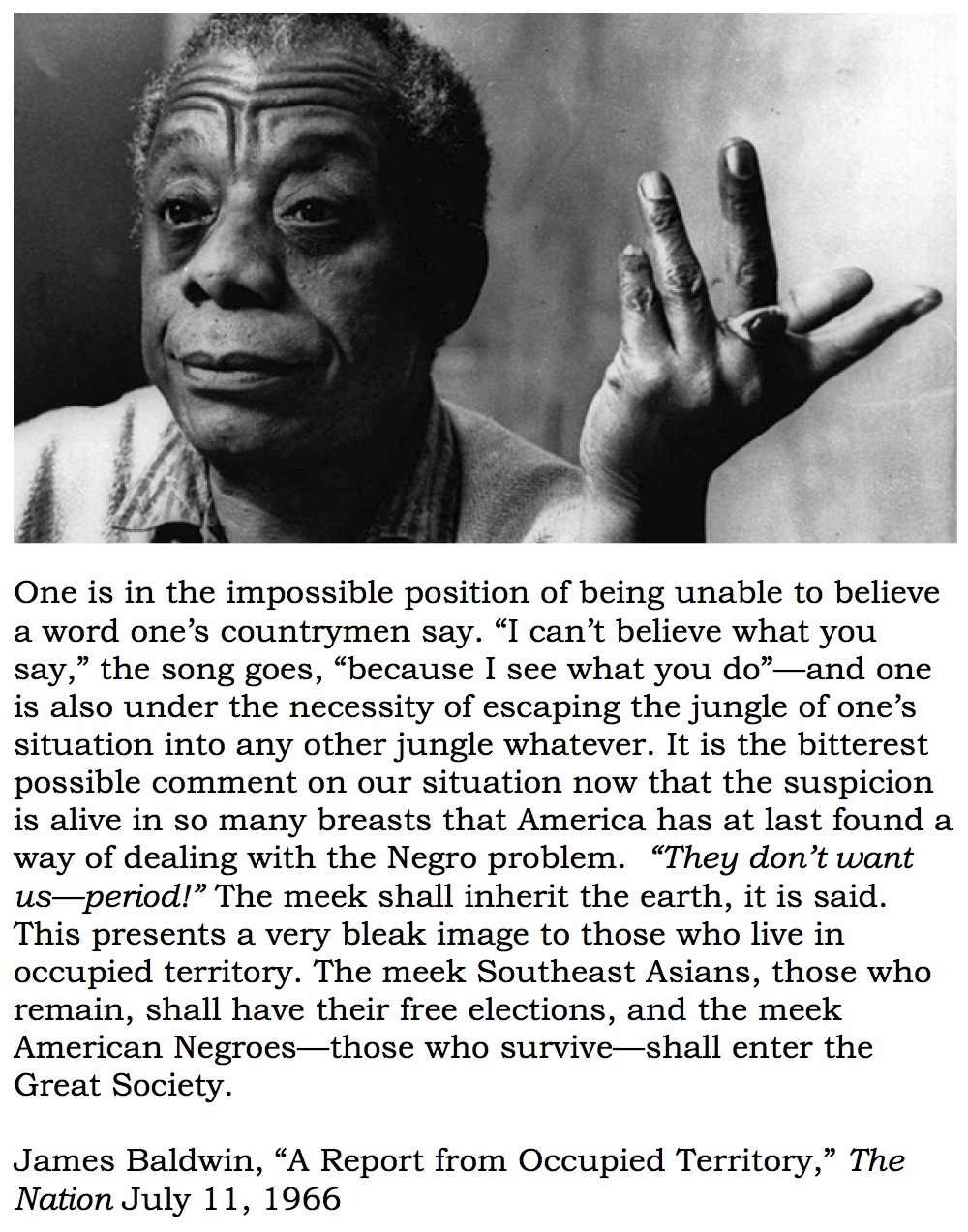
One is in the impossible position of being unable to believe a word one’s countrymen say. “I can’t believe what you say,” the song goes, “because I see what you do”—and one is also under the necessity of escaping the jungle of one’s situation into any other jungle whatever. It is the bitterest possible comment on our situation now that the suspicion is alive in so many breasts that America has at last found a way of dealing with the Negro problem. “They don’t want us—period!” The meek shall inherit the earth, it is said. This presents a very bleak image to those who live in occupied territory. The meek Southeast Asians, those who remain, shall have their free elections, and the meek American Negroes—those who survive—shall enter the Great Society. (p. 738)

Today, racism is thinly masked, and many refuse to see it.

In 1853, Frederick Douglass recognized what would 100 years later be portrayed as invisibility by Ralph Ellison:

Fellow-citizens, we have had, and still have, great wrongs of which to complain. A heavy and cruel hand has been laid upon us.

As a people, we feel ourselves to be not only deeply injured, but grossly misunderstood. Our white fellow-countrymen do not know us. They are strangers to our character, ignorant of our capacity, oblivious of our history and progress, and are misinformed as to the principles and ideas that control and guide us as a people. The great mass of American citizens estimate us as being a characterless and purposeless people; and hence we hold up our heads, if at all, against the withering influence of a nation’s scorn and contempt. (qtd. in Alexander, 2012, p. 140)

Douglass’s charges are echoed in Baldwin’s (1998) “No Name in the Street,” which points a finger at the entrenched American problem with race:

The truth is that the country does not know what to do with its black population now that the blacks are no longer a source of wealth, are no longer to be bought and sold and bred, like cattle; and they especially do not know what to do with young black men, who pose as devastating a threat to the economy as they do to the morals of young white cheerleaders. It is not at all accidental that the jails and the army and the needle claim so many, but there are still too many prancing around for the public comfort. Americans, of course, will deny, with horror, that they are dreaming of anything like “the final solution”—those Americans, that is, who are likely to be asked: what goes on in the vast, private hinterland of the American heart can only be guessed at, by observing the way the country goes these days. (pp. 432-433)

America doesn’t know what to do, but it is startlingly clear that we should know what not to do: Don’t suspend and expel young black men without just cause, don’t incarcerate young black men without just cause, don’t lure and then send young black men to war, and without a doubt, don’t allow anyone to demonize anyone else with racial slurs.

Maybe, in the end, racism remains a cancer on America the Beautiful because we will not face it or unmask it—and because we have become so cynical that the solution seems trite: As Jose stated, as King repeated, and as James (“Jimmy”) Baldwin demanded, the solution is love. Love everyone, but be vigilant about loving the least among us—children, the impoverished, the imprisoned, the hungry, the sick, the elderly—and do so color-blind.

As stated above, I offer these words because I walk freely among racism and because I, like Vilson (2013), refuse to believe “that we can’t coalesce around building a better education system for all children, regardless of background” (n.p.). Or, as Baldwin (1998) himself said: “‘I can’t believe what you say,’ the song goes, ‘because I see what you do’” (p. 738)—and we all must hear what everyone else says—especially the words they choose—never offering excuses for the racism of policy, the racism of action, or the racism of language.

James Baldwin: Challenging Authors

In 2004, poet Adrienne Rich (2009) wrote about a postage stamp bearing the face of American ex-patriot writer James Baldwin: “the stamp commemorates Baldwin’s birthday, August 2: he would have been eighty that year” (p. 49). This volume appears in 2014, the year that Baldwin would have turned ninety.

Rich’s essay reads as the journey of one writer’s experience embracing the other, but Rich also highlights what this volume seeks to address as well—the lack of attention that Baldwin receives in the twenty-first century U.S. Why, Rich asks, does a country still laboring under the same issues of race continue to ignore a powerful voice, as Americans certainly did when Baldwin spoke of racism?

Quoting from “Lockridge: ‘The American Myth,’” Rich (2009) includes the following:

The gulf between our dream and the realities that we live with is something that we do not understand and do not wish to admit. It is almost as though we were asking that others look at what we want and turn their eyes, as we do, away from what we are. I am not, as I hope is clear, speaking of civil liberties, social equality, etc., where indeed strenuous battle is yet carried on; I am speaking instead of a particular shallowness of mind, an intellectual and spiritual laxness….This rigid refusal to look at ourselves may well destroy us; particularly now since if we cannot understand ourselves we will not be able to understand anything. (p. 52; Baldwin, 1998, p. 593)

Baldwin’s challenge here should haunt us because it remains the challenge before us—“[t]his rigid refusal to look at ourselves.”

The following chapters—based on both scholarly and experiential perspectives—make significant contributions to the astonishingly slim amount of research and discussion that exists on one of the twentieth century’s most important public intellectuals. They provide key insights into Baldwin’s literary skills, his political views, and the impact his life and work had on historic, as well as ongoing, policy debates. They reveal a complicated, often tormented, and always provocative individual who confronted racism, imperialism, and homophobia as a black, gay pacifist. It should therefore come as little surprise that his work maintains its relevance as American society continues to grapple with racial, social, and political challenges.

See Also

A Raised Voice: How Nina Simone turned the movement into music.

References

Alexander, M. (2012). The new Jim Crow: Mass incarceration in the age of colorblindness (revised ed.). New York, NY: The New Press.

Baldwin, J. (1998). James Baldwin: Collected essays. New York, NY: The Library of America.

Ellison, R. (2003). The collected essays of Ralph Ellison. Ed. J.F. Callahan. New York, NY: The Modern Library.

Nolan, K. (2011). Police in the hallways: Discipline in an urban high school. Minneapolis, MN: University of Minnesota Press. [Kindle edition]

Rich, A. (2009). A human eye: Essays on art in society 1997-2008. New York, NY: W.W. Norton and Company.

Roy, A. (2004, November 8). The 2004 Sydney Peace Prize lecture. Real Voice.

Thomas, P. L. (2013, May 17). Education reform in the New Jim Crow era. Truthout.

Vilson, J. (2013, April 8). An open letter from the trenches [to education activists, friends, and haters] [Web log]. The Jose Vilson.

Woodson, C. G. (1933). The mis-education of the negro. New York, NY: Tribeca Books.

[i] Portions of this chapter are adapted from two blog posts: “The Deliberately Silenced, or the Preferably Unheard,” (2013, July 25), https://radicalscholarship.wordpress.com/2013/07/25/the-deliberately-silenced-or-the-preferably-unheard/ and To Jimmy (and Jose), with Love: I Walk Freely among Racism (2013, April 9), https://radicalscholarship.wordpress.com/2013/04/09/to-jimmy-and-jose-with-love-i-walk-freely-among-racism/

[ii] Vilson offers about himself at his blog, The Jose Vilson (http://thejosevilson.com/): “José Luis Vilson is a math educator for a middle school in the Inwood / Washington Heights neighborhood of New York, NY. He graduated with a bachelor’s degree in computer science from Syracuse University and a master’s degree in mathematics education from the City College of New York. He’s also a committed writer, activist, web designer, and father. He co-authored the book Teaching 2030: What We Must Do For Our Students and Public Schools … Now and In The Future with Dr. Barnett Berry and 11 other accomplished teachers. He currently serves as the president emeritus of the Latino Alumni Network of Syracuse University, as a board member on the Board of Directors for the Center for Teaching Quality, and has been a part of the Acentos Foundation, LATinos In Social Media (LATISM), the Capicu Poetry Group, BlogCritics, and the AfroSpear.”

Critical Studies of Southern Place: A Reader, William Reynolds, Ed.

Critical Studies of Southern Place: A Reader

William Reynolds, Ed.

[See “Look Inside” here.]

Critical Studies of Southern Place: A Reader

Peter Lang USA synopsis:

Critical Studies of Southern Place: A Reader critically investigates and informs the construction of Southernness, Southern identity, and the South past and present. It promotes and expands the notion of a Southern epistemology. Authors from across the South write about such diverse topics as Southern working-class culture; LGBT issues in the South; Southern music; Southern reality television; race and ethnicity in the South; religion in the South; sports in the South; and Southernness. How do these multiple interpretations of popular culture within critical conceptualizations of place enhance our understandings of education? Critical Studies of Southern Place investigates the connections between the critical examination of place-specific culture and its multiple connections with education and pedagogy. This important book fills a significant gap in the scholarly work on the ramifications of place. Readers will be able to center the importance of place in their own scholarship and cultural work as well as be able to think deeply about how Southern place affects us all.

Table of Contents

William M. Reynolds: Preface: Old Times There are Not Forgotten

Jennifer Beech: The Pedagogic Function of Work(ing-Class) Stories: An Exploration of Culture in the Deep South

Faith Agostinone-Wilson: Class Warfare: You’d Better Redneckognize

Randall Hewitt: Southern Satellite

Frank G. Jordan Jr.: Policing in the Heat of Hypermasculinity: The Blue Polyester Curriculum and the Critical Education of a Southern Cop

Henry A. Giroux: Drowning Democracy: The Media, Neoliberalism and the Politics of Hurricane Katrina

William M. Reynolds: Redneck Piece of White Trash: Southern Rebels and Music: Epistemologies of Class, Masculinity, and Race Identity

Robert Lake: Diddley Bows, Cross Harps, Banjars and Backbeats: The Rhythm and Sound of Personal Agency from Southern African America

Lalenja Harrington: Banjos and Shit: Reclaiming Indigenous Knowledge and the «Hermeneutics of Minstrelsy»

Tricia M. Kress: «Why Do They All Have ‘Powers’?» De/Constructing Southern «Otherness» in True Blood

Wayne Partridge: The Averted Gaze: Representations of Race and the American South in Contemporary Young Adult Fiction

Eleanor Blair: Here Comes Honey Boo Boo, Moonshiners, and Duck Dynasty: The Intersection of Popular Culture and a Southern Place

Karen C. Collier: Dirt Roads and Narrow Minds: Visual Media’s Queering of the American South

Mark Vicars: Subaltern Desires: Queer (in) Southern Story Lines: Looking at Movies and the Queering of/in the South

David P. Owen, Jr.: Duck Dynasty Is a TV Show: The Outdoors and Southern Identity

David M. Callejo Pérez: In the Shadows of the New South: Latinos and Modern Southern Apartheid

Derrick M. Tennial: Don’t Ask, Don’t Tell: The Unspoken Policy of the African American Church in the South

Karen Anijar-Appleton: Paula Deen and Those Days of White Magnolias with Bitter Tea

Theodorea Regina Berry: Reimagining Race: Teaching and Learning in an Urban Southern Elementary School

P. L. Thomas: Educated and Educating in the Post–Civil Rights-Era South: A Critical Memoir*

Brandon L. Sams: Reasons for Moving: Reading Lessons from Southern-Sacred Textuality

Consuela Ward: Purgatory’s Place in the South: A Black Woman’s Journey from Church to the Promised Land

Shirley R. Steinberg: Treasures and Ghosts: In the South, Nothing Is Just Black and White

Donald R. Livingston/Sharon M. Livingston: Yes Sir, Yes Ma’am, and the Ritual of Spanking: The Curriculum of Respect in the South

Leila E. Villaverde/Roymieco A. Carter/Dana M. Stachowiak: Visual Landscapes, Literacies, and Place: The South (Re)seen

Douglas McKnight: Of Time and River: How Place Racialized My Course in Life

Mark Helmsing: Grotesque Stories, Desolate Voices: Encountering Histories and Geographies of Violence in Southern Gothic’s Haunted Mansions

Elisabeth Blumer Hardy: Pageant Culture, Media, Social Class and Power

Natalie Adams/James Adams: «We All Came Together on the Football Field»: Unpacking the Blissful Clarity of a Popular Southern Sports Story

Hunter Chadwick: High-Priced Sports: Parents, Sports, and the South

Nichole A. Guillory: Finding My Place In/Against a Peculiar Institution

Kamden K. Strunk, Lucy E. Bailey, and William C. Takewell: «The Enemy in the Midst»: Gay-Identified Men in Christian College Spaces

Joshua Moon Johnson: Gay and Queer Men of Color at Southern Universities

Lemuel W. Watson: The World Through My Eyes: A Rural Southern Boy Comes of Age.

* Chapter compiled and adapted from the following posts:

Segregated South Rises Again

“Disaster Capitalism,” “Kids in Prison Program” Justified?

Passive Radicals: The Manufactured Myth

A Call for Non-Cooperation: So that Teachers Are Not Foreigners in Their Own Profession