
remnant 64: ‘Are we that warlike, that childish, that afraid?’.
Monthly Archives: September 2014
Imagine: On Bravado and Humility, 11 September 2014
On the eve of 9/11 2014, President Obama admitted, “Still, we continue to face a terrorist threat,” adding:
We cannot erase every trace of evil from the world, and small groups of killers have the capacity to do great harm. That was the case before 9/11, and that remains true today. That’s why we must remain vigilant as threats emerge….
Moreover, I have made it clear that we will hunt down terrorists who threaten our country, wherever they are. That means I will not hesitate to take action against ISIL in Syria, as well as Iraq. This is a core principle of my presidency: if you threaten America, you will find no safe haven.
In these words echo the same bravado expressed dozens of times by President George W. Bush in the days and years following the U.S. horror now known simply as 9/11.
Today, 11 September 2014, imagine a world we could have before us if we had then responded with humility instead of bravado.
Imagine a world in which the most powerful country in the world recognized the shared humanity that was rained upon us in the form of commandeered airplanes flown with the express purpose of taking our innocence in the form of casualties targeted merely for being the U.S.
Imagine a world in which the political and military leadership driven by the U.S. public embraced compassion and empathy, swearing never again to be on the wrong side of taking innocent lives in other countries simply because the act isn’t on our soil, isn’t aimed at our people.
Imagine a world in which the U.S. led not by military might but by honoring the basic humanity and dignity of all people in our actions and rejecting the politics-as-usual of wrapping warmongering in patriotic rhetoric.
Former lead singer of R.E.M., Michael Stipe was in New York city during 9/11. Writing about Douglas Coupland’s 9/11 artwork, Stipe confronts the bravado in the face of terrorism:
The Freedom Tower was meant to inspire patriotism and instead embodies the darker sides of nationalism. The 9/11 attacks and the Bush administration’s response, buoyed by the media, and our shock at having finally been direct victims of terrorism, paved the way for a whole new take on “We have nothing to fear but fear itself.” There was no longer any need to explain or publicly debate militaristic power, or the police state mindset. To do so was to be the opposite of a patriot.
And then Stipe asks:
Is that who we are now? Blind, unquestioning, warlike? Are we that violent, that childish, that silly, that shallow? Are we that afraid of others? Of ourselves? Of the possibility of genuine change? Are we that easily swayed, that capable of defending “American interests”, whatever “American interests” means? Are we that racist, that terrified, that protective of an idea that we don’t even question what the idea has come to represent?
As we collectively remain committed to our bravado, as the opportunity to embrace humility and compassion fades before us, our only answer to these questions is “Yes.”
Because as President Obama emphasized in the end of his speech:
That is the difference we make in the world. And our own safety — our own security — depends upon our willingness to do what it takes to defend this nation, and uphold the values that we stand for — timeless ideals that will endure long after those who offer only hate and destruction have been vanquished from the Earth.
“Our,” “our,” “our,” “we,” “we”—the Obama frame is essentially the us v. them narrative offered by Bush, used once again to justify military action as long as it is ours against them.
“Never forget!” Stipe prods, recognizing that a nation and a people can’t recall something they never acknowledged in the first place—humility, compassion, human dignity that knows no national, racial, or religious boundaries.
Today, 11 September 2014, imagine a world we could have before us if we had then responded with humility instead of bravado.
Adjectives and Video: The Willful Ignorance of a Violent Nation
Darkly humorous and deeply unsettling, “Rape Fantasies” by Margaret Atwood confronts the 1970s pop culture examination of date rape. As Atwood is apt to do, she forces readers to tread uncomfortably in the water of what constitutes rape, including details of women’s rape fantasies and the very real possibility that the narrator feels threatened by her date.
That “date” qualifies rape in this story came back to me as the U.S. is now confronting domestic violence—and yet another qualification with “domestic.” Domestic violence is now poised to gain the same popular (and short-lived) attention once afforded date rape; there will be dramatic headlines and many, many talking heads holding forth on the topic.
The current specific act of violence occurring within the sacred NFL and the video of the husband hitting his wife, knocking her unconscious, being released (another public layer of her assault) are compounding elements that are certain to increase the media frenzy to follow.
Almost 40 years after the mainstream press made date rape the issue of the moment, women are still highly likely to be sexually assaulted by an acquaintance such as a date; little changed, it seems, from the media spotlight, however distorted it was.
I see no reason to expect the safety of spouses and significant others to change much once the domestic violence frenzy has passed, and I regret that stance, basing it on our inability to learn from the past and our willful ignorance about our essential violent nature as a nation, cloaked in our urge to qualify (those distinguishing adjectives).
The Willful Ignorance of a Violent Nation
The military action by the U.S. in Vietnam should have offered many important lessons, but one of the most distinct, I think, was that once a war was televised directly into the homes of the public in the U.S., people were forced to consider their views about war. [1] Without the video, out of sight, out of mind.
Vivid video and disturbing photography remain with us from the Vietnam conflict, but instead of setting aside our eagerness to venture into wars (on other people’s soil), the U.S. has instead sought ways to keep the public from seeing the horrors of war. Still the government controls what we see each time we again venture into war, so that now war mainly looks like a big video game.
Little do we discuss the innocent women and children dying under the blanket of our smart bombs and drones, and rarely do we see such carnage. And thus, we can recede into our cocoon of willful ignorance about our acts of war while we condemn other countries and cultures for their barbarism.
One doesn’t have to read Orwell to confront the “police action” in Vietnam or the use of “peacekeeper” missiles. And it doesn’t take much to begin to see how adding “date” to rape and “domestic” to violence will not serve us well.
Without the video of what happened in a casino elevator, somehow the “violence” in domestic violence was comfortably out of sight, out of mind.
But now that we can see it, there is outrage and shock, but it appears the problem is the “domestic” and not the “violence.” And it appears many across the U.S. are shocked to confront that a man paid an enormous amount of money to be violent has turned that violence on a woman.
We appear equally shocked that an organization that makes billions of dollars from violence as entertainment seemed tone deaf about domestic violence and none too eager to do anything beyond tokenism about it (until it became a PR nightmare and threatened that bottom billion-dollar mark).
The U.S. is an NFL and college football nation—addicted to violence as entertainment. The U.S. has a disturbing gun fetish and an ugly comfort with mistreating children, not the least of which is corporal punishment. The U.S. continues a long tradition of war mongering as well (just as long as we control the video).
The problem, you see, is not the NFL or domestic violence—both of which reflect, not cause, our essential violent nature.
The problem is us, our willful ignorance that allows us to beat our chests about no man should hit a woman while never confronting that violence should nearly never be justified.
The problem is everyone who is complicit in this culture of violence, a violence not only tolerated but perpetuated as long as it is monetized.
It isn’t likely we’ll do anything substantial about domestic violence, at least no more than the token and passing interest we paid date rape. But I am certain we’ll find some way to start a bucket challenge about it on Facebook so no one has any time to throw cold water on all that money being made on violence as entertainment.
—
Language Arts: Grading in a Perfect World
Back-to-School Books at HuffPo

Authoritarian v. Authoritative: “With great power comes great responsibility”
The Peter Parker/Spider-Man myth—like most in the ever-reshaping and rebooting world of comic book superheroes—has spun a slightly inaccurate but powerful catch-phrase around Peter’s Uncle Ben: “With great power comes great responsibility.”
The original wording—“AND A LEAN, SILENT FIGURE SLOWLY FADES INTO THE GATHERING DARKNESS, AWARE AT LAST THAT IN THIS WORLD, WITH GREAT POWER THERE MUST ALSO COME — GREAT RESPONSIBILITY!”—was not spoken by Uncle Ben, in fact, but by the narrative’s omniscient narrator penned by Stan Lee:
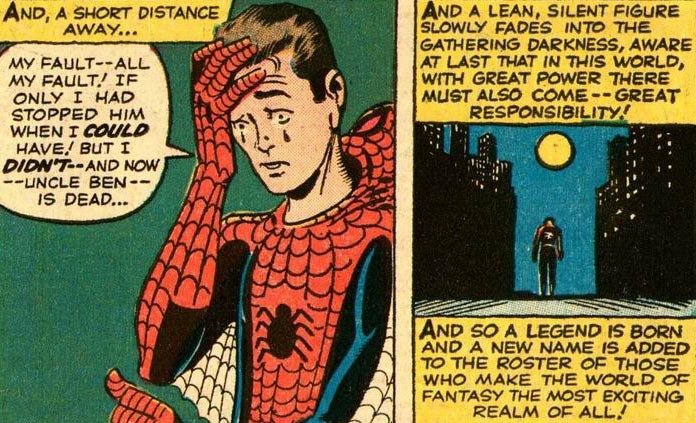
And for Peter Parker, this truism, however phrased, reveals his ongoing battle with the responsibility inherent in his acquiring super powers, complicated by that occurring without his choice. The world of Peter Parker/Spider-Man has been manipulated in the Marvel Universe (even literally) as an internal battle between that responsibility and Parker’s own personal desires (personified often as love interests such as Gwen Stacey and Mary Jane Watson).
In the real world, I believe, “With great power comes great responsibility” informs us in important ways, including a recurring concern about police using deadly force against young African American males, domestic violence, and the role of teachers in our classrooms.
Authoritarian v. Authoritative
As I have highlighted recently about the teacher Mrs. Price in Sandra Cisneros’s “Eleven”—“Because she’s older and the teacher, she’s right and I’m not”—the teacher/student relationship often hinges on whether the teacher embraces an authoritarian (Mrs. Price) or authoritative stance (see Freire).
Whether a person’s authority is a status (teacher, police) or a consequence of an imbalance of power (physical advantage, for example, men often have over women), authority (“great power”) carries with it “great responsibility.” Too often, however, those with that authority appear to forget or misunderstand what that responsibility is, resulting in a abuse of authority.
The authoritarian pose—might makes right—always fails people with authority but also those subjected to that authority: students, citizens, spouses, children.
Instead, the authoritative pose better serves the “great responsibility” of authority.
A first requirement of the authoritative pose is humility, embracing ones authority with the skepticism that the authority isn’t deserved, that especially those under that authority may merit the authority as much or more than anyone who holds it. That stance of humility allows those with authority to honor the dignity of those under that authority more than retaining the authority itself.
Whether the authority is a police officer (legal authority), a teacher (bureaucratic authority), or a husband (physical-dominance as authority), breeches of the responsibility of authority can often be traced to the person in authority seeking ways to prove that authority in order to retain the status. The consequence of this, of course, is sacrificing those subject to the authority, the ultimate abuse of authority (a police office shooting an unarmed person, a teacher crushing a student’s spirits, a husband hitting his wife).
A second requirement of the authoritative pose is seeking authority from authentic sources beyond status. While police and teachers, for example, cannot eradicate the status authority they hold, they can behave in ways that earn their credibility independent of their status. Police must not be above the law, for example, but must embody justice; teachers must not abdicate their content and teaching knowledge, but must model the highest qualities of teaching and learning for their students.
Here, physical authority represents a slightly different context in that having physical power gains credibility by the commitment never to use that physical dominance. Men must not hit women, and adults must not hit children. Such promises garner the highest levels of credibility, respect, and thus, authority.
The authoritative pose, then, is earned—whether in the context of authority status or not—and ultimately, the authoritative pose gains authority from honoring that “great responsibility” that lies in the dignity and safety of those under that authority.
The authoritarian pose remains a failure of both “great power” and “great responsibility.” We remain faced with too many examples of that failure, some subtle, some catastrophic.
While Peter Parker’s struggles with his superhero status remains enduring and compelling theater, the authoritarian pose remains a real-world tragedy we could do without.
—
See Q. and A.: Yong Zhao on Education and Authoritarianism in China

Our Practice, Our Selves
In my undergraduate introductory education course, I read aloud the first or second class Sandra Cisneros’s “Eleven.”
The central character is Rachel, and the setting is her school day on her eleventh birthday. School that day strips all the shine from what should be a day of celebration and joy for this child because her math teacher, Mrs. Price, demands that Rachel not only claim but also wear a red sweater the teacher is certain belongs to Rachel (although, as the readers, the teacher, and students discover, it doesn’t). A key moment in the story highlights the power dynamic between Mrs. Price and Rachel: “Because she’s older and the teacher, she’s right and I’m not.”
Even for college students (and especially for my sophomores when I taught high school in rural South Carolina), I am hard to take those first days, and even weeks. My teacher persona and my class ask a great deal of students, who often feel overwhelmed, disoriented, and even angry.
So this semester I have just had “the talk” with that introductory class (and I also teach two first years seminars that are writing intensive); it includes acknowledging that I recognize how disorienting my class and I are for them as well as reminding them of “Eleven” and Rachel.
I very consciously want my students to be intellectually and ideologically rattled, but I also am committed to a much more important and foundational imperative: Students must always feel and be physically, emotionally, and psychologically safe in their learning spaces that I orchestrate.
Rachel in Cisneros’s story cannot learn on that day when she feels tiny, powerless, dehumanized. And the agent of those feelings are Mrs. Price, her callous attitude toward her students (children), and ultimately her practice.
Our Practice, Our Selves
Those of us who teach are now likely beginning new academic years, whether at the K-12 or higher education levels. As a result, I have read many posts and conversations on social media about our practices.
For my first year students, for example, I shared John Warner’s really fine piece, New Cell Phone/Computer Policy Draft Version. The transition from high school (significantly rule-based) to college is often difficult for students for reasons beyond the greater academic expectations. I have found that the transition to making decisions and being self-sufficient is far more disorienting for our students than even the challenges of college academics.
I have also come across online debates about handling late work from students and even a Tweet about a professor banning students from emailing except for emergencies.
After 31 years of teaching, then, I have been thinking again about how our practice teaches our students who we are and sends lessons that may not be in either our or our students’ best interests. I want here to outline a few of these in order to highlight what has always driven me as a teacher, coach, and parent: Seeking ways in which to avoid practicing what I believe is the greatest failure among adults, hypocrisy—holding children to standards that we ourselves never meet:
- Let me start with Warner’s topic: cell phones and computers in class. Over my three decades as an educator, I have never attended a meeting with teachers or professors in which all of those attending paid full attention. In recent years, computers and cell phones are always out, and a significant number of teachers and professors are either multi-tasking or simply not paying attention. Thus, instead of imposing rules because I can, I discuss with students how and why their cell phones and laptops can be either productive or distracting in class—and how that is their decision, one that impacts everyone else in the room. I had similar talks with my high school students about needing to leave class to use the bathroom (automatic demerits where I taught, by the way). While teachers and schools are prone to embrace hard-line black-and-white rules, justifying them by invoking the real world, that approach to “rules” is in fact nothing like the real world.
- The professor banning email from students struck me hard because I not only encourage students to email me, but also give them my cell number and mention texting. In fact, I want communication from my students—and I expect that a significant amount of it will be frustrating (asking me information they should know) and even so-called “disrespectful” (emails with “BTW” and other such text-ese). But I encourage these communications because I seek as many opportunities to teach students as I can, and I also am committed to doing so with patience and affording them the dignity they deserve. I often say in class that they should feel free to say what they want in class, in part so I can warn them never to utter such again, especially in a college classroom.
- Both of the above, I think, are informed by my greatest pet peeve about (possibly) the most repeated commandment we make to teachers: Don’t be friends with your students. This always baffles and infuriates me because I cannot fathom what there is about friendship that isn’t appropriate for the teacher/student relationship. Kindness? Compassion? Attentiveness? I suspect that this dictum confuses a rightful restriction to the level of intimacy between teacher and student, but I also notice many teachers work so hard to maintain some artificial pose of professional distance between them and their students that all the humanity is drained out of teaching and learning. My students are my friends by default, and I love them. Again, I cannot comprehend how any of that should be avoided.
- And just to address one practice linked more directly to instruction: How do we treat late work? [1] First, I have already examined high and reasonable expectations for student work—in which I made an important point related to the first bullet above: While editing several scholarly volumes, I have yet to have all work submitted complete and on time by college professors and scholars. In fact, in each situation, a number of the pieces were late (not just one or two) and many had significant citation problems (including not using the requested style sheet) as well as most needing heavy copyediting and feedback. So once again, while meeting deadlines and high-quality work are obviously important to instill in students, both are not as pervasive in the adult world as many teachers model in their classes: “I don’t accept late work,” “Late work starts at a B (or C),” and such. I no longer grade work, but if I did, I would never put a grade on an artifact of learning that didn’t represent the quality of the artifact (and not outside aspects unrelated to that quality). I did include considerations of habitually late work in quarter grades when teaching high school, but the key there was “habitually late,” and the need to address that habit.
Basic human kindness and dignity—these are the lessons I want my students to learn. And I don’t see those lessons in rules, and certainly not embedded in adult hypocrisy. I feel compelled as a teacher to work against both extremes confronted by Paulo Freire:
It is in this sense that both the authoritarian teacher who suffocates the natural curiosity and freedom on the student as well as the teacher who imposes no standards at all are equally disrespectful of an essential characteristic of our humanness, namely, our radical (and assumed) unfinishedness, out of which emerges the possibility of being ethical. (p. 59)
How often under the considerable weight of being a teacher do we bend to the callousness of Mrs. Price (“the authoritarian teacher”) and her ultimate failure—”Because she’s older and the teacher, she’s right and I’m not”—at the expense of a child’s or young adult’s respect or dignity?
How often do we fall victim to what LaBrant confronted: “On the other hand, we should not, under the guise of developing literary standards, merely pass along adult weariness” (p. 276)?
Let us be vigilant in recognizing that our practice is our Selves. Let us seek always to avoid any of our students feeling as Rachel does on her eleventh birthday, a victim of “adult weariness”:
Today I’m eleven. There’s a cake Mama’s making for tonight and when Papa comes home from work we’ll eat it. There’ll be candles and presents and everybody will sing Happy birthday, happy birthday to you, Rachel, only it’s too late.
—
[1] See Late Work: A Constructive Response, Rick Wormeli
DRAFT NCTE Resolution: Grade Retention as Flawed Education and Reading Policy
DRAFT Proposal for Resolution [Please email your support, allowing your name to be included and note if NCTE member, and any edits ASAP to paul.thomas@furman.edu]
NCTE Resolution: Grade Retention as Flawed Education and Reading Policy
Grade retention as a major element in education and reading policy has been adopted by at least 14 states, with 32+ states linking reading intervention to high-stakes testing (Rose, 2012). These policies ignore four decades of research on the negative consequences of grade retention and the significant body of research on effective and supportive literacy instruction.
Grade retention, the practice of holding students back to repeat a grade, does more harm than good, including: (i) retaining students who have not met proficiency levels with the intent of repeating instruction is punitive, socially inappropriate, and educationally ineffective, (ii) grade retention, especially when based on high-stakes tests, will disproportionately and negatively impact children of color, impoverished children, ELL students, and special needs students, and (iii) grade retention is strongly correlated with behavior problems, increased drop-out rates, and discipline issues.
As such, grade retention represents a system of policies increasingly adopted based on misleading advocacy , resulting in a recursive cycle of punishment for young people, diminishing their sense of belonging and reducing their opportunity for educational equity. The academic benefits of retention are limited, short-lived and far outweighed by the negative consequences on students’ development in reading, writing, and all aspects of literacy. In fact, negative social, emotional, and academic effects of grade retention, at every level, are ongoing and persist into adulthood. Educators, policymakers, and political leaders must oppose the practice of retention.
The current pattern of political and public embrace of grade retention as a significant element in reading policy ignores solid decades of research refuting grade retention.
Resolved that NCTE strongly opposes the growing practice in several states of enacting into law grade retention requirements that children be retained in any grade who do not meet criteria in reading and other subjects.
And be it further Resolved that NCTE strongly opposes the use of high-stakes test performance as a major criterion for making judgments about retention in grade at any level or graduation.
If this resolution is adopted the NCTE staff will publicize this resolution to the public and urge similar actions by professional and other organizations. And the NCTE executive committee will schedule an agenda item to consider further implementations, including a plan to contact states with grade retention policies in order to advocate for repealing those policies and implementing sound literacy policy instead
Signed
NCTE Members
Yetta Goodman, Regents Professor Emerita
Ken Goodman, Professor Emeritus
Julie Gorlewski, Assistant Professor
David Gorlewski, Assistant Professor
P.L. Thomas, Associate Professor, Furman University
David Schultz, Assistant Professor
Janis Mottern-High
Steven Heller
Tara Seale
Renee M. Moreno, Ph.D.
Jesse P. Turner
Jeanne Gilliam Fain, Ph.D.
Joan Kaywell, Professor
Marjorie Siegel, Teachers’ College, Columbia U.
Renita Schmidt, COE, U.of Iowa
Dorothy King, retired
Connie Weaver, retired Endowed Professor of Reading and Writing, Miami U.
Diane Stephens, U. of So. Carolina
Prisca Martens, Towson U.
Jack S. Damico, U of Louisiana@Layfayette
Margaret Phinney, U. of Wisconsin River Falls
Amy Barnhill, U. of Houston, Victoria
Patricia L. Anders, U. of Arizona, COE
Michael Shaw, Director of the Reading Collaborative
J.C. Harste, retired Indiana U
Barbara Flores, San Bernadino City Unified School Board Member
Paul Crowley, Sonoma State U.
Yvonne Sui Runyan, NCTE Past President
Caryl Crowell, teacher, Tucson Unified School District
Eliane Rubinstein-Avila, Teaching, Learning & Sociocultural Studies, U. of Arizona.
Elizabeth Jaeger, Teaching, Learning & Sociocultural Studies, U of Arizona
Susan Seay, School of Ed., U. of Alabama, Birmingham
Richard Meyer, Language, Literacy and Sociocultural Studies, U. of New Mexico
Denny Taylor, Garn Press
Christian Z. Goering
Lenny Sanchez, U. of Missouri
Mitzi Lewison, Literacy, Culture & Language Education, Indiana U.
Koomi Kim, Mexico State U.
Kathryn Whitmore, Endowed Chair Early Childhood, U. of Louisville
Jan Turbill, U. of Woolongong, NSW, Australia
Carole Edelsky, retired, Arizona State U.
Dawn J. Mitchell, Adjunct Instructor Furman University/ Spartanburg Writing Project, USC Upstate
Sandra Wilde, City U. of New York
Bess Altwerger, Towson U.
Carol Lauritzen, Eastern Oregon U.
Nancy Patterson, Literacy Studies, Grand Vallley State U.
Scott Richie, Kennesaw State U.
Jane Baskwill, Mount Saint Vincent U.
Howard Miller, Mercy Coilege School of Education
Reade Dornan, retired Michigan State U.
John Stansell, Chair Teacher Education and Administration U. of North Texas
Karen Packard, retired
Dr. Geneva Smitherman
Additional Support
Dan Kenley, Retired K-12 Teacher, Principal, and Director
Bill Boyle, Principal
Tom Gallagher, Teacher
Russ Walsh
Jack Awtrey, Title I Academic Specialist, Elementary ELA
The Answer Sheet: Does holding kids back a year help them academically? No. But schools still do it.
Cashing in on Journalism’s Neutral Pose
As I have highlighted several times about how often education journalism fails the democratic goals of both the free press and universal public education, this Tweet from Juana Summers at NPR represents the power of the neutral pose among journalists:
@plthomasEdD I’m not sure it’s my place to say whether the study is credible, but we both note the significant criticism of the methods.
— Juana Summers (@jmsummers) June 18, 2014
Let me stress here, that this claim is not unique to Summers of NPR, but pervasive throughout media and journalism as the hallmark of “professionalism.” I have been mulling the breezy NPR approach to all topics for some time now, and thus was not surprised to find this piece from 1982, The Tedium Twins, which skewers the exact issue I have confronted over and over:
Trudging back through the “MacNeil/Lehrer” scripts, the hardy reader will soon observe how extraordinarily narrow is the range of opinion canvassed by a show dedicated to dispassionate examination of the issues of the day. The favored blend is usually a couple of congressmen or senators, barking at each other from either side of the fence, corporate chieftains, government executives, ranking lobbyists, and the odd foreign statesman. The mix is ludicrously respectable, almost always heavily establishment in tone. Official spokesmen of trade and interest groups are preferred over people who only have something interesting to say.
As we confront the inherent danger in honoring civility and balance over accuracy and taking evidence-based stances on credibility, we must also admit that the neutral pose is little more than a mask for something pretty insidious: the influence of the powerful and wealthy over what the media covers (and does not cover) and how those topics are framed. To that I invite you to read Mercedes Schneider’s Gates, Other “Philanthropy,” and the Purchase of a Success Narrative, including:
Billionaire Bill Gates funds the media.
This is no surprise to me.
What did surprise me is the discovery that he meets with the media he funds (and others) regularly behind closed doors.
[See also Adam Bessie and Dan Carino’s The Gates Foundation Education Reform Hype Machine and Bizarre Inequality Theory.]
So we are faced with our media and our educators trapped inside demands that they remain neutral, dispassionate, not political. And this is what that has gotten us (despite claims that our free press and public schools are essential to our democracy built on claims of equity and meritocracy), as detailed by Matt Bruenig:
The top 10% of families own 75.3% of the nation’s wealth. The bottom half of families own 1.1% of it. The families squished in between those two groups own 24.6% of the national wealth.
The present wealth distribution is more unequal than it was in 2010, the last year this survey was conducted. Specifically, the top 10% increased their share of the national wealth by 0.8 percentage points between 2010 and 2013. The bottom half and middle 40% saw their share of the national wealth fall by 0.1 and 0.7 percentage points respectively.
Bruenig also highlights that economic inequity in the U.S. is race-based (whites own the U.S.) and that within that white imbalance, there exists another layer of class imbalance:
This means that the top 10% of white families own 65.1% of all the wealth in the nation. The bottom half of white families own just 2% of the national wealth. And the white families in the 50th-90th percentile of white families own 22.9% of the national wealth.
Along the media spectrum from the breezy NPR dispassion (the so-called “Liberal Media”) and the faux “fair and balance” of Fox News (the so-called “Right-wing Media”), we must admit there is little difference in the consequences of any of our media since, as Paulo Freire has warned, all that neutrality is ironically not neutral at all.
As poet Adrienne Rich [1] has confronted:
Universal public education has two possible—and contradictory—missions. One is the development of a literate, articulate, and well-informed citizenry so that the democratic process can continue to evolve and the promise of radical equality can be brought closer to realization. The other is the perpetuation of a class system dividing an elite, nominally “gifted” few, tracked from an early age, from a very large underclass essentially to be written off as alienated from language and science, from poetry and politics, from history and hope—toward low-wage temporary jobs. The second is the direction our society has taken. The results are devastating in terms of the betrayal of a generation of youth. The loss to the whole of society is incalculable. (p. 162)
That second and wrong direction is the result of the neutral pose.
For Further Reading
Universal Public Education—Our (Contradictory) Missions
—
[1] Rich, A. (2001). Arts of the Possible: Essays and Conversations. New York, NY: W. W. Norton and Company.
 dr. p.l. (paul) thomas