Parents and Language: The Good, the Bad, and the Ugly

The Good

Middle-class and affluent parents are good because they pass on to their children good cultural capital (such as good literacy).

The Bad

Impoverished parents and working-poor parents are bad because they pass on to their children bad cultural capital (such as bad literacy).

The Ugly

Many, if not most people, in the U.S. embrace the above class- (and race-) based views of parenting and language (vocabulary, grammar, reading, and writing).

This ugly social mythology is identified by Pierre Bourdieu in Acts of Resistance:

I’m thinking of what has been called the “return of individualism,” a kind of self-fulfilling prophecy which tends to destroy the philosophical foundations of the welfare state and in particular the notion of collective responsibility….The return to the individual is also what makes it possible to “blame the victim,” who is entirely responsible for his or her own misfortune, and to preach the gospel of self-help, all of this being justified by the endlessly repeated need to reduce costs for companies….

In the United States, the state is splitting into two, with on the one hand a state which provides social guarantees, but only for the privileged, who are sufficiently well-off to provide themselves with insurance, with guarantees, and a repressive, policing state, for the populace. (pp. 7, 32)

But these deficit views that feed an environment of victim blaming also have been echoed in the comment section of a recent piece of mine refuting those very deficit views (see the reposting and comments at The Washington Post‘s PostEverything).

The ugliness rests on two separate and related issues—parents and language.

Parenting: Good or Bad versus Scarcity or Slack

Within a cultural of individualism, perceptions of  good or bad parenting are strongly correlated with social class—as noted above. Unpacking why and how those perceptions exist reveals the ugliness.

Despite evidence to the contrary—evidence that shows class and race are more powerfully correlated with success than effort—impoverished parents are blamed as bad and affluent parents are praised as good when we assume that individual effort of those parents has determined their status.

The focus on the individual also feeds assumptions about whether or not parents can, will, or even want to provide the necessary care and initial teaching for their children. See this comment as one of several such claims:

Being poor is not the problem…..acceptance of poverty and the social position it implies is the problem. When the poor decide that they would like their children to be better off than their parents, efforts will be made in that direction…..but, if the poor decide to instill in their children the idea that being poor is better than being rich, and that the rich are the bad guys in the play, the poor will remain resentful and poor which will define them and their children.

What is often missing in all of this are the tight margins of living in scarcity (poverty) as compared to the slack of living in affluence.

For example, good but impoverished parents may appear to be “bad” when compared to poor or neglectful affluent parents who appear to be “good”—especially when we focus on proxies for the quality of parenting such as a child’s vocabulary.

Good and conscientious but impoverished parents, doing the best they can under the stress and within the tight margins of poverty, may be accurately associated with a non-standard home language, and as a result, their children may enter school with measurable literacy that is deemed behind affluent children, whose parents may have been neglectful. However, those affluent children raised in the slack of affluence may have had surrogate people and experiences that mask the weak parenting.

Impoverished parents, on the other hand, have all of their decisions and all of the factors outside of their control amplified negatively by their poverty; while affluent parents have their weaknesses masked or even mitigated by their affluence.

Class-based differences in child rearing are not “good” versus “bad,” as much as more affluent children’s rearing matches social expectations, ands thus appears “good” in that context. [1]

Poverty creates reduced circumstances, razor-thin margins, and relentless stress; as Sendhil Mullainathan and Eldar Shafir note, people cannot take vacations from poverty.

Affluence, however, allows slack, an abundance of time and money that buffers mistakes, carelessness, and behaviors that would otherwise be considered “bad.”

Whether parents are “good” or “bad” is profoundly impacted by status (class and race)—more so than by individual qualities alone.

The Lingering, but Flawed, Connection Between Language and Character

The related ugly is our lingering, but flawed, connection between language and character. Many in the U.S. remain convinced that vocabulary, grammar, and even pronunciation are signals of not just intelligence but the “good” or “bad” in a person.

Non-standard English is associated with race and class, revealing more about our classism and racism than about linguistics or individual character (again, read the comments section linked above).

Deficit views of language perpetuate beliefs that the poor and racial minorities speak broken or inferior forms of English; that their language is not merely different, but inferior.

Alice Walker’s The Color Purple is an epistolary novel, a story told in letters. As impoverished, black women, Celie and Nettie create a rich tapestry of using language to confront and recreate their worlds. Walker’s novel, then, is a powerful rebuking of the belief that poverty and racial minorities are the provinces of flawed or deficient language.

The impoverished do not pass on “bad,” but socially marginalized language to their children; we must admit that non-standard forms of language trigger the dual ugliness of classism and racism in the U.S.

In 1963, novelist Ralph Ellison confronted this language stereotype directly:

“Language is equipment for living,” to quote Kenneth Burke. One uses the language which helps to preserve one’s life, which helps to make one feel at peace in the world, and which screens out the greatest amount of chaos. All human beings do this.

Further, Ellison rejects the deficit view held about the language of poor blacks:

Some of us look at the Negro community in the South and say that these kids have no capacity to manipulate language. Well, these are not the Negroes I know. Because I know that the wordplay of Negro kids in the South would make the experimental poets, the modern poets, green with envy. I don’t mean that these kids possess broad dictionary knowledge, but within the bounds of their familiar environment and within the bounds of their rich oral culture, they possess a great virtuosity with the music and poetry of words. The question is how can you get this skill into the mainstream of the language, because it is without doubt there. And much of it finds its way into the broader language. Now I know this just as William Faulkner knew it. This does not require a lot of testing; all you have to do is to walk into a Negro church.

Also unmasking deficit views of language related to class and race, in 1979, James Baldwin asked, “If Black English Isn’t a Language, Then Tell Me, What Is?”:

The argument concerning the use, or the status, or the reality, of black English is rooted in American history and has absolutely nothing to do with the question the argument supposes itself to be posing. The argument has nothing to do with language itself but with the role of language. Language, incontestably, reveals the speaker. Language, also, far more dubiously, is meant to define the other–and, in this case, the other is refusing to be defined by a language that has never been able to recognize him.

Like Ellison, Baldwin recognizes poetry where others see deficit:

Now, I do not know what white Americans would sound like if there had never been any black people in the United States, but they would not sound the way they sound. Jazz, for example, is a very specific sexual term, as in jazz me, baby, but white people purified it into the Jazz Age. Sock it to me, which means, roughly, the same thing, has been adopted by Nathaniel Hawthorne’s descendants with no qualms or hesitations at all, along with let it all hang out and right on! Beat to his socks which was once the black’s most total and despairing image of poverty, was transformed into a thing called the Beat Generation, which phenomenon was, largely, composed of uptight, middle-class white people, imitating poverty, trying to get down, to get with it, doing their thing, doing their despairing best to be funky, which we, the blacks, never dreamed of doing–we were funky, baby, like funk was going out of style.

Ultimately, then, Baldwin states boldly his own recognition of the ugly:

The brutal truth is that the bulk of white people in American never had any interest in educating black people, except as this could serve white purposes. It is not the black child’s language that is in question, it is not his language that is despised: It is his experience. A child cannot be taught by anyone who despises him, and a child cannot afford to be fooled. A child cannot be taught by anyone whose demand, essentially, is that the child repudiate his experience, and all that gives him sustenance, and enter a limbo in which he will no longer be black, and in which he knows that he can never become white. Black people have lost too many black children that way.

And now we are still confronted with “the brutal truth,” as Baldwin puts it. Why do we cling to deficit views of poverty and language, and why are so many angry and bitter toward people—families and children—who find themselves in poverty—while simultaneously praising the affluent?

It may well be that neither the quantity or quality of words children bring to school nor that both are strongly correlated with the socioeconomic status of those children’s parents matters as much as our cultural bitterness, callousness.

More important is how adults use words to demonize the marginalized and create an Other so that they do not have to confront themselves. [2] Again, if you doubt me, return to those comments that suggest to me that if we wish to judge parents by their children, there we have ample evidence to draw some pretty harsh conclusions.

[1] See Annette Lareau, Unequal Childhoods: Class, Race, and Family Life, who explains about the differences in child rearing by class between middle-class and working-class/poor families:

The differences are striking….

Neither the approach of concerted cultivation or the accomplishment of natural growth is without flaws. Both have strengths and weaknesses [emphasis added]. Middle-class children, for example, are often exhausted, have vicious fights with siblings, and do not have as much contact with their extended families as working-class and poor children. But when children enter institutions such as schools and health care settings, the strategy of middle-class child rearing of concerted cultivation is far more in compliance with the current standards of professionals than is the approach of the accomplishment of natural growth. There are signs that middle-class children gain advantages, including potentially in the world of work, from the experience of concerted cultivation. Working-class and poor children do not gain this benefit.
[2] See the ugliest of ugly here.

Shifting Our Deficit Gaze, Asking Different Questions about Literacy

Poor Kids and the “Word Gap” opens with an important admission by Jessica Lahey: The Horace Mann ideal that education is the “great equalizer” has not materialized (or at least, has eroded). While the impact of education appears powerful within class and race classifications, educational attainment remains ineffective in overcoming social inequity.

As the article title states, however, Lahey turns to the “word gap”—a compelling and repeated entry point for discussing the educational differences among social classes and races of children. Quoting a Clinton Foundation report, the article equates that “word gap” with childhood hunger and food insecurity before detailing the Obama administration’s initiative to bridge that socioeconomic word gap.

Lahey’s article, the Clinton Foundation, and the Obama initiative are all sincerely grounded in good intentions, and all rightfully highlight the need to address the inequity of education in the U.S. that mirrors the social inequities a rising and high percentage of impoverished children experience.

But, once again, the problem persists that we remain committed to a deficit gaze, one that ultimately blames the parents of children in poverty (often the mother) for the “word gap.”

Looking closely at the Clinton Foundation report, in fact, reveals that Hart and Risley’s 1995 research (see chart on page 10) continues to anchor assumptions that the quantity and quality of words are linked to both the socioeconomic status of a child’s home and then the child’s ability to succeed once in formal schooling.

As Dudley-Marling and Lucas emphasize, the foundational study by Hart and Risley and pathologizing the language of impoverished students are misguided and misleading because of the essential deficit perspectives embedded in each, perspectives reflecting and perpetuating stereotypes. “Pathologizing” language means that the language itself is seen as a “sickness” and thus what must be “treated”—including the concurrent implicating that the host of the language, the child, is also diseased and must be treated.

As well, research in the UK reveals that the dynamic among literacy, social class, and educational attainment is complex, but also powerful. Pleasure reading and even the quality of that reading appear to increase literacy in adults, Sullivan and Brown detail.

Sullivan reaches two important conclusions: the need to protect the library and the importance of books in the child’s home.

This focus—on strategies for enriching the literacy of children born into impoverished homes—offers important ways for shifting our deficit gaze away from blaming the victims of poverty and toward systemic causes for characteristics (“word gap,” for example) so that we can develop policy to prevent the conditions in the first place and also create contexts for alleviating inequity that already exists.

The great challenges facing the U.S. and our disturbingly high percentage of children living in poverty are social inequities linked to classism and racism. We must admit these problems, and then we must address them directly (and not by clinging to idealistic beliefs such as education will be the “great equalizer”).

But we must also address directly the existing inequities reflected in the homes and education of impoverished children.

Let’s not blame high-poverty mothers; instead, let’s develop policies that provide books for children in their homes while we commit to social programs that allow impoverished families the sort of security and opportunities supporting them in their roles as a child’s first teachers.

Let’s not diagnose and then treat impoverished children and their literacy; instead, let’s insure that all children have rich and engaging formal schooling experiences

The deficit gaze fails because it focuses on people and not the conditions within which people find themselves (through no fault of their own).

Regardless of good intentions, we must shift our deficit gaze and begin to ask different questions so we can create new and more humane answers.

Unpacking Education and Teacher Impact

Among media, political, and public claims driving calls for education reform, two beliefs are dominant: (i) education is the single most important lever for lifting anyone above the circumstances of her/his birth, and (ii) teacher quality is the single greatest factor in whether that educational experience accomplishes the first belief.

As I have increased my contribution to public debates about education reform, I have witnessed that media, political, and public comments are often knee-jerk and simplistic either/or responses to complex research.

For example, when I note that 40 years of research reject grade retention, responses tend to discount that research with “So you want us just to pass them on?”—suggesting that social promotion is the only alternative to grade retention (which, of course, it isn’t). Similarly, when I share that 60 years of research on corporal punishment also refute spanking—that, in fact, there is no debate on its use—responses immediately include, “So we are just supposed to let children do whatever they want?”

But I have also discovered that in my education courses, students challenge many research-based conclusions, although the students are more thoughtful—particularly when I share the evidence on the impact of education and teachers [1].

Consider the follow body of evidence below; and then, in the context of this evidence, I want to unpack what education and teacher impact actually entails.

Is teacher quality actually the single greatest factor in student achievement? Di Carlo details what research shows:

But in the big picture, roughly 60 percent of achievement outcomes is explained by student and family background characteristics (most are unobserved, but likely pertain to income/poverty). Observable and unobservable schooling factors explain roughly 20 percent, most of this (10-15 percent) being teacher effects. The rest of the variation (about 20 percent) is unexplained (error). In other words, though precise estimates vary, the preponderance of evidence shows that achievement differences between students are overwhelmingly attributable to factors outside of schools and classrooms (see Hanushek et al. 1998; Rockoff 2003; Goldhaber et al. 1999; Rowan et al. 2002; Nye et al. 2004).

Also consider Donald Hirsch’s research on the UK for the Joseph Rowntree Foundation: “Just 14 per cent of variation in individuals’ performance is accounted for by school quality [emphasis added]. Most variation is explained by other factors, underlining the need to look at the range of children’s experiences, inside and outside school, when seeking to raise achievement.”

We see here two important points: (i) out-of-school factors dwarf measurable influences of teacher quality, and (ii) teacher quality is a subset of school quality. Thus, school and teacher quality is not even close to the most important measurable factor in student achievement.

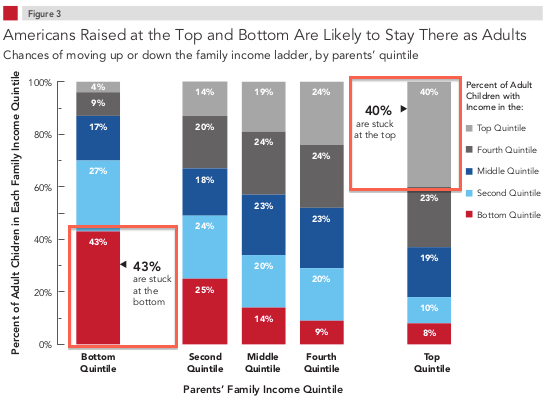
Now, what is the evidence on social mobility in the U.S., notably in terms of how educational attainment influences the relationship between social class or race and that mobility?

Social mobility appears fairly sticky in the bottom and top quintiles:

mobility
From Pew’s Economic Mobility Project data; analysis by Bruenig, 2013, June 13: “As far as income mobility goes, you are 10x more likely to wind up in the richest fifth as an adult if you were born there than if you were born in the poorest fifth.”
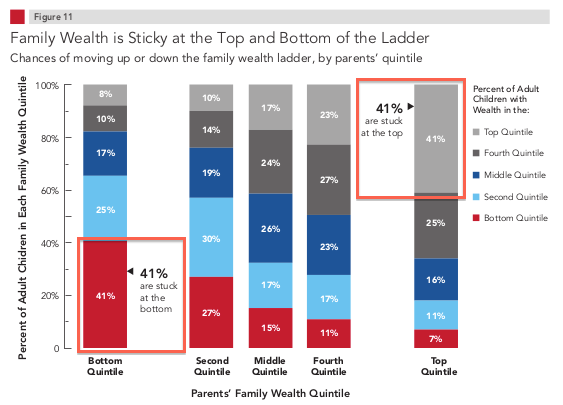
Fig 11
From Pew’s Economic Mobility Project data; analysis by Bruenig, 2013, June 13: “As far as wealth mobility goes, you are more than 5x more likely to wind up in the wealthiest fifth as an adult if you were born there than if you were born in the least wealthiest fifth.”

Next, Bruenig (2013, June 13) concludes:

One convenient way to describe what’s going on is that rich kids are more likely to get a better education, which translates into being richer and wealthier as adults. It is certainly the case that richer kids are more likely to get a college degree, and it is certainly the case that getting a college degree leaves you much better off on average than not getting one. But this does not explain the full picture of social immobility [emphasis added].

And thus, social mobility appears more strongly connected to the social class of a person’s family than to education (a function of combined school and teacher quality):

educationandmobility
From Pew’s Economic Mobility Project data; analysis by Bruenig, 2013, June 13: “[Y]ou are 2.5x more likely to be a rich adult if you were born rich and never bothered to go to college than if you were born poor and, against all odds, went to college and graduated.”
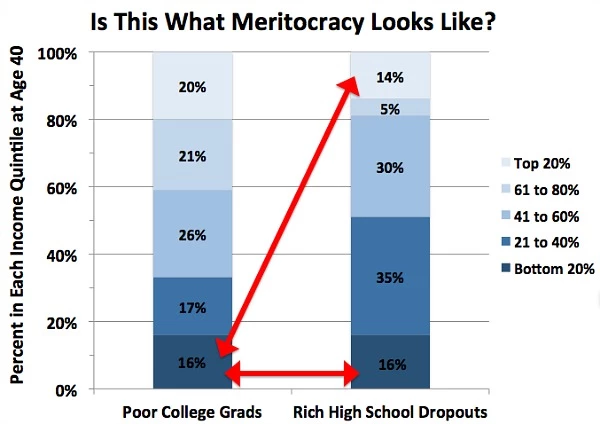
The consequences of the dynamic between social class and education are, as Matt O’Brien explains, as follows:

meritocracy
Data from Richard Reeves and Isabel Sawhill. O’Brien concludes: “Even poor kids who do everything right don’t do much better than rich kids who do everything wrong.”

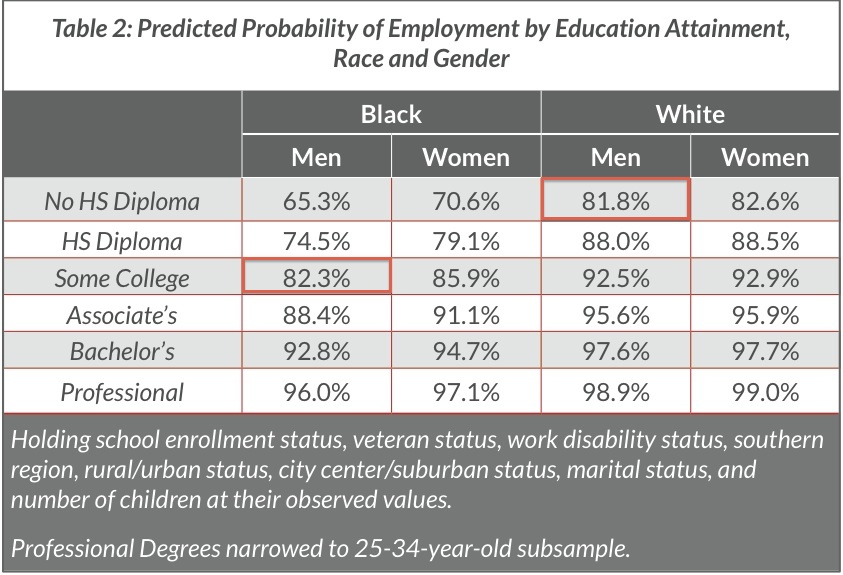
Now, consider the relationship between educational attainment and race. First, in Closing the Race Gap, O’Sullivan, Mugglestone, and Allison (2014) detail that blacks with some college earn about the same as whites with no high school diploma:

Table 2 copy
O’Sullivan, Mugglestone, and Allison (2014)

From this report as well, Susan Adams explains: “African-American college students are about as likely to get hired as whites who have dropped out of high school.”

Significant income disparities exist along racial lines despite educational attainment, as Bruenig (2014, October 24) shows:

fig_2
Bruenig (2014, October 24): “First, understand that blacks and Hispanics have lower incomes than whites up and down the educational spectrum. On average, black families at a given level of educational attainment receive incomes that are just 66% of what white families at the same level of educational attainment receive. For Hispanic families, that figure is 79%. Naturally, when education-controlled income disparities like this exist, education-controlled wealth disparities will exist.”

The impact of education (school and teacher quality), then, when placed in the context of both social class and race refutes the opening claims: (i) education is the single most important lever for lifting anyone above the circumstances of her/his birth, and (ii) teacher quality is the single greatest factor in whether that educational experience accomplishes the first belief.

When I offer these measurable facts to either the public or my students, often I hear: “So you are saying that education and teachers do not matter?”

Here is the hard part.

First, making claims that measurable education and teacher impact exists is problematic. Thus, I absolutely support that both education and teachers matter, but I also caution that this impact is not singular, direct, or easily quantified.

Part of that problem is that the impact of any person’s education or the influence of any teacher or teachers tends to occur over long periods of time, and we are hard pressed to tease out and measure specific teachers or practices since that impact is cumulative, interrelated, and multi-faceted (consider that a student can learn a valuable lesson from a flawed lesson or a weak teacher).

Our first conclusion, then, is that making claims about education being the single or sole factor in success or that the teacher is the single most important factor in achievement is misleading, overly simplistic.

But, there are fair and accurate claims we can make about the importance of education, leading to our second conclusion.

Our second conclusion is that within social class and race, educational attainment has significant influence, but that education alone appears less effective in overcoming large social inequities such as classism and racism.

From this, I think we have several important lessons:

  • Media, public, and political hyperbole about education and teacher impact does a disservice to public education, teachers, students, and the public. Overstating the impact of education and teachers assures that we will continue to fail our students and the promise of universal public education.
  • In our endless quest for education reform, we would be better served if we moved away from mostly measurable data points for making claims about and policies in education. Education is messy and complicated; quantified data are in fact simplistic and misleading.
  • Until we confront the corrosive influence of class and race in the U.S. and until we admit that education alone is not enough to overcome classism and racism, we are perpetuating social inequity.

Let’s be clear: Education and teachers matter. But, regretfully, they simply do not matter in the ways most people claim or believe, and certainly not in ways that are easy to identify.

The good news, however, is that there is much we can do to change this, if we have the resolve to confront the evidence, accept the ugly truths, and then to do something different.

See Related: If social mobility is the problem, grammar schools are not the solution, Gaby Hinsliff


[1] This post is in debt to my current, fall 2014 EDU 111 course at Furman University, a group of students fully committed to engaging with the topics, challenging claims, and seeking to understand the complexity of education. They are proof that teaching is an act of learning, if the teacher is there to listen as well as talk.

Karma, Tested by the Universe, or The Day I Did Not Kill My Dog

This past summer we had to put down both our dear chocolate lab Hershey and one month later our black lab Scout (named by her breeder after the To Kill A Mockingbird character).

I wanted a new lab immediately after Hershey, but my wife did not, unable to rise out of the pain from that loss (in most ways, they were very much her dogs). After the loss of Scout, however, we did buy a new pup, dear Zoe, a yellow lab.

Zoe 2
Sweet Zoe, with her wonderful green eyes, groggy in my floorboard after her adventure in spaying. (Note: Zoe is very smart, but, no, she isn’t reading Margaret Atwood’s new collection of stories.)

Yesterday as I was working on a blog post, I glanced outside to see Zoe chewing on the broom. A classic lab, Zoe chews everything; in fact, I believe she is Olympic or Guinness Book level in her chewing, and destruction.

So I went out, retrieved the broom, and then as I walked through the garage, I considered the possibility that my special edition Ridley Excalibur Flandrien bicycle was a target for Zoe. And much to my dismay, that feeling was confirmed:

Zoe 1
SRAM Force 22 carbon fiber cranks, bottle cages, and rear derailleur cable housing (not pictured) destroyed by dear Zoe. (Hint: Very expensive cycling parts.)

Let me pause here and back up.

This was Tuesday, and on Monday, I had participated in an online debate about corporal punishment for The Stream. That invitation was the result of recent pieces of mine arguing against corporal punishment, ironically for the show, stating that there is no debate about spanking.

During the discussion, I did not have the chance, but at one point, I wanted to say that I now own a new lab pup, and I wouldn’t dare hit a puppy—I certainly wouldn’t hit a child.

I have never been one for spirituality, or mysticism. But someone very dear to me, after years of my resistance, did bring me around to accepting karma, or at least that some universal consciousness exists—one seeking balance and possibly justice.

And thus, I stood in the garage with Zoe leaping against my leg; she is deep into the jumping and snipping phase, ruining our clothes, leaving bloody nicks on our hands and arms. I stood there looking at my precious bicycle, and I didn’t yell at, hit, or kill Zoe.

The damage done to the bicycle, of course, was my fault.

With my chest heavy, I took the bicycle inside—a bit angry I would have to spend the morning touching up the crank, replacing the cages and the cable housing, and thus eating into writing time—and then I took apart Zoe’s cage we had used when she was smaller but left in the garage because she was attached to the confines even though we now leave its gate open.

With some zip ties, I carefully created a barrier between Zoe and the side of the garage where my bicycle racks are.

Zoe is a beautiful and loving creature, but she is a dog. I am the human in this relationship.

In the same way, children are children, and any time a child is put in our care, we must observe the very real fact that we are the adults in those relationships.

As I carefully applied black and clear touch-up paint to the crank of my bicycle, I hoped I had been convinced correctly. I hoped for karma, for a universe seeking balance. But I also knew one thing for sure, a lesson from the universe: You better be ready to put up or you better shut up.

At least that appeared to be just behind Zoe’s amazing green eyes as she wanted nothing more than my attention while I wrestled against my anger spurred by her teeth marks etched in carbon.

Media Fail, 10,000 hours, and Grit: The Great Media-Disciplines Divide, pt. 2

In his The Danger of Delegating Education to Journalists: Why the APS Observer Needs Peer Review When Summarizing New Scientific Developments [1], K. Anders Ericsson makes several key points about how the mainstream media present disciplinary knowledge to the public, focusing on Malcolm Gladwell’s misleading but popular 10,000 hour rule.

Ericsson’s key point includes:

Although I accept that the process of writing an engaging popular article requires considerable simplification, I think it is essential that the article does not contain incorrect statements and misinformation. My primary goal with this review is to describe several claims in Jaffe’s article that were simply false or clearly misleading and then discuss how APS might successfully develop successful methods for providing research summaries for non-specialists that are informative and accurately presents the major views of APS members and Fellows. At the very least they should not contain factually incorrect statements and avoid reinforcing existing misconceptions in the popular media.

Through the Gladwell/10,000 hour rule example, Ericsson provides an important argument relevant to the current (and historical) public debate about school quality, teaching and learning, and education reform.

Much in the same way Gladwell has misrepresented research (which is typical within the media), and how that has been uncritically embraced by the media and public (as well as many if not most practitioners), a wide array of issues have received the same fate: learning styles, “grit,” collaborative learning, progressive education, charter schools, school choice, language gap, and so on.

Even when a claim or practice has a kernel of research at its source, popular oversimplification (often by journalists, but practitioners as well) and then commercialization/politicizing (creating programs and policies through publishers, “star” advocates, and legislation) significantly distort that research.

Education Has Failed Research, Historically

John Dewey represents an odd paradox in that he is possibly the most mentioned educator in the U.S. (either as the source of all that is wrong in education or idealistically cited as all that is right about how school could be), despite the reality that Dewey is mostly misunderstood and misrepresented; and thus his philosophy, progressivism, remains mostly absent in U.S. public schools.

Dewey can be blamed, in part, for this reality because he refused on principle to allow his experiments in education to be carefully catalogued because he believed no educational practice should be come a template for others.

Throughout much of the twentieth century, Lou LaBrant, a vigilant progressive educator, spent much of her career practicing and advocating for progressive literacy instruction, but LaBrant also confronted the many instances of how progressivism was misrepresented.

Broadly, and early, LaBrant recognized the public confusion about progressivism:

Two adults speak of “progressive education.” One means a school where responsibility, critical thinking, and honest expression are emphasized; the other thinks of license, lack of plans, irresponsibility. They argue fruitlessly about being “for” or “against” progressive education. (LaBrant, 1944, pp. 477-478)

But she also confronted how progressivism was mostly distorted in its application. LaBrant’s criticisms still reflect why education has failed research, and why research has not failed education.

Credible educational research-based philosophy, theory, and pedagogy are often corrupted by oversimplification.

In 1931, LaBrant published a scathing criticism of the popularity of the project method, an oversimplification of Dewey that resulted in students doing crafts in English class instead of reading or writing:

The cause for my wrath is not new or single. It is of slow growth and has many characteristics. It is known to many as a variation of the project method; to me, as the soap performance. With the project, neatly defined by theorizing educators as “a purposeful activity carried to a successful conclusion,” I know better than to be at war. With what passes for purposeful activity and is unfortunately carried to a conclusion because it will kill time, I have much to complain. To be, for a moment, coherent: I am disturbed by the practice, much more common than our publications would indicate, of using the carving of little toy boats and castles, the dressing of quaint dolls, the pasting of advertising pictures, and the manipulation of clay and soap as the teaching of English literature. (p. 245)

Credible educational research is often corrupted by commercialization/politicizing, reducing that research to misguided programs/legislation.

“[L]anguage behavior can not be reduced to formula,” LaBrant (1947) argued (p. 20)—emphasizing that literacy growth was complicated but flourished when it was child-centered and practical (for example, in the ways many privileged children experience in their homes because one or more of the parents are afforded the conditions within which to foster their children’s literacy).

By mid-twentieth century, LaBrant (1949) had identified the central failure of teaching reading: “Our language programs have been set up as costume parties and not anything more basic than that” (p. 16).

For at least 80-plus years since LaBrant fought this fight, the same patterns of media, political, public, and practitioners failing educational research have continued

Oversimplification, Commercialization/Politicizing: Recovering the Evidence

The list is incredibly long, too long to be exhaustive here, but consider the following: sloganism (“Work hard. Be nice.”), silver-bullet ideologies (“grit,” 10,000-hour rule), miracle schools (KIPP), evidence-based programs (Dibbles, 4-block, 6-traits), common sense claims and policy absent evidence (Common Core), and trendy legislation (3rd-grade retention policies as reading policy, merit pay) as well as politicized government reports (National Reading Panel).

Each of these can be traced to some kernel of research (sometimes robust bodies of research, and sometimes cherry-picked research), but all of these represent a current and historical fact: Education has failed research, but research has not failed education.

When educational research is reduced to scripts or programs/legislation, that knowledge base is invariably distorted, corrupted—as Ericsson details well above.

Journalists, politicians, and commercial education entities have all played a fundamental and crippling role in this reality; thus, as Ericsson argues, educators, scholars and researchers must not allow the fate of educational research to remain primarily in the wrong hands.

We have a public and professional obligation to confront these oversimplifications as well as the commercialization/politicizing of educational research. And we must do this through our public work that speaks to those failures and the public simultaneously.

As LaBrant and Ericsson reveal, unless we take that call seriously, we too are part of the reason education continues to fail research.

References

LaBrant, L. (1949). A genetic approach to language. Unpublished manuscript, Institute of General Semantics, Lakeville, CT.

LaBrant, L. (1947). Um-brel-la has syllables three. The Packet, 2(1), 20-25.

LaBrant, L. (1944, November). The words they know. The English Journal, 33(9), 475-480.

LaBrant, L. (1931, March). MasqueradingThe English Journal, 20(3), pp. 244-246.

For Further Reading

U.S. and Education Reform Need a Critical Free Press

My Open Letter to Journalists: A Critical Free Press, pt. 2

NPR Whitewashes “Grit” Narrative

Shiny Happy People: NPR, “Grit,” and “Myths that Deform” pt. 2

How I Learned to Distrust the Media (about Education)

My (Often Painful) Online Education

[1] See original and downloadable link to the paper here.

GUEST POST: The Danger of Delegating Education to Journalists, K. Anders Ericsson

The Danger of Delegating Education to Journalists: Why the APS Observer Needs Peer Review When Summarizing New Scientific Developments

K. Anders Ericsson, Department of Psychology, Florida State University

Tallahassee, Florida, October 28th, 2012

I have always viewed the APS Observer as a source for up-to-date summaries of advances in the wide research domains of the Association for Psychological Science (APS). Receiving summarized information about research outside my domain of expertise is only helpful if it accurately represents the consensus views of the active APS members and Fellows. The cover article by Eric Jaffe on “Piecing together performance” in the September 2012 issue of the APS Observer focused on my own area of expertise, namely expert performance and deliberate practice, so I feel that I am able to assess the accuracy of its presentation [1].

Although I accept that the process of writing an engaging popular article requires considerable simplification, I think it is essential that the article does not contain incorrect statements and misinformation. My primary goal with this review is to describe several claims in Jaffe’s article that were simply false or clearly misleading and then discuss how APS might successfully develop successful methods for providing research summaries for non-specialists that are informative and accurately presents the major views of APS members and Fellows.  At the very least they should not contain factually incorrect statements and avoid reinforcing existing misconceptions in the popular media.

Jaffe’s  (2012, p. 13) article discusses recent research on one of the longstanding issues in Psychology, namely  “the roles of natural endowment and hard work in human performance”(Jaffe, 2012, p. 13). It goes on to state that “Ericsson and his colleagues found in a 1993 study that professional musicians had accumulated about 10,000 hours of deliberate practice over the course of a decade. The results became the basis of Ericsson’s deliberate practice theory of elite performance, also called the 10,000 hour rule” (Jaffe, 2012, p. 13). With these two sentences Jaffe reinforces misconceptions in some popularized books and internet blogs that incorrectly infer a close connection between deliberate practice and the “10,000 hour rule”.  In fact, the 10,000 hour rule was invented by Malcolm Gladwell (2008, p. 40) who stated that “researchers have settled on what they believe is the magic number for true expertise: ten thousand hours.” Gladwell cited our research on expert musicians as a stimulus for his provocative generalization to a magical number. Our research found that the best violinists reported having spent a remarkably large number of hours engaged in solitary practice when, in fact, 10,000 hours was the average of the best group; indeed most of the best musicians had accumulated substantially fewer  hours of practice at age 20. Our paper found that the attained level of expert music performance of students at an international level music academy showed a positive correlation with the number of solitary practice hours accumulated in their careers and the gradual improvement due to goal-directed deliberate practice. In contrast, Gladwell (2008) does not even mention the concept of deliberate practice.

The focus of Jaffe’s (2012) paper is to report on empirical evidence to reject a straw man primarily advocated by bloggers on the internet. The Jaffe strawman argues that individuals would only display clearly superior performance after 10,000 hours or ten years of practice. This strawman is even rejected by our research on deliberate practice in music and other domains. The music performance of our violinists developed gradually by engaging in solitary practice under the guidance of teachers and coaches. In our study, the best violinists had practiced significantly more than the two less skilled groups of violinists (Ericsson, Krampe, & Tesch-Römer, 1993). After only a few thousands of hours of solitary practice, the music performance of our musicians was clearly superior to other groups of amateur musicians at the time they were accepted to the music academy.

Jaffe’s most surprising and potentially most damaging criticism of deliberate practice was made in the section with the interview with Joanne Ruthsatz, where she is described as having “reanalyzed Ericsson’s data from the 1993 study and found that the top violinists had begun to distance themselves well before they’d put in 10,000 hours“ (Jaffe, 2012, p. 13) [2]. Most remarkably, Jaffe’s APS article goes on to quote Ruthsatz as saying that, “when they [the top violinists] were eight years old, for instance, they won two-thirds of their competitions. Compare that to the “good” students, who only won about half at that age, and the lowest group, who won about a fifth of the time.” (p. 13). This statement is puzzling in light of our 1993 paper, which says that “The biographic histories of the four groups of subjects with respect to violin playing are remarkably similar and show no systematic differences between groups. The age when they began practice was 7.9 years old and essentially coincided with the age of starting systematic lessons, which was 8.0-years-old” (Ericsson et al., 1993, p. 374). Taken together, these two statements would imply thatthe violinists in all groups won competitions even before they started playing the violin or took systematic lessons—if confirmed, it would be the most compelling evidence for innate talent reported to date in a journal of scientific organization! However, it should be noted that in their only peer-reviewed published report Ruthsatz, Detterman,  Griscom, and Cirullo (2008) make a different claim than that reported by Jaffe (2012).  Namely, that “the group of elite violinists won more open competitions from the time they were 8 years” (p. 331). In contrast, this published claim is consistent with our 1993 paper, which reported that the top violinists had won significantly more open competitions (competitions without any age constraints) by the time that the top violinists were 23 years old on the average (their age at the time of our study). In our original 1993 paper we interpreted this finding as confirmation that the top violinists were exhibiting a higher level of performance at the time of the study as a result of their gradually gained improvements from more extensive training (e.g., a larger number of hours of solitary practice).

Jaffe (2012, p. 13) focuses his article around a statement made by APS Fellow Hambrick, who is reported to say that “it seems clear to me that there’s something else [than deliberate practice]”, as if these other factors were not already considered in the 1993 Psychological Review paper. The 1993 paper reviewed evidence for a wide range of immutable genetic factors, such as height and body size, and heritable individual differences in motivation: “We believe that a more careful analysis of the lives of future elite performers will tell us how motivation is promoted and sustained. It is also entirely plausible that such a detailed analysis will reveal environmental conditions as well as heritable individual differences that predispose individuals to engage in deliberate practice during extended periods and facilitate motivating them.” (Ericsson et al., 1993, p. 400).  More generally, our 1993 paper offered accounts of cognitive abilities, innate abilities, and personality differences in terms of their development from sustained practice activities. Ericsson, Roring, Nandagopal (2007a, 2007b) has a more comprehensive proposal for the account of giftedness. For example, mathematically gifted students would have had years of activities related to mathematics even before they attained a high score on the mathematical part of the SAT test at age 13; scientists would have decades of focused scientific study before they produced Nobel-prize winning research, and so on. Only future research will uncover the role of deliberate practice activities and associated motivational factors in accounting for their reproducibly superior achievement.

The most objectionable omission of a deliberate practice account in the evidence reviewed by Jaffe (2012) is presented under the heading “personality influences performance.” In this section, Jaffe (2012) describes the work of Angela Duckworth on grit and how “elite performers also tend to have a lot of endurance when it comes to achieving their goals” (p. 15). To argue that deliberate practice needs to be augmented, he explicitly cites an article, which includes deliberate practice in its title, “Deliberate practice spells success.” In that study we (as I was also one of the co-authors) collected data on “deliberate practice.” We found that “Grittier spellers engaged in deliberate practice more so than their less gritty counterparts, and hours of deliberate practice fully mediated the prospective association between grit and spelling performance”, (Duckworth,  Kirby, Tsukayama, Berstein, & Ericsson, 2011, p. 178).  In direct contrast to Jaffe’s (2012) suggestion that personality characteristics (grit) have a relation to performance completely independent of deliberate practice, the cited article shows that this relation is fully explained by the differential engagement in deliberate practice.

The more generalizable issues concern  how factually incorrect statements and misrepresentations were not captured prior to publication of this article in the APS Observer. Unlike regular newspapers, such as the New York Times, Jaffe could not have engaged in fact checking or even interviewed researchers with different theoretical orientations. From contacts with a number of researchers active in the study of expert performance Jaffe (2012) did not interview them—including researchers explicitly named in the article, such as Angela Duckworth and myself . Even Dean Simonton, who was interviewed felt that his arguments were not accurately described.

In response to the problems with Jaffe’s (2012) article, I hope that the APS Observer will not continue to hire professional writers to publish articles independently. I think that the APS Observer should have procedures to ensure that its articles are examples of engaging, yet accurate, summaries of research development.  If the professional writers are invited in the future to write on controversial topics, I recommend that the APS Observer rely on an APS member as an invited action editor that evaluates accuracy of the article by sending it out for peer review. It should be possible to develop procedures and standards for popularized articles that incorporate the checks and balances of the traditional journal procedure. In an interview the popular author MalcolmGladwell said the following: “There is an important distinction to be made between popular works and academic works. My book is intended to be a popular work based on academic research, but it is not the same as an academic work. It is a different kind of literary enterprise. And it has to be judged by different criteria.” (Gladwell cited in Gruber, 2006, p. 398). The procedures for assuring that popularized articles meet reasonable standards of scientific rigor will be different from the ones from those used with scientific journal articles, and should focus on avoiding factual mistakes and biased simplified accounts that misinform its readers. Hopefully the problems with the Jaffe (2012) article might lead to a discussion about how summary articles on research developments pertaining to controversial topics can be produced so that they exemplify how popularized articles on psychological topics can be made appropriate for the APS Observer, one of the flagship journals representing the Association for Psychological Science.

References

Duckworth, A. L., Kirby, T., Tsukayama, E., Berstein, K., & Ericsson, K. A. (2011). Deliberate practice spells success: Why grittier competitors triumph at the National Spelling Bee. Social Psychological and Personality Science, 2, 174-181.

Ericsson, K. A. (in press). Training history, deliberate practice and elite sports performance: An analysis in response to Tucker and Collins Review – What makes champions? British Journal of Sport Medicine.

Ericsson, K. A., Krampe, R. T., & Tesch-Römer, C. (1993).  The role of deliberate practice in the acquisition of expert performance.  Psychological Review, 100(3), 363-406.

Ericsson, K. A. Roring, R. W., & Nandagopal, K. (2007a). Giftedness and evidence for reproducibly superior performance: An account based on the expert-performance framework. High Ability Studies, 18, 3-56.

Ericsson, K. A. Roring, R. W., & Nandagopal, K. (2007b). Misunderstandings, agreements, and disagreements: Toward a cumulative science of reproducibly superior aspects of giftedness. High Ability Studies, 18, 97-115.

Gladwell, M. (2008). Outliers: The story of success. New York: Little, Brown and Company.

Gruber, D. A. (2006). The craft of translation: An interview with Malcolm Gladwell. Journal  of Management Inquiry, 15, 397-403

Jaffe, E. (2012). Piecing together performance. APS Observer, 25(7), 13-16.

Ruthsatz, J., Detterman, D., Griscom, W.S., & Cirullo, B.A. (2008). Becoming an expert in the musical domain: It takes more than just practice. Intelligence, 36, 330–338.

Footnote

  1. In the last month I (Ericsson, in press) responded to a similar misrepresentation of my collaborators’ and my work in British Journal of Sports Medicine.
  2. I have never given Dr. Ruthsatz access to our original data.