
Monthly Archives: December 2014
2014 NCUEA Fall Conference: Thirty Years of Accountability Deserves an F
Thirty Years of Accountability Deserves an F:
Education Accountability as Disaster Bureaucracy
[Access the supporting “Social Context Reform: Moving from Accountability to Equity in Education” in PowerPoint here.]
The accountability puzzle isn’t hard to put together because the pieces are in clear sight and fit together easily, but political, media, and public interest in facing the final picture is at least weak, if not completely absent.
Part of the problem is that the picture spans a tremendous amount of time for public consciousness.
The standards movement reaches back to the 1890s with The Committee of Ten.
Influential English educator and former NCTE president Lou LaBrant lamented in 1947 “…the considerable gap between the research currently available and the utilization of that research in school programs and methods” (p. 87).
And as a result, LaBrant urged: “This is not the time for the teacher of any language to follow the line of least resistance, to teach without the fullest possible knowledge of the implications of his medium” (p. 94).
So let’s move forward to the foundation of the current thirty-plus-year accountability movement: A Nation at Risk.
Gerald Bracey (2003) and more directly Gerald Holton (2003) exposed that the stated original intent under the Ronald Reagan administration was to create enough negative perceptions of public education through A Nation at Risk to leverage Reagan’s political goals:
We met with President Reagan at the White House, who at first was jovial, charming, and full of funny stories, but then turned serious when he gave us our marching orders. He told us that our report should focus on five fundamental points that would bring excellence to education: Bring God back into the classroom. Encourage tuition tax credits for families using private schools. Support vouchers. Leave the primary responsibility for education to parents. And please abolish that abomination, the Department of Education. (Holton, n.p., electronic)
The accountability formula spawned after A Nation at Risk swept the popular media included standards, high-stakes testing, and increased reports of pubic school failure.
While the federal report created fertile ground for state-based school accountability, that proved not to be enough for political leaders, who within 15-20 years began orchestrating national versions of education accountability. The result was No Child Left Behind and then Common Core standards and the connected high-stakes tests—both neatly wrapped in bi-partisan veneer.
About thirty years after Reagan gave the commission that created A Nation at Risk the clear message about the need for the public to see public education as a failure, David Coleman, a lead architect of Common Core, exposed in 2011 what really matters about the national standards movement; after joking about having no qualifications for writing national education standards, Coleman explained:
[T]hese standards are worthy of nothing if the assessments built on them are not worthy of teaching to, period. This is quite a demanding charge, I might add to you, because it has within it the kind of statement – you know, “Oh, the standards were just fine, but the real work begins now in defining the assessment,” which if you were involved in the standards is a slightly exhausting statement to make.
But let’s be rather clear: we’re at the start of something here, and its promise – our top priorities in our organization, and I’ll tell you a little bit more about our organization, is to do our darnedest to ensure that the assessment is worthy of your time, is worthy of imitation….
There is no amount of hand-waving, there’s no amount of saying, “They teach to the standards, not the test; we don’t do that here.” Whatever. The truth is – and if I misrepresent you, you are welcome to take the mic back. But the truth is teachers do. Tests exert an enormous effect on instructional practice, direct and indirect, and it’s hence our obligation to make tests that are worthy of that kind of attention.
The pieces to the puzzle so far then: Education accountability began as a political move to discredit public schools, and next the Common Core standards movement embraced that above everything, tests matter most.
And now we have the final piece; Gerwertz reports:
In a move likely to cause political and academic stress in many states, a consortium that is designing assessments for the Common Core State Standards released data Monday projecting that more than half of students will fall short of the marks that connote grade-level skills on its tests of English/language arts and mathematics.
“Political and academic stress”—here we need to have context.
On Black Friday 2014—when the U.S. officially begins the Christmas holiday season, revealing that we mostly worship consumerism (all else is mere decoration)—we are poised to be distracted once again from those things that really matter. Shopping feeding frenzies will allow Ferguson, Tamir Rice, and Eric Garner to fade away for the privileged—while those most directly impacted by racism and classism, poverty and austerity remain trapped in those realities.
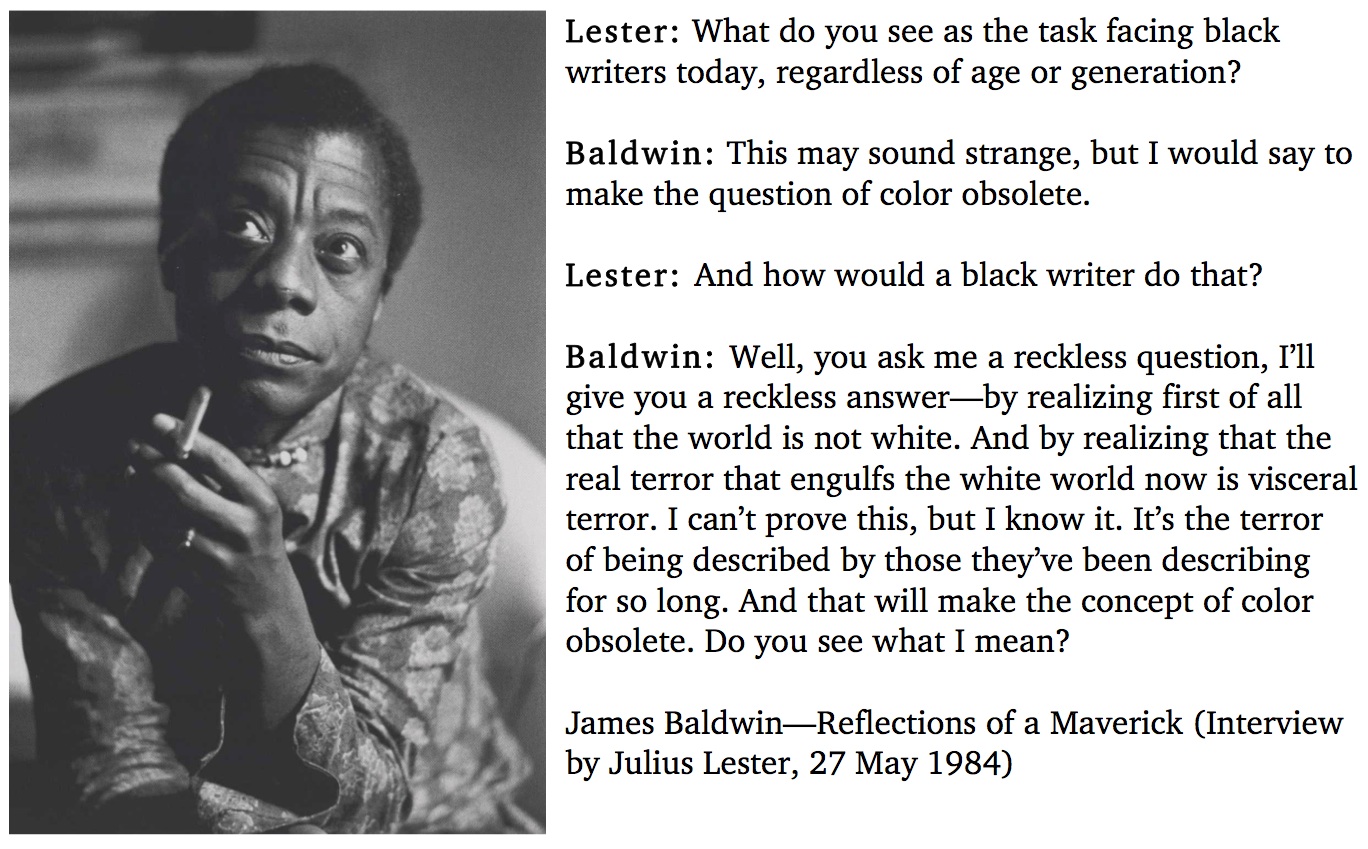
History is proof that these failures have lingered, and that they fade. Listen to James Baldwin. Listen to Martin Luther King Jr.
But in the narrower education reform debate, we have also allowed ourselves to be distracted, mostly by the Common Core debate itself. As I have stated more times that I care to note, that Common Core advocates have sustained the debate is both a waste of our precious time and proof that Common Core has won.
As well, we are misguided whenever we argue that Common Core uniquely is the problem—instead of recognizing that Common Core is but a current form of a continual failure in education, accountability built on standards and high-stakes testing.
With the release of Behind the Data: Testing and Assessment—A PreK-12 U.S. Education Technology Market Report*, we have yet another opportunity to confront that Common Core is the problem, not the solution, because it is the source of a powerful drain on public resources in education that are not now invested in conditions related to racial and class inequity in our public schools.
Richards and Stebbins (2014) explain:
The PreK-12 testing and assessment market segment has experienced remarkable growth over the last several years. This growth has occurred in difficult economic times during an overall PreK-12 budget and spending decline….
Participants almost universally identified four key factors affecting the recent growth of the digital testing and assessment market segment:
1) The Common Core State Standards are Changing Curricula
2) The Rollout of Common Core Assessments are Galvanizing Activity….
(Executive Summary, pp. 1, 2)
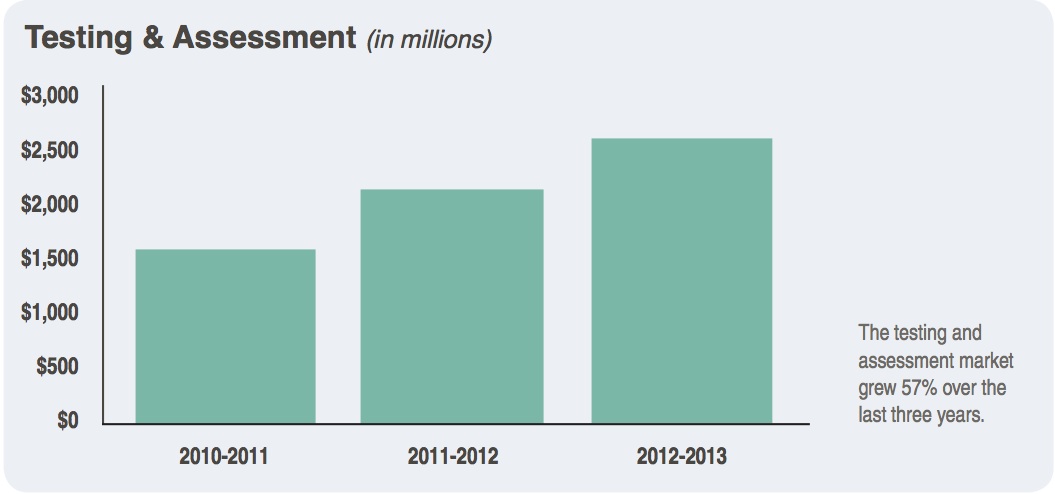
So Common Core advocacy is market-driven, benefiting those invested in its implementation. But we must also acknowledge that that market success is at the expense of the very students who most need our public schools.
And there is the problem—not the end of cursive, not how we teach math, not whether the standards are age-appropriate.
Common Core is a continuation of failing social justice, draining public resources from needed actions that confront directly the inexcusable inequities of our schools, inequities often reflecting the tragic inequities of our society:
As the absence or presence of rigorous or national standards says nothing about equity, educational quality, or the provision of adequate educational services, there is no reason to expect CCSS or any other standards initiative to be an effective educational reform by itself. (Mathis, 2012, 2 of 5)
Like Naomi Klein’s disaster capitalism—the consequences of which are being exposed in New Orleans, notably through replacing the public schools with charter schools—the Common Core movement is not about improving public education, but a form of disaster bureaucracy, the use of education policy to insure the perception of educational failure among the public so that political gain can continue to be built on that manufactured crisis.
Yes, disaster bureaucracy is an ugly picture, but it is evident now the accountability movement is exactly that.
Common Core is not some unique and flawed thing, however, but the logical extension of the Reagan imperative to use education accountability to erode public support for public schools so that unpopular political agendas (school choice, for example) become more viable.
The remaining moral imperative facing us is to turn away from political claims of school and teacher failure, away from their repeatedly ineffective and destructive reforms, and toward the actual sources of what schools, teachers, and students struggle under as we continue to reform universal public education: social and educational inequities that have created two Americas and two school systems that have little to do with merit.
Accountability built on standards and high-stakes testing (not Common Core uniquely) is the problem because it is a designed as disaster bureaucracy, not as education reform.
Who will be held accountable for the cost of feeding the education market while starving our marginalized children’s hope?
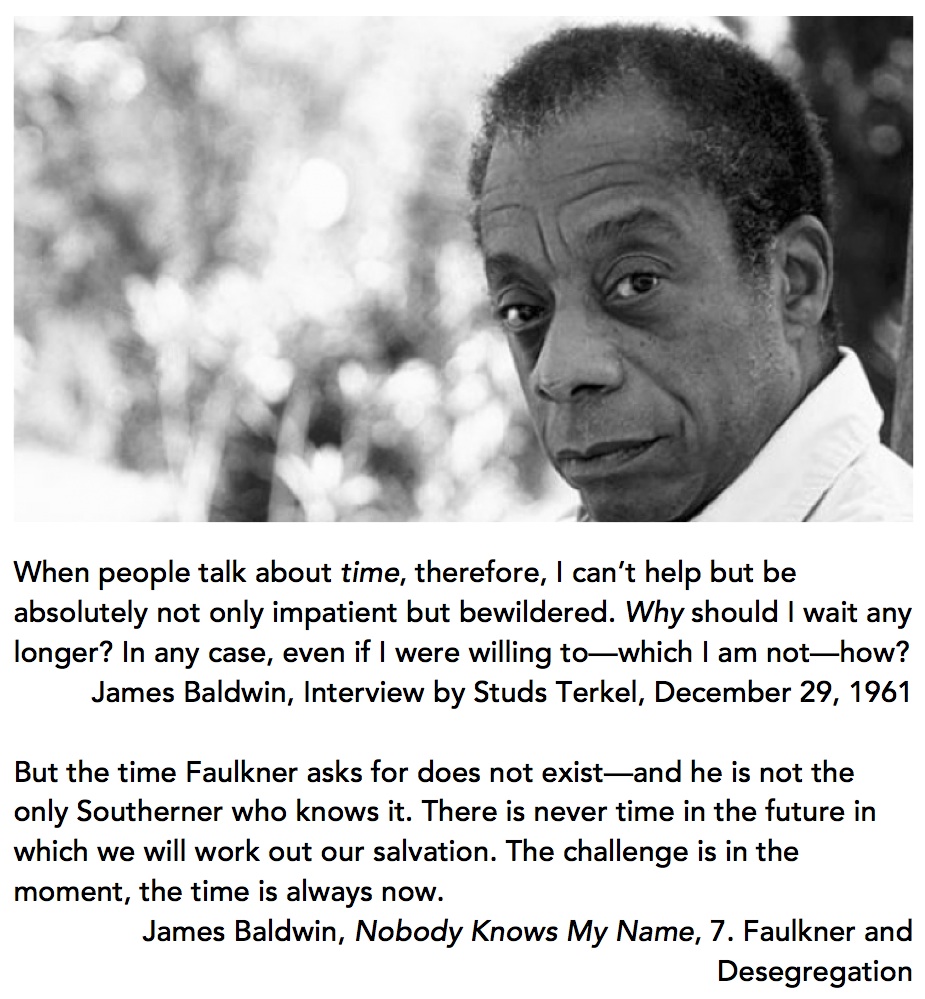
Let me end with two quotes from James Baldwin:
Reference
Bracey, G. W. (2003). April foolishness: The 20th anniversary of A Nation at Risk. Phi Delta Kappan, 84(8), 616-621.
Holton, G. (2003, April 25). An insider’s view of “A nation at risk” and why it still matters. The Chronicle of Higher Education, 49(33), B13-15. Retrieved March 26, 2010, from OmniFile Full Text Mega database.
LaBrant, L. (1947, January). Research in language. Elementary English, 24(1), 86-94.
Richards, J., & Stebbins, L. (2014). Behind the Data: Testing and Assessment—A PreK-12 U.S. Education Technology Market Report. Washington, D.C.: Software & Information Industry Association.
* Thanks to Schools Matter for posting, and thus, drawing my attention to the study.
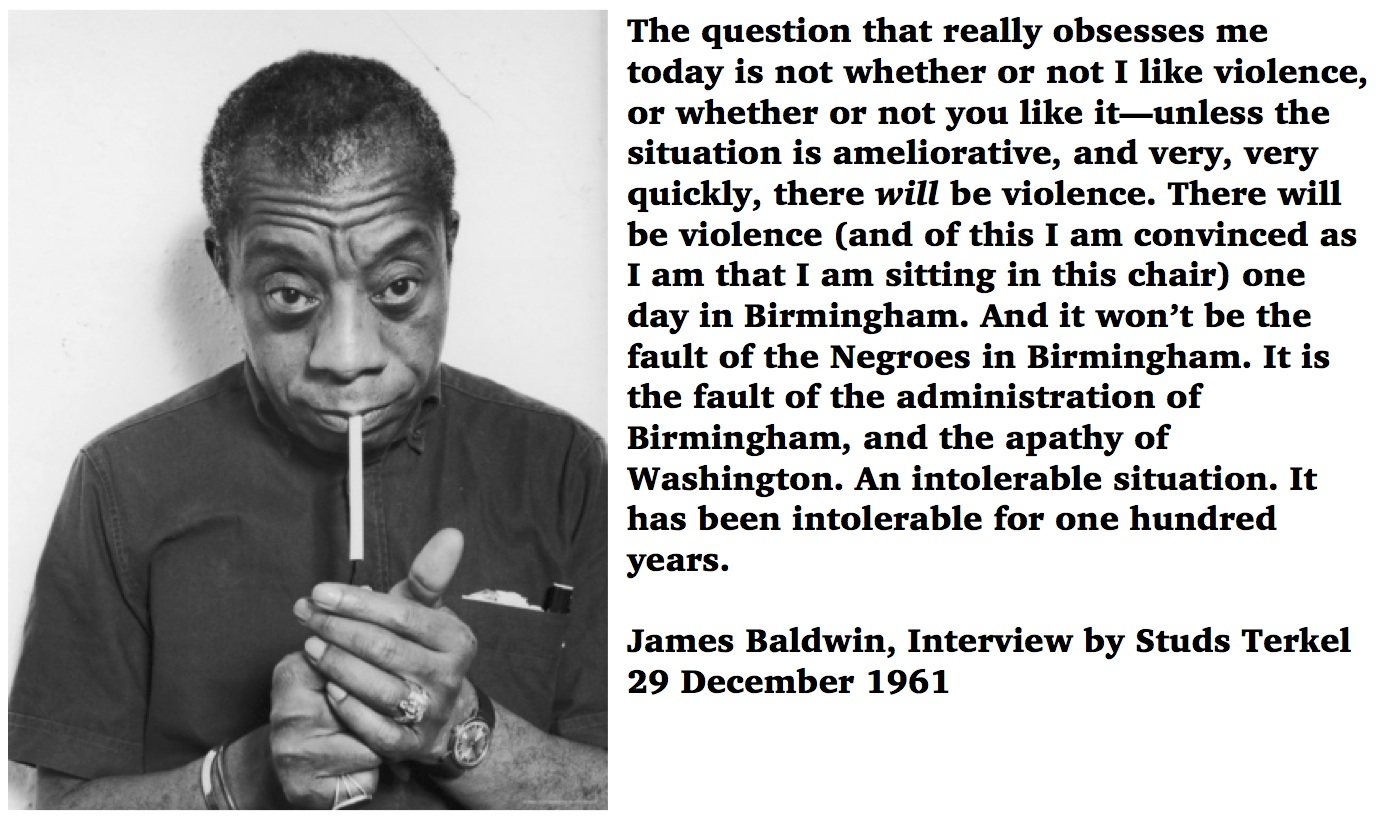
James Baldwin: “There will be violence…”
UPDATE 13 February 2020: Grit, Education Narratives Veneer for White, Wealth Privilege
SCROLL TO THE END FOR REGULAR UPDATES.
Political leaders and the mainstream media feed two enduring claims to the public, who nearly universally embraces both: Doing well in school and attaining advanced education are essential to overcoming any obstacles, and the key to succeeding in school is grit, effort and perseverance.
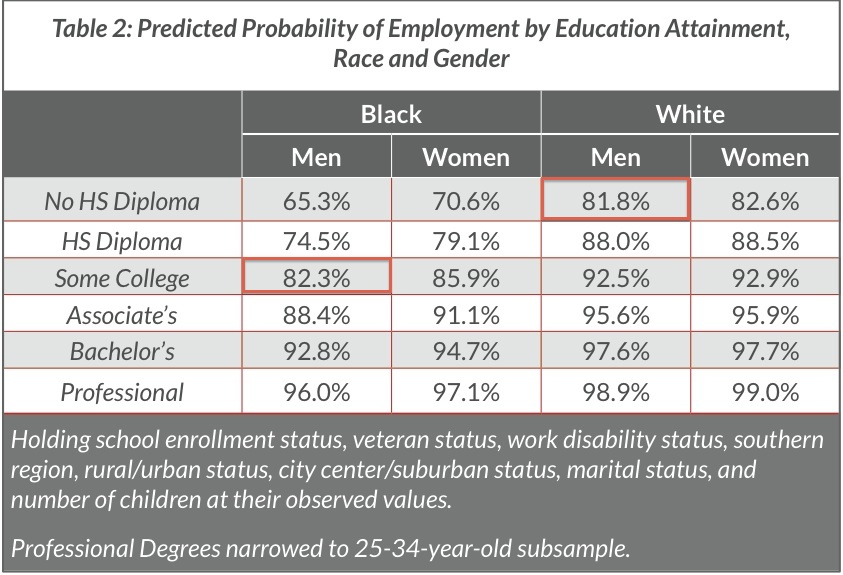
Education appears significant within race, but not the avenue to overcoming racism. Well educated blacks earn more than less educated blacks, but blacks and whites with the same education reflect significant race disparities favoring whites (Bruenig, 24 October 2014):

Rarely do we admit stunning data on race/education inequity. Blacks with some college have similar employment opportunities as whites with no high school diploma (Closing the Race Gap):
But certainly effort (grit and perseverance) matters more than simple accidents of a person’s birth? Actually, no (Bruenig, 13 June 2013):
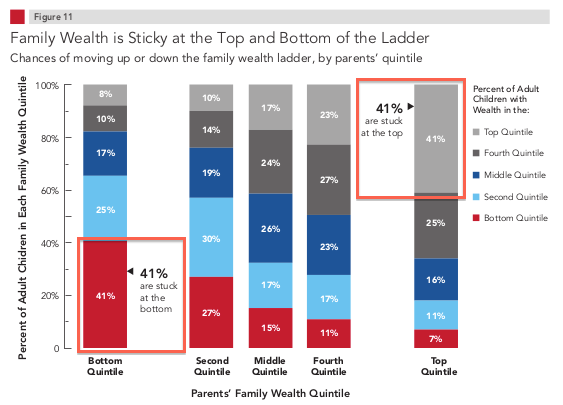
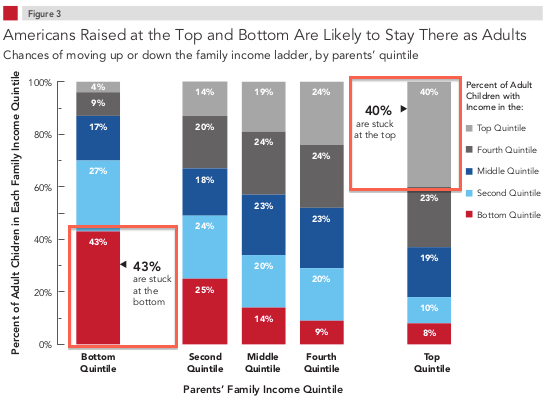
 We are left, then, with having to admit that the evidence is overwhelming that these are baseless cultural myths (possibly ideals we should aspire to, but certainly not the state of our society): Doing well in school and attaining advanced education are essential to overcoming any obstacles, and the key to succeeding in school is grit, effort and perseverance.
Grit and education narratives serve as veneer for white and wealth privilege.
Anthony Cody has now confronted the relentless and uncritical mainstream media fascination with grit in his The Resilience of Eugenics, linking claims about the importance of grit, the ability to identify students with grit, and the push to instill grit in certain students (brown, black, and impoverished, mainly) with Eugenics.
Cody’s argument has deep roots among many of us who have argued for quite some time that charter movements such as KIPP and grit arguments are not sound educationally, scientifically, or ethically. In fact, we have demonstrated that this entire package of narratives and policies is essentially racist and classist.
Update: Social Class, Home Status, and Education
Matt Bruenig has examined David Brooks’s claims about social class and stereotypes/prejudice, and thus offers even more evidence for the points above.
Bruenig’s first subhead is important for framing:
It is indeed the case that social mobility in the US is very low. This is easiest to see by looking at class-based education disparities, given that education is meant to be the thing that leads to social mobility.*
College attendance rates map directly on to parental income, with only 20% of the poorest children in college at age 19 compared to 90% for the richest children.
But the formula that Bruenig reveals, especially in chart form, is central to clarifying that accident of birth tends to trump significantly effort; life status of adults is built on access, opportunity, and privilege (or disadvantage): Home status leads to educational access and thus ultimately to adult status. [*My argument is that instead of crediting educational attainment as the key to adult success, educational attainment is a marker for home privilege, the valid source of adult success.]
Consider then the evidence:


Bruenig concludes: “Quite naturally then, even for reasons beyond these, a child’s eventual position in the social structure is heavily linked to that of their parents.”
Update 2: U.S. as “self-perpetuating class system”
Matt Bruenig’s Where Is Educational Mobility the Highest? continues to add evidence to the claims made above.
Bruenig’s key points supported by international comparison data:
As regular readers know by now, social mobility in the US is largely a myth perpetuated for political legitimation….
In reality, we live in a self-perpetuating class system where the children of the rich mostly go on to rule over the children of the poor….
So it’s clearly possible not to use education to retrench class. The question is whether we want to actually do what it takes to make that happen.
Please note his charts.
Update 3: Economic and judicial racism
Matt Bruenig from 24 September 2014:
As you can see, white families are much wealthier than black and hispanic families at every education level. More than that, all white families, even those at the lowest education level, have a higher median wealth than all black and hispanic families, even those at the highest education level. The median white family with an education level below high school has a net worth of $51.3k, while the median black and hispanic family with a college degree has a net worth of $25.9k and $41k respectively.


Although there were negligible differences among the racial groups in how frequently boys committed crimes, white boys were less likely to spend time in a facility than black and Hispanic boys who said they’d committed crimes just as frequently, as shown in the chart above. A black boy who told pollsters he had committed just five crimes in the past year was as likely to have been placed in a facility as a white boy who said he’d committed 40.
More recent statistics from the Department of Justice show that the juvenile justice system has continued to treat black boys more harshly. Although the overall number of cases in juvenile court has declined sharply since 2008, blacks still account for a third of cases in juvenile court, far more than their share of the population.
See the interactive chart.
Update 4: College doesn’t equal equity
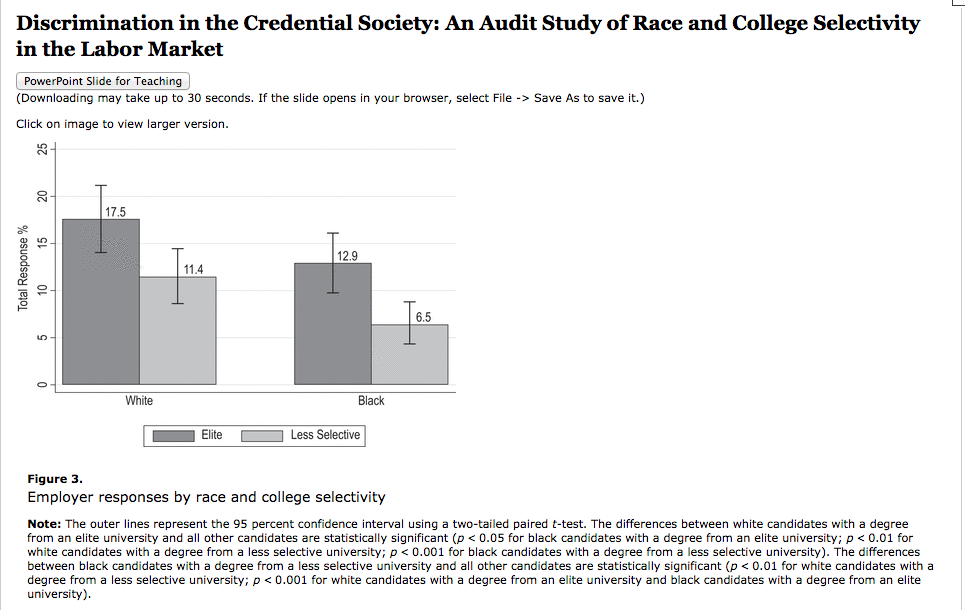
Discrimination in the Credential Society: An Audit Study of Race and College Selectivity in the Labor Market, S. Michael Gaddis
Abstract
Racial inequality in economic outcomes, particularly among the college educated, persists throughout US society. Scholars debate whether this inequality stems from racial differences in human capital (e.g., college selectivity, GPA, college major) or employer discrimination against black job candidates. However, limited measures of human capital and the inherent difficulties in measuring discrimination using observational data make determining the cause of racial differences in labor-market outcomes a difficult endeavor. In this research, I examine employment opportunities for white and black graduates of elite top-ranked universities versus high-ranked but less selective institutions. Using an audit design, I create matched candidate pairs and apply for 1,008 jobs on a national job-search website. I also exploit existing birth-record data in selecting names to control for differences across social class within racialized names. The results show that although a credential from an elite university results in more employer responses for all candidates, black candidates from elite universities only do as well as white candidates from less selective universities. Moreover, race results in a double penalty: When employers respond to black candidates, it is for jobs with lower starting salaries and lower prestige than those of white peers. These racial differences suggest that a bachelor’s degree, even one from an elite institution, cannot fully counteract the importance of race in the labor market. Thus, both discrimination and differences in human capital contribute to racial economic inequality.
Key point:
Overall, these results suggest that employers strongly value a degree from an elite university but also discriminate against candidates with black names. An additional area of inquiry is how these variables work together. For instance, can black candidates close the gap with white candidates when they have a degree from an elite university compared to a degree from a less selective university?
In figure 3, I examine total employer responses across race and college selectivity. These results suggest a tiered pattern of responses: White candidates with a degree from an elite university have the highest response rate (17.5 percent), followed by black candidates with a degree from an elite university (12.9 percent) and white candidates with a degree from a less selective university (11.4 percent),11 and finally black candidates with a degree from a less selective university have the lowest response rate (6.5 percent).12 Thus, a white candidate with a degree from an elite university can expect an employer response for every six résumés submitted, while an equally qualified black candidate must submit eight résumés to receive a response; white candidates with a degree from a less selective university need to submit nine résumés to expect a response, while a similar black candidate needs to submit 15 résumés to receive a response.
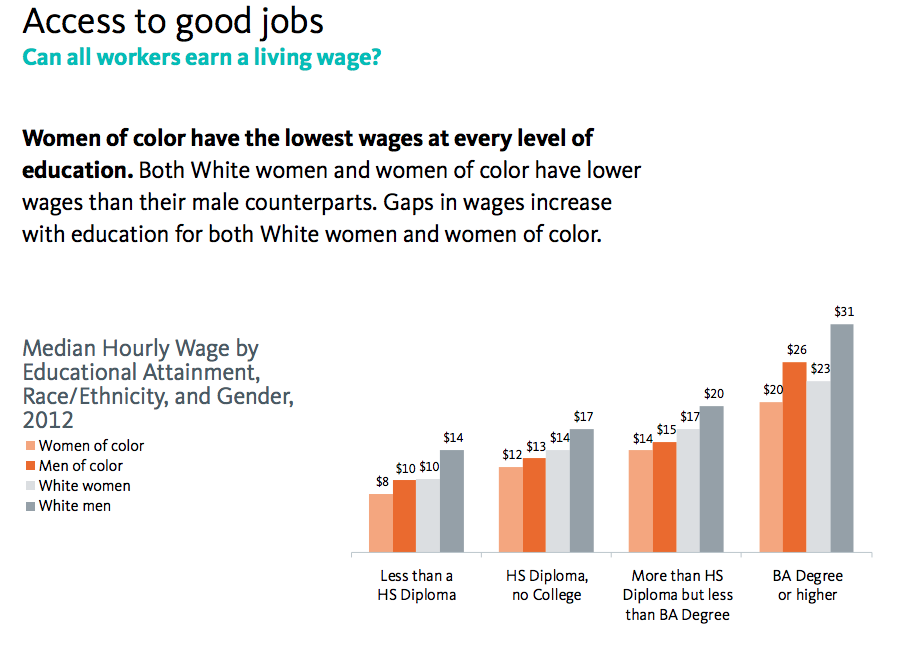
Update 5: Access to good jobs
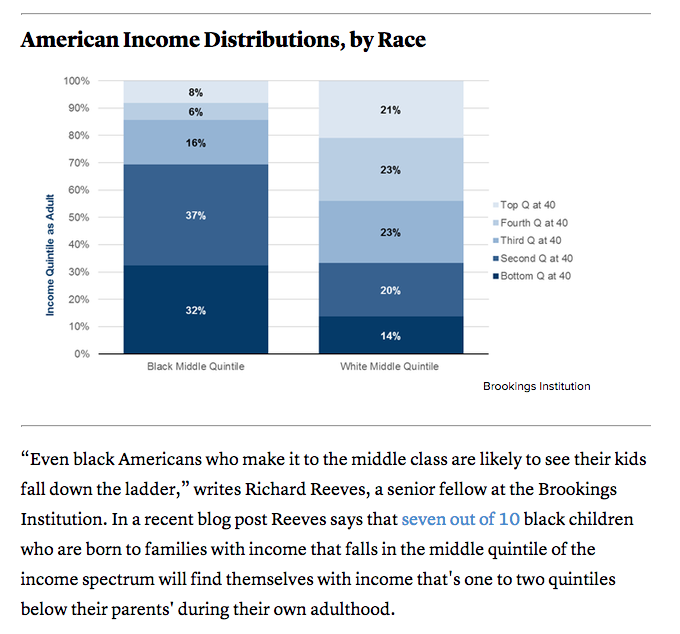
Update 6: How Black Middle-Class Kids Become Poor Adults
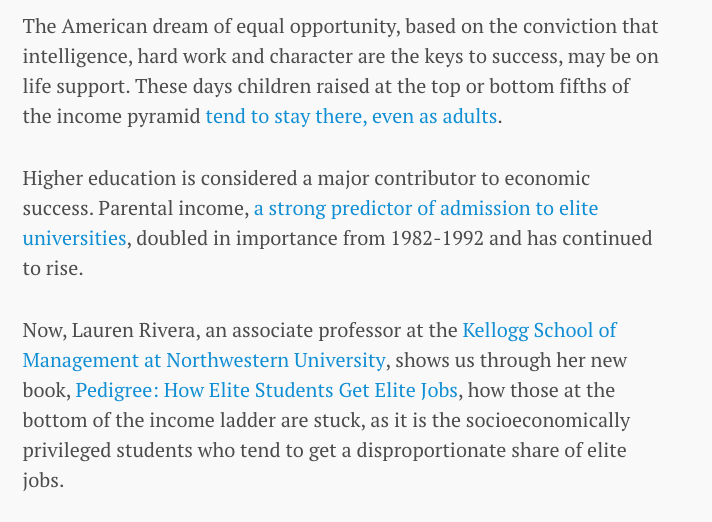
Update 7: The best way to nab your dream job out of college? Be born rich
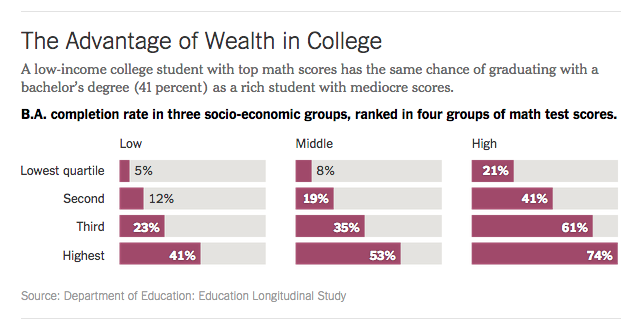
Update 8: For the Poor, the Graduation Gap Is Even Wider Than the Enrollment Gap
Rich and poor students don’t merely enroll in college at different rates; they also complete it at different rates. The graduation gap is even wider than the enrollment gap.
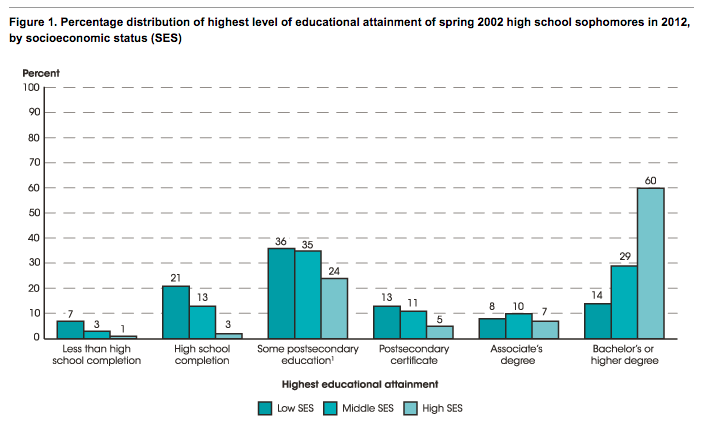
See also Postsecondary Attainment: Differences by Socioeconomic Status
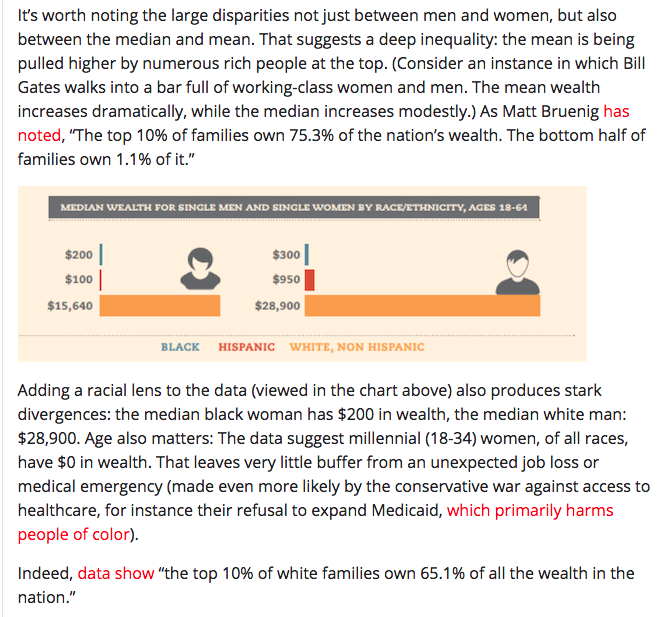
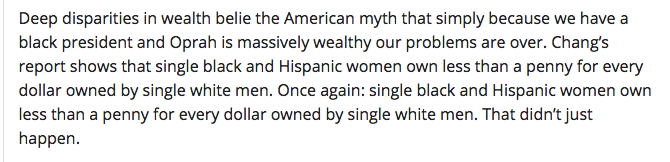
 Shocking new research confirms: It’s a great time to be a white guy in America (and a bad time to be anyone else), Sean McElwee
Update 9: Why rich kids do better than smarter, less advantaged kids: ‘opportunity hoarding’
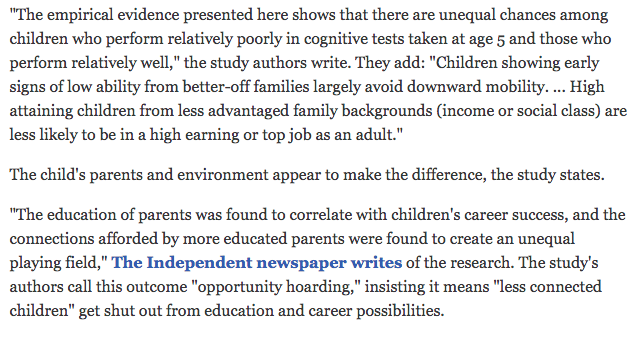
See the research cited: Downward mobility, opportunity hoarding and the ‘glass floor’
Update 10: Why Didn’t Higher Education Protect Hispanic and Black Wealth?, William R. Emmons and Bryan J. Noeth
College-educated families usually earn significantly higher incomes and accumulate more wealth than families headed by someone who does not have a four-year college degree. The income- and wealth-boosting effects of education apply within all racial and ethnic groups. Higher education may also help “protect” wealth, buffering families against major economic and financial shocks and mitigating adverse long-term trends. Based on two decades of detailed wealth data, we conclude that education does not, however, protect the wealth of all racial and ethnic groups equally.
Compared to their less-educated counterparts, typical white and Asian families with four-year college degrees withstood the recent recession much better and have accumulated much more wealth over the longer term. Hispanic and black families headed by someone with a four-year college degree, on the other hand, typically fared significantly worse than Hispanic and black families without college degrees. This was true both during the recent turbulent period (2007-2013) as well as during a two-decade span ending in 2013 (the most recent data available).
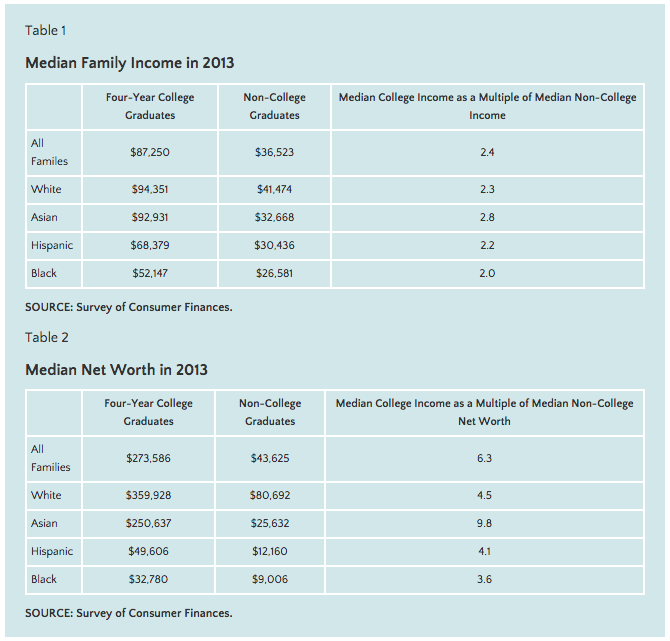
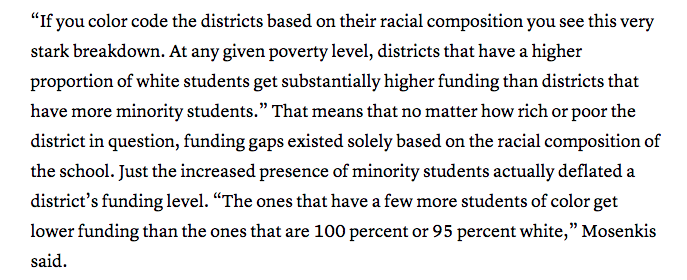
Update 11: The Data Are Damning: How Race Influences School Funding, Gillian B. White
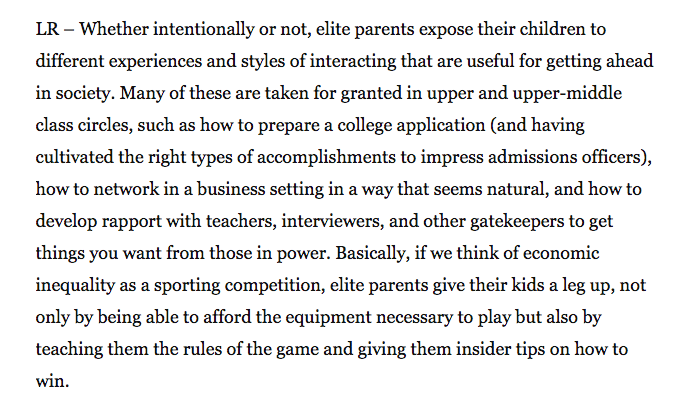
Update 12: Why are working class kids less likely to get elite jobs? They study too hard at college, Henry Farrell [EDIT: It’s a rigged game.]

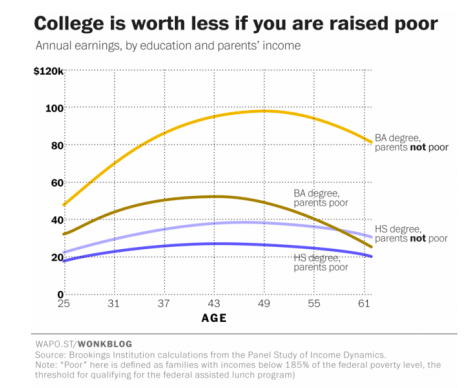
Update 14: Still think America is the “land of opportunity?” Look at this chart.
Not only that, but the earnings gap between poor and rich college-educated kids is huge, and it grows over the course of a career. Right after college, poor kids earn about two-thirds as much as rich kids, on average. But by mid-career, the typical college grad from a rich family is earning close to $100,000, while the grad from a poor family is making around $50,000.
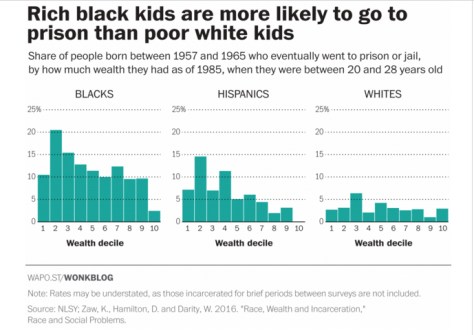
Update 15: Poor white kids are less likely to go to prison than rich black kids
Update 16: A Detailed Look At How Complex Equal Pay Day Really Is

Update 17: Black Harvard graduates have the same shot at a job call-back as white state college grads

For both the races tested, there was a difference of about 6 percentage points between the response rates for graduates of state schools and those of elite schools. But that gap widens to 11 percentage points when you compare white elite college graduates to black graduates from the state schools. And it narrows to just 1.5 percentage points, within the margin of error, between white state school graduates and black graduates of prestigious schools.
University of Michigan sociologist S. Michael Gaddis, who conducted the study, expected a gap between elite and state colleges, he tells Quartz, and he expected a gap between black and white applicants overall. He did not expect, however, to see that even among elite schools’ graduates, there was a big gap between whites and blacks.
“If we really think that education is the great equalizer, then someone who reaches the pinnacle of that system…should be rewarded pretty equally,” Gaddis says. “I would have been surprised, to be honest with you, to see no gap at all. But to see that the gap for Harvard and the other elite applicants was basically the same was very discouraging.”
Update 18: Job Growth Among Men Improves: Nearly 2 Out of 3 Jobs Added in the 4th Quarter of 2016 Went to Men
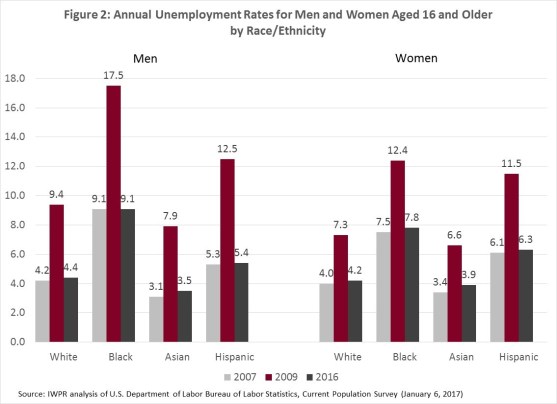
Figure 2 shows the annual average unemployment rates for men and women aged 16 and older by race and ethnicity at the start of the recession, at the end of the recession, and for 2016. Black and Hispanic women and men have higher unemployment rates than White women and men in each period. Unemployment rates remain higher in 2016 than in 2007 for most groups. Only Black men have an unemployment rate in 2016 comparable to 2007, but the unemployment rate in 2016 remains more than twice as high for Black men (9.1 percent) compared to White men (4.4 percent). After seven years of recovery, Black men’s unemployment rate is comparable to White men’s unemployment rate (9.4 percent) at the official business cycle trough. Similarly, Black women’s unemployment rate in 2016 (7.8 percent) is comparable to the unemployment for White women (7.3 percent) at the low point in the current business cycle.
Update 19: The Asset Value of Whiteness: Understanding the Racial Wealth Gap

Update 20: The Asset Value of Whiteness: Understanding the Racial Wealth Gap, Amy Traub, Laura Sullivan, Tatjana Meschede, and Tom Shapiro
Racial inequality in wealth is rooted in historic discrimination and perpetuated by policy: our analyses show that individual behavior is not the driving force behind racial wealth disparities. Typical black and Latino households that attend college and live in two-parent households still have much less wealth than similarly situated white households. Black and Latino households that include a full-time worker have much less wealth than white households with a full-time worker, and only slightly more wealth at the median than white households where the only person employed works part time. Differences in spending habits also fail to explain wealth disparities between black and white households.
See also: This is the one big reason American blacks are poorer than whites
Update 21: Whitened Résumés: Race and Self-Presentation in the Labor Market, Sonia Kang, Katy DeCelles, András Tilcsik, and Sora Jun
Abstract
Racial discrimination in labor markets is a critical process through which organizations produce economic inequality in society. Though scholars have extensively examined the discriminatory decisions and practices of employers, the question of how job seekers try to adapt to anticipated discrimination is often overlooked. Using interviews, a laboratory experiment, and a résumé audit study, we examine racial minorities’ attempts to avoid discrimination by concealing or downplaying racial cues in job applications, a practice known as “résumé whitening.” While some minority job seekers reject this practice, others view it as essential and use a variety of whitening techniques. When targeting an employer that presents itself as valuing diversity, however, minority job applicants engage in relatively little résumé whitening and thus submit more racially transparent résumés. Yet, our audit study shows that organizational diversity statements are not actually associated with reduced discrimination against unwhitened résumés. Taken together, these findings suggest a paradox: Minorities may be particularly likely to experience disadvantage when they apply to ostensibly pro-diversity employers. These findings illuminate the role of racial concealment and transparency in modern labor markets and point to an important interplay between the self-presentation of employers and the self-presentation of job seekers in shaping economic inequality.
See also Minorities Who ‘Whiten’ Résumés More Likely to Get Interview, Michael Harriot
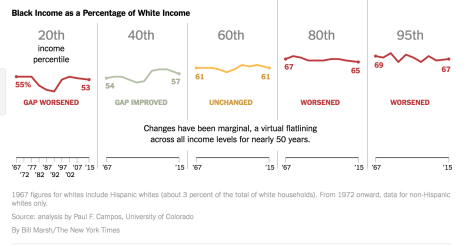
Update 22: White Economic Privilege Is Alive and Well, Paul F. Campos
Is the white working class losing economic ground because of policies intended to improve the lives of black people? Anxiety and resentment among some white voters about those policies certainly seemed to benefit Donald Trump’s campaign last year, with its populist, ethno-nationalist message.
The problem with this belief is that it is false. The income gap between black and white working-class Americans, like the gap between black and white Americans at every income level, remains every bit as extreme as it was five decades ago. (This is also true of the income gap between Hispanic and white Americans.)…
Conservatives like Charles Murray tend to blame either social welfare programs for sapping initiative and keeping black people poor, or black people themselves for being less intelligent than whites, or a “pathological” culture that now manifests itself in the white working class as well.
But the historical pervasiveness and contemporary persistence of racism in America offer more than adequate explanations for what should be considered a scandalous state of affairs in regard to race-based economic inequality.

UPDATE 23: Equal Pay Day for African-American Women, By the Numbers, Emily Crockett
Education levels don’t make much of an impact on the high wage gap between Black women and non-Hispanic white men. While more education corresponds with higher wages for both Black women and white men, Black women still make between 61 and 66 cents on the dollar compared to their counterparts at every education level. African-American women have to have at least a Bachelor’s degree to make as much as white men who didn’t finish college.
UPDATE 24: Black-white wage gaps expand with rising wage inequality, Valerie Wilson and William M. Rodgers III
What this report finds: Black-white wage gaps are larger today than they were in 1979, but the increase has not occurred along a straight line. During the early 1980s, rising unemployment, declining unionization, and policies such as the failure to raise the minimum wage and lax enforcement of anti-discrimination laws contributed to the growing black-white wage gap. During the late 1990s, the gap shrank due in part to tighter labor markets, which made discrimination more costly, and increases in the minimum wage. Since 2000 the gap has grown again. As of 2015, relative to the average hourly wages of white men with the same education, experience, metro status, and region of residence, black men make 22.0 percent less, and black women make 34.2 percent less. Black women earn 11.7 percent less than their white female counterparts. The widening gap has not affected everyone equally. Young black women (those with 0 to 10 years of experience) have been hardest hit since 2000.
UPDATE 25: What We Get Wrong About Closing the Racial Wealth Gap
In this report, we address ten commonly held myths about the racial wealth gap in the United States. We contend that a number of ideas frequently touted as “solutions” will not make headway in reducing black-white wealth disparities. These conventional ideas include greater educational attainment, harder work, better financial decisions, and other changes in habits and practices on the part of blacks. While these steps are not necessarily undesirable, they are wholly inadequate to bridge the racial chasm in wealth.
UPDATE 26: Classed outcomes: how class differentiates the careers of liberal arts college graduates in the US
Abstract
In the United States, attending a selective liberal arts college is often a sign of success. Human capital theory assumes graduates from these colleges share similar outcomes, in terms of employment and further education. This article reports, findings from a national (US) survey of liberal arts college students who graduated between 2012 and 2014. It finds significant differences in the immediate post-graduation outcomes of students based on family background. Using a Bourdieusian lens of capitals and habitus, the article links these different outcomes to differential experiences while in college, expectations, and parental resources. As in the public sector, classed pathways operate to produce differential outcomes for students of small liberal arts colleges. The article also demonstrates the continuing role of family-based material resources after graduation, and how these are used to differentiate students even when holding similar amounts of social and cultural capital.
UPDATE 27: The Class Pay Gap in Higher Professional and Managerial Occupations, Daniel Laurison, Sam Friedman
Abstract
This article demonstrates how class origin shapes earnings in higher professional and managerial employment. Taking advantage of newly released data in Britain’s Labour Force Survey, we examine the relative openness of different high-status occupations and the earnings of the upwardly mobile within them. In terms of access, we find a distinction between traditional professions, such as law, medicine, and finance, which are dominated by the children of higher managers and professionals, and more technical occupations, such as engineering and IT, that recruit more widely. Moreover, even when people who are from working-class backgrounds are successful in entering high-status occupations, they earn 17 percent less, on average, than individuals from privileged backgrounds. This class-origin pay gap translates to up to £7,350 ($11,000) lower annual earnings. This difference is partly explained by the upwardly mobile being employed in smaller firms and working outside London, but it remains substantial even net of a variety of important predictors of earnings. These findings underline the value of investigating differences in mobility rates between individual occupations as well as illustrating how, beyond entry, the mobile population often faces an earnings “class ceiling” within high-status occupations.
See also: The ‘Hidden Mechanisms’ That Help Those Born Rich to Excel in Elite Jobs
UPDATE 28: Black workers endure persistent racial disparities in employment outcomes
Conclusion
The persistence of racial disparities in employment outcomes across levels of education is troubling. While a tighter labor market has helped to reduce the black unemployment rate, even that has not been enough to eliminate multiple layers of racial inequality in the labor market, as we have shown here and as we summarize in Figure C. In particular, the fact that the country’s most highly educated black workers are still less likely to be employed than their white counterparts, and when they are employed, are less likely to be employed in a job that is consistent with their level of education, strongly suggests that racial discrimination remains a major failure of an otherwise tight labor market.

While Blacks and Latinos have made progress in educational attainment, their odds of having a good job are not as good as those of White workers with the same level of education, reflecting persistent racial disparities in the workforce. In fact, White workers are more likely than Black or Latino workers to have a good job at every level of educational attainment.

UPDATE 30: This is why the wealth gap between black and white Americans persists

•
We are well past time to confront these issues, and thus, I offer below links to a significant body of work building our case against grit:
March #Educolor Chat – Grit and Rigor
My posts on “grit”:
NPR Whitewashes “Grit” Narrative
Shiny Happy People: NPR, “Grit,” and “Myths that Deform” pt. 2
The Poverty Trap: Slack, Not Grit, Creates Achievement
The “Grit” Narrative, “Grit” Research, and Codes that Blind
Misreading “Grit”: On Treating Children Better than Salmon or Sea Turtles
Kids Count on Public Education, Not Grit or “No Excuses”
Learning and Teaching in Scarcity: How High-Stakes ‘Accountability’ Cultivates Failure
An Open Apology, with Explanations: Math, Behaviorism, and “Grit”
Snow Blind: “Trapped in the Amber of This Moment”
From Ira Socol:
Paul Tough v. Peter Høeg – or – the Advantages and Limits of “Research”
“Grit” Part 2 – Is “Slack” What Kids Need?
“Grit” – Part 3: Is it “an abundance of possibility” our kids need?
Grit Part 4: Abundance, Authenticity, and the Multi-Year Mentor
Angela Duckworth’s Eugenics – the University of Pennsylvania and the MacArthur Foundation
From Katie Osgood:
Ignoring Mental Health in the Grit Debate
And (please see the discussion thread):
Does “Grit” Need Deeper Discussion?
Note Living in Dialogue post from Lauren Anderson, EdWeek Editor’s Note, and comments:
Lauren Anderson: Grit, Galton, and Eugenics
And a consideration of Anderson:
Grit and Galton; Is psychological research into traits inherently problematic? Cedar Rienar
Also
I Think a MacArthur Genius Is Wrong About ‘Grit,’ John Warner
Got Grit? Dena Simmons
 dr. p.l. (paul) thomas