
By sheer coincidence, or at the bidding of the book gods [1], I discovered a connection between U.S. poet E.E. Cummings and Wonder Woman creator William Moulton Marston:
And then, on Thursday, June 24, 1915, an unseasonably cold day, Marston graduated from Harvard. In exercises held at Sanders Theatre, E.E. Cummings, a member of Marston’s class, delivered a speech about modernism called “The New Art.” (Lepore, p. 42)
After reading Susan Cheever’s compact and engaging E.E. Cummings: A Life, I turned to Jill Lepore’s The Secret History of Wonder Woman, completely unaware of the connection. Paired, however, these well written and researched books are also powerful histories that reveal the (possibly distorted) influence of Harvard in the U.S. as well as insight into the intersection of early twentieth century intelligentsia, art, and pop culture.
My initial interest in Lepore’s examination of Wonder Woman rested on my comic book background—although I was a Marvel collector in the day and quite not DC. However, Lepore’s volume is much more than about Wonder Woman or even a solid biography of Marston; this is a somewhat shocking story about U.S. feminism and sexual politics, commercialization, pop culture, and the enduring power of myth.
As a lifelong educator who essentially hid my comic book reading/collecting throughout junior and high school, I was initially sympathetic to Marston, who struggled at Harvard:
“I had to take a lot of courses that I hated,” [William Moulton Marston] explained. English A: Rhetoric and Composition was a required course for freshmen. “I wanted to write and English A, at Harvard, wouldn’t let you write,” he complained. “It made you spell and punctuate. If you wrote anything you felt like writing, enjoyed writing, your paper was marked flunk in red pencil.” (p. 6)
Especially in the wake of reading again about how Cummings developed while at Harvard, I recognized in Marston’s life (among his proclivities for living with and fathering children by multiple women) the development of creativity as an act against the norms of one’s time or community.
The short version of Lepore’s work is that Marston stumbled—often badly—through a career as a scholar/academic and inventor of the lie detector test until he created Wonder Woman in the foundational years of superhero comic books, the 1930s-1940s. However, what Lepore details well is that Marston’s creation grew significantly from the U.S. feminism movement in the early twentieth century and his relationships with Sadie Elizabeth Holloway, Margaret Sanger, and Olive Byrne.
While comic books and superheroes in the early decades of the medium from the 1930s and into the 1950s were often discounted and even savagely attacked as corrupting of children, Lepore builds a case not for Marston (who certainly comes off poorly as often a charlatan and essentially a self-centered hypocrite) but for the potential of pop culture as social activism.
Wonder Woman was created and written by Marston (with significant help, it appears, from the many women in his life) as a manifesto for women’s liberation, equality—sexual liberation, reproductive rights, work-place equality.
The farther Wonder Woman drifted from Marston, who wrote most of her comic book adventures from the early to late 1940s, the less that ideal held against the influence of the market, where traditional womanhood sold better than radical feminism (or least, that is what publishers believed).
Superheroes as pop icons have entered the U.S. consciousness through many media—comic books, television (Batman, The Hulk, and Wonder Woman, notably), and film. At any given moment in history, then, the “hot” superhero is often dictated by the medium of prominence. As a result, few people are likely aware that Wonder Woman was among the first big three in superhero comics, along with Superman and Batman.

And while all three have endured 70-plus years in pop culture—with all three having peaks, valleys, and fairly dramatic reboots—Wonder Woman has certainly not maintained either Marston’s original intent or the same weight as Superman and Batman.
That in itself is a message about how far women have yet to go in the journey to equality so well detailed by Lepore in her portrayals of Holloway, Sanger, Byrnes, and others.
Regretfully, after reading Secret History, I have a parallel concern I raised about a black Captain America: If Wonder Woman reinforces female stereotypes, objectifies women, what good a woman superhero?
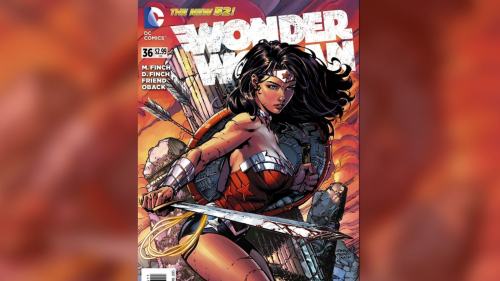
Hugh Ryan shares this concern by considering both the new team writing and drawing Wonder Woman, David and Meredith Finch, and how that essentially spits in the face of Wonder Woman as feminist ideal:
That comics are a bastion of sexism is a truism so banal it almost goes without saying. But it is particularly galling to watch the feminist superhero be treated in such a way. The Finches have made no small point of the fact that Meredith is one of only a handful of women to ever write Wonder Woman. “I love the idea that it’s a woman writing a woman,” David said in an interview with USA Today, “because we’re trying to appeal to more female readers now.”
Seeking to be celebrated for simply hiring a woman is tokenizing and offensive. From writer Gail Simone to artist Fiona Staples, there are incredible women already working in the industry. Let’s celebrate them. The Finch’s ideas of feminism, strength, and what appeals to women today seem retrograde, borderline misogynistic, and—to be frank—boring. Wonder Woman deserves better.
Cheever’s biography of Cummings and Lepore’s exploration of Wonder Woman reveal that truly flawed men (in these two cases) are often behind genuinely marvelous creation. And thus, the irony increases: Just as Cummings and Marston created as often flawed reactionaries, in spite of their environments, against the norms, we are now faced with rejecting a popular media failing not just Wonder Woman, but women once again.
—
See Also
In the U.S., Where the Female Nipple Is More Dangerous Than a Gun
[1] Since I am currently re-reading Neil Gaiman’s American Gods (author’s preferred text), I concede the possibility of the latter.

 dr. p.l. (paul) thomas