De-professionalization for Profit: “Leery of teachers”

In Common Core’s unintended consequence?, Jonathan Sapers examines a report from the Center for Education Policy (CEP), self-described as “a national, independent advocate for public education and for more effective public schools.”

CEP has discovered “that in roughly two-thirds of districts in Common Core states, teachers have developed or are developing their own curricular materials in math (66 percent) and English Language Arts (65 percent). In more than 80 percent of districts, the CEP found that at least one source for curriculum materials was local — from teachers, the district itself or other districts in the state.”

As has been the pattern throughout roughly thirty years of public school accountability—one characterized by a revolving door of state standards and high-stakes testing—new standards and tests mean profit opportunities for education-focused businesses.

Sapers reports:

However, Jay Diskey, executive director of the PreK-12 Learning Group of the Association of American Publishers, said publishers are pulling their weight. “We have more than 150 members in our PreK-12 Learning Group. And the ones I’ve seen over the past several years or more have tried very hard to align with Common Core standards in reading and math.”…

Some teachers and districts are viewing the dearth of materials as an opportunity, but experts and even some educators say putting the job of creating curriculum materials into the hands of teachers may not necessarily be a good thing [emphasis added].

And this is where the article takes a troubling turn, as highlighted here:
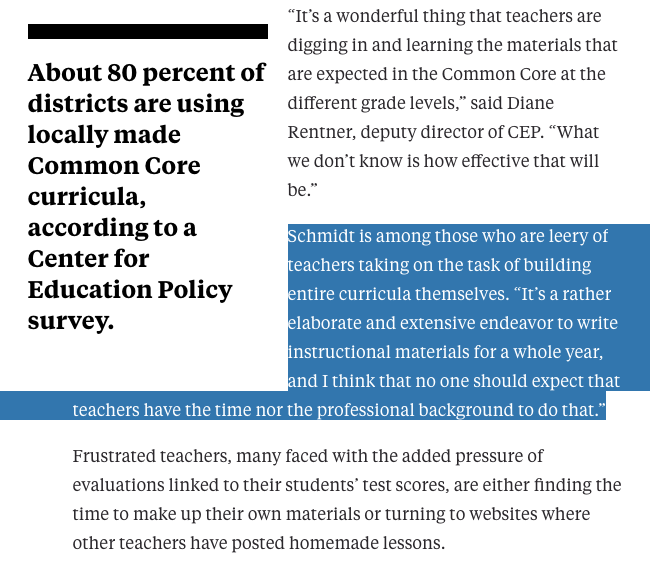
leery of teachers

“Leery of Teachers”

My career as an educator includes 18 years teaching English in a SC public high school throughout the 1980s and 1990s, followed by the most recent 13 years as a teacher educator in higher education.

Those experiences and in my work teaching future teachers, I note that a powerful and problematic difference between a K-12 teacher and a college professor is the locus of authority in terms of the content of any course.

Historically and currently, the authority over content for K-12 teachers has too often been textbooks, curriculum guides, standards, and high-stakes tests.

For college professors, the single most important element of teaching authority is that professors are the locus of authority of the content they teach; in fact, many if not most college professors have little or no formal training in pedagogy, how to teach.

The great irony of this distinction is that between K-12 teachers and professors, K-12 teachers have the greater expertise in teaching, but a far reduced status as a professional when compared to professors.

Along with the locus of authority over the content, the status of professional is strongly related to autonomy and respect—which brings me back to the “unintended consequence” above.

The attitude toward K-12 teachers not having time to create curriculum is valid, but the reason they do not have time includes the incessant changing of bureaucratic mandates that consume their time and that K-12 teachers do not have professional schedules (which professors do) in which to conduct research and create curriculum (which are often related at the university level).

However, the “leery” as well as the unsubstantiated claim that teachers do not have the “professional background” to create curriculum is a genuinely ugly example of the de-professionalization of teaching—a process aided by a historical marginalizing of teaching (significantly as an element of professional sexism), the bureaucratizing of teaching, and the union-busting momentum in recent years.

We should be exploring the real intended consequence of Common Core: billions are to be made off the standards and testing charade, and teachers creating their own curriculum and materials infringes on that profit.

Teaching at all levels includes curriculum, instruction, and assessment, but central to those elements are the unique set of students each teacher faces every day.

Curriculum, instruction, and assessment mean almost nothing without the context of students, and the only person qualified to make those decisions is the teacher.

If we must be leery, let’s be leery about think tanks, publishing companies, and mainstream media who all seem to have little respect for the professionalism of teaching.

See Also

Teaching: Too Hard for Teachers, Peter Greene

Passive Progressivism

Hamlet:
A man may fish with the worm that hath eat of a
king, and eat of the fish that hath fed of that worm.

King:
What dost thou mean by this?

Hamlet:
Nothing but to show you how a king may go a
progress through the guts of a beggar.

Hamlet (Act 4, Scene 3)

The phrase “bleeding heart liberal” has always created in me some tension between skepticism about those who use it as a baseless slur against left-wing ideology and recognition that those calling themselves “liberal,” “progressive,” and/or “Democrat” are as likely to disappoint me as right-wingers (although for different reasons).

A Twitter conversation today with Camika Royal prompted by my Are We (Finally) Ready to Face Teacher Education’s Race Problem? led to this:

I have previously examined how the status quo of power in the U.S. seeks to acknowledge Martin Luther King Jr. only as a distorted passive radical, and I have recently called out my own field of teacher education for the tendency of education professors to complain and then comply.

Passivity and compliance, I note, are both necessary for maintaining the status quo of inequity in the U.S. and the central qualities among so-called progressives.

Progressivism rightly viewed is the antithesis of conservatism—although in the U.S. both terms are rarely understood, expressed correctly, or embodied in their original meanings.

Progressivism is inherently about not only recognizing the inevitability of change, but also embracing change for often idealistic ends (and thus, when taken to an extreme, the “bleeding heart liberal” paralyzed by that idealism).

Conservatism is about maintaining (conserving) conditions within a framework of traditional (enduring) values.

Neither term or ideology is understood or practiced with much faith in the U.S., but with great regret, I must note that the negative connotation of “bleeding heart liberal” rings all too true when we examine the behavior of many on the left, including self-professed progressives.

U.S. progressivism as liberalism is mostly about symbolism and lip-service.

Liberal Hollywood talks a great game, but never gets off the bench.

The liberal academy, much the same—ironically clinging to traditional norms of the aloof ivory tower that discourages public intellectualism as base, beneath the scholar.

And the liberal media? The greatest disappointment of all as the mainstream media in the U.S. is trapped in the objective pose of recognizing both sides of every issue—as if the world is a ninth-grade debate team contest.

Passive progressivism is more powerful in the U.S. than the conservative center that keeps the U.S. moving forward at a glacial creep anchored by racism, sexism, bigotry, homophobia, and widespread inequity.

Progressivism is nothing without the radicalism of action, as expressed by Howard Zinn:

From that moment on, I was no longer a liberal, a believer in the self-correcting character of American democracy. I was a radical….The situation required not just a new president or new laws, but an uprooting of the old order, the introduction of a new kind of society—cooperative, peaceful, egalitarian.

Much as Democrat and Republican are different sides of the same partisan-politics coin, progressive and conservative are different sides of the same static coin in the U.S.

And thus action in the U.S. is marginalized as radicalism, serving only to benefit the world as we now have it.

To have a world otherwise, we must all embrace radicalism.

See also here and below:

Public School, Charter Choice: More Segregation by Design

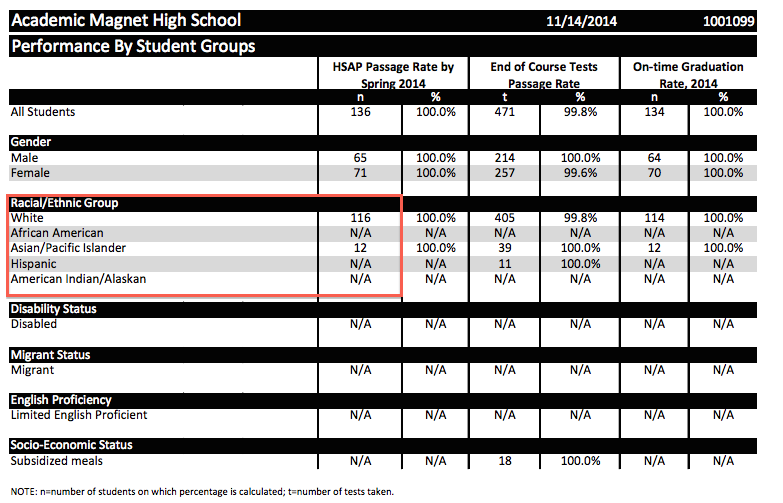
Academic Magnet High School serves the Charleston school district on the coast of South Carolina. The school functions under a choice umbrella, but requires students to submit to an admissions process.

SC is relatively more diverse than the U.S. on average in terms of white (+/- 70%)/black (+/- 30%) demographics, while less diverse in Hispanic/Latino (although those groups are growing significantly). Charleston certainly is even more diverse racially and culturally than the state.

Those realities have now prompted students at Academic Magnet to challenge the lack of diversity at their school:

Calls for a change in the admissions process at Academic Magnet High School continued Monday, with students urging the Charleston County School Board to tackle diversity issues at their school.

“Is the system that has produced an overwhelmingly white, upper-middle-class school in place of an equal opportunity magnet school for all Charleston County students fair?” asked Academic Magnet student Natalie Davidson….

Davidson said that although the school’s admissions process is “in a vacuum unbiased,” it has produced a “homogeneous” student body that is only 2 percent black in a school district that is 42 percent black.

The 2014 SC school report card for Academic Magnet shows absolute and growth ratings of excellent, but tested students included no African American or Hispanic/Latino students:

AMHS test 2014

Magnet and charter schools, however, are not the only choice mechanisms in SC since Greenville County school district offers (and aggressively markets) public school choice:

GCSD choice market

What has public school choice and charter choice produced in Greenville County?

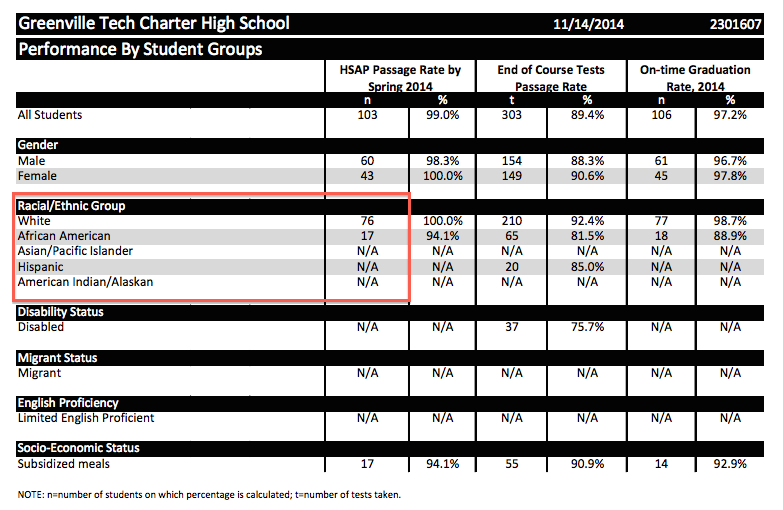
Greenville Tech Charter High School, like Academic Magnet, has 2014 school report card ratings of excellent/excellent, but just over 80% of the students tested are white with no limit English proficiency students included:

GTCHS tested 2014 race

Public school choice has also resulted in highly segregated schools within the same district.

Berea High School has a consistent record of being a majority-minority school and also serves a diverse population of students by poverty and special needs:

BHS race

BHS poverty special needs

As a result, Berea High’s 2014 school report card looks quite different when compared to Academic Magnet or Greenville Tech Charter—good (absolute) and below average (growth) ratings, and a much different tested demographic of students:

BHS tested 2014

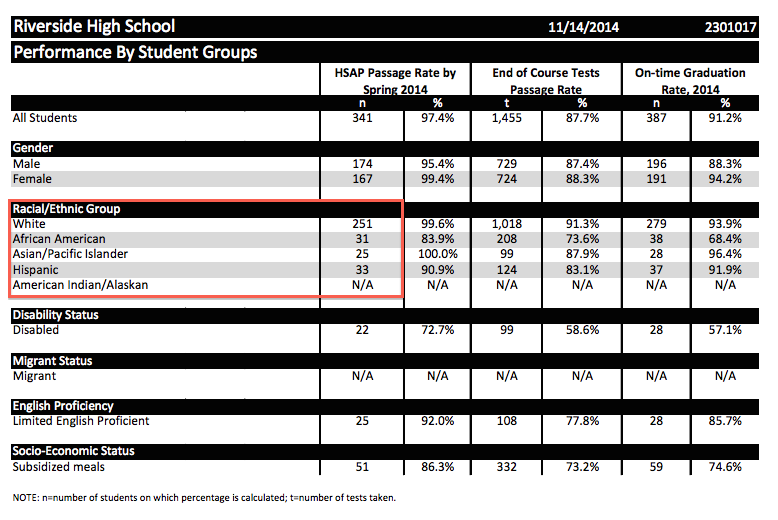
However, Riverside High School looks much more like Academic Magnet or Greenville Tech Charter—an excellent/excellent rating in 2014 and serving/testing a population 73% white:

RHS race

RHS tested 2014

Choice, then, in a variety of forms such as public school choice, charter schools, and magnet schools/academies are isolating students by race and class within highly diverse regions of a highly diverse state.

No longer vouchers or tuition tax credits, choice is now masked behind the allure of misleading labels—public, charter, magnet, academy—but ultimately resulting in one disturbing fact: choice segregates by design.

More choice will result in greater segregation and more shuffling, but market forces will never address equity and will always create winners and losers instead of establishing opportunities for all—as Academic Magnet demonstrates.

The call for fairness and diversity by students at Academic Magnet should be a call among all in SC and across the U.S.

See Also

Why Sending Your Child to a Charter School Hurts Other Children

On Memory and History: What’s in a Name?

In the 1996 film version of Arthur Miller’s The Crucible, John Proctor chooses his name over his life:

John Proctor: Because it is my name! Because I cannot have another in my life! Because I lie and sign myself to lies! Because I am not worth the dust on the feet of them you have hanged! How may I live without my name? I have given you my soul; leave me my name!

While Proctor speaks to the association between a name and honor, names also carry the burdens of gender and heritage. “I have guarded my name as people/ in other times kept their own clipped hair,” begins the speaker in Barbara Kingsolver’s “Naming Myself” from Another America. Later, she explains:

I could shed my name in the middle of life,
the ordinary thing, and it would flee
along with childhood and dead grandmothers
to that Limbo for discontinued maiden names.

But it would grow restless there.
I know this. It would ride over leaf smoke mountains
and steal horses.

Names also represent race and the lingering weight of the heaviest shackles of history. To that, Malcolm X explains his name:

Like Malcolm X, Countee Cullen confronts the name he was called, adding the power of memory, of how names and history combine:

Now I was eight and very small,
     And he was no whit bigger,
And so I smiled, but he poked out
     His tongue, and called me, "Nigger."

From his trip to Baltimore, Cullen concludes: “That’s all that I remember.”

The current debate over renaming Tillman Hall at Clemson University is yet another moment about the intersections of memory, history, and names. Possibly lost in the Tillman debate is the wider issue it represents.

“It’s true, South Carolinians would do well to remember Tillman’s legacy,” argues Paul Bowers, addressing directly the naming of Tillman Hall:

But we shouldn’t honor it, which is exactly what we’re doing by keeping his name on a building at a public university….

It’s another thing entirely for it to be named after Tillman, a progenitor and perpetuator of American apartheid who led lynch mobs during Reconstruction and boasted about it until his dying day.

Remembering history, the worst scars of history, is different than honoring those scars of history. And naming—whether it be a person’s name or a building’s—treads a thin line between remembering (as not to make the same mistake again) and honoring.

William Stafford’s “At the Un-National Monument along the Canadian Border” forces readers to consider through inversion that what we name is what we honor:

This is the field where the battle did not happen,…
where no monument stands,…

No people killed—or were killed—on this ground
hallowed by neglect and an air so tame
that people celebrate it by forgetting its name.

The South presents a history that must not be forgotten, but includes much that should not be honored—including the person, ideologies, acts, and name of Benjamin Tillman.

And somewhere between John Proctor’s impassioned but fictionalized plea and Malcolm X’s steadfast and reasonable refusal to accept the name given him lies my recognition that what we name anyone or anything, and why, is powerful evidence of what we remember and why—and ultimately what we honor beneath claims otherwise.

In Lynching in America, that fact—as in Stafford’s poem—is highlighted:

Most Southern terror lynching victims were killed on sites that remain unmarked and unrecognized. The Southern landscape is cluttered with plaques, statues, and monuments that record, celebrate, and lionize generations of American defenders of white supremacy, including public officials and private citizens who perpetrated violent crimes against black citizens during the era of racial terror [emphasis added]. The absence of a prominent public memorial acknowledging racial terrorism is a powerful statement about our failure to value the African Americans who were killed or gravely wounded in this brutal campaign of racial violence. National commemoration of the atrocities inflicted on African Americans during decades of racial terrorism would begin building trust between the survivors of racial terrorism and the governments and legal systems that failed to protect them. (p. 22)

Sandra Cisneros’s The House on Mango Street has a chapter “My Name” that begins, “In English my name means hope,” adding, “It was my great-grandmother’s name and now it is mine”:

She looked out the window her whole life, the way so many women sit their sadness on an elbow. I wonder if she made the best with what she got or was she sorry because she couldn’t be all things she wanted to be. Esperanza. I have inherited her name, but I don’t want to inherit her place by the window. (pp. 4-5)

Tradition is static, like “forgotten.” A name given, a name chiseled in granite, a name uttered each time someone gives directions.

Remembering in order to remain steadfast against the mistakes of the past does not require the echo of names, and renaming becomes an act of defiance and recognition, as Esperanza proclaims: “I would like to baptize myself under a new name, a name more like the real me, the one nobody sees” (p. 5).

The call to rename Tillman Hall, then, is not about erasing or forgetting, but about the baptism of re-naming as an act of courage, a claiming of honor too often denied and too often ignored. The refusal to rename Tillman Hall proves James Baldwin right, although he made these observations sixty years ago:

[The South] clings to the myth of its past but it is being inexorably changed, meanwhile, by an entirely un-mythical present: its habits and its self-interest are at war. Everyone in the South feels this and this is why there is such panic on the bottom and such impotence at the top. …

[I]t is, admittedly, a difficult task to try to tell people the truth and it is clear that most Southern politicians have no intention of attempting it….

This failure to look reality in the face diminishes a nation as it diminishes a person. (“Nobody Knows My Name: A Letter from the South”)

Renaming is a baptism long overdue in the Bible Belt.

See Also

Why the Heck Do Latino Reporters on Public Radio Say Their Names That Way?, Quenna Kim

Incessant Prediction for Education Reform: “bad things will happen”

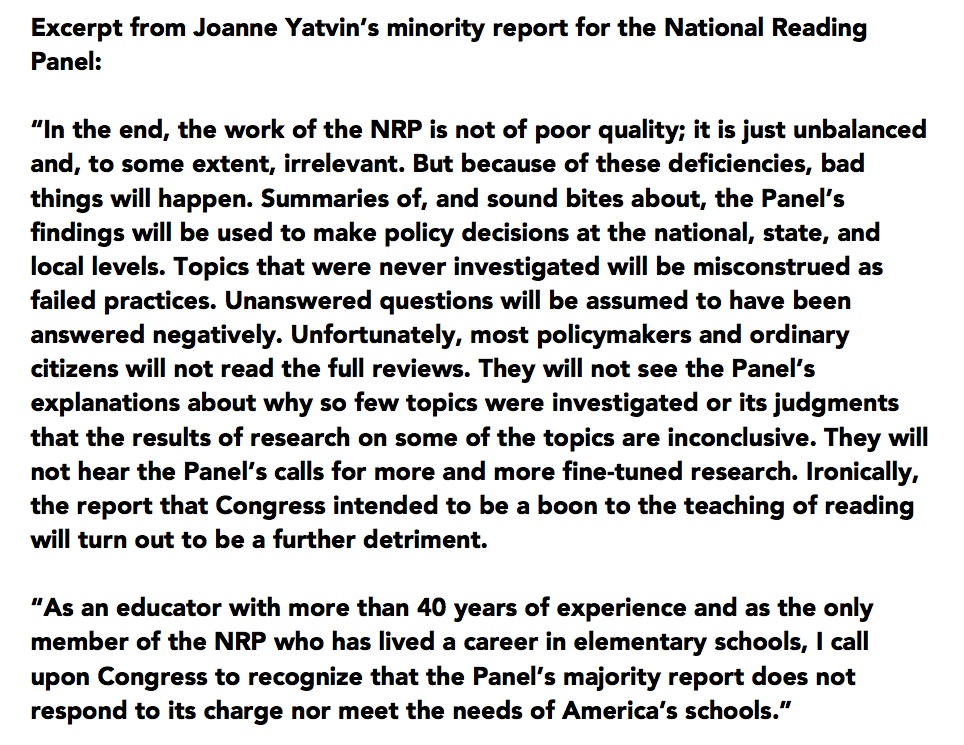
Prescient then and now, Joanne Yatvin’s minority report as part of the National Reading Panel is a must read (scroll to about page 444), and regretfully can be applied to every aspect of the enduring accountability-based education reform movement; see this excerpt:

Yatvin minority excerpt

Bad things have happened, bad things will continue to happen.

Beware the Technocrats: More on the Reading Wars

Since it is Academy Awards season, let me start with film as context.

Whiplash has received a great deal of Oscars buzz with five significant nominations. But that film praise is interesting to frame against a review that considers how the film’s topic, jazz, is portrayed:

The mediocre jazz in Damien Chazelle’s new film, “Whiplash,” the story (set in the present day) of a young drummer (Miles Teller) under the brutal tutelage of a conservatory professor (J. K. Simmons), isn’t itself a problem. The problem is with the underlying idea. The movie’s very idea of jazz is a grotesque and ludicrous caricature.

“Mediocre,” “grotesque,” and “ludicrous caricature” are certainly not the stuff of Oscars, one would think, but this contrast of responses to the film represents well my problem with the Mt. Rushmore of technocrats who are cited with missionary zeal whenever you spend much time in the reading wars (see the comments here): Daniel Willingham, John Hattie, E.D. Hirsch, and Grant Wiggins.

With some qualifications for Wiggins (who taught high school and coached for 14 years, but has focused primarily on assessment since then), these often cited men are primarily quantitative researchers who are not within the field of literacy (Hirsch’s background is literature, not literacy) and have created cottage industries out of their names/work: Willingham as a psychologist, Hattie as a researcher/consultant, Hirsch as a core knowledge advocate, and Wiggins as proponent of understanding by design and consultant.

As I have noted before, most of my concern here is how certain advocates for phonics and direct instruction in literacy use the Mt. Rushmore of technocrats to close the door on the reading wars—not with any of these men or their work specifically (except Hattie [1]).

Therefore, I must offer, Beware the technocrats, because of the following:

  • Beware the seductive allure of statistics, numbers, and “scientific” research. As I have detailed more often than I would have liked, a perfect example of this concern is the prevalence of the Hart and Risley research on the “word gap,” which persists despite many concerns being raised about not only the research itself, but also the deficit ideology that drives the conclusions. Of course, high-quality experimental and quasi-experimental research matters, but many aspects of teaching and learning require and lend themselves to other research paradigms—notably qualitative action research conducted by classroom teachers with the real populations they teach.
  • Beware the momentum of cottage industry gurus. Hattie, Hirsch, and Wiggins have created entire careers for themselves—books, workshops, consultations. I remain deeply skeptical of such ventures (see also Nancie Atwell and a whole host of gurus on the “softer” side of research and within literacy as well). Even the best people with the best intentions can find themselves victims of “‘filthy lucre,'” but just as the higher the quality of scientific research, the more likely it means less to real-world teaching, the urge to reduce an evidence base or best practice to a program means that evidence and practice are mostly ruined.

In the reading wars, then, I witness time and again that the advocates for intensive phonics, phonics programs, and direct instruction grounded in prescribed content are either not within the field of literacy [2] or themselves invested in programs that benefit from those positions (the Common Core debate represents the same issue since most advocates stand to benefit from Common Core being implemented, some politically and some financially).

Which brings me back to Whiplash. If you know little or nothing about jazz, the film likely appears more wonderful than if you do.

I have a thirty-plus year career in literacy, including teaching literacy (mostly writing) and scholarship addressing literacy. That context for me renders the Mt. Rushmore of technocrats not insignificant, but certainly less credible than a century of research and practice by literacy practitioners and researchers that informs my practice.

There is a tyranny to certainty among those who wield the work of Willingham, Hattie, Hirsch, and Wiggins in ways that end the conversation, that shut the door on a broader basis of evidence to inform, not mandate, practice. There is a greater tyranny of commerce lurking here also, using “scientific” as a mask for commercialization.

Both serve to further de-professionalize teachers, and both often result in classroom practices that may raise test scores but create nonreaders.

And thus, when Hattie is cited (yet again) during the reading wars, for example:

I posted a question in Pamela and Alison’s article last week, but didn’t get a response from anyone. My question is: if the “effect size” of synthetic phonics (according to Hattie’s research) is 0.54, and that of whole language learning is 0.06, does that mean:

  1. That whole language actually does have an effect; and
  2. Should we therefore use the two approaches in the ratio of 1:9 (i.e. the difference in their effect sizes)? (scroll to the comment from John Perry, who, I must add, is being reasonable here)

I share the exasperation Richard Brody expresses at the end of his review of a jazz film that uses Buddy Rich as the icon for the film’s protagonist: John Hattie. John Visible Learning Hattie.

In terms of evidence, that has the opposite effect intended.

See Also

Education ‘experts’ may lack expertise, study finds

Taming the Wild West of Educational Research, Simon P. Walker

[1] Those who rush to use Hattie are proof of solid research fail to note that his work has been challenged for quality, even within the quantitative paradigm; see:

[2] Since many people continue to refer to the National Reading Panel report, please examine Joanne Yatvin’s minority view, starting about page 444, including:

In the end, the work of the NRP is not of poor quality; it is just unbalanced and, to some extent, irrelevant. But because of these deficiencies, bad things will happen. Summaries of, and sound bites about, the Panel’s findings will be used to make policy decisions at the national, state, and local levels. Topics that were never investigated will be misconstrued as failed practices. Unanswered questions will be assumed to have been answered negatively. Unfortunately, most policymakers and ordinary citizens will not read the full reviews. They will not see the Panel’s explanations about why so few topics were investigated or its judgments that the results of research on some of the topics are inconclusive. They will not hear the Panel’s calls for more and more fine-tuned research. Ironically, the report that Congress intended to be a boon to the teaching of reading will turn out to be a further detriment.

As an educator with more than 40 years of experience and as the only member of the NRP who has lived a career in elementary schools [emphasis added], I call upon Congress to recognize that the Panel’s majority report does not respond to its charge nor meet the needs of America’s schools.

IAP: The Phenomenon of Obama and the Agenda for Education – 2nd Edition

The Phenomenon of Obama and the Agenda for Education – 2nd Edition

CONTENTS

Acknowledgments. Foreword: Barack Obama’s Neoliberal War on Public and Democratic Education (2014, for the second edition), Paul Street. Foreword: Challenging the Empire’s Agenda for Education (2011, for the first edition),Christine Sleeter. Introduction: Audaciously Espousing Hope (well into a second mandate) Within a Torrent of Hegemonic Neoliberalism: The Obama Educational Agenda and the Potential for Change, Paul R. Carr and Brad J. Porfilio.

SECTION I: USING HISTO RICAL AND THEORETICAL INSIGHTS TO UNDERSTAND OBAMA’S EDUCATIONAL AGENDA.

Even More of the Same: How Free Market Capitalism Dominates Education, David Hursh. “The Hunger Games”: A Fictional Future or a Hegemonic Reality Already Governing Our Lives? Virginia Lea. Ignored Under Obama: Word Magic, Crisis Discourse, and Utopian Expectations, P. L. Thomas. The Obama Education Marketplace and the Media: Common Sense School Reform for Crisis Management, Rebecca A. Goldstein, SheilaMacrine, and Nataly Z. Chesky.

SECTION II: THE PERILS OF NEOLIBERAL SCHOOLING: CRITIQUING CORPORATIZED FORMS OF SCHOOLING AND A SOBER ASSESSMENT OF WHERE OBAMA IS TAKING THE UNITED STATES.

Charter Schools and the Privatization of Public Schools, Mary Christianakis and Richard Mora. Undoing Manufactured Consent: Union Organizing of Charter Schools in Predominately Latino/a Communities,Theresa Montaño and Lynne Aoki. Dismantling the Commons: Undoing the Promise of Affordable, Quality Education for a Majority of California Youth,Roberta Ahlquist. Obama, Escucha! Estamos en la Lucha! Challenging Neoliberalism in Los Angeles Schools, Theresa Montaña. From PACT to Pearson: Teacher Performance Assessment and the Corporatization of Teacher Education, Ann Berlak and Barbara Madeloni. Value-Added Measures and the Rise of Antipublic Schooling: The Political, Economic, and Ideological Origins of Test-Based Teacher Evaluation, Mark Garrison.

SECTION III: ENVISIONING NEW SCHOOLS AND A NEW SOCIAL WORLD: STO RIES OF RESISTANCE, HOPE, AND TRANSFORMATION.

The Neoliberal Metrics of the False Proxy and Pseudo Accountability, Randy L. Hoover. Empire and Education for Class Consciousness: Class War and Education in the United States, Rich Gibson and E. Wayne Ross. Refocusing Community Engagement: A Need for a Different Accountability, Tina Wagle and Paul Theobald. If There is Anyone Out There…, Peter McLaren. Afterword: Working the Contradictions: The Obama Administration’s EducationalPolicy and Democracy to Come (from the 2011 edition), Dennis Carlson. Afterword: Barack Obama: The Final Frontier, Peter Mclaren. Afterword: Reclaiming the Promise of Democratic Public Education in New Times, Dennis Carlson. About the Authors. Index.

Obama 1


Obama 2

Collateral Damage from the Never-Ending Reading Wars

Education is an admirable thing, but it is well to remember from time to time that nothing that is worth knowing can be taught.

Oscar Wilde

Let’s start broadly with literacy by acknowledging that speaking and listening are essentially natural while writing and reading are artificial (and thus benefit greatly from direct, formal instruction).

Now let’s consider some aspects of literacy and the assumptions many (including educators) hold about writing and reading.

One of the traditional/essential elements of reading is vocabulary. As I have noted, educators, the media, and the public tend to mis-associate the quantity of words a child knows or uses with the literacy of the child.

In part, that process is efficient, albeit misguided.

Therefore, remaining within that paradigm, a typical high school graduate knows/uses about 60,000 words. If direct vocabulary instruction (a traditional instructional strategy) successfully teaches students about 10 words a week for the entire 12 years of formal schooling (an unlikely feat), teaching vocabulary to increase reading has contributed only about 4000 words.

As an effective strategy, then, direct vocabulary instruction fails against the mostly non-instructional ways in which children acquire about 90% of their words.

This also highlights a significant problem with confusing cause and effect: Increasing vocabulary does not cause good readers, but being an avid reader results in an extensive vocabulary.

Something I learned as a high school English teacher: Dump the inordinate amount of time spent assigning vocabulary, covering vocabulary homework, and testing vocabulary while replacing that time with free and frequent reading.

In the professional and public debates about teaching literacy, along with this cause/effect issue related to confusing discrete literacy skills for the holistic acts of literacy (vocabulary = literacy, grammar = writing, phonics = reading) is the issue of direct and formal instruction.

Linguists often examine children acquiring language [1], often before formal schooling, and have noted that virtually all English speaking children utter “goed” at some point, although no adults use that construction (language acquisition appears not to be mimicry) and that children (and adults) tend to construct “might not have been seen” in this grammatically correct order of wording, having never been taught the rule (which is nearly incomprehensible) and never being able to explain the rule.

Before I move on to the reading wars, I want to emphasize that I am not endorsing a “natural” theory of language or of teaching language in which children are left alone by adults and expected simply to acquire writing and reading abilities—the sort of (false) charge typically leveled at whole language scholars and practitioners.

But I do want to emphasize that the narrow reading war and the larger, varied literacy wars (including teaching grammar as part of writing, for example) have some fundamental areas of tension that must be confronted before the substantive debate(s) itself/themselves can be understood. Those tensions are between:

  • Incrementalists who hold fast to building discrete literacy skills in sequential and formulaic order versus those honoring the holistic nature of literacy.
  • Technocrats and quantitative researchers versus qualitative researchers and practitioners.
  • Missionary zeal (all students must have phonics!) versus inspiration (modeling a love for reading).

In that context, the reading war itself, I believe, results in collateral damage that is the real problem: children who are non-readers (some left without the ability to read, but even more left without the desire to read).

My life as a student included Dick and Jane readers; direct phonics instruction; year after year of vocabulary books, homework, and tests; and years of diagramming sentences. To this day I am a terrible speller (thanks phonics), and a highly literate adult who came to that despite my formal and highly structured and traditional literacy instruction (isolated and discrete phonics, isolated and intensive grammar).

My life of literacy was spurred by late adolescent comic book collecting, which led to science fiction novel reading.

That life story proves nothing, but it has made me skeptical of ways in which formal schooling will steamroll over students in order to implement this or that program.

That life story is why I am deeply skeptical of the phonics and grammar crowds, filled with missionary zeal and all too often bound to programs and structure at the expense of their students.

No credible person in literacy is against phonics or grammar instruction, by the way. That is a heinous straw man.

And all literacy ideologies or strategies are immediately ruined once they are codified (see California or New York) or reduced to a publisher’s program (see 4-block, reading/writing workshop programs, or literature circles).

“[L]anguage behavior can not be reduced to formula,” Lou LaBrant (1947) argued (p. 20)—emphasizing that literacy growth was complicated but flourished when it was child-centered and practical (for example, in the ways many privileged children experience in their homes because one or more of the parents are afforded the conditions within which to foster their children’s literacy).

By mid-twentieth century, LaBrant (1949) had identified the central failure of teaching reading: “Our language programs have been set up as costume parties and not anything more basic than that” (p. 16).

Writing and reading acquisition is always messy and unpredictable at the individual person level. Always.

That is why whole language and balanced literacy, for example, are philosophical constructs that create a space for the professional decision making of the teacher in the context of her class, a teaching and learning context that is always in flux.

All instructional strategies are on the table as long as the ultimate goals of literacy are being addressed for each student. And this is much more demanding of teachers as literacy professionals than scripted programs of any ideology.

Similarly, teaching and testing phonics and grammar, for example, ask less of students as well—including that acquiring discrete phonics and grammar knowledge (knowing the rules) is essentially merely academic, unlike being able and willing to read and write.

As early as the 1940s, hundreds of studies had revealed that isolated and direct grammar instruction failed to transfer to students’ original writing—a research base oddly ignored by the technocratic crowd.

However, the missionary zeal for Version X of phonics instruction is often built on a circular claim about “research”—failing to note that discrete phonemic instruction lends itself to multiple choice testing and measurement in a way that means a narrow view of research will always show phonics to be “better” than messier (and more authentic) literacy strategies that are not easily quantified or isolated at any point in time.

Our goals as literacy teachers include fostering children who are both capable and willing writers and readers.

Being an evangelist for phonics likely will not accomplish either of those—just as being an evangelist for whole language will not either.

Vocabulary books, homework, and tests are all very manageable, and continuing them all will likely cause not a ripple in your life as a teacher. But that process has mistaken “vocabulary” for literacy, and thus, does not achieve the larger goals of literacy while often insuring students will come to hate ELA class, reading, and writing.

The reading wars as a subset of the larger literacy wars are petty, I think, but that isn’t the real problem—the real problem being the collateral damage: children who are non-readers (some left without the ability to read, but even more left without the desire to read).

[1] Acknowledging the controversies around linguistic theories, I highly recommend Steven Pinker’s The Language Instinct and Words and Rules—not to endorse Pinker/Chomsky linguistics, but as rich avenues to understanding better language and the debates about language acquisition.

References

LaBrant, L. (1949). A genetic approach to language. Unpublished manuscript, Institute of General Semantics, Lakeville, CT.

LaBrant, L. (1947). Um-brel-la has syllables three. The Packet, 2(1), 20-25.

See Also

Teaching Reading and Children: Reading Programs as “Costume Parties”

More on Evidence-Based Practice: The Tyranny of Technocrats

Depending on your historical and literary preferences, spend a bit of time with Franz Kafka or Dilbert and you should understand the great failure of the standards movement in both how we teach and how we certify teachers—bureaucracy.

Bureaucracy tends to be inadequate because bureaucrats themselves are often lacking professional or disciplinary credibility or experience, depending, however, on the status of their authority to impose mandates. For education, Arne Duncan serves well as the face of the bureaucrat, an appointee who has only the bully pulpit of his appointment to hold forth on policy.

However, as corrosive to education—and ultimately to evidence-based practice—is the technocrat.

Technocrats, unlike bureaucrats, are themselves credible, although narrowly so. For technocrats, “evidence” is only that which can be measured, and data serve to draw generalizations from randomized samples.

In short, technocrats have no interest in the real world, but in the powerful narcotic of the bell-shaped curve.

As a result, a technocrat’s view often fails human decency (think Charles Murray and Richard Herrnstein) and certainly erases the very human reality of individual outliers.

The face of the technocrat—in fact, the technocrat’s technocrat—is Daniel Willingham, whose work is often invoked as if handed down by the hand on God, chiseled on tablets. [1] [Note: If you sense snark here, I am not suggesting Willingham’s work is flawed or unimportant (I would say important but narrow), but am being snarky about how others wield the technocratic hammer in his name.]

And it is here I want to return to a few points I have made recently:

  • Even the gold standard of experimental research fails the teacher in her day-to-day work because her classroom is not a random sampling of students, because her work is mostly with outliers.
  • And in the teaching moment, what counts as evidence becomes that teacher’s experience couched in that teacher’s content and teaching knowledge as all of that happens against the on-going evidence of the act of teaching.

Stewart Riddle, offering yet another effort in the reading war, is essentially speaking for evidence-based practice while raising a red flag against the tyranny of the technocrat, embodied by the systematic phonics crowd (those who wave the Willingham flag, for example).

On Twitter, in response to my piece on evidence-based policy and practice, Nick Kilstein raised a great point:

My ultimate response (prompting this blog):

My thoughts here, building on the bullet points above, are that having our practice informed by a wide range of evidence (including important evidence from technocrats, but also from other types of evidence, especially qualitative research [2] that can account for outliers, nuance, and the unexpected) is much different than having our practice mandated by evidence (think intensive, systematic phonics for all children regardless of needs or fluency because that is the program the school has adopted).

For day-to-day teaching, the tensions of the disciplines remain important: what we can measure against what measuring cannot address.

When Willingham proclaims that a certain type of research does not support the existence of learning styles, for example, teachers should use that to be very skeptical of the huge amount of oversimplified and misguided “teacher guides” and programs that espouse learning styles templates, practices, and models. [3]

But day-to-day teaching certainly reveals that each of our students is different, demanding from us some recognition of those differences in both what and how we teach them.

It is in the face of a single child that technocrats fail us—as Simon P. Walker notes:

Some educational researchers retreat to empiricist methods. Quantitative studies are commissioned on huge sample sizes. Claims are made, but how valid are those claims to the real-life of the classroom? For example, what if one study examines 5,000 students to see if they turn right rather than left after being shown more red left signs. Yes, we now with confidence know students turn left when shown red signs. But so what?  What can we extrapolate from that?  How much weight can that finding bear when predicting human behaviour in complex real world situations where students make hundreds of decisions to turn left and right moment by moment? The finding is valid but is it useful?

If that child needs direct phonics or grammar instruction, then I must offer them. If that child is beyond direct phonics and grammar instruction or if that direct instruction inhibits her/his learning to read and write, then I must know other strategies (again, this is essentially what whole language supports).

The tyranny of the bureaucrats is easy to refute, but the tyranny of the technocrat is much more complicated since that evidence is important, it does matter—but again, evidence of all sorts must inform the daily work of teaching, not mandate it.

Professional and scholarly teachers are obligated to resist the mandates by being fully informed; neither compliance nor ignorance serves us well as a profession.

[1] For more on worshipping technocrats, explore this, notably the cult of John Hattie and that those who cite his work never acknowledge the serious concerns raised about that work (see the bottom of the post).

[2] Full disclosure, I wrote a biography for my EdD dissertation (published here), and also have written a critical consideration of quantitative data.

[3] See, for example, how evidence (Hart and Risley) functions to limit and distort practice in the context of the “word gap.” The incessant drumbeat of the “Hart and Risley” refrain is the poster child of the tyranny of technocrats.