Bayard Rustin (March 17, 1912 – August 24, 1987): A Reader

Bayard Rustin (March 17, 1912 – August 24, 1987):

Bayard Rustin was born in West Chester, Pennsylvania, on March 17, 1912. He moved to New York in the 1930s and was involved in pacifist groups and early civil rights protests. Combining non-violent resistance with organizational skills, he was a key adviser to Martin Luther King Jr. in the 1960s. Though he was arrested several times for his own civil disobedience and open homosexuality, he continued to fight for equality. He died in New York City on August 24, 1987.

“The First Freedom Ride:” Bayard Rustin On His Work With CORE

FBI Records: Bayard Rustin

Bayard Rustin: Who Is This Man?

Obama Awards Bayard Rustin the Presidential Medal of Freedom, Peter Dreier

Demands of the March on Washington

Bayard Rustin, organizer of the March on Washington, was crucial to the movement, Steve Hendrix

Bayard Rustin: the gay black pacifist at the heart of the March on Washington, Gary Younge

Bayard Rustin: The Man Homophobia Almost Erased From History, Steven Thrasher

Brother Outsider: The Life of Bayard Rustin

Who Designed the March on Washington?, Henry Louis Gates, Jr.

Bayard Rustin: Martin Luther King’s Views on Gay People

A violent path traveled by a nonviolent man

Presidential Medal of Freedom Ceremony

President Obama awarded the Medal of Freedom to 16 people. The 2013 recipients were women’s rights activist Gloria Steinem; former President Bill Clinton; talk show host and actress Oprah Winfrey; the late astronaut Sally Ride; for Chicago Cubs shortstop Ernie Banks; former Washington Post executive editor Ben Bradlee; the late Senator Daniel Inouye (D-HI); country music star Loretta Lynn; former Senator Dick Lugar (R-IN); cognitive psychologist Daniel Kahneman; chemist and environmental scientist Mario Molina; the late civil rights activist Bayard Rustin; jazz musician Arturo Sandoval; basketball coach Dean Smith; civil rights leader Cordy Tindell “C.T.” Vivian; and appellate judge Patricia Wald.

To Catch a Cheat: More on the Pearson Problem as Our Problem

“Cheating by test takers is becoming more common in the United States and throughout the world,” explains T.J. Bliss, adding:

In the past year, multiple news agencies have reported several instances of cheating on high-stakes tests. Recently, news broke that doctors in a variety of specialties had cheated to pass certification exams (Zamost, Griffen, & Ansari, 2012). In another instance, high school students were arrested and charged with misdemeanors and felonies for cheating on the SAT (Anderson, 2011). At a university in Florida, over 200 students admitted to cheating on a midterm exam when faced with accusations based on statistical evidence (Good, 2010).

So what are teachers to do? Bliss offers evidence-based solutions:

There are many ways to detect cheating, some more useful and reliable than others (Cizek, 1999). Proctors and invigilators can walk the exam room and directly observe some forms of cheating, like answer copying. This method will not work, though, if a person cheats by gaining pre-knowledge of exam items (Good, 2010), is taking the exam for someone else (Anderson, 2011), or is trying to memorize items to share with others (Zamost et al. 2012). Some cheating is detected through whistle-blowers, manual comparison of answer and seating charts, and other qualitative approaches (Cizek, 2006). However, in both large-scale and classroom testing situations, statistical approaches have also been used to identify suspected cheaters. Such methods have been successfully utilized to detect several different kinds of cheating, including answer copying, collusion, pre-knowledge, and attempts to memorize items.

And why the increased cheating? It seems legislation, competition, and technology have roles in that:

With the passage of legislation requiring increased school accountability (e.g. No Child Left Behind Act, 2001) and increased compet[ti]iveness for jobs requiring certification (United States Bureau of Labor Statistics, 2010-2011) the stakes for passing standardized and licensure exams have increased dramatically. At the same time, technologies to enable cheating have also increased. For instance, some examinees have begun using smart phones, digital recorders, and other personal electronic devices to cheat during exams. Fortunately, the advent of new methods for administering exams (like Computer Adaptive Testing) and analyzing test results (like Item Response Theory) have led to the development of more complex and sensitive statistical methods to detect cheating.

For classroom teachers seeking ways to prevent cheating and catch students who cheat, the Internet offers a nearly endless supply of strategies:

To be honest, I could continue that list for dozens and dozens of bullets, all of which have about the same strategies.

How many of us as classroom teachers at all grade levels have given traditional tests such as multiple-choice, fill-in-the-blank, matching, etc., formats? How many of us have implemented some or many of the cheating prevention strategies commonly taught in methods courses such as creating several versions of the tests, asking students to cover their work, re-arranging desks and seating assignments, walking around the room during the tests?

And how many of us are outraged at Pearson and other testing corporations for monitoring social media in order to detect cheating and thus to protect the credibility of their product (as any business would do in a consumer society)?

How many of us as classroom teachers are rightfully angry about the misuse of value-added methods (VAM) for teacher evaluation and pay, and then hold our students accountable for tests in traditional formats in our classes?

How many of us help select, purchase, and then implement commercial programs for teaching and assessing our students?

I teach and co-teach several methods courses for candidates seeking certification to teach in high school. As a critical educator, my classes go something like this: For Topic A, here is what traditional/progressive educators say you should do, but here is what critical educators suggest.

Yes, this is a bit tedious, for me and, I suppose, my students.

In the methods course I co-teach, I am responsible for assessment, so the topics of tests and cheating are addressed.

In order to help my future teachers develop a critical lens, we often talk about their experiences with assessment and cheating while college students—by focusing on writing essays and being monitored for plagiarism.

Most of these students are familiar with directly or indirectly faculty using TurnItIn.com to evaluate plagiarism in student essays. And like most of the faculty, my students see nothing problematic about using that technology both to discourage and detect cheating.

As high-achieving students, my students tend to be harsh about cheating—until we start investigating their own behavior as students. Until we start unpacking what counts as cheating (for example, TUrnItIn.com allows each professor to manipulate the threshold for plagiarism, thus changing what counts as plagiarism from course to course).

Is sharing homework cheating? Is collaborating while writing an essay cheating? Is peer-editing an essay cheating?

And then we go further by asking why students cheat, and considering why students plagiarize.

Certainly all college students know not to plagiarize.

My larger point is about the conditions created in the classroom that foster cheating.

I explain to my students why I don’t give grades and don’t use traditional tests. My students submit multiple drafts of all essays and often spend a good deal of time in class drafting with me there to help.

I also detail how I incorporate a group midterm exam in my foundations of education course, the testing format being both small-group and whole class discussion with a focus on learning being a social construct.

I have consciously over 30-plus years sought ways to end the sort of testing culture that fosters cheating and instead implemented approaches to assessment that encourage full engagement that makes cheating (typically) not even an option.

Unable to avoid my English teacher Self, I tend to add that in Margaret Atwood’s The Handmaid’s Tale, a powerful theme addresses the consequences of “reduced circumstances”; the main character Offred/June, who appears to be a decent person before the world crumbles, expresses murderous cravings—fantasizing about stabbing someone with a knitting needle and feeling the blood run warm over her hand.

This dystopian novel forces readers to consider the sources of the violent urges—are they inherent in Offred/June or prompted by her reduced circumstances?

That same sort of critical inspection must be a part of both the wider education reform movement and our own classrooms.

Under high-stakes accountability, why the cheating scandals in Atlanta, DC, and elsewhere?

But also, why are students cheating in our classes?

Why do students not read assigned works? Why do students claim they hate to read?

As teachers and public school advocates, to maintain our gaze only on outcomes is to miss the reasons for those outcomes, and to avoid our own culpability.

And then we come back to Pearson and the commercial boom connected directly to the accountability era.

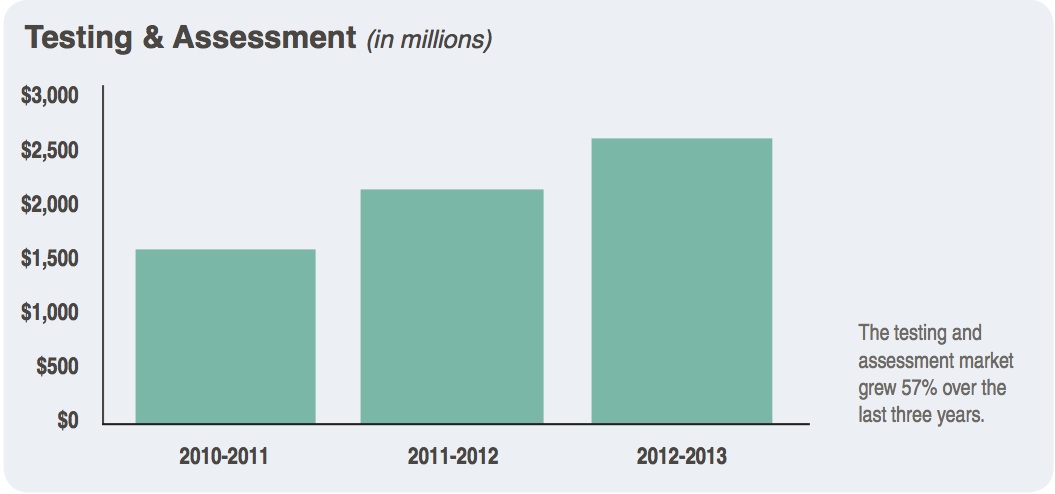
A Software & Information Industry Association report reveals, “testing and assessment products–which include software, digital content and related digital services–now make up the largest single category of educational technology sales,” increasing by 57% since 2012-2013:

testing and assessment 57 percent

That tax-payer’s cash grab combined with what Anthony Cody calls “necessary surveillance” for national high-stakes testing is a cancer on the educational body—one that must be not only cured, but also eradicated and then prevented.

However, we must also admit that this cancer is the result of cancer-causing behavior.

As teachers and public education advocates, we must continue to fight the profits and surveillance of Pearson and other commercial interests, but we also must face our own bad habits.

While we raise our voices against misguided and harmful policy (including taking a professional and political stance), we should practice what we preach by creating classrooms that reflect our obligations and commitments.

So I completely agree when Peter Greene makes this pointed and accurate claim connected to Pearson: “You know what kind of test need this sort of extreme security? A crappy one.”

I also support Jersey Jazzman concluding:

But even more than that: a good teacher gives assessments that are largely cheat-proof. So if the PARCC people really think their exam can be gamed by students over social media, they are admitting they have created an inferior product. …

Further: if the assessment is any good, and is really measuring higher-order thinking, it likely can’t be gamed. It’s easy to cheat on a multiple choice exam; it’s much harder to cheat on a chemistry lab. And it’s nearly impossible to cheat on a choir concert, or a personal response to a novel, or number line manipulative. …

But if the PARCC is so vulnerable that a tweet by a student after the test compromises the entire exam, it must be useless — particularly as a measure of student learning.

However, I feel obligated to raise a concurrent point related to the opening of this post: If our own assessment practices need the amount of surveillance and diligence detailed for preventing cheating and catching cheaters, there is ample evidence some pretty suspect testing is happening in our classrooms as well.

Let’s end the tyranny of high-stakes standardized testing that has spawned Pearson et al., but let’s make sure we address that tyranny in our own practice as well.

For Further Reading

Who’s Cheating Whom?, Alfie Kohn

Email to My Students: “the luxury of being thankful”

Grades Fail Student Engagement with Learning

“Students Today…”: On Writing, Plagiarism, and Teaching

De-Testing and De-Grading Schools: Authentic Alternatives to Accountability and Standardization, Bower, Joe / Thomas, P.L. (eds.)

The Fatal Flaw of Teacher Education: “We have met the enemy and he is us.”

The Problem with Pearson (and Hyperbole)

Passive Progressivism

The State (Columbia, SC): Hartsville documentary reminds us of failures of SC education ‘reform’ efforts

The State (Columbia, SC): Hartsville documentary reminds us of failures of SC education ‘reform’ efforts

[provided below with hyperlinks]

South Carolina has contributed significantly to the thirty-plus years of education accountability begun under President Ronald Reagan in the early 1980s, including former Governor and Secretary of Education Richard Riley’s leadership as well as the high-profile court case over school funding detailed in the documentary Corridor of Shame.

On March 19, PBS turns the education reform spotlight on Hartsville, as co-producer Sam Chaltain explains for The New York Times:

[I]n 2011, …[Hartsville] announced a five-year plan to transform its elementary schools. It partnered with Yale University’s School Development Program, which helps schools identify and meet the developmental needs of children. It began to evaluate its schools by a broader set of measurements – including the number of disciplinary referrals a bus driver had to write each morning. And it started to coordinate its social services to ensure a more equitable set of support structures for Hartsville’s poorest families.

This documentary will again raise issues about the powerful intersection of poverty, race, and education while also offering an opportunity for viewers in SC and across the U.S to evaluate the current commitments to accountability-based reform.

SC is now poised with the in-school transition created by the Common Core debate and the election of the new state Superintendent, Molly Spearman, who appears to have begun with a fresh and positive tone, to change not only how we view our education system but also what we do in the name of reform.

Setting aside partisan politics and accepting that a great deal of education reform in the state has been motivated by the best intensions, what do we now know about our major commitments to policy?

SC has like most states across the U.S. worked through several versions of standards and high-stakes tests, linking those tests to accountability for schools, students, and teachers. That we are set once again to go down the exact same path with the exact same promises that haven’t come to fruition, we should consider that the problem is not about standards and testing. In fact, there is no correlation over the past thirty years between the presence or quality of standards and student achievement or educational equity.

The charter school movement in SC has strong proponents, but we must also admit that, again as we see across the country, charter schools perform about the same as public school, including problems such as re-segregation.

Broadly, the primary list of education reform commitments—teacher evaluations liked to test scores, 3rd-grade retention based on reading tests, for example—has proven ineffective not only in SC but also throughout the U.S.

And this may be why the documentary on Hartsville is so important.

The educational problems of Hartsville are not new to our state; they are the exact reasons high-poverty and majority-minority schools and districts sued the state over funding.

Accountability, standards, testing, charter schools, and the like have not erased the shame of the I-95 corridor, but those commitments have shuffled a tremendous number of students and funding that could have been better served and used to confront what the Hartsville community appears to accept, as Chaltain explains:

Across America, more than 16 million children — slightly more than one in five — now live in poverty. And in communities like Hartsville, the need for a healthier social ecosystem is acute….

This clear connection between the percentage of children living in poverty and a school’s overall ranking is not just a cause for concern. It is also an opportunity to think more holistically about the needs of children.

Since No Child Left Behind, publisher Pearson has made 8 billion dollars annually on education reform, 4 billion of that in the U.S.

That investment, we must also admit, has not paid off for our children, our communities, or our state. If it had, we would not now be creating once again new standards and tests.

SC is a vivid example of both the importance of education and the inability of education alone to change the corrosive influence of poverty and racism.

Hartsville may be a call for expanding education reform beyond the walls of the school, but it is also a call for political leadership to seek new policies while admitting the accountability era has failed.

I Swear: On “Grit,” Adult Hypocrisy, and Privilege

I’m gonna cuss on the mic tonight.
“Rockin’ the Suburbs,” Ben Folds

My parents taught me that if you swear, it’s a sign of a poor vocabulary.
If I expect my players to be disciplined, then I have to be, too.
Dean Smith

Few things have been more important to me than discovering George Carlin during my teens years in the 1970s. Soon to follow was Richard Pryor.

Profanity and the art of crafting humor are easily the foundations for my life of words as avid reader and writer.

And yes, I swear.

But in both Carlin and Pryor I learned something far more important than how to swear in ways that gained me credibility among my peers (despite my frail nerdom); I had the curtain pulled back on adult authority—the hypocrisy of the “do as I say, not as I do” adult world.

Carlin and Pryor were my first critical teachers.

I grew up in a rural Southern town and school system where adults demanded children respect authority and tradition while behaving in ways that were inexcusable—racial slurs, profanity, drinking, smoking, you name it.

This was particularly pronounced among the coaches in the public schools.

Years after I graduated, I returned to that school to teach. A sophomore came into my class one day, stunned that the head football coach/athletic director/assistant principal had just given the student demerits for swearing—and had yelled profanities at the student during the issuing of those demerits.

So as I have noted before about Coach K and my fandom for Duke University basketball, I have a great deal of trouble with the berating, profane coach demanding character and discipline from his/her players—often children, teens, and young adults.

And we live in a world still where a coach launches into a profane tirade to reprimand his player for lacking class and a white, privileged male moralizes cluelessly, perched not on his own morality but his privilege (see Elizabeth Stoker Bruenig’s Poor People Don’t Need Better Social Norms. They Need Better Social Policies).

When Dean Smith recently passed away, the coverage did highlight Smith’s unique convictions as a coach—including that he did not use profanity, but also that he led a social activist life that was often ignored.

But let’s be clear that Smith’s convictions are about not just talking the talk, but walking the walk: “If I expect my players to be disciplined, then I have to be, too.”

So when I came across a profile of Angela Duckworth, who is the central person in the “grit” phenomenon mostly aimed at impoverished and minority children, I had the same reaction to some details as I have when Coach K screams profanities on the sidelines, when the Vanderbilt coach lost it, and when the privileged make moral demands of the impoverished—and as I noted above, my problem is not the profanity, but the hypocrisy.

Early in the profile of Duckworth, we learn:

Assistant Professor of Psychology Angela Duckworth Gr’06 has another explanation. Before she entered graduate school at Penn in 2002 she spent five years teaching math and science in poor urban neighborhoods across the United States. In that time she concluded that the failure of students to acquire basic skills was not attributable to the difficulty of the material, or to a lack of intelligence, or indeed to any of the factors mentioned above. Her intuition told her that the real problem was character [emphasis added].

“Grit” research claims that some people are successful and others are not because of something like resiliency, which is a subset of the larger character issue.

However, later in the profile, we also discover:

Duckworth jokes that the job-hopping she did in her twenties was a case study in “how not to be gritty,” but it seems more a function of the intensity and dynamism of her personality. In the course of reporting this article I heard colleagues call Duckworth the most extroverted person, the quickest learner, and the fastest thinker (and talker) they’d ever met.

On the day I visited she had a half-dozen bubble gum containers on her desk, suggesting an atmosphere of restless activity and a need to replenish the saliva that’s lost through such rapid-fire speech. She also uses expletives in a way that might impress even high-powered cursers like Rahm Emanuel. In the course of a 90-minute conversation she called a principal she knew “an asshole,” described the opinion of a leading education foundation as “fucking idiotic,” and did a spot-on impression of a teenager with attitude when explaining the challenge of conducting experiments with adolescents: “When you pay adults they always work harder but sometimes in schools when I’ve done experiments with monetary incentives there’s this like adolescent ‘fuck you’ response. They’ll be like ‘Oh, you really want me to do well on this test? Fuck you, I’m going to do exactly the opposite.’”

So when I Tweeted this, I found out that others immediately assumed I was concerned about Duckworth’s profanity.

Again, I swear. Quite a lot.

But the issue with the above is that I see in Duckworth more evidence of what William Deresiewicz confronts in Don’t Send Your Kid to the Ivy League and his book, Excellent Sheep: The Miseducation of the American Elite and The Way to a Meaningful Life:

Our system of elite education manufactures young people who are smart and talented and driven, yes, but also anxious, timid, and lost, with little intellectual curiosity and a stunted sense of purpose: trapped in a bubble of privilege [emphasis added], heading meekly in the same direction, great at what they’re doing but with no idea why they’re doing it.

Privilege and success are dangerous combinations:

Elite schools like to boast that they teach their students how to think, but all they mean is that they train them in the analytic and rhetorical skills that are necessary for success in business and the professions. Everything is technocraticthe development of expertiseand everything is ultimately justified in technocratic terms [emphasis added].

Such as identifying, measuring, and labeling children by their “grit”? A technocratic view of the world that ignores inequity, privilege?

And thus, I fear that the “grit” narrative as a veneer for privilege is part of the problem noted by Deresiewicz: “This system is exacerbating inequality, retarding social mobility, perpetuating privilege, and creating an elite that is isolated from the society that it’s supposed to lead.”

There is an arrogance, a self-righteousness, a contempt for others—carried by the flippancy of profanity—that make me convinced that, yes, “grit” is a veneer for privilege, a way to reduce marginalized people through a deficit view.

To be pointed, I am deeply concerned about the racism and classism beneath those embracing and endorsing “grit”—and Duckworth’s mockery of adolescents suggests a lack of awareness that reinforces my concern.

The formula: I worked hard and succeeded. You are struggling so it must be you aren’t working hard enough!

So the missionary zeal bothers me:

For Duckworth, however, the challenge of her research question is part of its appeal. She spent the first decade of her professional life unsure of how to apply her abundant talent. Now she no longer has any doubts. “I have complete conviction that this is an incredibly important scientific question,” she says. “If we can figure out the science of behavior and behavior change, if we can figure out what is motivation and how to motivate people, what is frustration and how do we manage it, what is temptation and why do people succumb to it—that to me would be akin to the semiconductor.”

The facts refuting that formula bother me even more: Educational attainment (a clear marker for effort) is often significantly trumped by race and class.

If we accept that “grit” includes “perseverance and passion for long-term goals” (such as achieving more education), I find the above details about Duckworth more evidence of the adult hypocrisy I experienced while growing up. Is her cavalier attitude and profanity any different than the attitude she is condemning among teens?

So my concerns are not personal, or personal attacks—because Duckworth is certainly not alone in her good intentions behind “grit” research or practices.

And my concerns are grounded in Paul Gorski’s scholarship in which he shares his own self-reflection, as have I, as I continue to do. Gorski explains:

Unfortunately, my experience and a growing body of scholarship on intercultural education and related fields (such as multicultural education, intercultural communication, anti-bias education, and so on) reveal a troubling trend: despite overwhelmingly good intentions, most of what passes for intercultural education practice, particularly in the US, accentuates rather than undermines existing social and political hierarchies (Aikman 1997; Diaz-Rico 1998; Gorski 2006; Hidalgo, Chávez-Chávez, and Ramage 1996; Jackson 2003; Lustig 1997; Nieto 2000, 1995; Schick and St. Denis 2005; Sleeter 1991; Ulichny 1996). (p. 516)

Further, I remain guided in my criticism of “grit” by Gorski’s questions:

The questions are plenty: do we advocate and practice intercultural education so long as it does not disturb the existing sociopolitical order?; so long as it does not require us to problematize our own privilege?; so long as we can celebrate diversity, meanwhile excusing ourselves from the messy work of social reconstruction?

Can we practice an intercultural education that does not insist first and foremost on social reconstruction for equity and justice without rendering ourselves complicit to existing inequity and injustice? In other words, if we are not battling explicitly against the prevailing social order with intercultural education, are we not, by inaction, supporting it?

Such questions cannot be answered through a simple review of teaching and learning theory or an assessment of educational programs. Instead, they oblige all of us who would call ourselves intercultural educators to re-examine the philosophies, motivations, and world views that underlie our consciousnesses and work. Because the most destructive thing we can do is to disenfranchise people in the name of intercultural education. (p. 516)

I am not, then, being a petty prude. (Want to listen to my CAKE or Ben Folds/Five mix CDs?)

I am not stooping to ad hominem, and this has nothing to do with who I like or dislike (as I don’t know Duckworth, and the other key “grit” advocates). I suspect, actually, they are good and decent people dedicated to doing the right thing.

This is about the hypocrisy of adult demands aided by the technocratic use of “grit” as a veneer for privilege.

I remain convinced that the appeal of the “grit” narrative is mostly a failure to do what Gorski notes above: “Such questions…oblige all of us who would call ourselves intercultural educators to re-examine the philosophies, motivations, and world views that underlie our consciousnesses and work.”

So when an award-winning researcher tells me poor and minority children simply lack “grit” or a New York Times pundit explains the moral shortcomings of the poor, I hear Ben Folds singing, “Let me tell y’all what it’s like/ Being male, middle class and white/ It’s a bitch”—except Folds in his profanity is being satirical and his work is mostly harmless entertainment.

The Problem with Pearson (and Hyperbole)

The education reform debate—one often derailed by both the tone taken and then the debate about that tone (and not the issues)—appears determined to have an Evil Person (or Evil Corporation) to slay.

There was Michelle Rhee (whose Time cover really was just begging for it), and then Bill Gates. But to be honest, the list of candidates for Evil Person has been pretty long.

If you mention a person directly, you are immediately discounted as using ad hominem (although in many if not most of those cases, legitimate issues have been raised about expertise, experience, and even intentions—and not ad hominem at all).

Now, Pearson has entered the picture and prompted a new round (and maybe a new level) of hyperbole.

Data security about children/students, surveillance of Twitter and social media—Pearson has become the manifestation of Big Brother for those skeptical of technology and high-stakes testing.

To that, I’d say that we can have a reasonable debate about whether the comparison is hyperbole or an apt literary analogy, but the larger point I’d like to make is that in ether the debate or the comparison, we are likely missing the important issue.

Pearson has earned 8 billion—4 billion in the U.S.—in annual sales as a consequence of the accountability policies adopted by those elected to office within a democratic process.

I’m sorry to have to note this fact, but Pearson is not a Evil Demigod or some such.

Pearson and its profits are a consequence of very clear and consistent decisions by people in power and the people who put them in power.

Pearson is the logical conclusion of democracy and capitalism—not some totalitarian monster.

When you look at the Pearson phenomenon, and its relationship with education policy and the drain on tax dollars, you must admit this: “We have met the enemy and he is us.”

And what hath we wrought?

If Pearson makes you angry, be sure to consider just who is to blame.

Time to Choose Equity Over Accountability

My home state of South Carolina is an ideal lesson in education reform.

SC is a high-poverty state (in the bottom quartile of affluence in the U.S.) that committed early to the accountability era built on state standards and high-stakes tests (exit exams, school report cards, etc.).

Currently, SC has in quick succession adopted and then rejected Common Core, resulting in the state having about 5 or 6 different versions of state standards and tests in those thirty years.

And as we watch winter turn to spring in 2015, ain’t nobody happy with public schools in SC. Also, SC continues to struggle with pockets of extreme poverty and segregated affluence as well as entrenched racism, hostile policies for workers, and Teflon-conservative politics.

That should lead one to question the process of accountability—although apparently it doesn’t.

Two examples, however, can help us here.

First, despite the demonstrable failure of the accountability era to improve schools adequately over three decades by focusing on test data to evaluate school quality and student achievement, the test-mania has now been targeted on teachers with the endless consideration of how best to use value added methods (VAM) to evaluate teachers.

Continuing down the technocratic road of making VAM work statistically, I argue, is another example of how to do the wrong thing the right way.

It is entirely possible that we can develop a scientifically credible use of VAM and also do more harm to education than good—and again, we will suffer the bitter lessons of chasing better tests.

And here comes the irony: If we are determined to keep our eyes focused on test data, why are we not recognizing what those tests tell us over the long haul?

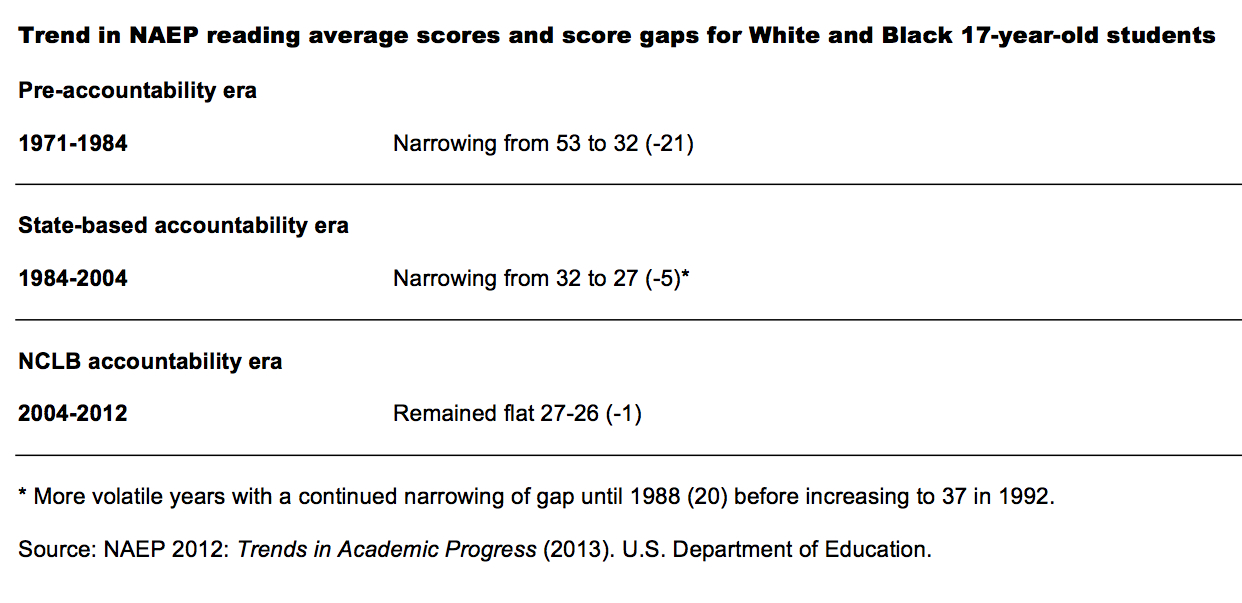
The second example was highlighted for me at Schools Matter, where two charts from longitudinal NAEP data were posted, one of which I have recreated in a different format to highlight phases in education:

NAEP gap simple 2

Before us now, after ample time has passed experimenting with accountability, we can drawn some tentative conclusions [1]: (i) the Civil Rights era from the 1950s into the 1970s (for example, SC schools did not fully integrate until early 1970s) when the focus was on equity seems to have fostered greater narrowing of the achievement gap than either (ii) the state-based accountability era or (iii) the NCLB accountability era.

And so: A lack of accountability, standards, or “good” tests was never the problem in U.S. public education, but as my home state of SC shows, a crippling history of inequity driven by racism, classism, and sexism is the primary plague reflected in the measurable outcomes found in our schools.

It is time to choose equity over accountability for our education policy. In fact, it is well past time to hold the advocates of accountability accountable for misreading their own data.

[1] FairTest has offered a more detailed analysis, drawing similar conclusions.

Manufactured Austerity, Disaster Capitalism, and Education Reform

aus·ter·i·ty /ôˈsterədē/ noun

  • sternness or severity of manner or attitude.

“he was noted for his austerity and his authoritarianism”

  • extreme plainness and simplicity of style or appearance.

“the room was decorated with a restraint bordering on austerity”

  • conditions characterized by severity, sternness, or asceticism.

plural noun: austerities

“a simple life of prayer and personal austerity”

synonyms: severity, strictness, seriousness, solemnity, gravity; frugality, thrift, economy, asceticism; self-discipline, abstinence, sobriety, restraint, chastity; starkness

#

In the second half of AMC’s The Walking Dead Season 5, the main characters and viewers discover Alexandria, introducing into the dystopian landscape a utopian [1] possibility.

This new setting raises, as Erik Kain explains, a different set of dangers, expressed openly by several characters: “The first danger will be the invitation of a warm bed and a warmer meal. Rick, Carol, Daryl, Michonne, Glenn and the rest all risk becoming as soft and weak and fat as their new hosts.”

Rick and his crew, then, are determined to remain vigilant against the creeping allure of becoming soft—having spent years now hardening themselves against the Social Darwinism of the zombie apocalypse.

In this dystopia, zombies are pervasive, and the possibility of any return to so-called normalcy appears gone. Rick, Carol, and Daryl, at least, seem certain that the relief of Alexandria is short-lived, if not entirely illusion.

#

Other than being key elements in education reform over the last 10-30 years, what do all of the following have in common?:

  • School choice formats: vouchers, tuition tax credits, public school choice, charter schools.
  • “No excuses” ideologies and policies.
  • “Grit” narratives and research.
  • No Child Left Behind, Race to the Top, Opting out of NCLB.
  • Value-added methods (VAM) of teacher evaluation and pay; calls to fire “bad” teachers (such as the bottom 5%, reminiscent of stack ranking).
  • Standards and standardized tests as part of high-stakes accountability.
  • School report cards.
  • Exit exams.
  • 3rd-grade retention based on high-stakes tests.
  • School and district take-over policies such as the RSD in New Orleans and ASD in Tennessee.

A common set of threads run through the accountability era: Assumptions that educational outcomes are the result of low effort by schools, teachers, and students; and thus, the need for incentives, competition, and overall accountability.

So my answer to my question above is that education reform is essentially manufactured austerity, resulting in educators, parents, and students being conditioned—like the main characters in The Walking Dead—to be hard in order to survive a dystopian world (a world that functions like New Orleans in a state of disaster capitalism).

The problem? The dystopia of the zombie apocalypse is fiction, and although humans are never going to achieve utopia, we in the more so-called advanced countries in the world (notably the U.S.) are coming very close to being able (if anyone had the political will) to create a world in which austerity is nearly absent.

That would be a world of community and collaboration, equity and trust—essentially nothing like the dystopias being created in our public school system by education reform.

And let me highlight once again the most disturbing element that represents my generalization: using VAM to evaluate, retain/dismiss, and pay teachers creates a system in which each teacher must seeks ways in which her/his students can beat other children in other teachers’ classroom in order to survive and thrive in the zombie apocalypse of education reform.

#

There is a stark reason zombie narratives are popular in the Western world, cultures in practice dedicated not to democracy and equity, but to Social Darwinism and consumerism—a dog-eat-dog existence that we at least unconsciously recognize in the zombie, the living dead trapped in a constant state of consuming simply to be consuming, not as nourishment.

Manufactured austerity feeds disaster bureaucracy, and as such, education reform is not about reforming education, but feeding disaster bureaucracy, as DeLeuze details:

We are in a generalized crisis in relation to all the environments of enclosure—prison, hospital, factory, school, family….The administrations in charge never cease announcing supposedly necessary reforms: to reform schools….But everyone knows that these institutions are finished….These are the societies of control, which are in the process of replacing the disciplinary societies….In the disciplinary societies one was always starting again (from school to the barracks, from the barracks to the factory), while in the societies of control one is never finished with anything [emphasis added]. (pp. 3, 5)

“[N]ever finished with anything”—like a new set of standards and new high-stakes tests every few years?

For Further Reading

Time as Capital: The Rise of the Frantic Class

Post-apocalyptic Mindset in a Civilized World

Endgame: Disaster Capitalism, New Orleans, and the Charter Scam

Education Accountability as Disaster Bureaucracy

Why Sending Your Child to a Charter School Hurts Other Children

Gates’s Cannibalistic Culture: Coming to a School Near You!

Death to Common Core! Long Live Failed Education Policy!

[1] See Margaret Atwood: the road to Ustopia for an excellent discussion of genre and the intersection of dystopia/utopia. Also, Margaret Atwood on Science Fiction, Dystopias, and Intestinal Parasites.

Good Intentions, Political Realities, Privileged Cluelessness: On Education Reform and Poverty

Education and education reform are vibrant examples of the wide spectrum of good people with good intentions and then all the way to the other extreme, spurious people with dubious intentions.

When my home state of South Carolina began sliding down that slippery slope of adopting (flawed and misrepresented) reading policy modeled on Florida, I came face to face (actually, voice to voice) with the harsh realization that good people with good intentions can be as harmful as spurious people with dubious intentions: Good people with whom I had been talking suddenly brushed me off, citing political expediency—better to get the money for reading and swallow the horrible grade retention element than to get no money at all, I was told.

I thought of this when I saw associate editor at The State Cindi Scoppe’s To fix SC schools, start with governance. Scoppe, for full disclosure, has published a number of my Op-Eds in The State, notable is that my positions are decidedly not in line with the politics or ideology of my home state.

Also, I am certain Scoppe is a good person with good intentions; she genuinely wants equitable and effective schools for all children in SC.

However, I also know good intentions (even mine) are not enough.

Scoppe opens with admitting she isn’t an expert on educating students, and then offers a relatively modest plan for education reform—ones she characterizes as “commonsense reforms that come from across the political spectrum.” Scoppe endorses the “best ideas from the right and left,” including:

  • Making it easier to fire bad teachers (right);
  • increasing teacher pay to teach impoverished students, and freeing teachers from non-teaching tasks (left);
  • increasing charter schools, magnet schools, and parental choice, and giving schools more freedom in spending (right);
  • implementing a better school funding formula, with more equity, and pursuing, possibly, district/school consolidation (left).

My immediate response was to share on Twitter my argument that we need not simply appease the political right and left, or the public, but instead should endorse evidence-based reform addressing equity.

So that leaves these questions:

  • Are bad teachers, and the difficulty firing them, major (or even minor) hurdles to high-quality education for all children in SC? I have never seen anyone making this claim show evidence that this is true. I am deeply skeptical of these claims, also, in a right-to-work state where teachers’ unions have no legal power and very limited buy-in by K-12 teachers in the state. The real teacher quality problem in SC (and across the U.S.) is a tremendous inequity of teacher assignment: affluent and white students disproportionately have experienced and certified/qualified teachers while impoverished, minority, ELL, and special needs students disproportionately have beginning/inexperienced and un-/under-certified/qualified teachers.
  • Would targeted merit pay for teaching high-needs students and relief from non-teaching tasks help improve education for high-poverty, majority-minority schools (notably along the Corridor of Shame)? Unlikely, since legislation in the past in SC has included both, unsuccessfully. Merit pay has been discredited for education (as well as all professions) in general, in fact (see the work of Daniel PinkAlfie Kohn, and Joe Bower). What we do know is that teachers are more motivated by teaching and learning conditions as well as support from administration and parents than by merit pay schemes. Step one for encouraging teachers to work with high-needs students is addressing directly teaching/learning conditions in high-poverty schools. Step two is to reject teacher evaluation plans that are predicted to discourage high-quality teachers from working with the students having the greatest needs.
  • Are investments in charter schools, magnet schools, and parental choice effective reform measures for achieving educational equity? No. Charters schools in SC have shown that 95% of charters perform about the same and worse than public schools while also being highly segregated and often underserving ELL and special needs students. And the sloganism of “parental choice” hasn’t proven to be effective either; many efforts to increase parental choice have shown parents rarely choose based on academic quality, but tend to seek social or ideological goals.
  • Does SC need a better school funding formula, one that is more equitable, and one that likely will require consolidation of schools/districts? Yes, with caveats. Here, evidence is key. While there is a “common sense” argument that “money doesn’t matter” or “you can’t just throw money at schools,” solid and long-standing research refutes both; see the work of Bruce Baker. SC needs a new funding formula, but it must not be a partisan political event, and it must be based on research and not talking points. And as a powerful example, school/district consolidation is exactly one of those common sense ideas that research challenges: “While state-level consolidation proposals may serve a public relations purpose in times of crisis, they are unlikely to be a reliable way to obtain substantive fiscal or educational improvement.”

Good intentions and political expediency, then, simply are not enough—and are likely to keep SC mired in bad education reform piled on top of the historical and lingering cancers of racism and concentrated poverty.

Which brings us to the other side of the spectrum—spurious people with dubious intentions, in this case the grand whitesplainer employed by The New York Times.

I refuse to mention he-who-shall-not-be-named, and gross stereotyping of people in poverty deserves as little attention as possible, but for balance here, I offer a wonderful refuting by Elizabeth Stoker Bruenig, Poor People Don’t Need Better Social Norms. They Need Better Social Policies.

And also, Emmitt Rensin offers a thorough unpacking and discrediting of “blame the poor” mentalities:

It would be one thing if we didn’t recognize the problem of American poverty. It would be easy if the moral scolding of our poor were confined to one section of our polity. Then we might pursue the many avenues of fiscal and monetary policy available to us. But among even those whose rhetoric suggests an awareness of the situation, even those who know that to be born monied in America is to be heir to a self-fulfilling prophesy of the kind of “good” behavior Brooks is crying out for, are so easily seduced by a reversal of effect and cause.

But out here, poor parents, poor kids and poor schools don’t have the luxury of indulging Brook’s harmful, costly relativism. They live by the most inflexible “code” of our national life: If you’re poor, you’re on your own. Good luck. Oh, and we’ll be watching. Future pay will reflect performance….

We aren’t bereft of ideals. Rather, we are plagued with bad ones—that discipline is proved by wealth, that the ideas of middle class luxury help children more than material wealth.

A better set might be the kind that makes the elected, empowered, ostensible advocates of America’s poor ask “tough questions” about their culpability in the condition of “our kids.” The kind that recognizes that there is a moral failure at the bottom of American poverty—but this failure does not belong to its own victims.

I will end with this: U.S. public education, notably in SC, is a disturbing reflection of the inexcusable inequity in our country not the result of anyone’s effort or character, but the consequences of privilege and inequity.

Until we make political, media, and public efforts to eradicate inequity and poverty—including that we rise above the hatred aimed at impoverished people, racial minorities, and women—from our society and our schools, whether we fire bad teachers, add more charter schools, or not will make little difference.

Middle-Class Assumptions Fail Literacy Instruction

My doctoral work was anchored significantly in John Dewey—highlighted, I recall, by discovering that Dewey had claimed we need not teach children to read because reading was something that naturally developed in children (and since he could not recall being taught explicitly to read).

I was struck by such a tremendous failure in a great thinker, one that exposes the dangers of assuming “my” experiences prove a generalization, especially when “my” experiences are ones of privilege.

When I posted Encouraging Students to Read: A Reader, this odd fact about Dewey came back to me when Peter Smagorinsky called me out, appropriately, for failing to acknowledge the middle-class assumptions beneath endorsing holistic approaches to teaching reading, ones that far too often have failed students who struggle to develop literacy due to class, race, gender, and other challenges.

I have noted before that progressivism, whole language, and balanced literacy have been misunderstood by politicians, the media, and the public, but we must also confront that practitioners have misunderstood and then implemented progressive and holistic approaches to literacy instruction in ways that have been extremely harmful to the exact students most in need of formal schooling.

The Dewey Paradox

Two aspects of Dewey’s progressive education philosophy are key in that context: (i) Dewey’s progressivism is steeped in idealism, leaning precariously on the edge of naturalistic views of children and learning (one that may be true if a child lives in privilege), and thus (ii) Dewey’s progressivism has mostly been misinterpreted and implemented in ways that do not reflect Dewey’s foundational commitments or serve many students well.

Not to be an apologist for Dewey, but to help clarify what many of us who stand on Dewey’s shoulders embrace (noting that I am a critical educator, and not a progressive), I recommend Dewey’s Experience and Education as well as Alan Ryan’s biography of Dewey (specifically his Chapter Four: The Pedagogue as Prophet).

For me, Dewey provided the seed for critical pedagogy to grow out of the soil of progressivism:

It is not too much to say that an educational philosophy which professes to be based on the idea of freedom may become as dogmatic as ever was the traditional education which is reacted against. For any theory and set of practices is dogmatic which is not based upon critical examination of its own underlying principles. (Experience and Education, p. 22)

In the reading wars, then, dogmatic commitments to either whole language or isolated phonics instruction instead of addressing the needs of each individual student to become a reader is the great failure Dewey himself would have acknowledged.

Misreading Dewey, however, has a long tradition itself. Lou LaBrant, a fervent Dewey progressive, wrote in 1931 a scathing attack on the project method, which claimed to be in the Dewey tradition:

The cause for my wrath is not new or single. It is of slow growth and has many characteristics. It is known to many as a variation of the project method; to me, as the soap performance. With the project, neatly defined by theorizing educators as “a purposeful activity carried to a successful conclusion,” I know better than to be at war. With what passes for purposeful activity and is unfortunately carried to a conclusion because it will kill time, I have much to complain. To be, for a moment, coherent: I am disturbed by the practice, much more common than our publications would indicate, of using the carving of little toy boats and castles, the dressing of quaint dolls, the pasting of advertising pictures, and the manipulation of clay and soap as the teaching of English literature. (p. 245)

Ryan’s biography achieves a manageable and complex picture of Dewey—one that Dewey failed to express clearly. But in that picture, we see the idealism noted above as well as a level of sophistication (for example, seeking to honor both the individual and community, instead of bowing to either/or thinking) that made Dewey hard for a general public and often inaccessible for practitioners who want the practical and not his pragmatic [1].

However, “Dewey himself argued that it was not enough to repudiate traditional education,” Ryan explains, adding:

It was not enough for progressive teachers to throw out everything the old schools had done, to replace discipline by chaos, a rigid syllabus with no syllabus. And Dewey was inclined to think that many schools had done exactly that and had used his name to justify it. The difficulty was to give an account of the educational experience that would elicit a kind of discipline, an approach to the syllabus and to the authority of the teacher in the classroom that would grow out of experience itself. (p. 282)

And it is here that I can speak directly to the great paradox of progressive and critical commitments in education, especially in terms of teaching literacy, as expressed by Dewey himself:

What avail is it to win prescribed amounts of information about geography and history, to win ability to read and write, if in the process the individual loses his own soul: loses his appreciation of things worth while, of the values to which these things are relative; if he loses desire to apply what he has learned and, above all, loses the ability to extract meaning from his future experiences as they occur? (Experience and Education, p. 49)

Teaching for over thirty years while attempting to avoid prescription and indoctrination, to foster joy and pleasure in learning, and to provide all students with the content they deserve and need has often lead to paralysis since those commitments are overwhelming in their contradictions. I have never settled for decoding or even comprehension in any student—always demanding we rise to include critical literacy that requires that students have the decoding and comprehension as well.

Despite Dewey’s warning, dogmatism is easier, and as Ryan warned, Dewey’s progressivism demands more of teachers than traditional approaches. And thus, when faced with the most challenging populations of students, we too often take the path of least resistance, mis-serving those students along the way.

Enter Delpit: Middle-Class Assumptions Fail Literacy Instruction

What appears to have happened in formal education throughout the U.S. is that literacy education has increased the gaps among social classes and racial subgroups because too often than not we have failed to honor the balance between fostering a love and joy for language with the necessary skills to read and write—and the students who suffer the most in that failure have been racial minorities and impoverished children.

Affluent students are allowed to relish in the joy of language (reaping the advantages of their privilege, which includes a literacy growth that seems transparent to them, as it did to Dewey) in formal schooling, while struggling students (disproportionately children of color and impoverished) are sentenced to drudgery masquerading as literacy instruction, further disadvantaging them.

Middle-class norms drive a great deal of practice in formal schooling since the wider U.S. society is trapped in those middle-class norms (ones that include not only socioeconomic but also racial [read “white”] expectations) and since the teacher workforce in the U.S. is itself a middle-class profession dominated by white females.

These middle-class blinders can be observed in the misguided embracing of Ruby Payne’s stereotypes about poverty, the nearly universal acceptance of the “word gap,” and the “grit” narrative as a veneer for white privilege.

Just as Dewey’s progressivism needed a critical re-imagining from Paulo Freire and others, Freire’s critical pedagogy needed bell hooks and others to confront Freire’s paternalism.

Then, enter Lisa Delpit, who provides the confrontation of the failures of misunderstood progressivism and holistic approaches to literacy instruction—the failures that often misrepresent whole language but exist under that terminology (see Ryan’s point about Dewey’s complaints above).

Writing in 1996 about Delpit, Debora Viadero explains:

But Delpit is best-known for the bombs she has lobbed at some of contemporary education’s most sacred cows.

A decade ago, Delpit started penning a series of eloquent, plain-spoken essays in the Harvard Educational Review that questioned the validity of some popular teaching strategies for African-American students. The essays were spun off into a book, Other People’s Children: Cultural Conflict in the Classroom, that was published last year by The New Press.

The problem, Delpit says in those writings, is not that whole-language reading instruction techniques or the process-writing approach to teaching writing are inherently bad. They work for some students–possibly most. They just do not work for everybody. And often the people they do not work for are children who, like Delpit herself, were born black and disenfranchised. What is more, these strategies might not work for children of any group that has strong, distinctive cultural roots and that stands on society’s perimeter peering in.

And while some continue to misrepresent Delpit in similar ways to how Dewey was/is misrepresented, Delpit offers to me the best understanding of achieving the balance Dewey sought.

The powerful phrase “other people’s children” comes from the work of Delpit, who confronts the inequity of educational opportunities for minority and impoverished children. Delpit highlights that marginalized students receive disproportionately test-prep and worksheet-driven instruction, unlike their white and affluent peers. While some have claimed her as a champion of traditional practice because her criticisms have included failures by progressives, Delpit counters:

I do not advocate a simplistic “basic skills” approach for children outside of the culture of power. It would be (and has been) tragic to operate as if these children were incapable of critical and higher-order thinking and reasoning. Rather, I suggest that schools must provide these children the content that other families from a different cultural orientation provide at home. This does not mean separating children according to family background [emphasis added], but instead, ensuring that each classroom incorporate strategies appropriate for all the children in its confines.

And I do not advocate that it is the school’s job to attempt to change the homes of poor and nonwhite children to match the homes of those in the culture of power [emphasis added]. That may indeed be a form of cultural genocide. I have frequently heard schools call poor parents “uncaring” when parents respond to the school’s urging, saying, “But that’s the school’s job.” What the school personnel fail to understand is that if the parents were members of the culture of power and lived by its rules and codes, then they would transmit those codes to their children. In fact, they transmit another culture that children must learn at home in order to survive in their communities.

And Monique Redeaux clarifies:

When Delpit began her work on “other people’s children” she predicted that her purpose would be misunderstood. People criticized her for “vindicating” teachers who subjected students of color to isolated, meaningless, sub-skills day after day. However, what she was actually advocating when she referred to “skills-based instruction” was the “useful and usable knowledge that contributes to a student’s ability to communicate effectively in standard, generally acceptable literary forms” and she proposed that this was best learned in meaningful contexts. In other words, Delpit argued that both technical skills and critical thinking are essential: a person of color who has no critical thinking skills becomes the “trainable, low-level functionary of the dominant society, simply the grease that keeps the institutions which orchestrate his or her oppression running smoothly.” At the same time, those who lack the technical skills demanded by colleges, universities, and employers will be denied entry into these institutions. Consequently, they will attain financial and social success only within the “disenfranchised underworld.”

Like my progressive muse LaBrant, I remain convinced that reading programs—including prescriptive, systematic phonics programs—are “costume parties” that fail our students—and waste a tremendous amount of funding and instructional time, money and time better spent with authentic texts.

But when I endorse choice, independent reading, and access to books, like Delpit, I am not excusing those who idealize those commitments (through middle-class lenses) and then fail to teach reading (or writing) based on the needs of each student, some of whom will flourish with little guidance and some of whom need intensive and direct instruction.

It is no petty thing to acknowledge that a hungry or abused or frightened child will not find joy in reading when allowed choice, independent reading, and access to books because those do not address the burdens denying them that joy and learning opportunity. It is no petty thing either to note that taking struggling students and simply demanding they ignore their life’s inequities and complete phonics worksheets will not work as well.

As Dewey would stress, either/or thinking and dogmatism serve no one well when we are teaching children to read and write. Too often, that dogmatism has its roots in our middle-class privilege that, as with Dewey, blinds us to what our students need most from our teaching.

[1] As Ryan explains: “Dewey spent a great deal of his adult life explaining that ‘pragmatic’ did not mean ‘practical’ in a merely utilitarian and down-to-earth sense” (p. 225).

Encouraging Students to Read: A Reader

Valerie Strauss has dedicated two blog posts (here and here) to a new report, Kids & Family Reading Report.

One key finding deserves highlighting (and a caveat):

Additional factors that predict children ages 12–17 will be frequent readers include reading a book of choice independently in school, ereading experiences, a large home library, having been told their reading level and having parents involved in their reading habits.

First, the caveat: Beware concerns about reading levels, which are the flawed domain of the technocrat. (See 21st Century Literacy, co-authored with Renita Schmidt.)

But more important is that (yet again) choice, independent reading, and access to books are all vital to supporting eager and sophisticated readers among children and students.

Note that eager readers are not the result of reading programs, worksheets, intense phonics instruction, or assigning classic reading lists (although all of those have some role to play if not abused, overemphasized).

“It is important that we do not set up in our class-rooms prejudices or snobberies which will make our students less instead of better able to understand, enjoy, and use this language,” argued Lou LaBrant, former NCTE president, in 1943, adding

Too frequently we give children books which have enough value that we call them “good,” forgetting that there are other, perhaps more important values which we are thereby missing. It is actually possible that reading will narrow rather than broaden understanding.Some children’s books, moreover, are directed toward encouraging a naive, simple acceptance of externals which we seem at times to hold as desirable for children….Let us have no more of assignments which emphasize quantity, place form above meaning, or insist on structure which is not the child’s. (p. 95)

See then:

LaBrant, L. (1937, February 17). The content of a free reading programEducational Research Bulletin, 16(2), 29–34.

LaBrant, L. (1941). English in the American scene. The English Journal, 30(3), 203–209.

LaBrant, L. (1943). Language teaching in a changing world. The Elementary English Review, 20(3), 93–97.

Stephen Krashen: Literacy: Free Voluntary Reading

Setting Free the Books: On Stepping Aside as Teaching

Progressivism and Whole Language: A Reader

Attack on “Balanced Literacy” Is Attack on Professional Teachers, Research

Reading Out of Context: “But there was something missing,” Walter Dean Myers