If anyone is truly interested in confronting the “soft bigotry” (not of “low expectations”) that is veiled racism/classism, please consider that an increasing number of black, brown, and poor students are being marched through the school day to “Work hard. Be nice.”
Telling children without boots to pull themselves up by their bootstraps is heinous.
Claiming “a rising tide lifts all boats” is cruel if we ignore those with leaking boats and those without boats.
—
The race and class bigotry of “no excuses” and “grit” approaches to educational practices and policies can be understood as yet more evidence of a long history of “blaming the victim” (Ryan, 1971, Blaming the victim. New York: Vintage Books).
In other words, to use an education example, we deny people in poverty access to equal educational opportunity, access to healthcare, and even access to air unspoiled by environmental hazards. We do this for generations and then, when some low-income youth don’t do well on standardized tests or drop out of school or seem disengaged in class, we forget about these iequities and blame it on their “culture.” (p. 54)
In the early 1990s after we had moved into our first stand-alone home (having lived in an owned townhouse a few years), my wife and I bought a Honda Accord—a typically American milestone of having finally risen above our station as Honda Civic owners.
As I was dong the paperwork for this car, I realized that the sale price was the same as what my parents had paid for their house in 1971 (a house, by the way, that still is more square footage than any house I have ever owned): $22,500.
I am one generation removed from the white working-class idealists who are my parents, both having been raised in the South during the 1950s—my mother the daughter of a mill worker and my father the son of a gas station owner.
Buying that Honda Accord, however, did not at that moment fill me with pride or a sense accomplishment. It made me feel extremely uncomfortable. I even called my father and told him about the coincidence of the prices of a car for me and the house my parents had worked themselves nearly to death to own.
My parents’ house sits on the largest lot of a local golf course, their having bought it as the course was being built and then scraped and clawed until they had the $1000 downpayment. Their monthly mortgage payment was also less than many of my car payments.
And while most people—especially my parents—would hold me up as proof of all that is Right with the U.S., I have to raise a hand of caution.
Yes, I have worked hard, but most of my success has come in academic settings—being a top student, and then working my way through undergraduate and graduate degrees while also having two careers, first as a high school teacher and now as a professor. To be perfectly blunt and honest, my success has been built on tremendous privilege—being white and male—and what appears to be hard work to many has in fact not been that hard for me at all.
Success in education depends a great deal on reading and writing—two behaviors that are for me both a joy and mostly easy to do.
#
In his Reaching and Teaching Students in Poverty, Paul C. Gorski notes “that many of us were raised to believe that the United States and its schools represent a meritocracy, wherein people achieve what they achieve based solely on their merit, so that all achievement is deserved rather than rendered” (pp. 14-15).
Historically, this American success story has been “tied to the Horatio Alger myth (Pascale, 2005) and the notions of rugged individualism and an ethic of self-sacrifice,” Gorski explains—what we often reduce to as “pulling ones self up by the bootstraps.”
However, this myth is nothing more than a twisted fairy tale—one that normalizes outliers and depends on a very ugly and false characterization of people in poverty: The impoverished, the subtext goes, create their poverty through their laziness.
The mostly false American success story keeps the accusatory gaze always on people in poverty so that little attention is paid to the larger forces of inequity in the U.S.
Gorski warns, “[M]ost of what poor people have in common has nothing to do with their culture or dispositions [ie., charges of laziness]. Instead, it has to do with what they experience, such as the bias and lack of access to basic needs” (p. 26).
#
Social forces—many of which are created and then perpetuated by privilege—drive conditions of scarcity (poverty) and slack (privilege) that are then reflected in the conditions surrounding and behaviors by individual people (see Sendhil Mullainathan and Eldar Shafir’s Scarcity: Why Having Too Little Means So Much).
Therefore, we must confront the real American success story, the one that is typical of life in the U.S. and not one that misrepresents outliers as the expectations for everyone.
In the U.S., the floors of the penthouse of the wealthy are incredibly secure and stable, the few cracks are nearly as tight as they are rare. The best road to success in the U.S. is to be born wealthy.
As well, the ceilings on the basement of poverty are incredibly secure, allowing only a rare fortunate few through by superhuman efforts.
George W. Bush has been very open as well about his struggle with alcoholism and his relatively unimpressive efforts at adulthood until he was nearly 40. Despite those hurdles and signs of laziness, he acquired part-ownership of the Texas Rangers and then became governor of Texas and president of the U.S.
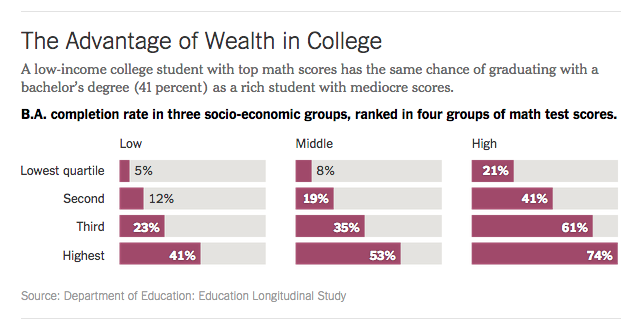
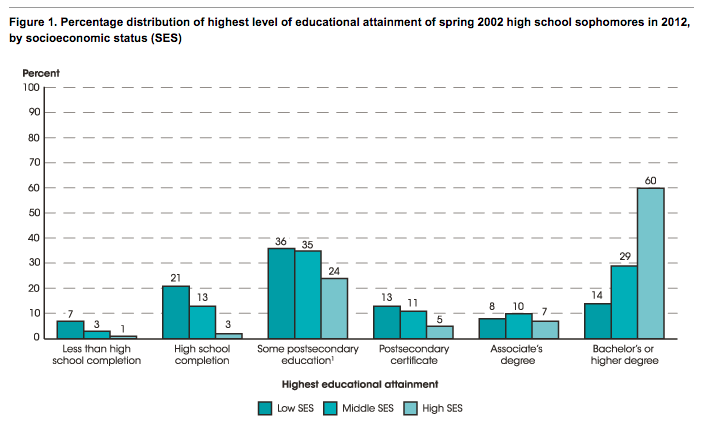
Rich and poor students don’t merely enroll in college at different rates; they also complete it at different rates. The graduation gap is even wider than the enrollment gap.
Source: Department of Education: Education Longitudinal StudySOURCE: U.S. Department of Education, National Center for Education Statistics, Education Longitudinal Study of 2002 (ELS:2002), Base Year and Third Follow-up. See Digest of Education Statistics 2014, table 104.91.
Further, Dynarski continues, and then concludes:
Academic skills in high school, at least as measured by a standardized math test, explain only a small part of the socioeconomic gap in educational attainment.
Here’s another startling comparison: A poor teenager with top scores and a rich teenager with mediocre scores are equally likely to graduate with a bachelor’s degree. In both groups, 41 percent receive a degree by their late 20s.
And even among the affluent students with the lowest scores, 21 percent managed to receive a bachelor’s degree, compared with just 5 percent of the poorest students. Put bluntly, class trumps ability when it comes to college graduation.
Poor students are increasingly falling behind well-off children in their test scores, as recent research by Sean Reardon at Stanford University shows.
That is, any poor children who manage to score at the top of the class are increasingly beating the odds. Yet even when they beat the odds in high school, they still must fight a new set of tough odds when it comes to completing college.
#
Steph Curry has gained a well-deserved high level of recognition as the NBA League MYV in the 2014-2015 season. Like Grant Hill, Curry is the black son of a successful and wealthy professional athlete.
Curry is recognized as a hard worker—practicing at rates and amounts that most people cannot comprehend.
Amaral is making a concession I have argued above.
Curry is an outlier, and the personification of a potentially corrosive promise: You can be anything if you just work hard enough.
Well, no, that isn’t true.
So those of us who are parents and educators are put in a truly ugly position.
I love to inspire and encourage young people. I dearly and deeply love young people.
But I also cringe at the adult proclivity to lie in order not to face themselves the ugly truths they create and perpetuate—often by refusing to face them.
There is tremendous value in hard work and effort for the sake of hard work and effort.
And, yes, the world should be a meritocracy, the world should be fair.
Pretending it is while it isn’t, wrapping our young in shallow feel-good slogans and stories—these are sure ways never to achieve the equity we say we love in the U.S.
If we do not want to tell students the real American success story—the one about winning the birth lottery—we damn well better do something to create a better story instead of continuing to lie to children and ourselves.
Because, as you know, it is entirely within your power to make things different, right?
In several undergraduate courses (a May course on education documentaries and first year seminars) and a graduate course (current trends in literacy) I teach, students write public pieces that challenges them to examine a common misconception and then help a general audience better understand the issue. The piece is created as an online document as well—requiring that students explore citing and supporting their claims with hyperlinks to credible and effective sources.
As a genre (commentary), a distinct medium (virtual/online), and advocacy, writing for the public is incredibly difficult and too often discouraging.
Primarily for K-12 teachers, academics, and scholars/researchers, this discussion of a framework for public writing also argues that we need more informed public voices—especially from educators, academics, and researchers.
Writing for the Public: A Framework
Public writing is an especially important genre of writing for stepping away from traditional views of essays and argumentation (as taught in formal schooling)—rejecting introduction (thesis), body, and conclusion templates; reconsidering paragraphing (short is better).
Openings (and even the title) of public works should seek to accomplish three goals (sometimes simultaneously): (1) engaging the reader by being interesting, (2) focusing the reader on the central topic and major claim of the piece, and (3) establishing for the reader your expertise or unique perspective related to the topic (consider that readers likely are reading you for the first time and have no context for your credibility).
For educators, academics, and scholars/researchers, public writing must purposefully and carefully recognize that popular perceptions about issues tend to be simplistic or even misinformed. That reality means the audience will be antagonistic and nearly impossible to sway.
Powerful examples of this for me has been writing about grade retention, corporal punishment, and the word gap. In all three situations, the evidence is overwhelming (or significantly complex, as with the research on literacy and social class) but also counter to popular beliefs.
For writers with expertise and experience in a field, public writing must remain constantly aware of that public while also navigating the high standards of traditional scholarship.
That means opening a public piece by being interesting can be accomplished by following a key guideline from Joseph Williams (Style): write with characters and plot. Readers are often interested in people doing things—narrative; and people are really interested in real people doing real things.
For teachers and professors, we can often share actual classroom stories, but public writing can also mine the rich world of journalism for real-world stories that accurately reflect the broader generalizations found in high-quality research.
Yes, qualitative data (narratives) can be outliers or misleading, but our job as experts is to choose and shape narratives that are representative, while also engaging the general public.
Within a few opening paragraphs, then, we want to engage and focus our readers while establishing our credibility; this is a much different and much harder task for a writer than the formulaic introduction/thesis.
Here, we need to acknowledge that public commentaries generally fall in a word-count range of about 750-1250 words (typically at the lower end). This is really brief for complex topics (ones that academics may cover in several 1000 words), and many feel writing public commentaries has more in common with writing poetry (concision, concision, concision) than other forms of prose.
The bulk of your piece, however, must be the main claims, evidence (hyperlinked) and elaborations that constitute the body. In the body, typically you are challenged to make complicated and sometimes technical information accessible to the general public.
Word choice, sentence formation, use of evidence—these are the really hard parts of doing public writing (and these i no template). And while your evidence is essential, hyperlinks must be used as if readers will not follow them, and the credibility of the evidence (just as you do initially with yourself) must be established in a way that is compelling to the average (non-expert) reader.
And here is the truly frustrating part of public writing: although, for example, I noted that major medical organizations and the American Psychological Association all have clear stances against corporal punishment of any kind, much of the responses I have received completely ignore or even discount that evidence (evidence that in the academic world would carry a great deal of weight).
Since public pieces are brief, as well, your agenda is best served by having a clear major claim/argument and then a few supporting claims; keep the argument as simple as possible without being simplistic.
Just as a narrative is engaging as an opening, the bulk of your discussion must be carried by concrete and vivid details; always give the reader as many sensory triggers as possible (an old Flannery O’Connor rule about writing fiction, by the way).
Now, as we think about an ending, I want to make a counterintuitive claim: The traditional view of the essay (as we have been taught in formal schooling) includes that the body is the meat of an essay; thus, the part that matters most. However, in public writing, the opening captures the reader’s attentions, and then the ending leaves the reader with the impression that likely works or doesn’t in terms of making your case.
Instead of thinking about a conclusion as a restatement of the introduction (horrible advice, by the way, that serves no purpose in any type of writing), the ending often is most effective when you work on framing your argument.
Framing also depends heavily on the use of the concrete. Once you establish a story—or even a refrain—in your opening, you can return to that image, those people, that event, or the refrain in the final paragraph or two.
That motif, then, gives your piece coherence in the reader’s mind, establishing an internal logic to the piece that may have a stronger influence on the reader intuitively than the rational arguments of the body.
As a final point—something I stress to my students since their writing often will be evaluated, graded: work diligently to have a final few sentences, a final few words that are vivid and leave the reader with the new idea or new impression that is at the center of your argument.
“What I have most wanted to do throughout the past ten years is to make political writing into an art. My starting point is always a feeling of partisanship, a sense of injustice,” explained George Orwell in “Why I Write,” adding, “I write it because there is some lie that I want to expose, some fact to which I want to draw attention, and my initial concern is to get a hearing.”
“The job is to reconcile my ingrained likes and dislikes with the essentially public, non-individual activities that this age forces on all of us,” Orwell continued; however, “It is not easy. It raises problems of construction and of language, and it raises in a new way the problem of truthfulness.”
As educators, academics, and scholars/researchers, we are well prepared to tackle “the problem of truthfulness,” and if we the informed do not, we are leaving that important task to others less credible.
educator, public scholar, poet&writer – academic freedom isn't free

 dr. p.l. (paul) thomas