Removing Confederate Battle Flag from State Grounds Facing, Not Erasing, History

Often ignored behind the whitewashed myth of the Founding Fathers and the so-called birth of a nation is that the Declaration of Independence was strategically limited to only white males due to, in part, delegates from South Carolina who balked on including language rejecting slavery.

My home state of South Carolina was also first to secede from the Union, hand-in-hand with Georgia, Mississippi, Texas, and Virginia in, explicitly, defense of slavery. South Carolina rebuked the Union for its “deference to the opinions and wishes of the other slaveholding States,” such as Mississippi who declared bluntly: “Our position is thoroughly identified with the institution of slavery– the greatest material interest of the world.”

Even as slavery began to collapse under the weight of its inhumanity and immorality, free whites in South Carolina increased the number of slaves—with nearly half of families owning slaves by 1850—at the beginning of the Civil War.

My home state of South Carolina also offered the political world John C. Calhoun, Ben Tillman, and Strom Thurmond—embodiments of racism as political capital.

And in the past few days, my home state of South Carolina has once again paraded in front of the U.S. and the world the bitter clinging to tarnished symbols and strident shouting of empty slogans that temporarily stalled the long-overdue act of bringing down the Confederate battle flag from state grounds.

#

Throughout the 1980s and 1990s, I taught in the rural upstate South Carolina high school I attended as a student.

One of my non-fiction units for American literature included a consideration of persuasive writing, beginning with Ralph Waldo Emerson and Henry David Thoreau and then examining Thoreau’s influence on Gandhi and Martin Luther King Jr.

The last works of that unit focused on Booker T. Washington, W.E.B. Du Bois, King, and Malcolm X—a dedicated and extended honoring of black history and debate that was much more than a token nod such as black history month.

One moment when I was handing out King’s “Letter from Birmingham City Jail” remains with me to this day.

A white male student brushed the photocopy of King’s letter off his desk top and into the floor with a hissed, “I ain’t reading that nigger.”

My class included black students, but my being white and this student’s own life experience had taught him his perverse righteous indignation was entirely justified; he might as well has snarled “heritage, not hate.”

More calmly than I should have, I returned the handout to his desk with my hand on the papers, and looking him in the eye explained he would never say that word again in my room, and he would in fact read what I had assigned.

For many if not all of my students, this was probably the first time they had witnessed a white male—from their home town, in fact—take such a stand.

In all-white situations throughout my life in the South, racist slurs and veiled racist comments and jokes have been and remain a cruel norm.

#

The debate about removing the Confederate battle flag from South Carolina state grounds has not been the shining moment our state or the nation deserves. The rhetoric has too often been lies about the flag somehow not being a racist banner of slavery from the beginning, the narratives have mostly omitted the racist intent of resurrecting that flag in the early 1960s as an ugly middle finger to desegregation and civil rights for blacks, and the state representatives and senators who were democratically elected but chose to clutch still that flag have exposed ugly truths about denial and racial inequity surviving and even thriving today.

Bringing down that flag is a symbolic act itself, but it is also a movement that must continue to include real admissions about race inequity and new policies that make this world a better place.

To bring down a flag, to change the names of buildings, to remove statues—these are necessary acts of facing, not erasing, history.

Memorials that honor the dishonorable are indignities to the true value of history, or even heritage.

There is no dishonor in admitting our failures; in fact, facing our past and acknowledging man’s inhumanity to humans (and such gender-biased language is suitable here) is the most honorable thing we can do.

If there is any dignity in democracy, the next step after symbolically removing that flag must be removing the elected officials who have tied their voices and their names to a lost cause that was corrupt from the beginning.

See

Here are the 20 lawmakers who voted against removing the Confederate flag

Scapegoat

The GEICO Scapegoat: It’s What You Do commercial transports me to 10th-grade English class with Lynn Harrill, who would become my mentor and friend.

Throughout high school, I was living a double life: at school I was a math and science student—the courses in which I made As—but at home, I was collecting and reading thousands of comic books as well as consuming science fiction (SF) novels, starting with Michael Crichton’s Andromeda Strain and working through Arthur C. Clark, Larry Niven and Jerry Pournelle, and other SF writers with the same obsession I brought to comic books.

In Mr. Harrill’s class, I experienced a paradigm shift about English class because 8th- and 9th-grade English had been spent doing grammar text exercises and days on end of sentence diagramming (assignments that earned me As in junior high). But in Mr. Harrill’s class, we wrote essays and spent (what seemed to me) hellish hours doing vocabulary workbook exercises and tests (assignments that pulled my English grade down to Bs).

Vocabulary words struck me as a huge waste of time, completely disassociated from my secret home life dedicated to words.

“Scapegoat” was one of those words that I still associate with feeling no connection between the isolated act of studying and being testing on the weekly list of words and being a young man who would in the coming years discover in spite of formal school he is a writer and a lover of books.

The word itself, “scapegoat,” as the commercial skewers, creates a tension between the word’s meaning and the embedded “goat,” that triggers most people’s prior knowledge. Out of context, studying “scapegoat” for a test cheated me—cheats all students—of being engaged with the rich etymology (one blossoming with allusion) of the word.

Formal English, I regret to admit, has mostly and continues to treat human communication as separate skills—grammar, phonics, vocabulary—meant for lifeless and mechanical analysis and acquisition.

Reading and writing in school are too often reduced to algebra.

I hate to confess also that in Mr. Harrill’s class I was chastised about reading SF—told I needed to read real literature—and never given any sense that my comic book life was worthy of being considered the foundation of my life as a writer, reader, and teacher.

While reading Gary Saul Morson’s Why College Kids Are Avoiding the Study of Literature, I immediately thought also of my high school experience with English and vocabulary—leading again to “scapegoat.”

“Time and again,” Morson explains, “students tell me of three common ways in which most high school and college classes kill their interest in novels.”

Morson’s three ways (“the technical, the judgmental, and the documentary”) essentially are reflected in my story above—reducing human communication to algebra, stripping the life out of reading and writing through school-only practices such as five-paragraph, prompted writing and answering multiple-choice answers after reading decontextualized passages.

But Morson’s criticism sparked for me the scapegoat-de-jour: the Common Core.

While it is fashionable for some to proclaim that the Common Core will save U.S. public education and others to condemn Common Core as the end to all that is good and right in the world, a much more accurate assessment of Common Core is that it reflects more than a hundreds years of misguided teaching and about thirty-plus years of horribly misguided education reform.

I attended junior and senior high school in the mid- to late-1970s, just a few years before accountability gripped my home state of South Carolina. However, my English classes were dominated by isolated grammar instruction, nearly no original essay writing or drafting, weekly vocabulary lists and tests, prescribed reading lists of novels by white males, and literature textbooks that were mostly god awful.

As I mentioned, Lynn Harrill would teach me 10th- and 11th-grade English, embodying the teacher I wanted to be, mentoring me as a beginning teacher, and guiding me into a doctoral program as well as eventually a university position as a teacher educator.

Many of our conversations over the years have been about his regrets as a teacher—about how even as a young and seemingly “radical” teacher himself, he bent to the pressures of traditional teaching that were not supported by research and instilled in the students he loved what Morson laments in his essay above: English classes often make students hate reading and writing.

How many students, as I did, fell in love with words in spite of school, in spite of their English teachers’ practices?

That doctoral program to which Lynn Harrill guided me opened another world to me—in much the same way a speech class in college opened the world of poetry high school had hidden and my English professors opened the world of black writers high school had ignored—the world of Lou LaBrant, the eventual subject of my dissertation.

“A brief consideration,” LaBrant wrote in 1947, “will indicate reasons for the considerable gap between the research currently available and the utilization of that research in school programs and methods.”

Just as no accountability, standards, or high-stales testing were mandating the bad practices of my junior and high school English teachers, LaBrant nearly 70 years ago leveled a charge that resonates today, coincidentally in our Common Core era.

As English teachers, we have a long tradition of abdicating our autonomy to a shifting series of scapegoats: next year’s teacher, textbooks, the canon, Standard English, standards, and high-stakes tests (to name a few of the most prominent).

Do we love reading and writing, love language? Do we love our students?

Each student who trudges through our classes and learns to hate reading, writing, and language suggests our answer is “no.”

Engulfed in war, the world LaBrant wrote in during 1943 prompted her to note: “Hence teaching is a unique profession, dealing with remote rather than immediate influence over society,” adding:

It is important that we do not set up in our classrooms prejudices or snobberies which will make our students less instead of better able to understand, enjoy, and use this language….

Too frequently we give children books which have enough value that we call them “good,” forgetting that there are other, perhaps more important values which we are thereby missing. It is actually possible that reading will narrow rather than broaden understanding….Let us have no more of assignments which emphasize quantity, place form above meaning, or insist on structure which is not the child’s….

We are responsible for such writing when we approve the correctly punctuated, correctly spelled, and neatly written paper which says nothing of importance, as against a less attractive but sincere account or argument. Children can and should learn to write correctly; but first should be sincere, purposeful expression of the child’s own ideas….

Similar unsound attitudes can be the result of being taught to “write just anything” (or to write on the teacher’s topic) ; to spend time correcting sentences which someone else has written about nothing of importance; to change one’s structure merely to have a variety of sentence forms; and so on through a whole series of assignments based on the principle that form is first and meaning second….

Today, LaBrant’s final warning rings true still: “Teachers should consider carefully what they are doing with the most intimate subject in the curriculum.”

As Lynn Harrill did with me—his greatest lesson—I now often face myself, the struggling me who stumbled and bumbled his way through teaching English—often badly—as I sought to gain my balance, stand on my own two feet in order to continue my journey toward being that teacher who embodies a love of language and students, to be in some small way the because and not the in spite of.

See Also

“A Call to Action,” P.L. Thomas, English Journal, 93(2), 67-69.

We Can, and We Must

I remembered it had been one of Mother’s pet ideas—she was always voicing it—that in the long run one gets used to anything.

The Stranger, Albert Camus (Trans. Stuart Gilbert)

Pamela Cantor offers her medical perspective to the education reform debate that tends to focus on high-poverty schools disproportionately serving  black and brown children:

The argument that says we can’t fix education until we fix poverty is a false one [1]. We can’t fix poverty or the other adverse events of children’s lives, but we can “fix” the impact of stress on the developing brain. In fact, we have to. We can and must teach schools and teachers how to do this now.

Lurking beneath the good intentions of this charge, however, is the false dichotomy of fatalism that is common among a wide range of education reformers.

For children living in poverty—a stressful and toxic life of unjust scarcity—this “we” has chosen simultaneously to concede that “we” can do nothing about poverty, racism, and inequity, but those impoverished children have been sentenced to both their lives of poverty and then formal education that replicates the stress of the lives (which “we” demand they set aside somehow just by walking through the doors of schools) through mantras of “no excuses,” manufactured lessons in “grit,” and race- and class-biased high-stakes testing that doubles down on stress and anxiety.

The false dichotomy of fatalism has built a world in which privileged adults with the power to tolerate this world or to change this world are afforded excuses (“We can’t fix poverty or the other adverse events of children’s lives”), but powerless and impoverished children are dehumanized with the demand of “no excuses.”

“I have always rejected fatalism,” writes Paulo Freire:

I prefer rebelliousness because it affirms my status as a person who has never given in to the manipulations and strategies designed to reduce the human person to nothing. The recently proclaimed death of history, which symbolizes the death of utopia, of our right to dream, reinforces without doubt the claims that imprison our freedom. This makes the struggle for the restoration of utopia all the more necessary. Educational practice itself, as an experience in humanization, must be impregnated with this ideal.

Meursault in Albert Camus’s The Stranger confesses and embraces human resignation, the fatalism that the world happens to us, that a world in which we are alive or dead is no different, that a world of freedom or prison is simply something “we” get used to.

Margaret Atwood offers a more detailed and darkly disturbing vision in The Handmaid’s Tale and Offred/June, who has been shaped a different woman in her lives before and after the fall of the world “we” know and the brave new world of Gilead.

The world “we” have created is neither existential fiction nor speculative dystopian fiction; the world “we” have created is far more terrible.

“Why exactly was I sad?” asks Ta-Nehisi Coates in Letter to My Son, as he confronts a “failed” guest appearance on a news show:

I came out of the studio and walked for a while. It was a calm December day. Families, believing themselves white, were out on the streets. Infants, raised to be white, were bundled in strollers. And I was sad for these people, much as I was sad for the host and sad for all the people out there watching and reveling in a specious hope. I realized then why I was sad. When the journalist asked me about my body, it was like she was asking me to awaken her from the most gorgeous dream. I have seen that dream all my life. It is perfect houses with nice lawns. It is Memorial Day cookouts, block associations, and driveways. The Dream is tree-houses and the Cub Scouts. And for so long I have wanted to escape into the Dream, to fold my country over my head like a blanket. But this has never been an option because the Dream rests on our backs, the bedding made from our bodies. And knowing this, knowing that the Dream persists by warring with the known world, I was sad for the host, I was sad for all those families, I was sad for my country, but above all, in that moment, I was sad for you.

July 5, 2015, is in too many ways ample evidence not of celebration but disappointment, one grounded in the exact document of declaration that prompts annual flag waving each July in the United States of America.

As “we” rebelled from the British crown, “we” pronounced to “hold these truths to be self-evident, that all men are created equal, that they are endowed by their Creator with certain unalienable Rights, that among these are Life, Liberty and the pursuit of Happiness”—excluding black humans shackled by slavery and those second-class humans, women.

Thomas Jefferson had faced slavery in the original draft of this declaration, but due to the pressure of Southern heritage and the Invisible Hand of the all-mighty market, “we” included only some men, despite the rhetoric otherwise.

More than 100 years passed before the rhetoric of law approached the apparent original intent of declaring independence, but the clock continues to tick as “we” throw up our hands when “we” don’t have them covering our eyes.

Coates above quotes James Baldwin because Coates recognizes in his own life as well as the life of his son that as Baldwin declared:

To be a Negro in this country and to be relatively conscious, is to be in a rage almost all the time. So the first part of the problem is how to control the rage so that it won’t destroy you. Part of the rage is this: it isn’t only what is happening to you, but it’s what’s happening around you all of the time, in the face of the most extraordinary and criminal indifference, the indifference and ignorance of most white people in this country.

“Indifference and ignorance of most white people in this country” is the fatalism “we” embody each time “we” claim nothing can be done about poverty, racism, or inequity—each time “we” ask more of children, the poor, the marginalized and dehumanized than of ourselves.

“We,” I regret, have chosen a resignation and paralysis that benefits the “we” “who believe that they are white,” as Coates channels Baldwin.

Freire believed, however, “we” can transform into we by “reject[ing] fatalism.”

We can, and we must.

[1] While I believe this first comment is a straw man argument (since many are calling for both equity-based reform of society and schools, and this smacks of implying some are using poverty as an excuse), Cantor should consider that Martin Luther King Jr. asserted: “We are likely to find that the problems of housing and education, instead of preceding the elimination of poverty, will themselves be affected if poverty is first abolished.”

What I’m Reading: June/July 2015

Because some of my favorite people have convinced me to share, I will try to post periodically what I’m reading so here is what is on my computer screen and in my hands as my reading life for June/July 2015.

Essay: James Baldwin’s “They Can’t Turn Back” (1960)

Mademoiselle editorial comment:

On February 1, 1960, four students from North Carolina A. & T., a black college in Greensboro, entered the local Woolworth’s department store. After making a few purchases, they sat down at the lunch counter, an area reserved for whites. Told that they could not be served, they remained in their seats until the store closed. More than any other event, the Greensboro sit-in launched the 1960s, a decade of political activism and students were on the cutting edge of social change. In 1960, the writer James Baldwin visited Tallahassee, Florida. to report on student activism there. Baldwin ruminated on the underlying causes of black protests and marveled at the militancy and idealism of the younger generation. To Baldwin, the movement challenged all Americans to rethink whether “We really want to be free” and whether freedom applied to all Americans or only to part of the population.

Short story: Alejandro Zambra‘s “Reading Comprehension: Text No. 1”

ILLUSTRATION BY MATT DORFMAN

This is a brilliant satire of testing and a powerful use of meta-fiction.

Poem: Nikky Finney’s “Dancing with Strom”

black people will forgive you

Powerful, disturbing, and important in the wake of the Charleston shooting at the AME church, this poem confronts and unmasks the racism under the label of “heritage” in South Carolina and the South in the person of Strom Thurmond.

Novel: Cormac McCarthy’s The Crossing

From McCarthy’s official web site:

The Crossing, publicized as the second installment of McCarthy’s Border Trilogy, is the initiation story of Billy Parham and his younger brother Boyd (who are 16 and 14 respectively when the novel opens). The novel, set just before and during World War II, is structured around three round-trip crossings that Billy makes from New Mexico into Mexico. Each trip tests Billy as he must try to salvage something once he fails in his original goal. On both his first and last quest he is reduced (or perhaps exalted) to some symbolic futile gesture in his attempt, against all obstacles, to maintain his integrity and to be true to his moral obligations. This novel explores such issues as guilt, the acquisition of wisdom, heroism, and the crucial importance of stories.

Graphic novel: Mark Millar and Steve McNiven’s Civil War

From Marvel’s description:

The landscape of the Marvel Universe is changing, and it’s time to choose: Whose side are you on? A conflict has been brewing from more than a year, threatening to pit friend against friend, brother against brother — and all it will take is a single misstep to cost thousands their lives and ignite the fuse! As the war claims its first victims, no one is safe as teams, friendships and families begin to fall apart. The crossover that rewrites the rules, Civil War stars Spider-Man, the New Avengers, the Fantastic Four, the X-Men and the entirety of the Marvel pantheon!

globalbike: Two wheels making a world of difference

For several years now, I have been a member of the globalbike Spartanburg chapter team. As pedaling billboards, we represent globalbike, a nonprofit founded and based in Spartanburg, South Carolina that provides bikes to community careworkers, and women and girls organizations in Tanzania, Africa.

July 4, 2015, our chapter team is sponsoring a metric century in part to raise money for the upcoming trip to Africa by globalbike representatives.

Please consider donating and supporting the cause: Two wheels making a world of difference.

From “Remediation” to “No Excuses”: The Indignity of Deficit Thinking

Speaking in Savannah, Georgia, March 21, 1861, in his “Corner Stone” Speech, Alexander H. Stephens, Vice President of the Confederate States of America, carefully enumerated the justification for secession among Southern states.

At length, Stephens addressed slavery: “The new [Confederate] constitution has put at rest, forever, all the agitating questions relating to our peculiar institution African slavery as it exists amongst us the proper status of the negro in our form of civilization.”

That “proper status”—according to Stephens and the declarations of secession by Georgia, Mississippi, South Carolina, Texas, Virginia— was misrepresented in the U.S. Constitution, that “rested upon the assumption of the equality of races. This was an error.”

The Confederacy, instead, embraced “the great truth that the negro is not equal to the white man; that slavery subordination to the superior race is his natural and normal condition.” Stephens chastised the North because “[t]hey assume that the negro is equal, and hence conclude that he is entitled to equal privileges and rights with the white man.”

Stephens called on the triple bedrocks of authority in his statement of the inequality of the races—science, law, and religion:

This, our new government, is the first, in the history of the world, based upon this great physical, philosophical, and moral truth. This truth has been slow in the process of its development, like all other truths in the various departments of science….

With us, all of the white race, however high or low, rich or poor, are equal in the eye of the law. Not so with the negro. Subordination is his place. He, by nature, or by the curse against Canaan, is fitted for that condition which he occupies in our system.

=

While apologists for Southern heritage remain unable or unwilling to confront the blatant racism of the Confederacy, many today remain nearly universal in our inability or unwillingness to recognize and then confront racism, classism, and sexism in the form of deficit thinking.

Deficit thinking, as Stephens represented, is imposing onto groups or individuals deficits as the primary characteristics of their humanity. In education, deficit thinking is pervasive and the foundational mechanism for formal schooling as an institution that reflects and perpetuates bigotry, inequity, and marginalization of people based on status instead of merit.

Some deficit thinking appears nearly harmless because of its common-place use—for example, the term and concept of “remediation.”

Remediation as a normalized deficit concept is at the heart of the third-grade retention movement masquerading as reading policy.

Remediation is built on several flawed assumptions: (i) learning is predictably linear and sequential, (ii) so-called skills such as reading can be accurately quantified (as in “grade level”), and (iii) some “types” of learning (associated with rates and/or biological ages of the students) are lesser than others (basic skills versus higher-order thinking skills, for example).

Remediation also fails a basic point of logic: If remediation is teaching a student something that student doesn’t know, isn’t all teaching remediation?

Remediation, then, is deficit thinking because we must first establish “third grade reading” and then test children in order to label them deficient—and thus the ultimate flaw of grade retention is allowing that seemingly scientific but biased quantifying to represent the entirety of any student.

=

Many key ideologies and practices in the education reform movement, as well, are masks for deficit thinking: culture of poverty, “grit,” the “word gap,” and “no excuses.”

As deficit thinking, all of these are driven by and contribute to unacknowledged racism and classism (often among those claiming to be fighting bias and inequity).

To say “poverty is not an excuse” or that student success depends on “grit” is to “blame the victim” since the focus of these slogans and the educational practices built on them highlight the students as deficient and thus needing to be “fixed.”

The lineage from the bald-faced racism of Stephens to the paternalistic and coded racism/classism of “grit,” “no excuses,” and the “word gap” is deficit thinking.

The racism of the Confederacy did not hide behind code, but more than 150 years later, we are faced with finding the will to decode and debunk the deficit thinking that is just as corrosive to individuals and society as corner-stone speeches.

Remediation, grade retention, lessons in “grit,” “no excuses” charter schools, strategies to end the “word gap”—these all disproportionately target black, brown, and poor children.

Those ideologies and practices, however, do not validate claims of deficient children, but expose a deficit of basic humanity among those in positions to honor the dignity of all children, but instead continue to choose otherwise.

=

About 100 years after Stephens’s racist declaration of secession, author Ralph Ellison concluded in “What These Children Are Like”: “I’m fascinated by this whole question of language.”

“The great body of Negro slang–that unorthodox language–exists,” Ellison explained:

precisely because Negroes need words which will communicate, which will designate the objects, processes, manners and subtleties of their urban experience with the least amount of distortion from the outside. So the problem is, once again, what do we choose and what do we reject of that which the greater society makes available? These kids with whom we’re concerned, these dropouts, are living critics of their environment, of our society and our educational system, and they are quite savage critics of some of their teachers.

Ellison’s lecture to teachers was an extended confrontation of deficit thinking, a powerful refuting of seeing black children and anyone’s language as deficient. His talk ended with a stirring plea:

I don’t know what intelligence is. But this I do know, both from life and from literature: whenever you reduce human life to two plus two equals four, the human element within the human animal says, “I don’t give a damn.” You can work on that basis, but the kids cannot. If you can show me how I can cling to that which is real to me, while teaching me a way into the larger society, then I will not only drop my defenses and my hostility, but I will sing your praises and help you to make the desert bear fruit.

Deficit thinking in its many forms is fruitless for its indignity.

For Further Reading

The Moynihan Report at Fifty, Stephen Steinberg

Letter to the Editor: The Moynihan Report at Fifty, Daniel Geary

The Moynihan Report Is Turning 50. Its Ideas on Black Poverty Were Wrong Then and Are Wrong Now, Daniel Geary

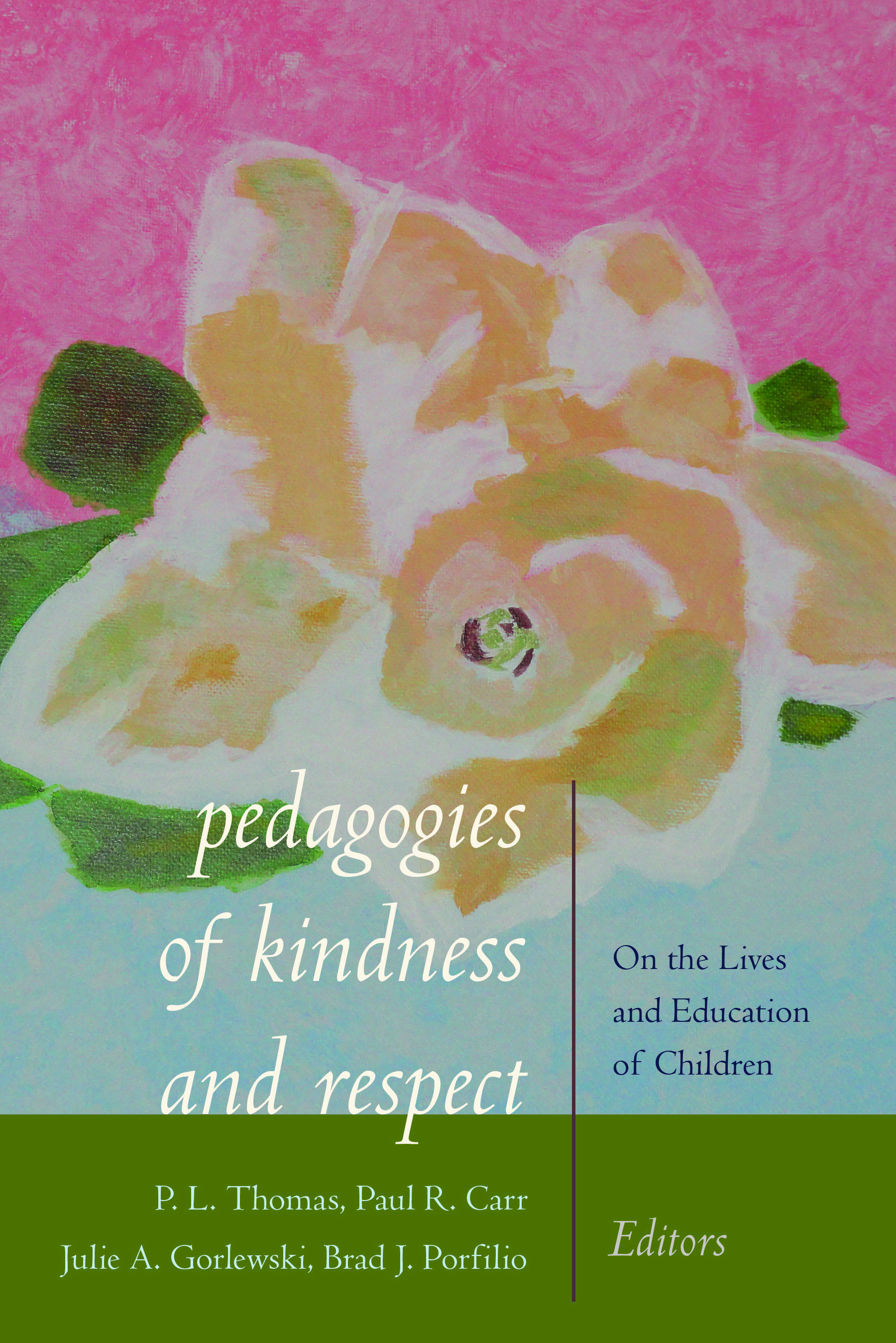
Pedagogies of Kindness and Respect: On the Lives and Education of Children (Peter Lang USA)

Pedagogies of Kindness and Respect: On the Lives and Education of Children (Peter Lang USA)

Thomas, P.L. / Carr, Paul R. / Gorlewski, Julie A. / Porfilio, Brad J. (eds.)

cover

Book synopsis

Pedagogies of Kindness and Respect presents a wide variety of concepts from scholars and practitioners who discuss pedagogies of kindness, an alternative to the «no excuses» ideology now dominating the way that children are raised and educated in the U.S. today. The fields of education, and especially early childhood education, include some histories and perspectives that treat those who are younger with kindness and respect. This book demonstrates an informed awareness of this history and the ways that old and new ideas can counter current conditions that are harmful to both those who are younger and those who are older, while avoiding the reconstitution of the romantic, innocent child who needs to be saved by more advanced adults. Two interpretations of the upbringing of children are investigated and challenged, one suggesting that the poor do not know how to raise their children and thus need help, while the other looks at those who are privileged and therefore know how to nurture their young. These opposing views have been discussed and problematized for more than thirty years. Pedagogies of Kindness and Respect investigates the issue of why this circumstance has continued and even worsened today.

Introducing: Debunked!

Please visit Debunked!—a central location to confront how formal education often reflects and perpetuates racism, classism, and sexism.

Practices and policies specifically addressed include Ruby Payne’s framework of poverty, deficit perspectives, Teach for America, “grit,” “no excuses” practices, and the “word gap.”