The Irrational Expectation of Rational Behavior

What do debates about “no zero” policies in schools and the presidential run of Donald Trump have in common?

They expose the irrational expectation of rational behavior.

Several years ago, I was having a casual conversation with an economics professor, and during that exchange, it hit me that his entire premise was based on a belief that consumers are rational—a faith that the market hinges on a careful analysis of Consumer Report before each purchase.

I have since seen some critiques of economics because of the use of rationality in the models, but I also witness this daily: people adamant that zeroes teach children lessons, forcing them to comply; people who call for the death penalty and tougher laws as deterrents; and now seemingly reasonable people espousing a series of reasons for supporting Trump.

And that brings me to the somewhat baffling fact that John Oliver has once again posed through comedy an incredibly rational deconstruction of those pro-Trump claims:

But here is the problem—from demanding we continue to give students zeroes to calls for tougher laws and the death penalty to dispassionately dismantling the lunacy that is Trump—rational has no impact on the irrational, and most people are irrational.

Purchases are often impulse buys, children and teens do not see school or the future in rational ways, crimes are often crimes of passion or desperation, and people supporting Trump are the very embodiments of irrational.

This realization is an ironic gift of having been born and raised in the South where there is no rational connection between what the self-defeating South believes and the reality of the world around us: the Bible-belt is anything but Christian, and our region is crippled by racism and poverty, but we wallow in hating “government.”

None of this makes any rational sense.

Now sitting before us is the Trump phenomenon to make all this desperately clear—Trump is the ultimate Teflon candidate who makes Reagan seem in hindsight less of a cartoon than he was.

If direct associations between the KKK and Trump had no impact on his appeal Super Tuesday, there is no hope that Oliver’s very careful and detailed dismantling of the facade of Trump will resonate—even if the anemic mainstream media would do its job.

Despite what religious texts or science fiction seems to show, the apocalypse is a slow unveiling, something only recognized well past its fruition.

The U.S. has always been an irrational belief culture, and now we are witnessing Trump cashing in on that in a way that makes reality TV, reality.

Questioning the Questions Asked about Education

Considering all the things I like about Twitter, having discussions or debates by Tweeting is not one of them because I often get lost and the character count works against elaboration and nuance.

Yesterday, I was added to a debate that appears to be about the impact of poverty on student achievement—and a central question about why some high-poverty students excel although most do not. One person seems to be seeking research that focuses on comparing high-poverty students against each other to tease out the reasons for why some achieve higher than most.

First, let’s consider that when we talk about student achievement we are almost always defaulting to high-stakes test scores. In that context, we must frame all questions about success, excelling, and/or achievement within some solid facts about what standardized tests reveal (and what they don’t).

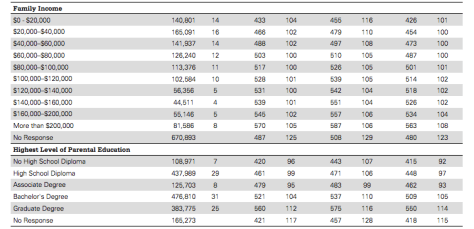
The SAT remains a fair representation of how all student scores on high-stakes standardized testing remain strongly correlated with race, social class, parental education levels, and gender. See for example from the 2015 SAT:

2015 SAT ethnicity

2015 SAT fam income lev edu

Therefore, in virtually all high-stakes standardized data sets, we find that being affluent, white, and male correlate strongly with high scores while being poor, of color, and female correlate with low scores.

Therefore, when we ask why do some (a few) high-poverty students excel while most do not, we could just as easily ask why do some (a few) wealthy students score low when most do not. And these are in fact the same question for a couple of reasons:

  • Poor students with high test scores and affluent students with low test scores are statistical outliers, and thus, provide little descriptive power for making decisions about the general populations of students. [As I cannot stress this enough, please reread that sentence until you get it.]
  • The question about why do some low-income students excel is a loaded question (and that we do not ask the parallel question about the few affluent students who score low is telling) because the real intent of that question is to suggest that student achievement is mostly controlled by the student, her/his teacher, and her/his school. Therefore, by isolating why some low-income students excel, we would be able to “fix” the majority of low income students, their teachers, and their schools.

This second point is huge, and complex, because it is deeply flawed in its essential implication. Student achievement remains in the U.S. a stronger indicator of social realities than student effort/ability, teacher quality, or school effectiveness.

That stated, could student achievement be positively impacted by addressing individual student qualities, teacher quality, or school effectiveness? Of course, and what education reform is attempting in these areas continues to be more harmful than helpful.

For example, charter schools and Teach For America are increasing educational inequity for the vulnerable populations of students (greater segregation and assigning low-income students of color beginning teachers without adequate training).

Now, if I return to the Twitter debate, yes, there are high-quality researchers looking at why low-income students struggle and achieve (see Sean Reardon here, here, and here), but the fundamental question about comparing success and failure within low-income student populations is an inherently flawed process that focuses our gaze almost exclusively on individuals while giving systemic forces a pass—the exact systemic forces that account for the greatest percentage of the scores we use to claim success or failure.

That social class, race, and gender are predictive of student scores on high-stakes standardized testing is not fatalism (using those characteristics as an excuse to do nothing), but a call to shift proportionately our questions to both systemic and individual sources for why some students excel and some struggle in formal schooling.

Race, class, and gender inequity in our society drive low test scores for many students—students who are then too often mis-served by inequitable school practices and policies such as tracking, teacher assignments, and discipline codes.

Why do some high-poverty students excel academically while most do not is one hell of a complicated question. But in most cases, it is the wrong question because of the misguided implications at its root (discussed above) and we remain unwilling to address social inequity and continue to use inequitable tools (high-stakes standardized tests) that create the very gaps we claim we want to close.

We need to prioritize questions about our broken systems before we can even begin to assess why individual students compare differently than their peers—and even then, outliers will never serve as valid gauges for all students.

Revised and Available: De-testing and De-grading Schools (Peter Lang USA, 2016)

Co-edited with Bower, J. (2016). De-testing and de-grading schools: Authentic alternatives to accountability and standardization. Revised ed. New York, NY: Peter Lang USA.

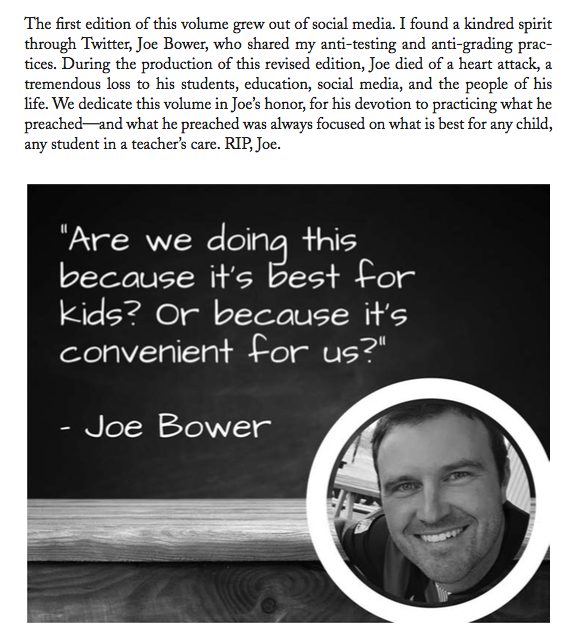
313058_cover RIP Joe

Book synopsis

A century of education and education reform, along with more than three decades of high-stakes testing and accountability, reveals a disturbing paradox: education has a steadfast commitment to testing and grading. This commitment persists despite ample research, theory, and philosophy revealing the corrosive consequences of both testing and grading in an education system designed to support human agency and democratic principles. This revised edited volume brings together a collection of updated and new essays that confronts the failure of testing and grading. The book explores the historical failure of testing and grading; the theoretical and philosophical arguments against testing and grading; the negative influence of tests and grades on social justice, race, class, and gender; and the role that they play in perpetuating a deficit perspective of children. The chapters fall under two broad sections. Part I, Degrading Learning, Detesting Education: The Failure of High-Stake Accountability in Education, includes essays on the historical, theoretical, and philosophical arguments against testing and grading. Part II, De-Grading and De-Testing in a Time of High-Stakes Education Reform, presents practical experiments in de-testing and de-grading classrooms for authentic learning experiences.

Contents: Rick Wormeli: An Unexamined Pedagogy Harms – Lisa Guisbond/Monty Neill/Bob Schaeffer: NCLB’s Lost Decade for Educational Progress: What Can We Learn from This Policy Failure? – Fernando F. Padró/ Michael F. Hawke/Laurie M. Hawke: Assessment and Quality: Policy-Steering and the Making of a Deus ex Machina – Anthony Cody: Technocratic Groupthink Inflates the Testing Bubble – Lawrence Baines/Rhonda Goolsby-Smith: America’s Obsessive-Assessment Disorder – Julie A. Gorlewski/David A. Gorlewski: Solidarity and Critical Dialogue: Interrupting the Degradation of Teacher Preparation – Morna McDermott: Feeding the World = Reading the World: Let Them Eat Tests – Richard Mora: Bubble in B for Boredom – Brian R. Beabout/Andre M. Perry: Reconciling Student Outcomes and Community Self-Reliance in Modern School Reform Contexts – David L. Bolton/John M. Elmore: The Role of Assessment in Empowering/Disempowering Students in the Critical Pedagogy Classroom – Christian Z. Goering: «How Long Does This Have to Be?»: Confronting the Standardization of Writing Instruction with Teachers in National Writing Project Invitational Summer Institutes – Joe Bower: Telling Time with a Broken Clock: Moving Beyond Standardized Testing – John L. Hoben: The Grading Mousetrap: Narcissism, Abjection, and the Politics of Self-Harm – Arnold Dodge/Ruth Powers Silverberg/Katie Zahedi: Leadership Denied: Principal as Compliance Officer – Hadley J. Ferguson: Journey into Ungrading – Jennifer Magee/Mark Dziedzic: An Oath to Stop Degrading Students: A Story of De-grading an Elementary Classroom – P. L. Thomas: De-grading Writing Instruction: Closing the «Considerable Gap» – Brian Rhode: One Week, Many Thoughts – Lisa William-White: Striving Toward Authentic Teaching for Social Justice: Additional Considerations – P. L. Thomas: Yes, to Be Clear, I Am Anti-testing, Anti-grading.