
July 2016 #BlackLivesMatter Reader (UPDATED)

Guiding Question: Why do we read and hear incessantly about black-on-black crime, but nothing about white-on-white crime?

Failsafe from Son of Baldwin

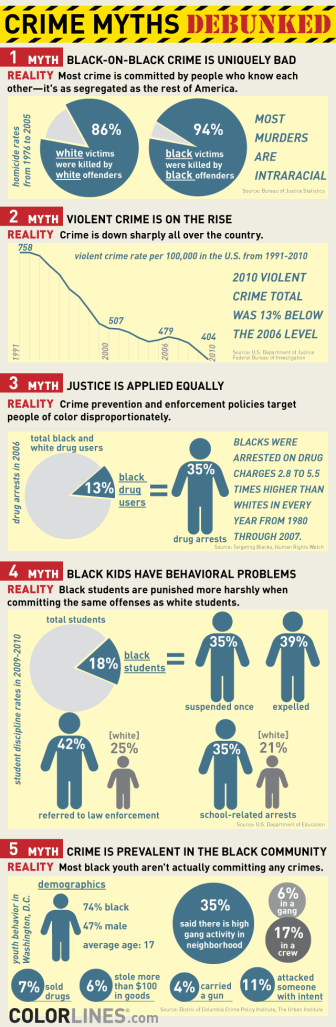
To begin, the fact that the term “black-on-black crime” exists in our lexicon, but not the term “white-on-white crime,” is one of the clearest signs that racism is a guiding principle in this country. And all one needs to do is look at the facts: 94% of all crimes committed against black people are committed by black people; 86% of all crimes committed against white people are committed by white people.

Surely, 86% is a number at which we can safely say that white-on-white crime is a very serious problem. Yet, we never do. The term is not in the dictionary. There is no Wikipedia entry for it. It is not browbeaten into the public consciousness. The media makes little to no mention of this term. There are no news specials dedicated to looking at this problem. Neither Oprah nor President Obama have touched on the topic.

As a result, black people are scapegoated and pathologized as especially criminal when, in reality, we are merely, pretty much, keeping pace with the rest of a society that thrives on violence. If black people are being asked to focus on black-on-black crime, then why aren’t white people being asked to focus on white-on-white crime? Why are some people so focused on black-on-black and black-on-white crime, but get upset when we focus on white-on-white or white-on-black crime?

Five Myths About Crime in Black America–and the Statistical Truths
crime_myths

After the bombing / speech at Ford Auditorium, Malcolm X

They used the press to make it look like he’s the criminal and they’re the victim. This is how they do it, and if you study how they do it [t]here, then you’ll know how they do it over here. It’s the same game going all the time, and if you and I don’t awaken and see what this man is doing to us, then it’ll be too late. They may have the gas ovens already built before you realize that they’re hot.

One of the shrewd ways that they use the press to project us in the eye or image of a criminal: they take statistics. And with the press they feed these statistics to the public, primarily the white public. Because there are some well-meaning persons in the white public as well as bad-meaning persons in the white public. And whatever the government is going to do, it always wants the public on its side, whether it’s the local government, state government, federal government. So they use the press to create images. And at the local level, they’ll create an image by feeding statistics to the press — through the press showing the high crime rate in the Negro community. As soon as this high crime rate is emphasized through the press, then people begin to look upon the Negro community as a community of criminals.

And then any Negro in the community can be stopped in the street. “Put your hands up,” and they pat you down. You might be a doctor, a lawyer, a preacher, or some other kind of Uncle Tom. But despite your professional standing, you’ll find that you’re the same victim as the man who’s in the alley. Just because you’re Black and you live in a Black community, which has been projected as a community of criminals. This is done. And once the public accepts this image also, it paves the way for a police-state type of activity in the Negro community. They can use any kind of brutal methods to suppress Blacks because “they’re criminals anyway.” And what has given this image? The press again, by letting the power structure or the racist element in the power structure use them in that way.

A very good example was the riots that took place here during the summer: I was in Africa, I read about them over there. If you’ll notice, they referred to the rioters as vandals, hoodlums, thieves. They tried to make it appear that this wasn’t — they tried to make it — and they did this. They skillfully took the burden off the society for its failure to correct these negative conditions in the Black community. It took the burden completely off the society and put it right on the community by using the press to make it appear that the looting and all of this was proof that the whole act was nothing but vandals and robbers and thieves, who weren’t really interested in anything other than that which was negative. And I hear many old, dumb, brainwashed Negroes who parrot the same old party line that the man handed down in his paper.

Here’s why I’m skeptical of Roland Fryer’s new, much-hyped study on police shootings, Dara Lind

So when the Times article summarily dismisses existing data as “poor,” and doesn’t explain what that data actually is, that should be a red flag — a clue that the article’s author isn’t going to provide you with an explanation of why this new data is so much better than the old data, and you’re going to have to do that yourself.

When Fryer (an economist by training) tells the Times that he got interested in police shootings because of “his anger after the deaths of Michael Brown and Freddie Gray,” and (in Fryer’s words) “decided I was going to collect a bunch of data and try to understand what really is going on,” that should be another humongous red flag.

It implies that Fryer assumed he was doing something pioneering, rather than asking first what work was already being done and what he could add to the existing conversation. This is something that often happens when people in “quantitative” social sciences, like economics, develop an interest in topics covered in other social sciences — in this case, criminology: They assume that no rigorous empirical work is being done.

See also Three Problems With How the NY Times Highlights a Non-Peer Reviewed Study Allegedly Showing No Racial Bias in Police Shootings, Sarah Beller, and A Multi-Level Bayesian Analysis of Racial Bias in Police Shootings at the County-Level in the United States, 2011–2014Cody T. Ross

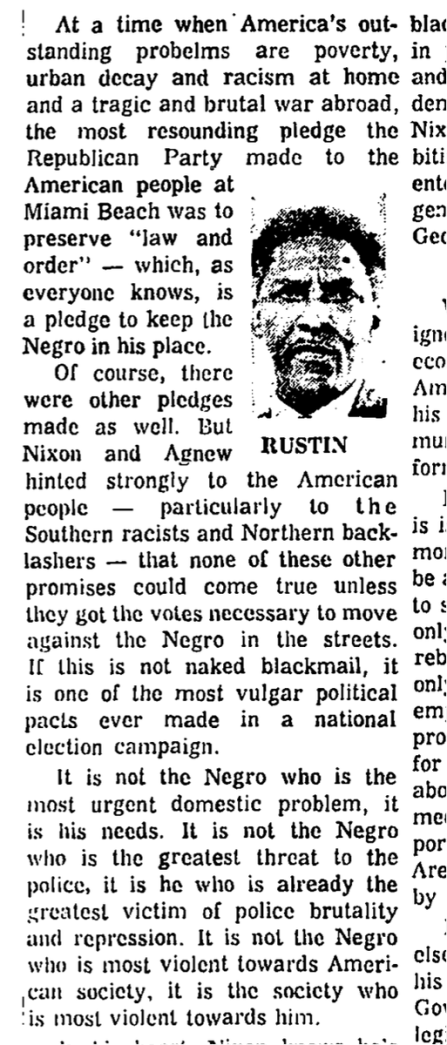
A Nixon Is an Agnew Is a Wallace, Bayard Rustin (New York Amsterdam News, 24 August 1968, p.12, col. 3) [1]
cnkdsu1waaa0dtd

The Near Certainty of Anti-Police Violence, Ta-Nehisi Coates

To understand the lack of police legitimacy in black communities, consider the contempt in which most white Americans hold O.J. Simpson. Consider their feelings toward the judge and jury in the case. And then consider that this is approximately how black people have felt every few months for generations. It’s not just that the belief that Officer Timothy Loehmann got away with murdering a 12-year-old Tamir Rice, it is the reality that police officers have been getting away with murdering black people since the advent of American policing. The injustice compounds, congeals until there is an almost tangible sense of dread and grievance that compels a community to understand the police as objects of fear, not respect.

What does it mean, for instance, that black children are ritually told that any stray movement in the face of the police might result in their own legal killing? When Eric Holder spoke about getting “The Talk” from his father, and then giving it to his own son, many of us nodded our heads. But many more of us were terrified. When the nation’s top cop must warn his children to be skeptical of his own troops, how legitimate can the police actually be?

Death in Black and White [2]

In the wake of these deaths and the protests surrounding them, you, white America, say that black folks kill each other every day without a mumbling word while we thunderously protest a few cops, usually but not always white, who shoot to death black people who you deem to be mostly “thugs.”

That such an accusation is nonsense is nearly beside the point. Black people protest, to one another, to a world that largely refuses to listen, that what goes on in black communities across this nation is horrid, as it would be in any neighborhood depleted of dollars and hope — emptied of good schools, and deprived of social and economic buffers against brutality. People usually murder where they nest; they aim their rage at easy targets.

It is not best understood as black-on-black crime; rather, it is neighbor-to-neighbor carnage. If their neighbors were white, they’d get no exemption from the crime that plagues human beings who happen to be black. If you want interracial killing, you have to have interracial communities….

Whiteness is blindness. It is the wish not to see what it will not know.

Aren’t more white people than black people killed by police? Yes, but no., Wesley Lowery

According to the most recent census data, there are nearly 160 million more white people in America than there are black people. White people make up roughly 62 percent of the U.S. population but only about 49 percent of those who are killed by police officers. African Americans, however, account for 24 percent of those fatally shot and killed by the police despite being just 13 percent of the U.S. population. As The Post noted in a new analysis published last week, that means black Americans are 2.5 times as likely as white Americans to be shot and killed by police officers.

Walking While Black in the ‘White Gaze,’ George Yancy

A black boy carrying a telescope wasn’t conceivable — unless he had stolen it — given the white racist horizons within which my black body was policed as dangerous. To the officer, I was something (not someone) patently foolish, perhaps monstrous or even fictional. My telescope, for him, was a weapon.

In retrospect, I can see the headlines: “Black Boy Shot and Killed While Searching the Cosmos.”

That was more than 30 years ago. Only last week, our actual headlines were full of reflections on the 1963 March on Washington, the Rev. Dr. Martin Luther King’s “I Have a Dream” speech, and President Obama’s own speech at the steps of the Lincoln Memorial to commemorate it 50 years on. As the many accounts from that long ago day will tell you, much has changed for the better. But some things — those perhaps more deeply embedded in the American psyche — haven’t.  In fact, we should recall a speech given by Malcolm X in 1964 in which he said, “For the 20 million of us in America who are of African descent, it is not an American dream; it’s an American nightmare.”


[1] Courtesy Louis Moore.

[2] See earlier version Dyson was asked to revise: What White America Fails to See.

What Is the Agenda?: More Propaganda without Evidence

Yet more public relations propaganda about Meeting Street Elementary @Brentwood from the Post and Courier—this time with a little extra ugliness not-so-subtly framing the article.

The “no excuses” charter school playbook is in full force as the article opens by focusing on the school’s selection process for teachers: you see, the real problem with schools is teachers who don’t care, who don’t try, and who embody the soft bigotry of low expectations:

“You’d think that those would be pretty simple questions,” Campbell said. “If you’re in education, you should assume that all kids can learn. But there’s a lot of implicit bias in teachers that we’ve found (toward) kids in poverty, kids of color.”

Trigger: “bad” teacher myth.

And then, while suggesting teachers are too often racists, the racism inherent in these sorts of takeover strategies is slipped in; you see, the other problem is poor black children need to be trained:

Brentwood’s high standards start with behavior. Campbell said teachers instruct students in how to walk in the halls, how to act in the cafeteria and even how to sharpen a pencil.

“They get four lessons on the playground before they’re allowed to touch any equipment,” Campbell said.

Trigger: “grit” narrative.

But all this is old hat—the nasty “grit” and “no excuses” model—and the real ugliness is saved for the end:

Founder and CEO of Meeting Street Schools Ben Navarro also addressed some concerns raised by education activists, who have been unsuccessfully filing Freedom of Information Act requests with the district to see all of the funding sources at Brentwood. They have also objected to the school’s special waivers from South Carolina’s teacher employment protection laws. He said his school had more oversight than most others, as Postlewait sits on Brentwood’s executive committee.

“What is the agenda of people doing the attacking? Is it about adults?” Navarro said.

That’s right, lazy bigoted teachers, poor black children in need of character training, and education activists with agendas—that’s what wrong with public education and serving high-poverty minority children.

Actually, methinks he doth protest too much.

If there is an agenda, we should suspect it is with those who haven’t provided the data.

The article gives a hint that Meeting Street Elementary @Brentwood is making its grand claims of unusual success based on MAP scores—but there is no way to confirm if those claims and that data are really about anything exceptional.

The real story here is buried in the middle of the article:

Meeting Street Elementary @Brentwood also offers what Campbell calls “wraparound services,” including a full-time speech therapist and a behavior interventionist. To maintain a racially diverse teaching staff, Meeting Street recruits teachers at historically black colleges and universities.

Part of the Meeting Street strategy also has to do with money. At Brentwood, Meeting Street Schools currently pitches in about $4,000 per student on top of the district’s $9,900 in per-pupil funding. The district’s partnership with Meeting Street Schools will reach a “sunset” after Burns and Brentwood have both expanded to the fifth grade, at which point the district will have to figure out how to fund the programs itself.

As I have been documenting [1], we know that money makes a difference when addressing high-poverty populations of students, we know that “miracle” schools almost always prove to be mirages, we know that charter schools who claim success usually benefit from student attrition and underserving high-needs populations (ELL and special needs students), and we know that small-scale success may be impossible to scale to all public schools.

What we don’t know is how or if any of this is relevant about Meeting Street Elementary @Brentwood.

What we do know is that a lot of press release propaganda continues to roll out while the data that would settle the issue do not.

If “What is the agenda?” is good for educational advocates, it is certainly essential for those positioned to benefit from big claims and hedging on allowing third-party examinations of the full body of evidence.


[1] Don’t Trust Invested Advocates in Edureform WarsQuestions for the P&C about School Closure, TakeoverMore Questions for The Post and Courier: “Necessary Data” or Press-Release Journalism?

For Pre-order: Teaching Comics Through Multiple Lenses: Critical Perspectives

Teaching Comics Through Multiple Lenses: Critical Perspectives

Editor: Crag Allen Hill

9781138649903

About the Book

Building off the argument that comics succeed as literature—rich, complex narratives filled with compelling characters interrogating the thought-provoking issues of our time—this book argues that comics are an expressive medium whose moves (structural and aesthetic) may be shared by literature, the visual arts, and film, but beyond this are a unique art form possessing qualities these other mediums do not. Drawing from a range of current comics scholarship demonstrating this point, this book explores the unique intelligence/s of comics and how they expand the ways readers engage with the world in ways different than prose, or film, or other visual arts. Written by teachers and scholars of comics for instructors, this book bridges research and pedagogy, providing instructors with models of critical readings around a variety of comics.

Table of Contents

Contents

Preface

1. Introduction: The Growing Relevance of Comics

Crag Hill

Section 1: Materiality and the Reading of Comics

2. Designing Meaning: A Multimodal Perspective on Comics Reading

Sean P. Connors

3. Multimodal Forms: Examining Text, Image, and Visual Literacy in Daniel Handler’s Why We Broke Up and Markus Zusak’s The Book Thief

Amy Bright

Section 2: Comics and Bodies

4. Illustrating Youth: A Critical Examination of the Artful Depictions of

Adolescent Characters in Comics

Mark A. Lewis

5. Just Like Us? LGBTQ Characters in Mainstream Comics

A. Scott Henderson

Section 3: Comics and the Mind

6. Telling the Untellable: Comics and Language of Mental Illness

Sarah Thaller

7. Christian Forgiveness in Gene Luen Yang’s Animal Crackers and Eternal Smile: A Thematic Analysis

Jake Stratman

Section 4: Comics and Contemporary Society

8. Poverty Lines: Visual Depictions of Poverty and Social Class Realities in Comics

Fred Johnson, Whitworth University, and Janine J. Darragh, University of Idaho

9. Can Superhero Comics Defeat Racism?: Black Superheroes “Torn between Sci-Fi Fantasy and Cultural Reality”

P.L. Thomas

10. Teaching Native American Comics with Post-Colonial Theory

Lisa Schade Eckert

Section 5: Endpoints

11. Crag Hill

List of Contributors

Additional resources were compiled by Shaina Thomas.

For Whom We Worry, and Why: Fear in Black and Blue

As I learn from you,
I guess you learn from me—
although you’re older—and white—
and somewhat more free.

“Theme for English B,” Langston Hughes

I have family members and friends who have been and are currently police officers [1]. When I read or watch on local news about a police officer being shot or killed, I hold my breath for a second.

When I was dating my wife, we sat watching TV many evenings until very late waiting for her father to come home; he was a career highway patrolman. His walking through the front door was always a kind of relief, especially when he came home some times much later than usual.

There is something about living with the unspoken but ever-present fear of being a police officer, of being in the family of a police officer that is hard to understand if you have not lived it yourself.

But police officers choose their profession knowing it is inherently dangerous. There is no way to be relieved of that fear for their safety because the job—to protect and serve—cannot be separated from danger, the risk of death in the line of that service.

I also believe very strongly in professions of public service, having been a public school teacher for almost two decades.

Public service is a noble calling.

And then there are my son-in-law, granddaughter, and soon-to-arrive grandson.

My son-in-law is black and my grandchildren, bi-racial.

I worry about them as well, I fear for their safety.

My granddaughter is two years old now, becoming more and more verbal; she understands and uses more and more words.

Soon, too soon, she will discover that she lives in a world of racial slurs. Maybe one will be directed at her, maybe one will be used about her father.

I suspect “maybe” is naive, too much hedging here.

At the very least, to be black in the U.S. means living in the ever-present violence of racial slurs, and the systemic racism that appears invisible to whites.

I fear for these family members for the fact of their race—not something they have chosen, not some inevitable reality of pubic service.

Simply for existing with a degree of observable skin difference that allows bigots and people with good intentions to judge them, call them names, pay them less, deny them opportunities.

Soon, too soon, my granddaughter will begin to read this world and the constant drumbeat of one single message: black lives do not matter as much as white lives in the U.S.

Sure, there was a time when the counterculture slurred police officers with “pigs,” and I am certain—justified or not—there is a good deal of negative sentiments among some, or even many, about police officers.

But to protect and serve behind the badge of the state is a choice made by adults. Even without those negative sentiments, the job is dangerous. And any officer, any time can simply quit that work and do something else.

To be black in the U.S. is not a choice, not something from which someone can take a vacation or something someone can simply walk away from.

Every day black children discover the world is hostile to them simply because they are black. Not because they have done anything to deserve that hostility.

So, of course, all lives matter, and blue lives matter.

But using those slogans to reject, erase, marginalize the need for #BlackLivesMatter is spitting in the face of the very real violences that are guaranteed black people through no fault of their own simply by living in the U.S.

So just imagine two children—one the child of a police officer and one the child of a black man, woman or both.

One day you sit down the child of the police officer to explain that the job is dangerous.

One day you sit down the black child to explain the word “nigger.”

There is absolutely no way to avoid the first discussion.

And in the U.S., white folk have decided there is nothing we will do about the second.


[1] This same pattern holds for my family and friends who are in the military.

All Lives Matter as a response to #BlackLivesMatter is offensive because…

All Lives Matter as a response to Black Lives Matter is offensive because it is a white response that denies we live in a country that daily shows that white lives matter more and black lives often matter very little.

Whites with LESS education than blacks earn the same and higher salaries.

Whites who commit the SAME crimes as blacks are charged, convicted, and sentenced LESS.

Whites with elite college degrees are called back MORE than blacks with the same elite degrees for job interviews.

[See HERE for evidence related to above.]

White males outnumber black males 6 to 1 but black males are in prison 6 to 1 compared to white males BECAUSE BLACKS ARE TARGETED MORE OFTEN (read The New Jim Crow).

Black children are seen as much older than they really are compared to white children and thus are treated aggressively and harshly by authority figures (Tamir Rice).

Black Lives Matter is a call to recognize an evil in a country that claims to be free but where that applies only to some.

For good people who truly want all lives to matter, you must first acknowledge the regrettable need for Black Lives Matter and you must be in solidarity and resist the white urge to offer your “yes, but…” whitewashing of the ugly realities that created Black Lives Matter.

[If you have the social media urge to “yes, but” this post, I will delete it because that would prove you didn’t read and don’t, can’t get it. Otherwise, peace.]

This Is U.S.: “To be a Negro in this country…”

To be a Negro in this country and to be relatively conscious, is to be in a rage almost all the time. So that the first problem is how to control that rage so that it won’t destroy you.

James Baldwin from “The Negro in American Culture,” Cross Currents, XI (1961), p. 205

Two nights ago, a friend shared with me a disturbing but all-too-common story about his two young adult daughters with their mother.

The three women were approached by a man while filling up the car with gas before all going to the station restroom. The man followed them into the station, and they all felt concerned for their safety.

This is a snapshot of what it means to be female in the U.S. in 2016.

Last night, I sat in my living room with my pregnant daughter, my biracial granddaughter, my wife, and my black son-in-law. My daughter was showing my wife videos from the recent gruesome shootings of two black males by police.

My son-in-law told us he saw two people pulled over by police on his drive home, shaking his head and adding, “I don’t want to be pulled over.”

This is a snapshot of what it means to be black in the U.S. in 2016.

White males are about 30-35% of adults in the U.S., yet white males control nearly all the wealth and all the power in this country.

And despite the disturbing power of the videos documenting the institutional executions of Alton Sterling and Philando Castile, this is the image of the U.S.

Brock Turner’s image captures the world created by the white male power structure of the U.S., the inequity designed and maintained by those white males in the service of white males.

Equity and justice—or rightly inequity and injustice—these exist as those in power choose. The powerless—children, women, people of color—did not bring this world about and do not maintain it.

Turner represents that the U.S. is two worlds: one criminal justice system for white males and another criminal justice system for everyone else.

This image of Turner—All-American athlete and all-around good guy—stands in stark contrast to the immediate efforts by the media and whitesplainers to justify the shootings of Sterling and Castile, the immediate framing of these men as inherently criminals who deserved street executions.

The American Dream is a whitesplainer’s myth; as George Carlin quipped: “It’s called the American Dream because you have to be asleep to believe it.”

“This is why those pious calls to ‘respect the law,'” argued James Baldwin in “A Report from Occupied Territory,” “always to be heard from prominent citizens each time the ghetto explodes, are so obscene. The law is meant to be my servant and not my master, still less my torturer and my murderer. To respect the law, in the context in which the American Negro finds himself, is simply to surrender his self-respect.”

And then, in Baldwin’s “No Name in the Street,” he points a finger at the entrenched American problem with race:

The truth is that the country does not know what to do with its black population now that the blacks are no longer a source of wealth, are no longer to be bought and sold and bred, like cattle; and they especially do not know what to do with young black men, who pose as devastating a threat to the economy as they do to the morals of young white cheerleaders. It is not at all accidental that the jails and the army and the needle claim so many, but there are still too many prancing around for the public comfort. Americans, of course, will deny, with horror, that they are dreaming of anything like “the final solution”—those Americans, that is, who are likely to be asked: what goes on in the vast, private hinterland of the American heart can only be guessed at, by observing the way the country goes these days. (pp. 432-433)

Before the U.S. is “the way the country goes these days.”

Let us not ignore that “the way” is exactly what white males who control the wealth and power want. If it were not, then things would be otherwise.

This is U.S.


See Also

“the world” (poem)

Four Poems: For Jordan Davis and Trayvon Martin

NEW from IAP: Learning from the Federal Market‐Based Reforms: Lessons for ESSA

Learning from the Federal Market‐Based Reforms: Lessons for ESSA

Edited by:
William J. Mathis, University of Colorado, Boulder
Tina M. Trujillo, University of California, Berkeley

A volume in the series: The National Education Policy Center Series. Editor(s): Kevin G. Welner, University of Colorado – Boulder. Alex Molnar, Arizona State University.

Published 2016

Over the past twenty years, educational policy has been characterized by top‐down, market‐focused policies combined with a push toward privatization and school choice. The new Every Student Succeeds Act continues along this path, though with decision‐making authority now shifted toward the states. These market‐based reforms have often been touted as the most promising response to the challenges of poverty and educational disenfranchisement. But has this approach been successful? Has learning improved? Have historically low‐scoring schools “turned around” or have the reforms had little effect? Have these narrow conceptions of schooling harmed the civic and social purposes of education in a democracy?

This book presents the evidence. Drawing on the work of the nation’s most prominent researchers, the book explores the major elements of these reforms, as well as the social, political, and educational contexts in which they take place. It examines the evidence supporting the most common school improvement strategies: school choice; reconstitutions, or massive personnel changes; and school closures. From there, it presents the research findings cutting across these strategies by addressing the evidence on test score trends, teacher evaluation, “miracle” schools, the Common Core State Standards, school choice, the newly emerging school improvement industry, and re‐segregation, among others.

The weight of the evidence indisputably shows little success and no promise for these reforms. Thus, the authors counsel strongly against continuing these failed policies. The book concludes with a review of more promising avenues for educational reform, including the necessity of broader societal investments for combatting poverty and adverse social conditions. While schools cannot single‐handedly overcome societal inequalities, important work can take place within the public school system, with evidence‐based interventions such as early childhood education, detracking, adequate funding and full‐service community schools—all intended to renew our nation’s commitment to democracy and equal educational opportunity.

CONTENTS
Foreword, Jeannie Oakes. SECTION I: INTRODUCTION: THE FOUNDATIONS OF MARKET BASED REFORM, Purposes of Education: The Language of Schooling, Mike Rose. The Political Context, Janelle Scott. Historical Evolution of Test‐Based Reforms, Harvey Kantor and Robert Lowe. Predictable Failure of Test‐Based Accountability, Heinrich Mintrop and Gail Sunderman.SECTION II: TEST‐BASED SANCTIONS: WHAT THE EVIDENCE SAYS, Transformation & Reconstitution, Betty Malen and Jennifer King Rice.Turnarounds, Tina Trujillo and Michelle Valladares. Restart/Conversion, Gary Miron and Jessica Urschel. Closures, Ben Kirshner, Erica Van Steenis, Kristen Pozzoboni, and Matthew Gaertner. SECTION III: FALSE PROMISES, Miracle School Myth, P. L. Thomas. Has Test‐Based Accountability Worked? Committee on Incentives and Test‐Based Accountability in Public Education(Michael Hout & Stuart Elliott, Eds.). The Effectiveness of Test‐Based Reforms. Kevin Welner and William Mathis. Value Added Models: Teacher, Principal and School Evaluations, American Statistical Association. The Problems with the Common Core, Stan Karp. Reform and Re‐Segregation,Gary Orfield. English Language Learners. Angela Valenzuela and Brendan Maxcy. Racial Disproportionality: Discipline, Anne Gregory, Russell Skiba, and Pedro Noguera. School Choice, Christopher Lubienski and Sarah Theule Lubienski. The Privatization Industry, Patricia Burch and Jahni Smith. Virtual Education, Michael Barbour. SECTION IV: EFFECTIVE REFORMS, Addressing Poverty, David Berliner. Racial Segregation & Achievement, Richard Rothstein. Adequate Funding, Michael Rebell. Early Childhood Education,Steven Barnett. De‐Tracking, Kevin Welner and Carol Corbett Burris. Class Size, Diane Whitmore Schanzenbach. School–Community Partnerships, Linda Valli, Amanda Stefanski, and Reuben Jacobson. Community Organizing for Grassroots Support, Mark Warren. Teacher Education, Audrey Amrein‐Beardsley, Joshua Barnett, and Tirupalavanam Ganesh. SECTION V: CONCLUSION.


Miracle School Myth

 P.L. Thomas, Furman University

Abstract

The accountability era of education reform began under President Ronald Reagan in the early 1980s, spurred by the Nation at Risk report. Throughout the 1980s and 1990s, education reform driven by accountability, standards, and high-stakes testing remained a state-based process, but during George W. Bush’s time as governor of Texas, the seeds of national accountability were sown, labeled the Texas “miracle” and providing the framework for No Child Left Behind. “Miracle” school narratives—including the Harlem “miracle,” the Chicago “miracle,” and other claims of “miracle” reform/policies (DC public schools, charter schools) and reformers (Michelle Rhee, Geoffrey Canada)—have followed a predictable pattern: claims of “miracles,” use of those claimed “miracles” to advance particular state and national education policy, media endorsing  the “miracle” claims, a nearly universal refuting of credibility of those “miracles,” and political, media, and public failure to recognize the debunking.

Why No Accountability for the Accountability Hawks?

It is a disturbingly easy list to make: police officers shooting/killing defenseless black males and females, Rush Limbaugh, OJ Simpson, Karl Rove, Hillary Clinton, Michelle Rhee, Bill Gates, ad infinitum.

Those shielded by privilege (wealth, race, celebrity, status) from the consequences of being held accountable for their actions.

And what is most disturbing is that among accountability hawks, those are the people least likely to be held accountable.

In the accountability era of education reform, the accountability hawks have been left unscathed even as they work to create school choice (public funds sent to private schools outside the accountability paradigm), more charter schools (relieved of accountability), and uncertified teachers (Teach For America).

Those accountability hawks, the politicians and the billionaire education hobbyists, are never held accountable as each policy and reform-of-the-day fails before s/he moves on to the next Great Reform.

Complicit in this failure to hold accountability hawks accountable have been spineless edujournalism and edupresses that have abdicated their role to press release journalism in the service of the edureformers.

And thus, as Audrey Amrein-Beardsley details:

Just this week, in Education Week — the field’s leading national newspaper covering K–12 education — a blogger by the name of Matthew Lynch published a piece explaining his “Five Indisputable [emphasis added] Reasons Why You Should Be Implementing Value-Added Assessment.”

I’m going to try to stay aboveboard with my critique of this piece, as best I can, as by the title alone you all can infer there are certainly pieces (mainly five) to be seriously criticized about the author’s indisputable take on value-added (and by default value-added models (VAMs)). I examine each of these assertions below, but I will say overall and before we begin, that pretty much everything that is included in this piece is hardly palatable, and tolerable considering that Education Week published it, and by publishing it they quasi-endorsed it, even if in an independent blog post that they likely at minimum reviewed, then made public.

Shame on Lynch, shame on EdWeek, but this is hardly anything out of the ordinary.

This is edujournalism as we have known it for decades now.

All hail the accountability hawks, and let neither evidence nor accountability deter their march!

Teaching Literacy, Not Literacy Skills

Through the lens of having been a teacher/professor, published writer, and recreational/competitive cyclist for over thirty years, several high school experiences are now illustrative of larger facts about the tension between teaching discrete skills versus fostering holistic performances.

In high school, I made As in math and science courses, but typically received Bs in English—and the source of that lower grade was poor scores on vocabulary tests. I balked at studying, found the process laborious and a waste of my time (better spent reading, collecting, and drawing from my comic book collection or reading the science fiction novels discouraged by my English teachers).

Throughout high school, I also worked frantically to be a good athlete, focusing on basketball. I wore ankle weights 24/7, including jumping rope hundreds of times each night with the weights on.

Despite my efforts and desire, I made the teams, but sat on the bench throughout high school.

Two aspects of that seem important: A track/football coach used to deride my ankle weight efforts by saying, “The only good those will do you is if you are in an ankle weight race”; and I could often be the best or near the best on any of my basketball teams when we had free throw shooting contests in practice.

Today, I feel safe claiming I have an unusually large vocabulary, and my career is deeply driven by by advanced literacy. In fact, I just completed teaching a graduate course in literacy.

All of this is gnawing at me because I have been watching a discussion on the NCTE Connected Community about vocabulary instruction. This thread reminds me of the recurring posts about grammar instruction.

During my graduate class, vocabulary and spelling were nearly a daily topic—along with concerns about “teaching grammar.”

Next week, I co-lead a Faculty Writing Fellows seminar for college professors who are exploring teaching writing at the university level (most of whom are outside of traditional disciplines for teaching writing). We will spend a great deal of time addressing and discussing the same concern: how to teach grammar.

As someone who loves to read and write, who lives to read and write—and as a teacher and writer—it makes my soul ache to confront how English teachers and English classes are often the sources of why children and adults loathe reading and writing.

But I also know intimately about that dynamic because in many ways that was me; I left high school planning to major in physics, only discovering I am a writer and teacher once I was in college.

And to this day I can see that damned vocabulary book we used in high school.

So when I became a high school English teacher, and faced throughout my early years what teachers continue to face today, I was determined that if I had to do vocabulary (required by the department and implicit in assigning students tax-payer-funded vocabulary books), I was going to find some way to do it as authentically as possible.

From those early years before I abandoned vocabulary instruction entirely and even accomplished as department chair having grammar and vocabulary texts not issued to students but provided as classroom sets to teachers who requested them, I recall a really important moment: A student wrote a sentence with the word “pensive” from the week’s vocabulary list—The girl’s boyfriend was very pensive when he bought her flowers.

The student was going through the motions of completing my inauthentic assignment (writing original sentences from the vocabulary list each week instead of doing the textbook exercises) that I thought was better and had simply looked at the one-word definition offered, “thoughtful.”

In fact, despite trying to make isolated vocabulary instruction authentic, I spent a great deal of time explaining to students that people didn’t use this word or that word the way the student had—although for them, the sentence seemed perfectly credible.

So what does all this mean?

Formal literacy instruction from K-5 through middle school into high school and even college is mostly failing our mission because we have fallen victim to an efficiency and analytical model of what literacy is and how to acquire so-called advanced literacy.

Two of the best examples of this skills plague are the obsession with prescriptive/isolated grammar instruction and the Queen Mother of literacy scams, the “word gap.”

The “word gap” persists despite the inherent flaws in the one research study driving it because most people have been lulled into believing the literacy-skills-equal-literacy hoax. [Think the Great Hooked on Phonics Scam that lures parents into believing that reading aloud is reading.]

Reducing literacy to and teaching discrete skills has been embraced in formal education because of the cult of efficiency that won out in the early decades of the education wars. That cult of efficiency was successful because classroom management has always overshadowed pedagogy in public schooling and also because the testing and textbook industries discovered there was gold in them there hills of schools.

Textbooks, worksheets, and multiple choice tests are certainly a soma of structure for the teacher and student alike—but they ain’t literacy.

Literacy is holistic, and the skills plague kills literacy.

Here, now, I want to make two important points about the skills plague.

First, we have made a serious mistake in flipping how people acquire so-called literacy skills such as vocabulary and grammatical dexterity.

As Stephen Krashen argued on the NCTE Connected Community thread, while it is true that highly literate people have large vocabularies and often great grammatical dexterity, they have come to those skills by reading and writing a great deal, in authentic ways.

But the efficiency cult has taken the fact that highly literate people have large vocabularies, for example, and flipped that to mean that we simply need to fill up students with words (usually arcane) or train them in root words, prefixes, and suffixes to create presto! literate humans.

Let me stress here that turning the holistic-to-discrete-skills pattern around is not only hogwash but also detrimental hogwash to our goals of literacy.

And so my second point is this: Students continue to spend inordinate amounts of time on harmful skills activities that would be better spent doing the holistic acts of reading and writing—holistic acts that would in fact accomplish the skills growth we claim we are seeking.

We know, as well, that student are not writing (for example) nearly enough—neither in amount of essays or length of essays—because teachers and students are overwhelmed with accountability mandates grounded in the efficiency model.

Let me end with my graduate course.

For 24 graduate students, all teachers, who had only reading and written assignments in the course (no tests, worksheets, or textbooks), I responded to over 320 drafts of three written assignments in a four-week period.

I highlighted this for the class to note that authentic literacy instruction committed to holistic approaches to literacy is not efficient, but it is incredibly time consuming and difficult.

I am 55 and I can see the vocabulary books in high schools that I still loathe—but I don’t recall a single word from that experience.

I am 55 and I still recall the day I sat listening to R.E.M.’s “You Are the Everything,” which made me fall in love with the word “eviscerate.”

I can also picture in my mind the words I highlighted as I read—words I didn’t know or also fell in love with as a writer—even recently when I was nudged to reconsider “decimate” in World War Z.

I remain angry and sad that the work we do as English teachers continues to create classrooms in which students have their love for reading and writing eviscerated instead of celebrated.


See Also

Try It Tuesday: Cite the Research that Drives Your Practice

It’s finally time to stop correcting people’s grammar, linguist says

Accidence Will Happen: The Non-Pedantic Guide to English Usage, Oliver Kamm