The following post is by Julie Gorlewski and David Gorlewski, NCTE members and editors of the English Journal and guest editors, Sean P. Connors and P.L. Thomas.
We are delighted to invite you to preview our November 2016 issue of EJ, which—in keeping with the presidential election—is particularly provocative and compelling. In this blog post, we feature the issue editorial, composed by guest editors Sean P. Connors and P. L. Thomas, as well as the introduction to a special section on teaching Adventures of Huckleberry Finn.We hope that the issues highlighted in this month’s EJ will open conversation among English teachers everywhere. —Julie Gorlewski and David Gorlewski
The Arc of the Moral Universe may bend toward justice, but it seems at this point on Planet Earth and specifically the good ol’ U.S. of A. that is mostly hokum—though I take some solace that you have been spared in your corporeal state from the darkest joke of all: The U.S. has literally elected your most iconic artwork:
Below, in your honor, as a small token to your years of service calling on humanity to dig deep and fulfill your fictional imploring: “‘God damn it, you’ve got to be kind,’” I offer this Vonnegut Reader on the day in which, if God had been Willing, you would be 94:
I was born and have lived my entire life in the cesspool of hypocrisy that is the Bible Belt—where conservative Republicanism and Christian values are thin veneer for hatred, bigotry, sexism, gun-lust, and enduring racism.
That hypocrisy failed me and then as a young adult and throughout my life I have been taught critical love and kindness by great writers and thinkers: Kurt Vonnegut, Eugene V. Debs, Alice Walker, Toni Morrison, Langston Hughes, and the greatest witness of all, James Baldwin.
With the election of Donald Trump as the U.S. president, the entire nation has before it this reality: Trumplandia confirms that the Republican Party, Christian Right, and white America have abdicated all rights to any moral authority.
First, despite efforts by mainstream media and pundits to argue otherwise, Trump and his rhetoric are continuations of central efforts by the Republican Party reaching back at least to Reagan: “tough on crime” as code for racist beliefs about blacks and Latinx, “build a wall” as just more xenophobia, and anti-government ranting as code for denying “free” offerings to the “lazy” people of color and “illegal immigrants.”
Trump’s Republicanism is directly in line with Reagan Republicanism. The only real difference is Trump’s outlandish and brash admissions aloud of the very worst of the Republican Party, such as calling Mexicans rapists and murderers. Traditional Republicans only hint at such.
For eight years, Barack Obama and his family—despite a history of being practicing Christians, despite Obama himself offering several eloquent and Christian speeches and hymns in times of tragedy, and despite Obama and his family living essentially good (read: Christian) lives—the Christian Right, and Trump, have refuted Obama’s Christianity and used accusations of his being a Muslim as a slur.
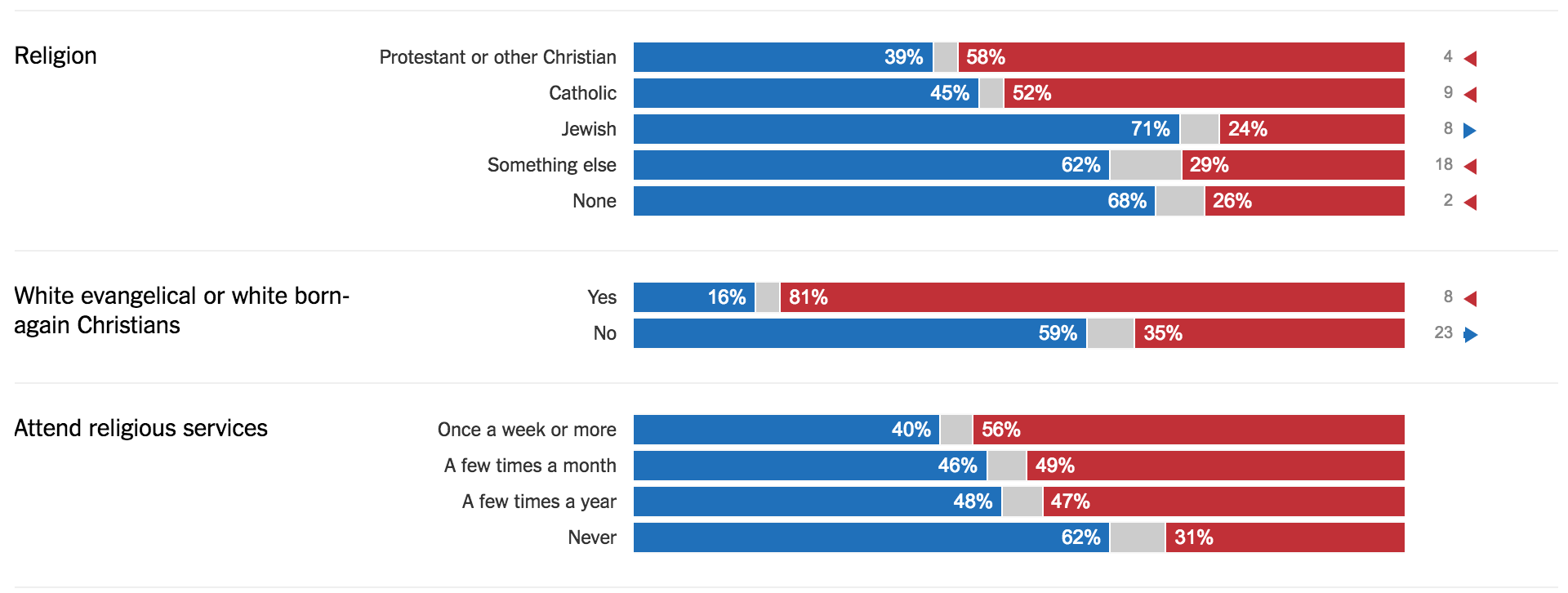
Yet, Trump’s hedonism, adultery, sexual assault, profane discourse, hate speech, sexism, and rapacious behavior as a business man and pseudo-billionaire [1], for the Christian Right, prove to be just fine.
Trumplandia has exposed there is nothing “Christian” or “right” about the Christian Right.
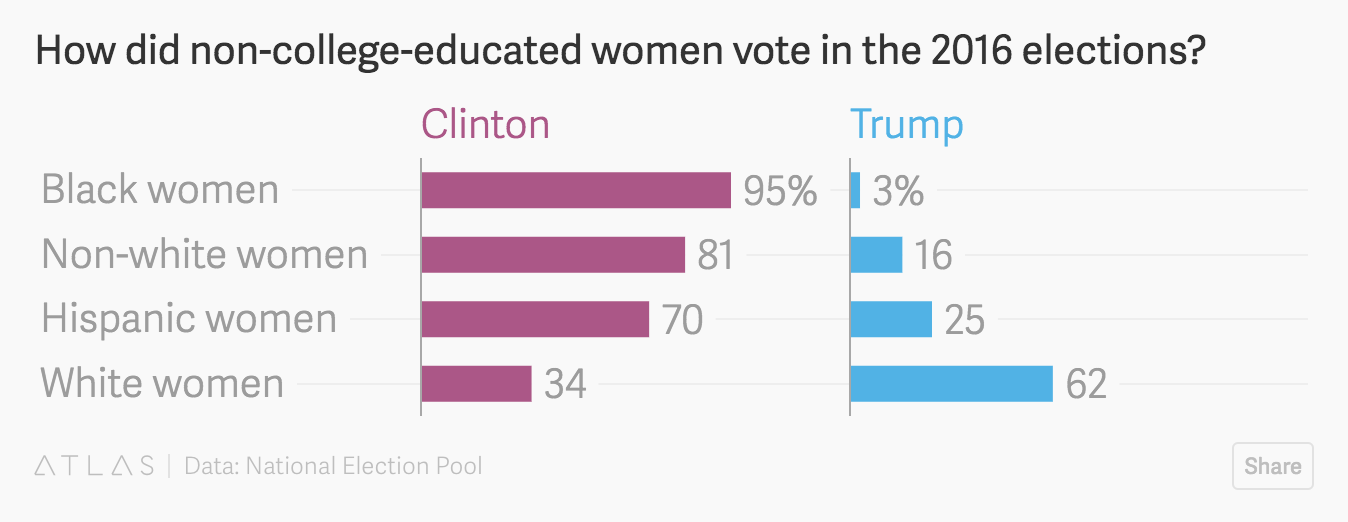
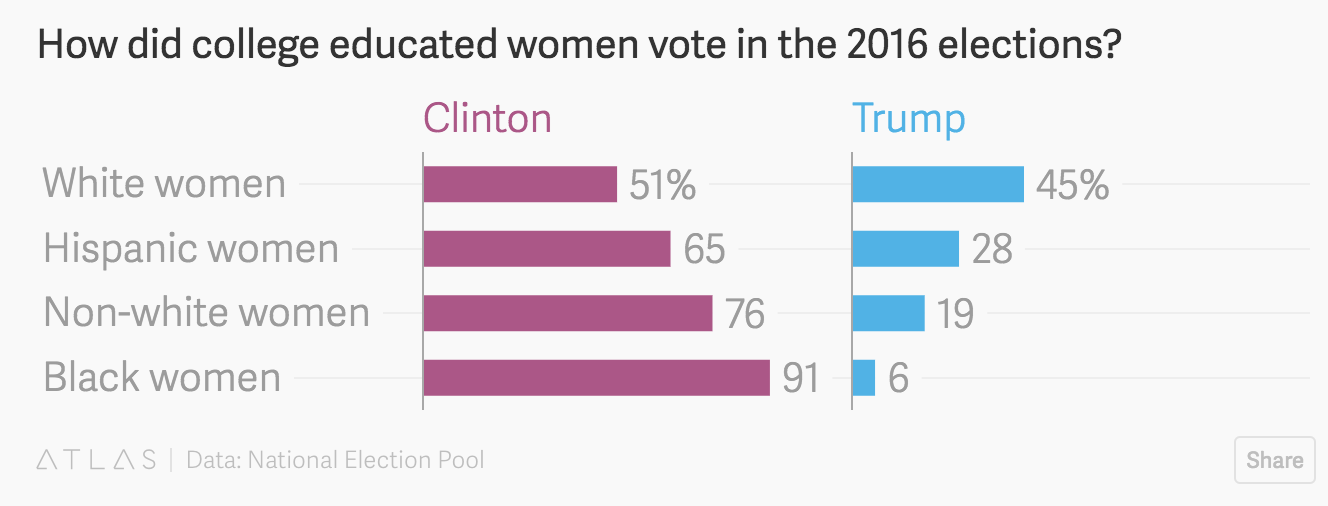
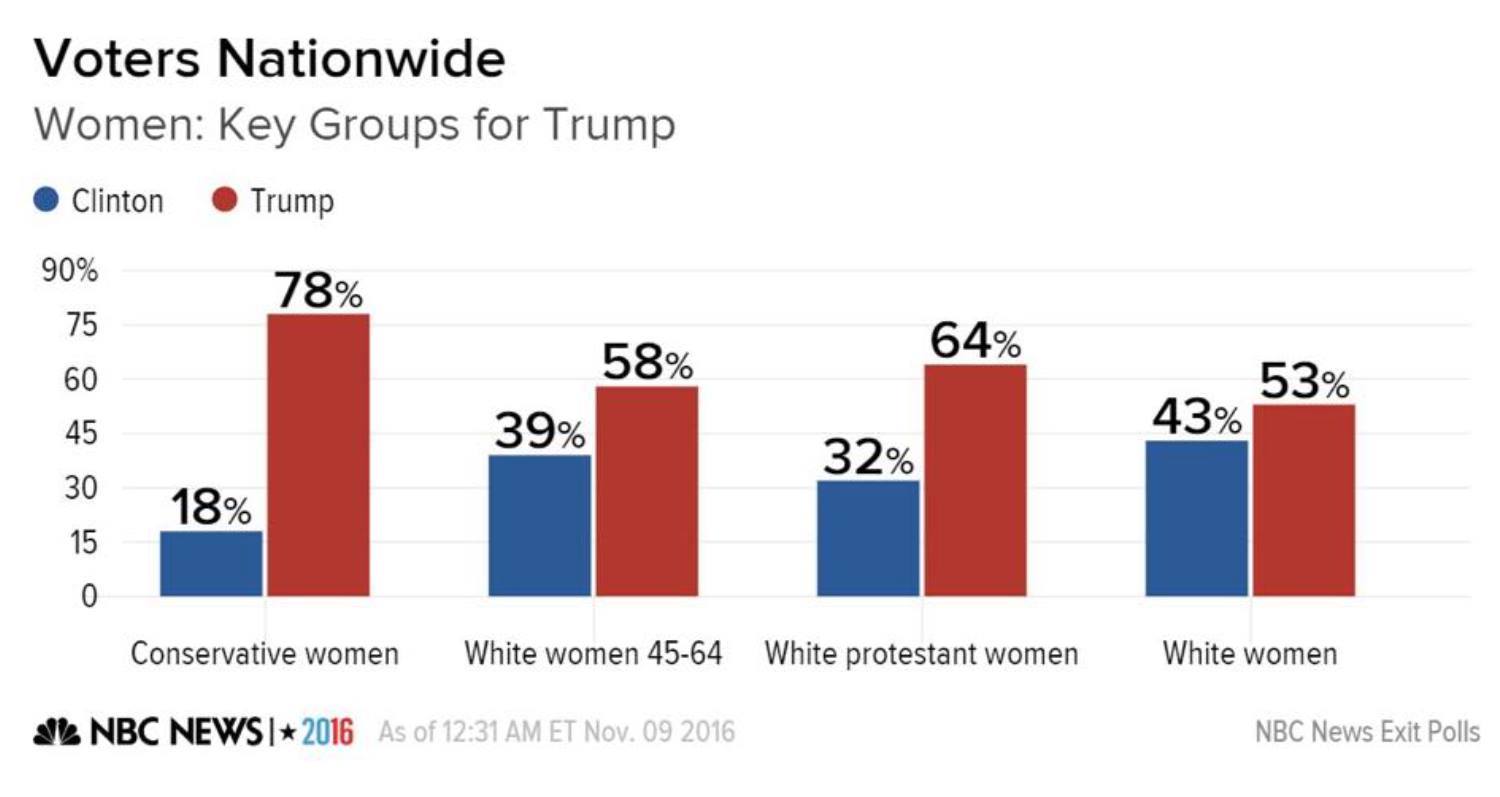
As expected, Trump did best among white voters without a college degree, beating Clinton by the enormous margin of 72 percent to 23 percent. Trump also won among white, non-college women 62 to 34 percent and white college-educated men, 54 to 39 percent. Among white voters, Clinton only won among women with a college degree by a 51 to 45 percent margin. Interestingly, among white voters, there is no evidence in the exit poll that income affected the likelihood that they supported Trump.
The conventional wisdom being promoted by whitewashed mainstream media is that the working and middle class have been abandoned by Democrats and the U.S. government; yet, exit polls show that the two lowest income categories chose Clinton by a slim majority (certainly skewed, however, by people of color over-represented in these groups, revealing how the media is mostly worried about “working class” and “middle class” only as that relates to whites):
Both sets of exit data from CBS and NYT, then, suggest that Trump’s support has more to do with race than disgruntled working class whites being ignored and disenfranchised.
Actually, mainstream media has its argument backward because Trumplandia confirms that white America has abandoned commitments to equity for all—not that any political party or the U.S. government has abandoned white America.
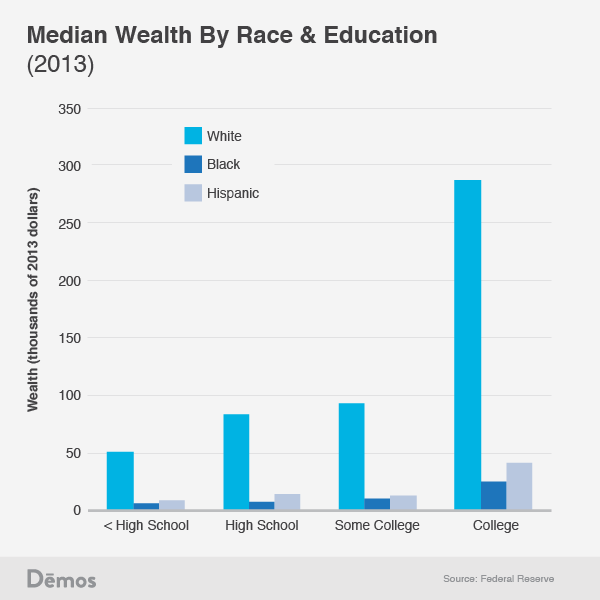
The problem with the hurting working/middle class white argument is that this is racially inequitable America:
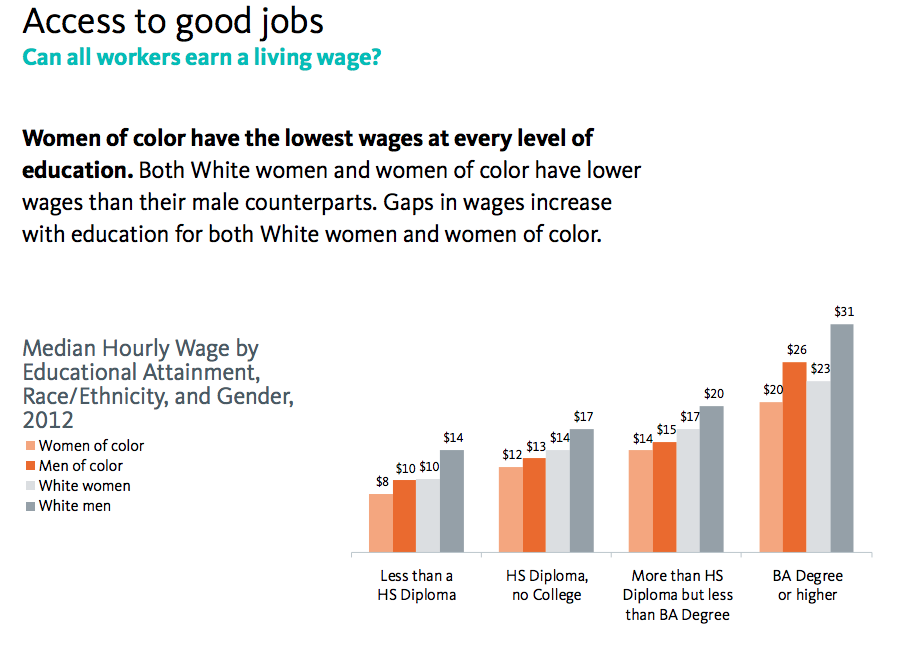
As a powerful contrast to the white male and female support to Trump, note that black women were by far least likely to vote for Trump—and they have the greatest reason to be disenfranchised (the lowest wages at every level of education, above):
The ultimate problem with the suffering working and middle class white argument for Trump’s rise is twofold: (1) white suffering may exist, but by comparison to black/brown suffering and gender suffering, white suffering remains relatively less significant, and (2) if whites are hurting, that fact should have spurred solidarity with historically marginalized groups, not the antagonism being heard from white America.
If white America ever really believed in the melting pot, believed in a country of immigrants, believed in equity for all, that may have existed in some distant and idealized past when white America saw that pot melting disparate whites into one homogenous white: equity for all who look like us (white).
Trumplandia is a white response (whitelash), not from working and middle class suffering, but against rising demands by oppressed groups (#BlackLivesMatter, Colin Kaepernick, gender neutral restrooms, marriage equity, immigration reform, etc.) for equity for all.
The only thing whites are poised to lose is their unearned privilege, but the rise of white support of Trump confirms that whites see their privilege as more important to preserve than equity for all is to attain.
“Make America Great Again” is slogan-as-code for maintaining white (and male) privilege.
#
In the tumultuous world faced by Marvin Gaye—especially war torn—he sang:
But who really cares? Who’s willing to try? To save our world To save our sweet world To save a world That is destined…to die
Trumplandia is a defiant “Not us” from white America—and efforts to whitewash that callousness as economic angst is further proof that the dirtiest word in the U.S. to utter is “racism” because of the delicate sensibilities of the most powerful people in the country.
[1] Matthew 19:24: Again I tell you, it is easier for a camel to go through the eye of a needle than for someone who is rich to enter the kingdom of God.
Although humans appear ultimately incapable of listening to and then acting upon our great capacity for art—which is an extension of our great capacity for compassion, love, and good—literature may offer some solace in a time when the US has announced itself still a racist, sexist, and xenophobic people, hiding behind the codes of “conservative,” “family values,” and “Christian nation.”
Out, damned spot! out, I say!–One: two: why,
then, ’tis time to do’t.–Hell is murky!–Fie, my
lord, fie! a soldier, and afeard? What need we
fear who knows it, when none can call our power to
account?–Yet who would have thought the old man
to have had so much blood in him.
When Pilate saw that he was getting nowhere, but that instead an uproar was starting, he took water and washed his hands in front of the crowd. “I am innocent of this man’s blood,” he said. “It is your responsibility!” [Matthew 27:24, NIV]
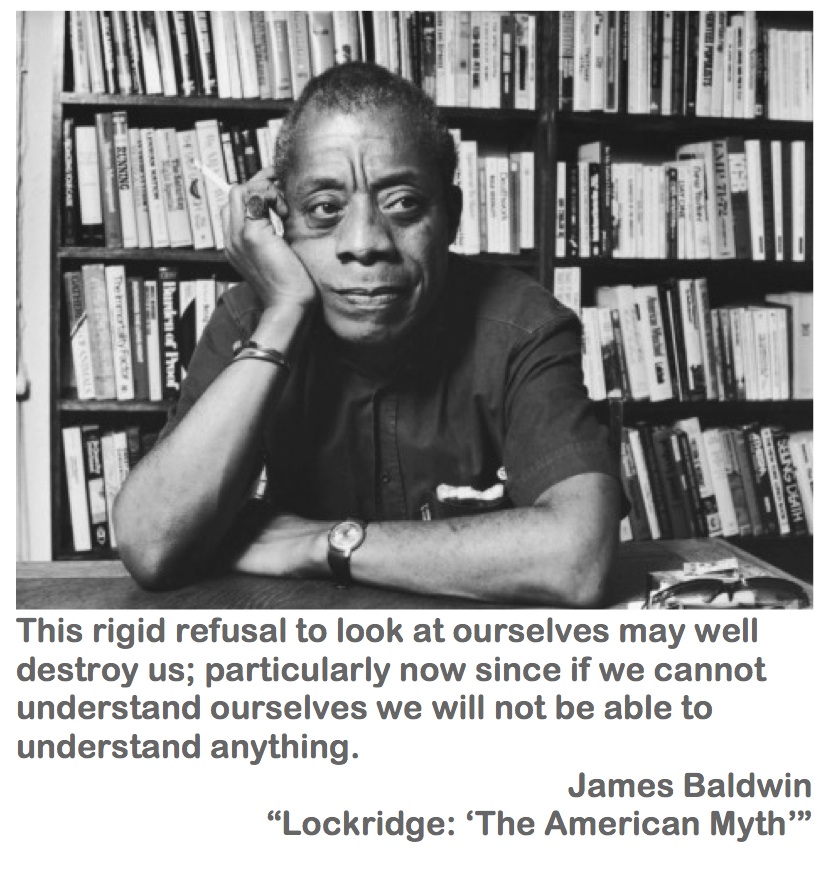
If we can have that moment in which we admit, confront, and atone for our responsibility in the evil that humans do, we must finally listen to James Baldwin:
O, let America be America again—
The land that never has been yet—
And yet must be—the land where every man is free.
The land that’s mine—the poor man’s, Indian’s, Negro’s, ME—
Who made America,
Whose sweat and blood, whose faith and pain,
Whose hand at the foundry, whose plow in the rain,
Must bring back our mighty dream again.
And face our children with our failures, against which Maggie Smith struggles:
Life is short, though I keep this from my children….
The world is at least
fifty percent terrible, and that’s a conservative
estimate, though I keep this from my children….
Life is short and the world
is at least half terrible, and for every kind
stranger, there is one who would break you,
though I keep this from my children.
The US and its majority white population have the greatest opportunity before them, a free and powerful nation of riches, and daily, that opportunity is squandered because of our “rigid refusal to look at ourselves.”
The US is undeniably inequitable, and to balance among gender, race, etc., we have only two options: to take away or to give to—but in either case, white privilege is erased and white sensibilities are challenged.
There is no evidence the white majority has the ethical backbone to make changes for equity or even to tolerate them.
On a dark mourning in America, I recommend reading or rereading Margaret Atwood’s The Handmaid’s Tale—a sobering imagining of the worst of white responses to the rise of the Others they have created.
We are now on that path, and it is ours to make the decision to turn around or move forward into that oblivion.
The public career and life of Malcolm X are fraught with contradictions and controversy—often complicated by the Nation of Islam and its discredited leader Elijah Muhammad.
Malcolm X’s infamy—as it contrasts with the idealizing and misrepresentation of Martin Luther King Jr. as a passive radical—lies often in his sloganized “By any means necessary” and “History proves that the white man is a devil.”
While Malcolm X himself confronted some of his more controversial and confrontational stances, in 2016, the U.S. is faced with the prescience in what seemed to be hyperbole and racial anger; however, there is much to consider about the evil capacity often behind the face of white men.
Living just across the highways from my neighborhood, Todd Kohlhepp has confessed to vicious murders after police found a woman chained in a storage container for two months.
Kohlhepp represents to a disturbing degree the classic profile of serial killers and sex offenders, central of which is being a white male.
The 20-year-old student, Alec Cook, has been arrested and appeared in court on Thursday, charged with 15 crimes against five women, including sexual assault, strangulation and false imprisonment. His modus operandi, according to police and prosecutors, was to befriend fellow students and eventually entrap and viciously attack them, while keeping notebooks detailing his alleged targets.
Kohlhepp and Cook, white males of relative affluence, are no outliers. Yet, political leaders and the media persist in characterizing for the U.S. public much different images of who to fear: Mexicans, black males, Muslims.
Daily violence—including sexual aggression and assault—is a real threat in a way nearly opposite of these political and media messages; each of us should fear people who look like us, and family, friends, and acquaintances deserve nearly equal scrutiny.
Political race-baiters and the mainstream media rarely stray from the black-on-black crime message, but also always fail to add a key fact: crime is almost entirely intra-racial as the white-on-white crime rate (86%) is nearly identical to the black-on-black crime rate (94%).
White Americans find it as difficult as white people elsewhere do to divest themselves of the notion that they are in possession of some intrinsic value that black people need, or want. And this assumption—which, for example, makes the solution to the Negro problem depend on the speed with which Negroes accept and adopt white standards—is revealed in all kinds of striking ways, from Bobby Kennedy’s assurance that a Negro can become President in forty years to the unfortunate tone of warm congratulation with which so many liberals address their Negro equals. It is the Negro, of course, who is presumed to have become equal—an achievement that not only proves the comforting fact that perseverance has no color but also overwhelmingly corroborates the white man’s sense of his own value.
White men control the political and media narratives, and thus, white males are bathed in the compassionate light of the white male gaze of power—everyone else becomes the feared Other.
The hatred spewed by Donald Trump is not solely what should be feared in this context, but that he personifies and speaks to “the white man’s sense of his own value” that seeks to erase that Other, as Astra Taylor reported from a Trump rally in North Carolina:
A few months ago Trump had rallied in Wilmington, North Carolina, the site of America’s only and largely forgotten coup. In 1898, in the waning days of Reconstruction, rioting white supremacists overthrew a multiracial progressive “fusion” government, deposing democratically elected leaders of both races and killing black citizens mercilessly. After that, populism in North Carolina, as in the South more broadly, was a white affair. At his rally near the site of that historic, shocking savagery, Trump suggested “the Second Amendment people” do something about Hillary.
The Trump narrative is essentially racist, and almost entirely false, Jason Stanley explains:
The chief authoritarian values are law and order. In Trump’s value system, nonwhites and non-Christians are the chief threats to law and order. Trump knows that reality does not call for a value-system like his; violent crime is at almost historic lows in the United States. Trump is thundering about a crime wave of historic proportions, because he is an authoritarian using his speech to define a simple reality that legitimates his value system, leading voters to adopt it. Its strength is that it conveys his power to define reality. Its weakness is that it obviously contradicts it.
And thus, Trump has public support from the KKK and Nazi groups for a reason; and that support is distinct from public support for any of the other presidential candidates, none of which draw hate groups into the light.
In A Dialogue between James Baldwin and Nikki Giovanni, Baldwin argues, “The reason people think it’s important to be white is that they think it’s important not to be black”:
It’s not the world that was my oppressor, because what the world does to you, if the world does it to you long enough and effectively enough, you begin to do to yourself. You become a collaborator, an accomplice of your own murderers, because you believe the same things they do. They think it’s important to be white and you think it’s important to be white; they think it’s a shame to be black and you think it’s a shame to be black. And you have no corroboration around you of any other sense of life.
Yes, we must be vigilant about the white gaze and the male gaze, both of which, as Baldwin witnessed, corrupt the agent and object of that gaze, but we must be as vigilant about the white male accusatory finger designed to keep everyone else’s gaze somewhere other than where the most power, and too often, the most evil reside.
White Americans find it as difficult as white people elsewhere do to divest themselves of the notion that they are in possession of some intrinsic value that black people need, or want. And this assumption—which, for example, makes the solution to the Negro problem depend on the speed with which Negroes accept and adopt white standards—is revealed in all kinds of striking ways, from Bobby Kennedy’s assurance that a Negro can become President in forty years to the unfortunate tone of warm congratulation with which so many liberals address their Negro equals. It is the Negro, of course, who is presumed to have become equal—an achievement that not only proves the comforting fact that perseverance has no color but also overwhelmingly corroborates the white man’s sense of his own value.
So what do I do? I want to teach practical skills and meaningful texts. I am instead faced with 50 year old texts in the book room, a list of goals and targets (fewer than 10% failures, increased graduation rates by more than 10%, 40 standards with subets) and the fear of retribution and firing if I stray too far from the mandated curriculum. I just want to teach students to trust the power of their voices when my own voice is silenced by bureaucracy and mandates, meetings and condescending professional development that adds another target (5 phone calls home per week). I read and believe your words, but what do I do? How do I change the world? One student at a time? Another 12 hour day?
Let me offer first some context.
Although I am a tenured full professor, I taught public high school English for 18 years in a right-to-work (non-union) state, and have witnessed the powerlessness of being a teacher in that state through my role in teacher education for these on-going past 15 years.
Yes, K-12 teachers nationally are de-professionalized more and more each day, and throughout the South, where non-union states dominate, teachers are even more silenced and powerless.
However, I do believe there are many ways teachers can claim and expand their professionalism.
Broadly, teachers must resist at all costs fatalism, a call by Paulo Freire I believe is foundational to claiming educators’ professionalism.
Now, then, let me address “So what do I do?”:
Take stock of how much of your professional and personal energy is being spent on being a professional and how much is drained by being a martyr—and then stop being a martyr. Especially for K-12 teachers, I advocate the Henry David Thoreau dictum about ours is to do something of value, but never to do everything. Too often, teachers are compelled to martyrdom, which erases all of our energy and is a cancer on our professionalism. Every teacher must take stock of her/his professional practices, and eliminate those that are time and energy draining with little to no positive instructional outcomes. For example, marking extensively on student work, and then not requiring students to respond in some substantive way to those comments is an act of martyrdom—a waste of professional time that produces an artifact of your spending time, but doesn’t benefit either you or your students.
Identify and evaluate a very detailed and specific list of those obligations over which you have no control and those aspects of your teaching over which you do have control. This is a useful exercise for individual teachers, but it is even more powerful if conducted as a department or grade-level team. For example, in a graduate course once, when I rejected teachers giving spelling tests, a teacher challenged my stance because, as she explained, “I have to give a spelling grade on the report card!” I asked if any mandates existed for how she determined that grade, exposing that she did have autonomy over the how, and thus, we discussed pulling spelling grades from original student writing. To often, I fear, due to understandable feelings of fatalism, we teachers think we are powerless when we in fact have options. A detailed inventory is an effective way to make these distinctions real.
Forefront in your day and planning those aspects over which you have power, and then determine professional strategies for advocating change in those obligations over which you have no current power. Daily, make as your first priority your empowering work as a teacher; do that over which you have control first and give your professional self that positive daily inoculation. Designate brief blocks of time for your compliance to mandates, and stick to that schedule. And then, waste no time fretting about those things over which you have no control.
Brainstorm with colleagues more authentic ways to comply with inauthentic mandates. Teachers, I believe, can attack those things about which we have no control—such as standards and high-stakes testing—through stepping back from the mandates and asking if there are alternatives to how to comply. One excellent example is resisting making test-based writing the entire writing curriculum, and instead, making prompt-writing one of the ways in which we teach writing; in other words, embedding prompted, test-based writing late in a more authentic writing program so that we do prepare students for the tests, but also remain true to authentic writing and student voice/autonomy. Also, when mandates are unpacked by a department or grade level team, re-imagined by the department/grade level, and then implemented in ways endorsed by the practitioners, these mandates become tools of professionals instead of de-professionalizing teachers.
Cultivate communities of empowerment and advocacy for expanding your professional autonomy. Teachers have historically and are currently often victims of the divide-and-conquer approach to management. The antidote to that is community—and for teachers, even more important is professional community. Start close and move outward: department/grade level professional communities; local, state, and national professional organizations. Now, let me emphasize here that cultivating communities of empowerment must not become an act of martyrdom (see above); I am not suggesting adding on to your professional commitment, but am arguing for re-evaluating your professional time so that you commit segments of time to more professionalism but less overall time to your work day.
Create advocacy roles for yourself that suit your own strengths and comfort with advocacy. Many years ago while I was a co-leader for a local chapter of the National Writing Project, I mentored a beginning teacher who struggled with her administration over implementing best practice in teaching writing to her elementary students. These were tense times since the young teacher feared for her job, but believed the school mandates were ineffective and even harmful to her students’ learning. She regularly shared with her principal and colleagues the wealth of professional literature on the practices she chose over the mandates and gradually built a case for what she was doing with her students—even though parents also challenged her practice. No one model works for every teacher, and certainly some aspects of being political pose real dangers for K-12 teachers. Yet, change necessary for greater teacher professionalism and autonomy can result only from teachers who are advocates and political. From blogging and Twitter to participating in professional organizations to implementing practices in your classroom to use as models for change in your school—advocacy and being political are necessary for teacher professionalism.
Expand your role as teacher beyond the classroom to parents, the community, and the public. We are teachers, but our power as teachers is not restricted to the classroom. One of the best avenues for helping change our profession is through building greater understanding and support among the parents of our students, the community we serve, and the wider public. Daily conversations outside school; regular newsletters to parents about best practice; letters to the editor or Op-Eds in local, state, and national forums; blogging and other social media dedicated to our work as professional teachers—these are ways in which we can teach beyond the walls of our classrooms.
Check your practice and refuse to scapegoat anyone else for your practices. Ultimately, as educators, we must behave professionally, even as we are not treated as or allowed to be professional. Any practice we do is our decision to do. It is neither healthy nor professional to argue that others make us do anything. If any mandate is harmful to children, we cannot comply. Period. If we do comply, we are implying we, in fact, admit it does no harm. While there is no requirement that teachers are perfect, we must adopt the professionalism we want guaranteed us.
Daily teaching and working toward greater teacher autonomy and professionalism are all very hard work—exhausting and stressful.
The path to greater teacher professionalism is build by teachers dedicated to teaching as a professional endeavor. The suggestions above, I believe, are some powerful ways to make this happen while also not sacrificing any teacher along the way.
And so I return to Henry David Thoreau’s “Civil Disobedience” with my small edit: “A [teacher] has not everything to do, but something; and because [she/]he cannot do everything, it is not necessary that [she/]he should do something wrong.”
In my fourth decade as a teacher, I believe the suggestions above help all teachers achieve these wise words.
Along with Slaughterhouse-Five, Kurt Vonnegut’s short story “Harrison Bergeron” is one of his most taught, and thus most read, works. Both narratives also represent Vonnegut’s characteristic genre bending and blending—notably dark satire with science fiction.
“Harrison Bergeron” is the second story in Kurt Vonnegut’s iconic Welcome to the Monkey House collection of short stories.
However, as I have examined, “Harrison Bergeron” is often misread and misinterpreted, reflected in the film adaptation 2081.
In 2016, just days before the presidential election, how and why the story is misread and misinterpreted—forcing on it American faith in the rugged individual and refusing to acknowledge Vonnegut’s principles grounded in socialism and free thinking—is a powerful commentary on U.S. politics broadly and Donald Trump specifically.
Misreading, Misinterpreting “Harrison Bergeron”
Vonnegut’s fiction and nonfiction are anything except simple—even though he practices a style that can be called “simple” because of his accessible vocabulary, mostly brief and simple sentence structure, and staccato paragraphing (which he claimed mimics the structure of jokes).
Yet, many impose onto “Harrison Bergeron” a simplistic theme (anti-communism) and a simplistic reading of Harrison as hero.
“If ‘Harrison Bergeron’ is a satire against the Left,” however, as Darryl Hattenhauer details, “then it is inconsistent with the rest of Vonnegut’s fiction.”
The misinterpretation stems from expecting narratives to have heroes and from careless reading of what the story says about equality; Hattenhauer clarifies:
But the object of Vonnegut’s satire is not all leveling—“any leveling process” that might arise. Rather, the object of his satire is the popular misunderstanding of what leveling and equality entail. More specifically, this text satirizes America’s Cold War misunderstanding of not just communism but also socialism.
Vonnegut’s enduring real-life hero was Eugene V. Debs, possibly the most well-known and influential socialist in U.S. history. Vonnegut was a lifelong advocate for socialism, and “Vonnegut’s concern for the working class eventually blossomed into a full-scale political outlook that was inspired by a combination of Midwestern populism and home-grown American socialism,” explains Matthew Gannon and Wilson Taylor.
Yet, the short film 2081 adapts “Harrison Bergeron” painstakingly true to Vonnegut—except for almost entirely missing that the story itself satirizes both the totalitarian state (embodied by Handicapper General Diana Moon Glampers) with its militaristic police force and Harrison Bergeron as megalomaniac would-be “Emperor!”
Again, as Hattenhauer emphasizes: “Like his fiction, Vonnegut’s non-fiction also satirizes the Right and endorses the Left. And the Left it endorses is not liberalism (America is one of the few nations where liberalism is not centrist).”
Therefore, “Harrison Bergeron” defies both being simple and America’s cartoonish hatred of communism as forced equality (a cultural failure to distinguish between brute equality and social equity). The story, Hattenhauer examines, has an unreliable narration, which describes a dystopian totalitarian state in which “anti-intellectual leveling” is satirized—not “income redistribution,” which Vonnegut as socialist endorsed.
Vonnegut attacks, then, the exact American myths that many who misread the story claim it endorses, as detailed by Hattenhauer:
According to the proponents of the ideology of America’s dominant culture, equal income redistribution would contradict the fact that some are smarter than others (the corollary: the rich are smart and the poor are dumb), and also contradict the fact that some are better looking or more athletic than others (the corollary: attractive and athletic people deserve wealth).
Nonetheless, “Harrison Bergeron,” understood as Vonnegut intended, proves to be a powerful commentary on the 2016 presidential election and the rise of Donald Trump.
Harrison Bergeron 2016
Vonnegut’s writing never fits neatly into clear genre categories, but like Margaret Atwood, he constantly plays with and within genre conventions both in loving devotion to the forms and in ways that defy those conventions.
As well, Vonnegut’s fiction resists traditional portrayals of the hero and main characters. Billy Pilgrim and Harrison Bergeron, for example, are not heroes—but they are not anti-heroes or everyman main characters.
In many ways, Vonnegut keeps an even focus on many characters throughout his works, and tends to include a mixture of positive and negative qualities in even the most static characters—mostly because nearly everything and everyone in Vonnegut is open to satire.
Charles Shields and Gregory Sumner suggest Vonnegut is nearly always the main character in his work, as authorial voice overseeing even identified narrators.
As a result, Harrison Bergeron is presented through an unreliable narrator as larger than life; at 14 years old, Harrison is seven feet tall and “a genius.” But the reader soon learns, as a fugitive, “Harrison’s appearance was Halloween and hardware.”
In short, Vonnegut’s dystopia and Harrison as a character are cartoonish.
“Clanking, clownish, and huge” as well as “wear[ing] at all times a red rubber ball for a nose,” Harrison bursts into the story with “‘I am the Emperor!'”
Misread as rugged individual hero, Harrison is, in fact, a megalomaniac—his bombast a sour joke.
Yet, as a genius and a renegade, he remains a threat to the totalitarian state; thus:
It was then that Diana Moon Glampers, the Handicapper General, came into the studio with a double-barreled ten-gauge shotgun. She fired twice, and the Emperor and the Empress were dead before they hit the floor.
Vonnegut’s dark, dark cartoon of a story ends with a joke worthy of a drumroll, but the story cannot be read with a smile in 2016 because Harrison Bergeron has been manifest in reality as Republican candidate for president, Donald Trump.
Trump as faux-billionaire, bombastic failed business man, and reality TV star stands before the U.S. as a threat as well—although to the promise (albeit tarnished) of democracy.
Enough Americans misread Trump as a hero to suggest why so many misread “Harrison Bergeron” as some sort of anti-communist propaganda: our rose-colored rugged individualism lenses are powerful, like the “spectacles with thick wavy lenses” worn by Harrison “to make him not only half blind, but to give him whanging headaches besides.”
The flaw in the American character that makes so many misread Trump is not simple either. Yes, there is racism and misogyny—but there is also a profound tension between a valid fear of totalitarianism and a simple-minded blurring of communism/socialism with totalitarianism.
When government actually is indistinguishable from the military (Diana Moon Glampers), a people have lost their precious freedom.
But Vonnegut’s cartoon dystopia omits entirely the utopian possibility of democratic socialism and free thinking that Vonnegut championed his entire life—and that many, if not most, in the U.S. remain unable to embrace.
“Harrison Bergeron” does speak to the center-right politics of the U.S., in which the so-called left is represented by a classic Republican (Hillary Clinton) and the so-called right has been reduced to a clown (Trump).
If this were a Vonnegut story or novel, it would be goddam funny.
As real life, the presidential campaign of 2016 is a metaphorical “double-barreled ten-gauge shotgun” aimed at our heads, and it is in our hands with our fingers on the trigger.
educator, public scholar, poet&writer – academic freedom isn't free










 dr. p.l. (paul) thomas
