
Education Reform in the Absence of Political Courage: Charleston (SC) Edition

Words matter, and thus, I must apologize by opening here with a mundane but essential clarification of terms.

As I have written over and over, everything involving humans is necessarily political, even and especially teaching and learning. Therefore, no teacher at any level can truly be apolitical, objective. Taking a neutral or objective pose is a political choice, and an endorsement of the status quo.

Key to that claim is recognizing the difference between political and partisan. Partisan politics involves allegiance to and advocacy for organized political parties, notably Republicans and Democrats.

A partisan feels compelled to place party loyalty above ideology or ethics. To be political can be and should be a moral imperative.

We can avoid being partisan, even as that is political. And when many people call for education and educators to avoid being political, what they really are seeking is that education and educators not be partisan—a position that is achievable and one I endorse.

This distinction matters in public education and public education reform because all public institutions in the U.S. are by their tax-supported status at the mercy of partisan politics.

From around 1980, in fact, politicians at the local, state, and national levels have discovered that public education is a powerful and effective political football. The standard politician’s refrain is “Schools are horrible, and I can make them better!”

The current rise of the inexpert ruling class at the presidential level has been foreshadowed for more than three decades by the partisan politics around education reform—politicians and political appointees with no experience or expertise in education imposing pet reform initiatives onto public schools because these policies appeal to an equally mis-informed public.

Even with large failed crucibles such as New Orleans post-Katrina, political leaders remain committed to finding themselves in a hole and continuing to dig.

In my home state of South Carolina, infamous for our Corridor of Shame, Charleston, on the east coast and part of that corridor, continues to represent the savage inequalities that result from a combination of an inexpert ruling class and an absence of political courage.

Charleston schools reflect the most stark facts about and problems with K-12 education across the U.S.: private and gate-keeping public schools (such as academies, magnet schools, and some charter schools) that provide outstanding opportunities for some students in contrast to grossly ignored high-poverty, majority-minority public schools that mis-serve “other people’s children.”

As a result of these inequities and dramatically different student outcomes exposed by the accountability era obsession with test scores, Charleston has played the education reform game, committing to provably failed policies over and over: school choice, school closures and takeovers, school turnaround scams, overstating charter schools as “miracles,” and investing in Teach For America.

Why do all these policies fail and what ultimately is wrong with inexpert leadership? The absence of political courage to address directly the blunt causes of inequitable student outcomes in both the lives and education of students.

Currently in Charleston, the closing of Lincoln High and transferring those students to Wando High (see here and here) highlight that the gap between commitments to failed edureform and political courage to do something different persists.

The debates and controversy over how former Lincoln students are now performing at Wando offer some important lessons, such as the following:

  • The media and the public should be aware of partisan political code. A garbled reach for “the soft bigotry of low expectations” has been used to explain why Lincoln students’ grades have dropped while at Wando. The “soft bigotry” mantra is a conservative slur triggering the public’s belief in “bleeding heart liberals,” who coddle minorities. But the more damning part of the code is that it focuses blame on the administration and teachers in high-poverty, majority-minority schools and thus away from political leadership.
  • And thus, the public needs to distinguish between blaming educators at Lincoln for low expectations (again, garbled as “low standards”) and the expected consequences of high-poverty, majority-minority schools suffering with high teacher turnover, annual under-staffing, and persistent teacher workforces that are new and/or un-/under-certified. Additionally, the accountability era has unrealistic demands of these schools when compared to low-poverty, low-minority schools that have much greater percentages of experienced and certified teachers.
  • The apparent drop in student grades and test scores from Lincoln to Wando is extremely important data that deserve close scrutiny, but so far, that scrutiny has been reduced to partisan politics and deflecting blame. Dozens of reasons could explain the grade differences, including the transfer as well as the staffing differences between the two schools (neither of which is the simplistic “soft bigotry” argument used primarily to justify closing a community school).

The partisan political approaches to schools and education reform are tarnished by both willful ignorance and a confrontational blame game.

The willful ignorance of politicians and the public refuses to acknowledge huge social inequity driven by racism and white privilege; the blame game seeks ways to blame the victims of those inequities instead of confronting systemic forces.

What should political leaders be doing and what should the public be demanding that is different from the patterns identified above, than the policies already proven as failures?

  • Recognize that in-school only reform creates two serious problems: (1) unrealistic demands with high-stakes consequences produce unethical behavior among otherwise good people (see the Atlanta cheating scandal), and (2) since out-of-school factors overwhelmingly influence measurable student achievement, even the right in-school only reform is unlikely to result in measurable improvement.
  • Interrogate the proclaimed cause of low student achievement—”low expectations”—and instead seek to understand the complex reasons behind that low achievement by poor and black/brown students based on available evidence that includes carefully interviewing the administrators, teachers, and students involved.
  • Advocate for public policy that addresses serious inequity in the lives of children—policy impacting access to health care, a stable workforce, access to safe and stable housing, and high-quality food security.
  • Refuse to ignore needed in-school reform, but reject accountability-based reform for equity-based reform focusing on equitable teacher assignment for all students, articulated school funding that increases funding for schools serving struggling communities, guaranteeing the same high-quality facilities and materials for all children regardless of socioeconomic status of the communities served, and eliminating gate-keeping policies that track high-needs students into test-prep while advantaged students gain access to challenging courses such as Advanced Placement and International Baccalaureate.

Ultimately, the absence of political courage in SC and across the U.S. is where the real blame lies for inequitable student achievement along race and class lines.

Many students, the evidence shows, are doubly and triply disadvantaged by the consequences of their lives and their schools.

Trite and misleading political rhetoric, along with “soft bigotry of low expectations,” includes soaring claims that a child’s ZIP code is not destiny.

Well, in fact, ZIP code is destiny in SC and the U.S.; it shouldn’t be, but that fact will remain as long as political leadership chooses to ignore the expertise within the field of education and continues to lead without political courage.

Political courage requires direct action, even when it isn’t popular, and refuses to deflect blame, refuses to wait for what market forces might accomplish by taking the right action now.

Political courage, as James Baldwin expressed, embraces that “[t]he challenge is in the moment, the time is always now.”


For More on Political Courage

Support Betsy Devos Shoot Yourself In The Foot, Andre Perry

Black Activists Don’t Want White Allies’ Conditional Solidarity!, Stacey Patton
Navigating Choice Reading with High-Stakes Accountability in Mind

As long as we have had formal education in the U.S., we have had a fair amount of public crisis discourse about how students can’t read, and we persist in committing to classroom practices that often contradict our stated goals of creating eager and proficient readers among our students.

One of my arguments about how we fail reading in our schools is that virtually all K-3 students are eager to read, but very few high school students maintain that same joy; what those students have in common are 10+ years in school, where reading goes to die.

English educator and researcher Lou LaBrant began in the 1920s and 1930s producing what we would call today action research showing the essential power of choice in reading to foster both eager and proficient readers.

In the subsequent years, research on reading has confirmed over and over that access to books in the home and choice in reading are the most powerful ways to achieve the kind of literacy we often lament is missing in our young people.

During the most recent accountability era, when high-stakes testing has become king, students are increasingly schooled in scoring well on test-reading, and as a result, they are taught to hate reading. We may well have today a much greater problem in the U.S. with people who hate to read, who don’t read, than who can’t read.

And that fact is the fault of formal schooling.

The source of this dilemma is high-stakes accountability grounded in testing. As a high school English teacher throughout the 1980s and 1990s, I taught in South Carolina, an early adopter of standards and testing, and I also taught in the Advanced Placement program.

After attending my local Writing Project and finishing my dissertation on LaBrant to complete and EdD, I became resolved to seek ways to honor choice reading and my obligations to prepare students for testing. I documented that adventure with my AP students in English JournalWhen Choice Failed—Or Did It?

When I saw a recent post, AP English and Choice Reading, I was prompted to revisit some of the key elements of how all teachers can remain committed to powerful and research-based literacy practices such as choice while also meeting our obligations during high-stakes accountability.

My short version is what I always say about good writing instruction: If we practice rich and authentic reading practices, students will be even better equipped when faced with narrow and reductive test-reading than if they had only test-prep reading instruction.

The fundamental shift that must occur in order for any teacher to make choice reading work in real world demands of the classroom is to let go of seeing any text as the goal of instruction and to recognize our literacy goals are broader than any details about that text.

In other words, we must not seek to make our students experts on The Scarlet Letter, nothing more than fostering trivia knowledge, but seek to use any novel in the pursuit of all literacy moves (including critical literacy) and to foster genre, medium, and form awareness.

If we believe people should read novels, we must seek ways to invite students to read any novel in order to grow more proficient in that practice, to grow more eager and joyous as well.

As I detailed in EJ in 2003, instead of doing assigned whole-class novels and plays in AP Literature, I allowed students to explore the provided list of writers from the College Board/AP as well as the identified works over the years on the AP Literature test.

From that narrowed and purposeful range of works, we developed broad categories within which students chose works to facilitate whole-class discussions even as students were reading different works.

For example, we had units grounded in black writers and female writers, but we also included Shakespeare and modern U.S. drama categories in order to prepare well for the AP test.

I call this tethered choice because students become active and informed participants in both choosing what they read and keeping that choice tethered to instructional goals and accountability demands.

Choice reading is powerful and accountability is a reality for both students and teachers; however, these two facts do not have to become a regrettable choice for teachers.

If we teachers can embrace the eagerness and joy all children bring to school and then become facilitators for helping those students remain avid readers who recognize the formal obligations of schooling, our reading classrooms can honor both choice reading and achieve the sorts of measurable outcomes demanded by accountability.

Know-Nothing Follies, American Style

Some time in the 1980s while I was teaching high school English in rural upstate South Carolina, my home town, a student turned in an essay about Pink Floyd, a group my students knew I liked.

The student’s essay raved about Pink Floyd—as a person, not a group. The irony of this, of course, was totally lost on the student. [1]

Throughout my 30-plus years teaching, I have encountered dozens of smug, cavalier know-nothings like that student. Too uninformed to even be able to conceive that their ignorance is entirely transparent.

Know-nothings often surround themselves with know-nothings, and the resulting echo chamber is truly stunning. They find themselves clever, and cool; they are ultimately self-perpetuating, and self-sustaining.

Young males often fall into this trap as a pursuit of coolness to hide their insecurities; young women are drawn to feigned know-nothingness as a ploy to attract guys, also a defense against insecurity.

Many if not most grow out of the know-nothing-as-cool/attractive phase.

But enough don’t that the know-nothings have now elected the master of know-nothing president, and that know-nothing president has surrounded himself with know-nothings to run the country.

The great irony of the culture of know-nothingness is that these people are compelled to appear knowledgable while having no capacity for knowledge.

The evidence is easy to confirm:

  • Trump completely oblivious to who Frederick Douglass is.
  • SOE Betsy DeVos’s Tweet misspelling W.E.B. Du Bois, and then misspelling again in the apology.
  • Trump’s inauguration poster using “to” for “too.”
  • The GOP Tweeting a false quote attributed to Lincoln.

These examples from our political elites have their roots in right-wing radio where Rush Limbaugh often holds forth quoting Shakespeare’s “brevity is the soul of wit” (clueless that this is the comment of a buffoon, not a pearl of wisdom) and repeatedly calling Ayn Rand “Anne.”

Here are the remnants of know-nothings to add to the culture of lies and the flippant serial plagiarism that characterize Trump and company.

And as a result of this flurry of know-nothingness, post-truth, and fake news, many have begun to turn to literature, from George Orwell to Margaret Atwood.

While I appreciate the focus on dystopian science fiction that addresses the power of manipulating words, facts, and truth—see Orwell and Atwood—many are glossing over the importance of Aldous Huxley’s Brave New World, which dramatizes the normalizing of the know-nothing culture that now controls our country.

I highly recommend Amusing Ourselves to Death: Huxley vs Orwell, a careful side-by-side graphic comparison of the work by these two authors from Neil Postman who argued in favor of Huxley’s warnings being more apt.

Huxley, the graphic notes, envisioned a people distracted by pleasure, reality TV replacing the urge to read or to seek knowledge.

Huxley recognized the bankruptcy of over-stimulated consumers, bathed in the glow of screen after screen and the incessant access to information.

Huxley feared how truth and fake news would blur in the collective consciousness of a people who just want to have fun—orgy-porgy.

Huxley drew on Shakespeare’s The Tempest, titling his novel in a way that is ominous and satirical since Miranda is deluded by her idealism: “How beauteous mankind is! O brave new world,/ That has such people in’t!”

Imagine, then, that the know-nothing student in my class trying to curry favor without making any real effort had been the son of a racist millionaire who left him a huge inheritance and a cushy leg up on a career as a huckster.

He could have been well on his way to the presidency.

See Also

Rethinking Orwell’s ‘1984’ and Huxley’s ‘Brave New World’ in Trump’s America, Henry Giroux


[1] Note: “The name is derived from the given names of two blues musicians whose Piedmont blues records Barrett had in his collection, Pink Anderson and Floyd Council.”

The Rise of Crony Appointees and the Inexpert Ruling Class

Imagine the U.S. president appointing the Secretary of Education based almost entirely on that appointee being connected, and not because of a wealth of experience and expertise in public education.

No, this is not about Trump and Betsy DeVos—or at least not just about the most current spit in the eye of educators. The opening comment applies to Barack Obama appointing Arne Duncan, his Chicago basketball buddy.

The line from Duncan to DeVos is not some dramatic leap, but very direct and incredibly short.

“In the disciplinary societies one was always starting again (from school to barracks, from barracks to the factory),” wrote Gilles Deleuze in Postscript on the Societies of Control, “while in the societies of control one is never finished with anything—the corporation, the educational system, the armed services being metastable states coexisting in one and the same modulation, like a universal system of deformation.”

Many would discount this as so much French philosophical hokum, but when Deleuze turns to the fiction of Franz Kafka, the more concrete warning of this examination appears. Writing over a century ago, Kafka was keenly aware of the soul-destroying consequences of the bureaucratic existence.

Just as Kafka himself offered dark humor in his existential tales, more recently we have the comic strip Dilbert and two versions, UK and US, of the TV sitcom The Office as well as cult class films such as Office Space to dramatize exactly what Deleuze and Kafka feared: the rise of crony appointees and the inexpert ruling class.

Duncan and DeVos are inners, building careers on being connected and buying connections. And education has been a harbinger for the inevitability of Trump for three decades now since being without expertise and experience has driven who controls public education and what policies are implemented.

Education and education policy have been a playground for Innovators! who have no historical context or real experience in day-to-day teaching and learning.

The policy equivalent to DeVos being confirmed as SOE is the charter school—a garbled Frankenstein of pet policies manufactured by Innovators!

Charter schools sew together “public” with “choice” and hire inexperienced and uncertified TFA corps members who dutifully (although briefly) implement Innovation! such as project-based learning (PBL).

And as a result of the inexpert ruling class, we continue to hear this sort of nonsense:

In fact, the rise of charter schools mirrors disruptive innovation, a term coined by the Harvard Business School professor Clayton Christensen. The theory explains how technology allows for the creation of better services, which eventually replace those of well-established competitors. Traditional public schools, for example, are focused on low-risk, sustainable improvements. They lost their dominance in the market to cutting-edge charters that worked to transform labor, capital, materials, and information to better meet consumer needs.

Yes, Technology! and Disruptive Innovation! But there is more:

For more than 2.5 million students in almost 7,000 schools, 43 states, and the District of Columbia, charter schools have ignited innovations in how education is delivered, measured, and structured, by lengthening school days, emphasizing project-based learning, and using new and creative models for classroom management. That traditional public education has adopted many of the same notions first tried in charters is cause for celebration. The more established innovations become, the greater their impact. But charters also run the risk of losing the very conditions that made them able to innovate in the first place.

Wow, Ignited Innovation! As you can tell, this is a hot mess.

The vapid Newspeak of inexpert Innovators! is a veneer covering a complete lack of credibility or substance.

And the result is a reduction of teaching and learning to the exact sort of bureaucratic hell found in Kafka, Dilbert, The Office, and Office Space—know-nothing bosses and managers dutifully keeping the workers on task by constantly changing those tasks.

If we simply unpack the Innovation-of-the-Moment!, PBL, we have a model for exactly how Trump came about, and what to expect in the wake of that rise.

“The cause for my wrath is not new or single. It is of slow growth and has many characteristics,” writes Lou LaBrant. “It is known to many as a variation of the project method; to me, as the soap performance,” explaining:

I am disturbed by the practice, much more common than our publications would indicate, of using the carving of little toy boats and castles, the dressing of quaint dolls, the pasting of advertising pictures, and the manipulation of clay and soap as the teaching of English literature.

LaBrant, then, concludes:

In encouraging much of handwork in connection with the reading of literature, it seems to the writer, wrong emphasis is made. The children may be interested, yes. But it makes considerable difference whether the interest be such as to lead to more reading or more carving….

That the making of concrete models will keep interested many pupils who would otherwise find much of the English course dull may be granted. The remedy would seem to be in changing the reading material rather than in turning the literature course into a class in handcraft.

Let’s note here LaBrant was confronting the failures of obsessive commitments to PBL in 1931.

That’s right.

1931.

The very ugly truth about our crony appointees and inexpert ruling class is that all they have is snake oil and barker’s bullshit.

Innovation! Technology!

Bullshit.

Since one of the first controversies after DeVos was confirmed involved her using a public school for a photo-op, prompting protests and Duncan’s crony-appointee solidarity, I invite anyone who genuinely cares about education to not only visit a public school but also listen to the teachers and students trapped in the Kafkan nightmare that is, for example, a school-wide embracing of PBL.

Teaching and learning—necessarily messy things, essentially personal endeavors—are reduced to a never-ending quest to do PBL as prescribed, teaching and learning be damned (just as LaBrant observed almost 90 years ago).

And as Deleuze recognized, education remains trapped in “always starting again,” “never finished with anything”; education Innovator’s! obsession with Technology! has nothing to do with teaching and learning, but everything to do with making someone money and with discipline and control.

The ceaseless updating of technology requires vigilant retraining (educators are always in a state of retraining), the ceaseless reintroduction of New! standards requires vigilant retraining (educators are always in a state of retraining), and the next program Innovation! requires vigilant retraining (educators are always in a state of retraining).

All the technology and facilities retooling and teacher retraining to implement PBL must necessarily call on Innovators! to create something New! to replace the tired and (once again) ineffective practices.

Once PBL becomes the norm of schooling, Innovators! will pounce on the New! opportunity to Innovate! No, with great speed and determination—Disruptive Innovation!

The know-nothing ruling class and their enablers will scoff at French philosophy and Prussian fiction because that is all about being informed, knowledgable.

We in education have lived under this nonsense for decades now so let me say to the rest of the U.S.: welcome to our nightmare.

Michael Scott has been elected POTUS, and he has given all his friends the cool jobs while he pecks away on Twitter giving the rest of us the middle finger emoji.

Recommended

Amusing Ourselves to Death: Huxley vs Orwell

Teaching Students, Not Standards or Programs

Teaching Reading and Children: Reading Programs as “Costume Parties”

Comments Shared with my Colleagues on the Responsibility of the Intellectual

The study of silence has long engrossed me. The matrix of a poet’s work consists not only of what is there to be absorbed and worked on, but also of what is missing, desaparecido, rendered unspeakable, thus unthinkable.

Adrienne Rich, Arts of the Possible

Since this is a voluntary gathering of concerned faculty, I am going to risk assuming we are here mostly in solidarity.

None the less, I recognize I am offering at least two controversial points and asking that you afford them your immense breadth and depth of knowledge as well as your patience.

First, while it is now popular in this time of Trump for pundits and the media to wring their collective hands about post-truth and fake news, my opening controversial claim is that despite that attention, neither of these is something manufactured by Trump, and fake news is not the primary problem.

Please consider this Twitter exchange between me and Juana Summers, a well-respected journalist at NPR in 2014, the time of the exchange., and now with CNN:

Summers represents here a tradition that journalists and educators, including professors, assume a neutral pose, honoring a call that they remain apolitical.

In that context, let me ask you next to consider an article published in the New York Times  just a week before Trump’s inauguration: In the Shopping Cart of a Food Stamp Household: Lots of Soda.

The headline and the article itself are mainstream media, not fake news; yet, what that distinction reveals is that our day-to-day public discourse is often indistinguishable from the click bait and false content we are lamenting in fake news.

O’Connors article cites a study from the USDA, which along with this being in the NYT, appears to be credible and compelling.

However, Joe Soss, writing in Jacobin and professor in the Humphrey School of Public Affairs at the University of Minnesota, has exposed that O’Connor’s article badly misrepresents the USDA study and expresses instead ugly stereotypes about people in poverty, what many in the public believe about people depending on food stamps.

So my first controversial claim, which leads into the second, is that public discourse has crossed the Bigfoot line. While there is a spectrum from fake news (entirely false and created to generate clicks online and thus revenue) to mainstream journalism, virtually all of that fails policy and the public because of traditional and misguided commitments to neutrality, objectivity.

There was a time when the National Enquirer depended on a facile commitment to report without unpacking the credibility of the person making a claim; thus, “Hiker has close encounter with Bigfoot!”

Might we imagine that journalist deflecting: “I’m not sure it’s my place to say whether the hiker is credible”?

In that era, mainstream media mostly refused to cross that Bigfoot line. But today, major media outlets are debating if journalists should report “Trump makes claim X” or “Trump makes false claim X”—or even more astounding “Trump lies.”

So I want to end with my second controversial claim.

If you google “fake news,” you are likely to read about a Davidson College graduate, and for us, this may trigger our own Yik-Yak founders.

I think this is not a trivial connection as we gather in our concern as university faculty, intellectuals, serving the liberal arts and our disciplines.

Across our campus, across our disciplines, the liberal arts is an argument that each of our fields is one way of coming to know the human condition. From biology to religion, from economics to philosophy, from psychology to education, and everything in between, we are carefully considering not only what knowledge exists, but what knowledge matters.

Our collective knowledge, or collective pursuit of knowledge, is more likely to serve us well than any one alone.

And then, there is the whole world beyond our beautiful fountains.

Therefore, when Donald Trump says torture works, or when his final TV ad in SC blatantly falsified data on the employment and crime rates, I think about fake news, hot new smartphone Apps, and the failures of mainstream media—each of which fails us if we resist looking at this world informed, if we pretend we can be apolitical, if we close our eyes to larger questions of ethics and morality.

The responsibility of the intellectual—and that includes us—is not about taking a neutral pose, but about speaking beyond those fountains, about modeling what it means to be well informed, to honor the truth, as difficult as at that is to attain, and to model for everyone what it looks like to work in the service of humanity, and not simply to say what you are paid to say, not simply to advocate for your own self-interest.

The responsibility of the intellectual is inescapably political, even as we pledge rightfully to be non-partisan.

Now, I end by appealing as an old English teacher, a writer, must—through metaphor.

Activist historian Howard Zinn’s memoir argues that the human condition is a moving train, and any of us who choose to sit quietly are in effect endorsing where that train is heading.

And thus, as Zinn believed and practiced, ours is always a political act—whether in our passivity or our action.

The responsibility of the intellectual?

For me, it is acknowledging that you cannot be neutral on a moving train, and I must add, you must not be neutral on a disaster-bound train—so I urge that we express our concern as action, informed and ethical.

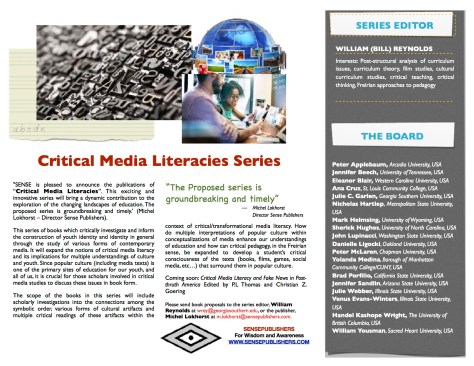
UNDER CONTRACT CFP: Critical Media Literacy and Fake News in Post-Truth America

Critical Media Literacy and Fake News in Post-Truth America

Co-editors P.L. Thomas and Christian Z. Goering

UNDER CONTRACT:

Critical Media Literacies and Youth series[1], Sense Publishers

Series Editor, William Reynolds

Rationale

In the fall of 2016, just after the U.S. elected Donald Trump president, a black female first-year student submitted an essay on the prospects for Trump’s presidency. The course is a first-year writing seminar focusing on James Baldwin in the context of #BlackLivesMatter; therefore, throughout the course, students have been asked to critically investigate race, racism, gender, sexism, and all types of bias related to the U.S.—through the writing of Baldwin, Ta-Nehisi Coates, Roxane Gay, Teju Cole, and Arundhati Roy, among others.

The student’s discussion of Trump’s policies, however, were hyperlinked to Trump’s campaign website. Discussing the draft with the student revealed that the current post-truth America is a significant issue among youth who seem unable to distinguish between facts and so-called fake news.

To blame youth for this lack of critical media literacy seems misguided since the mainstream media itself plays a significant role in misinforming the public. For example, as a subset of the wider media, edujournalism represents a default lack of critical perspective among journalists.

Claims by mainstream media are impressive:

Education Week is the best independent, unbiased source for news and information on pre-K-12 education. With an average of 42 stories posted each weekday on edweek.org, there is always a news, multimedia, or opinion piece to keep you up-to-date on post-election changes in policy, and to help you become a better practitioner and subject matter expert.

The reality is much different. When journalists at Education Week were challenged about their lack of critical coverage of NCTQ, Juana Summers Tweeted, “I’m not sure it’s my place to say whether the study is credible.”

In other words, mainstream media are dedicated to press-release journalism and maintaining a “both sides” stance that avoids making informed decisions about any claims from their sources—including the campaign of Trump.

This volume, then, seeks contributions that address, but are not limited to, the following in the context of teaching and reaching youth in the U.S. about critical media literacy:

  • Unpacking the lack of critical perspectives in mainstream media.
  • Examining “post-truth” America.
  • Confronting issues of race, racism, sexism, misogyny, homophobia, and xenophobia as related to the media.
  • Exploring the promises of the New Media as a haven for truth.

Contributions should seek ways to couch chapters in practical aspects of teaching and reaching youth in the U.S., but can reach beyond the traditional classroom into youth culture as that intersects with critical media literacy.

UPDATED CALL:

We have room for about 3-5 more chapters. Please send a proposal ASAP (by April 1) or a full chapter draft within the following guidelines:

Submit 5000-6000 word chapters by June 1, 2017. (double-spaced, APA 6th, please)

To: paul.thomas@furman.edu and cgoering@uark.edu

Mss guidelines:

  • Minimal formatting as we have to prepare a camera-ready manuscript.
  • 12 pt, New Times Roman font, double spaced, 1” margins
  • Format block quotes and hanging indents with the Word ruler (NOT return/tab)
  • Do NOT use auto-formatting citation Apps
  • Do NOT use Word templates for header or anywhere in the mss

Chapters returned for revisions by August 1, 2017.

Final Chapters due by September 1, 2017.

Proofs to authors by October 1, 2017.

Book published in fall 2017.

Please include the following information with proposals or draft chapters:

  1. Your commitment to follow through and meet the deadlines as stated.
  2. All contact information (email address REQUIRED) for each author of your chapter.

[1]

cmls-2-copy

The Bootstrap Lie and the Politics of Privilege

This is going to be difficult and uncomfortable.

I invite you, then, to be patient while I start with something slightly less uncomfortable but just as difficult.

The tragic but real story of Pat Tillman is many things—one of which is a complete unmasking of how powerful and dangerous cultural mythologies are and how often our cultural mythologies prove to be both false and serving the interests of privilege (primarily white, male, and wealth privilege).

Tillman believed in the sacred duty of a person to serve his country, and then, in that service, Tillman not only lost his life, but also had his death story fabricated to perpetuate the very false myth that failed him.

Those with power sullied Tillman’s legacy to reinforce that the false myth of patriotism could be preserved in the service of their power — and were willing to sacrifice anyone buying the myth.

Again, that is a very hard discussion, a nearly impossible reality to recognize and digest.

But this is even more difficult because it entails race and racism as well as the very ugly stereotypes the U.S. perpetuates and embraces about people in poverty.

And as a very privileged and successful white man, I am walking onto very thin ice by confronting and naming black leaders who, as I will outline, represent a tragedy similar to Tillman’s.

Next, before I become more pointed, my caveat here is that I offer this as a witness in the tradition of James Baldwin, to whom I will return at the end. These are critical views of the world that I have learned by listening carefully, by setting aside my own urge to mansplain, whitesplain—to be the authority.

I am not the authority, but I am a diligent student.

To be considered:

Lawyer Michelle Alexander has detailed a disturbing dynamic: many black communities have advocated against their own best interests by embracing the “get tough on crime” myth perpetuated in the service of privilege. Alexander’s best example, I think, is that police often sweep black neighborhoods (are often invited to do so by blacks themselves), but choose not to do similar sweeps in white and affluent areas such as college campuses—although both are likely to have recreational drugs being used and sold.

Critical educator Chris Emdin, writing on his Instagram page, confronts a parallel paradox in education: “Black teachers with white supremacist ideologies [are] just as dangerous as white folks who don’t understand culture.” From Geoffrey Canada to Steve Perry to Joe Clark—many black educators have embraced the essentially racist “no excuses” ideologies that target black, brown, and poor children while perpetuating that the problems with educating these children lies in deficits of the children, and not any systemic forces. Education designed to correct, “fix,” fundamentally broken children (racial minorities, impoverished children) is inherently racist and classist.

Scholar Stacey Patton advocates against corporal punishment, specifically addressing how many blacks have internalized racist demands that the black body be punished, reaching back to U.S. slavery. As Patton explains:

Dr. Stacey Patton: People think that hitting a child is a form of teaching. We think it will protect them.  And people grow up to invert the violence they experience as children as something that was good, particularly in African-American culture.  As a people, we attribute our success to having had our bodies processed through violence and quite frankly what it does is confirm a long-standing racist narrative about Black bodies. The only way to control us, the only way to make us “good,” law-abiding, moral people is with a good whupping. It seems that we unconsciously agree with that narrative.

Alexander, Emdin, and Patton represent a much larger body of work that recognizes how often privilege recruits outliers of marginalized groups in order to distort those outliers as proof of false myths, specifically pointing to any successful black person as proof that the bootstrap myth is real, that we have achieved a meritocracy.

Popular culture is filled with examples—O.J. Simpson, Ben Carson, Clarence Thomas, Bill Cosby, just to name a few who have become spokespersons in the service of privilege, who, as Emdin notes, are “just as dangerous.”

So here is the very hardest and most uncomfortable part, forced by the nomination of Betsy DeVos as Secretary of Education, an ideologue billionaire hell-bent on perpetuating the choice myth that serves only people like her at the expense of marginalized people, especially children who should not have to wait for the Invisible Hand and who should be served immediately by leaders of the wealthiest country in human history.

Senator Tim Scott (R-SC) has eagerly supported DeVos within his own unwavering advocacy for choice, often invoking that poor and minority families and children deserve the same choices as white and wealthy families and children.

Scott has sold his political soul (much like Clarence Thomas) to an ugly and harmful bootstrap myth, as expressed on his biography page:

An unbridled optimist, Senator Scott believes that despite our current challenges, our nation’s brightest days are ahead of us. As a teenager, Tim had the fortune of meeting a strong, conservative mentor, John Moniz. Moniz helped instill in Tim the notion that you can think your way out of poverty, and that the golden opportunity is always right around the corner. The American Dream is alive and well, and Tim’s story is a concrete example of that.

Scott is an outlier, and his story of success is commendable—except it is an ugly thing to hang one’s success over the heads of others, demanding that their not reaching a similar success is simply due to not “think[ing] [their] way out of poverty.”

No, the American Dream is not alive and well:

access-to-good-jobs-race-gender

At the same levels of effort, women and racial minorities remain disadvantaged by systemic forces that work against them; these inequities are not the result of the ugly “laziness” myth about black, brown, and poor people that lies underneath the bootstrap myth, the rugged individual myth, the meritocracy myth.

The free market and all sorts of choice are crap shoots, and they are in no way mechanisms for equity, for justice.

Scott’s “notion that you can think your way out of poverty” is a slap in the face of adults and children who are already working and trying as hard as they can, and worst of all, this bootstrap mantra maintains the very systemic forces it refuses to recognize.

Billionaires from Trump to DeVos are spreading cultural lies, and they depend along the way on recruits into these narratives, recruits—as Alexander, Emdin, and Patton reveal—who may even look just like the people being cheated.

And so I will end by coming back to Baldwin, whose legacy is being renewed, and whose message still resonates as Rich Blint concludes:

As the latest entry of the brilliance of James Baldwin on film, I Am Not Your Negro (along with Baldwin’s scathing account of American film-making, The Devil Finds Work) lays bare the rhetorical and imagistic sleight of hand that enables the fiction and terror of race in American life to persist with such a renewed and deadly power. As he suggests, the extent to which we truly wrestle with our psychic need for the myth of the “nigger,” will determine the future of the country. It is still the only song left to sing.