
Lost in Space with Jaroslav Kalfar: So It Goes in One Man’s Nightmare of Errors

Spaceman of Bohemia by Jaroslav Kalfar immediately appealed to me as a very near-future, 2018, science fiction story by an intriguing new novelist. Kalfar was born in Prague, Czech Republic, but came to the U.S. as a teenager, completing his education here and now residing in Brooklyn.

The story seems relatively simple for much of the novel: Jakub Prochazka, a scientist, is enlisted to be the first Czech astronaut to explore a phenomenon of space particles that could be crucial to all of humanity—but also may gain his home country the sort of influence and significance that has been dominated by the U.S. and Russia (powers that lurk throughout the novel).
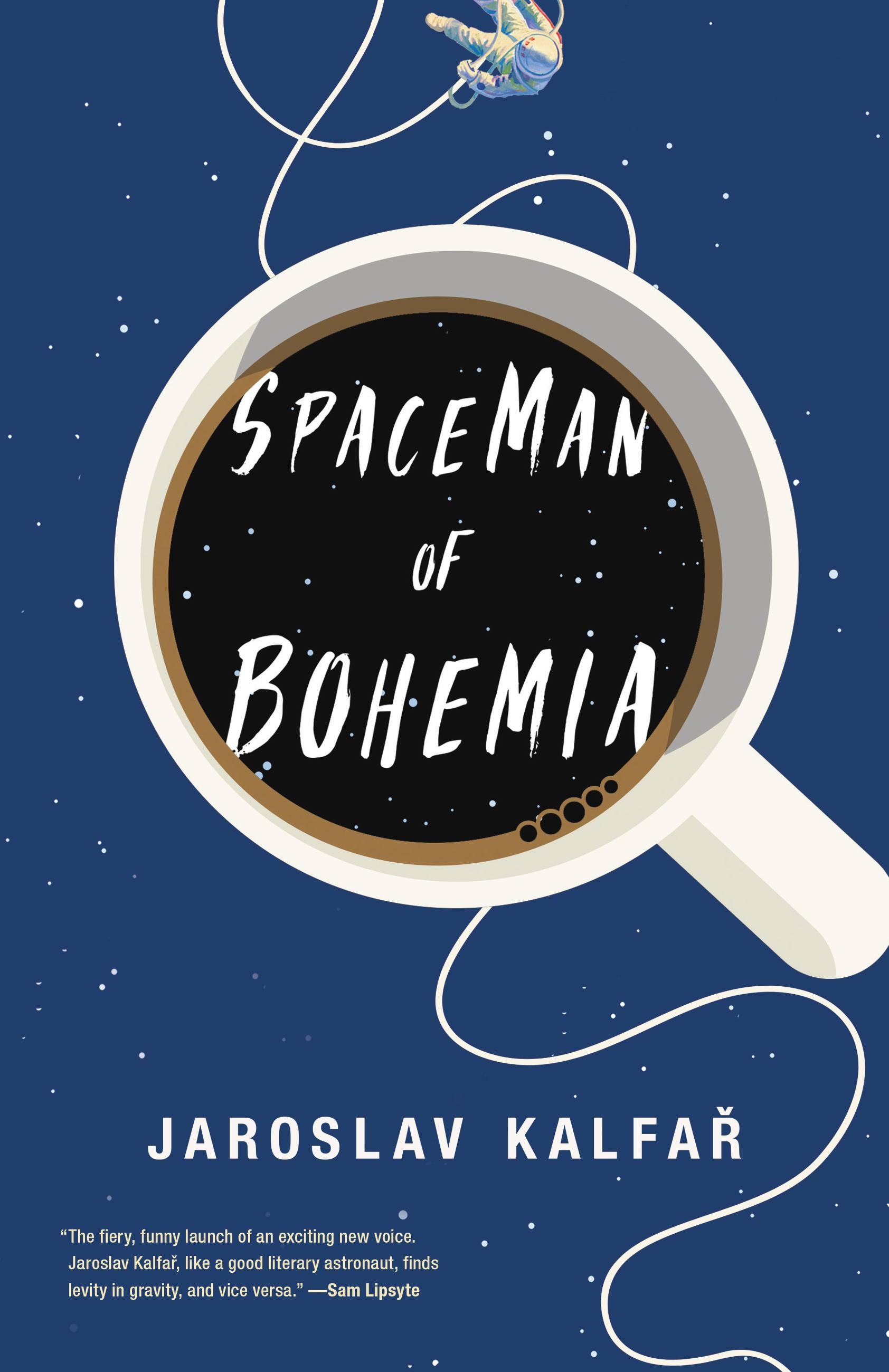
As I was reading, I became intrigued at how Kalfar’s space odyssey seemed a powerful and superior companion to Andy Weir’s novel, The Martian, and the film Gravity.

Spaceman of Bohemia sputters some with managing time and maintaining the delicate tension in tone, mostly tragi-comic early and then sporadically through the middle and end. But on balance, Kalfar avoids the critical pitfalls of The Martian (glorifying the sacred white male) and Gravity (subsuming the female lead in masculinity), while depending on the plot tricks of both—being lost in space and manipulating the possibility that the protagonist will not survive.

But as my mind was parsing Spaceman against the lesser novel and film, Prochazka alone in his spacecraft encounters (or imagines) an alien, eventually gifted the human name Hanus (one of many aspects of the novel that highlights and also satirizes Czech history, its national heroes and its political unrest driven by Cold War communism/capitalism anxieties).

Kalfar’s writing had already triggered my love for Franz Kafka, maybe too easy a notice, but it was at the philosophical exchanges between Prochazka and spider-like Hanus that I recognized Kurt Vonnegut’s Slaughterhouse-Five—Billy Pilgrim, time (not space) traveller and Tralfamadorians debating free will and human nature as well as concepts of time.

Kurt Vonnegut also had a career as a visual artist.

Pervasive throughout Spaceman, in fact, are both the weight and levity of Kafka’s existential metaphor of human existence as a nightmare and Vonnegut’s fatalistic refrain, “So it goes”—possibly (but definitely beautifully) captured by the ever-present allure of Nutella, nectar of the gods, it seems.

Kalfar embodies Czech/Russian-European ideologies and historical/political groundings—distinct from the worldview of U.S. literature or even Margaret Atwood’s Canadian-fueled literary speculative fiction.

Spaceman falls into the genre, then, literary science fiction, that is Vonnegut’s (and Atwood’s) domain; in other words, the conventions of lost in space and an alien are vehicles for a dark satire of the human condition, the fact of humans as pawns of their own devices (politics, technology, the pursuits of knowledge and power, love, and capitalized materialism).

There is a melancholy and even fatalism to the novel, of love, loss, distance, and time, yes, but more overwhelmingly something more biblical—the sins of the father are the sins of the son.

Prochazka’s father becomes a political pariah, and his grandfather tries to help Prochazka cope as a child while the grandfather skins a rabbit:

“You know that the world is always trying to take us. This country, that country. We can’t fight the whole world, the ten million of us, so we pick the people we think should be punished, and we make them suffer the best we can. In one book, your father is a hero. In another book, he is a monster. The men who don’t have books written about them have it easier.”

The weight of history, familial history, shapes and even twists Prochazka, reminding me of the violent urges experienced by Offred in The Handmaid’s Tale: “I think about the blood coming out of him, hot as soup, sexual over my hands.”

While Billy Pilgrim literally travels back and forth in time, Kalfar stylistically shifts the narrative back and forth in time, where readers witness the young Prochazka struggle with the personal against the political:

I don’t care what reigns outside our house—capitalism, communism, or anything else—as long as my parents will return to me and keep me safe from men like the stranger [a man tortured by his father before the fall of communism]. Yes, perhaps my father could even torture him a little. I would allow it. I would ask my father to torture the man until he stopped hating me.

And like the alien Hanus, the grandfather becomes a philosophical voice of doom: “‘Different lords and the same shit for the commoners.'” And eventually, Prochazka appears to have drawn a similar conclusion: “Now I am a cadaver in waiting….The body is the worker and the soul the oppressor.”

Ultimately in that existential despair, however, Prochazka as scientist seems to survive, somewhat hopeful nonetheless: “If a sequence of random events is repeated many times, patterns can be detected and studied, thus creative the illusion that human observers can truly know and understand chaos.”

Spaceman of Bohemia ends with Prochazka pummeled by that weight of history, the existential facts dramatized in the novel—Nutella smeared on his arm to attract the spider (substituting for Hanus) in his dilapidated childhood home.

The fantastical of science fiction and the ambiguity of a psychotic main character or a human having a close encounter with an alien build to a harshly realistic ending, winding through echoes of Vonnegut to something we can imagine a twenty-first century Kafka would have penned.

Against Spaceman, The Martian (novel and film) and Gravity are exposed as propaganda and careless, even when they are compelling and grand.

Kalfar’s first novel is satisfying, although a bit uneven, and extremely promising—especially for those who are drawn to the sort of science fiction that embraces the conventions as a captivating way to help us continue, like Prochazka, to make meaning out of the chaos that is being a human on a tiny, fragile planet in the infinity of the universe.

UPDATED: Black Power and the Rise of Trumplandia

During my formative years of the 1960s and 1970s, the political unrest driven by race and racism churned somewhat innocuously for me in the dim background. Several aunts and an uncle lived in Asheville, North Carolina, and their school lives were punctuated with protests, my mother receiving frequent updates by phone as we lived about an hour and a half south of there in South Carolina.

The working class white racism of my family and being a son of the recalcitrant South significantly skewed the ongoing version of history occurring around me—the othering of black people (protests in Asheville were always “riots”) and the discrediting of the Civil Rights movement and its black leaders.

Then, “black power” existed for me in two forms—pop culture versions of blaxploitation media, including Luke Cage, Hero for Hire and Shaft, and real-world protest such black gloves and fists raised, John Carlos and Tommy Smith at the 1968 Olympics.

After the election of Donald Trump as president, many have continued to scramble to explain the rise of Trumplandia, often falling into two opposing camps—one arguing Trump’s support is because more people were hurting under Obama than the pundits ever admitted and the other demanding that we admit Trump’s rise was fueled by racism, now neatly cloaked in terms such as “nationalism” and “alt-right.”

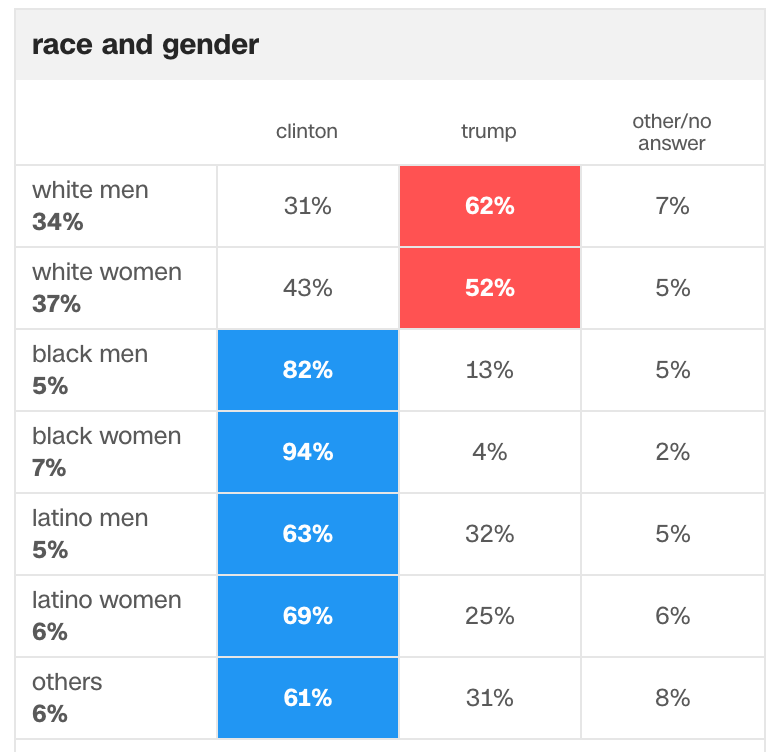
I am of the second camp because the data are overwhelmingly compelling about how white men and women voted for Trump in large percentages:

trump race gender
CNN Politics

We stand in 2017 continuing a corrosive tradition confronted by James Baldwin—”this rigid refusal to look at ourselves.”

“White” remains unspoken as the normal, as the given, and then any excuse is embraced in order to ignore the lingering weight of racism in the U.S.

As might be expected, “black power” in 2017 is before us in the form of economic power, a rising economic autonomy by blacks that likely played a major role in motivating Trump’s supporters who seek to keep the U.S. white.

Two recent controversies may serve as evidence of this: LaVar Ball creating a a sports brand around his soon-to-be-drafted son, Lonzo, and former president Barack Obama’s speaking engagements and fees.

The backlash against both Ball and Obama are interesting and telling since the critics are often those who elected Trump—a bravado and hollowness that dwarf anything Ball has said or done—and who worship Ronald Reagan—who earned millions speaking in Japan after leaving office.

The problems are not bravado, self-promotion, or capitalizing on political careers; the problems are when blacks seek the same avenues as whites to fortune and power.

Moments of this racial anger occurred under George W. Bush as well when his administration sought to dismantle affirmative action, racial preferential treatment for college admission; although Bush himself had benefitted from legacy admission to college.

Trump’s wealth and political success began with an inheritance, one that he has squandered and continued to grow on the backs of others, at the expense of others. Trump now right in front of the entire world works daily to pass on that unearned privilege to his family.

But we are somehow offended by Ball and Obama’s speaking fees—somehow offended that these black men are doing exactly what the capitalistic American Dream says we are supposed to do.

And swirling around all this are black superheroes returning to pop culture prominence—Luke Cage on Netflix and The Falcon as well as the Black Panther in the Marvel film universe.

And just as it did when I was growing up, as long as these black heroes generate money for the right people (“right” means “white”), all is good.

But those same people paying to watch black superheroes, as my family did about Carlos and Smith, turn their scorn on #BlackLivesMatter, rigidly refusing to look at themselves.

Twenty-first century black power is LeBron James, who demands not only the wealth he earns but the power to control that wealth.

Trumplandia is a self-defeating racist response to black power, one that is a real-world dystopia not far removed from another message of pop culture begging for our viewing dollars, The Handmaid’s Tale on Hulu.

We must admit black power spawned Trumplandia, a white fright, and we can only hope, in part, black power will be able to dismantle it.


Recommended

Status threat, not economic hardship, explains the 2016 presidential vote

More Evidence That Racism and Sexism Were Key to Trump’s Victory

Understanding White Polarization in the 2016 Vote for President: The Sobering Role of Racism and Sexism – Schaffner – 2018 – Political Science Quarterly – Wiley Online Library

Does White America Fear Black Equality? The Economic Forces Behind Trump’s Win

Top Democrats are wrong: Trump supporters were more motivated by racism than economic issues, Mehdi Hasan

Race, Religion, and Immigration in 2016 | Democracy Fund Voter Study Group, John Sides

Ultimately, the 2016 campaign helped make attitudes related to immigration, religion, and race more salient to voter decision making in a way that many other attitudes were not. This was particularly consequential for Clinton because a substantial number of white Obama voters had less favorable views of immigrants, Muslims, and black people. Of course, these attitudes were not the only thing associated with how people voted in 2016. Moreover, the findings I have presented here characterize the entire sample of white voters; they are not an account of how any single voter, or every voter, made his or her choice. Nevertheless, these findings suggest that, compared to the 2012 election, the 2016 election was distinctively about attitudes related to racial, ethnic, and religious minorities.

Economic Anxiety Didn’t Make People Vote Trump, Racism DidSean McElwee and Jason McDaniel

Analysis | Racism motivated Trump voters more than authoritarianism, Thomas Wood

Trumpism: It’s Coming From the Suburbs, Jesse A. Myerson

Analogies Like Land Mines: Treading Carefully When We Discuss Teaching Writing

Metaphor is a powerful element in the craft of language. Writers and speakers seek metaphors, similes, and analogies to produce rich expression, but the analogy is a part of everyday discourse and all types of public expression and debate.

One of the staples of my years teaching high school English was Flannery O’Connor’s “A Good Man Is Hard to Find,” a dark satire and enduring example of the brilliance found in Southern literature.

My students and I always paused early in that story, the second paragraph, that begins:

Bailey didn’t look up from his reading so she wheeled around then and faced the children’s mother, a young woman in slacks, whose face was as broad and innocent as a cabbage and was tied around with a green head-kerchief that had two points on the top like a rabbit’s ears.

As a cabbage? we would always ponder. The early descriptions establish O’Connor’s use of contrast to cause tension between some of the cartoonish elements with the grim reality of the story’s plot.

But I also feel in the cabbage simile that O’Connor was poking a bit at metaphorical language itself—something like a meta-metaphor.

Less as craft and more as a strategy for argument, however, Donald Trump, apparently, has posed that he avoids exercise because, he claims, humans are like batteries, having a finite amount of energy. He believes we waste that energy store when exercising.

Both of these example highlight, I think, that we must always investigate the use of analogy for the essential validity of the relationship being presented.

At different times in the past, the mind, for example, has been characterized as a blank slate and a muscle—and then, evidence and careful consideration of these analogies have been discredited.

Where analogy fails, it seems, is when we take a position and then reach for a comparison that confirms the position. Trump, in his baseless battery analogy, simply clamored for something to justify his position—one that falls apart if we interrogate the comparison.

Yet, the analogy is a powerful tool, and often compelling because analogy brings the concrete and the understood into complex and often abstract settings: the mind as a blank slate or muscle is far more manageable for the average person than how the mind actually functions, a domain for specialists.

As a writer and a teacher, my world is often deeply entrenched not only in language, but also in investigating how language works (and doesn’t) to create warranted meaning.

Both as a writer and reader, I have come to live by a guideline that helps remind me of the need to resist the uncritical allure of the analogy: Just because someone can make a comparison doesn’t mean that the comparison is valid.

Writing Is Like?

Recently, I have had several experiences with people making analogies in order to understand writing (composing) and teaching writing: writing like learning to ride a bicycle (starting with training wheels to justify teaching the five-paragraph essay), writing like playing a piano (moving from scales to playing a full piece).

Both of those are recurring analogies, and thus, they must be compelling. However, here I am asking us all to think more carefully about these analogies.

Writing (composing) is nothing like riding a bicycle, and is also nothing like playing the piano, because writing (composing) is creating something from nothing, an act of synthesis.

“Writing” as a term can cause some of the problem, in fact, so let’s first consider writing (as handwriting) versus writing (as composing).

Even in behaviors that depend on something like rote actions (such as handwriting, riding a bicycle, and playing a piano) [1], the repetition of behaviors must be “correct” (or you are learning to do something “wrong”) while also incrementally moving from something like novice to proficient to expert.

Let me risk next an analogy between coaching a scholastic sport and teaching.

As a soccer coach, I worked hard to maintain some level of quality in drills during practice (isolated and rote), for the fact above, to prepare players for playing an actual soccer match (holistic and autonomous, although conforming to a body of rules); but my work as a coach would have been much different if I were helping the team create a whole new game instead of teaching them how to conform to an existing system.

Now we have come against the inherent flaw in the analogies about writing like riding a bicycle or playing a piano because writing (composing) is not of the same kind of behavior. Instead, writing is more validly analogous to visual art such as painting or drawing.

While writing (composing) and visual art do in fact have discrete skill sets that can and should be honed in isolated and somewhat artificial ways, practice, composing a written piece and visual art come from trying the whole thing inexpertly at first and then continuing to do the whole thing in incrementally more proficient ways until some level of expertise is achieved.

Writing (composing) and visual art begin by facing blank paper, acts of synthesizing and creating from nothing to something.

And thus, in pursuit of a more valid analogy, just as we do not teach painting by first asking students to paint-by-number, we should avoid at least an overuse of templates (five-paragraph essay, etc.) when teaching composition.

Further, the field of composition has ample evidence (as do those of us who teach writing/composition) that once students have been prompted to conform to a template, they are dogged in never letting go; the template, sigh, is not a set of training wheels easily removed.

Metaphor, simile, and analogy are powerful tools, but the pursuit of analogy is like navigating a field littered with land mines; we should tread more carefully when making our comparisons, avoiding the Trump error above (selecting the analogy to confirm a belief without investigating if the comparison is accurate, without starting with a credible claim itself).

Just as we scramble to understand better how the brain/mind works, often resorting to analogy, we who write and teach writing (composing) are confronted with something equally complex, and are rightfully looking for how to better navigate that understanding.

In that pursuit, I believe the bicycle and piano analogies to writing mis-serve us and our students. Let us seek instead analogies grounded in capturing the holistic and chaotic nature of rendering meaning from nothing and presenting comparisons that are of the same kind.


[1] I urge you to look into how the 10,000-hour rule was misrepresented in the media by Gladwell and others.

Accreditation: “‘relatively superficial, extremely time-consuming and doesn’t lead us to a goal of significant improvement'”

For well over three decades, I have been both a full-time educator (high school English teacher for 18 years and currently a college professor, going on 16 years) and a writer. As a high school teacher, I also taught journalism and was the faculty sponsor for the school newspaper and literary magazine over about 10-11 years.

Therefore, I have a great deal of experience in the fields of education and journalism, experience that has revealed to me a rather damning fact: One can be well trained in educational pedagogy or the craft and conventions of journalism, but without nuanced and deep knowledge of the content of that teaching and writing, the outcome can and often is quite awful.

In journalism, for example, the vaunted New York Times publishes and fails to recognize blindly awful articles about poverty. And Education Week regularly features the worst of edujournalism.

And let me emphasize here, these criticisms are about the very best of the field.

The rise of Trumplandia has also birthed a renewed concern about the media and journalism—much gnashing of teeth about fake news and post-truth—so this announcement from Northwestern University may seem ill-suited in the context of those concerns:

In a nontraditional move, officials at Northwestern University‘s prestigious journalism and communications school have decided not to renew the program’s accreditation, letting the designation lapse.

The dean of the Medill School of Journalism, Media, Integrated Marketing Communications said Monday that school officials chose not to pursue renewed accreditation, which provides outside approval of academic programs, because the process is “flawed” and not useful.

More pointedly, the dean explains:

“Our goal is always to be the best in the world, and this process doesn’t get us there,” Hamm said in an interview Monday afternoon. “We just don’t find that the review provides us with anything beyond what we already know today. It’s relatively superficial, extremely time-consuming and doesn’t lead us to a goal of significant improvement. It’s sort of a low bar.”

The current hyper-focus on media and journalism has been a parallel reality in the field of education over the last three decades-plus; therefore, there is much to unpack about the parallels in the two fields.

As a lifelong educator, I had to seek certification during my formal college education, I worked as a classroom teacher in public schools under standards and testing, and I now must conform to the mandates of teacher certification and program accreditation as a teacher educator.

In all of those contexts, I am a witness to that accreditation (like certification) is, in fact, “’relatively superficial, extremely time-consuming and doesn’t lead us to a goal of significant improvement. It’s sort of a low bar.’”

All types of bureaucratic accountability—such as the thirty years of standards and high stakes testing in public education reform—are ultimately reductive by shifting the focus toward meeting standards and requirements that are secondary and tertiary approximations of authentic goals (holistic goals that have been cannibalized into discrete elements for the sake of efficiency).

Why, we should be asking, do disciplines such as journalism and education feel the need to add the layer(s) of accreditation (and certification) onto their degrees—when other disciplines trust that the degrees themselves are enough?

Two reasons are practitioners in both disciplines suffer from the low self-esteem of the fields and the twin-tyrannies of the market place and bureaucrats.

Since I focused on journalism above, let me shift here to education.

No discipline or profession has suffered more under the weight of political and public marginalizing and de-professionalization than education—in part as a consequence of sexism (teaching long associated with being a woman’s job) and in part due to the burden of K-12 and many college teachers/professors being agents of the state, working in tax-funded public institutions.

Education currently labors under a nearly unmanageable matrix of mandates related to degrees, certification, and accreditation; and these requirements are in constant flux—standards and mandates for proving those standards have been met shifting every 3-5 years.

Over the accountability era, then, many teacher certification programs have dropped educational philosophy courses, foundations courses, and what many people would consider the more academically challenging knowledge base of education degrees (degrees, by the way, that have historically been slandered as “too easy”).

Education programs are in constant flux, changing courses and programs to meet state certification mandates and accreditation mandates—neither of which are being driven by scholars or practitioners but by bureaucrats.

The most perverse of ironies has occurred, then, in education because those who claimed education degrees are flimsy have successfully made them a maze of nothingness through certification and accreditation mandates.

Ultimately, we must face these realities:

  • Increasing an emphasis on the technical aspects of education and journalism distorts the importance of both and has created practitioners who may perform with proficiency while failing miserably at the larger responsibility to what is being taught and what is being expressed as well as who is being taught and who is being informed.
  • No generic teaching or journalism skills exist absent the content of what is being taught or written about, and therefore, reducing teaching or journalism to discrete skills necessarily dilutes holistic professions to simplistic bureaucracy.
  • There is no option for objectivity in education or journalism; both are political acts that require moral and ethical distinctions as well as seeking out the Truth/truth.
  • Accreditation (and certification) is more about power and political grandstanding than about the integrity of any discipline. In fact, accreditation is necessarily counter to the integrity of any discipline.

Reaching back to Franz Kafka and then recurring throughout pop culture (mainly satire such as Dilbert and Office Space), the folly of bureaucracy has been exposed time and again; yet, it remains entrenched in some of the foundational disciplines in our democracy—education and journalism.

Northwestern University has taken a bold but necessary step that should be a beacon for all of journalism and education; we are well past time to end accreditation (certification) as the process that strangles the vibrancy out of any discipline.

Intimacy, Privacy, and Consent

Tom. Look—I’ve got no thing, no single thing—

Amanda. Lower your voice!

Tom. In my life here that I can call my own!

The Glass Menagerie, Tennessee Williams

I am in high school, junior or senior year, I think, playing pick-up basketball on the concrete court in my yard with several friends and my father.

At some point, I say something wrong to my father as the game heats up, and he slaps me hard across the face—bringing the game to a sudden stop and silence.

I had—as I did more and more often as a late teen—breached the respect line due all adults engrained in me by my father. I had been slapped before walking down the street when I failed to say “yes, sir” to someone we had spoken with in our hometown.

To this day, as reflex, I say “yes, sir” and “yes, ma’am” to almost everyone, from my students to my peers and always those older than me. To most people, it seems quaint, I am sure, and yet another marker of my very Southern Self.

On balance, however, my father was unflinchingly wonderful to me; my childhood, nearly idyllic—although I have had to cast aside many of the beliefs and practices my father passed onto me.

The iron-fisted authoritarianism of my childhood and teen years harvested the opposite effect intended. To this day, I bristle at all authority, mostly because I recognize in it such crass hypocrisy that I can barely hold my tongue—just as I often could not hold my tongue with my father triggering him to throw me across my bedroom and into the wall even though I was an inch taller then he, triggering him to wrestle me to the ground, pinning me down and demanding that I just not say one more word.

Straining against his weight and strength, I would add: “Word.”

In the wake of the four decades between then and now, I often think about that day I was slapped in front of all my friends. I do not recall it, and cannot make some dramatic claim that the slap still burns on my cheek.

I think about it, often.

During just under thirty years as a father, more than thirty as a teacher, and almost three as a grandfather, I think about that slap as I work moment by moment to be a kinder and more patient human, especially to children, young people, and anyone in my care.

“All we gotta do is be brave/And be kind,” guides me along with “I’m so sorry for everything.”

I urge my teacher candidates to say “please” and “thank you” to their students; I beg them to have higher standards for themselves than for the students in their care—always to walk the walk instead of or before talking the talk.

It is ours to be that which we expect in others, to earn and deserve the respect that my father demanded by default.

And without fail, my teacher candidates report to me that teachers in the field tell them to stop the “please,” stop the “thank you” because children don’t work that way, and often this is code for “those children”—black, brown, poor unlike the teachers embodying the same sort of stoic harshness of my father.

I was well on my way in this journey before the birth of my granddaughter almost three years ago, but that tiny human has accelerated my efforts, and sharpened my resolve.

I have helped with daycare with my granddaughter, Skylar, and now also my grandson, at least once a week throughout her life.

As a toddler, Skylar on those days when we were alone would often take my finger and guide me to the floor. I sat cross-legged, and she would use me as a chair; she would also just as often pull me next to her just to be touching as she played.

She still climbs onto the couch just to be close, taking my hand and guiding it to hold her foot or leaning into my hand as I scratch her tiny head beneath that wild flourish we call her hair.

I am now very conscious that she needs but is also learning about what healthy and promised intimacy means, how it looks and feels.

My granddaughter is also learning about this in the context of how men and women interact. It will be an ongoing journey for her—one about which I am terrified because the world remains a horrible and violent place for children and women.

Skylar, approaching three, also seeks from time to time her privacy, becoming aware that some of human behavior is ours alone, and not the loneliness alone, but the privacy alone.

We know when she hides around the corner or goes to another room, we need to change her diaper, which has also become a delicate matter between her and the people who love her, care for her.

I ask her gently for permission to change her diaper because she hates this necessary act; she is aware of its encroachment on her privacy, her emerging awareness of her physical privacy, her physical spaces that are hers to share or not.

I seek her consent, her understanding that I am a caregiver and simply fulfilling a duty she will be able to do on her own someday.

As I change her, especially as I wipe her, I say over and over, “I’m sorry. I’m sorry.”

Skylar has embraced this as well; her sweet refrain, “I’m sorry,” lacing any time she feels she has somehow breached expectations—prompting my always: “It’s ok.”

We talk softly to each other in these exchanges.

Because making mistakes is being a child, being fully human. Who among us is above that?

My dear Skylar, unlike me, has never been and will never be hit by me as a caretaker because this is something unlike my upbringing I have brought to my family, to my daughter’s family.

And so, this becoming fully human child, Skylar, rudders me, will not allow me to ignore the sanctity of intimacy, privacy, and consent.

These, I am resolute, shall not be breached; these remain inviolate.

Because “I’m so sorry for everything.”