Hiding Behind Rhetoric in the Absence of Evidence

Having been extensively cited in recent news articles on education, I have received the typical responses, both by email and an Op-Ed (High expectations lead to achievement).

What is notable about these disgruntled responses can be seen directly in the headline above—a dependence on soaring and idealistic rhetoric to mask a complete failure to either discount my evidence or to provide any credible evidence for the counter arguments.

A recent email argued that I was causing more harm than good for emphasizing the impact of racism on literacy education and achievement by students; the rebuttal, however, was peppered with “I believe” and not a single effort to rebut the dozens of research studies I provided on both grade retention and racism/sexism.

While I pressed that point in a few replies, the offended person only ever produced as some sort of evidence a TED Talk, an unintended confession that his world-view depends on whiz-bang showmanship and seeing in any outlier example a confirmation of his biases—what Maia Szalavitz identifies as “’fundamental attribution error’. This is a natural tendency to see the behavior of others as being determined by their character – while excusing our own behavior based on circumstances.”

The emails were almost entirely rhetorical, like a TED Talk, and then divorced from any sort of empirical evidence.

The Op-Ed reflects in a more public way this same disturbing pattern. William W. Brown, founder and chairman of the board of Legacy Early College, holds forth in defense of the charter school’s “no excuses” approach to educating poor and mostly black/brown students, an ideology and set of policies that I have rejected for many years as inherently racist and classist.

While Brown quotes a few of my comments from a news article and then suggests he aims to rebut them, he merely slips each time into restating the ideology of the charter school, the rhetoric of high expectations.

Early in the commentary, Brown notes: “However, Thomas does not acknowledge that a college education is the single most reliable way to lessen the effect of systemic racism and end poverty.”

Here is the exact strategy employed by Arne Duncan throughout his tenure as Secretary of Education: make a grand rhetorical claim that most people in the U.S. believe (education is the “great equalizer”), and then offer no evidence it is true while hoping no one calls you on it.

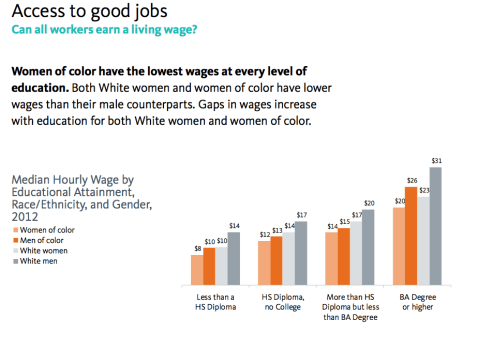
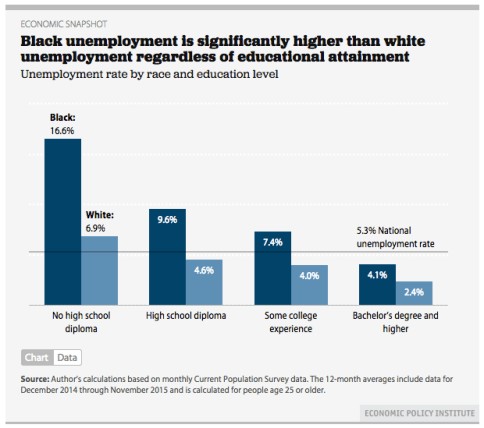
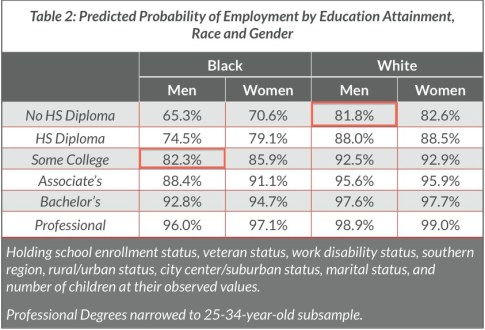
The truth is hard to swallow, however, because education can be shown through ample evidence to have very little impact on erasing inequity driven by racism and sexism. For just a few of many examples, please consider the following:
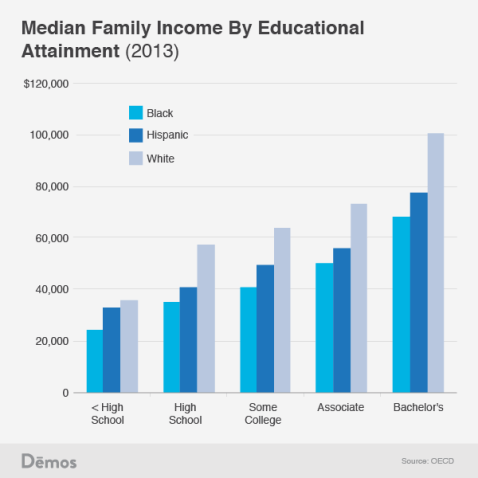
Whites with only high school completion earn more than Blacks/Hispanics having completed 2 years of college. (Bruenig, 24 October 2014)
White men with no high school diploma have the same employment opportunities as black men with some college completion. (Closing the Race Gap)
Race and gender remain powerful sources of inequity despite educational attainment. (Access to good jobs)

Brown also cites this: “He goes on to say, ‘Successful people in the United States tend to be white and come from privilege and they’re not necessarily working harder than anybody else but they have incredible advantages.'”

And then makes no effort to address why he believes my comment is “problematic.” Perhaps he could consider the following:
The best way to nab your dream job out of college? Be born rich
Why rich kids do better than smarter, less advantaged kids: ‘opportunity hoarding’
 Black unemployment is significantly higher than white unemployment regardless of educational attainment | Economic Policy Institute

Abstract

Racial discrimination in labor markets is a critical process through which organizations produce economic inequality in society. Though scholars have extensively examined the discriminatory decisions and practices of employers, the question of how job seekers try to adapt to anticipated discrimination is often overlooked. Using interviews, a laboratory experiment, and a résumé audit study, we examine racial minorities’ attempts to avoid discrimination by concealing or downplaying racial cues in job applications, a practice known as “résumé whitening.” While some minority job seekers reject this practice, others view it as essential and use a variety of whitening techniques. When targeting an employer that presents itself as valuing diversity, however, minority job applicants engage in relatively little résumé whitening and thus submit more racially transparent résumés. Yet, our audit study shows that organizational diversity statements are not actually associated with reduced discrimination against unwhitened résumés. Taken together, these findings suggest a paradox: Minorities may be particularly likely to experience disadvantage when they apply to ostensibly pro-diversity employers. These findings illuminate the role of racial concealment and transparency in modern labor markets and point to an important interplay between the self-presentation of employers and the self-presentation of job seekers in shaping economic inequality. (Whitened Résumés: Race and Self-Presentation in the Labor Market, Sonia Kang, Katy DeCelles, András Tilcsik, and Sora Jun)

One other tactic I experience is the subtle and not-so-subtle effort by the “no excuses” crowd to turn charges of racism toward those of us calling out the racism of “no excuses” practices: “If you believe the zip code where you were born should determine your educational outcome, you basically believe that some people aren’t built for success, which is — to put it bluntly — racist.”

Two aspects of this strategy are important to highlight. First, Brown here and others must misrepresent my claims (I have never and would never embrace or suggest that we ask less of any child or that some group of people have less ability than others because of inherent deficiencies; in fact, my scholarship and public work directly reject deficit ideologies).

Second, this rhetorical slight of hand is designed to point anywhere other than the person making the claim.

This second part of the move is important for charter advocates and the “no excuses” crowd because evidence is not on their side.

The Legacy Charter school endorsed by Brown has three consecutive years of “below average” state report cards (2012-2014, the most recent since report card assessments have been suspended in SC until this coming fall).

And my analysis of two years of data on SC charter schools has shown:

  • Using 2011 SC state repost cards and the metric “Schools with Students Like Ours,” charter schools performed as follows: 3/53 ABOVE Typical, 17/53 Typical, and 33/53 BELOW Typical.
  • Using 2013 SC state repost cards and the metric “Schools with Students Like Ours,” charter schools performed as follows: 2/52 ABOVE Typical, 20/52 Typical, 22/52 BELOW Typical.

The “high expectations” movement, again mostly aimed at black/brown and poor children, has some serious flaws because the rhetoric is discredited by the evidence.

In short, education is not the “great equalizer” in the U.S. And committing to “high expectations” for children living inequitable and overburdened lives suggests their struggles are mostly their fault because they simply are not working hard enough.

That is a calloused and racist/classist lie.

As I detailed above, success in the U.S. is mostly about advantages, not working hard.

Brown concludes with a flurry of rhetoric: “You could burn the world down as it is because it’s too hard to fix systemic injustices, or you could build it up to the sky because you know in your heart that’s where we belong. Keep your matches. I’m grabbing a hammer and a ladder.”

What should disturb us is how easily the winners (even those claiming good intentions) in the U.S. are willing to throw up their hands when challenged to address systemic racism, classism, and sexism.

In fact, this admission is awash in excuses and absent the exact resilience needed to address inequity that these adults demand of children, who must somehow set aside their lives each day they walk through the doors of school and behave in ways the adults refuse to do.

SC Fails Students Still: More on Grade Retention and Misreading Literacy

But their remedies do not cure the disease: they merely prolong it. Indeed, their remedies are part of the disease.

Oscar Wilde (1891), The Soul of Man under Socialism

Bells will certainly continue to signal class changes in public schools all across South Carolina this fall, but there is a much more serious (and unwarranted) bell of doom for many third-graders because of SC’s punitive Read to Succeed legislation.

Paul Hyde’s Furman professor: Read to Succeed retention policy ‘a disaster’ offers a primer on the politically and publicly popular move across the U.S. to retain students based in part or fully on third-grade high-stakes tests of reading.

Once again, literacy policy often fails to address valid literacy practices or to acknowledge that literacy proficiency is strongly correlated with systemic conditions beyond the walls of the school or the control of teachers.

Worksheets on literacy skills, test-prep for state assessments of reading and writing, linking teacher evaluations to students’ test scores, and retaining children are simply not only flawed literacy policies, but also negative influences on children’s literacy and academic achievement.

And decades of creating ever-new standards and then purchasing ever-new reading textbooks and programs have utterly failed children and literacy.

For about a century, in fact, we have known what is needed to help students develop literacy—but the political will remains lacking.

A robust literacy strategy for schools must include instead the following:

  • Addressing access to books in all children’s homes.
  • Insuring access to books in all children’s schools.
  • Providing all students ample and extended time in class to read by choice.
  • Guaranteeing every student balanced literacy instruction based on each student’s demonstrated literacy needs (not the prescriptions of literacy programs).
  • Discontinuing the standards and testing disaster dominating schools and classrooms by providing teachers the materials, time, and professional autonomy to teach literacy in evidence-based ways.

Just as education policy ignores a rich research base, political leaders and the public refuse to address how public policy directly and indirectly impacts student achievement; the following would create higher student achievement and literacy:

  • Eradicating food deserts and insuring food security.
  • Providing universal healthcare to children and families with children.
  • Creating job security for families with children.

Finally, we must acknowledge that grade retention fulfills a cultural negative attitude about children and people in poverty among the U.S. public—one grounded in individual blame and punishment.

But decades of research has shown (yes, even with the failed Florida policy that serves as a template for many states such as SC) that grade retention may raise test scores short term, but that gain disappears in a few years and the many negative consequences of retention remain.

As the National Council of Teachers of English detail in their position statement on grade retention and high-stakes testing, grade retention fails in the following ways:

  • retaining students who have not met proficiency levels with the intent of repeating instruction is punitive, socially inappropriate, and educationally ineffective;
  • basing retention on high-stakes tests will disproportionately and negatively impact children of color, impoverished children, English Language Learners, and special needs students; and
  • retaining students is strongly correlated with behavior problems and increased drop-out rates.

Of course all children need and deserve rich and rewarding literacy experiences and growth, but third grade literacy is both a manufactured metric (by textbook and testing companies) and a misleading emergency.

Grade retention and skills- and standards-based literacy instruction and testing have failed and continue to fail horribly the students who need authentic literacy instruction the most—black and brown children, English language learners (who may need a decade to acquire a second language), students in poverty, special needs students.

These populations are a significant portion of the students served in SC public schools; our hateful and misguided policies are created and tolerated by a more white and affluent political leadership and public who have racist and classist biases against “other people’s children.”

In fact, failed literacy policy in SC can be linked directly to how the U.S. demonizes and fails the impoverished:

It all starts with the psychology concept known as the “fundamental attribution error”. This is a natural tendency to see the behavior of others as being determined by their character – while excusing our own behavior based on circumstances.

For example, if an unexpected medical emergency bankrupts you, you view yourself as a victim of bad fortune – while seeing other bankruptcy court clients as spendthrifts who carelessly had too many lattes. Or, if you’re unemployed, you recognize the hard effort you put into seeking work – but view others in the same situation as useless slackers. Their history and circumstances are invisible from your perspective.

Struggling students in SC are viewed as lacking or broken, in need of repair and/or punishment to correct.

If you think this is harsh, compare how mostly white and more affluent students learn literacy in advanced and gifted classes in public schools (a dirty little secret about how we have maintained segregation) and most private schools.

Like No Child Left Behind and Every Student Succeeds Act, Read to Succeed is an Orwellian name for a horrible way to view, treat, and teach children.

SC continues to be a morally bankrupt state, calloused and driven to punish instead of offering our citizens, especially our children, the compassion and opportunities all people deserve.

For Further Reading

At Duke, I realized how badly many South Carolina schools are failing students like me, Ehime Ohue

Grade Retention Research

Executive Summary: THE EFFECTS OF MANDATED THIRD GRADE RETENTION ON STANDARD DIPLOMA ACQUISITION AND STUDENT OUTCOMES OVER TIME: A POLICY ANALYSIS OF FLORIDA’S A+ PLAN (9 January 2017)

THE EFFECTS OF MANDATED THIRD GRADE RETENTION ON STANDARD DIPLOMA ACQUISITION AND STUDENT OUTCOMES: A POLICY ANALYSIS OF FLORIDA’S A+ PLAN, Kathleen M. Jasper (2016)

NCTE: Resolution on Mandatory Grade Retention and High-Stakes Testing

Retain to Impede: When Reading Legislation Fails (Again)

Confirmed: SC Implementing Retain to Impede

Beware Grade-Level Reading and the Cult of Proficiency

Teaching Reading and Children: Reading Programs as “Costume Parties”

Florida Retention Policy a Blight on Literacy, Children across US


Freedom, Choice, and the Death of Us

“they did not stop to think they died instead”

“‘next to of course god america i,'” e.e. cummings

Over the course of a couple hours after my mother was discovered comatose, the ER doctor offered us a choice: airlift my mother to a larger hospital for surgery to remove the clot in her brain that caused her stroke or leave her comatose, each moment destroying more of her brain.

Just twelve days later, in front of my mother then in a rehabilitation facility after responding well to the high-risk surgery,  my father became unresponsive; the EMS team summoned by a 911 call were frantically trying to resuscitate my father, kept alive by his pacemaker/defibrillator. Since my father had resisted switching off the defibrillator and choosing a do-not-resuscitate (DNR) order, the lead EMS responder asked me where I wanted him to be transported.

Because of the proceeding days when we all scrambled against my parents’ health insurance, my first thought was how was I to know where his insurance would cover this event (ultimately the last moments of his life).

While cycling on the local rail trail near my university and where my mother now remains in a single room—the building in which she witnessed my father’s death—a friend and I pedaled up to a road crossing where a father sat on his bicycle with a trailer attached for children to ride along.

This intersection has decorative circles of brickwork on each side of the road. As this man crossed, he steered poorly around the brickwork—the cart left wheel rolling up onto the brick, tipping the cart and his two sons over onto the side of the trail and jerking the bicycle out from under the father.

These are all complicated and difficult stories about choice and freedom in the U.S.

The U.S. is a cruel and calloused culture that values a false narrative about freedom and choice, an idealized version of freedom and choice as concepts that trump all else.

Even human dignity.

Even life.

Especially in healthcare, education, and providing social support for the poor, the guiding principle is giving people choice, believing that individual responsibility is the root cause of poor health, failing students and schools, and finding oneself in poverty.

The meritocracy and rugged individualism myths are so powerful in the U.S. that winners and losers both cling to them even when the game is revealed to be fatally rigged. As Tim Maly explains:

So there are people who can be so wrapped up in a certain worldview that even in the face of serious evidence that they have been taken in, and despite many warnings from the rest of the world, they persist. Indeed, warnings from the rest of the world seem to serve only to entrench them in their position. With some of them, it’s as if they end up making bad choices specifically to spite the people warning them.

The U.S. has instilled a tremendous amount of self-loathing, in fact, among marginalized groups (blacks, English language learners, women) who feel compelled to embrace the bitter American Dream in order to be American—even as each of them could utter as Langston Hughes wrote:

Let America be America again.
Let it be the dream it used to be.
Let it be the pioneer on the plain
Seeking a home where he himself is free.

(America never was America to me.)

The parent cycling with his children in tow was free to choose placing those boys in the trailer, free to choose to pedal along the trail and then to send them tumbling.

And there we must admit, parental choice is not universally a good thing, and we must also confront that anyone’s choice necessarily encroaches on the freedom of others: children routinely suffer the consequences of their parents’ choices.

The children were fine, however, but my mother and father—along with our family—have been navigating a hellscape of healthcare dictated by patient choice and freedom, jumbled with a nightmare of bureaucracy in which mandated and bounded choices are not really choices at all.

In the U.S., we celebrate the choice between a Toyota Camry and Honda Accord (essentially the same car with the free market promise of competitive prices in your local market!), but few people are afforded the freedom of not buying a car at all—and no one is allowed the freedom from sales and property taxes or freedom from insurance and liability for all that driving.

Freedom and choice are in fact a nasty shell game used to keep the masses occupied so that they do not realize only the few have some sort of economic freedom and choice because of the labor of those masses, those people drawn to the myths like moths to a flame but never allowed to survive the allure.

It’s July 4th, a patriotic orgy in the U.S. that is as shallow and materialistic as the country we celebrate.

A people truly committed to equity and our moral obligations as humans would recognize that sometimes, maybe even often, choice and freedom are not as important as insuring that no one needs to choose because essentials are collectively provided for everyone to insure the dignity of simply being a human.

No child left to the lottery draw of their parents, no sick person tossed into the meat grinder of market-based healthcare, no elderly cast into the dark well of individual responsibility.

As we wave tiny plastic flags today, swill (mostly) cheap beer while overeating from our decadent grills, let us roast in the sun and the recognition that we actually have freedom and choice—and this heartless and selfish country is what we have chosen.

For Further Reading

Why poverty is not a personal choice, but a reflection of society, Shervin Assari

‘What to the Slave Is the Fourth of July?’ by Frederick Douglass