“Your House Is Just a Place for Your Stuff”

The secretary’s desk is dark wood with a pull down door and one drawer beneath the main section, divided into sections for office supplies and such. It sits now in a very dark corner of my parents’ living room, and I am certain we had that desk in our house in Enoree, South Carolina during the 1960s, and then in the two subsequent houses after.

I spent part of Saturday afternoon taking three car loads of trash from their house to the nearby dump. But part of the time helping one of my nephews go through everything in my deceased parents’ house was spent cleaning out that desk.

Stacks of medical bills reaching back almost two decades, tax returns from the late 1980s and 1990s, unopened packs of pens and Rook playing cards—the desk was some awkward combination of mausoleum, careless filing system, and hoarding.

I found handwritten notes my nephew had left for my parents to wake him on time; also his assorted certificates from school along with school pictures of my other nephew when he was on the basketball team.

In the single lower drawer was a hefty stack of newspaper pages and clippings—all of me.

There I saw a jumbled cataloging of my hair, facial hair, and glasses (or not) styles, and then on the bottom, I found a dark yellow page crumbling at the edges.

The date was 1968, and staring out at me was my first-grade school picture beside a brief story about my surprise seventh birthday party.

My childhood at that moment holding a crumbling yellowed newspaper seemed especially foreign, as if not in a different time but a different world. A child’s birthday party and picture in a small town newspaper.

I felt like the brother and sister must have in Pleasantville after being transported into a TV sitcom from the 1950s.

My nephew and I were on a second weekend of going through my parents’ stuff, in hopes that we can over the summer sell the house. The finality of my parents’ death can only come through the total eradication of their stuff, in the wake, of course, of all the legal complications of deceased people, their stuff, and those who may have claims against them and that stuff.

The process has developed into determining if everything is either something someone in the family would want, something for a yard sale, or trash.

Almost everything from the desk I shuffled through went into a large box that I loaded into my SUV with as many garbage bags as it would hold to toss mostly without any thought into the giant and relentless trash compactor at the waste site.

The main compartment of the refuse receptacle has criss-crossing bars over the top to control the size of what people can toss in. The near side is a large angled metal surface that bags and trash slide down violently into a smaller area where a giant plunger pulls back and then compacts the trash into a surprisingly small storage area to the right.

All this stuff my parents had kept, much of it paperwork documenting all the stuff of their lives—this machine thoughtlessly pounded into a uniform rectangle of just trash to be hauled to yet another refuse facility, probably a landfill.

When we die, people go through all our stuff and throw most of it away.

The stuff we just had to buy, the stuff we made ourselves miserable to attain, and the stacks and stacks of paperwork documenting all that stuff and all the payments of our monied lives—all of it comes mostly to trash.

But before it is trash, it must be handled one last time, christened trash, sometimes thoughtlessly and sometimes with the hesitation of placing it in a stack as if it should carry on—until in a flash it too is tossed into a box or bag as once-stuff-now-trash.

Three times carrying my parents’ stuff to my SUV, three times unloading bags and boxes to be tossed into the giant compactor, three times driving to and from the waste site—this mini-ritualizing of my parents stuff into trash was yet one more thing I could not have anticipated about the terrible thing that is any person’s death.

Just common flawed people, my parents both died in ways no one really deserves—clinging to bodies that simply had run their course and laboring under the dark cloud of how much everything would cost and a medical care system reduced to a mechanistic nightmare by the insurance industry.

As I paused a few times watching the giant trash compactor work—steeling myself against the smell and the din of this machine grinding on and on—I recognized an unintended metaphor for what my parents had experienced in their dying.

Or to be brutally honest, their living also.

When we die, people go through all our stuff and throw most of it away.

During one trip back to their house from the waste site, I thought about George Carlin’s routine on stuff:

“The whole meaning of life, isn’t it: Trying to find a place for your stuff”—so when you die, it is all in one place, easier to sort through and mostly haul off as trash: “They don’t bother with that crap you’re saving. Ain’t nobody interested in your fourth grade arithmetic papers.”

I put yellowed and brittle paper from 1968 to the side while I finished sorting through the desk. I picked it up, thought about being seven and recalling my parents as a young couple, and then could not bear the thought of taking this newspaper page to my house for someone to look at and decide it was finally trash.

All of that stuff mattered the wrong way, and then it became in a flash stuff that doesn’t matter at all.

When we die, people go through all our stuff and throw most of it away.

Where Do Poems Come From?

The quaint euphemistic way we once talked around having “the talk” with children about the birds and the bees is at least metaphorical, even poetic in its tip-toeing.

Here, I want to play a bit with a slightly different version of “the talk”—specifically walking through where poems come from.

It was a Friday afternoon, and I found myself alone with friends all somewhere else even though we usually congregate at the local brewery on Fridays.

So I came equipped with a book, Acceptance by Jeff Vandemeer, as well as a lingering dose of depression and anxiety. This seemed an ideal opportunity to inject a few pints of the seasonal beer just being released.

I also came with my constant companions—anxiety, introversion, and solid doses of ADHD and OCD.

It was mid-afternoon so only a modest crowd was there mulling around and the band had not yet begun. My introversion runs in a way that this sort of public space allows me to disappear and be nearly relaxed. Once the crowd grows and especially when live music cranks up, the same space become the worst sort of hell for me.

To appease my ADHD as I read, I slipped into my smart phone surfing that annoys my intimates because I am apt always to be doing several things at once, giving off the impression that I am not in the moment with any one person. Ever.

And then it happened.

I was scanning through Instagram, where I follow several artists, and saw a post by Valeria Ko:

hanging clothes

The painting of a woman in only panties, from behind and holding a laundry basket outside near a trailer, immediately prompted these words:

we buy an RV
and then unceremoniously we leave

somehow we reach the desert
where we park for days

because we have been watching
on the couch Breaking Bad

Let me pause here to stress how this represents at least for me where poems come from.

This scenario holds several elements that I find are consistent: the presence of creative works (reading volume 3 of Vandemeer’s science fiction trilogy, Ko’s artwork), a sudden burst of lines of poetry that seemingly just come to me, and not a small dose of sadness or depression.

Many poems of mine begin in some way while reading, viewing a film, or listening to new music; visual artwork is also a powerful trigger [see Fisherman and The Siren (vortex of desire)].

Poetry, unlike my blogging and scholarly writing, always comes first as inspired words, phrases, and lines; in other words, I never sit down to write a poem.

The poem itself initiates the writing.

Some who know I am a poet and read my work have noted as well that depression and sadness seem to rest next to my poetic output. I must confess that seems fair.

Now, back to the writing of this poem*.

Mornings can be fertile times for poetry to call, but typically, my first move with a poem is to type the inspired words or lines into notes on my phone and then email that to myself to work on at the computer.

I often will continue to run through those lines in my head, incessantly and often that repeating causes the poem, or story, to grow.

In this case, I knew I had a good bit of time alone and would not be at the computer until the next day, likely, so I did something I think I have never done before; I began drafting the poem right there on the notes of my phone.

Drafting a poem includes after the initial rush of inspiration a recursive act of discovering what the poem wants to be (in terms of content and story as well as craft) and then writing and revising to meet those unfolding demands.

A few initial ideas were the repetition of “we” and then “some” in “somehow” and “some times.” I considered for a while having “we” in every line but let that slip eventually.

The central purpose of the poem appeared to be my associating an RV and the desert with the series Breaking Bad, which I have been re-watching.

The artwork spoke to my essentially visual nature, but it also challenged me to think about, as someone who read the poem noted, the voyeuristic motif that is present in the painting and my poem.

As I drafted, I returned to the Instagram post and discovered something truly stunning: The painting itself, as Ko notes, was “[i]nspired by @joshsoskin photos” (see here and his web site).

A photographer inspired a painter who inspired a poet—all of which depends on both the intent of artists and the co-created meanings of those viewing/reading the art.

What is the intended tone of the painting? Of the photographer’s image? And then how does the intended story I created resonate with any or all of that?

The original idea and the focus on “we” soon became subsumed by the imagery of the poem, specifically the desert scene.

The first title of the poem was just “we,” but I eventually revised as “we (deserts),” editing that to “we (desert)” since this narrative is clearly about one couple in one desert—a singular event and a poem about being alone while also existing in a way that is the antithesis of lonely.

Some key elements revealed themselves and became the focus as I read, reread, and drafted: the couple as voyeur and watched (man inside, woman outside), the concept of being alone as a couple and that being a state of freedom, and the overarching reframing of a desert, not as barren or oppressive but as a refuge, a paradise.

My poetry tends toward narration more than narrative, but this poem clearly was meant to be a story with characters and setting. But I also seek an economy of language, inspired always by Gwendolyn Brooks’s “We Real Cool.”

To say the least possible for the greatest effect—so two stark images of the woman (grounded in the painting); adding “cacti,” “sand,” and “brush.”

Also along with the voyeur/viewed problem I felt compelled to focus on stasis (man) and motion (woman) while keeping the dynamic of the couple both something I was celebrating and problematizing.

How to end a poem is always a challenge, one that typically comes to me in a similar way as the initial lines—I simply feel it, both the sense that it is not finished and then that these lines are it.

The turning point for this poem being finished was “people i suspect don’t know/a goddamn thing about deserts” and imagining this couple in the desert during the longest daylight weeks of the year (so the 14 hours detail).

I enjoy being able to talk about and through a poem once I have made it public and can hear others respond. Doing that led me to describing this as a post-apocalyptic poem, the apocalypse not some nuclear holocaust but the act of this couple: “we buy an RV without a plan or map/and then unceremoniously we leave.”

An act not away from anything but toward their being entirely alone and together, free as the woman seems to be in her complicated image of the painting—the gendered domesticity outside and partially clothed while being watched by her lover.

As much as I was motivated by the opening lines—that I still love—and the narrative, I am mostly haunted by the next to the last stanza, and wondering what do people know especially about being happy, about refusing to sit there alone instead of holding tight the one you love.


* we (desert)

But what if you discover that the price of purpose is to render invisible so many other things?
Acceptance, Jeff Vandermeer

we buy an RV without a plan or map
and then unceremoniously we leave

somehow we reach the desert
where we park for days then weeks

because we have been watching sometimes naked
on the couch Breaking Bad

we realize we are o so alone
except for sand and brush

on warm bright mornings i watch
you outside hanging clothes

sometimes wearing only a shirt unbuttoned
other times only panties soft tan like your skin

i do not run through the door and sand
tackling you cradled in my arms to the ground

because my chest is overfilled with this
so that everything seems to be spilling from my eyes

and once you turned seeing me through the window
curtsying and opening the shirt with a smile

people i suspect don’t know
a goddamn thing about deserts

or being all alone as we are
with 14 hours of sunshine and cacti

“Out of Joint”: On Ideology and Anxiety

The time is out of joint. O cursèd spite,
That ever I was born to set it right!

Hamlet, Act I, Scene 5, ll. 190-191

My high school English students in Upstate South Carolina throughout the 1980s and 1990s were mostly unmotivated by huge portions of the early American literature canon—notably Ralph Waldo Emerson, Henry David Thoreau, and Nathaniel Hawthorne’s The Scarlet Letter.

The problem was reading those works, but many of the conversations that the assigned reading spawned were some of the best moments of my teaching career.

After plodding through Emerson and Thoreau, tackling the ideologies of American Romanticism and Transcendentalism, the darker vision of humanity offered by Hawthorne allowed me to pose a powerful and often unexamined question to students about the essential nature of humans: Are people basically good or evil?

These were 10th and 11th graders, most of whom attended fundamentalist Southern Baptist churches (specifically the large church that sat directly in the middle of the four schools that served the town, all within a few blocks of each other).

Students throughout the years enthusiastically responded that people were basically good, to which I would remind them of Emerson and Thoreau followed by asking them about their understanding of Original Sin and the Garden of Eden story.

For many of my students, this was one of the foundational moments when they had to confront that their ideology was “out of joint.” Their professed religious beliefs did not align with what they had determined about the universe on their own, or to put it another way, what they were coming to recognize about themselves.

This sort of personal disequilibrium is different than what I witness almost daily—and notably among my former students with whom I am social media friends—on Facebook: When a person’s ideology is “out of joint” with reality and facts.

These former students, I know, experienced repeatedly in my classroom the opportunity to investigate what they believed and understood while keeping that grounded in the evidence around them.

As a teacher for almost forty years now, I am regularly discouraged by how powerful unfounded beliefs are against evidence, and I am greatly disappointed when I watch that play out among my own former students.

From provably false memes about Hitler, the Holocaust, and gun control to hijacking other people’s posts with diatribes about the lazy poor (often thinly veiled racism) and rehashing lazy Libertarian lies, these moments on social media represent the larger problem with cultural myths—and the toll those myths take on both those who embrace them and those who suffer inequity and injustice because of them.

Just as my students had never interrogated that their religious beliefs (and religious training) often did not match their personal ideologies, white Americans and affluent Americas—who benefit from the lion’s share of privilege in the U.S.—rarely question the myths they both embrace and perpetuate—specifically the narratives that the poor are responsible for poverty and that black are responsible for racism.

I won’t spend time elaborating, but evidence quite overwhelmingly disputes these narratives:

But these ideologies that frame people in poverty and racial minorities as lazy, deserving of their inequity, are also logical fallacies since only those with power can maintain or dismantle systemic forces.

Whites are responsible for racism, and the wealthy are responsible for poverty; in fact, whites depend on racism, and the wealthy depend on poverty.

No one can assume a neutral pose on either classism or racism in the U.S. since both are enduring realities and since everyone either benefits from or suffers under classism and racism.

When ideology, cultural narratives and myths, are “out of joint” with reality, the consequences are devastating to everyone, creating an environment of anxiety.

In “The Neurotic Academic,” Vik Loveday examines this dynamic of academia, which is a subculture (as reflection and perpetuation) of the larger American Myths of meritocracy and pulling oneself up by the bootstraps.

“The experience of anxiety is also a fundamentally isolating one,” Loveday explains, adding, “whilst viscerally felt at the individual level, to admit to feeling anxious and stressed-out is also to risk being perceived as failing to cope with the demands of academic life.”

In the U.S. culture that renders poor, black, and brown people as lazy and deserving their inequity and injustice, they are also rendered marginalized, isolated as Loveday argues. Poor, black, and brown Americans, then, because of classism and racism are trapped not only in systemic inequity but also in personal anxiety—the prison of recognizing that “who I am” and “how I am portrayed” are “out of joint” but “I was born to set it right,” as Hamlet laments (himself the anxious scholar).

Loveday discovers “anxiety is quite clearly an effect of the conditions under which it is produced” because those who suffer this anxiety

felt as though they had very little control over their working lives apart from the possibility of “working on the self” – taking personal responsibility for productivity, success, and “excellence” through the pursuit of student satisfaction, publications, or external funding, which was often achieved through chronic over-work fuelled by anxiety, but with no financial security or guarantee of permanent work at the end of contracts.

Like Hamlet, then, the isolated (by class and race) are simultaneously aware of being “out of joint” and compelled to feel responsible for correcting those forces beyond their control.

As I have pondered on social media and about social media, I am not sure if Facebook and Twitter have created or merely exposes the zeal that many feel to post ideological memes and rants that are easily discredited; I am also deeply troubled that those who enjoy race and class privilege are the ones most eager to perpetuate ideological lies through social media.

Ultimately, however, everyone loses when either personal ideologies or cultural myths are “out of joint” with reality, with what we can show is true.

And this brings us back to one of the lazy Libertarian lies, the one that demands a false dichotomy, a manufactured war between the individual and the collective (society, government)—something that can be traced back to our Transcendental roots where Emerson and Thoreau themselves railed against Society as the enemy of the Individual.

O, Emerson: “Society everywhere is in conspiracy against the manhood of every one of its members.”

O, Thoreau: “Moreover, any man more right than his neighbors constitutes a majority of one already.”

Yet, despite their Transcendental idealism about the Individual, there is no individual without community, and there is no community without the individual.

And as such, each of us has a moral obligation to investigate our personal and cultural ideologies as a first step to slaying the real dragon threatening us—the anxiety spawned when those ideologies are “out of joint.”

Peace, both individual and social, is an equilibrium, when what we believe is in balance with reality.

That peace relieves anxiety by eradicating the threats that false narratives and baseless myths create.

Again, more narrowly, “[w]hat I have termed as the ‘neurotic academic,'” Loveday concludes, “is an entrepreneurial figure who is governed through responses to the anxiety generated by employment uncertainty within an increasingly competitive sector, but who is simultaneously encouraged to then take responsibility for the self-management of those anxieties.”

When our personal and cultural ideologies are “out of joint,” we are in a restless state of competition, with ourselves and each other, that is the root cause of anxiety—a state of powerlessness combined with the compulsion to be the sole change agent for that which is beyond our control.

This is why racism is a poison to the racist (indirectly) and the oppressed (directly).

This is why classism is a poison to those who demonize the poor (indirectly) and to the poor (directly).

Like my students who were asked to confront what they truly believed about basic human nature, we all owe ourselves and everyone else the time spent interrogating our ideologies, personal and cultural.

And then, we must carry that into our real and virtual lives, resisting the baseless meme and promising not to hijack other people’s social media spaces in the name of calloused ideological football.

What Does This Poem Mean?: On the Politics of Core Knowledge and Reading Instruction

While I am skeptical of nostalgia, the mostly vapid good-old-days approach to anything, I want to return to my high school teaching years, mostly pre-Internet and smart phone years throughout the 1980s and 1990s.

One of the best parts of teaching English was forming bonds with students over popular music. Gradually, in fact, my entire poetry unit was grounded in the music of R.E.M., the alternative group based in Athens, GA.

R.E.M. achieved immediate critical success with their first album, Murmur, and then were college rock stars throughout the 1980s, with popular stardom coming more than a decade after they formed.

What made R.E.M. particularly fascinating for my students and me was that they typically did not release the lyrics for their earliest albums, and thus, we would spend hours listening and trying to figure out just what Michael Stipe was saying. In fact, some early jabs at R.E.M. referred to Murmur as Mumbles since Stipe had a signature way of being terribly unclear.

I can still recall wrestling with “You Are the Everything”—students puzzled by “eviscerate” and all of us thrown by “With your teeth in your mouth.”

The beauty of all this for me as a teacher of poetry was that we had to work diligently first on the what, the literal, of the lyrics before we could begin trying to tackle meaning.

Too often, I found, students felt compelled (a really flawed lesson learning in school) to jump immediately to “this song/poem means” without taking any care to read the poem literally first.

Ultimately, investigating poetry was yet more efforts at learning to read, a behavior that is always in a state of emerging (despite the technocratic view that we can reach proficiency).

These memories came to me when I read Carol Black’s excellent Twitter thread:

Black carefully and powerfully unpacks and discredits the E.D. Hirsch Core Knowledge argument about reading that is compelling to those so-called experts outside of literacy and especially to the media, politicians, and textbook publishers.

As Black details, the argument that some core or essential knowledge exists in an objective apolitical way falls apart once you unpack how facts are presented and, more importantly, who determines what knowledge matters.

A disturbing example of Black’s critique immediately surfaced, also on Twitter:

This example of whitewashing slavery further exposes that no knowledge is value neutral and that the details of knowledge are far less important than confronting the authority behind what knowledge counts as fact or true.

So let me return to my students and me trying to decipher Stipe’s mumbling so that we could start to imagine what those wonderful songs meant.

The essential flaw of Core Knowledge arguments is that it promotes the passive acquisition of knowledge (what Paulo Freire criticized as the “banking concept” of teaching and learning) instead of the interrogation of knowledge, the domain of critical literacy.

Yes, we listened to the songs over and over so that we could as a community create the text, and we also scoured the music press for any and everything we could find from the band members about those lyrics, especially anything Stipe might reveal.

And we also built knowledge about the band and Stipe himself to provide context for those interpretations. Once Peter Buck said his favorite line from Monster was “Oh, my kiss breath turpentine,” explaining that it didn’t mean anything, but sounded great.

In other words, lyrics, as Stipe also explained at some point, were a way for Stipe’s voice to be another instrument in the song, not necessarily always about coherent meaning in the traditional use of text.

We were not acquiring knowledge, but interrogating an audio text in an effort to discover and uncover meaning, even as that meaning was tentative.

Recently, Bertis Downs, long-time lawyer for R.E.M., posted “Photograph” to social media, where I listened again and read along to the lyrics:

Always a favorite song of mine, including the beautiful accompaniment of Natalie Merchant, I was struck this time by the lines: “Was she willing when she sat/And posed a pretty photograph.” The “willing” speaks to the #MeToo era in a way I had not noticed many years ago.

As well, this song reminded me of Margaret Atwood’s “This Is a Photograph of Me,” which I taught for many years in A.P. Literature.

As an entry point to think deeply about consent, the song has new meaning, a meaning that works beyond the text and resonates because of a changing time and new social awareness.

All text meaning is political, communal, and tentative—not a fixed or objective truth.

And then, Atwood’s poem always posed tremendous challenges for students. In short, the ambiguity of the poem was an ideal way to help students learn to ask questions as a pursuit of meaning, instead of looking for the meaning.

Other than being in lines and stanzas, the poem achieves its poetic form without many of the traditional elements students expect (rhyme, for example). Further, the poem’s second section in parenthesis asks readers to consider the implications of punctuation as that contributes to meaning.

“(The photograph was taken/ the day after I drowned” opens that section and immediately challenges the reader with the literal problem since the photograph appears to be of the lake: “I am in the lake, in the center/ of the picture, just under the surface.”

Moving from R.E.M.’s song to Atwood’s poem and then, for example, adding Stevie Smith’s “Not Waving but Drowning” builds for students a body of problematic texts that warrants investigation, and not simple knowledge acquisition.

These three texts certainly are better read when the reader is more knowledgeable, but let’s not misread “knowledgeable.”

To be well read, in fact, is having had many experiences interrogating text and knowledge which is also the process of acquiring knowledge.

The more R.E.M. I listened to, the better I read those songs. The more Atwood I read, the more I understood Atwood (her word play, her misdirection).

What does this poem mean?—this becomes a journey and not a destination, an interrogation, not a proclamation.

Black’s dismantling the Core Knowledge propaganda about learning to read, then, pulls back the curtain on how Core Knowledge advocates are themselves serving an unspoken politics by taking on a faux veneer of apolitical essential knowledge.

Unintended I am sure, Atwood’s poem itself speaks to this as well:

the effect of water
on light is a distortion

but if you look long enough,
eventually
you will be able to see me.)

Let us invite our students to “look long enough,” beyond the “distortion,” so that they will “be able to see.”

The Lazy Libertarian Lie: Paul Ryan Edition

Before the expected Ben Folds’ “Rockin’ the Suburbs” “Let me tell y’all what it’s like/Being male, middle-class, and white/It’s a bitch, if you don’t believe” response can envelope this post, I want to offer a few caveats.

I have strong libertarian tendencies, ones that have drawn me to a Henry David Thoreau sort of thinking grounded in rejecting authority and appreciating that adults should be allowed to live as they please within the constraints (see below) that acknowledge a simple but inescapable truth: “No man is an island, entire of itself; every man is a piece of the continent, a part of the main” (John Donne, Meditation XVII).

And I know some self-declared Libertarians who are somewhat evangelical about their ideologies but, none the less, routinely demonstrate that they have souls—even as they haven’t rectified the disconnect between being a soulless Libertarian (a redundancy) and living life in any sort of humane way. And thus, I am not really holding forth below about those Libertarians who ultimately do not live by what they profess.

The lazy Libertarian lie depends on several failures of logic.

One is the “damned government” argument such as those who refuse to wear helmets while driving a motorcycle or rail against the shrinking areas allowing people to smoke (although laws still permit adults to smoke in their homes and cars while under-age and non-consenting children are present, and are thus inhaling the toxic smoke that the law prevents them to inhale by purchasing cigarettes).

This argument is, at its core, a fundamental cluelessness about individualism—in short, the lack of awareness, see Donne above, that individualism simply does not exist.

Taking risks—no helmet, smoking—never has consequences only for the risk taker. Trauma and illness resulting from this risk taking stress unnecessarily a health care system that impacts everyone else.

Despite these “I did it my way” risk takers’ choices, EMS and medical staff are ethically obligated to keep them alive, often a tremendous drain on their time and at great costs (trauma care in the ER and after, cancer treatment, etc.).

Another of the great logic fails is the “I built this” crowd, the ugly but enduring lie of the self-made billionaire.

All individual wealth in the U.S. is built on other people’s labor and facilitated by (brace yourself) the “damned government”; for example, there are no business ventures possible at the degree experienced in 2018 without the road and highway system in the U.S. (brace yourself: publicly funded).

And the entire free market fetish for property and personal property is possible only because of the legal and justice system that monitors a relatively high level of property safety.

And this brings us to poster boy Paul Ryan, an incredibly dishonest Libertarian (when it suits him) who cherry-picks his Ayn Rand adolescent rants.

Like the political Rands, and the cartoon Randites like Rush Limbaugh (who pronounces her first name as “Ann”), Ryan has profited handsomely from his white man Teflon and his American mythology sound bites grounded in lazy Libertarian lies.

Ryan lies about his athleticism.

And as James Fallows has documented, Ryan lies “in ways large and small.”

Behind the hairdo and the suits, Ryan has been trafficking in the racism and poverty-hating that some think was created by Trump.

Like Ayn Rand herself, Ryan has announced the end to his career in politics (brace yourself: Ryan is the “damned government”) and is poised to received $79,000 annually for life (brace yourself: tax dollars just handed to him for doing nothing).

Ultimately, Ryan embodies the great big pile of excrement that is the lazy Libertarian lie: My ideology is mostly about what I want for you, but not at all what I want for me.

You see, there simply are no rugged individuals. Not a damned single person who has pulled themselves up by the bootstraps.

Like the horrible literature and vapid philosophy of Ayn Rand, these are not enduring American myths, but calloused lies in no way grounded in reality.

They are designed to aggrandize the wealthy and demonize the poor; yet they are lies about both.

The sinister irony of these lazy Libertarian lies is that the wealthy and privileged are more likely to be the immoral and unethical class in the U.S. than the working class and poor.

My libertarian urges of boyhood, grounded in Thoreau and Emerson (not Rand), ended with my boyhood.

I grew up, physically, intellectually, and morally.

I recognize and appreciate collectivism, community, and collaboration.

A turning point for me was John Dewey’s pragmatism, an argument that either/or thinking fails humans. In short, Dewey argued that it is a false choice between individualism and collectivism—that they are symbiotic, not antithetical.

Any libertarian urges that remain—and they do because I certainly fear totalitarianism and regret that so little of life in the so-called “free” U.S. is actually free—are always tempered by what has come to be for me the greatest acknowledgement of the moral imperative of collectivism that grounds me, by Eugene V. Debs:

Your Honor, years ago I recognized my kinship with all living beings, and I made up my mind that I was not one bit better than the meanest on earth. I said then, and I say now, that while there is a lower class, I am in it, and while there is a criminal element I am of it, and while there is a soul in prison, I am not free.

My freedom is inevitably bound to everyone else’s freedom—and this is the great moral truth denied by the lazy Libertarian lie.

Education’s Fatal Flaw: “[T]he considerable gap”

In my upper-level writing and research course, Scholarly Reading and Writing in Education, students have been practicing critical discourse analysis of how media cover selected issues in education in order to compare that coverage to the research base on that topic.

They have recently submitted initial drafts of the major scholarly essay and are now drafting a public commentary drawn from the same analysis. One student in last evening’s seminar approached me with a question.

She was very concerned that her topic seemed to show a distinct disconnect between education policy and the research base, wondering if that was unique to her topic, and why that failure existed.

Her question came during the workshop time after we had read and discussed a recent public commentary of mine on school safety and the threat of gun violence as a model for their commentaries. I noted that her observation was accurate, and that it was not simply her topic, but common across all of public education—as I noted in my commentary that challenges popular school safety measures not supported by research

Coincidentally, I came across the next morning a Twitter thread about the broader failure in education to embrace progressivism:

While progressivism in education (often linked directly to John Dewey) has been routinely blamed for causing educational failure, as Alfie Kohn has addressed, the reality is that education has failed progressivism:

The rarity of this approach, while discouraging to some of us, is also rather significant with respect to the larger debate about education. If progressive schooling is actually quite uncommon, then it’s hard to blame our problems (real or alleged) on this model. Indeed, the facts have the effect of turning the argument on its head: If students aren’t learning effectively, it may be because of the persistence of traditional beliefs and practices in our nation’s schools.

Kohn’s analysis is a mere decade old, and if anything, his observations have intensified as the U.S. continues to double-down on traditional and technocratic practices such as standards and high-stakes testing.

However, if we look back to 1942, Lou LaBrant exposed the exact same dynamic grounded in a public outcry over low literacy among men enlisted in the military:

Within the past ten years we have made great strides in the teaching of purposeful reading, reading for understanding (the kind of reading, incidentally, which the army and navy want). Nevertheless, we hear many persons saying that the present group of near-illiterates are results of “new methods,” “progressive schools,” or any deviation from the old mechanical procedures. They say we must return to drill and formal reciting from a text book. (p. 240)

However, LaBrant completely discredits the blame:

1. Not many men in the army now have been taught by these newer methods. Those few come for the most part from private or highly privileged schools, are among those who have completed high school or college, and have no difficulty with reading.

2. While so-called “progressive” schools may have their limitations, and certainly do allow their pupils to progress at varied rates, above the second grade their pupils consistently show superior ability in reading. Indeed, the most eager critics have complained that these children read everything they can find, and consequently do not concentrate on a few facts. Abundant data now testify to the superior results of purposeful, individualized reading programs.

3. The reading skills required by the military leaders are relatively simple, and cause no problem for normal persons who have remained in school until they are fourteen or fifteen. Unfortunately the large group of non-readers are drop-outs, who have not completed elementary school, come from poorly taught and poorly equipped schools, and actually represent the most conservative and backward teaching in the United States. (pp. 240-241)

Just 5 years later, LaBrant penned what would become a refrain of her six-plus decades as an educator: “A brief consideration will indicate reasons for the considerable gap between the research currently available and the utilization of that research in school programs and methods” (p. 87).

“[T]he considerable gap” between policy/ practice and research has, then, defined public education throughout the twentieth and into the twenty-first centuries.

Again, as I confront about fortifying schools against gun violence and the research base on those so-called safety measures, practices such as grade retention and even corporal punishment [1] remain policy all across the U.S. despite decades of evidence overwhelmingly rejecting their use. Grade retention, for example, has been formally refuted by the National Council of Teachers of English (NCTE), yet states continue to adopt grade retention based on high-stakes tests for third graders.

As LaBrant challenged decades ago, literacy today is failing students because policy remains anchored to discredited practices and ideologies such as the “word gap,” reading programs, leveled texts, isolated phonics and grammar instruction, and test-prep.

Possibly one of the most troubling examples of this phenomenon is the relentless and bi-partisan obsession with charter schools, especially the abusive practices found in so-called “no excuses” charters. As this review details,

A report, Charter Schools and the Achievement Gap, finds that, though charter schools on average perform no better than traditional public schools, urban “no-excuses” charter schools—which often use intensive discipline to enforce order—demonstrate promising results. It recommends that these schools and their practices be widely replicated within and outside of the charter school sector. We find three major flaws with this conclusion.

This endorsement of “no excuses” charter schools, again, simply ignores the broader research base that cautions against charter schools broadly and “no excuses” practices more specifically.

So, as I answered my student’s insightful question, I noted a few important ways to understand “the considerable gap” between policy/practice and research.

First, educators—unlike doctors and lawyers, for example—have never controlled the field of education. Public education has always been hostage to partisan politics and mind-numbing bureaucracy.

Let me caution here that I am not making a narrow Libertarian swipe at “government” schooling—since we are government—but acknowledging that just as education has failed progressive and critical theory and practice, public institutions have mostly failed the promise of democratic government because of partisan politics and bureaucracy.

Next, and related, the evidence vacuum that exists in the dynamic between political leaders and the public, again, can be witnessed in the school safety debate. Politicians both speak to and perpetuate public misconceptions about fortifying school—the public’s irrational trust in armed police on campuses, surveillance cameras, and metal detectors (all of which have been shown to make schools more dangerous, not safer).

But that same evidence vacuum occurs throughout the adoption and implementation of education policy.

LaBrant’s 1947 unmasking of “the considerable gap” ends with her imploring English teachers and NCTE:

This is not the time for the teacher of any language to follow the line of least resistance, to teach without the fullest possible knowledge of the implications of his medium. Before we, either as individuals or as a Council, experiment with methods of doing specific things or block out a curriculum, let us spend some time with the best scholars in the various fields of language study to discover what they know, what they believe uncertain and in need of study. Let us go to the best sources, and study the answers thoughtfully. (p. 94)

As teachers strike across the U.S. in 2018, let’s us carry LaBrant’s message forward because the only hope that exists for our schools and the students they serve is to close the gap by allowing teachers as professionals to practice our field guided by the evidence too long ignored by the political bureaucracy that has defined public education for more than a century.


[1] The list of ideologies and practices that represent “the considerable gap” is far too long to include in the discussion above, but here are many of the key ones worth recognizing: “grit,” growth mindset, merit pay, VAM, standards, and high-stakes testing. Please refer to the Categories in the right menu for posts related to each of these.

Flawed Men Artists and Their Crumbling Art

Have you ever told a lover insecure about their attractiveness, “You are beautiful,” or “You are sexy”? And then have them reply, “Yes, but you love me.”

I guess we are left with something like beauty is in the eye of the beholder—or at least we are aware that our love and our crushes can allow us to see all the wonderful while conveniently ignoring the troubling.

I have massive literary and artistic crushes, and as a result, I often have to come to terms with my rose-colored glasses. I was warned by a college professor (a wonderful, kind, and smart woman who introduced me to a feminist perspective) that I would someday think less of Ernest Hemingway, and of course, Hemingway gives me fits.

Actress famous for her teen roles, Molly Ringwald shares a really compelling and personal experience with confronting in the same way John Hughes:

I made three movies with John Hughes; when they were released, they made enough of a cultural impact to land me on the cover of Time magazine and to get Hughes hailed as a genius. His critical reputation has only grown since he died, in 2009, at the age of fifty-nine. Hughes’s films play constantly on television and are even taught in schools. There is still so much that I love in them, but lately I have felt the need to examine the role that these movies have played in our cultural life: where they came from, and what they might mean now.

As a high school English teacher, in fact, I was one of those who taught annually Hughes’s Ferris Bueller’s Day Off; it struck me as unusually smart about high school as well as a powerful example of craft (and I can say the same about the Coen brothers’ Raising Arizona, which I also showed every year).

Ringwald eventually concludes:

If I sound overly critical, it’s only with hindsight. Back then, I was only vaguely aware of how inappropriate much of John’s writing was, given my limited experience and what was considered normal at the time. I was well into my thirties before I stopped considering verbally abusive men more interesting than the nice ones. I’m a little embarrassed to say that it took even longer for me to fully comprehend the scene late in “Sixteen Candles”…

It’s hard for me to understand how John was able to write with so much sensitivity, and also have such a glaring blind spot. Looking for insight into that darkness, I decided to read some of his early writing for National Lampoon. I bought an old issue of the magazine on eBay, and found the other stories, all from the late seventies and early eighties, online. They contain many of the same themes he explored in his films, but with none of the humanity. Yes, it was a different time, as people say. Still, I was taken aback by the scope of the ugliness.

I just completed a scholarly chapter on Marvel superhero Daredevil, including several sections on the influence of writer/artist Frank Miller. This is an excellent example of the essential problem confronted by Ringwald: How do we navigate the flawed artist and (often) his crumbling art?

Miller is a highly celebrated comic book creator who revolutionized Batman and Daredevil directly and thus superhero comics more broadly. Yet, Miller’s ideology and tendencies are quite disturbing at times.

As Sam Riedel unpacks in a review of the reissue of Hard Boiled, “Miller is working within the same misogynist trope that’s plagued genre fiction for decades: that women are all deceivers who use sex to manipulate men into doing what they want.”

Miller, like Hughes, benefits for the powerful shield of being white and male, which allows them to revel in the role of artist; its all about craft and not about substance (a deformed modernist argument).

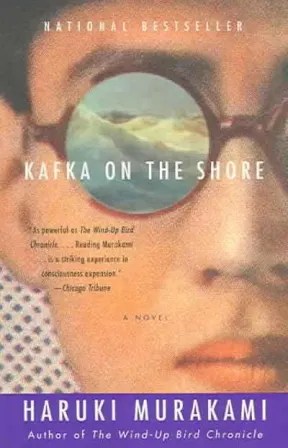
Haruki Murakami: A Case Study in the Artist/Art Dilemma

A former student and early-career teacher is rereading Kafka on the Shore as a possible new text in her works in translation unit for International Baccalaureate (IB).

Murakami represents one of my more recent literary crushes, and I nudged her to his work while I was co-editing a volume on the world-famous Japanese writer.

We share a strong affection for Kafka on the Shore, among a couple others as the best of Murakami, but her rereading has both reinforced that affection and given her pause about, especially, Murakami’s flurries of sexism, a problem I touch on in a brief review of his short story collection, Men Without Women.

As I considered her concerns, I then had a near out-of-body experience as I listened to myself wrestle with a reply.

Murakami, I explained, is of a generation and a culture that could help explain (but not excuse) that his works often portray women and attitudes toward women that are accurate for that time and place. I then noted Murakami presents a layered problem since his literary background seems to rest on problematic men writers, many of whom personify a macho literary tradition: J.D. Salinger, Raymond Carver, John Irving, F. Scott Fitzgerald (Murakami often identifies).

Further:

After the Second World War, novels like “The Old Man and the Sea,” “The Call of the Wild,” and “Moby-Dick” entranced Japanese readers yearning for a future of heroism, naturalism, and reason in the wake of the chaotic militarism and destruction they’d endured. Instruction was still a part of the appeal, but heroism and identity moved to the forefront. The transformation to a more purely literary engagement with American fiction, with readers appreciating and actually enjoying American prose over what it could teach them, occurred in 1975. That’s when Kurt Vonnegut and Richard Brautigan were translated into Japanese and introduced a sense of humor, absurdity, and social criticism voiced in vernacular prose.

Murakami, the case can be made, embodies a sort of literary tradition found in Albert Camus’s The Stranger, a work written intentionally to mimic Hemingway’s style but also includes some of the same gender and sexism problems found in Hemingway’s work.

Murakami’s Hard-Boiled Wonderland and the End of the World seems to nod pretty hard toward these stylistic (hard-boiled) influences, but that sort of excuse wears thin, I think.

Several degrees further away, I have also been wrestling, like Ringwald, with Blade Runner and the many decades later sequel Blade Runner 2049; just as I tried to explain about Murakami, these films may be describing elements of sexism and misogyny without endorsing them.

But how do we know, and what do we do?

I imagine there is a line, maybe not black and white but fairly wide and gray. Some artists and their art are rightfully at last beyond excuse; those we dismiss, maybe with due fanfare.

Some are allowed a new life, one that is about tempering the praise, balancing it against the flaws.

But always, I think, we must keep this powerful observation from Lindsay Lynch on Salinger: “It turns out sad women don’t get to be asshole geniuses.”

Flawed men artists and their crumbling art remind us that we have excused and still do excuse men (often mediocre) almost anything while simultaneously discounting women and people of color for any transgression.

Maybe there is an unintended lesson to these flawed men and their flawed works that can lead us to a better way that allows them some limited space as we make room for those too long ignored and even silenced.

“You’re Actually Rooting for the Clothes”

As I have aged, I have lost interest in both sports fandom and partisan politics at about the same time.

Those prone to name-calling cannot resist discounting me as a “Democrat” or the ever-popular “Liberal,” although I am neither.

New research suggests that I have good reason for my disdain for fandom and partisan politics:

Abstract

The distinction between a person’s ideological identity and their issue positions has come more clearly into focus in recent research. Scholars have pointed out a significant difference between identity-based and issue-based ideology in the American electorate. However, the affective and social effects of these separate elements of ideology have not been sufficiently explored. Drawing on a national sample collected by SSI and data from the 2016 ANES, this article finds that the identity-based elements of ideology are capable of driving heightened levels of affective polarization against outgroup ideologues, even at low levels of policy attitude extremity or constraint. These findings demonstrate how Americans can use ideological terms to disparage political opponents without necessarily holding constrained sets of policy attitudes.

And we need to look no further than a Seinfeld skit to understand this succinctly:

The Never-Ending Allure of Scientific Racism

[Header Photo by Braňo on Unsplash]

Who in their right mind would argue with a Harvard geneticist?

I mean Harvard. And geneticist.

And then, who in their right mind would argue with a Harvard geneticist published in the New York Times.

I mean New York Times.

And therein lies the essential problem with the NYT publishing David Reich’s How Genetics Is Changing Our Understanding of ‘Race,’ followed up, of course, by the eager “Hey, look! A Harvard geneticist said this thing we have been saying! A Harvard geneticist!” (The short version of Andrew Sullivan’s Denying Genetics Isn’t Shutting Down Racism, It’s Fueling It.)

Not to belabor, but to make a case, possibly that most people can grasp in a way that isn’t oversimplified and misleading (see Reich’s mess as I will detail below), I want to focus on the argument at the core of Reich’s piece that both misrepresents and conveniently ignores how we should best understand race and then racism.

Here’s the key part from Reich:

It is true that race is a social construct. It is also true, as Dr. Lewontin wrote, that human populations “are remarkably similar to each other” from a genetic point of view.

But over the years this consensus has morphed, seemingly without questioning, into an orthodoxy. The orthodoxy maintains that the average genetic differences among people grouped according to today’s racial terms are so trivial when it comes to any meaningful biological traits that those differences can be ignored.

Reich suffers from what many so-called elite experts struggle to resist; he feels quite qualified to hold forth on everything just because some people look to him as an expert in one thing.

That he has framed this “orthodoxy” as “average genetic differences among people grouped according to today’s racial terms are so trivial” and “those differences can be ignored” serves two disturbing purposes: first, it sets him up to explain that science argues these differences are, in fact, not trivial, and second, it provides him cover for never confronting the actual orthodoxy about race (how it becomes a blunt tool of racism) in the U.S. and much of the Western world.

So let me now offer a counter-argument, although I am but a lowly education professor.

To be frank, I don’t know a damned person of any intelligence who thinks there are not easily identifiable differences among humans along a wide spectrum of characteristics to classify people. There is no blasphemy to stating that men and women are different, that our social identification of people by skin color (most common use of “race”) also can be used to recognize differences.

But Reich completely misses the boat on the consequences of identifiable differences among humans, and here is the most important point, how identifiable differences become substantial in the hands of the powerful.

You see, the thing Reich and scientific racism refuse to confront is the issue of power.

Here is how human structures have mostly worked: Any group that gains power becomes to some degree insular (tribal) and then idealizes those distinct qualities of the tribe in order to create structures that honor those features while using identifiable differences in the weak to keep them subjugated.

In other words, while Reich seems to think there is some sort of “I don’t see race” orthodoxy in the U.S. and West, he fails to see himself that this isn’t the case, and that “not seeing race [or differences]” isn’t even the goal.

The problem, then, is not if we can isolate, quantify, and thus emphasize something called “intelligence,” and it isn’t even that when we have done and do that now, that we can then also identify differences.

The problem is two-fold: The markers for intelligence are determined by those in power (thus, they are arbitrary) and tend to represent well those in power while marginalizing those who are powerless, and then, that process invariably uses the allure of “scientific” to entrench power deeper for the powerful and disadvantage further the weak.

The reading of “scientific” as “objective” in the pursuit of highlighting and labeling differences is where Reich and others completely fail this debate; this, in fact, is the primary province of scientific racism.

So humans are confronted with the ever-growing body of knowledge about our genetics, what makes us human as well as what makes us unique among and even within our tribes, and we cannot simply take off our socially constructed races like we are discarding an old suit.

The pursuit of quantifying intelligence, the purview of scientific racism, is at its core about proving that the winners deserved to win, about proving that the losers deserved to lose, about denying the power of privilege and inequity.

I am deeply skeptical of Reich’s hand wringing since it remains trapped in the codes of “scientific” and absent any real confrontation of not that humans have differences but how power shapes what happens to those differences.

I am skeptical because that track record on science and racism is quite ugly, and it isn’t one that is tucked away in our dark past.

The daily use of measurement in education and how that makes differences fatalistic (the wealthy are nearly guaranteed their privileges and the disadvantaged are bound to their lives of inequity) is how we do the science of intelligence now.

That is an orthodoxy that should be exposed, unpacked, and dismembered.

Recommended

Populations are not races