The Politics of Education Policy: Even More Beware the Technocrats

Man Prefers Comic Books That Don’t Insert Politics Into Stories About Government-Engineered Agents Of War (The Onion) includes a simple picture of a 31-year-old white male with the hint of a soon-to-be Van Dyke:
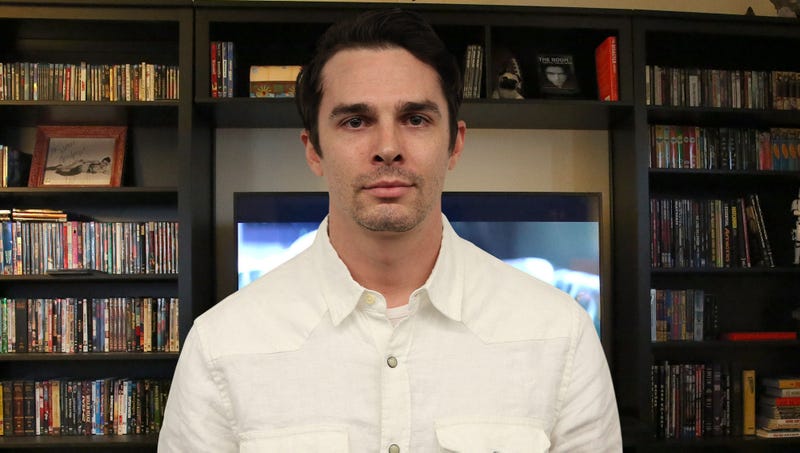
The fictional “man,” Jeremy Land, explains:

“I’m tired of simply trying to enjoy escapist stories in which people are tortured and experimented upon at black sites run by authoritarian governments, only to have the creators cram political messages down my throat,” said Land, 31, who added that Marvel’s recent additions of female, LGBTQ, and racially diverse characters to long-running story arcs about tyrannical regimes turning social outsiders into powerful killing machines felt like PC propaganda run amok. “Look, I get that politics is some people’s thing, but I just want to read good stories about people whose position outside society makes them easy prey for tests run by amoral government scientists—without a heavy-handed allegory for the Tuskegee Study thrown in. Why can’t comics be like they used to and just present worlds where superheroes and villains, who were clearly avatars for the values of capitalism, communism, or fascism, battle each other in narratives that explicitly mirrored the complex geopolitical dynamics of the Cold War?”

The satire here is the whitesplaining/mansplaining inherent in the politics of calling for no politics.

It strains the imagination only slightly to understand how this commentary on comic book fanboys also parallels the persistent combination in education of calling for no politics while using policy and a narrow definition of data and evidence to mask the racial and gender politics of formal schooling.

Let’s imagine, then, instead of the fictional Land an image of David Coleman (who parlayed his Common Core boondoggle into a cushy tenure as the head of the College Board) or John Hattie (he of the “poverty and class size do not matter” cults that provide Hattie with a gravy train as guru-consultant).

A close reading of David Coleman’s mug shot reveals a whole lot of smug.
In his “visible learning” hustle, John Hattie likely prefers to keep his enormous profits invisible.

Coleman and Hattie as technocrats feed the systemic racism, classism, and sexism in formal education policy and practice by striking and perpetuating an objective pose that serves as a veneer for the normalized politics of political and economic elites in the U.S.

As Daniel E. Ferguson examines, Coleman’s Common Core propaganda, the rebranded traditional mis-use of New Criticism into “close reading,” argues:

Close reading, as it appears in the Common Core, requires readers to emphasize “what lies within the four corners of the text” and de-emphasize their own perspective, background, and biases in order to uncover the author’s meaning in the text.

However, Ferguson adds,

Critical reading, in contrast, concerns itself with those very differences between what does and does not appear in the text. Critical reading includes close reading; critical reading is close reading of both what lies within and outside of the text. For Paulo Freire, critical reading means that “reading the world always precedes reading the word, and reading the word implies continually reading the world.”

And thus, close reading serves the cult of efficiency found in the high-stakes standardized testing industry that depends on the allure of believing all texts have singular meanings that can be assessed in multiple-choice formats—a dymanic Ferguson unmasks: “The story beyond the four corners of Coleman’s video is one of a man whose agenda is served by teachers following a curriculum that requires students to read in a way assessable through standardized tests he oversees and profits from.”

Simultaneously, of course, keeping students and teachers laser-focused on text only detracts them from the richer context of Martin Luther King Jr. and the broader implications of racism and classism informed by and informing King’s radical agenda.

Simply stated, close reading is a political agenda embedded in the discourse of objectivity that whitewashes King and denies voice and agency to King, teachers, and students.

Concurrently, Hattie’s catch phrase, “visible learning,” serves the same political agenda: Nothing matters unless we can observe and quantify it (of course, conveniently omitting that this act itself determines what is allowed to be seen—not the impact of poverty or the consequences of inequity, of course).

Hattie’s garbled research and data [1] match the recent efforts in education reform to isolate student learning as the value added (VAM) by individual teachers, yet another off-spring of the cult of efficiency manifested in high-stakes standardized testing.

Just as many have debunked the soundness of Hattie’s data and statistics, the VAM experiment has almost entirely failed to produce the outcomes it promised (see the school choice movement, the charter school movement, the standards movement, etc.).

Coleman and Hattie work to control what counts and what matters—the ultimate in politics—and thus are welcomed resources for those benefitting from inequity and wishing to keep everyone’s gaze on anything except that inequity.

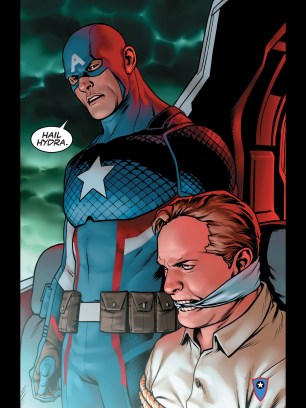
The misogyny and racism among comic book fanboys allows the sort of political ignorance reflected in The Onion‘s satire.  If we remain “within the four corners of the text” of Marvel’s Captain America, for example, we are ignoring that, as I have examined, “Captain America has always been a fascist. … But … Captain America has always been our fascist, and that is all that matters.”
3e281
Captain America: Steve Rogers #1 (c) Marvel

The politics of education policy seeks to point the accusatory finger at other people’s politics, and that politics of policy is served by the technocrats, such as Coleman and Hattie, who feed and are fed by the lie of objectivity, the lie of no politics.


[1] See the following reviews and critiques of Hattie’s work:

NEW: Critical Media Literacy and Fake News in Post-Truth America

Critical Media Literacy and Fake News in Post-Truth America

Edited by Christian Z. Goering, University of Arkansas, USA and Paul L. Thomas, Furman University, USA

This edited collection is not a response to the 2016 United States Presidential Election so much as it is a response to the issues highlighted through that single event and since when incredibly smart, sophisticated, and intelligent members of our society were confused by misinformation campaigns. While media literacy and critical media literacy are ideas with long histories in formal education, including K-12 students and higher education, the need for increased attention to these issues has never reached a flash point like the present. The essays collected here are confrontations of post-truth, fake news, mainstream media, and traditional approaches to formal schooling. But there are no simple answers or quick fixes. Critical media literacy, we argue here, may well be the only thing between a free people and their freedom.

Table of contents

Foreword vii
William M. Reynolds1. An Introduction: Can Critical Media Literacy Save Us? 1
Christian Z. Goering and P. L. Thomas2. An Educator’s Primer: Fake News, Post-Truth, and a Critical Free Press 7
P. L. Thomas

3. Reconsidering Evidence in Real World Arguments 25
Troy Hicks and Kristen Hawley Turner

4. What Is the Story? Reading the Web as Narrative 39
Sharon A. Murchie and Janet A. Neyer

5. Fighting “Fake News” in an Age of Digital Disorientation: Towards
“Real News,” Critical Media Literacy Education, and Independent
Journalism for 21st Century Citizens 53
Rob Williams

6. Educating the Myth-Led: Critical Literacy Pedagogy in a Post-Truth World 67
Robert Williams and Daniel Woods

7. Teaching Critical Media Literacy as a Social Process in Writing
Intensive Classrooms 85
Joanne Addison

8. Before You Click “Share”: Mindful Media Literacy as a Positive Civic Act 99
Jason L. Endacott, Matthew L. Dingler, Seth D. French and John P. Broome

9. Engaging the Storied Mind: Teaching Critical Media Literacy through
Narrative 115
Erin O’Neill Armendarez

10. Supporting Media-Savvy Youth-Activists: The Case of Marcus Yallow 127
Mark A. Lewis

11. Creating Wobble in a World of Spin: Positioning Students to Challenge
Media Poses 141
Sarah Bonner, Robyn Seglem and Antero Garcia

Author Biographies 155

The Fourth Lie, and What Hope Truth?

The irony of truth may often be more impressive than truth itself. Consider the pithy truism “There are three kinds of lies: lies, damned lies, and statistics.”

While the snark of this aphorism certainly spurs us toward a kind of truth about the misuse of numbers, ironically, the words themselves are typically associated with Mark Twain, who did popularize the phrasing, but certainly was not the original source; and to make this more complex, it seems no clear source has been identified.

And while it is now in vogue to debate the rise of fake news and how we find ourselves in a post-truth society, the jumbled relationship between mainstream media and truth/fake news reaches well back into the 1800s.

We seem unable even to face the truth about fake news.

As an educator and writer (one who ventures, foolishly, into public discourse), I have a long and frustrating relationship with a fourth kind of lie: Things people just believe, regardless of the evidence otherwise.

Over three decades, for example, I have talked patiently on the phone with education journalists—from The New York Times to state and local newspapers—who responded to evidence-based arguments with equal parts shock (“I have never heard that before”) and disbelief.

Here are some of the public claims I have doggedly shared for decades now:

  • Education is not the great equalizer; in fact, home and community conditions combined with race, gender, and other individual characteristics are far more powerful influences than school or teacher impact on both academic outcomes by students and then their status after formal education.
  • In-school education reform is destined to fail if out-of-school factors remain unaddressed due to a lack of political and public will to confront systemic inequity with public policy reform.
  • Accountability, standards (always changing), high-stakes testing (also, always changing), and grades are all flawed mechanisms for insuring universal public education in the pursuit of democracy, individual agency, and equity.
  • Formal schooling reflects and perpetuates the norms of community it serves; formal schooling almost never proves to be a change agent.
  • The type of schooling—public, charter, private—tends not to determine educational quality; school quality (typically determined by narrow measures such as student test scores) remains mostly bound to the characteristics of the students and communities being served. As a concurrent fact, there are no “miracle” schools.
  • Formal education must remain a commitment to public institutions; market forces are inappropriate for insuring all children have an equitable opportunity to learn.

Repeatedly, however, these claims, all strongly supported by significant bodies of research, elicit, at best, my being discounted as just a “critic,” and at worst, my being framed as some sort of enemy of reform out to protect anyone or anything except children, a cursed “defender of the status quo.”

And there was also too often crass nastiness, anger, and of course, lies.

Since education in practice is the result of state and public policy (driven, typically, by public and political narratives and beliefs—see lie four), here is a larger truism I have repeated for years with responses again running from disbelief to anger: The Obama education policy and discourse were just as misguided and harmful as the W. Bush education policy and discourse.

Toward the end of Obama’s administration, in fact, I had moved past skepticism and solidly into cynicism in terms of whether any journalists or politicians would set aside their beliefs (the fourth lie) and confront the truth about education and education reform.

However, in the fall of 2016, I noticed what I felt at the time was a crack in charter school support and began drafting a proposal that this was a harbinger of the end of the accountability era.

Before that piece was published, Trump was elected president, and my spark of hope soon looked like fool’s gold. In fact, I was embarrassed to have momentarily felt a glimmer of hope.

A year into Trumplandia, with a Department of Education and Secretary of Education that make the dumpster fires that were the DOE and SOE under W. Bush and Obama look like “the good ol’ days,” the irony has reached a new level.

Despite the market-based agenda under Trump/DeVos, the crack in charter school support has now been joined by mainstream pushback against testing and even grades; as well, recent arguments against the “tyranny of metrics” seem to match the case I and other educators/scholars have posed since the early 1980s when Reagan ushered in the accountability era for education reform.

Irony, in fact, seems to be trumped by the absurd—this from Trump-supporting South Carolina conservative (and Foghorn Leghorn impersonator) Governor Henry McMaster, as reported by Cindi Scoppe at The State:

So it was no surprise that the best part of [McMaster’s] first State of the State address was the way he framed public education. He could have been channeling so many teachers when he talked about the role poverty and parents play in how well children do in school. “Poverty,” he said, “is the enemy of education; some of our children, through no fault of their own, live in circumstances so bleak that intellectual stimulation and learning are but fleeting experiences. Ultimately, gainful employment of the parents or adults in the home offers the surest deliverance of the child into educated society.”

But he didn’t use that as an excuse for failure, noting instead that: “Good teachers and good principals clearly are the key to success. There is rarely a child who will not or cannot be taught. The key is not trying to pour knowledge in, but rather opening eyes and imaginations and letting eagerness and fascination out. A good teacher can do this.”

Unlike Scoppe, I am shocked, damned shocked.

Poverty, McMaster seems to concede, is an essential and powerful force determining the education of children in SC. But let’s also unpack that he still idealizes “[g]ood teachers and good principals” as “key[s] to success.”

Yes, teachers and principals matter, but as I have argued and as the evidence shows, they rarely have causal impact that can be measured because of out of school factors and other systemic forces such as racism and sexism.

And let’s not ignore that McMaster remains trapped in the fourth lie because he believes in market forces and fails to put his rhetoric into practice with actual policy (embracing instead tax cuts that certainly will erode any hopes of effective education policy).

Creeping into 2018, I am trying to regain my skepticism, a first step toward hope that truth can rise through all this muck, decades of muck.

Lies, I recognize, have the upper hand—lies, damned lies, statistics, and what people just stubbornly and blindly believe—but truth seems to be resilient.

At least it seems pretty to think so.

The Existential Itch: “It’s the most human thing we can do”

Hindsight gives those of us with writerly instincts the fodder of a script—as if everything is packaged with intent that falls together like a play or a film with a twist.

It was nearly impossible for me to avoid falling in love with science fiction—first, the blended SF/horror films of the first half of the twentieth century, and then, SF novels, often prompted by films—because of my mother’s influence.

That boyhood romance with a genre blurred into my teenage addiction to comic books, Marvel superheroes; I was mostly unaware that this fascination branched into reading, drawing, and the most powerful heroine of all, collecting.

And then by college, I found myself often sitting alone for hours, in the library or my dorm room, reading existential philosophy.

To me now, approaching 60, that all makes perfect sense, although it likely doesn’t to many others.

Insecurity and low self-esteem mixed generously with searing anxiety—this was my cocktail for a frantic pursuit of who I was since mostly I felt an acute awareness that I was unlike most people, most humans.

Crawling out of the heaping ignorance that was my upbringing, simply the facts of my culture and home norms, I consumed SF, comic books, and then philosophy uncritically. In some ways, this allowed me to fall in love without the pressure of acknowledging all the problems I would come to recognize in these seemingly unrelated texts that shaped me.

Let me work backwards.

Existentialism immediately resonated with me; again, in my ignorance, in my true state of being unlike most humans, I never read existential philosophy as some negative or dark portrayal of the human condition.

In fact, existential explanations for the human condition were a tremendous relief since they echoed how I mostly viewed the world (although in a much cruder way).

To feel passion is to suffer; and thus, to seek a life without suffering is to seek a life without passion. As Sartre dramatized, then, hell is other people.

To love deeply is necessarily to hurt deeply, and this math of being fully human, for me, reinforced my commitment to seek passion and love, to resist the urge to avoid suffering (since it is unavoidable).

Sartre’s No Exit as well as Camus’s “The Myth of Sisyphus” and The Stranger remains powerful texts for what being human means to me.

SF and comic books, I realize now, prepared me for this as they both had been salve for my own struggles with questions about the human condition.

It seems fitting, then, that one of the seminal SF loves of my life was Blade Runner (1982). I was 21, and still naive enough to fall in love with its SF brilliance while not yet critical enough to recognize that, like most SF and comic books (and pop culture or literature), the film presented some real problems about whether or not the work reflected or endorsed sexism, racism, and other regrettable norms of the modern human condition.

I saw Blade Runner in the theater, alone and during the day. Nearly everyone else who attended left during the film, but I sat entranced. I have watched it dozens of times since.

And now, finally, I just viewed Blade Runner 2049, a much delayed sequel.

Both films remain grounded in the ideas of Philip K. Dick without remaining strictly true to Dick’s characters and plot found in Do Android’s Dream of Electric Sheep?

As Dick explained:

The two basic topics which fascinate me are “What is reality?” and “What constitutes the authentic human being?” Over the twenty-seven years in which I have published novels and stories I have investigated these two interrelated topics over and over again.

Like the original, Blade Runner 2049 depends a great deal on atmosphere, which may allow the casual viewer to ignore some real problems, or at least questions that need to be answered.

Anna Smith reported:

“Blade Runner 2049 has a women problem,” cried the internet this weekend, as the critically praised sci-fi sequel hit cinemas. Tweets and blogs cited the fact that female characters were treated as sex objects, and that the narrative was almost entirely driven by men, including Ryan Gosling’s replicant-hunter K and his predecessor Rick Deckard (Harrison Ford). Outrage quickly spread, including from those who had not yet seen the film.

Smith later concedes that the film at the very least presents a mixed message:

And, indeed, there are a number of [female] characters. Robin Wright is terrific but underused as K’s slick, strong, black-clad boss, Lieutenant Joshi, and Sylvia Hoeks’s icy baddie Luv is great fun, but in thrall to her male boss (sinister replicant-creator Wallace, played by Jared Leto). Mackenzie Davis’s Mariette shows initial promise as a strong character who can give as good as she gets, but she is also a sex worker who is literally used as a puppet. Visually, sexualised images of women dominate the stunning futuristic cityscapes, from pirouetting ballerinas to giant statues of naked women in heels looming over K as he goes on his journey. Of course, one of the themes of Blade Runner 2049 is a world littered with artifice, from replicants to sexbots – but these mainly seem to cater to heterosexual males. A hint of a woman considering a “pleasure model” is brief and unexplored. Meanwhile Wright’s Joshi appears attracted to K, but she is not permitted to use him for her sexual pleasure. Where is her holographic lover, her Joi?

In the original film, Deckard (Harrison Ford) falls in love with a replicant (and may be one himself); and the sequel introduces “K” (Ryan Gossling) with a hologram girlfriend (one who hires a prostitute, Mariette [Mackenzie Davis], so the hologram and “K” can experience “real” sex).

So these works of SF use android women to make a commentary about idealizing and objectifying women? Or are these works themselves idealizing and objectifying women?

Evidence for the former may be that two women utter directly some of the essential Dick themes of the film:

Mariette: More human than humans.

Freysa: Dying for the right cause. It’s the most human thing we can do.

Blade Runner 2049 continues the debate about what counts as real and what makes humans human. The sequel includes the rise of replicants, fighting against their slavery in a quest to be “[m]ore human than humans,” and teases out the possibility of androids reproducing.

I recognize this time around the problems with the sequel, ones that occur in the original, but I will come back to this film again and again. I must find a way to resolve for myself why I flinched when “K”‘s hologram girlfriend is destroyed—although I suspect we all want love, and see in those who have it a thing to be treasured.

But this film, and all its existential meanderings, comes as I myself am struggling with an existential itch, trying to reassemble a puzzle that I once held dear, a puzzle scattered and I feared permanently ruined.

After about 13 months of self-exile from one of my passions, road cycling, I am now able to stand back and realize the loss that comes with trying to find ways to avoid suffering.

In the last week, I have ventured back onto the road with my cycling friends. Despite the rides being relatively brief (a couple hours each) and typical winter casual rides, I felt the same elation I may have allowed myself to ignore after thirty-plus years riding, may have been unable to recall after the accident that shook me into admitting I was done with road cycling.

Certainly, life provides no guarantees, and we can seek a life as free of unnecessary suffering as possible; we should be making that true for others (and here Blade Runner 2049 does makes a case for how unnecessarily awful the world is for children and women).

Deckard tells “K,” “Sometimes to love someone, you got to be a stranger,” a confession or justification for never seeing his child with Rachael, his replicant lover.

Later when Deckard is being used to find that child, Niander Wallace offers a key point about Deckard’s quest to avoid his own suffering and the suffering of those he loved: “It was very clever to keep yourself empty of information, and all it cost you was everything.”

To live is to risk everything. To avoid risk is to avoid life. And love.

Maybe few things are more fully human than our need to be reminded of this over and over as long as we are fortunate enough to have the options.

ANNOUNCING: FREE EBOOK! On Writing: Garn Author Interviews

FREE EBOOK! On Writing: Garn Author Interviews

On Writing: Garn Author Interviews FREE eBook Downloads EPUB and MOBI

EPUB (iPad and other eReaders) and MOBI (for Amazon Kindle) made possible through your Patreon donations.

Download EPUB: For Apple iPad and other eReaders (Free)

Download MOBI: For Amazon Kindle and other Amazon Readers (Free)

FREE EBOOK (PDF Version): On Writing: Garn Interview Series PDF Download (Free)

I, Marxist

It is not for the theater alone, but the theater itself would justify the moment in each class I teach when I out myself as a “communist” (pausing, then clarifying the whole communist-socialist-Marxist mess that most Americans cannot untangle).

And that comes early so that I can punctuate about once a class period a key point with “Here is the communist propaganda of the day.” Eventually, this prods laughter when at first there were silent faces, eyes down, of utter fear.

In almost all of my courses, we back up and reconsider terms such as “theory,” “hypothesis,” “belief,” “objectivity,” and of course the cursed trinity, “communist-socialist-Marxist.” What is interesting as well is that most of my students are as ill-informed about “capitalism,” “democracy,” and “republic” as they are misguided about the Red Scare.

While I remain resistant to any and all labels (see this about my born-again agnostic confession), I am, in fact, more or less a Marxist, with the caveat that the term itself and the ideologies surrounding it are contentious, at best.

I was never an Ayn Rand simpleton (excuse the redundancy), but in my early life as a would-be intellectual/academic (my teens), I was powerfully drawn to American Romanticism’s star-struck gaze on the individual—the stuff of the three-name bullshitters, Ralph Waldo Emerson and Henry David Thoreau (for whom I still have some affection, by the way).

But my twenties and thirties included a great awakening that ran through John Dewey (rejecting the either/or thinking of society v. individual) and directly into Paulo Freire, a (the?) patron saint of educational Marxists.

The boy-to-man transition can be a slow one, but I eventually shrugged off my idealizing the individual and demonizing the collective (damned Society), and came to a much more nuanced understanding of the moral and ethical implications (or absence thereof) inherent in the rugged individual myth and the larger consumerism/capitalism norm of the good ol’ U.S. of A.

This transition, I realize, is part of a personal journey to an ethical way of being, and thus, I had to reject rugged individualism and capitalism (consumerism) for their amorality; I had to embrace Marxism for its moral imperative.

Of course, I realize that “moral” and “ethical” are social constructions, not some objective thing handed down by G(g)od; however, I think humans can create norms that seek ways to honor the collective and individual good.

I am still traversing along Dewey’s call to reject the either/or—despite the wealth of post-apocalyptic science/speculative fiction (that I love) grounded in the evil collective assaulting the idealized indivdual. See Winston’s head trapped in the cage under the threat of loosed rats.

Pretty damn hard to resist this warning, but it’s hokum, mostly, especially since this sort of propaganda by Randian capitalists and aimed at demonizing the government is a distortion of a more credible warning about totalitarianism, something more likely when government is corrupted by corporations (not the implied message that government is the inherently corrupt force in the universe).

Thus, my Marxism runs toward the recognition (the paradox) that if we do value individual freedom and the so-call free market (insert sarcastic cough here), the path to those ideals begins with insuring the robustness of the public good first.

Randian capitalists preach that the free market comes first, as the sacred Invisible Hand—while public institutions (gasp) are to be tolerated only and always under a skeptical gaze.

As ideologies, both of these approaches are idealistic, and possibly inherently unattainable.

I remain with the Marxist camp because it is the moral idealism against the amoral idealism of Randian capitalism.

I am willing to concede that having two or three competing pharmacies facing off across the street and corners from each other can work to depress prices—possibly more so than depending on the usually bungled bureaucracy of government to serve the people well (here, read some Kafka).

But the public good will not be served by Walgreens and Ekerd alone in terms of just what pharmaceuticals they sale; in fact, if anything, the U.S. is a horrible parable about the failure of allowing the market to drive the selling of medicine. (Consider Tamiflu, which is mostly sold to create profit for drug companies, but likely is not close to being cost effective or curative for patients).

The free market spawned Viagra and Cialis, we must consider, but cancer is left to private non-profits begging for people to be decent, and, human.

Charity.

So to stand before my students and confess “I, Marxist,” is no mere theater, although it serves that well also.

It is, in fact, an act of confessing my own moral imperative as a teacher, and a human—as flawed as all that is.

It is a defiance in the wake of all the cartoonish Red baiting that has characterized the U.S. for more than a century.

And I persist, although “I’m not sure all these people understand.”

SCCTE 2018: Teaching Writing Beyond “College and Career Ready” and High School

Teaching Writing Beyond “College and Career Ready” and High School

Paul Thomas, Furman University

Session E.9/ 2:50-3:35

Yeamans 2

Teaching high school students to write, traditionally and in the era of “college and career ready,” often fails to prepare students either for college writing or real-world writing. This session will invite a conversation about how students are taught to write in high school English (highlighting AP and test-prep) in the context of disciplinary writing in college as well as so-called authentic writing beyond formal education.

Resources

See PowerPoint HERE

Advice on Writing, Trish Roberts-Miller

Advice to Students and Authors: Submitting Your Work

UNC Writing Center Handouts

Writing for Specific Fields

Prompt Analysis for Genre Awareness (A. M. Johns)

Web Literacy for Student Fact Checkers, Michael A. Caulfield

Why are there so many Different Citation Styles

Framework for Success in Postsecondary Writing

Recommended

What do College Professors Want from Incoming High School Graduates?

Welcome to College!: How High School Fails Students

To High School English Teachers (and All Teachers)

Writing and Teaching Writing: By Topics

Disciplinary Writing

First-Year Composition

A Year of Loss and the Things that Define Us

People who quit smoking often explain that part of the struggle with quitting is that without smoking they don’t know what to do with their hands.

Smoking often defines the smoker, and quitting is more than an end to smoking; it is a terrifying experiment in redefining the Self.

My parents were both smokers who came of age in the 1950s and 1960s; and they both quit, although on much different terms—Dad quit while I was in high school, and Mom only many years after I had moved out. When my mother died (7 December 2017), the final straw was stage 4 lung cancer.

That was just a bit over five months after my father’s death.

2017 for me was a year of loss that began with the thing that defined me being taken away as well—road cycling—after a senseless car accident on Christmas Eve 2016 that impacted directly four cyclists in a pack of 10, but resonated throughout our entire cycling community as well.

Mountain biking and some running have slipped into the gap where road cycling used to be, but like ex-smokers who don’t know what to do with their hands, I remain often lost without road cycling.

My life as a road cyclist stretched over four decades since the 1980s with some waxing and waning, but from about 2003 until 2016, I was logging around 9,000-10,000 miles a year on the road and leading weekly rides as well as organizing pretty big cycling events.

WBL dec 2015
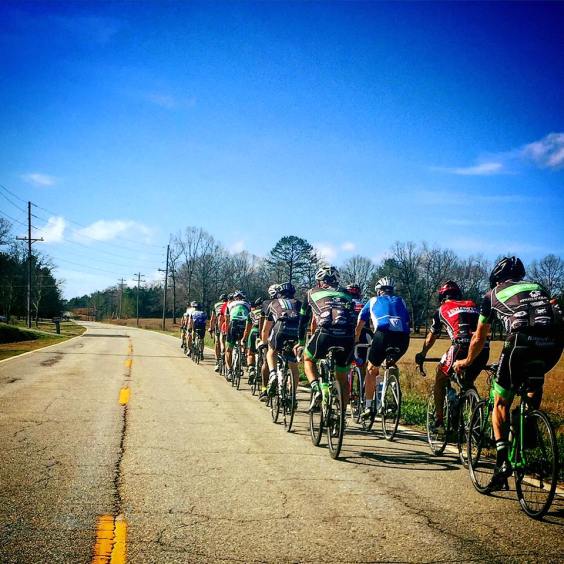
Social media can be cruel; this image from 2015 captures the thing that defined me that was not a part of my life in 2017. I take a break here at the back of the pack, riding the green Ridley that was destroyed in the car accident.

I was cycling seriously about 4-5 days a week without fail, regardless of weather, regardless of professional and personal obligations.

It was what I did.

It was who I was.

And for the most part, that meant no questions asked by family, friends, or colleagues.

My first class meeting of spring 2018 was my evening course, a new writing/research-intensive offering for my department and university. As students filed in, I arranged the handouts and such on the table at the front of the room, and checked that my smartphone was on vibrate, placing it face-up and in easy view near the piles of papers.

Then it hit me.

My smartphone obsession was in part due to having had infirm parents for many years, always on alert that they could call during class, and if so, it was probably urgent.

That moment was the first time I confronted that part of my life being over since both parents died in 2017.

In that flash of realization, I also thought about the beginning of class in January 2017—when I was barely able to walk, using a cane to counter the limp from a fractured pelvis.

Over the weeks and months of physically healing from the fracture, and looking for ways to regain my athletic life, I was forced to think about the other things that defined me.

Fortunately, as a teacher/professor and writer, those aspects of who I am were mostly unscathed—although all loss reminds us of the fragility of being human, the temporal nature of all that we do, all that defines us.

My journey through my 50s was already haunted by a lingering fear of the end of my cycling life well before the accident. I was riding at very high levels of intensity and with elite cyclists.

No one maintains these physical levels of exertion, I was quite aware, but having that fear turned into reality in a blink, and in a way beyond my control, was far more psychologically scarring than I really would like to admit.

But here, yes, I am admitting that.

When people refer to me professionally, they still tend to say I am an English teacher, even though I have not been one in over 16 years.

When people talk about me as a writer, they mention that I blog—I tend to hear “just a blogger”—and that I am prolific, often a back-handed compliment that carries more than a whiff of brushing aside.

I tend to weather those pretty well, I think, because my teacher/professor-Self and my writer-Self are quite resilient after well over 30 years at both. Those moves have much left to improve, but I have them in pretty good form; people tend to think I do them effortlessly, and that is a testament to all the hard work leading up to now and all the hard work I do when no one is watching.

Teaching and writing are things that define me, and I love them, I cherish them.

I am equally terrified of losing them in the ways road cycling was stripped from my life.

Alzheimer’s. Blindness.

Yesterday in the just-at-freezing midday temperature, I joined two friends, Rob and Wayne, to mountain bike for the third day in a row over the MLK holiday weekend.

Rob and Wayne were close members of my road cycling life—Rob and I mostly about equal in our cycling abilities, and Wayne an elite cyclist who inspired me to keep at it on rides even as I reached my limits.

We planned to ride about 1.5 hours and wanted to head over to a trail we typically avoid due to heavy horse traffic. The trails were muddy from recent rains, but some of that was frozen, making for an interesting day of slipping and plowing over and through sections both slick and solid.

Just a couple years ago, Rob, Wayne, and I were regular members of the so-called A group of area road cyclists. Yesterday, Rob and Wayne simply rode away from me, waiting at intervals as I crept up to them—at one regroup, me tumbling over with a disturbing thud just as I reached them.

Especially after my year of loss, my MTB rides are equal parts bitter frustration and a constant reminder that at least I can ride.

I used to be a fairly accomplished road cyclist, and now I sputter off the back; slip, step off, or crash; and generally flounder as a mountain biker; this simply is not the thing that I want to define me as I approach 60.

I have never been one for arbitrary traditions and things like holidays or celebrating the new year, especially with resolutions.

But with 2017 being a year of loss, and as I age not so gracefully, I feel the tug of a new year, and the allure of having some hope to regain the thing that defines me.

I know I am tired after 2017, psychologically drained and physically weary.

I also know I am tired of sputtering off the back, floundering on mountain bike rides, and too often dreading all of that against the Siren’s song of just riding that I still hear loudly.

Smokers quit for many reasons, I imagine, especially now that public smoking is shunned, but primarily, I think, smokers quit as some sort of very human resistance to death. Not many people inhale a cigarette gleefully expecting to die of cancer.

My last accident on a bicycle involving a car was actually my fourth incident so I must admit that road cycling always confronted me with the specter of death—like a smoker lighting up each time.

I lay in the ER Christmas Eve 2016 realizing all the people I would have to look in the eyes, most of them again, with some anticipation about if or when I would once again pedal along the road. That last time was the first as a grandfather, and I couldn’t shake the weight of those eyes as I thought about the very real likelihood that I would never again be a road cyclist.

It’s been fourteen months since then, and I still don’t know what to do with my hands.