The Often Ignored Consequences of Being Gifted: On Misunderstanding Being Smart

Although routinely misunderstood as well, many people do acknowledge that standardized test scores by students are more strongly a marker for socioeconomic conditions of students and their parents than for student achievement or effort.

Despite efforts to create unbiased tests and to control for factors not related to achievement, standardized tests and similar measure of IQ remain weak indicators of what they claim to measure.

Giftedness, however, receives far less scrutiny for what it represents and how it is identified.

In both cases, we tend to jumble what we consider “smart.” For example, when students are tested for beginning algebra early, those students identified are usually directly and indirectly considered the smart group in a class.

These students are not necessarily smarter (whatever that is), but have developed abstract reasoning (brain development) sooner than some peers (see this as a consideration of being ready to do algebra, abstract mathematical reasoning). Biological age corresponds loosely with abstract reasoning development, but some people do not reach that level until late adolescence or even early adulthood.

While a teacher, I received training in gifted and talented education, but I really didn’t understand the label in a critical way until I was introduced through social media to Webb’s Dabrowski’s Theory and Existential Depression in Gifted Children and Adults.

What is very important here is that this discovery was a key step of my own struggles with anxiety.

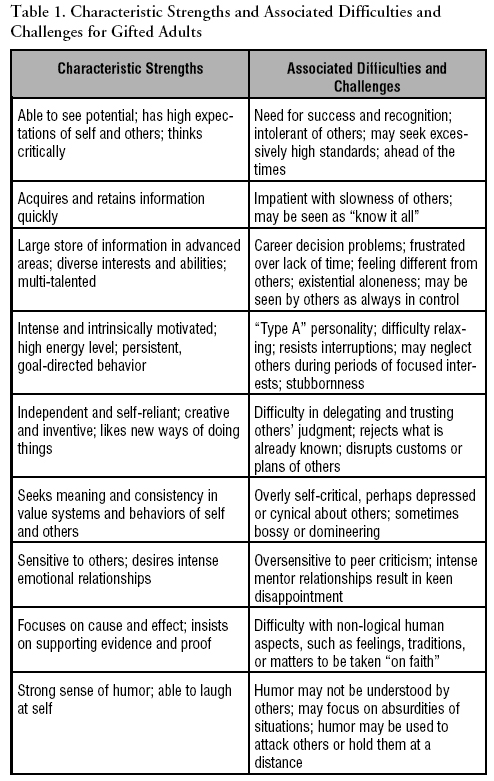
Reading Webb’s analysis was a moment I will never forget. I cried throughout the article, tears of relief prompted by a recognition I had never experienced before. One of the most profound elements of that reading is this chart:
dabrowskis 1.jpg

I returned to this article and chart recently because my virtual colleague and fellow critical pedagogue Angela Dye raised a question about giftedness:

This time working back through Webb’s examination of Dabrowski has coincided with my own renewed journey to address my anxiety and life-long struggle with chronic pain.

The chart above, I think, is incredibly important since it balances and complicates identifying students and adults as “gifted.”

As I replied to Dye’s question, I am not necessarily against the label of “gifted” (although I do balk at most labeling), but:

I have noted above that many measures claiming to identify student achievement and intelligence (being “smart”) are misleading so I want to spend some time here unpacking the negative consequences.

First, giftedness in formal education often feeds into tracking. While tracking is popular, it is overwhelmingly not effective for any students, even those who receive the boost of being advanced. As the analysis of algebra readiness explains, students identified as “advanced” are biologically advanced; this is not about merit but an accident of human development.

Therefore, when giftedness is used for tracking, it is harmful and should be avoided—especially since it often signals incorrectly that some students are smarter (better, more deserving) than other students.

Next, identifying students as gifted has a great deal of potential if it is used for counseling instead of primarily for academics. I have often joked that OCD and ADHD helped me achieved a doctorate (and most of my successes in life, actually), but the really unfunny part of that is my life-long anxiety has robbed me of a great deal of pleasure that every person deserves.

Anxious people rarely live in the moment and even when successful are unable to enjoy that success, or even see it is as success.

Tracking children and teens as gifted in their academics often works to further mask the negative consequences outlined in the right-hand column above—intolerance of others, self-loathing, social awkwardness and isolation.

Since I teach at a highly selective university, my students tend to respond strongly when I discuss these dynamics. By misunderstanding and mislabeling “gifted” and “smart,” formal education perpetuates deeply unhealthy behaviors in young people who would be better served if they recognized early and began to address the profound struggles associated with crisis thinking, anxiety, and depression.

To some, recognizing giftedness as a positive (“smart,” “advanced”) may seem a welcomed alternative to deficit ideology and our cultural urge to pathologize and medicate; however, in this case, I am calling for expanding our recognition and response to giftedness to include the negative consequences so that children, teens, and adults can accentuate their strengths while also addressing the mental and physical toll of anxiety and depression—especially when those conditions are ignored, repressed in the sufferer.

For me, recognition and awareness have been liberating, an important first step to finding ways to heal. Most of my life, I have repressed my anxiety since it has caused me a great deal of physical pain as well as social stress since I am routinely misunderstood (my behavior is misinterpreted as negative personality traits instead of anxiety responses).

Since I did not have any real understanding of these mental challenges until I was 38, and then I didn’t discover Webb’s analysis of Dabrowski until a few years ago when I was in my early 50s, I have a tremendous mountain to climb—decades of self-harming habits that feel normal even as they cause me physical pain and diminish the quality of my life.

All of that, of course, exists in a professional and social context whereby people view me as highly successful, extremely smart, and profoundly overachieving—while also viewing me as impatient, bossy, domineering, arrogant, aloof, etc.

In the early 2000s during my first (and mostly failed) effort at therapy, I declared that I would gladly give up the positives from my anxiety for some relief. My therapist argued that the positives were a gift, although I was hard pressed to see that.

Now I recognize this was a nuanced conversation about giftedness that I was simply uninformed about. I also recognize that no one has to choose as I was willing to do because with awareness and help, those of us who suffer because we have qualities some see as gifts can alleviate the negative consequences if and when we come to recognize the full picture of who we are.

Aliens in Academia: Teaching Writing from the Margins

One of my earliest and most vivid experiences with being an alien in academia happened many years before I entered higher education. I was teaching high school English in the same English classroom of the high school I had attended.

One day, exasperated, a tenth grade student exclaimed during class, “When are we going to do English? All we do is read and write, read and write!”

For her nine or ten years of formal education, she had come to view “English” as plowing through grammar text books, worksheets, and tests. That my class was solidly grounded in teaching them to write—even the reading was mostly about reading like a writer more so than traditional literary analysis—transported her and other students to an alternate universe that was at least disorienting.

A bit past midway into my 18 years as a high school English teacher, I entered a doctoral program and developed a more cohesive awareness of the source of my status as an alien in academia—critical pedagogy.

I remained in my high school classroom for four years after my doctorate, but the move to higher education, I must admit, was in many ways a search for belonging. The alienation I felt for nearly two decades of public school teaching reached a saturation point (some of which, I think, manifested in my panic attacks and realization I was a life-long sufferer of anxiety in the year after I received my EdD).

However, I have to report that 17 years into higher education I am possibly even more aware of being an alien in academia.

Recently on Twitter, John Warner, Paula Patch, and I wrestled with a thread started by Warner:

While the three of us are joined by expertise and experience in teaching writing, we all have different degrees and backgrounds along with different higher education fits.

Several aspects of this discussion highlight that teaching writing at the college level is its own unique kind of being an alien in academia. Here are some of the issues worth considering:

  • Tenure-track and full-time teaching at the university level tends to require faculty with terminal degrees. The word “terminal” implies that this is the highest degree a person can earn in a field, but it also suggests the stress of achieving the degree (the experience could kill you, if it doesn’t necessarily kill your spirit) and, as the points raised by Warner and Patch reveal, represents the unspoken reality that the degree kills your opportunities beyond a very narrow band of “fit.” Too often, it seems, advanced degrees are alienating instead of being one of many possible ways to enter and grow in higher education as faculty.
  • The fine and performing arts, for example, offer a counter-model to how the teaching of writing often exists on the margins in colleges and universities. Fine arts and performing arts professors may not have terminal degrees, but do have expertise; notable, though, is that the fine and performing arts are not viewed as discrete skills that can and should be taught across the curriculum. In other words, the teaching of writing has experienced two contradictory and corrupting characterizations: (1) all students and academics need the essential skill of writing, and thus, (2) all disciplines and professors should and can teach writing (seemingly without any formal understanding of pedagogy).
  • This writing-across-the-curriculum has worked to push the teaching of writing even further to the margins by seeking ways to integrate it everywhere. Composition exists as an independent structure in some colleges, but more often than not, writing is diluted as something to be taught by everyone and even worse as something students should have already acquired (or can acquire in one or two first-year seminars)—thus, the teaching of writing is mandatory drudgery, a low act of remediation.
  • The teaching of writing, extremely well highlighted by Warner’s experiences, also labors under limiting and limited constraints, tensions among remediation, first-year composition, writing-across-the-curriculum (and among the disciplines), scholarly writing (citation and concerns about plagiarism), and so-called creative writing (fiction, poetry). These tensions highlight the common failure for colleges and universities to consider who qualifies to teach writing, how to structure writing instruction and programs, and how to recruit, support, and foster expert faculty of writing.

Teaching writing suffers from its diversity, its need for faculty who either have some generalist leanings or seek ways to grow and develop beyond the narrow expertise of a terminal degree. Teaching writing is about both pedagogy and content expertise—the teaching of writing requires expertise and experience in the teaching and being a writer.

My journey as an alien in academia has many facets; my credentials mean I belong in teacher education, but I do not fit there because my soul is somewhere that fits better with English and composition as well as sociology, all of which are places I do not belong.

Being working-class and critical do not help things either.

The conversation among Warner, Patch, and me raises a powerful question about the essential nature of teaching writing in higher education where those of us teaching writing are mere aliens, pushed to do our work at the margins while struggling within the paradox of writing as essential and something any professor can teach.

This may, of course, lead to another paradox, the community that is formed by our status as aliens teaching writing at the margins that in some ways hold everything together.

Invisible in Plain Sight: On Refusal

I am invisible, understand, simply because people refuse to see me.

Ralph Ellison, Invisible Man

A few days into my first-year writing seminars, I have begun to guide students toward reading like writers, navigating texts for the what and how of written expression.

As a way to interrogate their misconceptions about the essay (grounded mostly in inauthentic templates), we walk very carefully through the first six paragraphs of James Baldwin’s A Report from Occupied Territory, published 11 July 1966 in The Nation.

The essay exposes students to the historical realities of racial and racist police brutality—which we connect to Colin Kaepernick and NFL protests—as well as Baldwin’s powerful craft as a writer of non-fiction and a more rich and subtle awareness of the essay. This report helps, for example, students re-imagine how effective writer’s create essay openings—not functional single-paragraph introductions with unimaginative thesis sentences.

Each time I explore this essay with first-year students, however, I am reminded of how some of the best elements of the work—Baldwin’s use of “occupied territory” and “a foreign jungle but in the domestic one”—remain mostly invisible to those students.

Baldwin is referencing war, the Vietnam War that was pervasive at the time of the essay, in order to create a critical portrayal of the police as militaristic. Many students are inhibited from recognizing this analogy.

They have a sanitized view of war (contemporary war as drone attacks has been rendered invisible). I grew up in the 1960s watching the Vietnam War on the nightly news.

They are also blinded by their assumptions about authority figures, such as the police.

While not all of my students view the police positively (perspectives among races and social class vary among my students as we explore the NFL protests, for example), they have recently left K-12 education where the norm is that all authority must be respected, where the adults in authority appear mostly uniform in that deference to all authority.

Dominant ideologies, then, have the power to create invisibility in plain sight. Once anything becomes normal, many simply refuse to see what is right their before their eyes.

Consider the dilemma by a woman scholar, Nikki Usher, prompted to cite a scholar she had actively worked to avoid because of his sexism:

And for those men whose academic sexism hasn’t risen to the level of actionable correction, and very likely won’t — while they continue ignoring female scholars and belittling their work on a daily basis — their reputation overall will remain clean. A serial sexist is unlikely to cite the work of female scholars, but if he is a predominant voice in your field or subfield, there is no way for you to avoid having to continue to build his academic reputation through citations, even if you would like to avoid doing so.

In my first-round submission, instead of mentioning this male professor’s work, I found and cited a half-dozen other scholars who made the points I needed for my theoretical scaffolding, although not in the same foundational articles. But of course the journal reviewers went looking in my manuscript for a citation of the serial sexist’s name and work.

This is a bind that we have yet to account for — how the process of building on academic work itself burnishes the reputations of people whose scholarship is good and sometimes even foundational, but whose characters are awful. In the case of a sexist jerk, you are often left without recourse: Cite him, or look like you don’t know what you’re talking about to reviewers and readers.

Sexist men scholars not citing women often works invisibly and makes women scholars invisible, when the field refuses to see that, of course.

Scholars taking the faux pose of objectivity (citing the seminal work of men scholars, and claiming not to be endorsing the scholar as a person or his behavior) create another level of invisibility—both of which work to perpetuate disciplinary status simultaneously along with refusing to hold abusive scholars accountable.

Those who refuse to see white and male privilege are complicit in maintaining both as invisible in plain sight.

One problem with invisibility as refusal, however, can be seen in my students reading Baldwin and Usher struggling to manage her own scholarship and status.

That problem is grounded in how the marginalized are often positioned with the responsibility to bring that which has been rendered invisible into the light while also being poised to suffer the greatest consequences for that unmasking.

The student stepping back from idealized views of the police in order to acknowledge Baldwin’s criticism is taking a risk in a context that is mostly authoritarian.

A woman scholar taking ethical stances against the powerful current of her field is assuming risk in a context that maintains a false veneer of objectivity and high rigor.

To focus on Usher’s dilemma, this is a nuanced aspect of the #MeToo movement that itself has been rendered invisible, micro-aggressions of scholarship dominated and controlled by men. There is a pretense here that scholarship is somehow distinct from the personal, the person.

I imagine for those outside of academia, sexist men scholars systematically ignoring women scholars (not citing) seems a pale thing when compared to Harvey Weinstein and Louis CK.

For women, however, the cumulative and ultimate consequences of all types and degrees of sexism and gender-based aggression are similarly erasing, paradoxically creating women as invisible in plain sight.

I think about Margaret Atwood recalling that when she attended an all-male graduate course at Harvard, the professor sent her for coffee—Atwood the woman as scholar was rendered invisible behind her perceived status as servant to men.

Ultimately, those left invisible in plain sight remain trapped by the system that perpetuates itself, as Usher exposes.

Ralph Ellison’s Invisible Man recognizes his invisibility and in the novel’s end has embraced it, reclaimed it, hibernating himself as a sort of resignation.

This too is a paradox, the incredible weight of invisibility, the burden of being erased through refusal.

If we are to experience a revolution of recognition, the leverage of those with privilege is essential, to pry away the cloaking in order to see what has been right their in front of our eyes all along.

“If you read this story out loud”: Carmen Maria Machado’s Stories

A former first-year writing student who has transferred to another university to become a writer shared Carmen Maria Machado’s “The Husband Stitch” with me.

I fell in love with the story and the writer almost immediately, reading the story so quickly I had to throttle myself repeatedly—pausing and then looping back to re-read. I recalled the first time I read Roxane Gay’s “There is No ‘E’ in Zombi Which Means There Can Be No You Or We,” my gateway into her An Untamed State.

Machado’s stories are more than compelling; they are precise, incisive, and disturbing.

Fortunately, Machado has collected eight short stories in Her Body and Other Parties, a volume that has garnered praise and awards but also establishes her gifts for storytelling, blending and blurring genres, and making the lives and terrors of being a woman central to the universes she conjures.

The stories weave together deftly meta-fiction (the volume begins parenthetically, “If you read this story out loud…”), horror, science fiction/fantasy, and experimentation (although this isn’t an exhaustive list) while also remaining true to the art of storytelling. The reader is always compelled by what John Gardner called a “vivid and continuous dream.”

Melissa Febos’s examination of “Intrusions” steers quickly toward literature, John Cheever’s “The Cure.” Throughout this haunting personal essay, Febos returns again and again to fiction—film and TV specifically as well as literature.

As she navigates her own disturbing experience with a voyeur, Febos confronts the reader with the perverse normalcy of other women’s stories against the backdrop of fictional recreation (Brian DePalm, Alfred Hitchcock, and “[o]ne of the many friends and acquaintances whom I began interviewing a few months ago about being peeped on”):

It is also a narrative that exonerates men. The more plausible it seems that women are always performing, the less indictable the watching. If we want it, where is the crime? Better yet, make us seductresses, inverting the men’s role even more extremely: They are our victims! One of the most shared qualities of all predators is their self-conception of victimhood.

And then:

Women are bombarded not only with suggestions that we are always performing for men but also with prescriptions for doing so, from the moment we are able to take direction. “A man’s presence,” John Berger writes in Ways of Seeing, “is dependent on the promise of power he embodies . . . A man’s presence suggests what he is capable of doing to you or for you.” Conversely, “How a woman appears to a man can determine how she is treated. To acquire some control over this process, women must contain it and interiorize it.”

Febos eventually confronts her “peeping tom,” and even overcomes her hesitancy to seek out the police (having been at that time a sex worker). But similar to other women she interviews, Febos discovers moving as her best option in a world where men in power view women as complicit, a prop, and where her role as victim creates a repeat performance as object, as the intruded, chillingly examined in Adrienne Rich’s “Rape”:

You hardly know him but now he thinks he knows you:
he has taken down your worst moment
on a machine and filed it in a file.
He knows, or thinks he knows, how much you imagined;
he knows, or thinks he knows, what you secretly wanted.

Just as Febos’s story and the stories of other stalked women are terrifying, they provide a counter-narrative to fiction:

A big difference between the two cultural narratives about peeping—that of the harmless romantic lead and that of the violent—is that one is much truer than the other. … Many of those television narratives boast of being pulled from real headlines, which gives the false impression that women are mostly murdered by sociopathic strangers. In reality, more than half of female victims are murdered by their romantic partners. … The documented frequency with which women are murdered by their lovers is why the pop-culture narratives in which the line between danger and romance gets purposefully blurred are most troubling to me.

The real-world violence and fear women live with and against pervasively also contrast the ultimate failure of pop fiction’s romance with peeping and stalking: the use of “women solely as a backdrop for his tableau of masculinity,” returning to Cheever:

The Cheever story is also interested in women solely as a backdrop for his tableau of masculinity—though in this case featuring conflict rather than collaboration. When the narrator of “The Cure” spots his peeping neighbor with his daughter on a train platform, the apparent purity of the daughter persuades him not to confront the peeper. … We are meant to be impressed by how deeply the protagonist is affected by the neighbor’s violation, and by his impending divorce. Alone in the house he usually shares with his wife, our protagonist’s behavior is weird, but not unsympathetic. Bachelorhood and the intrusion on his privacy seem to have agitated a deep well of aggression whose contents require some receptacle or outlet. He’s not a creep; he is reclaiming the masculine presence that Berger describes as “dependent on the promise of power he embodies,” and passing on the baton of victimhood. The woman’s fear assures him that he is no longer the object, but the subject.

And then back again to the real world:

One of the most common denominators in the stories I heard from women was of other men dismissing the peeping, as has long been done with so many forms of abuse. Freud himself considered the incest reports of his female patients to be fantasies. … We have all fielded this kind of response to one thing or another. We are exaggerating. We are overreacting. We are villainizing hapless men. And besides, it’s flattering.

Febos’s masterful essay ends with “I am still waiting,” chilling the reader the same way I felt by the end of Machado’s “The Husband Stitch.”

Experimental and long for a short story, “Especially Heinous” offers “272 Views of Law & Order: SVU” through each episode over twelve seasons, including each original episode title and Machado’s own rendering of that episode’s synopsis.

This story is challenging in many ways, but it also provides a companion to Febos’s “Intrusions” while illuminating how fiction can rise above Febos’s powerful critiques of fiction’s persistent failures about the lives and terrors of women.

“Especially Heinous” builds its own narrative over the course of 272 faux-synopses, simultaneously breathing life into the horrors of inhabiting a woman’s body and dismantling the often trite and lifeless tropes of pop culture:

“DISROBED”: A disoriented, naked, pregnant woman is discovered wandering around Midtown. She is arrested for indecent exposure. …

“REDEMPTION”: Benson accidentally catches a rapist when she Google-stalks her newest OKCupid date. She can’t decide whether or not to mark this in the “success” (“caught rapist”) or “failure” (“date didn’t work out”) column. She marks it in both. …

“GHOST”: A prostitute is murdered. She is too tired to become a spirit.

“RAGE”: A prostitute is murdered. She is too angry to become a spirit.

“PURE”; A prostitute is murdered. She is too sad to become a spirit.

Reading “Especially Heinous” and all of Machado’s stories prompt me toward sentiments repeated in Fabos’s essay:

“Are you fucking kidding me?” I asked. …

“What the ever-loving fuck?” she commented.

Machado and Fabos, through fiction and non-fiction, illuminate and confront the gross negligence of a world in the hands of men who refuse to listen, who persist in driving their words and images over and through the terrors of being a woman as if those men are the only things that matter.

When you finish Machado’s collection, return to the opening parenthetical words, “”If you read this story out loud, please use the following voices,” and then say aloud the last directions as directed: “ALL OTHER WOMEN: interchangeable with my own.”

Can you hear it?

Understanding, Honoring Pat Tillman: A Reader

With a new Nike campaign including Colin Kaepernick, the Right in the U.S. cannot help themselves by once again invoking a false and offensive characterization of Pat Tillman, who gave up his NFL career for the military.

Tillman’s family has once again been forced to reject those who misuse Tillman’s name and tragic death for false conservative narratives. The truth about Pat Tillman is complex, but that truth is not hard to find.

Here, then, is a reader to help those who genuinely wish to honor Tillman:

https://twitter.com/i/moments/904850202875404289


Making Writing Instruction Work: Conferencing

Here’s an open secret about teacher education: While politicians and pundits have been criticizing teacher education intensely since the Obama administration (think VAM), we in teacher education are disturbingly aware that many (if not most) of our candidates do not and cannot practice what they are taught once they enter the classroom.

Let me focus here on writing instruction as an example of that conflict.

Applebee and Langer’s most current and comprehensive research revealed some disturbing conclusions about “the considerable gap between the research currently available and the utilization of that research in school programs and methods” (LaBrant, 1947, p. 87):

Overall, in comparison to the 1979–80 study, students in our study were writing more in all subjects, but that writing tended to be short and often did not provide students with opportunities to use composing as a way to think through the issues, to show the depth or breadth of their knowledge, or to make new connections or raise new issues…. The responses make it clear that relatively little writing was required even in English…. [W]riting on average mattered less than multiple-choice or short-answer questions in assessing performance in English…. Some teachers and administrators, in fact, were quite explicit about aligning their own testing with the high-stakes exams their students would face. (pp. 15-17)

As I explain in my review of their research:

This gap between research and practice, reaching back to LaBrant (1947), is highlighted again and again throughout this volume—in ELA, social studies/history, mathematics, and science. Applebee and Langer emphasize that the negative consequences of high-stakes testing distinguish this study from their earlier work and that accountability has essentially stymied the influence of writing research (Graham & Perin, 2007; Smagorinsky, 2006), professional organizations, and teacher professionalism.

Teacher education struggles mightily against the persistent “considerable gap,” in fact, but the stalemate between informed practice and the realities of day-to-day classroom teaching can be alleviated.

Recently, I was again reminded of this problem when an early career teacher who completed my program was struggling with student-teacher conferences.

One of the greatest benefits I have experienced by moving to higher education (teaching first-year writing) from secondary education is the ability to require conferences from my students and having the time to make these conferences highly effective.

Since I have de-graded courses (as I did when teaching high school by the way), I include minimum requirements for student participation (see my fist-year writing syllabus). Those minimum requirements for writing-intensive courses include submitting full initial drafts, conferencing with me, and submitting at least one revision based on the strategies we identify in those conferences.

My feedback on writing has shifted significantly away from marking essays (using track changes and comments in Word) and toward more and more face-to-face conferencing.

I have, however, far more time available for conferencing than secondary ELA teachers, and my student load for my writing-intensive courses hovers around 20-24 students (a dramatic difference when compared to the 100-150 students most secondary teachers have).

Now if we confront that many K-12 teachers do not practice what they are taught as research-based best practice, we must also address that this gap is driven by the impracticality and inefficiency of effective writing instruction in the so-called real world of secondary teaching.

The early-career teacher mentioned above was exasperated because she had spent a couple days conferencing with students about their first essays of the academic year but had many students still to conference with. This amount of time and energy for conferencing was, she admitted, overwhelming and impractical.

She simply cannot sustain this over the semester weighed against all the other responsibilities she faced as their teacher.

As we discussed how to make writing instruction work, I mentioned I had addressed these problems in her methods course—although we both had to realize that here is another paradox of teacher education: Much of learning to teach cannot and will not happen until teachers are in the classroom, and that learning is an ongoing journey, not something to be acquired and then practiced.

Teacher educators too often oversimplify teaching during teacher preparation (the art of teaching tends to be framed as the science of teaching—rubrics, model lessons, etc.), and then practicing teachers feel they enter the classroom unprepared once the complexity and unpredictability of teaching become a daily reality.

Here, then, let me focus on the conferencing dilemma noted above.

First, when teaching students to write, we all must do less better. Teachers at all levels should decrease how much they mark student writing and then must narrowly target the time and content of face-to-face conferences.

I mark about the first quarter or third of student essays, and then add a few additional comments throughout the rest of the essay. When I conference with students, we create a two-to-three-point revision plan.

Less is more effective, and we must all resist the urge to martyr ourselves. (The lamenting in the teachers’ lounge or on social media about how much of our lives outside of school is spent lugging around and marking student writing is something we should all stop—the lamenting and the time, by the way.)

So, yes, face-to-face conferencing with students learning to write is a powerful research-based part of effective writing instruction, and conferencing is incredible time intensive, nearly unmanageable in the real-world of secondary teaching.

These are pragmatic compromises between best practice and reality that serve teachers and students well while remaining committed to the effectiveness of conferencing:

  • Regardless of how we conference, we must set realistic time limits and then not break those structures. And we must recognize that a few minutes can be more effective than marathon sessions that overwhelms teachers and students. I schedule my student conferences in about 20-minute blocks but we use less than that most times. Conferences of 4-5 minutes can be very effective in the secondary classroom—if well planned and targeted.
  • Another essential element of responding to student writing, whether by marking or in conferences, is to frame that work within students being required to address what is marked. If there is no structure for required revision and editing, and if the amount of revision and editing is unmanageable, then the time spent marking and conferencing is just more martyrdom.
  • While responding to student essays, and remaining committed to marking less, keep notes on common issues among most of the students to drive whole-class instruction (a companion to conferencing*, in fact), and group students by less common patterns to facilitate small group conferences as an alternative to individual conferences. This last practice allows teachers to manage 5 or 6 small group conferences of 5-10 minutes each (one class period if you are on a block schedule) versus trying to conduct 25-30 individual conferences of 5-10 minutes (several class sessions).
  • Create a schedule over your grading period that guarantees each student at least one or two individual conferences by targeting a handful of students for each major writing assignment, but not conferencing with all students for every writing assignment. Here I want to stress Henry David Thoreau’s “A [hu]man has not everything to do, but something; and because [she/]he cannot do everything, it is not necessary that [she/]he should do something wrong” (“Civil Disobedience”).
  • Related to the point above, and significant for all aspects of writing instruction, teachers must have identified goals for each writing assignment, and again, the fewer the better. Responding to student writing either by marking student drafts or conferencing often suffers from teachers marking too much (wasting their time) and overwhelming students to the point of paralysis. But that targeting should also consider levels of importance to that feedback. Elements of revision addressing content and organization as well as word choice and sentence formation should be emphasized over basic editing (not to be ignored, but to be positioned at the end of the writing process once the writing deserves editing).
  • Student-teacher conferencing should work symbiotically with peer conferencing. In fact, student-teacher conferences should have the goal of making students more autonomous so that peer conferences and individual drafting become more and more effective, the role of the teacher gradually reduced. Teacher time and energy, then, more pronounced early in a course but relieved throughout the course. Also, student-teacher conferences can gradually focus on revision while editing can be gradually shifted to peer conferencing.

An irony of how we can close the gap between research and classroom practices is that effective writing instruction grounded in workshop methods requires a great deal of structure and organization. Many falsely see workshop as haphazard and traditional teacher-centered teaching as structured, if not rigid and authoritarian.

However, teaching writing well does not require that teachers martyr themselves. In fact, writing instruction greatly improves once we learn to do less better.


* Another way to make best practice practical is to step back from the practice and understand the concept. One of the key elements of conferencing is that it is based in student artifacts of learning. If most students are struggling with endings in their essays, a whole class session on endings is nearly as effective as meeting each student one-on-one. Here, whole-class teaching grounded in evidence of student needs is honoring a key aspect of conferencing without creating the stress of time.

Why Can’t We Be Friends?

New academic year, and even more stress for new teachers—including the traditional advice heaped on those new teachers, including:

Another pearl of wisdom along the same lines is the warning that teachers shouldn’t be friends with students.

Both are deeply flawed advice because they misrepresent basic humanity, essential goals of being a teachers, and the positive qualities demonstrated by friendship.

Telling teachers to be humorless, ostensibly tough, in the first months of any class is a truly perverse view of the relationship necessary for a teacher to be effective. This advice also expresses a really ugly view of human nature, and young people.

One thing I have learned over 35 years of teaching and almost 30 years of being a parent and now grandparent is that children and young people need and appreciate adult transparency and consistency. They also respond to our modeling kindness, patience, and respect.

Taking on the veneer of being humorless and tough is a false representation of Self, and doing so for a set few weeks or months—obviously as a precursor to becoming your true Self—is setting students up to distrust the teacher as yet another adult playing roles and yet another adult who students cannot anticipate or trust.

So here is better advice: From second one of any new class, teachers should be their full and authentic Selves, and should seek to be kind, open, genuine, and trustworthy.

In short, as the professional in the room, teachers should model from that first second and throughout their teaching the sort of ethical and loving human we would want all children to become.

Of course, the Teacher Self is a version of our fuller Self beyond the classroom. But that Teacher Self should never be something forced or artificial—in part because I firmly believe students sense that and learn to distrust it.

This advice about being stern, deadly serious, is akin to “don’t be friends with your students,” another piece of horrible advice in terms of the relationship between teacher and students as well as a complete misreading of “friendship.”

To be a friend with someone is not monolithic, just as there is no singular love (familial love is not the same as romantic love, although both may run very deep).

Students as evolving humans need teachers as trusted mentors to model being friendly in appropriate and nuanced ways, and showing love, kindness, and even affection in appropriate and nuanced ways.

Friendship includes codes about trust and kindness that are not only appropriate for teaching and learning, but essential.

Over the coarse of our lives, we have dozens, even hundreds of friends—and those friendships are on a spectrum. We have collegial friends, recreational friends, etc.

But all types of friendship are not the same because there are implicit and explicit boundaries to those friendships.

Are you kind and patient with students? Do you spend a great deal of quality time with students? Do you seek ways to make students’ live better, more informed and joyful? Do you develop shorthand ways to communicate, to joke and laugh?

These are elements of friendship—and certainly friendliness in classrooms among teachers and students carries some important boundaries, mostly about levels of intimacy and professionalism (teachers separating the personal from the artifacts of learning that teachers must respond to and assess).

This last point about boundaries is central here since I think people give horrible advice to beginning teachers because we tend to distrust teachers and their ability to be both fully human with their students and able to perform the key moves of teaching (mostly the evaluation and grading elements).

Teachers can and do hold those boundaries, make those distinctions—just as doctors and lawyers do, although doctors are urged to develop “bedside manners” to connect personally with patients in order to improve care.

Ultimately, to teach is about way more than the prescribed content of courses. All teachers are mentors and counsellors, fully human practitioners who are indirectly and directly shaping the full humanity of young people.

To this day, on social media and over text messages, I offer “I love you” to several former students—something I expressed when they were my students, and something they eagerly and often express to me.

We became friends when they were my students and we remain indebted to each other because we made each other’s lives richer in some way.

To recognize the humanity in each other has always meant for me that no boundaries dare be crossed that would hurt those students, mislead them in any way.

Nothing is easy or simple, but teachers being fully human—including being kind, joyful, and loving—is never something to be withheld or hidden from students.

It is imperative, in fact, that we share our full selves the first moment of any class, and then honor our own and their dignity and humanity throughout the course—and into their lives after school.

There is no room for pretense in teaching, and there is no shame in the kindness of one person toward another.

“That’s How I Got My Name”: Expanding the First Day of Class with Baldwin

Last academic year, I wrote about considering our students’ names more intentionally in terms of diversity and inclusion through activities around the following texts:

Today as I began an introductory course in education foundations and two first year writing seminars, I confronted students about how these texts address names and gender, familial connections in names, power dynamics, race and culture, and the connection between a name and understanding Self.

Instead of the usual cycling around the room for introductions, I asked which students disliked their names (see “My Name”), calling on them to share their names and why. From there I asked who liked their names, using the same process, and then prompted those with clipped names or nicknames, and those who went by middle names.

Many of the students during this discussion of the text did, in fact, introduce themselves, and we also shared stories of our names.

I explained that when I was in second grade Mrs. Townsend told me I was named for my father. However, I was Paul Lee Thomas, II, and named after my paternal grandfather (my father was Paul Keith Thomas, and went by Keith).

Since I grew up in a small town where everyone knew each other, my teacher identified my grandfather as Tommy; I suspect almost no one in the town were aware of his full given name.

I correct Mrs. Townsend, politely offering, “No, ma’am, I am named for my grandfather.”

This was the late 1960s in small town America so I was immediately sent into the hall as punishment for arguing with a teacher.

I was terrified, mostly about what punishment awaited me when I returned home. My father’s standard rule was my sister and I would receive double the punishment for any trouble we caused at school.

I imagine my parents either called Mrs. Townsend or my mother spoke with her. None the less, the next day, Mrs. Townsend took me in the hall to apologize.

To this day, I recall all this, more than 50 years ago, and I still resent that she refused to apologize in front of the class.

My story fits well against Hughes’s “Theme for English B,” which explores identity—student/black, instructor/white—and the imbalances of power connected with identity.

That power imbalance in schools and schooling is particularly important to name and address the first day of class, when our teaching is grounded in critical awareness.

With the first year writing seminars, I also added this year a talk by James Baldwin, “Baldwin’s Nigger”:

We watched the first 7 minutes or so, including when Baldwin uses the phrase “Baldwin’s nigger” to explain “That’s how I got my name.”

First, I shared this clip to explain to students my own complicated relationship with the racial slur—refusing to say the word aloud except when I am reading passages that include it, confessing I was raised in a racist home and community where the slur was all too common in the mouths of whites.

From there, I introduced my students to discomfort in a formal learning setting. They should expect to be intellectually uncomfortable from time to time, but none of them, I stressed, should be emotionally or physically uncomfortable.

Further, I guaranteed that they could come to me in private and their discomfort would be honored and addressed. For first year students, these are likely new concepts, I realize.

Baldwin’s talk also addresses the weight of names and ownership (similar to Kingsolver’s “Naming Myself”) so we explored the impact of names on gender and racial stereotypes as well as how names and titles can create or perpetuate imbalances of power.

I included a brief discussion of Malcolm X (renaming himself in defiance of enslavers’ names) as well as the “ordinary thing” of women giving up their maiden names and the implication of ownership in “Mrs.”

Including Baldwin’s talk, I think, has made this opening activity much richer, breathing even greater vivacity into starting a journey with students—notably since I also challenged them to seek ways to be humans and not students in our class.

We ended class by brainstorming about student behaviors that are not common outside of school—having to ask to go to the bathroom, raising a hand to speak.

While I was excited last academic year about my name activity and having a much deeper and more nuanced understanding of diversity and inclusion, this expanded version, adding Baldwin, has greatly enhanced the experiment—one I think I must always see as in progress.

“I was formed in a certain crucible,” Baldwin explains. For my students, today began a “certain crucible” for each of them, one they will eventually name and one that will, I hope, deepen their own understanding of the names and identities they choose and cast upon them.

A few months from now, we will all be something different, something new, and maybe even something better.

Cleaning the Kitchen the Last Time

When my parents died in June and then December of 2017, they left a meager inheritance to my three nephews and me. The greatest bulk of that is their home, which we moved into when I was 10 in 1971.

My young parents, younger sister, and I lived in rented houses in Enoree and Woodruff, South Carolina before they bought the largest lot on the newly built Three Pines Country Club just north of Woodruff.

Scraping by and paying off the lot, my parents wrangled a local contractor to build their dream house in his spare time. The loan was more than they could handle and a bit less than a car loan for me much of my adult life.

The house they left behind was, then, the house I associate with my formative years, having lived there in some way into my early twenties. Even when newly married, I lived there briefly, and after I did move out, my three nephews all grew up in that house with my parents providing a great deal of their rearing.

So the four of us—and on Saturday my former brother-in-law as well—spent this past weekend doing the final herculean push to clean the yard and the house for selling.

We had begun this journey trying to account for all my parents’ stuff many months ago, and I have been wrestling with watching their life being reduced to so much trash.

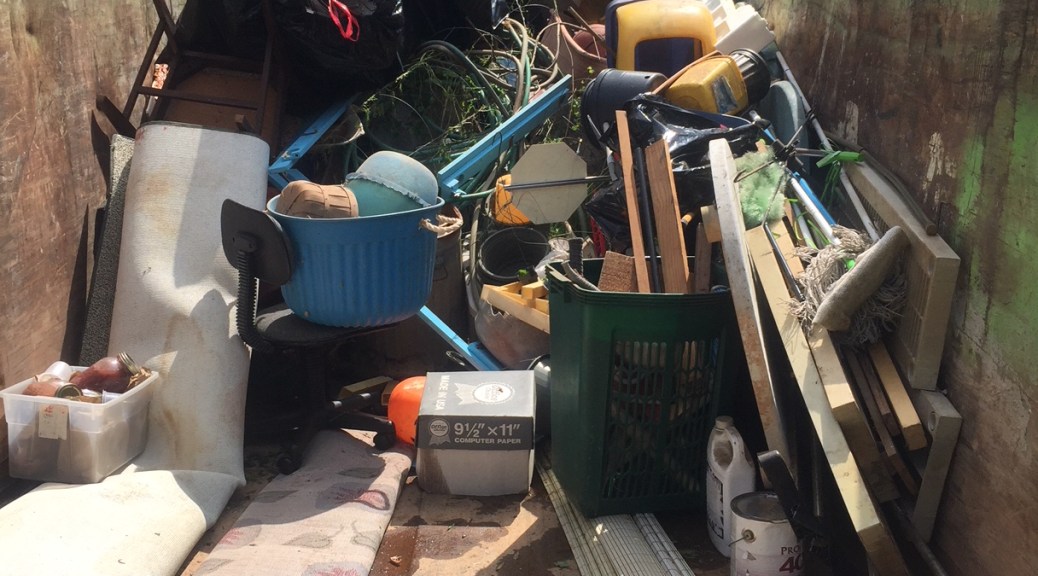
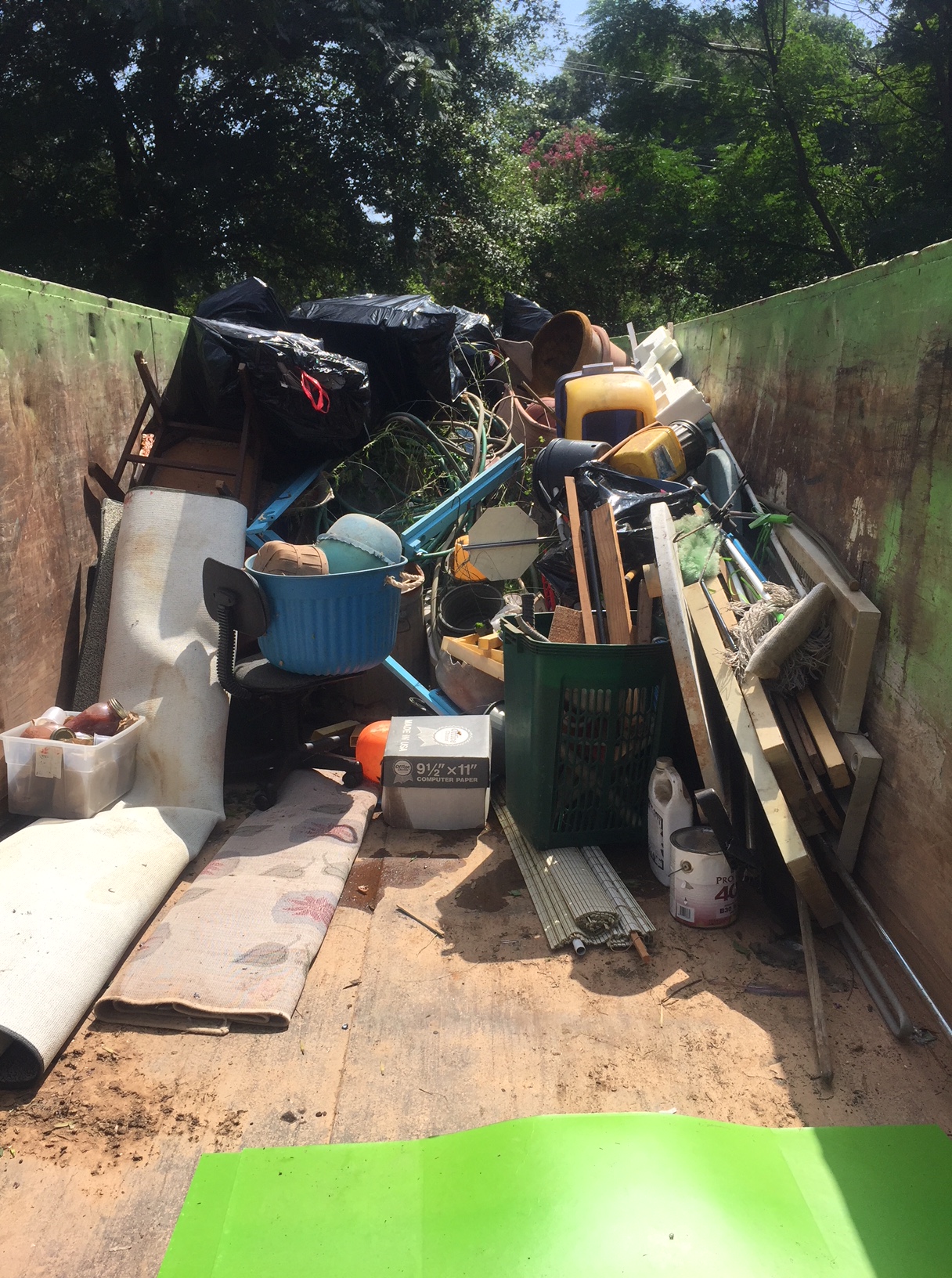
There is, however, a finality to this past weekend. The yard has been rendered nearly barren (compared to the jungle my parents spawned), and the house is almost entirely emptied—much of that waiting in the driveway, a dumpster filled with lives now past.

IMG_5562

Throughout Saturday and Sunday, the task was overwhelming, physically demanding since it seemed that no matter what we hauled to the dumpster even more appeared to be hauled away.

But until late in the day Sunday, I had not found the experience the emotional hurdle that a best friend anticipated when he offered to help.

The unexpected, I suppose, must be unexpected.

I showed up Saturday after a morning cycling ride not really prepared for the day of work in the yard; my mind had convinced me that I would help inside. Once the scope and weight of the task at hand—having the house ready to sell by the end of the weekend—struck everyone, we were past midday Saturday and had resigned ourselves to the only way to finish was simply to throw everything remaining away.

So after working outside all day Saturday, I returned early Sunday morning with the same stubborn resolve to clean the inside of the house.

I began vacuuming the side porch, and although I was summoned out a few times to help the remaining loads to be packed into the dumpster, I then moved to each room of the house, vacuuming floors again and again.

A few hours after lunch and some unanticipated impromptu pest control, we could see the light at the end of the tunnel. Last on the list was scrubbing down the bathrooms and the kitchen.

I vacuumed the front rooms and kitchen, saving them for last since we were tracking through them during the day, and moved to cleaning counter tops in the two bathrooms, ending with the kitchen.

And then the unexpected.

As I wiped the counter and sink in the kitchen, my youth flooded over me, and I had to pause in order to restrain a powerful urge to cry.

One of the great joys of my life was simple. We were a breakfast-for-supper family, a treat we allowed ourselves a few times a month.

I grew up, in fact, thinking that French toast was mainly a vehicle for bacon—not a cross between breakfast and confections. French toast began in my mother’s kitchen with frying an enormous pile of bacon, the grease then recycled for cooking the pile of French toast as well as a side of scrambled eggs.

For most of my life, I ate French toast without syrup and butter—certainly no powdered sugar or syrupy fruit toppings.

But none of this is why I felt a sudden urge to cry.

I don’t recall when it began, but I was tasked in the family with cleaning up after supper. I washed the dishes and cleaned the entire kitchen, diligently.

My mother heaped praise on me for being so meticulous; it was something I did well, and gave me status in the family.

I still feel something soothing about the process of making the kitchen space tidy, clean.

Mid-afternoon yesterday, with Clorox wipes in hand and leaning against the kitchen sink, I felt suddenly heavy, as if I was holding up my entire life lived in that house. I was cleaning my mother’s kitchen for the last time.

Tears made it no farther than the edge of my eyes, blurring my contacts as I breathed against that weight of memory and loss. I gathered myself, wiped the sink, and then moved on to the bar where I had stood day after day in my brace for scoliosis to draw from comic books throughout my teens years.

“The bar is clean,” I told my nephews when they came into the kitchen, “but it is so stained and nicked, it doesn’t look like it.” They mentioned the oven hood, equally clean and terribly stained as well.

My oldest nephew had used the Magic Eraser on the bar, he said, but it still looked dirty.

Some things are indelible, I think, like the sudden realization you are cleaning the kitchen for the last time.

All of us are back at our separate lives today, and that dumpster filled to the rim awaits a truck that will carry all of my parents’ life turned trash to a landfill to be buried.

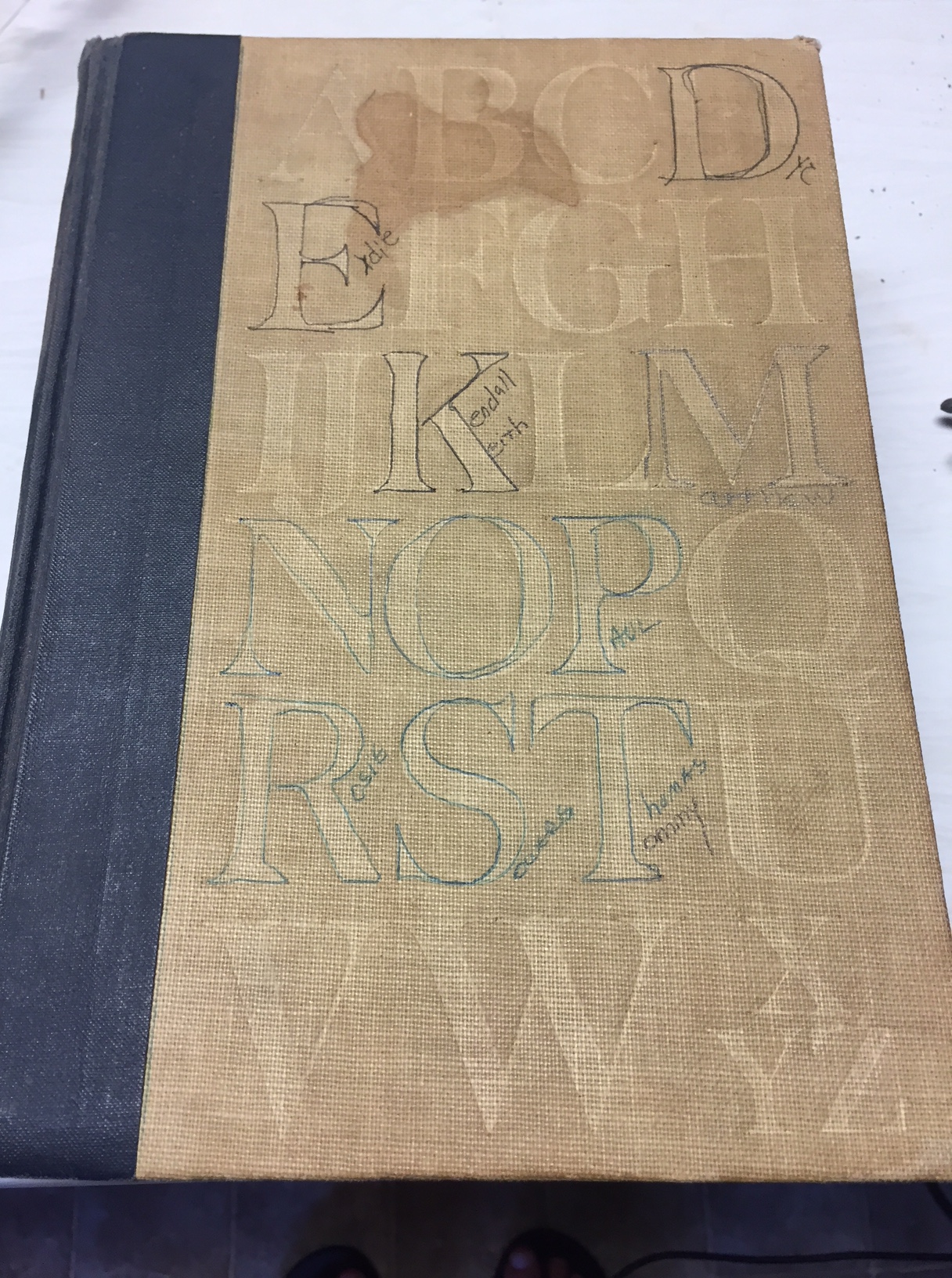
I left with my baptism certificate and the family dictionary, family names scribbled on the cover since the 1960s.

IMG_5556

At some point, too, this will be just trash. Someone else’s problem, maybe even something to fret over before tossing it into a dumpster.

Later in the day Sunday, my nephews took new flowers and a small urn of my mother’s ashes to my father’s grave. I didn’t go.

I had spent the weekend in a kind of graveyard already. I had grunted and sweated toward a sort of stasis that might allow someone else to own this house and land of my parents’ blood, sweat, and tears.

Nothing prepares you for the feelings that rush over you, cleaning the kitchen for the last time.

I am afraid I will never forget. I am afraid I will forget.

Mainstream Journalism Can’t Handle the Truth

Soon-to-be former Associate Editor of The State (Columbia, SC), Cindi Ross Scoppe noted in her good-bye column:

Newspapers the nation over are making a rapid transition into an all-digital future, and right now, there’s not a huge market online for fact-based opinion journalism, particularly when it isn’t extreme, or at least aligned with one side in our culture wars. People like me the nation over are trying to find ways to maintain their integrity, and their pragmatism, while creating a stronger following, and I wish them nothing but the best with this. Unfortunately, the next round of layoffs came too soon for me.

Mainstream journalism, notably the traditional newspaper, is in rapid decline. Scoppe’s departure is yet one more example of the actual human cost of media contracting.

Having placed a number of Op-Eds with The State, I have interacted with Scoppe for many years. On balance, I would place her in a small percentage of journalists about whom I am mostly positive, keeping in mind that I regularly criticize both mainstream journalism broadly and edujournalism narrowly as deeply flawed.

I have, in fact, stated bluntly that even so-called good journalists and good journalism leave a great deal to be desired. Journalists remain steadfast in their commitment to both-sides journalism, and the entire media field/industry is every day more deeply entrenched in press-release journalism out of necessity.

These on-going contractions require fewer and fewer journalists to do more and more. Journalists as generalists (their expertise is journalism, lacking content expertise in the topics they cover), then, simply try to keep their heads above water even when they are faced with a rising tide they have never navigated before.

I paused at Scoppe’s “[p]eople like me the nation over are trying to find ways to maintain their integrity, and their pragmatism.” I am deeply torn between recognizing Scoppe as a very good journalist with genuinely good intentions (in my opinion) and also being able to see that her “pragmatism” (and journalistic code that includes both-sides reporting and a naive pledge “to express my political opinions, with no allegiance to any person or political philosophy,” or seek ways not to be political) more often than not trumped that integrity.

Let me give an example that I think reflects the much larger problem in journalism and news reporting across the U.S.

Scoppe and The State have remained supporters of current South Carolina governor Henry McMaster, calling him the best candidate and even praising him for having integrity.

Yet, McMaster is a strong Trump ally and a shameless NRA candidate. In short, McMaster isn’t a candidate with integrity. His partisan politics are an affront to the high percentage of black and brown citizens of SC as well as to the large percentage of the state that lives in mostly ignored poverty.

This state-level example is not much different than The New York Times remaining unwilling (unable?) to call Trump and his administration liars. The so-called newspaper of record is mostly concerned about White House access.

The truth that mainstream journalism cannot handle is that journalism is its own worst enemy. Journalists are trained to avoid taking ethical stands, to refuse to make evidence-based decisions about credibility and validity.

Mainstream media are complicit in how the U.S. has become a political joke throughout the world.

Chris Cuomo, for example, on CNN plays the role of “journalist holding the administration’s feet to the fire,” but continues to give Kellyanne Conway airtime.

The ugly truth that mainstream journalism cannot handle is that there is no journalism—only theater.

The U.S. has a faux-billionaire reality-TV star as president. The media created him and the media are playing right along to keep this sinking ship afloat.

Like universal public education (which journalists have covered badly for more than a century and a half), the free press is essential to a free people.

Like universal public education, the free press is mostly a deeply flawed—and failing—experiment in democracy since both are deeply tainted by the free market.

However, universal public education and the free press are not the problem. We have failed them; they haven’t failed us.

Education and journalism are both inherently political. Yet formal schooling and the mainstream media function with false expectations that teachers and journalists remain apolitical.

Education and journalism are both inherently ethical pursuits. Yet formal schooling and the mainstream media function with false expectations that teachers and journalists skirt moral and ethical pronouncements.

One of the greatest risks teachers and journalists can take that can directly threaten their careers is to be activists, the highest form of political and ethical behavior.

The activist is one who seeks to garner power to confront the entrenched power of the status quo in the pursuit of change, change that bends the arc of the moral universe toward justice.

Many teachers (and professors) and journalists are in separate boats that are both none the less sinking.

And the harsh truth is that they have created the holes themselves by conforming to the traditional expectations that teachers and journalists simply allow the world to continue as it is.

Don’t be political and surely don’t take any ethical stand in your roles as teachers and journalists.

Almost daily, I see The New York Times begging for subscriptions to keep journalism alive while they refuse to call a lie “a lie.” And while their Op-Ed page devolves more and more into something many of us find hard to distinguish from The Onion.

Maybe journalism deserves to be razed since it can’t stop itself from throwing gasoline on the dumpster fire that is U.S. politics and disaster capitalism.

Maybe we must let this all burn to the ground and hope for a Phoenix rising from the ashes, a new version of a critical free press that can handle the truth.


See Also

Fair and Balanced Education and Journalism: On the Death of Democracy