
At first glance, I thought this was satire from The Onion or McSweeney’s:
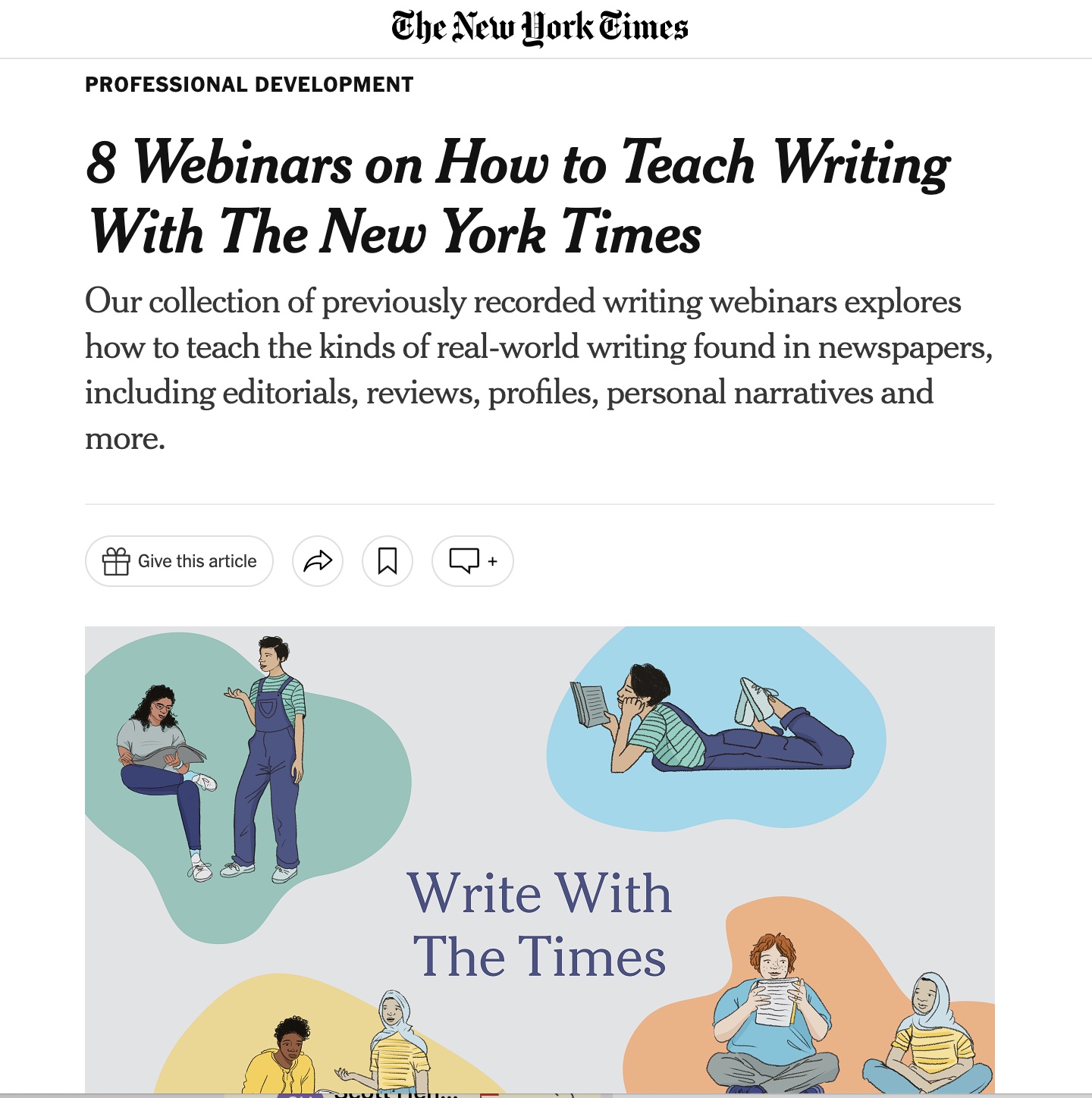
Since this is a real thing, I want to state clearly for anyone aspiring to be a writer or (which is the case for many of us) for anyone currently being a writer and trying to continue our journey, don’t write like the NYT.
I am not being satirical, by the way, and I am not being hyperbolic.
The NYT provides an unmatched platform for their journalists and opinion columnists:
The New York Times (NYT) is an American daily newspaper, founded and continuously published in New York City since September 18, 1851. It has won 112 Pulitzer Prizes, more than any other news organization. Its website is one of America’s most popular news sites, and the most popular among all the nation’s newspapers, receiving more than 30 million unique visitors per month as reported in January 2011. The paper’s print version remains the largest local metropolitan newspaper in the United States and third-largest newspaper overall, behind The Wall Street Journal and USA Today. Following industry trends, its weekday circulation has fallen to fewer than one million daily since 1990. Nicknamed The Gray Lady, The Times is long regarded within the industry as a national “newspaper of record”. It is owned by The New York Times Company. Arthur Ochs Sulzberger Jr., whose family has controlled the paper since 1896, is both the paper’s publisher and the company’s chairman. Its international version, formerly the International Herald Tribune, is now called the International New York Times. The paper’s motto, “All the News That’s Fit to Print”, appears in the upper left-hand corner of the front page. Its website has adapted it to “All the News That’s Fit to Click”. It is organized into sections: News, Opinions, Business, Arts, Science, Sports, Style, Home, and Features. The New York Times stayed with the eight-column format for several years after most papers switched to six, and was one of the last newspapers to adopt color photography.
Roper Center for Public Opinion Research
Yet, invariably, nearly daily, the NYT and its journalists badly mangle their public duty to report the news and offer high-quality and informed opinions from what can be argued as the loftiest perch in print/online newspapers in the U.S.
Being this big and this powerful, it seems, has simply allowed the NYT to be arrogant and incredibly lazy—even petty.
A search on my blog site reveals that over the past ten years I have blogged dozens of times about the inaccurate, misleading, and even harmful articles that are essentially what is common in the NYT.
In a 2017 open letter to the NYT, I detailed why the newspaper of record is failing its mission, including a list of posts where I detail those failures:
- UPDATED: Mainstream Media in (Perpetual) Crisis: More Education Meat Grinder
- The New York Times in an Era of Kool-Aid Journalism
- Mainstream Media, Not Fake News, Spawned Trumplandia
- When Fake Is Real and Real Is Fake: More on Crossing the Bigfoot Line
- Fair and Balanced Education and Journalism: On the Death of Democracy
- U.S. and Education Reform Need a Critical Free Press
- My Open Letter to Journalists: A Critical Free Press, pt. 2
- Invoking “Oliver Rule (Expanded)” for Education Reform Debate
- O, Free Press, Where Art Thou?
And over the past five years, I have continued to catalogue the many predictable ways that the NYT fumbles their relentless coverage of education (and specifically teaching reading) and other topics:
- New Orleans RSD Mirage, Not Miracle: A Reader
- Roundup July 2022: Media, Reading, and Misinformation
- NYT Blasts Calkins with “Science of Reading” propaganda
- Media and Political Misreading of Reading (Again): NYC Edition
- US Media Consumers Trapped in Both-Sides Multiverse [updated]
- Conservative Wet-Paper-Towel Commentary and the So-Called “Liberal” Media
- David Brooks, All-American: A Reader
- Give Me Your Soda, Your iPhone, Your Sick Yearning for Healthcare
So here, at no cost, I want to outline why no one should write like the NYT, and ironically, how reading critically the NYT can serve as a “what not to do” as a conscientious and credible writer.
First, at a superficial and practical level, the NYT simply represents that mainstream media and journalism are in serious decline (however, I want to emphasize, as I will explain below, that the NYT essentially is deeply flawed because of traditional and long-standing journalistic standards of writing). Even major newspapers have been firing editors and journalists for many years.
The field of journalism has contracted significantly, and one of the great costs has been a reduction in editing and editorial oversight as well as shifting the workforce from veterans with full-time, well paid positions to younger (read: cheaper) and even part-time (or freelance) journalists who often have to survive through their own blogging even while being traditional journalists or after they lose their full-time position. (For a little peak at the consequences, I recommend following Typos of the New York Times on Twitter.)
More substantially, however, the NYT is a bastion of bad writing that is a reflection of bad thinking—again, in part, because that is how journalists are trained to write (and think).
In the posts I include above, I have detailed all these essential problems with bad writing/thinking at the NYT and all across mainstream media, but here let me make an accessible list of those problems:
- Both-sides journalism. The NYT is certainly among almost all journalism in this flaw, but, again, the outsized platform that is the NYT makes their impact far greater, and more harmful. Journalists are taught to look for and present “both sides” of issues to give the appearance of not being biased (see more on this below). First, presenting any issue as a “both sides” argument is lazy, the sort of thinking I would not allow in my first-year writing students. Next, by presenting “both sides,” journalists often give the impression the sides are equally valid (and they often are not).
- Press-release journalism. As a result of the contracting industry, journalists have ceded investigative journalism and research to aggressive think tanks and advocacy organizations. Too often, articles in the NYT and across mainstream media are simply repackaged versions of press releases, regardless of the credibility of the information or perspective. Readers are left with deeply biased information presented as credible and unbiased “news” coverage of a topic.
- Crossing the Big Foot Line. Press release journalism is one aspect of a larger shift in journalism. At one point, tabloid journalism and the type of credible journalism found in the NYT were distinct. The example I use is Big Foot. The National Inquirer (tabloid) used to run when I was growing up repeated stories about someone seeing Big Foot. The scam was that the tabloid simply covered that someone made the claim (there was no effort to verify the claims of the source). Just because a tabloid printed a story that Bob claimed the world was going to end in October didn’t mean the tabloid actually was reporting the world would end in October; the article was about Bob claiming the end of the world. Not to be nostalgic or to oversimplify, but mainstream media at that time decades ago would not have touched that sort of story. Yet, during the Trump era and again because the field is contracting, more and more mainstream media simply covers a topic without seeking verification of credibility of any claims (see the many years of Trump when mainstream media simply reported Trump saying false things but refusing to label his claims as “lies”).
- Peddling stereotypes. One of the most insidious flaws with the NYT is grounding journalism and commentary in stereotypes and “common sense” thinking. The NYT perpetuates stereotypes about people living in poverty, public education, policing, race/racism, and essentially every topic they cover. The NYT is absent any critical interrogation of assumptions—mostly because journalists and commentators have little or no background in the topics covered.
- Lacking historical context and crisis rhetoric. Journalists tend to have backgrounds in journalism (a problem as noted above). Without expertise in a topic, journalists and commentators are often trapped in presentism, and the result is Christopher Columbus journalism—the delusion that you have discovered something new and the failure to realize there is a history and likely many experts on the topic to draw from. This is common in coverage of education topics. Because of the lack of context, the coverage often frames topics in crisis rhetoric. Over the past few years, the media coverage of reading is a classic example of misreading a topic, failing to offer historical context, and misidentifying an issue as a “crisis.”
- Taking an objective/non-political pose (and fearing the “liberal media” label). The journalism especially, but the commentary also, at the NYT is mostly discredited by the relentless effort to take an objective pose. That is inherently a lie since everything is subjective, and political. By simply choosing to cover a topic, journalism is biased; by deciding which “side” of “both sides” to present first, journalism is biased. As I have noted before, when I interact with journalists and challenge them for framing “both sides” as equally credible (when they are not), those journalists have often retorted, “It isn’t my job to determine if the position is credible or not.” Yet, in fact, that certainly should be their job. Since journalism and the NYT are often slandered as “liberal media,” the NYT seems determined to prove otherwise—resulting in a constant gaze into the minds of conservative America. The key point here is that the NYT (and any media) cannot be unbiased, objective, or non-political; instead, the NYT could make a much greater effort to be biased toward nuanced and valid claims about the topics they choose to cover.
Suffice it to say, don’t write like the NYT.
And don’t believe most of what you may read in the NYT because the “national ‘newspaper of record'” is broken.
 dr. p.l. (paul) thomas