It was the summer of 1975 when I was diagnosed with scoliosis—and eventually fitted with a massive upper-body brace designed to allow my vertebrae to grow and my spine to return to something like normal.
I was entering ninth grade, scrawny and nerdy. Deeply insecure, introverted, and (although I wouldn’t realize this for over 20 years) nearly paralyzed with anxiety.
My parents were incredibly supportive; they rushed to provide anything they could to make the experience less traumatizing. But I was heading off to school daily in the brace, the self-consciousness of adolescence intensified exponentially.
By sheer coincidence, my refuge from this experience was comic books, which I began collecting and also drawing from while I stood at our long bar separating our kitchen and living area.
Eventually, my efforts as an artist—which progressed from tracing to drawing superhero comics to drawing in pencil realistic portraits and even recreating album covers on the walls of our dorm rooms—waned in my early 20s.
Four-plus decades later, I discovered Procreate on the iPad, having watched my partner teach herself art on the program.
If Procreate/iPad had existed when I was a teen, I believe I would have never stopped doing art, but I have jumped back in.
The feel of drawing digitally has been disorienting so I started doing some photograph-based work to learn how to use the program and adjust to the feel of the digital pencil.
My first experiment was with the only image I have of Lou LaBrant:
What I had planned to be a way to practice Procreate, however, became something I want to do as artwork, although working from my original photgraphs.
Here are two of my projects, both from original photgraphs.
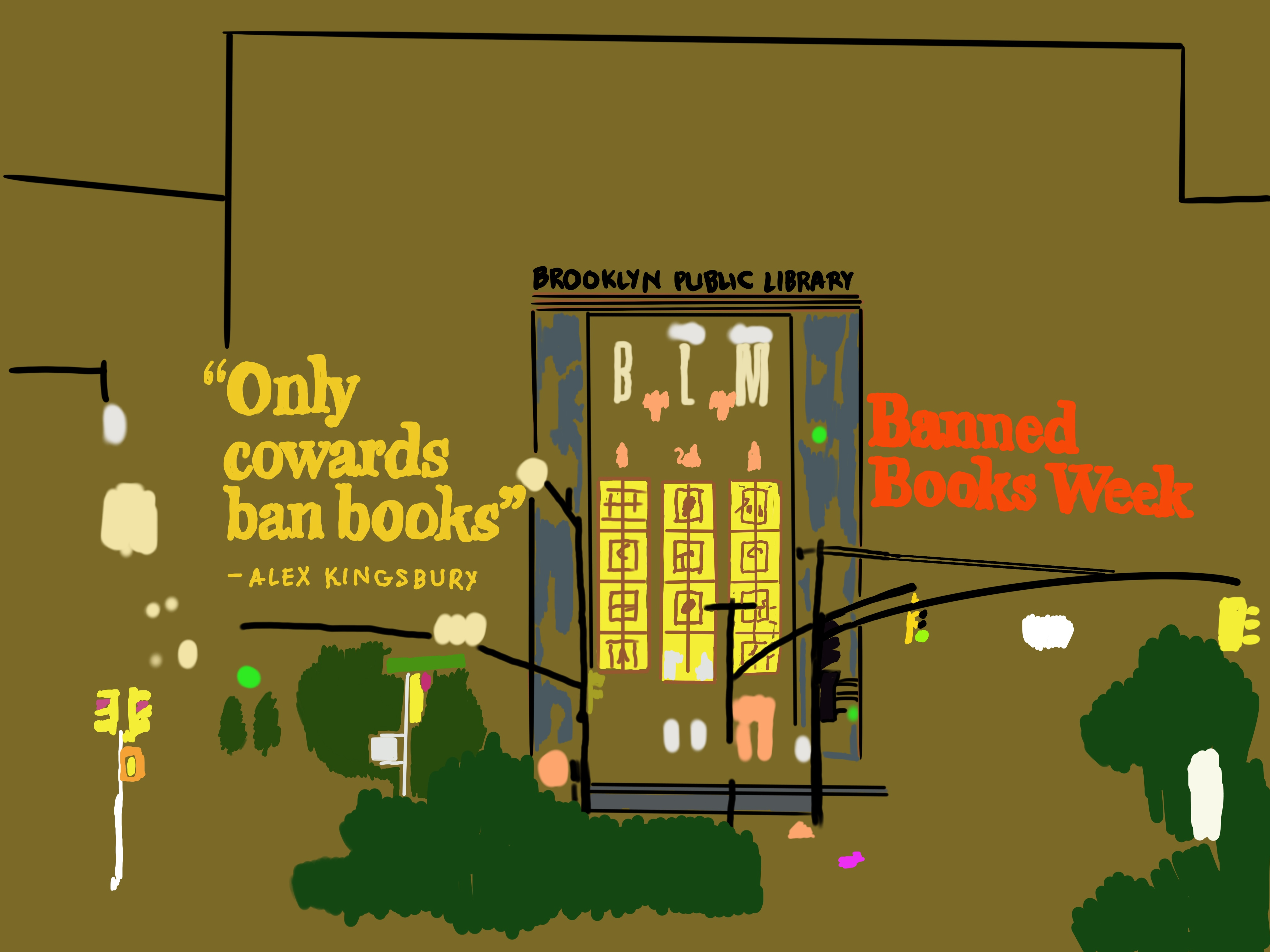
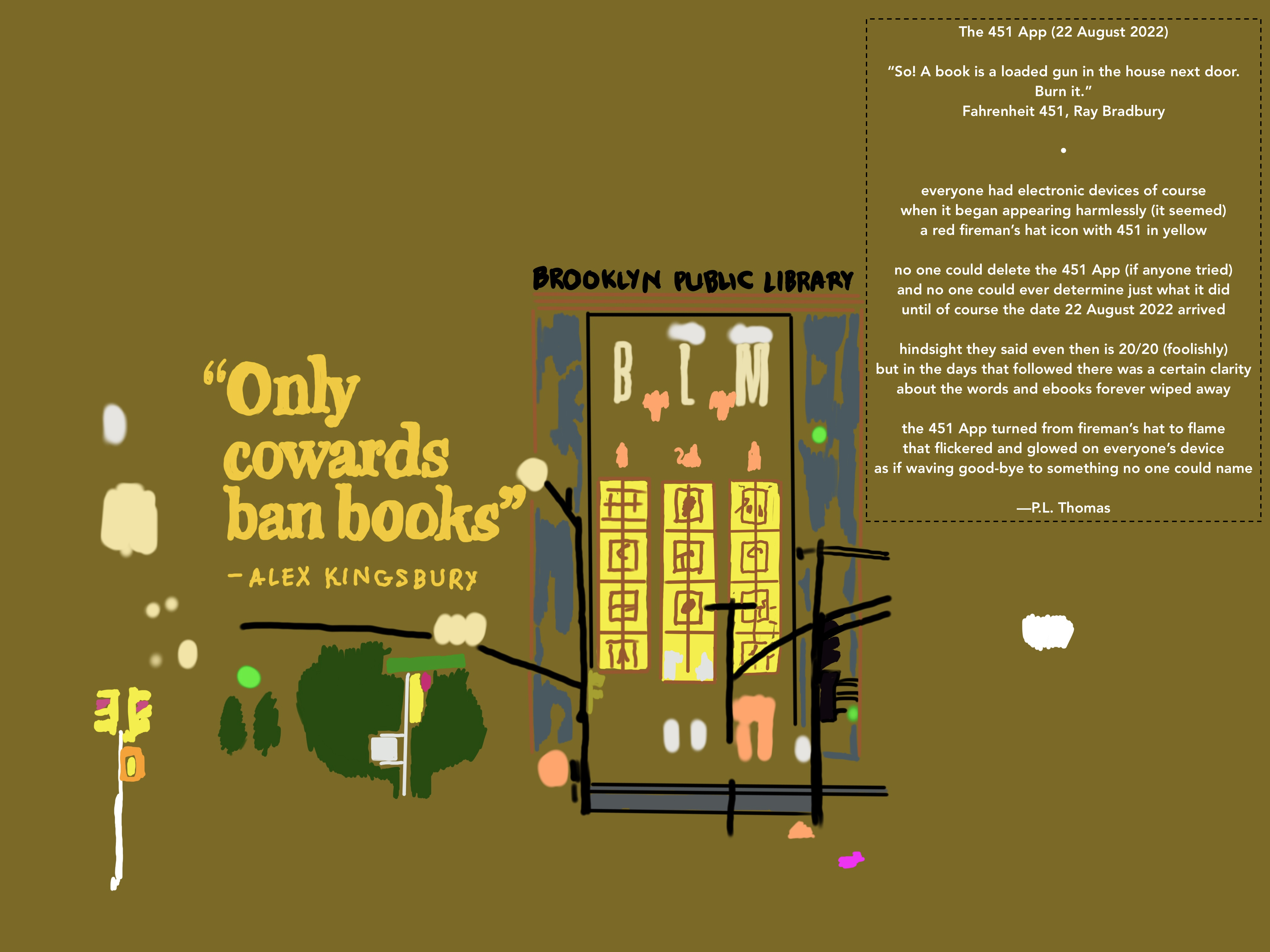
First, I based “Only Cowards Ban Books” on a photograph I took at the Brooklyn Public Library. Part of my purpose here was to play with colors and since this addresses censorship, I have a great deal of space where parts of the original photograph are missing.
Also absent is that the original was taken at dark so I used color to emphasize the sporadic lights.
This follows Pickens County schools banningStamped, Racism, Anti-Racism, and You (for 5 years) and Perks of Being a Wallflower (for 3 years). As well, Runkle also reported, the Greenville County Republican Party targeted LGBTQ+ books included in children’s sections of the library.
Unreported, however, are numerous “quiet” bans and censorship occurring weekly if not daily in schools all across the Upstate of SC and the US broadly.
For Republicans, Banned Books Week is a time for them to actively ban books—another misreading of what academic freedom and individual rights mean in the US.
Again, the new normal in US schools—classrooms and libraries—and now increasingly including public libraries is allowing individuals to ban access to books for everyone else.
This is not about parental rights, as one often-banned author asserts:
“They act like they’re concerned for the kids, but they’re not,” said Ellen Hopkins, the author of Crank, Tricks, People Kill People, and many other challenged books. “By saying, ‘Books on LGBTQ content can’t be there,’ they’re not only saying these kids don’t count. They’re saying they shouldn’t exist.”
…According to the PEN list, Hopkins is the author most frequently banned, with 43 bans. Gender Queer by Maia Kobabe, the second most banned author, is the most banned book. The memoir has been pulled from 41 districts, according to the report. Next comes All Boys Aren’t Blue by George M. Johnson and Pérez’s Out of Darkness.
If the bans were about parental rights, we would be acknowledging that when one parent has books removed from libraries and classrooms, that parent is denying the rights of all other parents who want their children to have access to those books.
But even more important is that access to books is about children’s and students’ rights, as author George M. Johnson explains:
My book, “All Boys Aren’t Blue,” is a young adult memoir about my experience growing up Black and queer in America. In my story, I discuss growing up in a Black family who loved and affirmed me; the good, bad and ugly truths about what teens really deal with; and my journey through gender and social identity. My life was and still is full of joy, but also include some painful moments involving nonconsensual sex, as well as my experience with losing my virginity. Unfortunately, my sexual experiences have been deemed “an issue” — pornographic by some. To be clear, this book is for ages 14-18 and it contains truths that many of us have experienced and are healing from. People’s backlash, in all forms, is being used to disguise the real issue.
Access to books is access to ideas and coming to know ourselves, regardless of whether or not anyone meets societal standards of “normal,” which can be very harmful for those who discover they exist outside those expectations. Suicide and self-harm are disproportionate among LGBTQ+ young people, and book banning as well as curriculum censorship contribute to hostile environments for these young people.
I came out as queer to my mom as a senior in high school. It took almost a decade to also come out to her as nonbinary, even though I had been questioning my gender identity since I started puberty at age 11. A major reason for this long delay between my first coming out and my second was the lack of visibility of trans and nonbinary identities when I was young. By high school, I had met multiple out gay, lesbian and bisexual people, but I didn’t meet an out trans or nonbinary person until I was in grad school. The only place I had access to information and stories about transgender people was in media — mainly, in books.
Ultimately, book banning and censorship can never be justified. If parents want to shelter or indoctrinate their own children (homeschooling that teaches flat-earth misinformation)—as disturbing as that is—that is substantially different than any parent seeking to control how everyone else navigates books, ideas, and learning.
Republicans are misreading Banned Books Week as a call for bans and censorship, the most UnAmerican ways to destroy our libraries and schools.
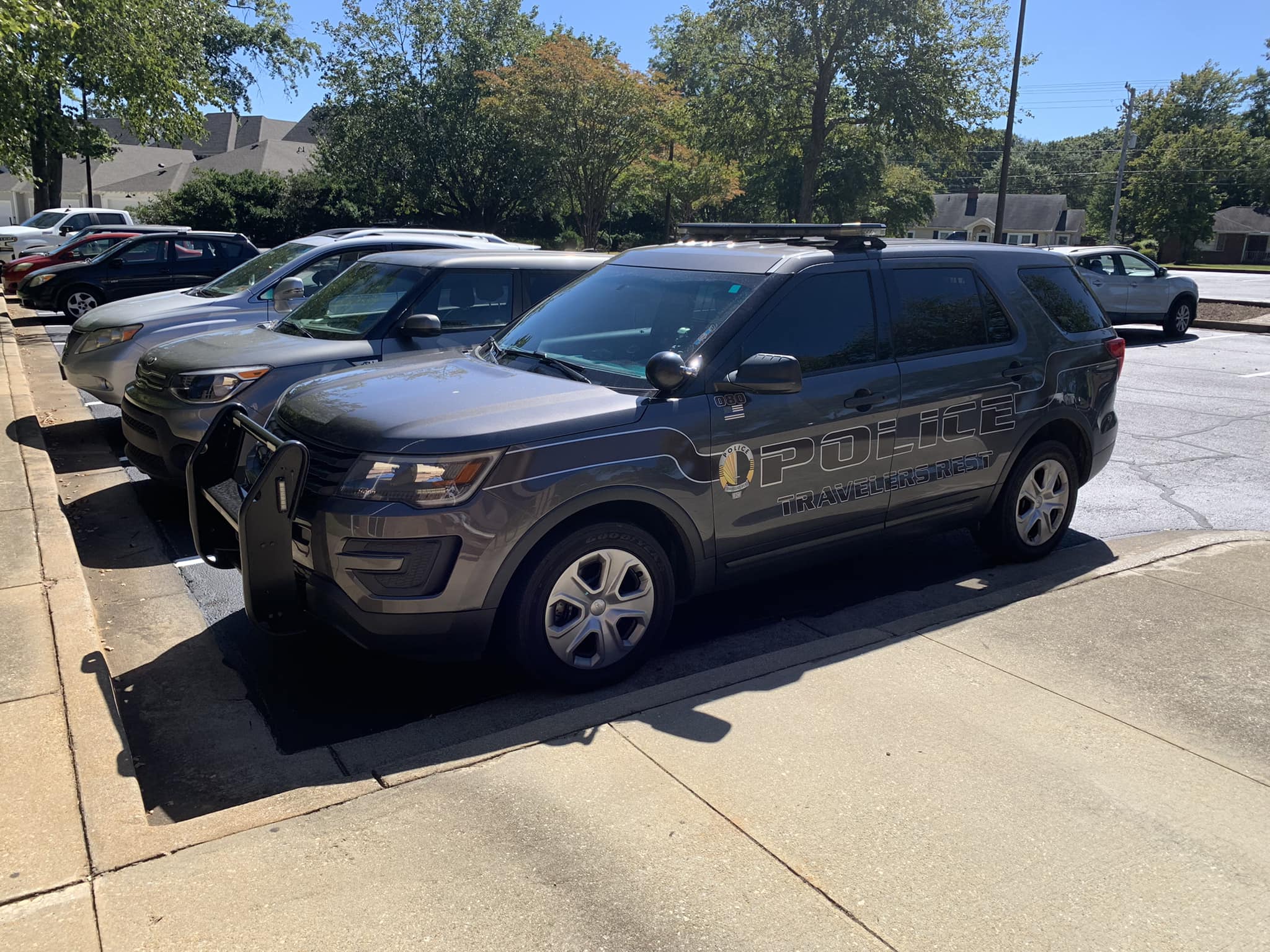
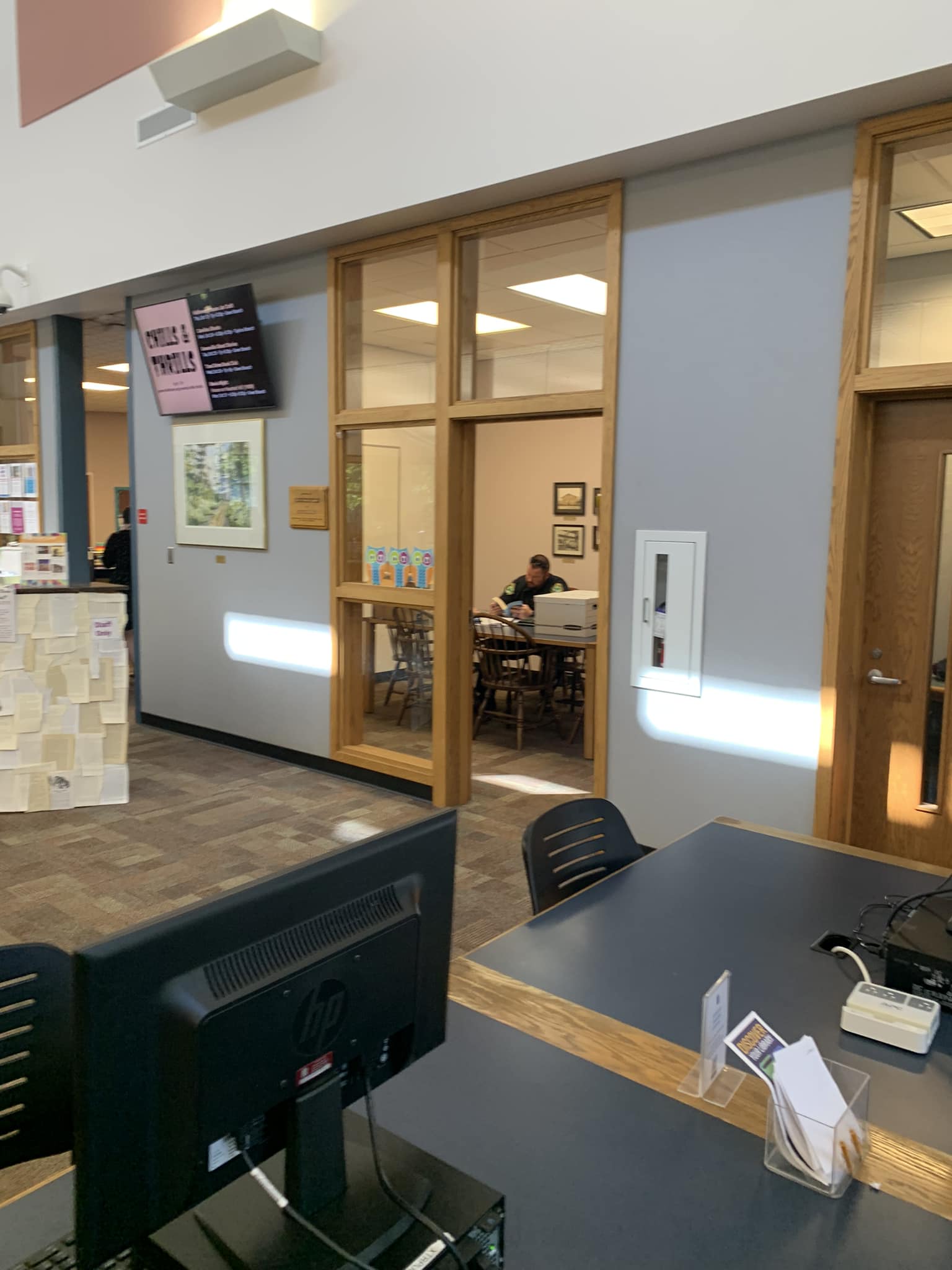
Armed police officers walking into a public library to evaluate the books available to a free people is proof that we are in fact not a free people.
did they tell you
the feathers are merely ornamental?

that’s to keep you from trying

that's to keep you from flying

grounded
ground into dust

•

did they tell you
you are no bird—

or of course
we need the babies?

need you overfull
weighted down

•

these lies
you must carry

these lies
you must come to terms with

—P.L. Thomas
NOTE: My original poetry will now be posted here, but please find my poetry-only blog here for older poems.
i tiptoe through your garden
but it is dark
so there will be carnage

i should have done this barefoot
and in the daylight
i realize stepping blindly

then i could feel and see
this trail of me
my silent destructions

(other people would just tapdance on your heart
or carelessly bloody your shins
ruthless and graceless)

in the morning you will find me surefooted
knees caked in mud
my head resting apologetically against your back door

—P.L. Thomas
NOTE: My original poetry will now be posted here, but please find my poetry-only blog here for older poems.
My partner and I took two of my grandchildren—Brees, 6, a kindergartener, and Skylar, 8, a third-grader—to a local high school football game where their father is an assistant coach.
As we were leaving, Brees said “Dorman” as we passed a sign for the school. My partner asked if he read the word, he explained he remembered “Dorman” starts with a “D” and ends with an “N” so he made a contextualized, and correct guess.
We praised him, and then he proceeded to spell “Dorman” with brief hesitations—”D,” “O,” “R,” “M,” “E,” “N.” My partner told him he did a great job and that he was nearly perfect, but the final vowel is “A,” although the “E” was a reasonable choice considering how the word is pronounced (especially here in the South).
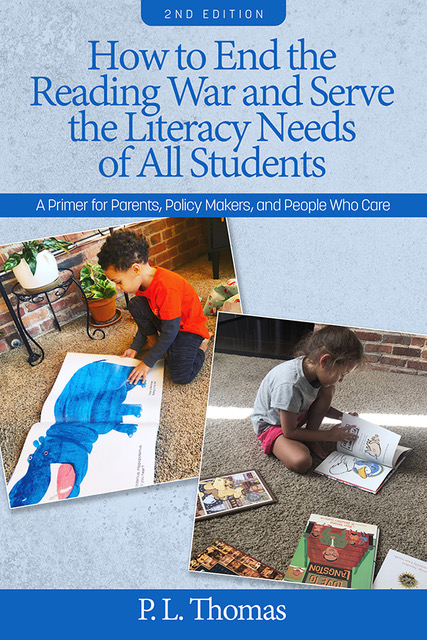
I think about these children, beginning and emerging readers both, often as I continue to challenge the reductive current reading war driven by the “science of reading” movement. I have written about Skylar, an eager reader, and included both children on the cover of the second edition of my book about that reading war:
Brees demonstrated the value of having a wide and deep toolbox for reading for meaning, and represents, I think, the real-world value of seeking context and clues beyond simple decoding and reliance on phonics (although both are, of course, part of that toolbox). Ultimately, the key to his reading “Dorman” was experiential—having visited the school and having seen the word on clothes, etc., with his father.
And while this reading war leaves me nearly drained from frustration—and even angry—I am possibly more concerned about the other reading war. That reading war is the rise of censorship by parents and elected Republicans as well as the self-censorship occurring in our schools, self-censorship that is often nearly invisible but eroding literacy and academic freedom.
To paraphrase John Dewey and add a bit of attitude, why the hell are we concerned about teaching children to read if we are bound and determined to erase books and meaningful texts from their hands?
Traditionally, we have implemented in schools two approaches that I reject—whole class assigning and studying of texts (often limited to a very narrow canon) and allowing parents to opt their children out of those assignments.
My frustration with those practices now seems very naive since the new normal is that any single parent can have books and texts banned not just for their children, but for all children. And unlike the occasional complaint I experienced when teaching high school, states have passed book bans and curriculum censorship—exclusively by Republicans—all across the U.S.
I spent a few days this past week in Flatbush/Brooklyn, and while walking around, passed the Brooklyn Public Library just after sunset:
There is no way to justify book bans or censorship—not by Republicans, not by parents, and especially not by educators, the most vile actors in this movement.
There are books and ideas I genuinely loathe, such as the so-called novels of Ayn Rand. I criticize them, and would never encourage anyone to read them, but I would fight to make sure they are on book shelves of school and public libraries and in books stores, that anyone has access to them, that everyone has access to them.
“Coward” seems too mild a word, in fact.
But, yes, people who ban books, people who censor are cowards, and our children as well as academic freedom are the collateral damage in this senseless and UnAmerican reading war.
Increasingly, this is how students are being assessed in classrooms, but also in standardized tests of “reading,” often as evidence that the “science of reading” works (see Coles for a thorough examination of how the media and schools make this misleading claim [1]).
This approach is grounded in DIBELS [2], an assessment of nonsense words, but many reading programs that are phonics-first and phonics-intensive now incorporate having students pronounce nonsense words and promote the programs as the “science of reading” and/or “structured literacy.”
Structured Literacy
Structured literacy describes a scripted approach to teaching reading that requires uniform instruction. It may include the following: scripted lessons, systematic phonics (including programs such as Orton-Gillingham [59] ), decodable texts, [60] prescribed reading instruction for all students based on the needs of struggling students, structured literacy reading programs, and strict requirements for program compliance. [61] Structured literacy draws from cognitive psychology, brain research, and neuroscience, although literacy researchers caution there is still much to learn about the brain and learning to read. [62]
While proponents of competing theories all claim research support, there is general agreement that the evidence-based literature presents at least three consistent and compelling conclusions: Reading is a complex process consisting of a wide range of skills and strategies; culture and experience impact learning to read; and student needs change as they develop reading proficiency. [63]
Thomas, P.L. (2022). The Science of Reading movement: The never-ending debate and the need for a different approach to reading instruction. Boulder, CO: National Education Policy Center. http://nepc.colorado.edu/publication/science-of-reading
Several problems exists with this new emphasis on systematic phonics and phonics-first instruction (devoid of comprehension). First, focusing on strict rules of phonics and using nonsense words teaches young readers that mere pronunciation is reading (which it isn’t) and allows overly simplistic definitions to feed overly simplistic (and misleading) assessments.
And that leads to a second problem—raising scores on basic pronunciation of words, especially nonsense words that are designed to meet the simplistic rules being taught, is much easier to do than to teach and assess comprehension. Notably, raising these scores is even easier once other policies are in place, such as the harmful but effective use of grade retention.
Current examples of reading “miracles” (such as Mississippi from 2019; see here) are mirages; the score gains are distortions of data and the assessments are simply not measuring reading (again, they are measuring a very reduced type of pronunciation devoid meaning).
The greatest problem, however, is that the current nonsense word focus significantly misrepresents what the reading science shows about systematic phonics:
Systematic Phonics and Comprehension
Although phonics is only one essential aspect of reading, many researchers emphasize the importance of systematic phonics instruction for beginning and struggling readers. Research on the direct impact of phonics on reading comprehension is complicated because many approaches to phonics exist—from synthetic or analytic phonics [68] and systematic phonics programs (such as Orton-Gillingham) to phonics instruction embedded in holistic instruction [69] (such as whole language and balanced literacy [70]).
In short, research on the importance of phonics instruction is clear, but there is much less clarity about what type of phonics to teach and how much direct instruction students need or when. [71] There is consensus that proficient readers have strong phonics knowledge, but how that occurs (through direct instruction, reading, or both) remains a point of debate.
One recent overview of 12 meta-analyses [72] of the effectiveness of systematic phonics concluded that systematic phonics instruction for all students was no more effective than whole language or balanced literacy approaches. This analysis raises concerns about conducting research comparing competing instructional reading practices and recommends that policy-makers seek additional approaches to reading instruction. [73] As noted earlier, a 2022 analysis of England’s shift to systematic phonics concluded that the new phonics-first approach was not as effective as a “balanced” approach to reading instruction. [74]
Recent research on systematic or direct phonics instruction continues to show effectiveness in children pronouncing real and nonsense words (notably in Grade 1), but less effectiveness in promoting comprehension, especially in kindergarten or for readers in later grades. [75] Instead of systematic phonics, reading amount and comprehension instruction are more effective or at least as important as phonics for fostering comprehension and learning to read. [76]
Thomas, P.L. (2022). The Science of Reading movement: The never-ending debate and the need for a different approach to reading instruction. Boulder, CO: National Education Policy Center. http://nepc.colorado.edu/publication/science-of-reading
Ultimately, the “science of reading” movement is oversimplifying the messages the public, parents, and political leaders receive concerning how to teach reading, what counts as reading, and how to assess reading.
Learning to read is complex, and unique to each student; thus, teaching reading is also complex and somewhat haphazard. Ideally, formal schooling in reading should foster reading over many years, recognizing that individual students will progress at different rates.
Yes, we want eager and skilled readers, and we should work purposefully to provide all students the experiences they need to learn both the enjoyment of reading and the power of critical literacy. And yes, skilled critical readers have decoding skills, content knowledge, and a number of inter-related strategies for making meaning from text and other communication signals (we “read” icons all across our technology devices, for example).
But for many of us who are skilled readers, we have gained all those skills from reading, not from doing isolated, decontextualized, and nonsense practice instead of reading.
Pronouncing nonsense words is complete nonsense, and even worse, it is not reading—but it is wasting valuable teaching and learning time that every student deserves, time better spent with meaningful experiences with real words and real texts.
59 “Structured Literacy is an umbrella term that was adopted by the International Dyslexia Association to refer to the many programs (like Orton-Gillingham) that teach reading by following the evidence and research behind the Science of Reading. Programs that exemplify the components and methods that are outlined in the term, Structured Literacy, have been found to be beneficial for all students and essential for students who struggle with reading.” Retrieved July 26, 2022, from https://www.orton-gillingham.com/
61 Compton-Lilly, C.F., Mitra, A., Guay, M., & Spence, L.K. (2020). A confluence of complexity: Intersections among reading theory, neuroscience, and observations of young readers. Reading Research Quarterly, 55(S1), S185-S195. Retrieved July 26, 2022, from https://doi.org/10.1002/rrq.348
62 Compton-Lilly, C.F., Mitra, A., Guay, M., & Spence, L.K. (2020). A confluence of complexity: Intersections among reading theory, neuroscience, and observations of young readers. Reading Research Quarterly, 55(S1), S185-S195. Retrieved July 26, 2022, from https://doi.org/10.1002/rrq.348
Seidenberg, M. (2018). Language at the speed of sight: How we read, why so many can’t, and what can be done about it. Basic Books.
Seidenberg, M.S., Cooper Borkenhagen, M., & Kearns, D.M. (2020). Lost in translation? Challenges in connecting reading science and educational practice. Reading Research Quarterly, 55(S1), S119-S130. Retrieved July 26, 2022, from https://doi.org/10.1002/rrq.341
Willingham, D.T. (2017). The reading mind: A cognitive approach to understanding how the mind reads. Jossey-Bass.
63 Compton-Lilly, C.F., Mitra, A., Guay, M., & Spence, L.K. (2020). A confluence of complexity: Intersections among reading theory, neuroscience, and observations of young readers. Reading Research Quarterly, 55(S1), S185-S195. Retrieved July 26, 2022, from https://doi.org/10.1002/rrq.348
70 Bowers, J.S. (2020). Reconsidering the evidence that systematic phonics is more effective than alternative methods of reading instruction. Educational Psychology Review, 32(2020), 681-705. Retrieved July 26, 2022, from https://link.springer.com/article/10.1007%2Fs10648-019-09515-y
72 “Meta-analysis is the statistical combination of results from two or more separate studies.” See Deeks, J.J., Higgins, J.P.T., & Altman, D.G. (2022). Chapter 10: Analysing data and undertaking meta-analyses. Cochrane Training. Retrieved July 26, 2022, from https://training.cochrane.org/handbook/current/ chapter-10
73 Bowers, J.S. (2020). Reconsidering the evidence that systematic phonics is more effective than alternative methods of reading instruction. Educational Psychology Review, 32(2020), 681-705. Retrieved July 26, 2022, from https://link.springer.com/article/10.1007%2Fs10648-019-09515-y
74 Wyse, D., & Bradbury, A. (2022). Reading wars or reading reconciliation? A critical examination of robust research evidence, curriculum policy and teachers’ practices for teaching phonics and reading. Review of Education, 10(1), e3314. Retrieved July 26, 2022, from https://doi.org/10.1002/rev3.3314
75 Bowers, J.S. (2020). Reconsidering the evidence that systematic phonics is more effective than alternative methods of reading instruction. Educational Psychology Review, 32(2020), 681-705. Retrieved July 26, 2022, from https://link.springer.com/article/10.1007%2Fs10648-019-09515-y
Davis, A. (2013, December 13). To read or not to read: Decoding synthetic phonics. IMPACT No. 20. Philosophical Perspectives on Education Policy. Retrieved July 26, 2022, from https://doi.org/10.1111/2048-416X.2013.12000.x
Filderman, M. J., Austin, C.R., Boucher, A.N., O’Donnell, K., & Swanson, E.A. (2022). A meta-analysis of the effects of reading comprehension interventions on the reading comprehension outcomes of struggling readers in third through 12th grades. Exceptional Children, 88(2), 163-184. Retrieved July 26, 2022, from https://doi.org/10.1177/00144029211050860
Pearson, P.D. (2019, October 12). What research really says about teaching reading—and why that still matters [Video]. International Literacy Association 2019 Conference. Retrieved May 18, 2022, from https:// ila.digitellinc.com/ila/sessions/123/view
Wyse, D. & Bradbury, A. (2022). Reading wars or reading reconciliation? A critical examination of robust research evidence, curriculum policy and teachers’ practices for teaching phonics and reading. Review of Education, 10(1), e3314. Retrieved July 26, 2022, from https://doi.org/10.1002/rev3.3314
76 Allington, R.L., & McGill-Franzen. (2021). Reading volume and reading achievement: A review of recent research. Reading Research Quarterly, 56(S1), S231-S238. Retrieved July 26, 2022, from https://doi.org/10.1002/rrq.404
Filderman, M.J., Austin, C.R., Boucher, A.N., O’Donnell, K., & Swanson, E.A. (2022). A meta-analysis of the effects of reading comprehension interventions on the reading comprehension outcomes of struggling readers in third through 12th grades. Exceptional Children, 88(2), 163-184. Retrieved July 26, 2022, from https://doi.org/10.1177/00144029211050860
In the 2000s, the National Reading Panel (NPR) report and the reports from its subgroups[1] were adopted into George W. Bush’s No Child Left Behind (NCLB) legislation, mandating scientifically based instruction[2] and establishing a framework for how reading should be taught in the U.S.—what is often identified as the Five Pillars of Reading: phonemic awareness, phonics, fluency, vocabulary, and comprehension.[3]
However, only two decades later, the U.S. is facing another reading “crisis” along with an increase in state-level reading legislation and policy being revised or introduced.[4] The current movement is often the result of advocacy by parents concerned about dyslexia (Decoding Dyslexia[5]) and media coverage of the “science of reading.”[6] That advocacy and media messaging have been incredibly effective in terms of driving legislation and policy; however, many literacy scholars and researchers have noted the media-based movement exaggerates and oversimplifies claims about reading, science, and research; depends on anecdotes and misleading think-tank claims about successful implementation of reading research; and creates a hostile social media climate around reading debates.[7]
A summer 2022 analysis by Education Week shows that at least 30 states have passed revised or new reading legislation in the past decade and 2/3rd of those states includes grade retention policies.[8] Over that decade, state-level reading policies and practices include the following:
Legislation focusing on reading proficiency by 3rd grade, often including grade retention policies linked to high-stakes testing.[9]
Commercial reading programs being banned at the state level and re-evaluated at the district and school levels.
Reading policy and practices targeting dyslexia, including universal screening and mandates for systematic phonics instruction (often Orton-Gillingham[10]).
Policies have mandated systematic phonics instruction for all students.
A renewed emphasis on phonics in teacher professional development (such as requiring training in LETRS) and teacher education.[11]
Two aspects of this reading “crisis” and subsequent legislation and policy are important for all policy makers in states across the U.S.: (1) Continuing to follow the same in-school only policy approaches to education and reading[12] are destined to fail again,[13] and (2) several elements of the “science of reading” movement are contradictory and even harmful for students.[14]
Below, this examination focuses on grade retention as reading policy, highlighting the complicated impact of grade retention on reading achievement (specifically standardized test scores) as well as the disproportionate negative impact of retention on vulnerable populations of students (racial minorities, multilingual learners, students identified as at-risk, high poverty, below reading proficiency, etc.)
Grade Retention as Reading Policy
As noted earlier, grade retention as reading policy is relatively common and expanding across the U.S.:
The “science of reading” movement has increased state policies mandating grade retention based on high stakes testing, copycat versions of the post-NCLB “Florida model,” despite evidence suggesting that retention remains harmful.[15] Media have presented increased standardized test scores in Mississippi (see an examination of Mississippi’s 2019 NAEP scores below) as proof of the effectiveness of reading science reforms,[16] although it is likely, as Todd Collins for Thomas B. Fordham Institute explains, that Mississippi’s high retention rate[17] and not classroom instruction reform is the primary source of the score increases. Evidence since the mid-2000s confirms grade retention can increase test scores short-term, but the long-term impact is negative, since grade retention remains associated with students dropping out of high school.[18]
Because of short-term reading score increases, grade retention policy remains politically compelling for policy makers because high-profile research is covered in the media and used by advocates to impact policy change based on standardized reading scores.[19] Yet, policy makers must be cautious because research has not yet clarified if those increases are caused by retention or other policies impacting retained students: “This means the researchers do not know if these positive outcomes for those below the cut-score were due to the greater likelihood of retention or to the assurance of additional services”; reviews of short-term gains continue to show that they fade over time and that negative consequences of grade retention (like eventually dropping out of school) remain.[20]
Ultimately, grade retention increasing 3rd and 4th grade standardized test scores is likely a statistical mirage (notably since evidence shows those gain disappear by middle school). That mirage is likely the result of how grade retention changes the population of students being tested by
(1) removing students likely to score low from the testing pool (students retained in 3rd grade would not be in their peer testing pool in 4th grade) and
(2) creating a population of students to be tested when at least one year biologically older than the pool being testing (once those retained in 3rd grade are promoted to 4th grade).
Since grade retention as reading policy is unlikely to produce valid increases in reading proficiency among students and since grade retention remains strongly associated with negative outcomes for students (dropping out of high school, for example), policy makers are strongly encouraged to eliminate grade retention mandates based on standardized test scores in grade 3 as identified by a Resolution from the National Council of Teachers of English (NCTE):
Grade retention, the practice of holding students back to repeat a grade, does more harm than good:
retaining students who have not met proficiency levels with the intent of repeating instruction is punitive, socially inappropriate, and educationally ineffective;
basing retention on high-stakes tests will disproportionately and negatively impact children of color, impoverished children, English Language Learners, and special needs students; and
retaining students is strongly correlated with behavior problems and increased drop-out rates.[21]
What about Mississippi?
While a high-profile article in the New York Times suggested a Mississippi reading “miracle” based on 2019 National Assessment of Educational Progress (NAEP) scores,[22] that conclusion was greatly misleading and incomplete. However, a closer and more nuanced look at Mississippi provides a valuable understanding for current policy makers concerned about reading legislation and policy.
First, as noted above by Collins, Mississippi’s 2019 NAEP scores are significantly impacted by grade retention, and policy makers must acknowledge that grade retention disproportionately impacts vulnerable student populations (see NCTE Resolution), for example:
Table 1 shows that, specifically for example, Black students are disproportionately impacted by grade retention. Numbers of students retained and that disproportion are strong indicators of the harm and punitive impact of grade retention.
Further, Mississippi’s 2019 NAEP reading scores for grade 4 were outliers compared to the rest of the U.S, that outlier status suggests that Mississippi may not be a valid source of scaling up reform for other states. Nonetheless, Mississippi’s longitudinal data, since 1998,[23] suggests improved test data over time and well before many of the recent policies:
Although Mississippi’s policies, standards, and assessments have varied since 1998, the state has shown gradual but persistent improvement in grade 4 reading scores on NAEP. The 2019 large increase used by the “science of reading” movement to claim “miracle,” however, is not unique; see the significant increase from 2002 to 2009, occurring well before any use of the term “science of reading.”
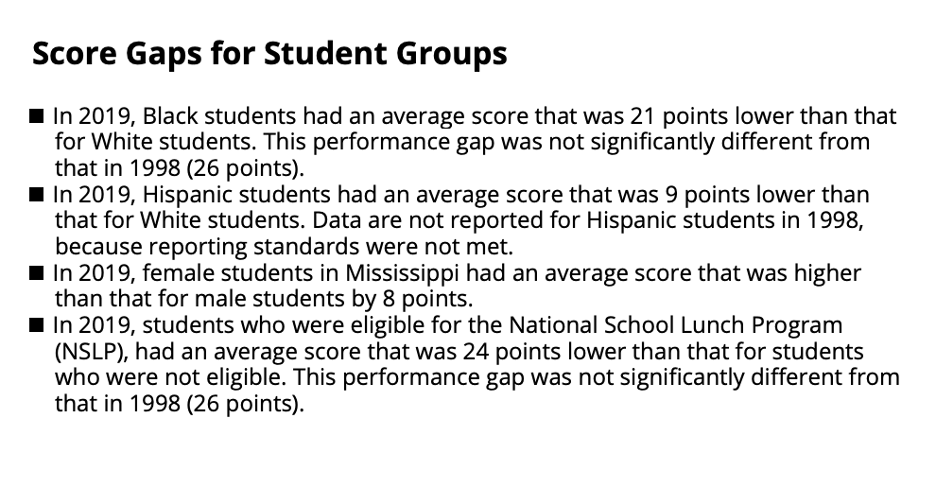
Important to understand is that improvement in education is likely complicated to cause and difficult to link to any single practice; therefore, policy makers must be diligent about “first, do no harm” by avoiding policies that may have politically expedient outcomes at the expense of the best interest of students and teachers. The relative increase and success by Mississippi in 2019 when compared to the rest of the U.S. is strongly tempered by a fuller analysis also:
Many policy makers have been seeking ways to close these gaps for decades, and Mississippi shows us that even when there is gradual and persistent improvement, problems of inequity remain.[24] Therefore, Mississippi’s 2019 NAEP data are not a “miracle,” but they are an important red flag about the insufficiency of school-only policy and of doing the same things over and over while expecting different results.[25]
Grade retention distorts test data, disproportionately impacts and punishes vulnerable populations of students, and creates a distraction from reading reform’s ultimate goal of increased student reading proficiency.
Third-Grade Proficiency and the “Word Gap”
Along with grade retention, policy makers must reconsider two other aspects of reading that often influences policy and practice—third grade reading proficiency and the “word gap.”
Policy makers and educators tend to focus on third grade reading proficiency because it (like grade retention) is correlated with negative outcomes for students, such as dropping out and prison.[26] However, while these concerns are valid, grade-level reading must be recognized as a measurement primarily created and used by the textbook industry; identifying “third grade reading level” is not as accurate or useful as many people think. More importantly, research suggests a correlation between third grade proficiency and negative outcomes, which does not warrant creating high-stakes policy around a single grade or a single measurement.[27]
Based on a popularize and often cited study by Hart and Risley from 1995,[28] it has become “common knowledge” to associate literacy with social class, specifically that high-poverty students have low literacy (fewer words) and that middle-class and affluent students have high literacy (more words). A number of scholars, however, have discredited the study as well as called into question associating literacy with simple word counts.[29] Curt Dudley-Marling notes that the Hart and Risley study is marred by poor methodology (should not be used to generalize about all students) and is grounded in class and race stereotypes; in short, the “word gap” is little more than a misguided assumption about students, reading, and literacy.[30]
Alternative Policy: A Recommendation
States must absolutely respond to valid concerns about reading achievement by parents and other advocates; however, the historical and current policies and reforms have continued to fail students and not to achieve goals of higher and earlier reading proficiency by students, especially the most vulnerable students who struggle to read.
While a broad range of new approaches are needed for state policy and classroom practice,[31] immediately states must repeal retention policy linked to high stakes testing in 3rd grade. Grade retention creates a test-score increase that is a mirage, harms students in the long run, and distracts from more effective and supportive reading policy.
Instead of punitive policies such as grade retention, state policy makers should consider the following:
Eliminate high-stakes policies (retention) around a single grade (3rd) and create a more nuanced monitoring process around a range of grades (3rd – 5th) based on a diverse body of evidence (testing, teacher assessments, parental input, etc.).
Remove punitive policies that label students and create policies that empower teachers and parents to provide instruction and support based on individual student needs.
See Also
Thomas, P.L. (2022). The Science of Reading movement: The never-ending debate and the need for a different approach to reading instruction. Boulder, CO: National Education Policy Center. Retrieved [date] from http://nepc.colorado.edu/publication/science-of-reading
Addendum
An analysis of achievement as measured by NAEP scores shows many states have significant decreases between grades 4 and 8, notably Florida. Since the “Florida model” of grade retention has been used in many states, this decrease reflects that grade 4 scores are often mirages. See:
What is the cost to the individual children and overall system performance?
Is that affecting Florida’s learning rate for older kids and the eighth grade NAEP collapse? A 2017 study of a cohort of southwest Florida students showed that seven years after retention, 94% of the retained group remained below reading proficiency. It also showed that third and sixth graders find retention as stressful as losing a parent.
First, this is a working paper supported by Mississippi Department of Education and the acknowledgements add: “This project was made possible by a grant from ExcelinEd.”
Here are some key additional caveats beyond how biased this report likely is in terms of meeting the ideological aims of ExcelinEd:
The policy brief concedes: “That said, though the results are distinctly positive for the policy treatment overall, the analysis cannot entirely disentangle the extent to which the observed benefits in ELA are due to the additional year of instruction or to other specific features of the approach Mississippi took to providing literacy-focused supports and interventions to students.”
In the full working paper, section “2.1 Within-Age vs Within-Grade Comparisons” details a common failure of analyzing grade retention: “Comparing the later outcomes of students retained at a point in time to students in their cohort who were promoted is complicated by the fact that the two groups are enrolled in different grade levels during later years.” The findings of this working paper must be tempered by this fact of the study: “Unfortunately, within-age comparisons of student test scores are not possible in Mississippi because scores on the state’s standardized tests are comparable within grades over time but not across grades.” In other words, as noted above, higher test scores may be the result of students simply being older in a tested grade level, and not because grade retention or any of the services/instructional practices were effective. Again, these “gains” are likely mirages.
[2] Wilde, J. (2004, January). Definitions for the No Child Left Behind Act of 2001: Scientifically-based research. National Clearinghouse for English Language Acquisition and Language Instruction Educational Programs. Retrieved June 9, 2022, from https://ncela.ed.gov/files/rcd/BE021264/Definitions_of_the_NCLB_Act.pdf
[4] Cummings, A. (2021). Making early literacy policy work in Kentucky: Three considerations for policy makers on the “Read to Succeed” act. Boulder, CO: National Education Policy Center. Retrieved May 18, 2023, from https://nepc.colorado.edu/publication/literacy
Cummings, A., Strunk, K.O., & De Voto, C. (2021). “A lot of states were doing it”: The development of Michigan’s Read by Grade Three law. Journal of Educational Change. Retrieved April 28, 2022, from https://link.springer.com/article/10.1007/s10833-021-09438-y
Hoffman, J.V., Hikida, M., & Sailors, M. (2020). Contesting science that silences: Amplifying equity, agency, and design research in literacy teacher preparation. Reading Research Quarterly, 55(S1), S255–S266. https://doi.org/10.1002/rrq.353
Johnston, P., & Scanlon, D. (2021). An examination of dyslexia research and instruction with policy implications. Literacy Research: Theory, Method, and Practice, 70(1), 107. https://doi.org/10.1177/23813377211024625
MacPhee, D., Handsfield, L.J., & Paugh, P. (2021). Conflict or conversation? Media portrayals of the science of reading. Reading Research Quarterly, 55(S1), S145—S155. doi:10.1002/rrq.384
[9] Cummings, A. (2021). Making early literacy policy work in Kentucky: Three considerations for policy makers on the “Read to Succeed” act. Boulder, CO: National Education Policy Center. Retrieved May 19, 2023, from https://nepc.colorado.edu/publication/literacy
Cummings, A., Strunk, K.O., & De Voto, C. (2021). “A lot of states were doing it”: The development of Michigan’s Read by Grade Three law. Journal of Educational Change. Retrieved April 28, 2022, from https://link.springer.com/article/10.1007/s10833-021-09438-y
[11] Hoffman, J.V., Hikida, M., & Sailors, M. (2020). Contesting science that silences: Amplifying equity, agency, and design research in literacy teacher preparation. Reading Research Quarterly, 55(S1), S255—S266. https://doi.org/10.1002/rrq.353
[13] Cummings, A. (2021). Making early literacy policy work in Kentucky: Three considerations for policy makers on the “Read to Succeed” act. Boulder, CO: National Education Policy Center. Retrieved May 18, 2023, from https://nepc.colorado.edu/publication/literacy
Cummings, A., Strunk, K.O., & De Voto, C. (2021). “A lot of states were doing it”: The development of Michigan’s Read by Grade Three law. Journal of Educational Change. Retrieved April 28, 2022, from https://link.springer.com/article/10.1007/s10833-021-09438-y
Collet, V.S., Penaflorida, J., French, S., Allred, J., Greiner, A., & Chen, J. (2021). Red flags, red herrings, and common ground: An expert study in response to state reading policy. Educational Considerations, 47(1). https://doi.org/10.4148/0146-9282.2241
[14] Thomas, P.L. (2022). How to End the Reading War and Serve the Literacy Needs of All Students:A Primer for Parents, Policy Makers, and People Who Care (2nd ed.). Information Age Publishing.
National Education Policy Center & Education Deans for Justice and Equity (2020). Policy statement on the “science of reading.” Boulder, CO: National Education Policy Center. http://nepc.colorado.edu/publication/fyi-reading-wars
Thomas, P.L. (2022). The Science of Reading movement: The never-ending debate and the need for a different approach to reading instruction. Boulder, CO: National Education Policy Center. Retrieved from http://nepc.colorado.edu/publication/science-of-reading
Huddleston, A. P. (2014). Achievement at whose expense? A literature review of test-based grade retention policies in U.S. school. Education Policy Analysis Archives, 22(18). http://dx.doi.org/10.14507/epaa.v22n18.2014
Jasper, K., Carter, C., Triscari, R., & Valesky, T. (2017, January 9). The effects of the mandated third grade retention on standard diploma acquisition and student outcome over time: A policy analysis of Florida’s A+ Plan. Policy Analysis. Retrieved July 24, 2022, from https://theoptoutfloridanetwork.files.wordpress.com/2017/01/e782a-executivesummary.pdf
Huddleston, A. P. (2014). Achievement at whose expense? A literature review of test-based grade retention policies in U.S. school. Education Policy Analysis Archives, 22(18). http://dx.doi.org/10.14507/epaa.v22n18.2014
Hughes, J. N., West, S. G., Kim, H., & Bauer, S. S. (2018). Effect of early grade retention on school completion: A prospective study. Journal of Educational Psychology, 110(7), 974–991. https://doi.org/10.1037/edu0000243
Jasper, K., Carter, C., Triscari, R., & Valesky, T. (2017, January 9). The effects of the mandated third grade retention on standard diploma acquisition and student outcome over time: A policy analysis of Florida’s A+ Plan. Policy Analysis. Retrieved July 24, 2022, from https://theoptoutfloridanetwork.files.wordpress.com/2017/01/e782a-executivesummary.pdf
National Council of Teachers of English. (2015). Resolution on mandatory grade retention and high-stakes testing. Retrieved May 19, 2023, from https://ncte.org/statement/grade-retention/
[20] Robinson-Cimpian, J.P. (2015, December). Review of The effects of test-based retention on student outcomes over time: Regression discontinuity evidence from Florida. National Education Policy Center. Retrieved July 24, 2022, from https://nepc.colorado.edu/thinktank/review-NBER-retention
[21] National Council of Teachers of English. (2015). Resolution on mandatory grade retention and high-stakes testing. Retrieved May 19, 2023, from https://ncte.org/statement/grade-retention/
[24] Ladson-Billings, G. (2006). From the achievement gap to the education debt: Understanding achievement in U.S. schools. Educational Researcher, 35(7), 3-12.
[25] National Education Policy Center & Education Deans for Justice and Equity (2020). Policy statement on the “science of reading.” Boulder, CO: National Education Policy Center. http://nepc.colorado.edu/publication/fyi-reading-wars
[27] National Council of Teachers of English. (2015). Resolution on mandatory grade retention and high-stakes testing. Retrieved May 19, 2023, from https://ncte.org/statement/grade-retention/
[28] Hart, B. & Risley, T.R. (1995). Meaningful differences in the everyday experiences of young American children. Brookes.
[30] Dudley-Marling, C. (2007). Return of the deficit. Journal of Educational Controversy, 2(1), Article 5. Retrieved August 10, 2022, from https://cedar.wwu.edu/jec/vol2/iss1/5
[31] Thomas, P.L. (in press). The “science of reading”: The never-ending reading war and the need for a different approach to literacy instruction (policy brief). Boulder, CO: National Education Policy Center.
educator, public scholar, poet&writer – academic freedom isn't free













 dr. p.l. (paul) thomas