I have created a design based on my original photo of the Brooklyn Public Library and a powerful quote by NYT editor Alex Kingsbury (who has approved use):
Please follow this LINK to purchase, and note you can click on a tshirt (or product) of your choice, and adjust quality/price, color, etc.
This site does generate profit; therefore, ALL profit generated will be donated to libraries and other organizations dedicated to free access to books and academic freedom.
Students struggle in introductory courses in many disciplines, but failure rates tend to be particularly high in STEM. Those introductory courses “have had the highest D-F-W rates on most campuses for several decades at least — in fact, most of them persist back into the ‘30s and ‘40s,” says Timothy McKay, associate dean for undergraduate education at the University of Michigan at Ann Arbor’s arts and sciences college. “To me, this is a sign that they’re unsuccessful courses.”
I have multiple connections to this controversy, including two decades of navigating college students who often find my courses “hard” and my feedback “harsh” as well as almost four decades of resisting a traditional education system that requires testing and grading.
For the record, students are not as happy with courses absent tests and grades (where grades are delayed until the final submission of grades required by the university) as you might imagine.
And despite how conservative politicians and pundits characterize higher education as filled with leftwing radicals, higher education in practice is extremely conservative and traditional—including a mostly uncritical use of so-called objective tests, grading students on bell curves, and not just tolerating but boasting about courses and professors with low grades and high failure rates.
Departments and professors who have students succeeding with higher grades are routinely shamed by department chairs, who have been shamed by administrators. We receive breakdowns of grade distributions by professors and departments and the unquestioned narrative is that high grades (“too many A’s”) are a sign of weak professors/departments and low grades are a sign of rigorous professors/departments.
And here is something I think almost no one will admit: Anyone can implement a course with multiple-choice tests designed to create a bell curve of grades that insures some students fail each course session.
In fact, that is incredibly easy (I would say lazy and irresponsible), and teachers/professors who adopt that model of instruction will almost always be praised as a “hard” teacher and the course will be lauded as “rigorous.”
This is academic hazing—not teaching, and it inhibits both teaching and learning.
I want to extend McKay’s comment above that low grades and high failure rates in introductory (or any) courses is a sign of “unsuccessful courses” because of negligent teachers/professors who hide behind a traditional system of grading.
This debate about who is to blame for students failing a course is a needed discussion, but I fear it will not focus where it should—just what is the purpose of education?
The high-failure-rate introductory courses in colleges are intentionally designed to “weed out” weak students and recruit good students for departments and disciplines.
Again, academic hazing.
I started de-testing and de-grading as a high school English teacher because I found both tests and grades did not support my students’ learning and tests/grades contributed to a hostile relationship between students and teachers. As well, tests and grades are elements in a deficit approach to how we view students and learning.
However, since this debate is grounded in a college professor, I want to focus on how grading practices are particularly egregious in higher education.
As a junior in college just starting my courses in education (my major), I had my first experience with a very modest challenge to traditional grading. My advisor and professor, Tom Hawkins, noted in class one day that college students are a mostly elite subset of all high school students, and since a bell-shaped curve is relevant to representative samples, he anticipated students in his college courses to fall on the A-C range of grades, not A-F (unless of course a student simply did not do the work, etc.).
At that moment, I began to interrogate grades and concepts such as “objective” in multiple-choice and standardized testing.
I, like Dr. Hawkins, anticipate that my students will not only engage seriously in my courses but that they will likely produce A or B work if they trust and follow my guidance. This is reinforced by my teaching at an academically selective university.
Another element of this concern about college courses, professors, and grades must acknowledge that college students are adults.
The teaching/learning dynamic among adults must have consent, cooperation, and common goals.
This brings me back to the problem with antagonistic dynamics among students and teachers/professors.
Building a reputation as a professor or department that many or some of the courses offered are guaranteed to have students fail is establishing antagonism and eroding teaching and learning. Period.
Whether intentional of not, The Chronicle’s headline is almost perfect: What Does It Mean When Students Can’t Pass Your Course?
The key here is “can’t” because there are many courses across the U.S.—disproportionately in the so-called hard sciences and hard-science adjacent disciplines—that predetermine how many students receive specific grades and monitor that grades fall in a proportional way across the entire spectrum of grades from A to F.
That sort of a-statistical nonsense is not just common, but almost entirely unchallenged even though it is being imposed on non-representative populations of students.
To be specific, in my first-year writing seminar with 12 students at an academically selective university, where several of the students were valedictorian/salutatorian (and almost all of them graduation in the top 10% of their classes), a final grade distribution of 1 A, 2 Bs, 6 Cs, 2 Ds, 1 F would be pure orchestrated nonsense, but would almost never be challenged.
When my classes routinely have all As and Bs (because they submit work, have conferences with me after receiving written feedback, and then are required and allowed to revise), however, I am repeatedly challenged for those grades—directly and indirectly—and framed as “easy” or that I “give” As and Bs.
The NYT story about Dr. Jones will be fodder for “kids today” lamenting and the failure of higher education to hold students accountable. Some will likely drag out the tired “grade inflation” nonsense that has been voiced for 100 years (when, o, when, were grades not inflated?).
But the real story is that grades inhibit teaching and learning, but remain a central feature of traditional schooling—yet even more proof that higher education is mostly conservative, not the leftist indoctrination factory conservatives rail against.
Ada Limón’s “The Raincoat” ripped through me as I read the poem; it begins:
When the doctor suggested surgery
and a brace for all my youngest years,
my parents scrambled to take me
to massage therapy, deep tissue work,
osteopathy, and soon my crooked spine
unspooled a bit, I could breathe again,
and move more in a body unclouded
by pain.
I was diagnosed with scoliosis in the summer of 1975 as I was about to enter ninth grade. My entire high school experience was shaped (literally) by wearing a full upper-torso brace.
This was deeply traumatizing for an anxious, skinny, and deeply self-conscious teenager, but it was also unimaginably moving—especially in hindsight—because my working-class parents never hesitated to seek out, pay for, and support anything I needed medically or emotionally to straighten my spine and live somewhat normally once it was removed.
My scoliosis years are also my introduction to reading, collecting, and drawing from Marvel comic books.
Recently, I have come back to creating art although I abandoned my aspirations to be a comic book artist somewhere in my early 20s.
I started out simply tracing from comic books in 1975, but soon began drawing freehand from my favorite artists working at Marvel. By my senior year and into early college, I was drawing more realistic pencil work usually from photographs.
I was entirely self-taught because my high school in the late 1970s had no art courses (until my senior year when the only art class offered was during a required class), just as it had no Advanced Placement courses.
Early in life, I was engaged in self-education in a way that seems logical as I remained in formal schooling until I was 37, when I finished my doctorate.
Yes, I have degrees in education, but my real expertise is learning.
I also spent decades learning to be a serious cyclist and my own bicycle mechanic. And my life as a creative writer, now mostly poetry, is very much self-taught (although I did enroll in one graduate creative writing course during my EdD).
While I have returned to art, prompted by my partner exploring art for the first time in her life through Procreate, I have had to revisit what it means to do any sort of work from a naive and inexperienced position while there are people doing that same work from a position of expertise and many years of purposeful pursuit of that work.
My nephew is a professional photographer, yet, much as my partner expressed, he recently worried over texting about his submitting an art display on school shootings. He and my partner are very aware of both imposter syndrome and epistemic trespassing (although the latter, more so as a concept and not necessarily the term).
The conversations with both of them while I have committed anew to being a visual artist myself (which has not progressed as I anticipated; see here and here) have allowed me to think carefully and deeply about how to justify being self-taught, how to navigate imposter syndrome, and how to avoid epistemic trespassing.
First, as I explained to my nephew, to do any creative work, art for public consumption, takes a degree of arrogance—the assumption that your expression matters in some way and that others should or need to experience it.
As a writer, I have the fortunate “gift” that despite my trepidations and insecurities, once I feel the urge to write something, I do it, I do it with zeal, and then I share it. (Yes, later I suffer the terror of having done all that, but the terror never impedes my doing it, fortunately.)
But as we in the literary world know, arrogance is a dangerous thing; arrogance is so dangerous, much of literature bangs the warning drum repeatedly: “My name is Ozymandias, King of Kings;/Look on my Works, ye Mighty, and despair!/Nothing beside remains” (“Ozymandias,” Percy Bysshe Shelley).
Next, then, since creative acts take at least a modicum of arrogance, the key is the most important lesson I learned over three decades as a dedicated student: The moment you have a “great idea” you must understand that there are many people who have already had that idea and spent years upon years purposefully exploring that idea (or behavior).
Your creative arrogance must be tempered by humility, a healthy alternative to both imposter syndrome and epistemic trespassing.
A doctorate (not exclusively of course) like any advanced formal schooling or training provides skills in that humility—such as first knowing there are experts that have come before you (and concurrent with you), researching who those people and their work are, and then assessing how to navigate their expertise in ways that inform your coming to know and to do.
My scrawny ass, fully braced, standing at the bar of my parents’ house knew that I deeply wanted to draw something as wonderful as Gil Kane, something as stunning as Jim Steranko, something as beautiful as Frank Frazetta.
During that same time I was falling in love with writers—reading, reading, and mimicking.
Being creative requires that balance between arrogance and humility; however, I also think one other reality is very important to confront.
American culture tends to suggest that many human behaviors are for gifted people only—especially visual arts and poetry, for example.
So, most of us pause when we have creative urges—”Who am I …?”—although, and I cannot emphasize this enough, to be human is to be creative.
Creativity is not for the gifted only. Or better yet, we are all potentially gifted, and thus, potentially creative.
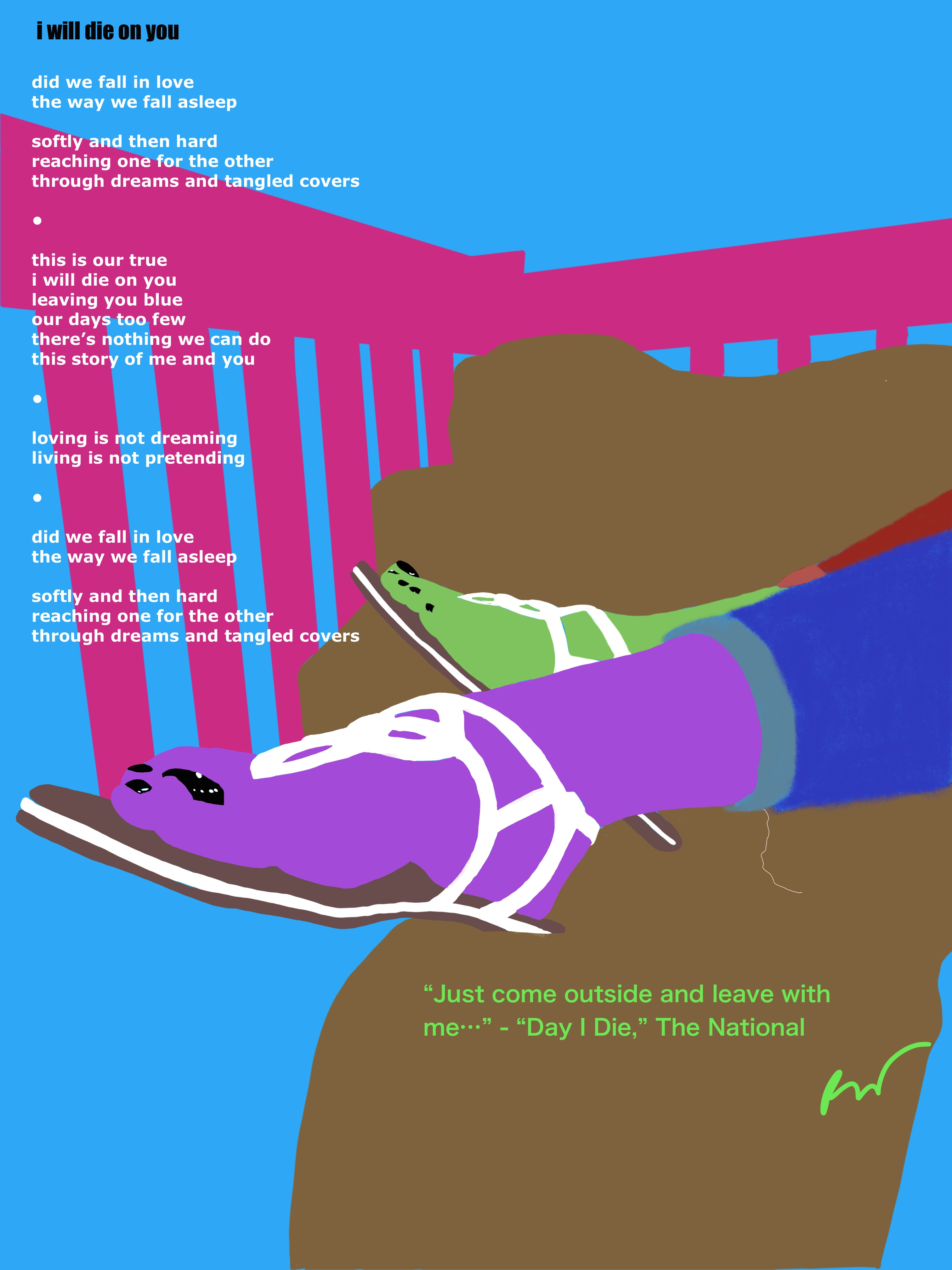
My new life of visual art isn’t what I planned or expected. It involves the wonders of technology (iPad and Procreate) that allow me to blend my very naive attempts at photographs, my latent and self-taught abilities as a visual artist, and my many decades as a purposeful and serious writer.
For me, then, I move forward arrogantly with the humility of “Who am I …?” as my background music while I work.
Natasha Romanoff/Black Widow is in comic book limbo.
Again.
The limbo after the end of v.8, just 15 issues, suggests that Marvel is only capable of underestimating her in the long run, but the latest (last?) run shows once again—and possibly at the highest level—that breathing rich and vibrant life into this character is not only possible but also needed.
The core team of v.8 offers readers one of the best volumes featuring Black Widow—Kelly Thompson (writer), Elena Casagrande (artist), Jordie Bellaire (colorist), and Adam Hughes (cover artist) with additional artists Rafael De Latorre, Carlos Gómez, and Rafael Pimentel making strong contributions.
While many familiar patterns are once again found in v.8, this run is held together by the unifying purpose that resonates throughout the writing and the visual power, solidly anchored in a creative team of women (Thompson, Casagrande, and Bellaire).
Covers by Adam Hughes alert readers to the visual allure of v.8—a red/black motif driven by Elena Casagrande and Jordie Bellaire interiors. (Issue 1 and issue 11)
“This Can’t Be It”
Just a few beautiful pages into issue 1—immediately situating Black Widow with Hawkeye and Captain America—Natasha thinks in dramatic fashion, “This can’t be it,” as she falls, drugged, from her apartment window.
Issue 1 with Thompson (writer), Casagrande (artist), and Bellaire (colorist).
In hindsight, with Black Widow’s current limbo in mind, this seems like a signal larger than the narrative tension of yet another death of Natasha Romanoff. However, Natasha is not dead, but is discovered by Clint and Bucky to be living months later in San Francisco (a nod to the Daredevil/Black Widow run from the early 1970s) as Natalie with a partner and a child—seemingly unaware that she is Black Widow.
Readers, like Clint and Bucky, recognize that Natasha remains just below the surface, eager to reappear.
Thompson is the star writer of this series, but a strong case can be made for Casagrande’s artwork defining this run. As “Natalie” thinks, “Well, this doesn’t suck.”
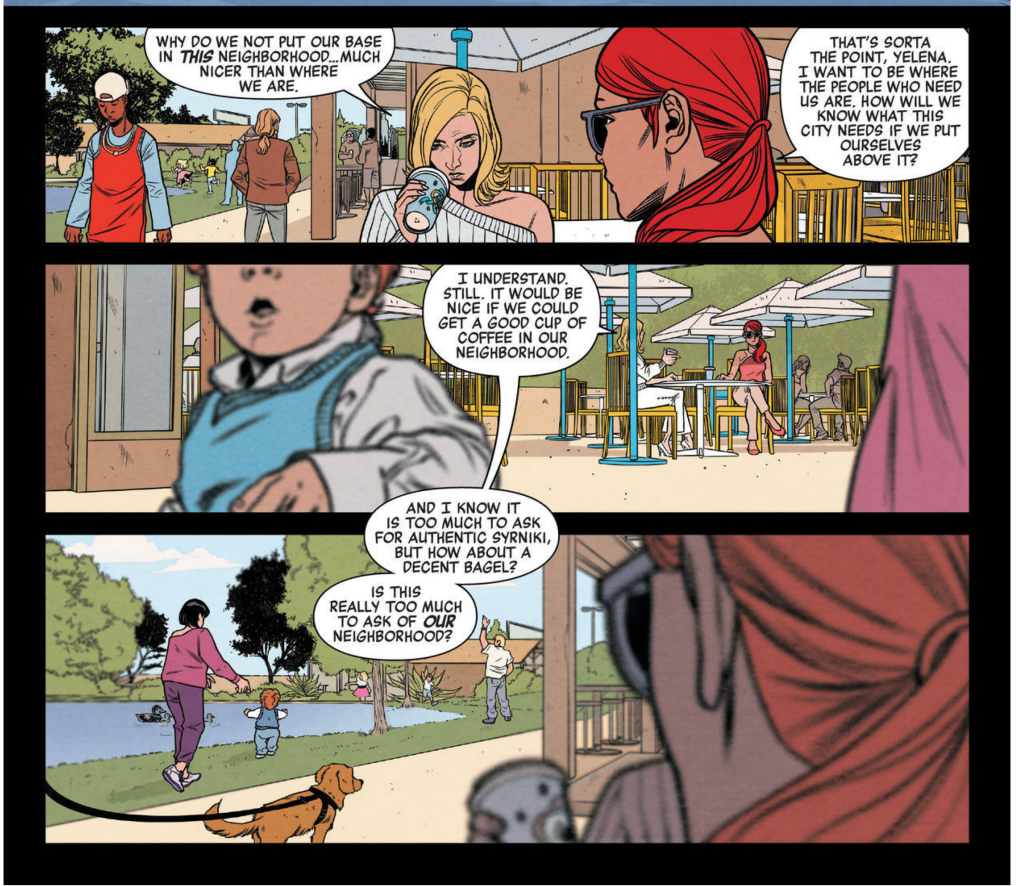
Soon, Yelena (White Widow) appears as a covert babysitter, and the usual cast of characters in Black Widow narratives is gradually assembled while Natasha remains underneath this new “Natalie” with an inexplicable child (only three months have passed since her fall and disappearance).
While the story arc seems to be well-worn territory so far in issue 1, one of the most effective examples of the purposefulness throughout this series is the use of color.
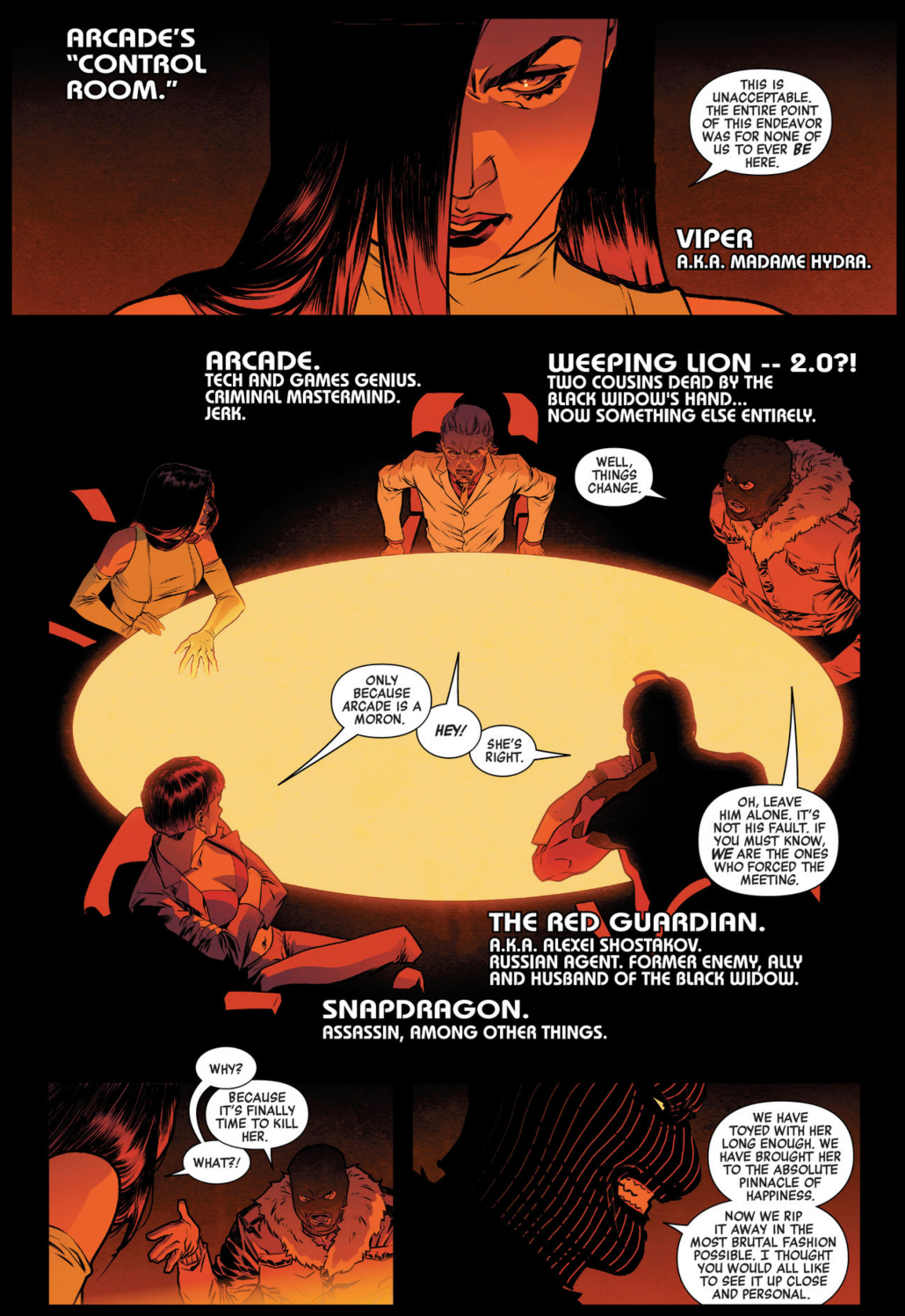
Issue 2 highlights the wonderful use of color motifs by Bellaire; here the vibrant red with Natalie/Natasha and green with the introduction of Arcade.
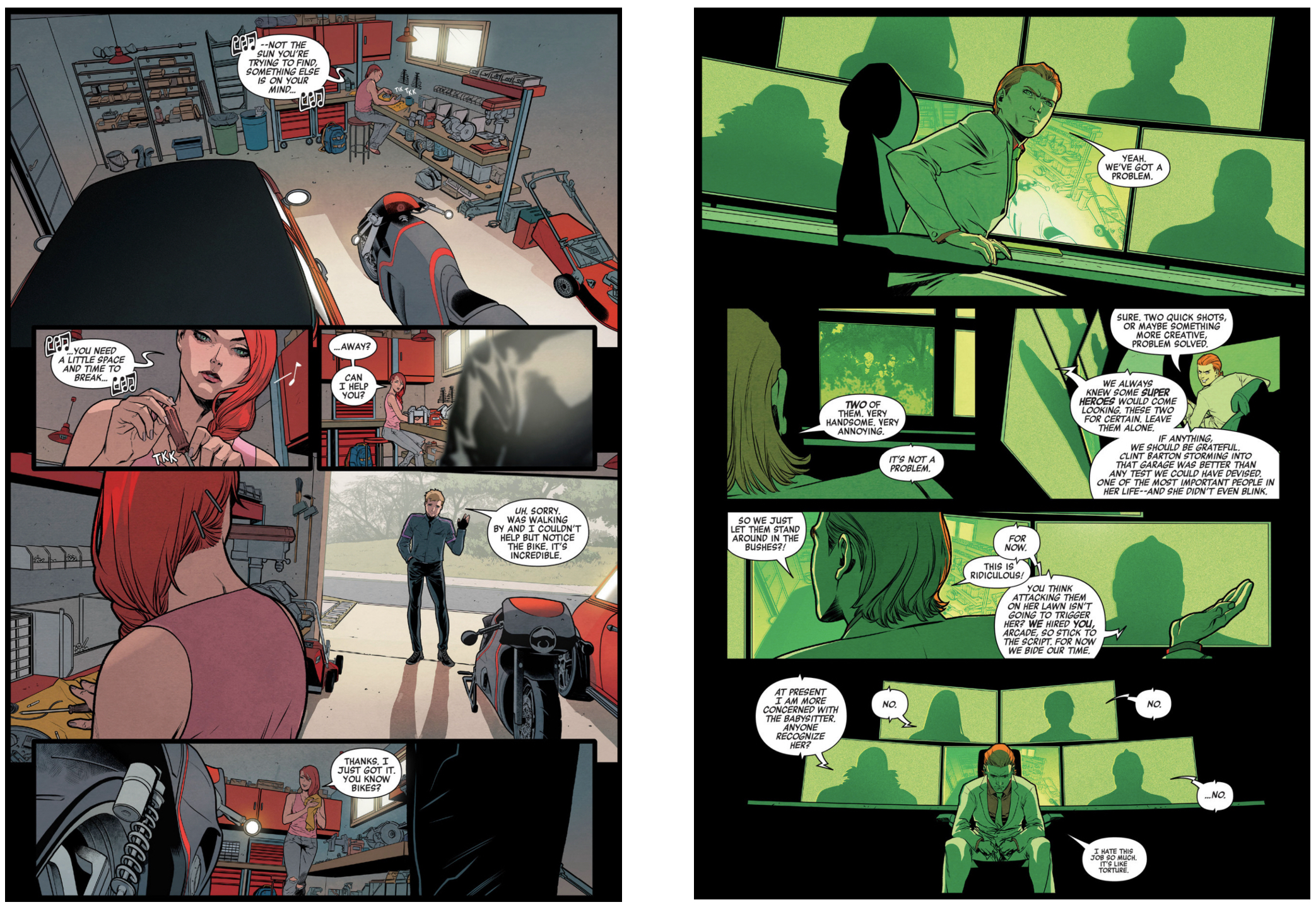
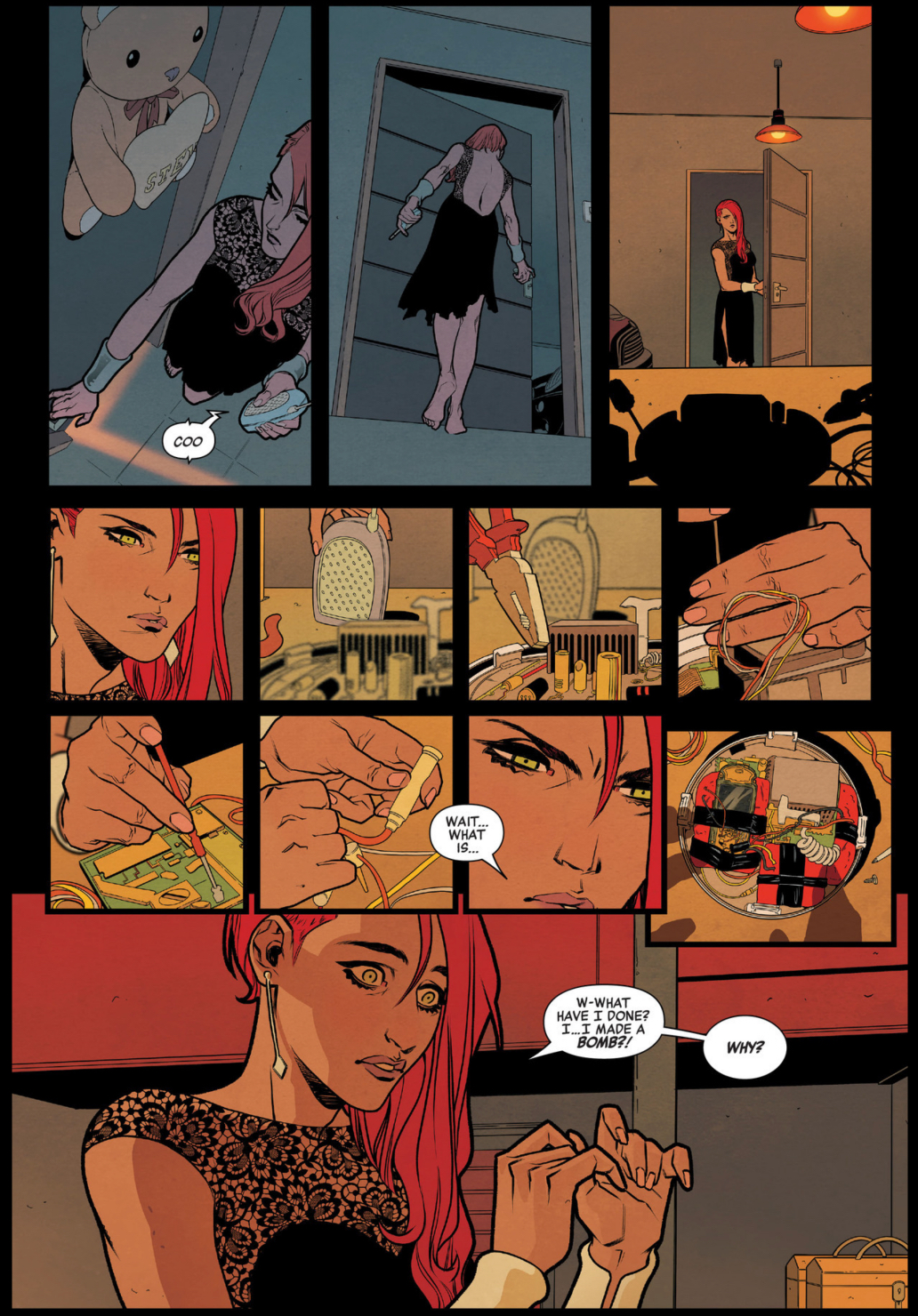
Another compelling aspects of issue 1 is watching Natasha/Black Widow resurface from the puzzling new life of Natalie (one Yelena, Clint, and Bucky gradually piece together). First, the motorcycle, and then, building a homemade bomb.
Issue 2 is a stellar showcase of Casagrande’s and Bellaire’s work.
Clint and Bucky grapple with Natalie/Natasha’s happiness from afar while they, along with Yelena, discover that Natasha is a pawn in an elaborate scheme monitored by Arcade, including that the child is in fact Natasha’s.
Gradually, a gallery of villains are revealed in issue 3 as Black Widow continues to resurface and then forms her own group, another of the many gifts offered by Thompson’s writing.
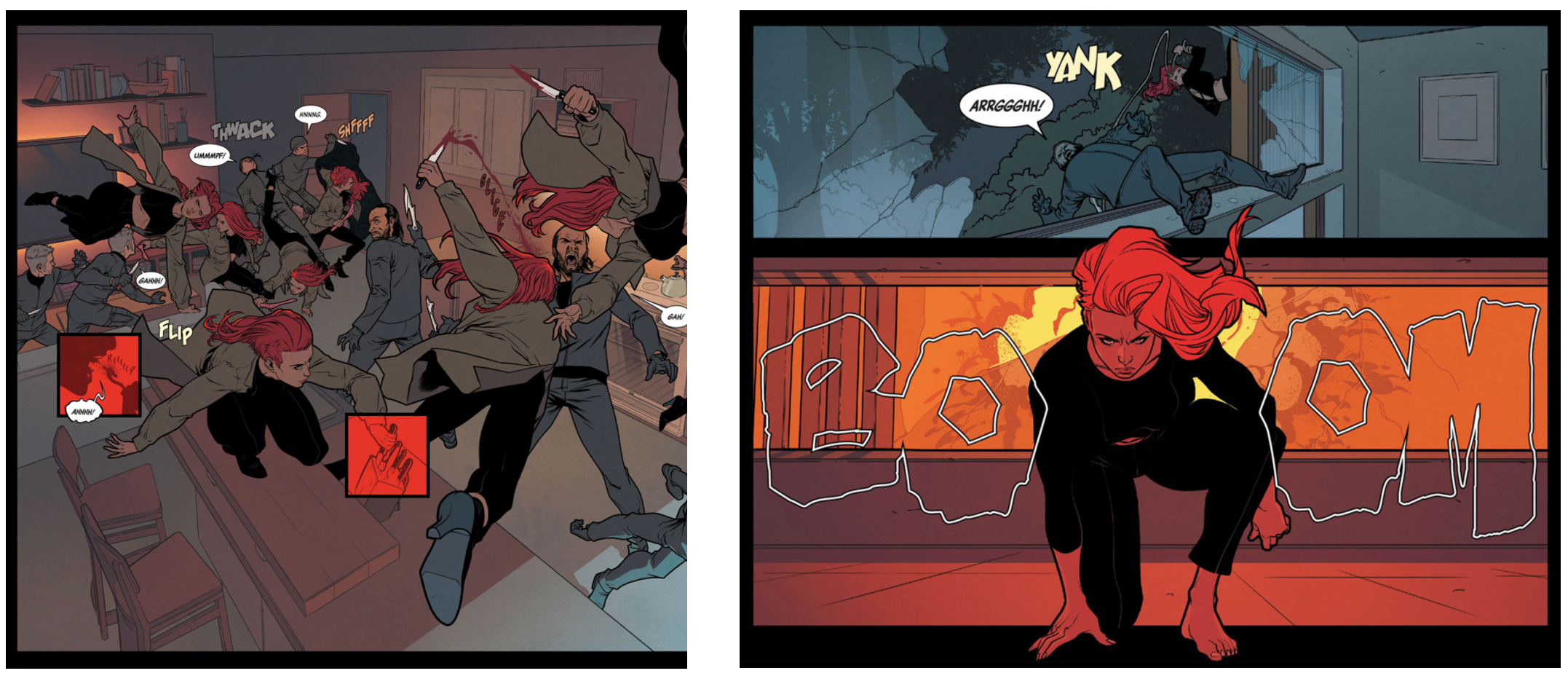
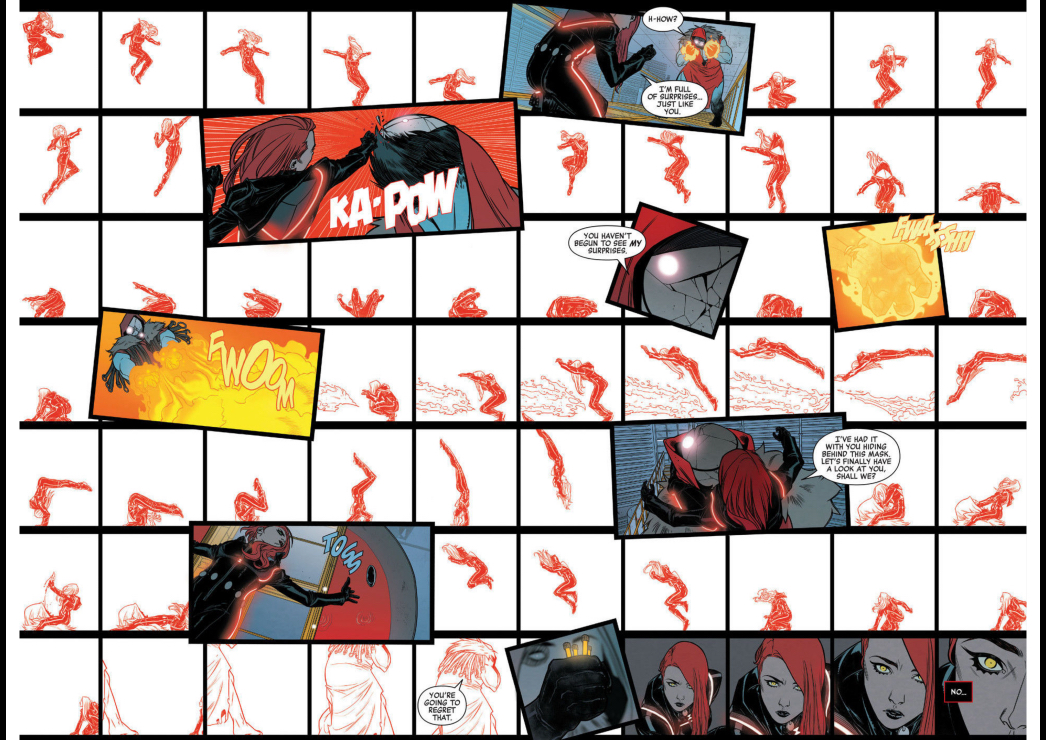
Issue 3 also portrays fresh and dynamic takes on iconic depictions of Black Widow—the acrobatic fight scene and the superhero landing pose:
Casagrande and Bellaire remind me of the brilliant run by Phil Noto in v.5.
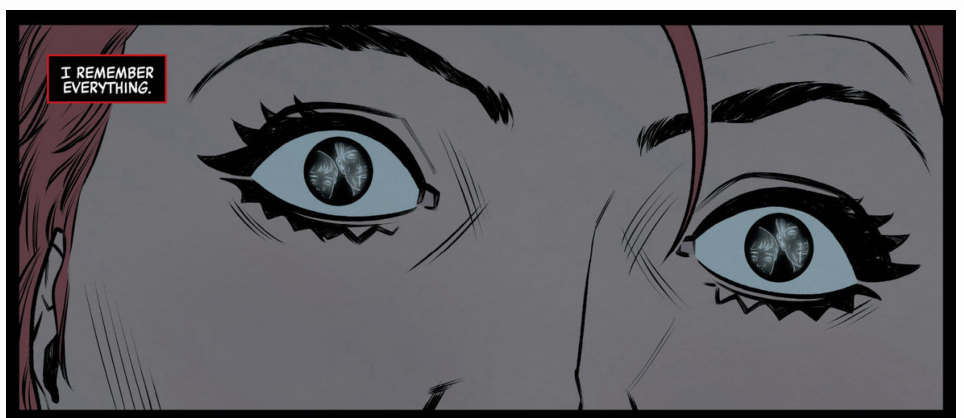
By issue 4, Natasha regains her memory, and readers learn about her manufactured family—a family that is none the less “real.”
Issue 4 includes flashback scene art by Carlos Gómez.
Once Natasha/Black Widow understands her predicament, she joins Clint, Bucky, and Yelena in an elaborate scheme to protect her partner and child—a plot that once again leaves Natasha alone.
Casagrande and Bellaire render the images in issue 4 and issue 5 as dramatically as the plot itself.
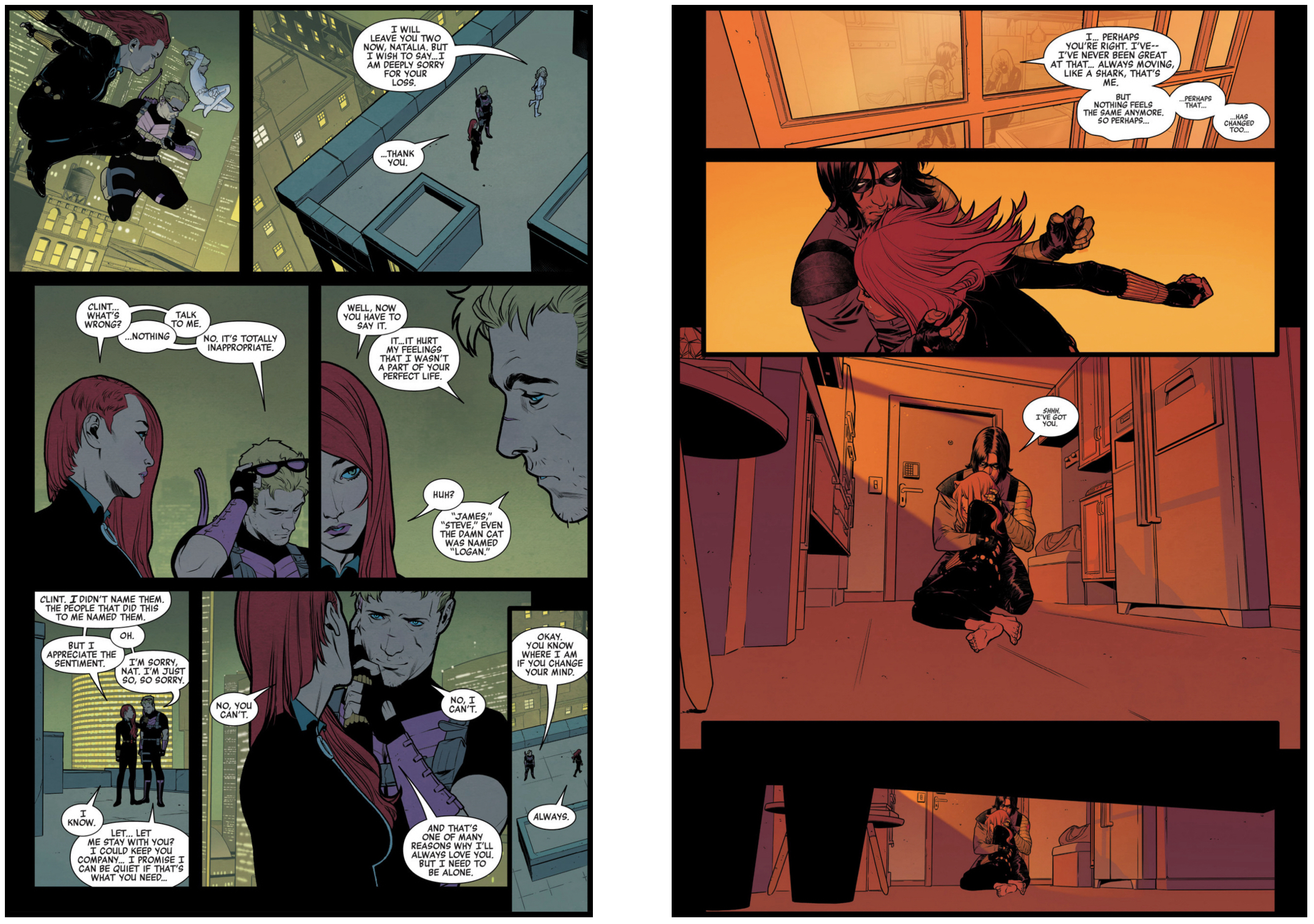
The tensions, romantic and otherwise, between Natasha and Clint as well as between Natasha and Bucky are emphasized in issue 5 as Natasha grapples with the new reality of a manufactured family that she loves and must abandon to protect.
Thompson’s take on Natasha’s need to be a mother (explored in several earlier volumes) and the classic theme of being a superhero as a barrier to maintaining relationships are fresh and sincere.
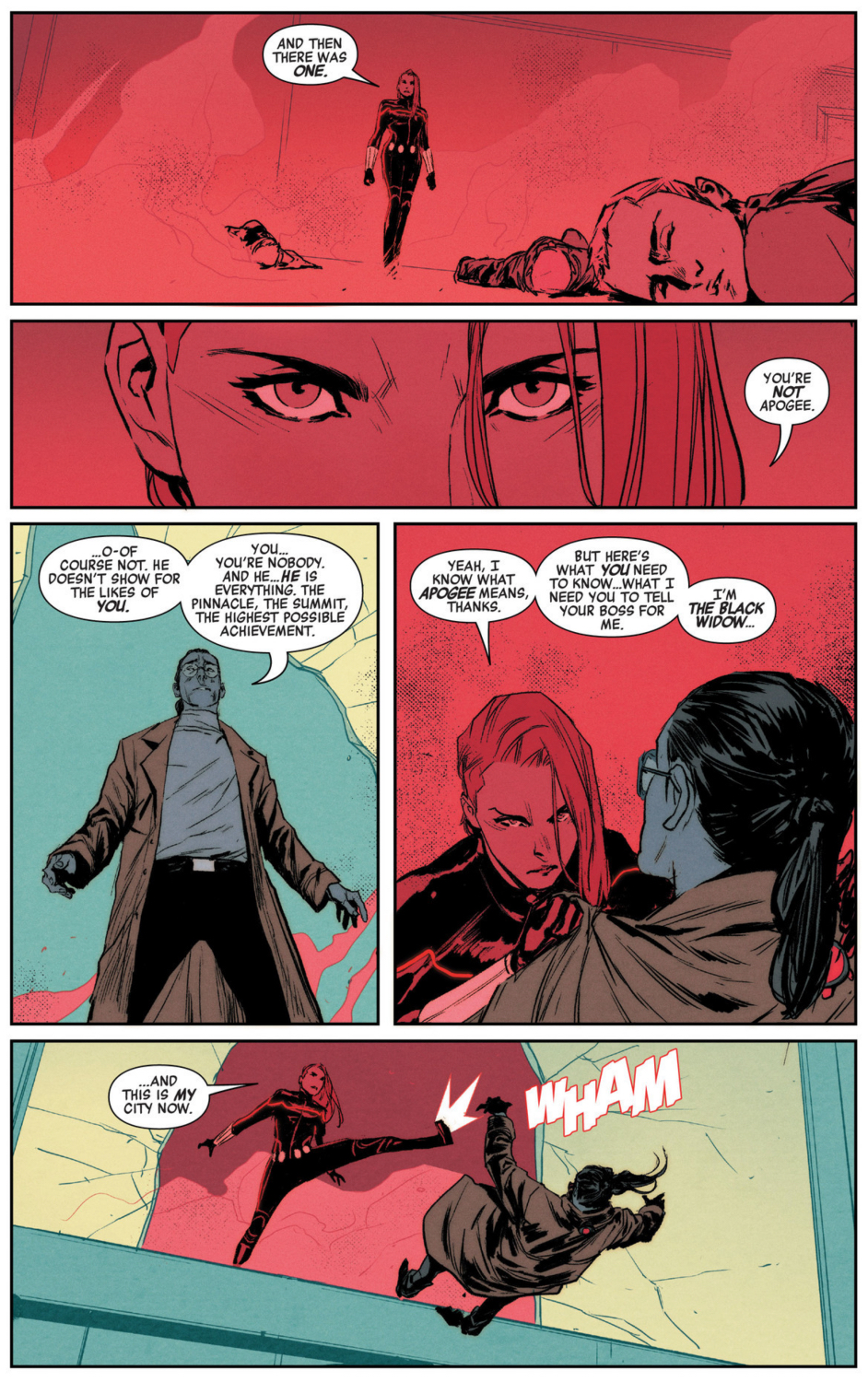
“‘…And This Is My City Now'”
Even though v.8 has a core creative team of women, elements of the male gaze, objectification, and sexual innuendo are not absent, but framed in a different context, enabling readers to interrogate how women navigate s violent and sexually aggressive world.
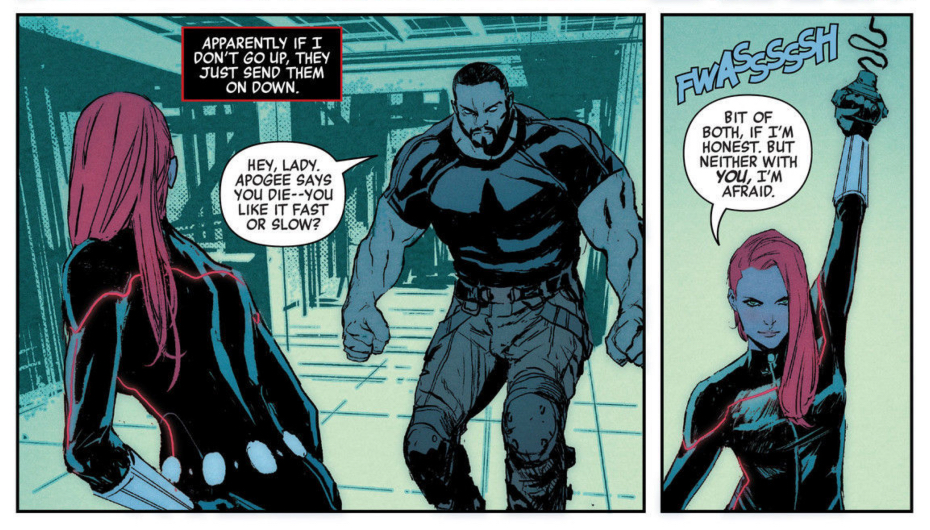
Issue 6 includes a staple of Black Widow stories—sexual innuendo—with Rafael De Latorre maintaining the outstanding artwork presence.
In the second third of this volume, the story shifts to Natasha/Black Widow taking control of her world—the sexual banter vocalizes her power and control, for example. And this new life, this new world, is in her reclaimed city of San Francisco.
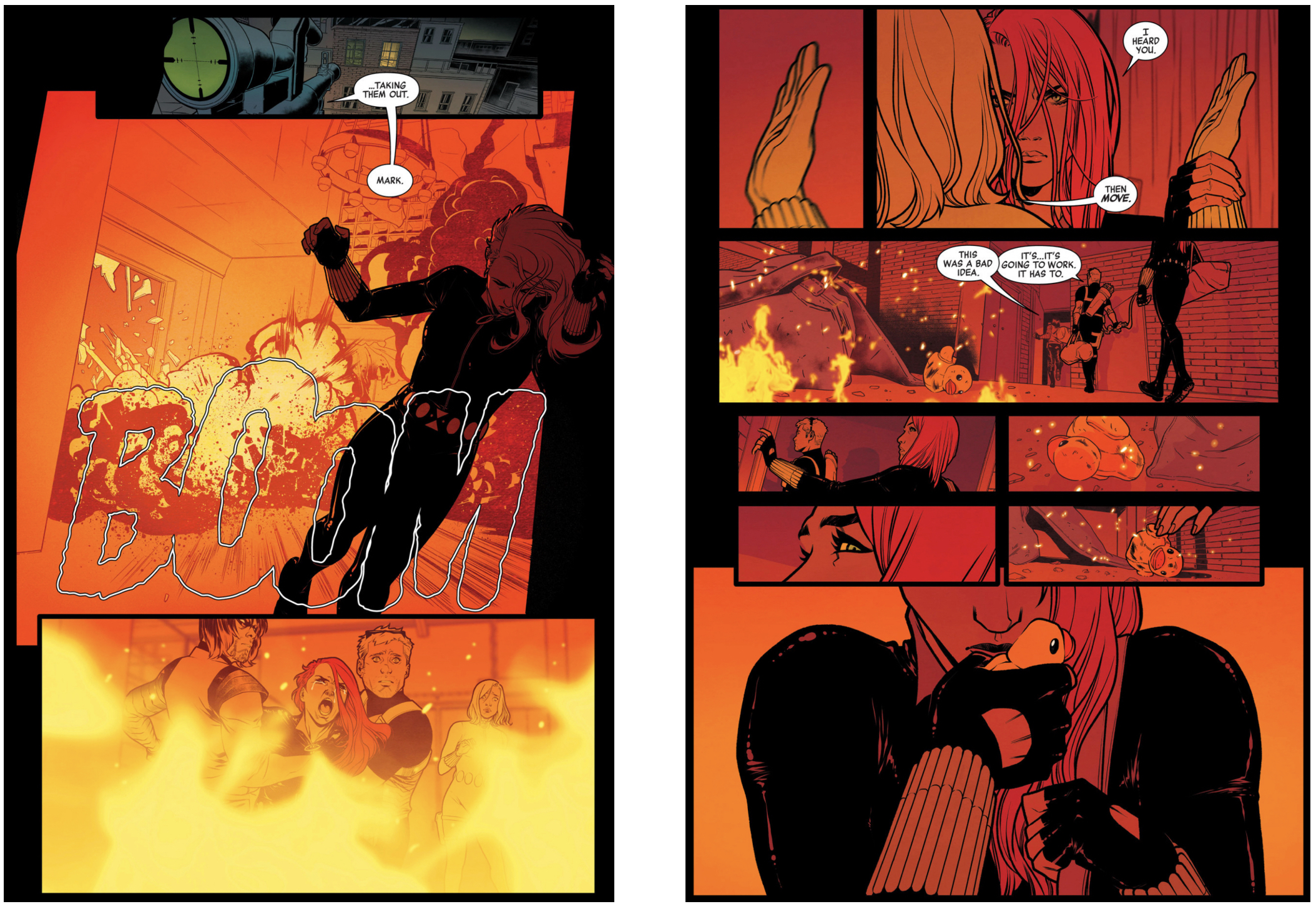
As Black Widow asserts control, the falling imagery in issue 6 parallels the first issue fall that is the initial transition of this volume.
This volume is grounded in women creators who, by issue 7, begin to center the narrative on women characters as Black Widow forms a group of women superheroes.
In issue 7, Natasha interacts with Spider-Girl and Lucy, characters that highlight elements of the complexities involved with being a superhero as they are compounded by also being a woman (as well as issues related to age).
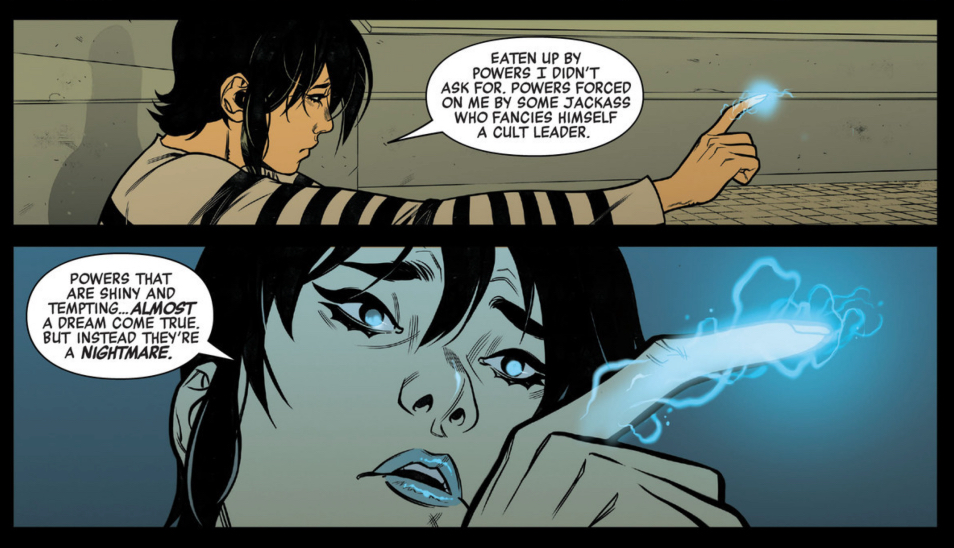
For Lucy, coming to terms with new super powers highlights her frailty and the uncertainties of being differently human. One of the hallmarks of the Marvel approach to superheroes from the beginning in the 1960s was emphasizing the “human” in “superhuman”—such as acknowledging the negative as well as positive consequences of being “super.”
In many ways, Lucy parallels Natasha’s journey, and she offers a context for the dualities of being superhuman. (Issue 8)
As well, the interactions between Yelena and Natasha explore the iconic “with great power comes great responsibility” motif. Yelena speaks often for her own interests as Natasha remains deeply committed to serving those in need.
Issue 8 continues to explore Natasha’s commitment to San Francisco as her city now.
Thompson’s work as writer for this volume excels in the complex and rich portrayal and development of the characters, notably the women. Like Natasha, Yelena stands out in Thompson’s care for the character.
None the less, Yelena receives some of the often problematic elements found in many volumes of Black Widow—being bound and killed. In issue 8 and issue 9, Thompson’s approach to these well-worn narratives rises above mere objectification (being bound) and simplistic as well as hollow tension (being killed).
Yes, Yelena is bound to a chair, but the perspective avoids the lurid gaze found in earlier volumes, and Yelena’s apparent death also fits into a motif of the power of women to (in this case) literally save each other’s lives.
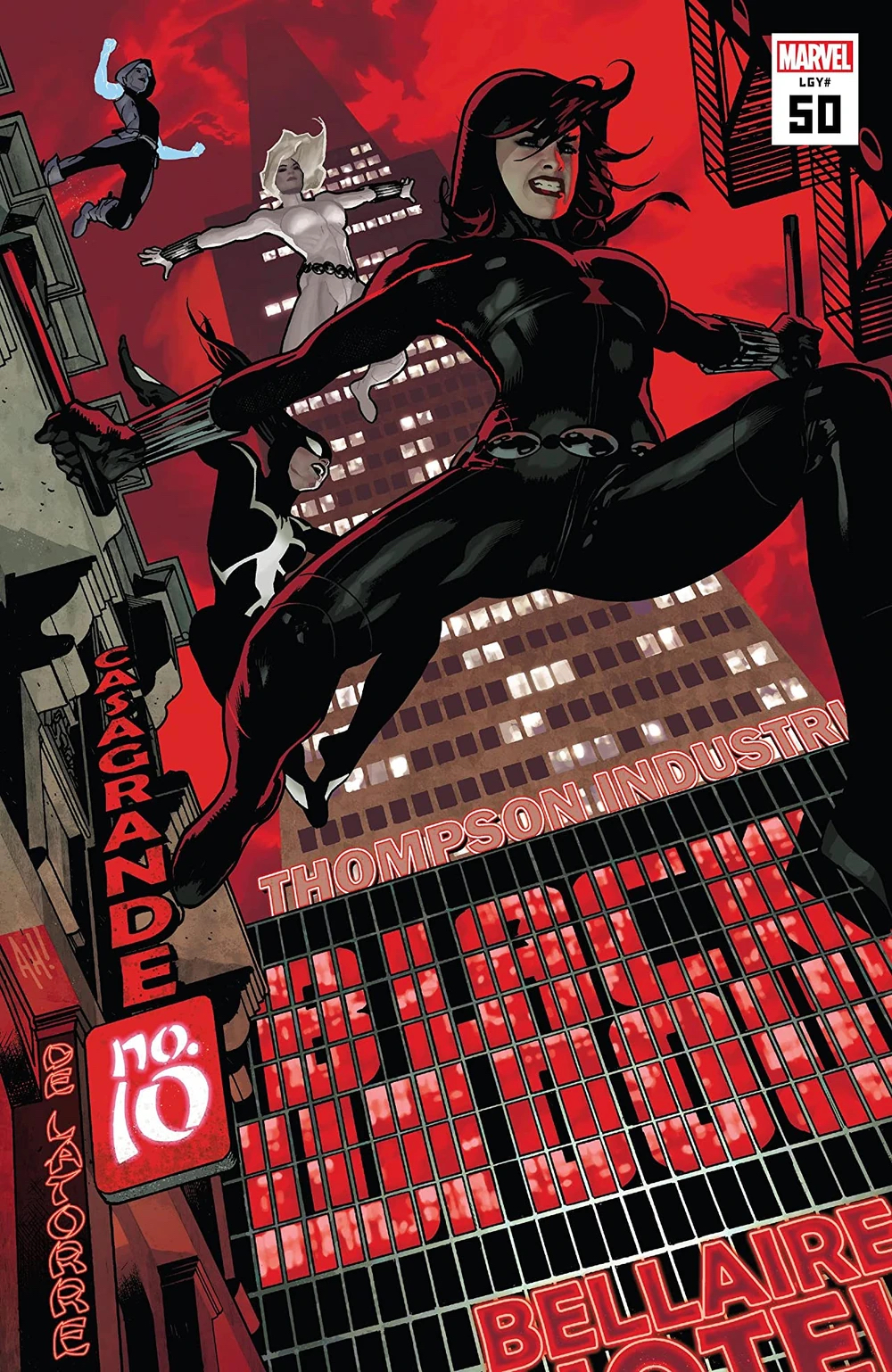
The second third of this volume reaches a milestone for the much underestimated character of Black Widow, the legacy issue 50 (issue 10). Marvel’s new normal of constantly rebooting and renumbering is annoying, and in my opinion, nonsense, but the legacy acknowledgements temper some of that.
Adam Hughs offers another visually dynamic cover for legacy issue 50, a fitting tribute to Black Widow as a underestimated and hypersexualized character in the Marvel Universe.
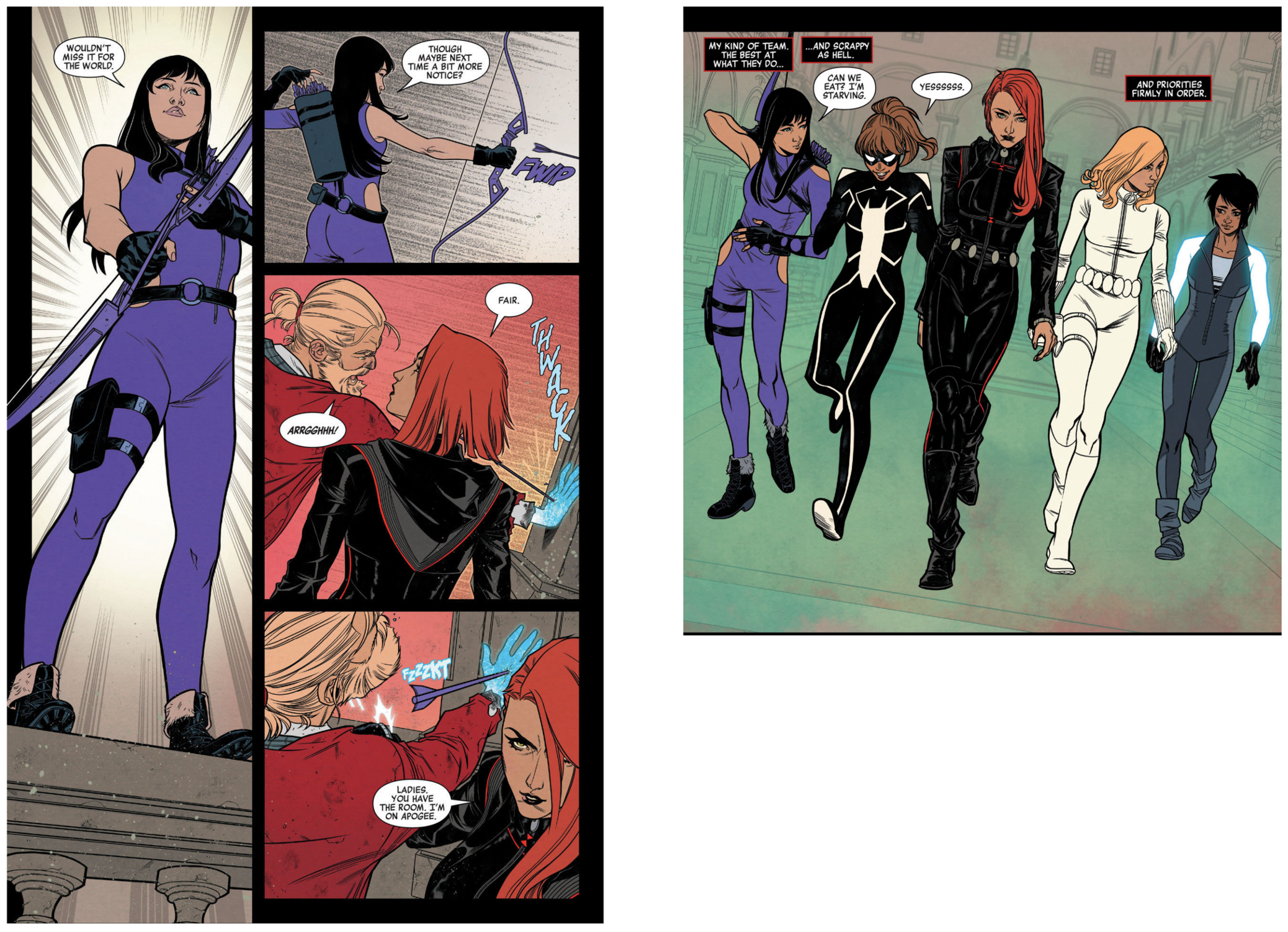
Issue 10 introduces another derivative woman superhero, Hawkeye, like Spider-Girl, but the assembling of a mostly women team remains a powerful aspect of this run. Natasha herself acknowledges this, suggesting a sense of community linked to their shared womanhood (even with a touch of her sarcasm).
While the comic book industry has suffered from lacking representation and often failed by seeking diversity in derivatives (women taking on male superhero roles), Natasha’s “My kind of team” carries a great deal of weight in terms of Thompson’s rich portrayal of both being a superhero and a woman.
This key legacy issue also includes more of the iconic depictions of Black Widow as an acrobatic and gifted super-agent and fighter.
Paneling and coloring continue to define v.8 as one of, if not the best runs featuring Black Widow.
“This Is Beautiful”
Issue 11 highlights in the final third of this volume Natasha’s remaining internal struggles. Although she has found and fostered a community with her new team, she remains in her bones a loner, and as in previous volumes, continues to value the power of secrets.
Nat certainly is well represented on a motorcycle—the solo vehicle that is an extension of her individuality as well as her power and grace.
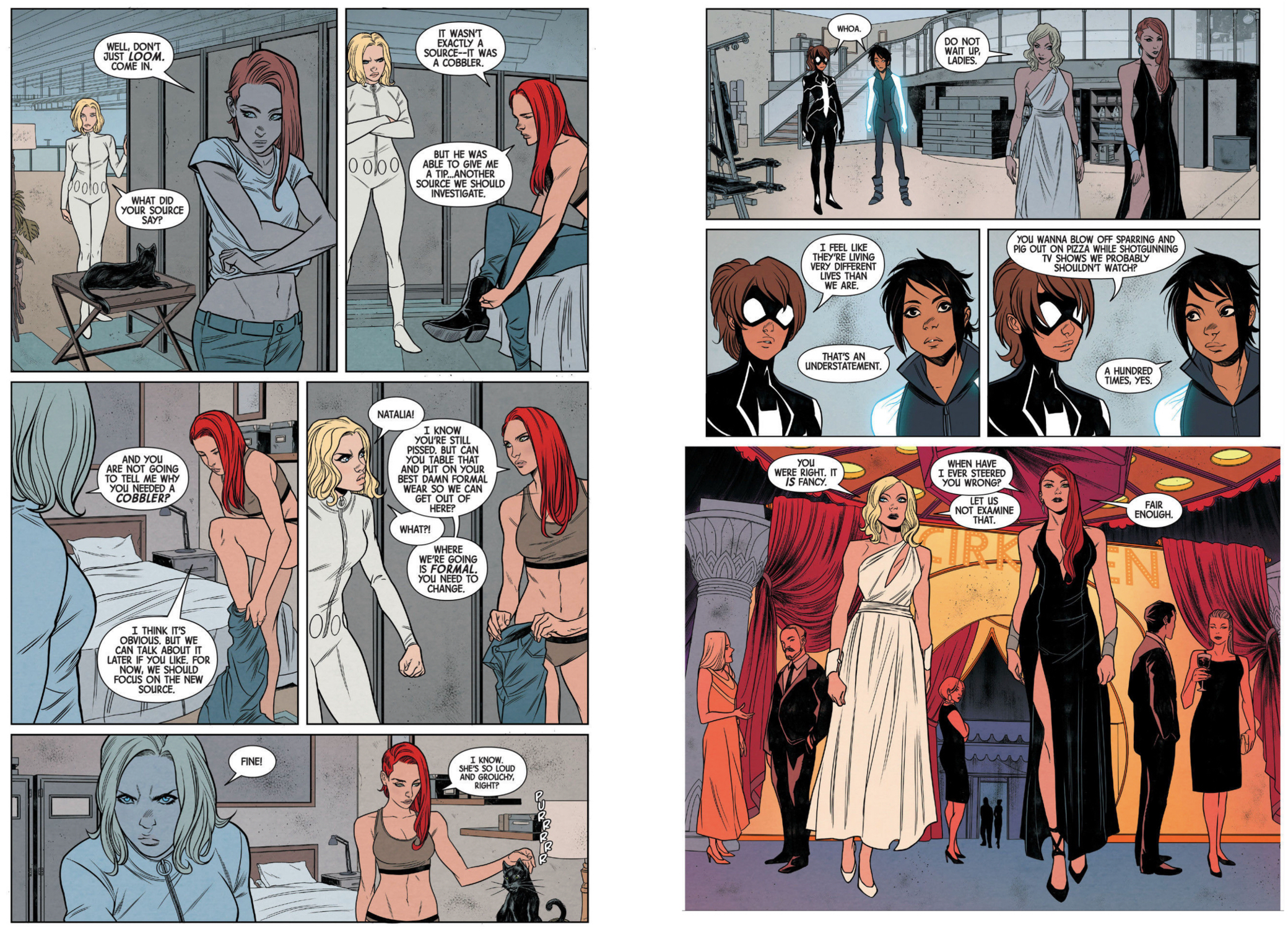
How humans are portrayed in comic books has a long problematic history. Men and women alike are often drawn in distorted ways (particularly for me, the low point being the artistic style of the 1990s)—although women are more often than not hypersexualized. Black Widow has suffered that fate often, too often, so v.8 is an interesting way to interrogate women’s bodies, the gaze afforded readers when women are centered, and the role of clothing and fashion in depicting women superheroes.
Casagrande’s style is often similar to Noto’s in terms of portraying superheroes closer to realistic human shape while embracing elements of beauty without reducing women to their cleavages or mid-drifts (see here).
In short, women are celebrated as beautiful, unique, and powerful without the lens of the lurid male gaze. Fashion, in fact, plays a central role, and the characters are allowed to embrace what is often seen traditionally (and problematically) as womanhood in complex and even playful ways by the characters themselves.
In earlier volumes, Natasha and Yelena were puppets for revealing outfits and exposing cat fights. Thompson and Casagrande avoid these failures by centering both characters as autonomous humans who are both their bodies and much more.
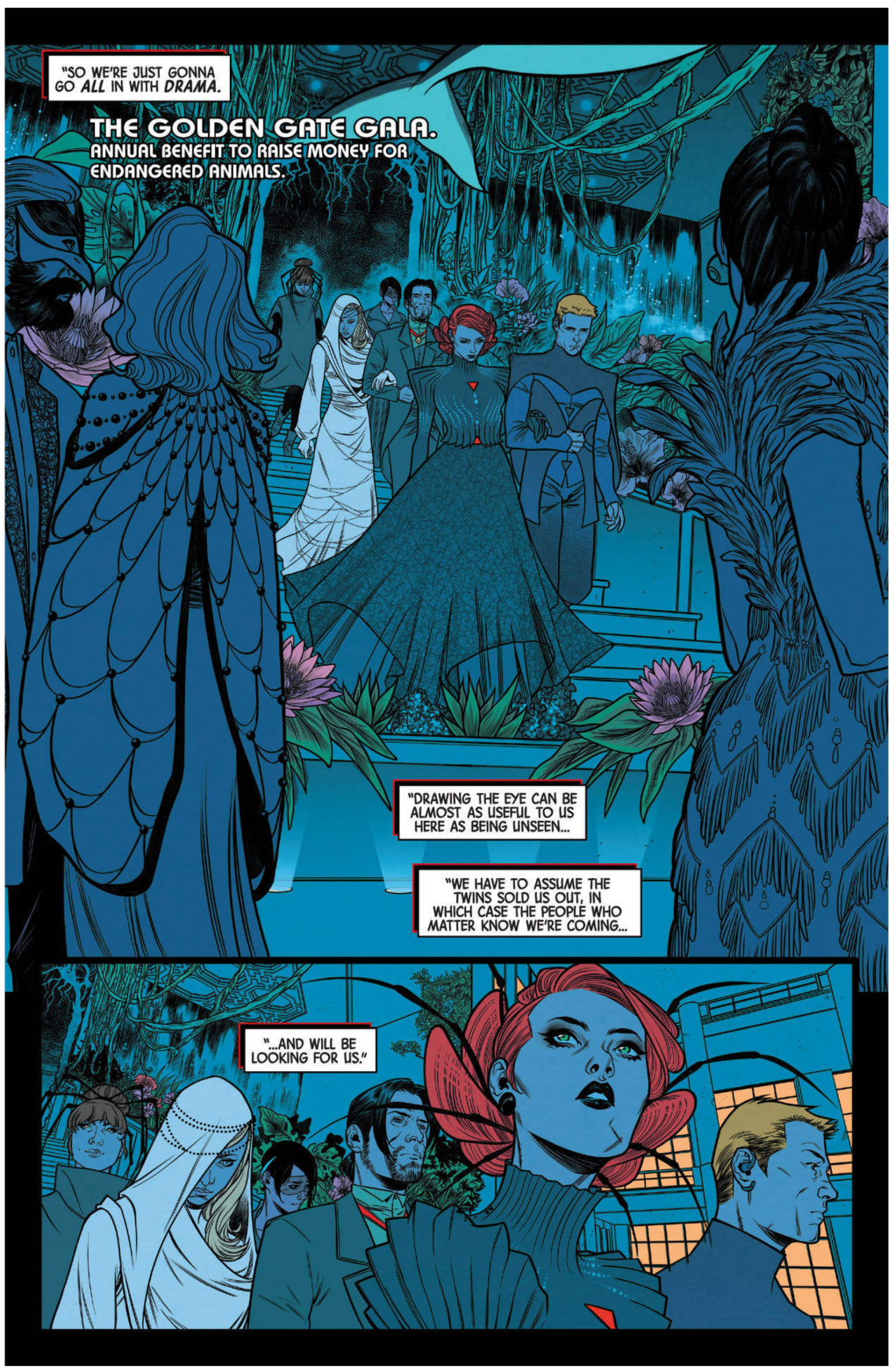
At the center of how characters are portrayed, in fact, is the wonderful work of Casagrande and Bellaire (again). Possibly the best way to describe v.8 is that the entire run is simply beautiful—in the most inspiring use of the word.
Issue 12 is stunning in terms of art and coloring, a masterclass in the ways in which comic books can avoid underestimating characters and their readers.
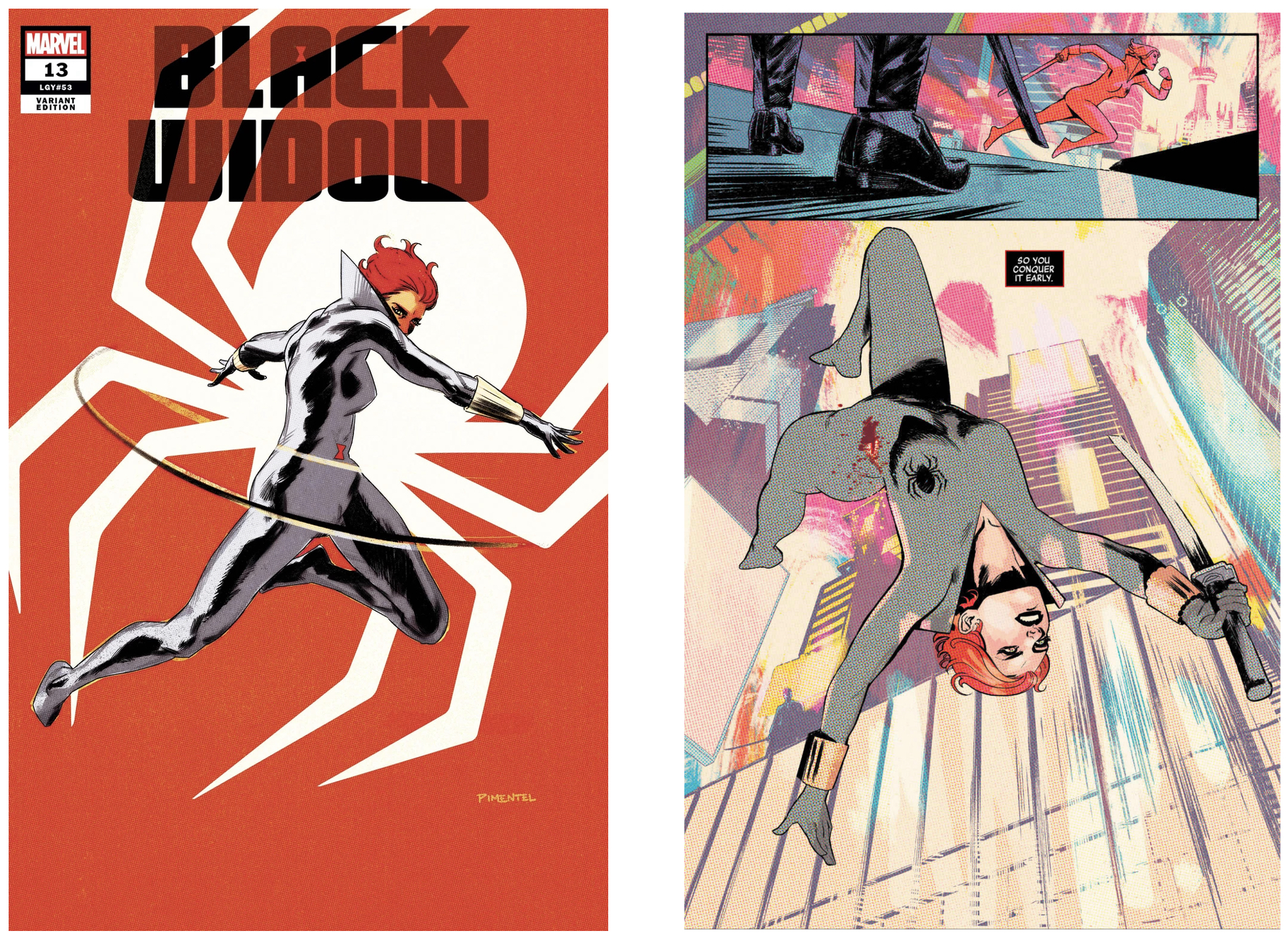
Another element of fashion is the use of flashback in issue 13 with artwork on a variant cover and interiors by Rafael Pimentel. The use here of the gray Black Widow costume associated with Frank Miller is both a homage of sorts to the comic book legacy of the character as well as another dynamic exploration of how Black Widow is often defined by her costume.
Pimentel provides a stellar and complimentary addition to v.8. The variant cover for issue 13 is one of the highlights of the run.
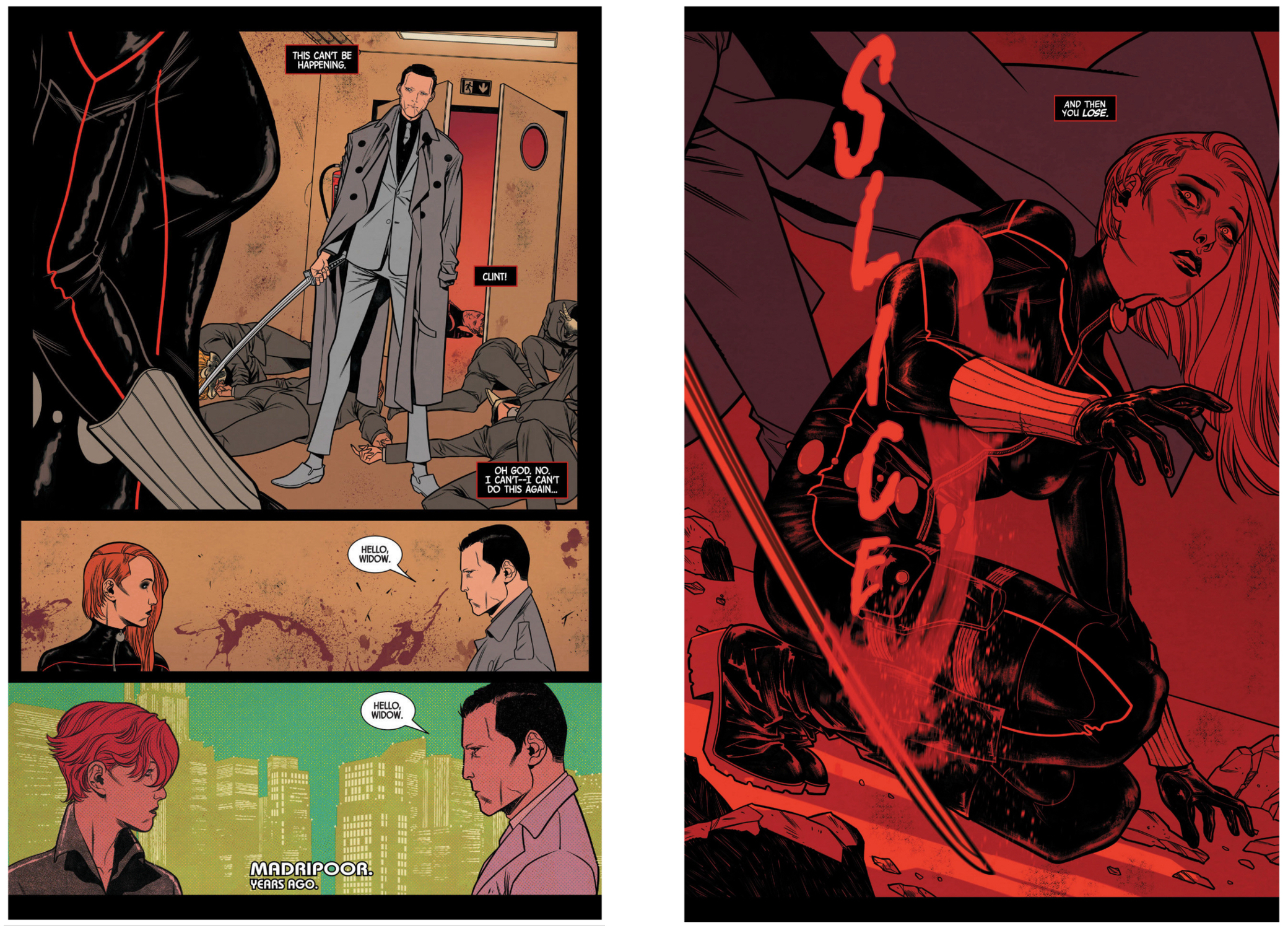
The final issues of this volume, beginning with issue 12, matches Black Widow against the Living Blade (issue 13 provides the backstory for their rivalry). From the re-introduction of the Living Blade (and Natasha’s internal monologue exposing her fear) to the most WTF scene of issue 14, the core team of Thompson, Casagrande, and Bellaire take readers on a genuinely dramatic ride, punctuated with the sort of real surprise (Black Widow’s arm severed) that is rare in comic book narratives.
Bellaire maintains a high level of purposefulness in how the color motifs drive the narrative, tone, and emotional impact established by Thompson and Casagrande.
Many of the problems created throughout this series are resolved satisfactorily and without slipping into cliche; there simply is no lazy work in v.8.
And while I remain very frustrated that this series ended after (only) 15 issues and the Black Widow remains in comic book limbo, I think the real accomplishment of the series is the willingness to drive the narrative to a positive ending (in a way that reminds me of Alice Walker’s choice of ending for The Color Purple).
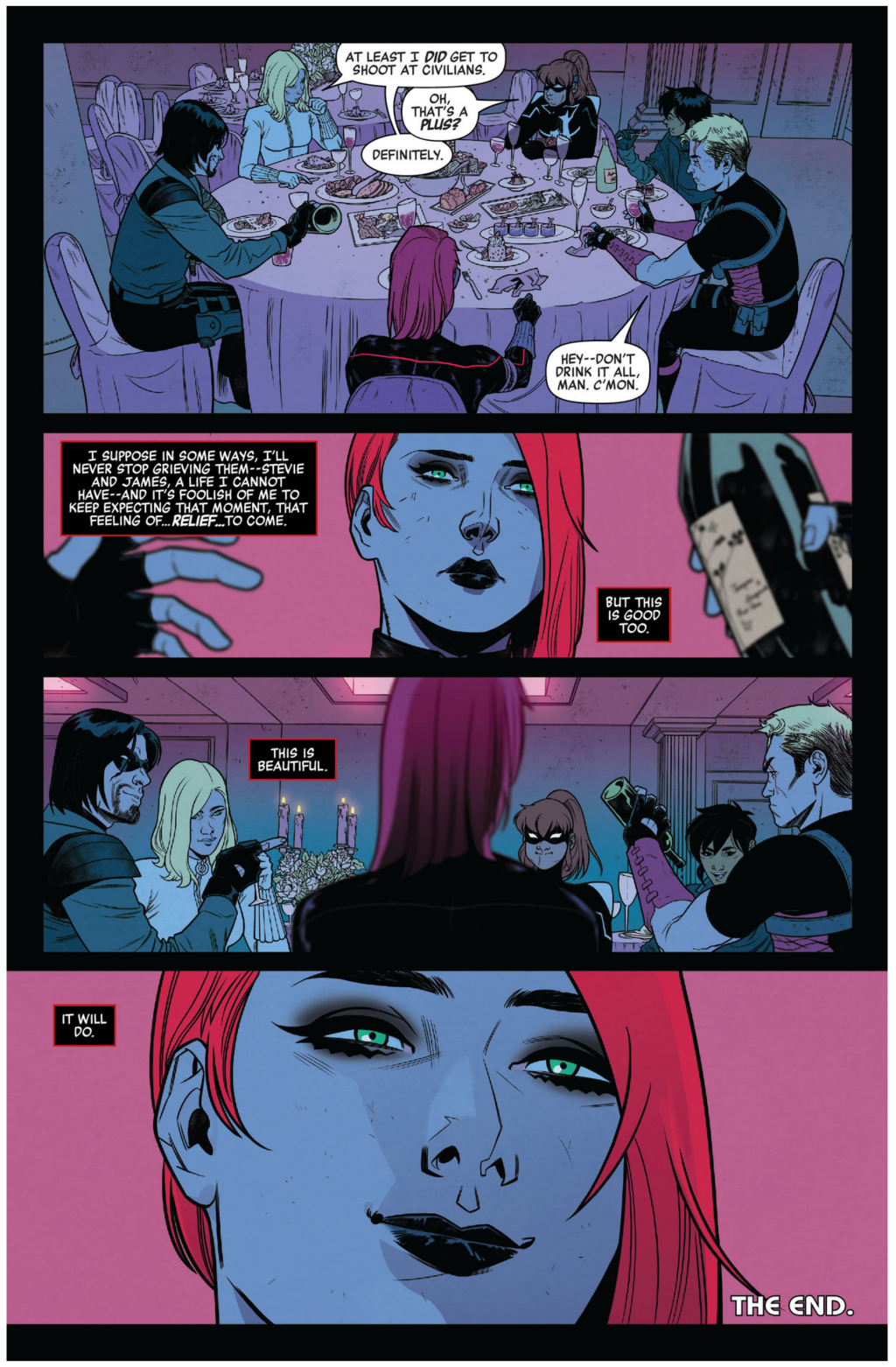
Despite the weight of her past and the traumas that continue in her life, Natasha makes a heart-warning final pronouncement—”This is beautiful”—and musters a genuine smile.
Issue 15, in many ways, offers the perfect way to think about v.8, “beautiful.”
educator, public scholar, poet&writer – academic freedom isn't free















 dr. p.l. (paul) thomas