SOR Endgame: The Reading Program Boondoggle

Within a year or so of the initial “science of reading” (SOR) media campaign launch in 2018, states such as Arkansas banned reading instruction (three-cueing) that effectively banned some of the most popular and demonized reading programs in the US.

This was the canary in the coal mine for one of the most powerful (but ignored) elements of the SOR movement—reading program marketing.

In order for a new reading program market place to open, the existing programs had to be vilified and then, ultimately, banned and replaced (see here and here).

The uncritical endorsement of the SOR story remains a central feature of media coverage even as the inherent problems and flaws with that story and it consequences are beginning to be acknowledged:

And the next shoe has dropped, fulfilling the logical consequences of the entire SOR movement [1] built on false and oversimplified cries of crisis and demonizing of literacy frameworks (balanced literacy) and popular programs (Fountas and Pinnell, and Calkins’s Units of Study):

Principals historically have enjoyed enormous leeway to select curriculums. Proponents argue this allows schools to stay nimble and select materials appropriate to their specific student populations. But some experts, and even the city’s own schools chancellors, have argued that the approach can lead to a tangle of instructional practices that can vary widely in quality from classroom to classroom. 

Now, officials are taking steps to rein in the city’s free-wheeling approach to curriculum. Beginning next school year, elementary schools in about half of the city’s 32 districts will be required to use one of three reading programs: Wit & Wisdom, from a company called Great Minds; Into Reading from Houghton Mifflin Harcourt; or Expeditionary Learning, from EL Education.

By September 2024, city officials are expected to require all elementary schools to use one of those three options, according to an education department official familiar with the city’s plans.

NYC schools could soon be forced to adopt a mandated reading curriculum, sources say

NYC has been a disturbing and important example of the very worst aspects of the media-driven political responses to a false story (see here and here). The city is proof that a false story has more influence than actual evidence or science.

Blaming balanced literacy and popular reading programs for a reading crisis that doesn’t exist lacks scientific research:

I am, like you, struck by the degree to which people are willing to invoke a literacy crisis, when the data do not support anything like a literacy crisis. NAEP scores, aside from the pandemic then– but NAEP scores, over the last 10, 15 years have grown– slowly, but they have gotten better in literacy. 

And it’s deeply puzzling to me why we have all of this public discourse about a literacy crisis. If I were deeply cynical, I would say it’s probably a useful technique for companies that are trying to sell their programs to get people to buy those programs, if parents and some school districts are very agitated about the so-called literacy crisis. 

Now that isn’t to say that all American children are doing wonderfully in literacy. Obviously, they aren’t. But it is to say that there’s not a new or a sudden decline in literacy performance, other than that associated with the dip that had to do with the pandemic. 

Harvard EdCast: To Weather the “Literacy Crisis,” Do What Works

As Snow notes, claiming crisis is not supported by the most common evidence cited, NAEP trends:

And many scholars have raised concerns about structured literacy (the proposed alternative to balanced literacy in the SOR movement):

We recognize that some teachers using structured literacy approaches will find ways to respond to the interests, experiences, and literacy abilities of individual students; however, we are concerned about the indiscriminate and unwarranted implementation of the following practices:

• Directive and/or scripted lessons that tell teachers what to say and do and the implementation of lesson sequences, often at a predetermined pace (Hanford, 2018)

• Privileging of phonemic awareness and phonics as primary decoding skills (Hanford, 2018, 2019; IDA,2019; Paige, 2020; Pierson, n.d.; Spear-Swerling, 2019)

• Use of decodable texts that do not engage multiple dimensions of reading (Hanford, 2018; IDA, 2019; Paige, 2020; Spear-Swerling, 2019)

• Specialized forms of reading instruction designed for particular groups of students as core literacy instruction for all students and teacher educators (Hanford, 2018; Hurford et al., 2016; IDA, 2019; Pierson, n.d.)

• Mandating structured literacy programs despite the lack of clear empirical evidence to support these programs

• Privileging the interest of publishers and private education providers over students

Particular concerns relate to the assertion that there is a consensus across the research community about the primacy of systematic phonics approaches. This supposedly undisputed consensus was severely challenged by the findings of a review of meta-analyses (Bowers, 2020).

Compton-Lilly, C.F., Mitra, A., Guay, M., & Spence, L.K. (2020). A confluence of complexity: Intersections among reading theory, neuroscience, and observations of young readers. Reading Research Quarterly, 55(S1), S185-S195. https://doi.org/10.1002/rrq.348

Further, at least one of the mandated reading programs (Into Reading from Houghton Mifflin Harcourt) for NYC, where a high percentage of diverse students are being served, has been identified as not meeting social justice and diversity goals:

1. All three curricula were Culturally Destructive or Culturally Insufficient.

2. All three curricula used superficial visual representations to signify diversity, especially skin tone and bodily presentation, without including meaningful cultural context, practices or traditions.

3. All three curricula were dominated by one-sided storytelling that provided a single, ahistorical narrative. 

4. All three curricula used language, tone and syntax that demeaned and dehumanized Black, Indigenous and characters of color, while encouraging empathy and connection with White characters.

5. All three curricula provided little to no guidance for teachers on engaging students’ prior knowledge, backgrounds and cultures; or reflecting on their own bias, beliefs and experiences.

Lessons in (In)Equity: An Evaluation of Cultural Responsiveness in Elementary ELA Curriculum

The education market churns is the actual endgame of the SOR movement. The only people likely to benefit from the SOR story are journalists, politicians, and the corporations willing to jump on the reading program branding bandwagon.

The reading problems today are little different than overt the last 80 years, and most of the causes of those problems remain outside of schools—home and community poverty and inequity—and linked to in-school issues of equity, not reading programs or reading philosophies and practices.

Yet, on the horizon, it seems, schools, teachers, and students are going to be bombarded by “structured literacy”—at least until the next unwarranted reading crisis is declared so another round of blame, ban, and adopt can start all over again.


UPDATE

See the plan here in this proposed bill in Ohio:


[1] Thomas, P.L. (2022). The Science of Reading movement: The never-ending debate and the need for a different approach to reading instruction. Boulder, CO: National Education Policy Center. http://nepc.colorado.edu/publication/science-of-reading

Recommended

What Reading Program Should Schools Adopt?

Media Coverage of SOR [access materials HERE]

Hoffman, J.V., Hikida, M., & Sailors, M. (2020). Contesting science that silences: Amplifying equity, agency, and design research in literacy teacher preparation. Reading Research Quarterly, 55(S1), S255–S266. Retrieved July 26, 2022, from https://doi.org/10.1002/rrq.353

MacPhee, D., Handsfield, L.J., & Paugh, P. (2021). Conflict or conversation? Media portrayals of the science of reading. Reading Research Quarterly, 55(S1), S145-S155. Retrieved July 26, 2022, from https://doi.org/10.1002/rrq.384

Cryonics Phonics: Inequality’s Little Helper – New Politics

[UPDATE]

The Science of Reading and the Media: Is Reporting Biased?, Maren Aukerman, The University of Calgary

The Science of Reading and the Media: Does the Media Draw on High-Quality Reading Research?, Maren Aukerman

The Science of Reading and the Media: How Do Current Reporting Patterns Cause Damage?, Maren Aukerman

Making sense of reading’s forever wars, Leah Durán and Michiko Hikida

[UPDATE]

Harvard EdCast: To Weather the “Literacy Crisis,” Do What Works

Disrupting the Disruptors: Reimagining Policy Advocacy in a Post-Truth Era, Helen Aydarova

Caught In a Web of Privatizers: Science of Reading Reforms in the State of Tennessee, Helen Aydarova

“Whatever You Want to Call It”: Science of Reading Mythologies in the Educational Reform Movement, Helen Aydarova

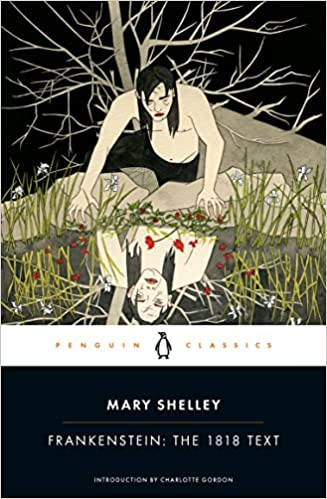
Frankenstein 2023

My relationship with Frankenstein is grounded in two films and my mother’s love of science fiction/horror as a merged genre—the classic 1931 film starring Boris Karloff as The Monster and the now iconic Young Frankenstein from 1974 (a tour-de-force from Mel Brooks, Gene Wilder, Madeline Kahn, Cloris Leachman, Teri Garr, and others).
Now common in pop culture, I associated “Frankenstein” with The Monster because most of the nuance in the source, Mary Shelley’s novel, was erased by adapting a novel into film.

Some of that erasing includes Mary Shelley being fully recognized for a foundational work in the history of science fiction and horror, but the popular jumbling and blurring of Shelley’s creation also erases the more subtle messages and themes of her original work.

Yet it is hard to ignore that the Frankenstein myth/narrative is incredibly enduring in American pop culture.

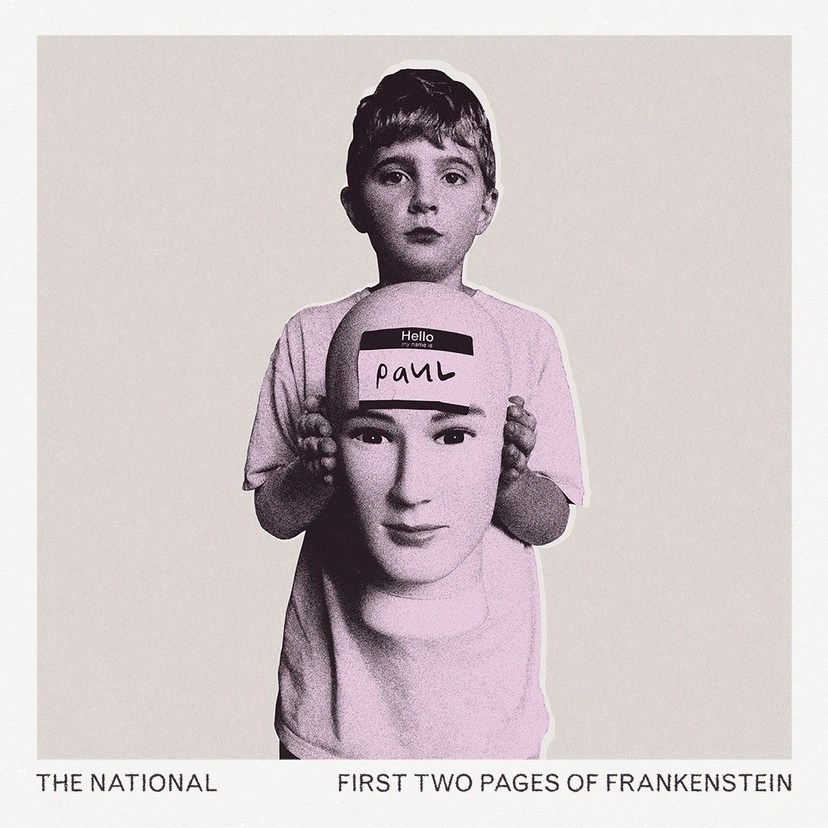
It is 2023, The National is set to release an album titled First Two Pages of Frankenstein, using the actual first two pages of the novel (cleverly edited) and a brief video of Matt Berninger turning to the viewer with the novel in his hand at the piano to promote the work:

Just a few weeks before the release of The National’s album Lana Del Rey’s Did you know that there’s a tunnel under Ocean Blvd includes these lines:

I know they think that it took somebody else
To make me beautiful, beautiful
As they intended me to be
But they’re wrong
I know they think that it took thousands of people
To put me together again like an experiment
Some big men behind the scenes
Sewing Frankenstein black dreams into my songs
But they’re wrong

“Grandfather please stand on the shoulders of my father while he’s deep-sea fishing”


From Shelley to Del Rey, the intersection of the Frankenstein narrative with the lives and portrayal of women is a fascinating journey, but again, something is powerfully compelling about this story of human arrogance and the essential horror in our imagining a science-fueled future (or present).

These reminders of Frankenstein in 2023 also overlap with the paperback release of Wolverine: Weapon X Deluxe Edition.

Also due mainly to films, Wolverine (as portrayed by Hugh Jackman) has achieved an iconic place in US pop culture, one that parallels in many ways elements found in Shelley’s source material.

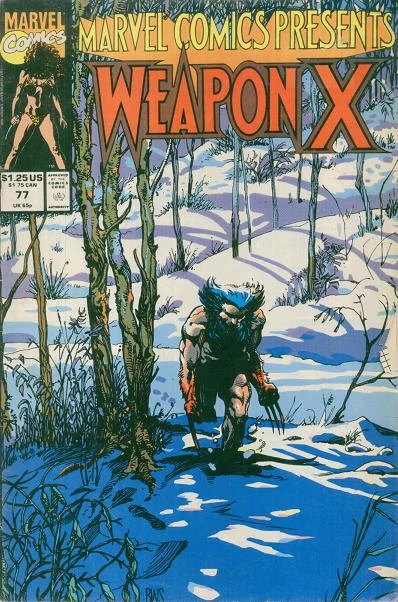
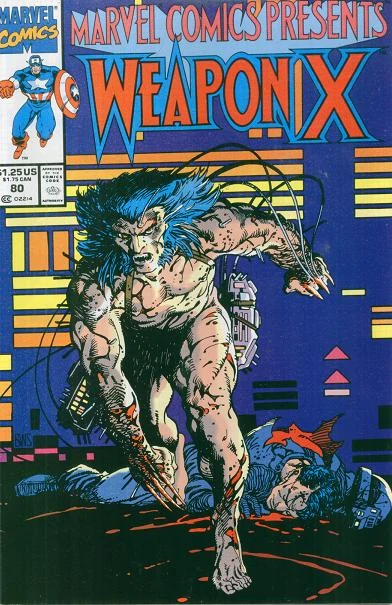
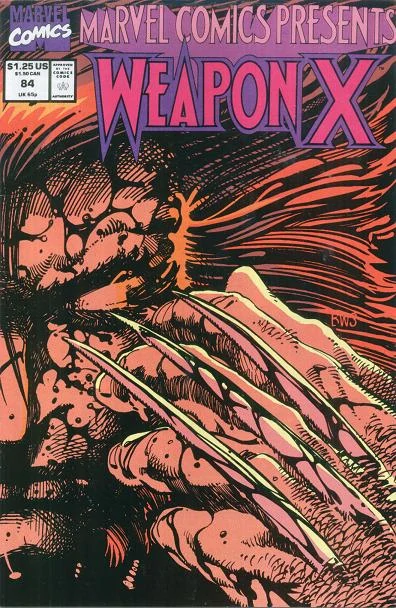
And not as well recognized outside of the comic book world, is Barry Windsor Smith’s brilliant portrayal of Wolverine’s origin story in Weapon X.

My association with Smith is his breakout work on Conan the Barbarian for Marvel in the early 1970s (see here).

Conan the Barbarian #21

By the 1990s, Smith stood out among the rise of the all-star artists working in comic books, like Frank Miller and Todd McFarlane; Smith helped define and represents the recognizable 90s comic book style as well:

The hyper-realism and detailed work of many artists in the 1990s are both era-defining and problematic (see about Rob Liefeld, for example), but Smith remains a highly regarded comic book artist, in part due to his 13-issue run for Marvel Comics Presents featuring Wolverine.

Smith’s arc is a reimagining of the Frankenstein myth, blending the misuse of science with more fantastical elements found in superhero comics. The mutant element of Wolverine/Weapon X helps provide a fresh way to interrogate human dignity and agency since Wolverine (Logan) is The Monster (human-made) and a mutant in this retelling.

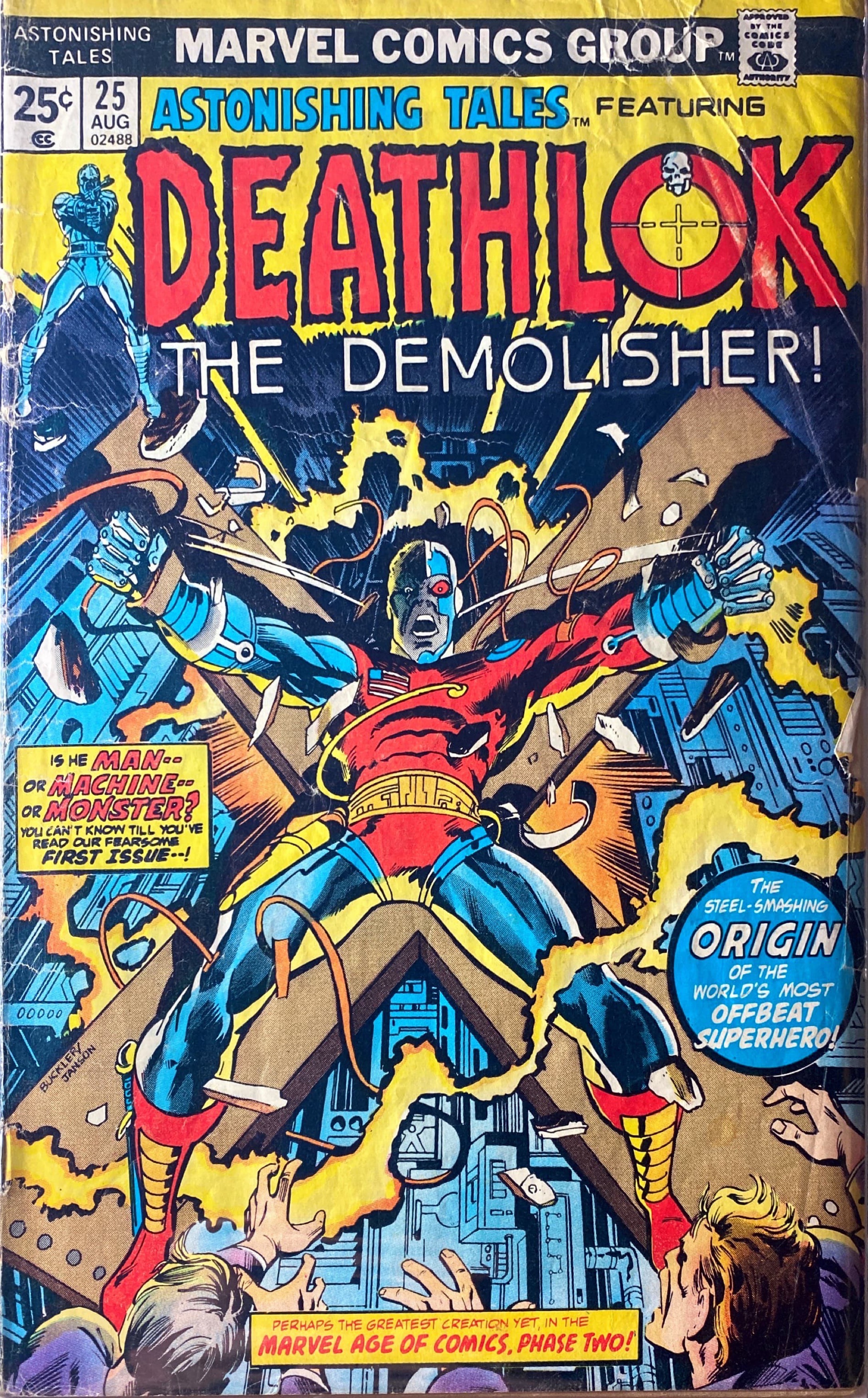
Smith’s Wolverine origin story dramatizes, I think, why science fiction and horror fit perfectly together since the essence of unbridled science threatens both individual agency and cultural stability—paralleled well, I think, by another science-gone-wrong creation from Marvel in the mid-1970s, Deathlok [Astonishing Tales featuring Deathlok 25-28, 30-36, Marvel Spotlight 33 (1974-1977)].

Astonishing Tales 25 (cover by Rich BucklerKlaus Janson and Gaspar Saladino)

Humans have a very complicated relationship with the human intellect, of which science is a key part. The recent Covid epidemic exposed that once again, people struggle with understanding exactly what “science” means—and doesn’t mean.

Contemporary life for many people in 2023 depends heavily on technology, and the allure of science fiction remains strong even as we seem to resist the messages those stories offer.

Whether it is Frankenstein’s Monster or Wolverine, the possibilities of science gone wrong moves us, speaks to our humanity, and offers us a better way.

It is always worth noting Shelley’s subtitle, another thing erased by pop culture—The Modern Prometheus.

Science, it seems, is a key urge of humans to be god or supplant god. And as our recycling of the Frankenstein narrative shows again and again, a quest to be god or deceive god is pure folly, our own arrogance turned against what makes us human.

Wolverine as The Monster should speak to us through the coupling of his immortality (an off-and-on quality in Marvel’s portrayals) with his constant state of suffering—just like Shelley’s original Monster whose sentience should move our hearts and souls as much as our minds.

I am drawn to the chorus in first single released by The National for their new album:

I was so distracted then
I didn’t have it straight in my head
I didn’t have my face on yet or the role or the feel
Of where I was going with it all
I was suffering more than I let on
The tropic morning news was on
There’s nothing stopping me now
From saying all the painful parts out loud

Tropic Morning News

Distracted and suffering like each iteration of The Monster, who, ultimately, is each of us.

Fostering Purposefulness (and Not Correctness) in Students as Writers: The National Edition

A confluence of language has washed over me lately, completely an accident of living. I have been reading and finished Cormac McCarthy’s The Passenger just as The National has begun releasing singles from their upcoming album, First Two Pages of Frankenstein.

Currently my favorite band, The National’s music is characterized by their lead singer’s (Matt Berninger) literary elements, augmented by co-writing with his wife, Carin Besser. The new album leans heavily into the literary with the odd title, grounded in Berninger’s struggles with writer’s block when starting to compose this album.

The first three releases—“Tropic Morning News,” “New Order T-Shirt,” and “Eucalyptus”—sound like they have 1960s and 1980s pop influences and offer what appears to be an evolution in Berninger as a lyricist.

These three songs seem grounded in “Not in Kansas” from I am Easy to Find, a rambling sort of song that achieves its lyrical/poetic elements in many rhetorical and syntactical ways while also depending on specific details (such as references to other musical groups).

Having been a serious writer since my first year of college, I am often drawn to words and language in my hobbies, and lyrics fascinate me in the same way that poetry does.

I spent almost two decades teaching poetry to high school students through the songs of R.E.M. And among the many things I miss about teaching high school English is that I don’t have the space as I did then to engage students with lyrics as models for writing with purpose (a much more foundational writing skill than correctness).

As a poet and a teacher, I am not arguing that all students should love poetry (although I suspect that student resistance to poetry is mostly instilled in them by formal schooling ruining poetry), but I do maintain that studying how poetry/lyrics are written is an excellent context for fostering purposeful students as writers.

Lyrics are poetry adjacent; lyrics absent the music are not necessarily poetry, but a form of composing that embraces an essential quality of poetry—economy of language.

Poetry as a form relies on a purposeful structure—lines and stanzas—and a heightened form of expression through language. Poems tends to be brief and most pop songs hover around 3 minutes so these forms of text share that urgency to make the most out of the fewest words possible.

Yes, there are prose poems and book-length poems, but even then, these poetic forms are formed in tension with expectations of lines/stanzas and brevity.

What has struck me with the first 3 songs off The National’s upcoming album is Berninger’s (and when co-writing with Besser) use of specific details as well as rhetorical and syntactical patterns that raise the lyrics to poetry beyond the expected use of rhyme.

I want to focus here on two of the songs, “New Order T-Shirt” and “Eucalyptus,” as models for fostering purposefulness in students as writers.

A writing challenge in poetry and lyrics is achieving a coherent text within a very short space while also attending to more than creating meaning; to that last point, poetry and lyrics often depend heavily on exact word choice and rhetorical/syntactical elements in a compressed and layered way that isn’t necessarily in prose (although my recent McCarthy reading drifts far closer to poetry than standard prose).

So how do the lyrics of these two songs demonstrate qualities students as writers should aspire to?

First, I want to highlight how rhetorical and syntactical elements of raise the language of two songs to “poetic” (in the same way we associate rhyme and meter with “poetic”).

Consider the following:

When you rescued me from the customs cops in Hawaii
When I shut down the place with my Japanese novelty bomb
And your dad came along
How you had me lay down for a temperature check
With the cool of your hand on the back of my neck
When I said, “I think I’m finally going crazy for real”

“New Order T-Shirt”

What about the glass dandelions?
What about the TV screen?
What about the undeveloped cameras?
Maybe we should bury these
What about the last of the good ones?
What about the ceiling fans?
What if we moved back to New York?
What about the moondrop light?

“Eucalyptus”

Both songs’ opening stanzas are compelling and coherent structurally, relying on rhetorical patterns—the “when” and “how” clauses drive “New Order T-Shirt” and the “what” questions anchor “Eucalyptus.”

In typical Berninger fashion, these two examples also highlight how the specific details give writing weight and richness; both songs are heavily concrete, including a dependence on proper nouns and details.

Focusing on how the songs open also contributes to helping students interrogate how meaning is built by the writer and for the reader. The writer must have a coherent plan and purpose, but also present a text in a way that allows the reader to construct meaning.

Although cliche and a bit simplistic, poetry and lyrics when done well capture the truism “show, don’t tell” since the meaning comes from the whole text as a result of its parts.

Like poetry, as well, lyrics depend heavily on sound and patterns.

We expect rhyme in lyrics and poetry, so the near rhyme of “screen” and “these” in “Eucalyptus” both draws in and disorients the listener, reinforcing the complex topic of the song dealing with what appears to be a break up.

In those lyrics also, Berninger plays with meaning in the chorus:

You should take it ’cause I’m not gonna take it
You should take it, I’m only gonna break it
You should take it ’cause I’m not gonna take it
You should take it, you should take it

“Eucalyptus”

The listener must navigate the tension in the layers of the chorus: “take it” as in physically possessing an object and then “take it” as in putting up with a situation.

Rhetoric, syntax, and diction are the tools of the poet/lyricist who has chosen to work within the limiting constraints of poetry or a pop song; that’s where the economy of language and the need to express merge, creating poetic language.

There are many more things students could be asked to do with these lyrics, but I wanted here to start and continue a consideration of how lyrics and poetry can serve as powerful models for being an effective writer through acknowledging purposefulness and control by the writer.

There are no temples, and simplistic rules for writing often fall flat (like “show, don’t tell”), but there are enduring concepts emerging writers need to examine and adopt.

Concrete and specific details, rhetorical patterns applied with purpose, and paying attention to the sounds and emotional impact of words and syntax—this is the stuff of writing well, and these are the elements found throughout the songs I have identified here.

Some aspects of becoming a writer are ignored or simply bulldozed over, yet are as essential as the things we have traditionally taught (five-paragraph essays, rubrics, correctness, etc.)—such as engaging the reader and balancing the content of writing with the aesthetics of language.

Lyrics and poetry are ideal for highlighting those ignored elements because they are brief, rich, and engaging.

For a while now, this has been playing over and over in my head:

How you had me lay down for a temperature check
With the cool of your hand on the back of my neck
When I said, “I think I’m finally going crazy for real”

“New Order T-Shirt”

As a fan, this clearly resonates with me, but as a writer/teacher I want students to investigate how these lines are compelling—the rhetorical patterns (“how,” “when”) throughout the song creating meaning and the details shaping a very brief but compelling narrative.

Unlike (for me) McCarthy’s The Passenger, the three new songs from The National are satisfying and fulfilling, even when I find some of them fragmentary, possibly incomplete.

They also warrant re-listening because that element of fulfilling grows over time with the text and complete song.

Our students are unlikely to be poets, lyricists, or even writers beyond formal schooling, but there is a great deal to be gained from exploring purposeful things in order to foster purposefulness in what we do and why.

The speaker in “New Order T-Shirt” admits a few times, “I carry them with me like drugs in a pocket,” and for me, this is the thing about poems and songs I love. That line reminding me:

i carry your heart with me(i carry it in
my heart)i am never without it(anywhere
i go you go,my dear;and whatever is done
by only me is your doing,my darling)

[i carry your heart with me(i carry it in], e.e. cummings

Finally, I think, we often get lost trying to teach writing, mired in the technical, the rules and such. But language is more often about how we feel and about our need to communicate through language.

Poetry and lyrics are an ideal medium for not getting lost in the technical when inviting students to explore becoming writers.


Recent Poem

closer (turn inside out before washing)


closer (turn inside out before washing)

I keep feeling smaller and smaller

“I Need My Girl,” The National

i tripped and fell i think tumbling
or maybe i just leaned over too far?

i could have been pushed i think
lying at the end of this falling

that’s my problem always
trying to be closer and closer

until you are standing there cornered
your back firmly against the wall


i keep seeing my deceased father in my dreams
i keep seeing my deceased father in the mirror

we just moved all our clocks forward
to be closer to spring driving out the cold

so i’m thinking about clearing my head
turn inside out before washing

but i can no longer tell if i am
falling or simply fading away


in the darkness thinking of my father
i hear you softly telling me not to yell

you only need to turn around
you standing there behind me

i lean just a bit closer
as you lean just a bit closer

if it all falls apart you say softly again
in my ear we can rebuild it together

we have everything we need


—P.L. Thomas

Arthur Miller’s The Crucible: 2023

Over 18 years of teaching high school English, I taught American literature for English III (mostly a course for juniors) as part of the required curriculum in South Carolina.

Our required reading list of novels and plays was quite bad, overwhelmingly white authors and so-called classic works of literature (although the “classic” was merely the entrenched modernist works common in most public schools).

Along with the overkill of white men writers and characters, I found the American literature required list inordinately obsessed with Puritanism; students were required to study both Nathaniel Hawthorne’s (god awful) The Scarlet Letter and Arthur Miller’s The Crucible.

Either one would have been more than enough, and frankly, only The Crucible should have been included, if either at all. Students barely tolerated discussing The Scarlet letter, and I think very few actually read the novel (with the entire experience confirming for most of them that they hated to read).

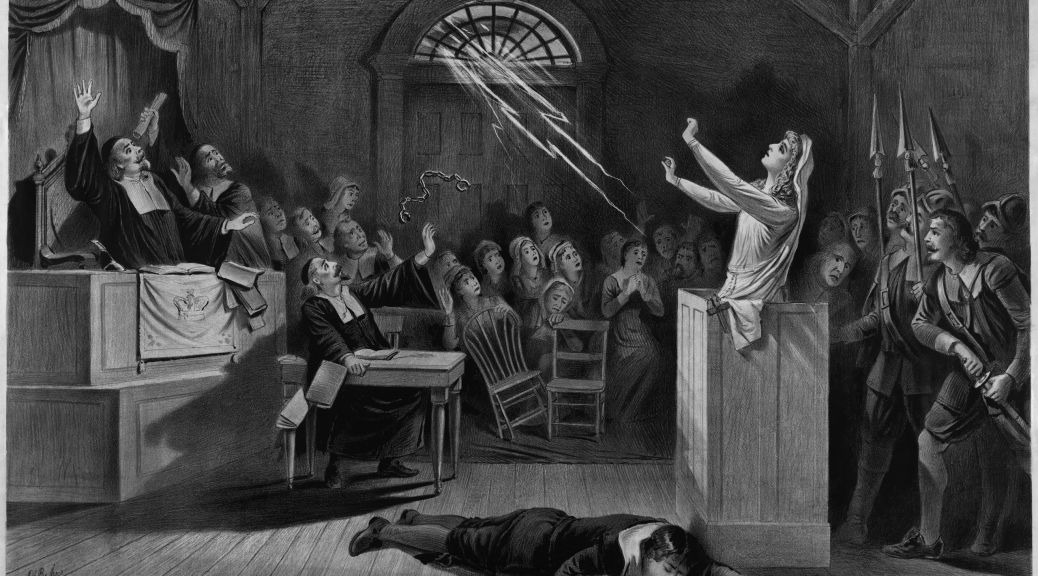
However, we often had a good experience with Miller’s metaphorical/historical confrontation of the McCarthy Era. Over the years, I turned The Crucible unit into a world-wind of an experience that included listening to an audio version of the play (later in the mid-1990s, we watched the film version), an opening activity using R.E.M.’s “Exhuming McCarthy,” and a closing activity centered around watching the original film version of Invasion of the Body Snatchers (1956).

What I think made The Crucible resonate with high school students in the South in the 1980s and 1990s was my effort to help them navigate how the play was designed to address patterns of human behavior that had occurred in Puritan America and then repeated in the McCarthy Era; Miller, of course, was suggesting that this pattern would continue if humans were not vigilant to recognize it.

I have always found compelling the scene when Proctor is confronted with the accusations about witches; he responds that he has not realized “the world is gone daft with this nonsense.”

That nonsense is a fatal combination of religious fever/ missionary zeal, political authoritarianism (the blurring of church and state), and an incredibly dangerous commitment to manufactured evidence.

While The Crucible dramatizes a political/ religious/ legal tragedy mostly anchored in real historical events, in 2023, it is a powerful allegory about our current political over-reaches related to schools and radiating out into our culture and personal liberties.

The same toxic combination of religious fever/ missionary zeal, political authoritarianism (the blurring of church and state), and an incredibly dangerous commitment to evidence can be seen in all of the following:

  • Anti-CRT and anti-woke legislation.
  • Book bans and censorship targeting race/racism and LGBTQ+ content and authors.
  • Anti-trans and anti-drag legislation and rhetoric.
  • Reading legislation committed to the “science of reading.”

In each case, “”the world is gone daft with this nonsense.”

The core problem we are experiencing in the US in 2023 is that religious fever/ missionary zeal among some Americans is being leveraged by Republicans to bolster their political power, skewing toward totalitarianism.

That combination corrupts the evidence being used to push these agendas.

Evidence is being reduced to whatever suits the political/authoritarian goals, and as a report out of UCLA notes regarding specifically the anti-CRT movement, the “conflict campaign thrives on caricature.”

Caricature and misinformation to drive political agendas include how “CRT,” “woke,” banned novels and authors, trans care, drag shows, and elements of reading instruction (such as three-cueing and balanced literacy) are mischaracterized in order to attack the mischaracterization.

Social media is flooded with false definitions of “woke,” for example, grounding outlandish calls for “protecting children.”

For Americans who value life, liberty, and the pursuit of happiness, we must acknowledge Miller’s message that evidence cannot survive in the context of religious fervor/ missionary zeal and totalitarian politics (the consequential inevitability in theocracies).

While there is no such thing as objective evidence, there is a value in dispassionate evidence decoupled from authority.

The US was founded in part on a recognition that the church/state dynamic was oppressive, necessarily so, and despite the many flaws of the so-called Founding Fathers, they were drawn to the Enlightenment and a move toward scientific inquiry.

Despite the continued misuse of the term, “science” rightly understood is about grounding claims and conclusions in a careful analysis of evidence regardless of who makes the claims (decoupling from authority). And science is not about dogma (fixed Truth) but about the pursuit of truth by a community.

In 2023, we are living in the same “nonsense” Proctor named because too many are willing to abdicate the sanctity of evidence for their religious fervor/ missionary zeal and because there are enough political leaders eager to use that to leverage their pursuit of power at any cost to others.

If Nero fiddled while Rome burned, we are conveniently distracted by our many screens while life, liberty, and the pursuit of happiness are reduced to ash.

The Science of Scarcity and Sleep that Education Reformers (Want to) Ignore

[Header Photo by Richard Stachmann on Unsplash]

In the middle of the Obama years of education reform, I discovered and cited often Sendhil Mullainathan and Eldar Shafir’s Scarcity: Why Having Too Little Means So Much.

Mullainathan and Shafir use the term “scarcity” for the conditions associated with living in poverty and “slack” for what most people would call “privilege.”

This book is an overview of the scientific research base around the consequence of being poor. This point has always struck me as incredibly important:

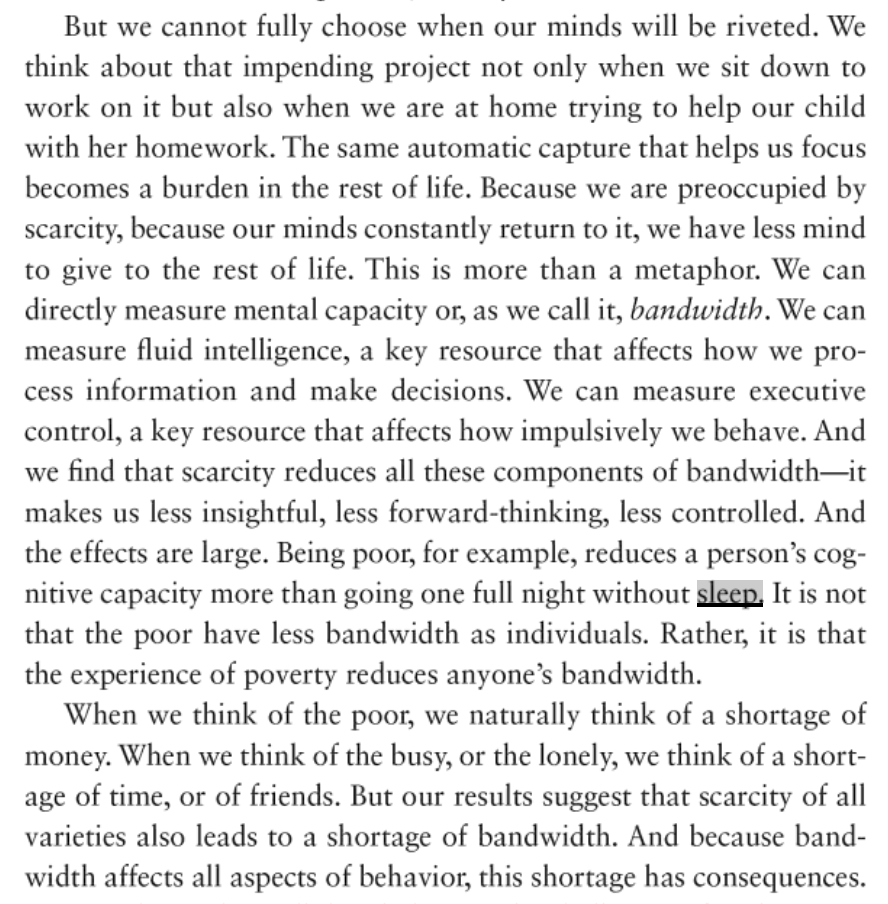
And to focus on the kernel point related to bandwidth: “Being poor…reduces a person’s cognitive capacity more than going one full night without sleep.”

Imagine, if you will, that this is likely magnified for children—and when they are younger, even more so.

Now let’s place that science on scarcity into a recent student on sleep and students:

Although numerous survey studies have reported connections between sleep and cognitive function, there remains a lack of quantitative data using objective measures to directly assess the association between sleep and academic performance. In this study, wearable activity trackers were distributed to 100 students in an introductory college chemistry class (88 of whom completed the study), allowing for multiple sleep measures to be correlated with in-class performance on quizzes and midterm examinations. Overall, better quality, longer duration, and greater consistency of sleep correlated with better grades. However, there was no relation between sleep measures on the single night before a test and test performance; instead, sleep duration and quality for the month and the week before a test correlated with better grades. Sleep measures accounted for nearly 25% of the variance in academic performance. These findings provide quantitative, objective evidence that better quality, longer duration, and greater consistency of sleep are strongly associated with better academic performance in college. Gender differences are discussed.

[abstract] Okano, K., Kaczmarzyk, J.R., Dave, N. et al. Sleep quality, duration, and consistency are associated with better academic performance in college students. npj Sci. Learn. 4, 16 (2019). https://doi.org/10.1038/s41539-019-0055-z

Also focus on this: “Sleep measures accounted for nearly 25% of the variance in academic performance.”

Next imagine that children living in poverty are likely to be under the weight of poverty (similar to sleep deprivation) and to experience actual sleep deprivation.

And if we add some other recent data, that children accidentally born in a month earlier than their peers also contributes to variances in test scores (the most common proxy for learning), and data created under the value-added methods era (teaching impact on measurable student learning is about 1% to 14%), then we are being confronted again with the problems associated with test-based accountability and in-school-only education reform.

Poor children don’t need to be “fixed” (just give them growth mindset and grit) and their teachers don’t need to have higher expectations, or higher quality, or the “science of reading”; poor children need their living conditions changed so that the negative consequences of scarcity (such as indirect and direct sleep deprivation) allow them the opportunities to learn and excel.

Almost all traditional education reform remains laser focused on blaming children, teachers, and schools in order to justify yet another round of in-school education reform.

We must not ignore the full and complicated science of learning just because it is inconvenient and fails to support the false stories we have almost always embraced.

Recommended

Poverty and Education are Inextricably Linked

“Freedom From” as Totalitarian Rhetoric

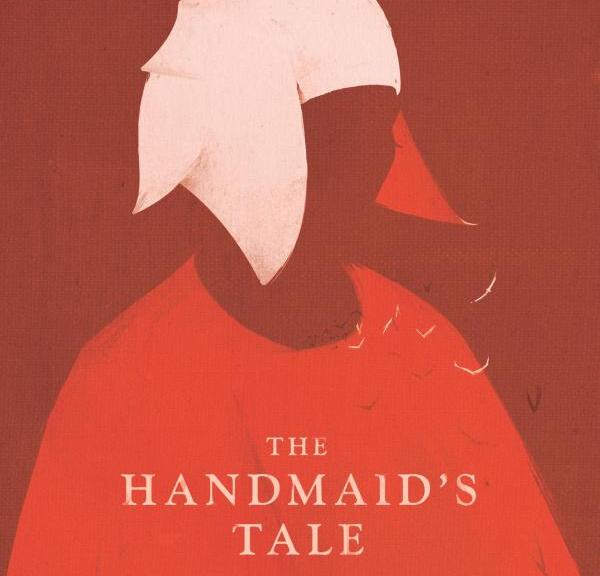
“But in The Handmaid’s Tale, nothing happens that the human race has not already done at some time in the past, or that it is not doing now, perhaps in other countries, or for which it has not yet developed technology,” explains Margaret Atwood in “Writing Utopia,” adding, “We’ve done it, or we’re doing it, or we could start doing it tomorrow.”

Or, we must admit, we are doing it right now.

Atwood’s most well know work is morphing itself into daily headlines, notably featuring a Republican governor from Florida:

As Atwood has warned, “freedom from” is the rhetoric of totalitarianism. In The Handmaid’s Tale, a few women are manipulated to control other women. The handmaid’s are trained by Aunts, who instill the propaganda:

There is more than one kind of freedom, said Aunt Lydia. Freedom to and freedom from. in the days of anarchy, it was freedom to. Now you are being given freedom from. Don’t underrate it….

We were a society dying, said Aunt Lydia, of too much choice. (pp. 24, 25)

The Handmaid’s Tale

Throughout the novel, readers must navigate how Offred (June) weaves the overlap of her own original ideas and vocabulary as that intersects with the propaganda of Gilead:

Will I ever be in a hotel room again? How I wasted them, those rooms, that freedom from being seen.

Rented license. (p. 50)

The Handmaid’s Tale

“Freedom” and “license” are exposed as bound words, the meanings contextual.

As Offred (June) continues to investigate rooms, she discovers a powerful but foreign phrase:

I knelt to examine the floor, and there it was, in tiny writing, quite fresh it seemed, scratched with a pin or maybe just a fingernail, in the corner where the darkest shadow fell: Nolite te bastardes carborundorum.

I didn’t know what it meant, or even what language it was in. I thought it might be Latin, but I didn’t know any Latin. Still it was a message, and it was in writing, forbidden by that very fact, and it hadn’t been discovered. Except by me, for whom it was intended. It was intended for whoever came next. (p. 52)

The Handmaid’s Tale

The power to control language includes defining words, often characterizing them incorrectly in the pursuit of political aims (such as “CRT” and “woke”), but also denying access to language—forbidding reading and writing, literacy, to those in bondage.

And then, Offred (June) explains about her life before Gilead:

We lived, as usual, by ignoring. Ignoring isn’t the same as ignorance, you have to work at it.

Nothing changes instantaneously: in a gradually heating bathtub you’d be boiled to death before you knew it….The newspaper stories were like dreams to us, bad dreams dreamt by others. How awful, we would say, and they were, but they were awful without being believable. They were too melodramatic, they had a dimension that was not the dimension of our lives.

We were the people who were not in the papers. We lived in the blank white spaces at the edges of the print. It gave us more freedom.

We lived in the gaps between the stories. (pp. 56-57)

The Handmaid’s Tale

And from that previous life of “ignoring” the other since it wasn’t about them, Offred (June) finds herself the procreation slave of a Commander, in “reduced circumstances” where she realizes: “There wasn’t a lot of choice but there was some, and this is what I chose” (p. 94).

It takes a special kind of “ignoring” to allow “freedom to” to be erased by the calloused allure of “freedom from” uttered with a smile by a totalitarian.

Better that we listen to a novelist: “We’ve done it, or we’re doing it, or we could start doing it tomorrow.”

Beware lest we all no longer have any of the words needed to be free at all.

Even More Problems with Grade-Level Proficiency

I have explained often about the essential flaw with grade-level proficiency, notably the third-grade reading myth.

Grade level in reading is a calculation that serves textbook companies and testing, but fulfills almost no genuine purpose in the real world; it is a technocratic cog in the efficiency machine.

Now that we are squarely in the newest reading war, the “science of reading,” two other aspects of grade-level proficiency have been central to that movement—the hyper-focus on third-grade reading proficiency that includes high-stakes elements such as grade retention and the misinformation rhetoric that claims 65% of students are not reading at grade-level (the NAEP proficiency myth).

These alone are enough to set aside or at least be skeptical about rhetoric, practice, and policy grounded in grade-level proficiency, but there is even more to consider.

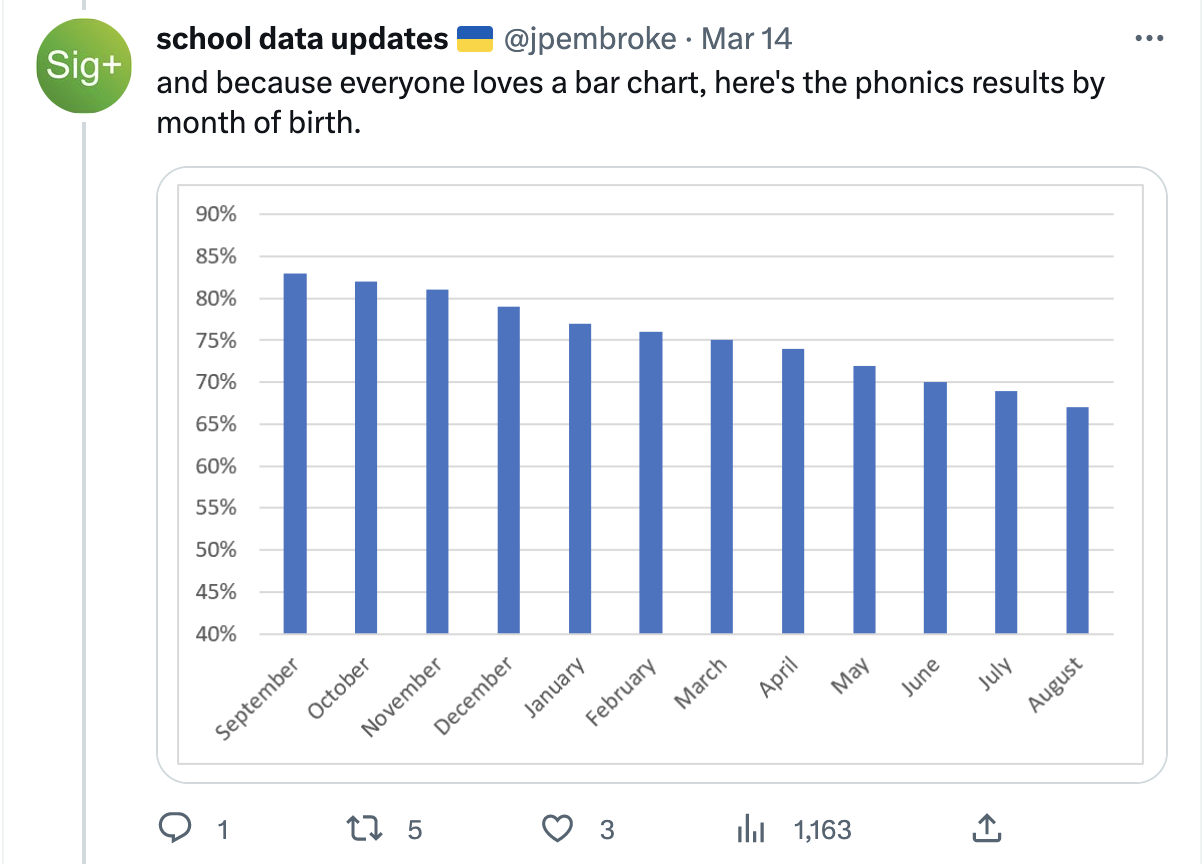
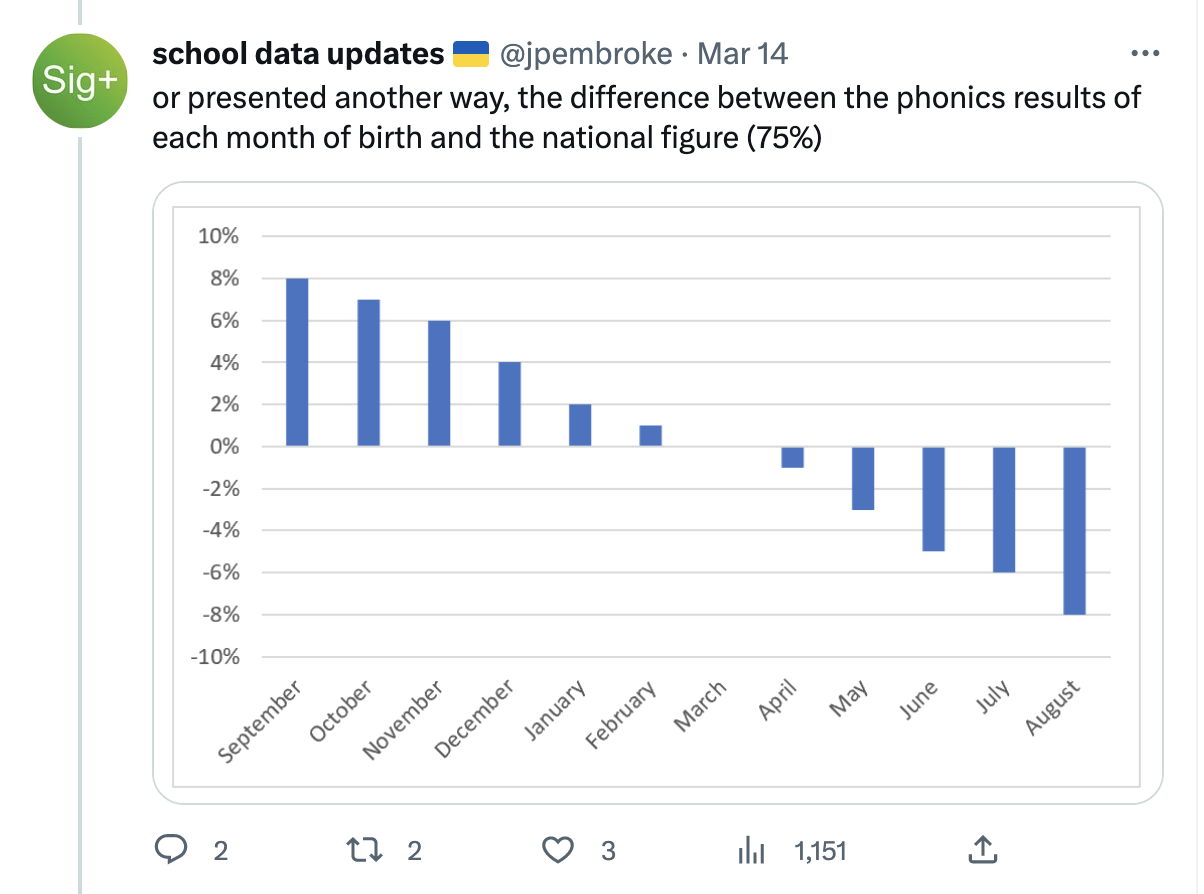
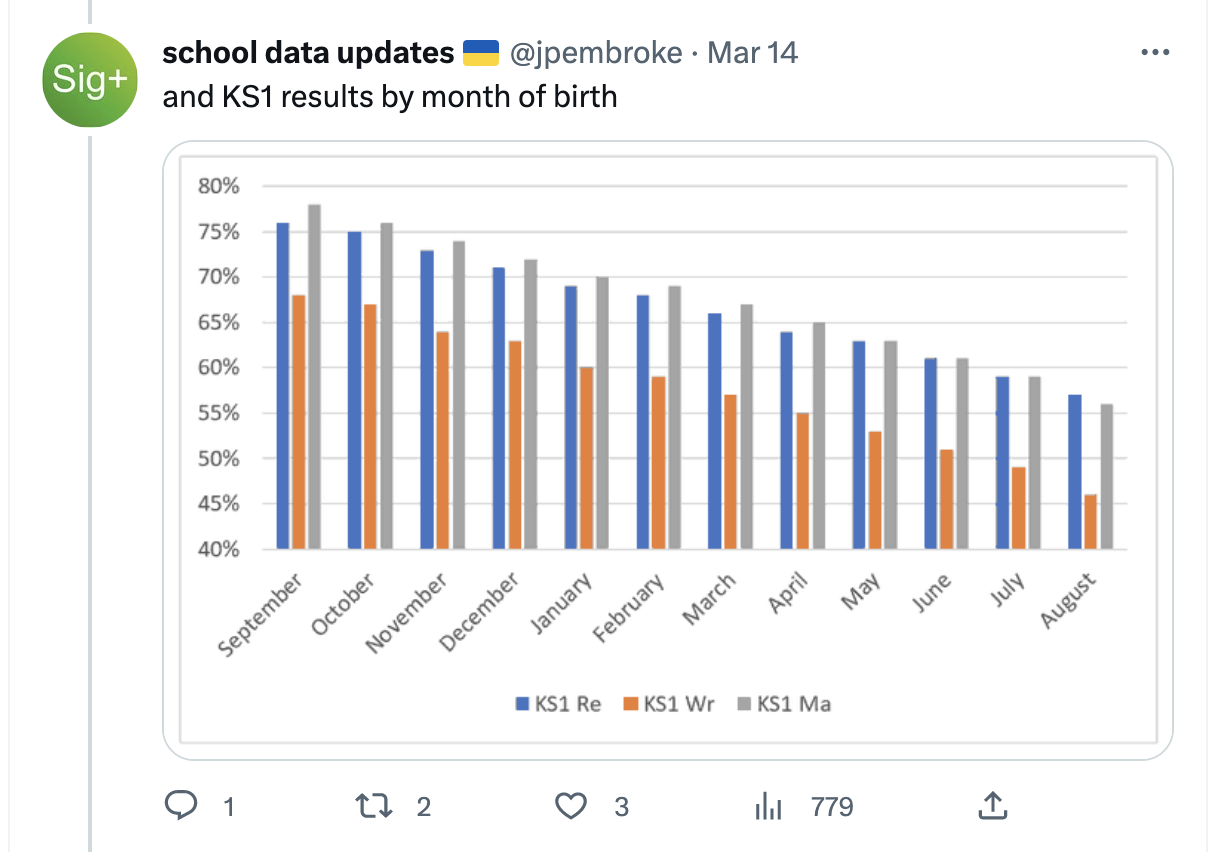
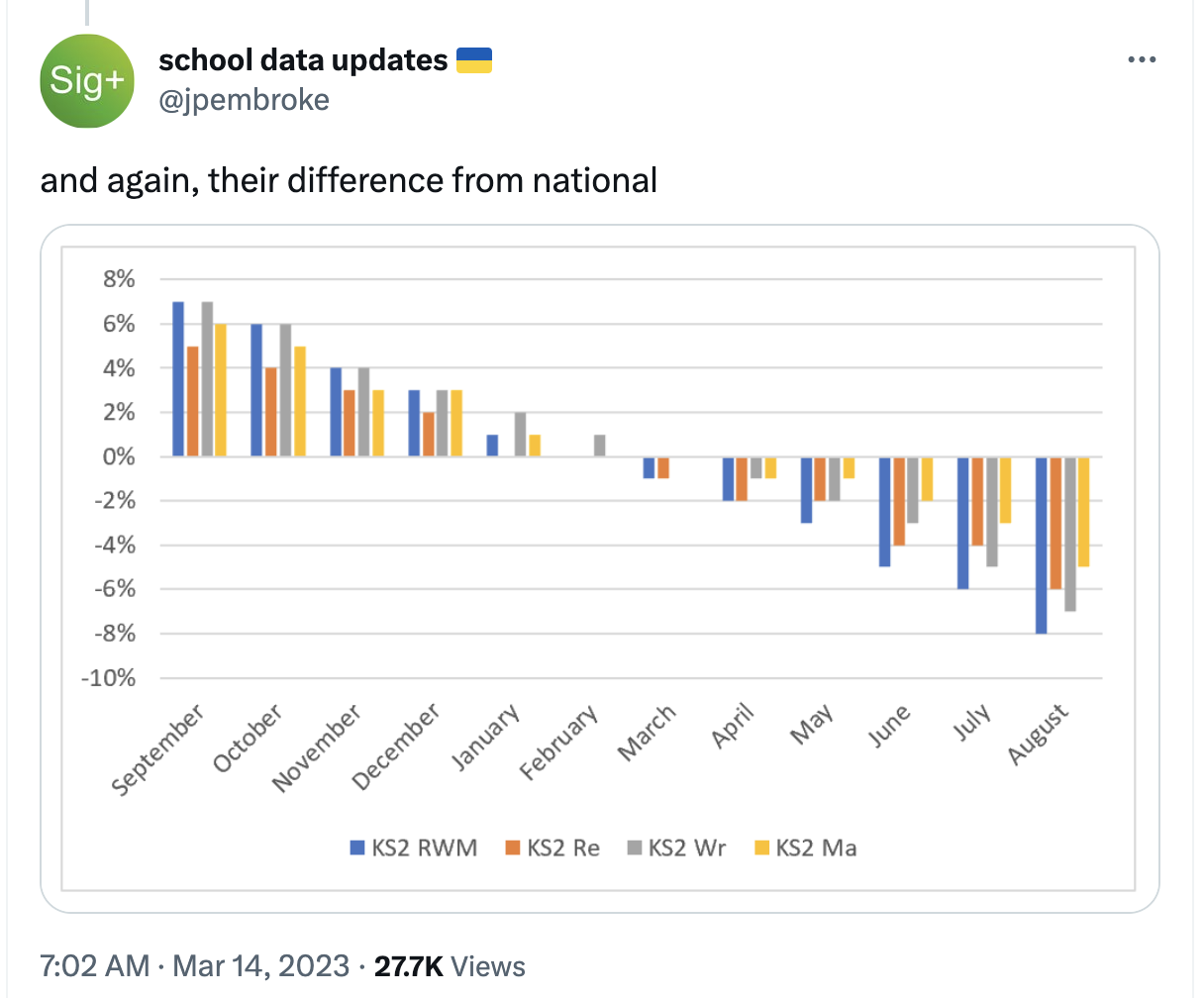
A Twitter thread examines grade-level achievement aggregated by month of birth:

The thread builds off a blog post: Age-Related Expectations? by James Pembroke.

The most fascinating aspect of this analysis thread is the series of charts provided:

As the analysis shows, student achievement is strongly correlated with birth month, which calls into question how well standardized testing serves high-stakes practices and how often standardized testing reflects something other than actual learning.

Being older in your assigned grade level is not an aspect of merit, and being older in your assigned grade seems to have measured achievement benefits that aren’t essentially unfair to younger members of a grade.

Further, this sort of analysis helps contribute to concerns raised about grade retention, which necessarily removes students most likely to score low on testing and reintroduces those students as older than their peers in the assigned grade, which would seem to insure their test data corrupts both sets of measurements.

This data above are from the UK, but a similar analysis by month/year of birth applied to retained students and their younger peers would be a powerful contribution to understanding how grade retention likely inflates test data while continuing to be harmful to the students retained (and not actually raising achievement).

There appears to be even more problems with grade-level proficiency than noted previously, and now, even more reason not to continue to use the rhetoric or the metric.

Republicans Seek IndoctriNation

[Header Photo by Markus Spiske on Unsplash]

Books, ideas, and knowledge are not inherently dangerous.

Political control of education, books, ideas, and knowledge, however, is likely the end of individual freedom as we know it, and which we claim to embrace.

Republicans have now fully committed to banning books, censorship, and mandating what can and cannot be taught in all levels of formal education.

Ironically, there are some dangerous books for Republicans: George Orwell’s 1984, Ray Bradbury’s Fahrenheit 451, and Margaret Atwood’s The Handmaid’s Tale.

These are cautionary tales about totalitarian governments, book banning and censorship, and theocracies. Yet, Republicans have apparently misread them as how-to manuals.

It is also important to recognize that Republicans have sought to control the teaching of history since banning novels is merely attacking imagined worlds.

Again, Republicans appear to have completely misunderstood what history is, why history is taught, and something that has now become nearly cliche to express: Those who ignore history are doomed to repeat it.

Consider the language and justification for book bans and burnings here:

At the meeting places, students threw the pillaged and “unwanted” books onto bonfires with great ceremony, band-playing, and so-called “fire oaths.” In Berlin, some 40,000 persons gathered in the Opernplatz to hear Joseph Goebbels deliver a fiery address: “No to decadence and moral corruption!” Goebbels enjoined the crowd. “Yes to decency and morality in family and state! I consign to the flames the writings of Heinrich Mann, Ernst Gläser, Erich Kästner.”

Holocaust Encyclopedia

If we sanitize the past—as Republicans demand in the name of objectivity—we find ourselves banning books and ideas in the name of protecting children and “morality.”

If we pay attention to Orwell, for example, we recognize that the Nazi’s were using “decency and morality” as a cover for totalitarian aims.

And then, when Republicans claim to be against politicizing education and indoctrination, we must recognize they are actually politicizing education and seeking indoctrination:

Most of us, especially on the left, completely agree with a sincere charge that “a university should not involve political indoctrination,” and therefore, we would be forced to point out that Florida and other Republican-led states are rushing to create exactly that—universities that are nationalistic and Christian-based political indoctrination.

It would behoove Republicans (most of whom have university degrees and ironically disprove their own claims that colleges brainwash students into being “woke” zombies) to sit in on any of my courses.

Republicans have a really hard time with words and concepts, especially the ones they are most angry about; they routinely cannot define the concepts they seek to control and ban—”CRT,” “woke,” and even “free.”

You see, education is not indoctrination because education is mostly about how to navigate knowledge, discourse, and the world—not about endorsing or embracing any predetermined set of ideas or ideologies.

For example, consider if a student expresses the two following brief claims:

“I do not believe in evolution because I do not think humans came from monkeys.”

“I believe God created humans because of my Christian faith.”

In an education setting (putting aside concerns for what the course may be), what would be appropriate responses to these claims by the teacher?

The first should be challenged—not because the student rejects evolution but because the claim is sloppy (scientific theory is not something to “believe” or not) and it makes an implication that incorrectly defines evolution (evolution is a theory, thus proven with evidence, that never claims humans “came from monkeys”).

Therefore, that first claim fails to fully and correctly define terms in order to make evidence-based claims, which has nothing to do with whether or not the student personally accepts evolution as a concept.

The second claim, of course depending on whether or not it is relevant to the course objectives, is completely solid, making no false implications and drawing a reasonable conclusion. Again, the credibility of that second claim has nothing to do with what the teacher believes (or not) and certainly isn’t in any way related to wanting a student to believe or not in any supreme being.

Rhetorically and logically the second statement is far more valid in an education setting than the first. The ideologies of the student and teacher are, therefore, irrelevant to how these fit into the student being educated (and not indoctrinated).

More complicated is whether these claims are relevant in specific fields of knowledge such as biology and religion; students well educated learn that field-based claims are not necessarily in conflict but based on different ways of thinking and knowing.

The first may be better suited for biology, and the second, for religion, but as the liberal arts embraces, these both may be better examined in a full range of disciplines and ideologies that understand science and religion as complimentary, not adversarial.

Faith-based people can understand evolution, of course, but those different ways of knowing may create tension in a person’s journey to understanding the world as a free person.

Education often involves and even requires discomfort, something Republicans seek to eliminate as part of their indoctrination package.

The problem facing the US, of course, is that Republicans cannot fathom a place where the human mind is trusted, where education is the goal and indoctrination is genuinely rejected.

Republicans can only envision people with power indoctrinating those over whom they have power so they are seeking complete control of education-as-indoctrination.

As I have noted often, those of us on the left were likely compelled to that ideological viewpoint because critical pedagogy (grounded in Marxism) is antithetical to indoctrination. As my all-too-brief mentor Joe Kincheloe explains, “Critical pedagogy wants to know who’s indoctrinating whom.”

I have been teaching across five decades, and I have never demanded that a student accept or endorse any ideologies or concepts. I have repeatedly offered challenges to students’ assumptions and worldviews in order for them to fully understand and live with whatever they choose to believe and accept.

Can students fully and accurately define the concepts and words they use? Can students make claims and draw conclusions baed on credible evidence or logic?

That’s it.

Nothing more nefarious or sinister than that.

Like Emerson and Thoreau, I believe in and trust the human mind when it is free of indoctrination, fear, and coercion.

I believe in the possibility of humans who have critically challenged themselves and the assumptions of their families, their communities, and their countries.

I believe in the beauty and power of the human imagination—often found in books, art, and all sorts of creations that bring us to tears, laughter, doubt, wonder, and a whole host of emotions that make us fully human.

And I know deep into my bones that “only cowards ban books” and ideas because cowards are seeking ways to hold onto their power or control over any and everyone else.

There can be no human dignity or freedom without a free mind, and a free mind deserves an education that is grounded in academic freedom and open access to all the possibilities found in books and lessons that cannot be mandated by or restricted by mere government (political) mandate.

Small-minded Republicans are the sort of cowards Orwell, Bradbury, and Atwell—among millions of others—have warned us about.

Cowards and bully politics are seeking an IndoctriNation that a free people must not allow.


Update

Rightwing ‘PragerU’ content is now available through SC education department portal

Granny’s Ironing Service

A former student of mine from my 18 years as a high school English teacher in my home town, Woodruff, SC, lived in the house across the street from my home, where my parents lived from 1971 until they died in 2017.

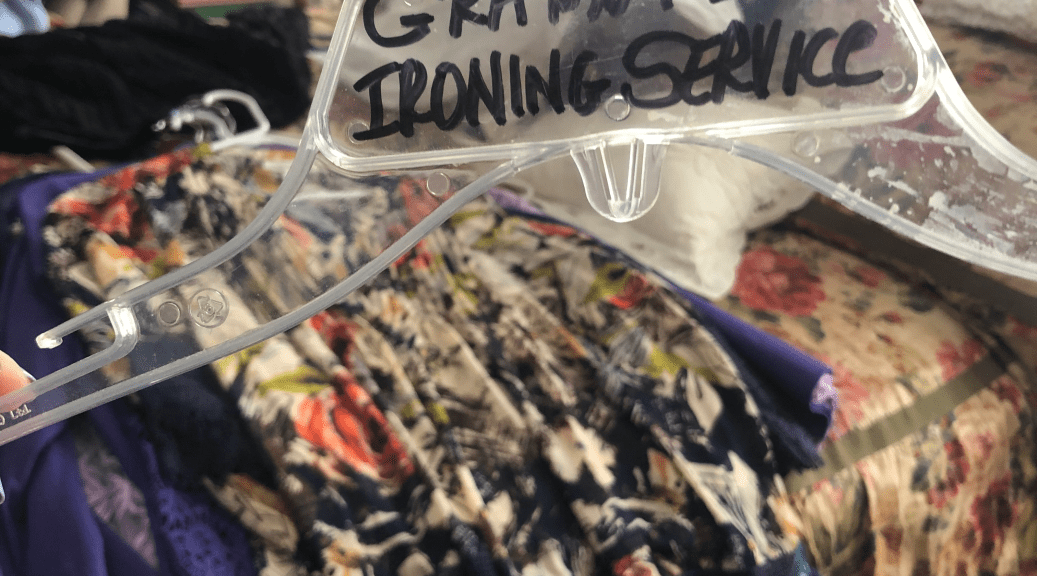
The former student was visiting her mother and helping clean out closets. She texted me that she had found this in her mother’s closet:

Those houses sat on the golf course just north of my hometown, and I had spent my childhood in an even smaller town, Enoree, just south of Woodruff. Both very small town were mill towns, although most of the mills in the area are now abandoned or converted into apartments (I live in one of those mill-to-apartment complexes now in the larger city of Spartanburg only about 20 minutes north of my golf course home).

I immediately felt myself about to cry when she sent the picture of the hanger, an artifact of my mom’s small washing and ironing service.

I have romanticized my childhood, lived and doted upon with my mother often an at-home mom until she started working as an office assistant at the elementary school I attended for third grade (my sister was there in the second grade also).

My mother’s earliest work, that I recall, was as a cashier in the Winn-Dixie grocery store just across the street from where my dad was born in the kitchen of the house where his grandmother lived after his parents moved into the house just down the slope behind there.

The job at the elementary school was more about my parents’ racism than about needing to make money; this school was in the Black neighborhood, Pine Ridge, that sat across the railroad tracks.

She took the job to watch over us, continuing to closely mother us through life. Mom wasn’t a helicopter parent; she was a tether parent, always keeping us in her eyesight.

By the time I was a preteen and we had moved to the golf course, Three Pines, my mother became the bookkeeper for the country club. I also started working at the golf course—as an club house helper, as a life guard at the pool, and as an assistant pro throughout my teens into my early 20s.

My parents were never empty-nesters since they helped raised three of my nephews over all the years after I moved out until they passed away. At their deaths just 4 months apart, my youngest nephew was still living most of the time with my parents.

Over the course of about three decades, then, my mother shifted to what seems almost normal now, working from home.

She ran an elaborate yard sale, for a while at my great uncles defunct store between Woodruff and Enoree, but then in the front yard of their home.

That cobbled together job resulted in an emotionally and physically taxing experience after they died; my nephews and I had to clean out their house, incredibly cluttered from years of my other buying out yard sales and storing other people’s junk to sell herself.

But she had other at-home jobs too.

For a long time, my mother ran a daycare in her house; dozens of people recall her fondly since they spent years of their childhood in her care. This job was the essence of my mother, a natural mother of sorts beginning with her helping raise her brother and sisters as the oldest sibling.

My mother as daycare provider is bittersweet because her inclination to mother was also an inclination to self-sacrifice, martyrdom.

And then there was the washing and ironing service, what proved to be her last job as my father’s health quickly deteriorated and then she suffered a stroke just two weeks before my father passed away at her side in a care facility.

When my former student sent me the picture of the hanger, I recognized the handwriting, but I also immediately sent it to my oldest nephew.

He recognized the hanger much as I did, sharing associations that both warm and break our hearts. Then he texted that he still irons his clothes with an iron my mother gave him.

So I cried twice.

My parents shuffled off this mortal coil with hearts kept beating by medical wizardry—pace makers, defibrillators.

And they leave us who were often in their care with heavy hearts, hearts often so full that tears run down our faces.

Of all the things and people my mother rushed to care for, the one person she always ignored was herself.

That left her some parts doting and loving but other parts disillusioned and bitter.

A clothes hanger, some handwriting—we are left with everyday artifacts that rekindle the memories we must navigate with our heavy hearts.


Poems

the philosophy of gerunds (my mother is dying)

my mother has returned to where she began

wisteria (like a photograph)