How can anybody know
How they got to be this way?
Daughters of the Soho Riots, The National
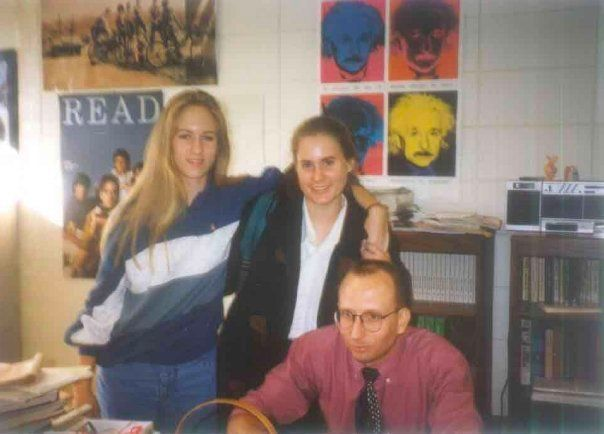
I graduated high school 8th out of 150 students and took with me a great deal of affection and respect for two life-changing teachers—Harold Scipio (chemistry/physics) and Lynn Harrill (English).
My academic success was bolstered by making mostly As in math and science courses, but I puttered along with Bs in English (resisting the drudgery of vocabulary tests and assigned novels). Therefore, I left high school intending to major in physics.
School had taught me I was good with numbers, and I learned that the field of English was grammar book exercises and diagramming sentences (junior high school) or vocabulary tests and assigned novels I had no interest in reading (high school).
Those experiences with English in school were in stark contrast to my ignored and marginalized literary life at home—collecting and reading comic books as well as reading voraciously science fiction and thriller novels.
In fact, that closeted life of reading was teaching me that genre literature was wonderful while English courses and teachers indirectly and directly told me genre writing was trash, that I should read real literature.
I entered a junior college less than thirty minutes from my home with those perceptions of school and myself as well as a youthfully distorted view of my abilities as a golfer and a want-to-be comic book artist.
There a few interesting things happened, notably linked again to teachers for whom I developed affection and respect—Steve Brannon (speech) and Dean Carter (British literature).
Mr. Brannon re-introduced me to e.e. cummings (in a speech course of all places) and sparked my first-year realization that I am a poet and writer; it was during the spring of that first year of college that I began writing seriously.
The other pivotal moment was when Dean Carter (who regularly berated me for my shoes and clothing in front of the class) approached me, asking if I’d like to start tutoring for the course. I clarified for him that I was a math and science person, not an English person.
After Dean Carter explained to me that I was the strongest student in that British literature survey class, however, I began tutoring and soon discovered that I was good at helping other students and I also enjoyed it.
Somehow I didn’t quite get it yet, and I was still mulling options for when I transferred to a four-year university, toying with architecture and pre-law.
A friend with whom I had gone to all 12 years of public school and then junior college and I were set to transfer to the main campus of the state university, but he had a paralyzing accident that summer. I panicked and chose to attend the satellite state university near my home instead of venturing to the main campus.
Having spent over 20 years now in higher education, this next part is something we rarely talk about—how people really chose their majors and how coincidental and haphazard that life-shifting decision can be.
With my friend’s accident and my late change of universities, I was rushed through registration where I was asked (as a rising junior) my major so courses could be chosen for that fall.
At that point I had no real idea but my thinking had shifted to majoring in English (still possibly as a path to law school). Coming from a working class family where neither parent had attended a four-year college, I was hyper-practical, however.
So on the spot I decided I would major in education because that would prepare me for a job and a career. When I said “education,” the advisor nudged me by asking what kind.
Having no idea what that meant, I shrugged and then was prompted with elementary or high school. I immediately said high school only to be asked what kind of high school teacher.
It was at that moment I chose secondary English education as a major; three years later, I entered as a high school English teacher the same classroom that Lynn Harrill had taught me in.
That full circle, I eventually recognized, helped me reconsider what I believed when I left high school, notably that Mr. Scipio and Mr. Harrill had set me on course to be a teacher.
Now here is what we don’t talk about when we talk about teacher education.
Once again, over the last 2.5 years of undergraduate education, I had some really influential professors.
Dr. Tom Hawkins was my secondary English advisor and teacher, and he planted the seeds of how I would eventually think about teaching and learning, specifically about grading (and he introduced me to triathlons, which set me on course to be a life-long serious cyclist).
But I was also an eager English student, taking extra English courses beyond what was required by my education certification; English professors Dr. Richard Predmore and Dr. Nancy Moore profoundly shaped me as a writer and as a potential scholar.
My student teaching was divided between two schools and two teachers, one middle school and one high school.
Here is the really complicated part.
I was greatly motivated to become a teacher so that I could create English classes unlike what most English classes were (no grammar book exercises and tests, no diagramming sentences, no vocabulary tests). And student teaching mostly proved to me all the ways in which I did not want to teach.
Once I was firmly in schooling from the teacher side, I also realized that virtually all the literature I had studied in college would never be works I could teach. In fact, I had to scramble to be prepared to teach the texts assigned and in textbooks during student teaching.
My teaching career began the fall of 1984, right at the beginning of the current 40-year accountability era sparked by the manufactured crisis of Reagan’s A Nation at Risk.
I was handed over a dozen textbooks (grammar, literature, and vocabulary texts) and the journalism course (school newspaper and literary magazine).
Now this is what people really do not want to talk about: I was almost entirely unprepared to teach that fall.
I had no background in journalism (I was a writer, sure, but I had been on the annual staff in high school and dabbled in college newspapers very slightly), and, as I noted above, I was not familiar with almost all of the required literature across four different English courses (mostly British literature) in the textbooks and the required novels/plays.
Most significantly, although my central goal for being an English teacher was to teach my students to write, I soon realized I had almost no composition pedagogy—other than I was myself an accomplished writer in school and college as well as a practicing professional writer (submitting a great deal of writing for publication without success).
Much of that first decade of teaching was spent teaching myself to teach; that journey was supported by also working through my MEd during those years.
But one of the most significant moments was entering the Spartanburg Writing Project (SWP) housed where I had received my undergraduate degree.
I had been teaching (frantically) for several years when I took the SWP summer institute, and it is there, once again, that a teacher changed my life.
The director, Brenda Davenport, essentially took me aside and set me straight, metaphorically kicked my butt.
I had been teaching myself to teach writing with a missionary zeal that had driven me down the wrong road; certainty and arrogance were quickly replaced with humility and patience.
Brenda helped me learn the one thing that we almost never talk about when talking about teacher education and teaching: teaching is learning to teach, and there is no finish line.
I spent much of my first decade of teaching trying to perfect The Way to teach. But each different Way I designed fell just as flat as the Way before.
After SWP, I embraced a true Deweyan approach, recognizing that each new class is a new experiment, informed by all the experiments before but its own different set of humans and requiring different ways of teaching and learning.
You see, there is no One Right Way to prepare people to teach (just as there is no One Right Way to teach reading, for example) because nothing can prepare a person to start teaching.
This fall I start year 40 as a teacher. It will not be like that fall in 1984 when I was first called a teacher.
But it is entirely new, and like that first fall, this is another experiment where I learn how to teach by teaching.



 dr. p.l. (paul) thomas