Deja Vu All Over Again: The Never Ending Pursuit of “Scientific” Instruction

Writing in NCTE’s Elementary English (known as Language Arts since 1975), Lou LaBrant offered a bold proclamation that resonates still today: “This is not the time for the teacher of any language to follow the line of least resistance, to teach without the fullest possible knowledge of the implications of his medium” (1947, p. 94).

LaBrant entered the classroom in 1906, and after experiencing forced retirement in her 60s, she found ways to remain in the field at historically Black colleges, finally retiring fully in 1971 from Dillard University. This impressively long career sits at the center of an impressively long life, living until she was 102 after writing her memoir at 100.

The embodiment of Deweyian Progressivism, LaBrant was equally demanding of herself as she was of others—particularly educators. Her high standards and blunt speaking and writing style make her appealing and often intimidating.

Her piece from 1947 also includes other statements I have repeated in my public and scholarly work:

A brief consideration will indicate reasons for the considerable gap between the research currently available and the utilization of that research in school programs and methods…. (p. 87)

It is not strange, in view of the extensive literature on language, that the teacher tends to fall back upon the textbook as authority, unmindful of the fact that the writer of the text may himself be ignorant of the basis for his study. (pp. 88-89)

LaBrant, L. (1947, January). Research in languageElementary English, 24(1), 86-94. http://www.jstor.org/stable/41383425

Seventy-six years later, LaBrant could just as easily be speaking into the current “science of reading” (SOR) debate that centers research (“science”) and the imbalance of authority often conceded to reading programs.

Some, in fact, may be compelled to assume LaBrant would be an outspoken advocate for SOR. However, LaBrant’s scholarship and practice offer a window into why the SOR movement is misguided and misleading, specifically about the central role of pursuing “scientific” instruction.

To understand that the current SOR is a misuse of the term “scientific” we should reach back a bit farther in LaBrant’s career to 1931:

The cause for my wrath is not new or single. It is of slow growth and has many characteristics. It is known to many as a variation of the project method; to me, as the soap performance. With the project, neatly defined by theorizing educators as “a purposeful activity carried to a successful conclusion,” I know better than to be at war. With what passes for purposeful activity and is unfortunately carried to a conclusion because it will kill time, I have much to complain. To be, for a moment, coherent: I am disturbed by the practice, much more common than our publications would indicate, of using the carving of little toy boats and castles, the dressing of quaint dolls, the pasting of advertising pictures, and the manipulation of clay and soap as the teaching of English literature. (p. 245)

LaBrant, L. (1931, March). MasqueradingThe English Journal, 20(3), 244-246. http://www.jstor.org/stable/803664

In the first couple decades of the 1900s, John Dewey practiced and developed a progressive approach to teaching and learning that was grounded in his call for scientific instruction and holistic approaches to education. Many associate Dewey with “learning by doing,” a relatively fair summary but one that is ripe for misapplication.

Similar to what has been repeated in educational practice for at least a century, William Heard Kilpatrick seized onto Dewey’s concept but packaged it as the Project Method, the source of LaBrant’s “wrath” in 1931.

Dewey’s progressive education philosophy has a very odd history that includes progressivism routinely being blamed for educational failure even though public education in the US being historically and currently deeply traditional and conservative (read Kohn on this paradox).

Two dynamics are at play.

First, formal public education in the US has mostly grounded practice in efficiency since the 1920s—packing as many students per teacher into the classroom as possible and structuring curriculum and instruction around commercial programs and standardized testing.

Second, progressive “scientific” is much more complex and nuanced than current and narrow uses of “scientific” in the SOR movement.

Dewey and LaBrant were advocates for teacher autonomy and authority, which rested on the expectation that teachers know the current evidence base (the “science”) of their filed of literacy but in the context of their day-to-day classroom practice. Both, for example, would strongly reject teaching reading through a commercial reading program of any kind.

Dewey’s progressivism, then, is tethered to the real world in front of the teacher—student behaviors and classroom dynamics.

Philosophy and theory (based on evidence, some of which is generated by the scientific process) provide the teacher with a place to start instruction; however, the evidence in front of the teacher during the act of teaching perpetually shapes practice.

Dewey advocated for “scientific” teaching as an ongoing experiment, not teaching grounded to a template derived from a narrow body of experimental and quasi-experimental research.

If LaBrant were alive today, she would be writing pieces very similar to her 1931 diatribe about the project method, but targeting the SOR movement and the deeply unscientific legislation and practices that movement has spawned: testing students with nonsense words, grade retention, scripted reading programs, one-size-fits-all systematic phonics, LETRS training, NAEP data, “miracle” claims, and more.

Yes, as LaBrant lamented in 1947, public education has a long history of a “considerable gap” between research (“science”) and classroom practice, but another problem sitting between better instruction and greater learning by students is the never ending pursuit of “scientific” instruction that weaponizes “science” and fails to acknowledge the most powerful messages of Dewey’s progressivism—teaching and learning must be focused on the real students sitting in front of teachers daily.

Those unique and diverse students are best served by teachers who teach as scientists perform science—starting with informed hypotheses, implementing instructional practices, developing temporal and unique theories for each student, and adjusting practice based on that evidence for the benefit of each student.

Progressive ideas of “science” are ways to navigate the world in informed and practical ways; conversely, the SOR movement has once again reduced “scientific” to an ideological and political baseball bat used to batter anyone not conforming to their misinformation.

Although LaBrant left us over three decades ago, I can feel her wrath for the SOR movement growing somewhere in the universe, and regret we do not have her voice still to guide us—but we do have her words: “This is not the time for the teacher of any language to follow the line of least resistance, to teach without the fullest possible knowledge of the implications of his medium” (1947, p. 94).
Education Reform Has Been Bipartisan and Conservative for More than 40 Years: What Would Progressive Education Reform Look Like?

As I wrote about recently, the “science of reading” movement fits into a 40-plus year cycle of neoliberal (conservative) education reform.

However, using terms such as “neoliberal” or “conservative” means very little to most people since these are broad (and often shifting) terms about ideologies or beliefs.

Education reform since the early 1980s has been almost entirely conservative in the following ways:

  • The structure of reform has been entirely accountability, which has often been punitive (school report cards and grades that have led to school takeovers, value-added evaluation of teachers that resulted in ranking and firing teachers, exit exams that kept students from graduating, grade retention, etc.).
  • Reform has used standardized testing to justify reform and to monitor reform outcomes despite well-known concerns about inequity in such testing.
  • Reform has been entirely in-school only, depending on and perpetuating education guru marketing such as that by Hattie (although his research and ideologies [can’t do anything about poverty] have been refuted).
  • The rhetoric around reform has depended on a false crisis/miracle dynamic without either being verified by evidence; reform has primarily been perpetuated by political rhetoric and media stories.
  • Reform has surrendered public institutions (schools) to the marketplace, choosing indirect reform over directly reforming how schools works or addressing any social inequity that is reflected in school data.
  • Reform is grounded in rugged individualism myths—students and teachers just need to work harder (and they will do so only if held accountable), downplaying or ignoring systemic forces.
  • Reform is often trapped in over-sold programs and one-size-fits all approaches that seem more efficient.
  • Reform reaches for technology at the expense of teacher autonomy and authority as well as individual student needs.

Progressive education has never really been practiced in the US, and the US has certainly never implemented progressive education reform.

Considering what progressive education reform would entail may help clarify how our current cycle of education reform is essentially conservative. Progressive education reform would include the following:

  • Acknowledging that out-of-school factors (systemic forces) have the greatest impact on measurable student achievement, progressive education reform would reject either/or thinking and advance social reform and in-school reform grounded in equity, and not accountability.
  • Progressive education reform would reduce or eliminate the role of standardized testing in driving what reforms are needed and how well reforms work. Evidence for effective teaching and student learning would be much more broadly and deeply defined.
  • Collaboration, community, and transparency would replace punitive accountability.
  • Aspirational and idealistic outcome goals would be replaced by patience and realistic expectations for human behavior.
  • Progressive education reform would center individual student needs and teacher autonomy over market and political interests.
  • Progressive education reform would reject one-size-fits all solutions, crisis rhetoric, and competitive models that pit stakeholders against each others’ interests.
  • Progressive education reform would be critically skeptical of fads and pre-packaged programs.
  • Progressive education reform would put individual freedom and democracy above market/career goals.

I believe progressive (and especially critically progressive) education reform has great promise for serving the needs of students and society much better than our schools have done historically or currently.

I also recognize that we lack the political or public will to set aside our grounding of neoliberal/conservative ideologies.

Ironically, too often people are not well educated enough to step back and challenge their beliefs even as all the evidence around them shows those beliefs are not working.

I suspect that even though we find ourselves in a very deep neoliberal education reform hole, we are going to just keep digging.

Everything You Know Is Wrong: Reading Edition

As a teenager in the 1970s, I was turned on to The Firesign Theater, and in those days, it was listening to their extended faux radio skits on vinyl (or as we said then, “albums”). One of their album titles lingers in my mind often: Everything You Know Is Wrong.

In fact, thinking about that title inspired me to post a couple polls on social media:

The first set of questions speaks to how we are often trapped in presentism, especially in the stories told by the media and messages perpetuated by politicians.

As I document in my reading policy brief and my book on reading wars, there has not been a single moment in the history of the US since at least the 1940s that we have not in the media and by politicians lamented low reading proficiency in students; as well, no standardized measurement of reading proficiency has ever been substantially different than now.

As with all measurements of student learning, reading proficiency has never been good enough and reading test scores have always correlated strongly with poverty, race, and gender.

Therefore, crisis rhetoric around reading is another manufactured crisis that is dismantled once we step back for historical perspective.

The second poll exposes how powerful media misinformation is, and how common it is for a claim to get into the public rhetoric without ever being interrogated.

The correct answer is “unknown,” although 30-35% not at grade level proficiency can be viewed as a credible estimate.

60-70% is definitely wrong, but represents the power of media messaging (based on not understanding NAEP). In 2018, Emily Hanford established this false claim: “More than 60 percent of American fourth-graders are not proficient readers, according to the National Assessment of Educational Progress, and it’s been that way since testing began in the 1990s.”

Then in 2023, Nicholas Kristof jumped into the long line of journalists who simply repeat this misinformation without ever checking the facts: “One of the most bearish statistics for the future of the United States is this: Two-thirds of fourth graders in the United States are not proficient in reading.”

We in the US love criticism of schools, students, and teachers, and making a negative claim about any of those will likely go unchecked.

Notice anything familiar about Susan O’Hanian’s experience at the Educator Writers Association (EWA) conference in 2003?:

Kati Haycock, though, was the one who really came up to the table for No Child Left Behind, reiterating these points:

  • Colleges of education are still teaching reading the way we thought it should be taught ten years ago.
  • There’s a “scientific” way to teach reading and teachers should be trained to do it.
The Press: All the News about Public Schools They Feel Like Printing

The rhetoric and claims of those who want and need an education crisis are consistent, reaching back, again, to the 1940s, but also as recent as just 20 years ago when NCLB legislated “scientifically based” instruction and codified the National Reading Panel (NRP).

The media has taken a term, “proficiency,” and carelessly misinformed the public (because most journalists have little or no background in education, testing, statistics, etc.).

NAEP uses “proficiency” for achievement well above grade level, as is explained at the NAEP website (see also for a full explanation Loveless, 2023Loveless, 2016):

NAEP student achievement levels are performance standards that describe what students should know and be able to do. Results are reported as percentages of students performing at or above three NAEP achievement levels (NAEP Basic, NAEP Proficient, and NAEP Advanced). Students performing at or above the NAEP Proficient level on NAEP assessments demonstrate solid academic performance and competency over challenging subject matter. It should be noted that the NAEP Proficient achievement level does not represent grade level proficiency as determined by other assessment standards (e.g., state or district assessments). See short descriptions of NAEP achievement levels for each assessment subject.

Scale Scores and NAEP Achievement Levels

NAEP “basic” is closer to what states have established as “grade level proficiency”; however, to further complicate the matter, the US has no standard definition for “grade level proficient,” and most people have never confronted that we should actually be using “age level proficiency.”

Thus, 60-70% is, in fact, absolutely not how many students are not reading at grade level. If we trust NAEP basic, it may be fair to say that about 30% or so are not at grade level.

But the most accurate claim we can make is that we have no real idea because we have failed to create the structures needed to know.

Why?

To be blunt, media and politicians benefit from constant education crisis, and if we actually implemented effective education reform, the profit of perpetual reform would disappear.

More historical perspective: None of the reforms have worked over the past 40 years of high-stakes accountability.

None.

The manufactured crises were all lies, and the solutions had little to do with education.

Reading crisis?

Nope.

Once again, the crisis rhetoric is a lie and the reforms benefit almost anyone except students and teachers.

Thanks to media and political misinformation, everything you know is wrong.

EWA Doubles Down on Media Misinformation Campaign about Reading

Although the “science of reading” (SOR) is now essentially the law of the land in the US—nearly every state has passed some form of reading legislation grounded in SOR—the Education Writers Association (EWA) has decided to double down on the media misinformation campaign about reading: Covering How Students Learn to Read: Tips to Get Started.

Not surprisingly, this brief overview for journalists relies heavily on the work of Emily Hanford (whose career was significantly boosted by EWA’s support for her relentless coverage of SOR) and repeats a number of claims in the SOR movement that have been discredited by scholars of literacy (see below).

The SOR education reform movement, however, is yet another neoliberal reform movement grounded in the “bad teacher” narrative (see the second excerpt below).

Education reform since the 1980s is mostly about creating churn and crisis for the benefit of media (sensational stories attract an audience for floundering outlets such as APM), the education marketplace (out with the old and in with the new—the same entities make money off Heinemann and the “new” structured literacy programs), and political grandstanding (despite none of the education reforms ever working).

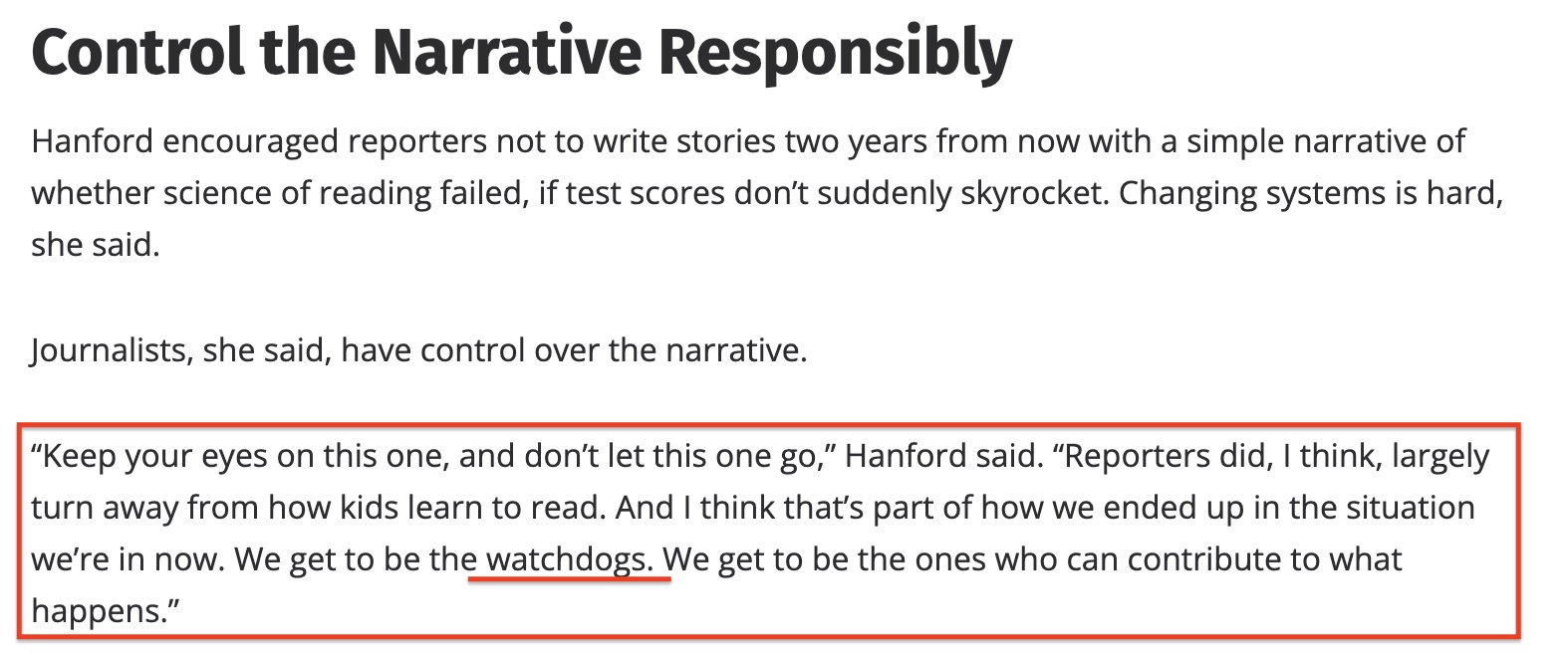
Let me draw your attention to two passages from EWA and then offer a reader that dismantles the false stories and offers the full picture of what we know (and don’t know) about teaching reading):

The research on reading is not in fact settled (see here) and this last passage exposes the fundamentally negative attitude (“watchdogs”) about teachers at the core of the SOR movement and its public and political appeal.

The media has been and seems determined to be irresponsible with their reporting about reading, students, and teachers.

For the full and complicated story, here are alternative texts:


Recommended

The Press: All the News about Public Schools They Feel Like Printing, Susan Ohanian

New Poem: two poems against the squandering

of under me you so quite new

e.e. cummings, [i like my body when it is with your]

It’s a calculation I made a mistake on
I never should have said it like I said

“Space Invader,” The National

i. these unspokens (innocent taboos)

selected poems by e.e. cummings
a carefully placed bookmark

this first gift to you

these unspokens
innocent taboos


hands joined under tables
knees touching and held there

longings kept out of view

these unspokens
innocent taboos


night incantations conjuring
the impossible possible

lover’s prayers

these unspokens
innocent taboos


parking lots and parked cars
secret sanctuaries

chasing possible

these unspokens
innocent taboos


now spoken and acted
let’s hold on to these

against the squandering

ii. the edge

we visited the edge
didn’t we

i never wanted
that trip

but you needed it
i think

i never wanted to gaze
into that abyss

so i was relieved when
we turned

around hand in hand
to return

our place together
solid ground

the meteors found us
i said

the rainbows helped them
you smiled

—P.L. Thomas


The Paradox of Fostering Community Norms in the Classroom in an Era of Indoctrination Histrionics

After 18 years teaching high school English, I transitioned to higher education in 2002. For well over a decade, I have been teaching first-year writing to incoming college students, who in many ways struggle with the contrast between what it means to be a high-achieving high school student and a successful college students. [1]

One of the first discussions I have with those first-year students is about student behaviors, ways in which students are expected to behave that are unlike behaviors outside of the classroom.

We often discuss hand raising, asking permission to go to the restroom (or being denied access to the restroom), bell systems for being late and class dismissal, and taking tests (and the focus on not cheating).

The discussion is designed in part for students to interrogate the norms of being a student and schooling, but also to begin to consider how college norms are different.

I start here advocating for students to stop behaving as students since many of those behaviors center the authority of the teacher/professor and erase the humanity and autonomy of those students.

My university has recently committed to an expanded advising program that guides students purposefully through their first two years. Since I enjoy working with first-year students, I just volunteered for the program and attended training last week.

One of the sessions addressed the community norms that the program seeks to foster in students, norms of classroom behaviors that should be applied across all of their courses.

Although we didn’t spend much time on this, what stood out to me was the tension between “community” and “norms”—terms that are too me positive, the former, and negative, the latter [2].

Additionally, I am certain that our current political climate around education—anti-CRT legislation, curriculum bans, and book censorship—that suggests teachers and schools (especially higher education) are indoctrinating and grooming children and young people would result in some people finding these norms “woke indoctrination.”

Ironically, these goals are designed to encourage a more free and considerate exploration of ideas; in short, this is about the importance and power of community:

But teachers like McLaughlin and a growing group of parents are starting to realize that for our children to be healthy, happy and successful, we need to teach them a more profound lesson: interdependence — that is, how to rely on others and how to be a person whom others can rely on, too.

What McLaughlin knows and what research suggests is that lasting self-worth cannot come from approval based solely on external rewards, such as trophies, college acceptance letters and fancy job offers. Rather, an understanding of one’s inherent value comes from knowing one’s place in a community — from the sense that others value you and that you add value to others. Researchers call this feeling “mattering”: Only by building interdependence can kids gain social proof that they do indeed matter.

Forget independence. Teach your kids this instead.

I have two vivid and humbling experiences from college. The first in Mr. Pruitt’s class as a first-year student and the second in Dr. Predmore’s class, likely when I was a junior.

As an eager students who had a great deal of success engaging in classroom discussions in high school English (Mr. Harrill’s classes), I found myself excitedly speaking up in Mr. Pruitt’s class until I suddenly realized I was embarrassing myself.

That day I recognized I had much left to learn and not speaking up, listening with new ears, was often a better option.

Just a couple years later, after I had declared as a secondary English education major, I had grown some as a student, but I entered class one day for Dr. Predmore’s Southern literature course and once again found myself embarrassed at my lack of knowledge (but I had learned not to speak up too quickly by then).

I was then evolving in my quest for academic/intellectual humility.

Much of my grounding as a teacher for forty years has rested on those experiences and how to foster high engagement, intellectual humility, and intellectual curiosity in students. I also recognize that a great deal of the norms of schooling are counter to human dignity and deeply engaging with knowledge in critical ways.

There is also another layer to the paradox of community norms in the classroom; along with the tension between education and indoctrination is how teachers/professors and students can navigate academic freedom in a space that has a diversity of beliefs and experiences.

Academic freedom is incredibly important in an education system dedicated to fostering democracy and individual freedom; however, “freedom” is not license, and neither teachers/professors nor students are “free” to simply say anything.

Further, learning is often uncomfortable (student discomfort having been politicized, even weaponized, by conservative recently), but while intellectual discomfort may be expected or even necessary, no one should feel emotionally or physically threatened or unsafe.

Few people have a genuinely good grip, though, on where that line is, and often, the teacher/professor is left to determine that threashhold.

Currently, issues around safe spaces, trigger warnings, and other mechanisms designed to encourage respectful and open discussions are also under attack (and some of the debate around this is certainly warranted).

In the real world, students and teachers/professors will make mistakes, but I remain convinced that formal education must seek to balance academic freedom, free speech, and seeking ways not to further marginalize or dehumanize anyone—recognizing fully that some topics and comments are necessarily inappropriate for class discussions.

Free speech and academic freedom, however, fall back under the problem of norms.

If you spend just a few minutes on social media, you soon learn that billionaires, politicians, and the so-called average citizen all have very weak or even distorted understanding about free speech and academic freedom.

Simply put, what we can say and should be allowed to say on Twitter/X simply is not the same as a classroom, and technically, free speech is grounded in the role of government to monitor or control speech (made even more complicated by the recent over-reach by states such as Florida).

The paradox of community norms in the classroom then becomes that a classroom setting is the ideal place to identify norms and then interrogate that if those norms are ultimately fair and healthy.

Community matters, but share values are not without problems—unless we are willing to continually revisit and revise those shared values in the context of avoiding either/or thinking in which we reduce “value” to either supporting the individual or the community.

As John Dewey and other progressives have argued, we simply do not have to choose one or the other since in a democracy, community and the individual are sacred.

So I return to the problem I have with “community norms.”

Often “norms” are fixed and work in ways to control or police human behavior; community is. a thing in progress, an evolution that is made stronger by its constant state of possible flux.

Norms, you see, are the seeds of indoctrination, and while I fully reject the current conservative histrionics around indoctrination, I am a critical educators who also fully rejects indoctrination.

The best classroom, one where human dignity and humanity are honored in the pursuit of democracy and individual freedom, is a community, and the best community is a thing in progress, stable enough to support us and malleable enough to serve us better as we grow together.


[1] What Do College Professors Want from Incoming High School Graduates?

[2] See:

On Normal, ADHD, and Dyslexia: Neither Pathologizing, Nor Rendering Invisible

Normality in Sayaka Murata

A Vision of Being Human: “Am I normal?”

International Literacy Educators Coalition (ILEC) Responses

July 28, 2023

ILEC Response: Reading Reform Across America (The Albert Shanker Institute, July 2023), Susan Neuman, Esther Quintero, and Kayla Reist

August 4, 2023

ILEC Response: Mainstream media coverage of reading proficiency, teachers of reading, NAEP scores, and teacher preparation

August 10, 2023

ILEC Response: Toward Addressing and Resolving Disparities in Reading Outcomes: A Statewide Database of Curriculum, Instruction, and Assessments in Minnesota (CAREI, University of Minnesota, June 2023), Kimberly Gibbons, Robert Richardson, Eskender Yousuf, Annie Goerdt, and Mahasweta Bose

September 2, 2023

ILEC Response: The Right to Read: The greatest civil rights issue of our time.

November 10, 2023

ILEC Response: Sold a Story: How Teaching Kids to Read Went So Wrong

May 9, 2024

ILEC Response: Reading Science: Staying the Course Amidst the Noise (Albert Shanker Institute)

ILEC Response: Toward Addressing and Resolving Disparities in Reading Outcomes: A Statewide Database of Curriculum, Instruction, and Assessments in Minnesota (CAREI, University of Minnesota, June 2023), Kimberly Gibbons, Robert Richardson, Eskender Yousuf, Annie Goerdt, and Mahasweta Bose

International Literacy Educators Coalition

ILEC Vision: To promote literacy learning practices that enable all children and youth to realize their full potential as literate, thinking human beings.

Download a PDF of the response.


ILEC Response: Toward Addressing and Resolving Disparities in Reading Outcomes: A Statewide Database of Curriculum, Instruction, and Assessments in Minnesota (CAREI, University of Minnesota, June 2023), Kimberly Gibbons, Robert Richardson, Eskender Yousuf, Annie Goerdt, and Mahasweta Bose

The report asserts: “Minnesota is in dire need of comprehensive literacy reform,” raising reading crisis claims from the “science of reading” (SOR) movement. Framing reading achievement as “alarming,” the report offers an ambitious body of data related to reading programs in the state, correlations of reading achievement and curricula, assessments used for screening and monitoring, and interventions implemented.

This report on Minnesota provides a needed model for understanding reading instruction and achievement in all states, but is seriously compromised by bias related to an uncritical acceptance of SOR stories. Claims made fail standards for “scientific,” and the report relies on media stories and surveys, and selected evidence while making a narrow case for “scientific” reading preparation and instruction.

Positive Aspects of the Report:

  1. Data gathered on key aspects of reading instruction should be a model for all states.
  2. The report highlights the significant inequity challenges represented by reading achievement data.

ILEC Concerns:

  1. The report makes sweeping inaccurate claims using “crisis” rhetoric and repeating stories from the SOR movement not supported by research, specifically misrepresenting reading programs and instructional practices (such as three cueing)[1] as ineffective or not supported by SOR.
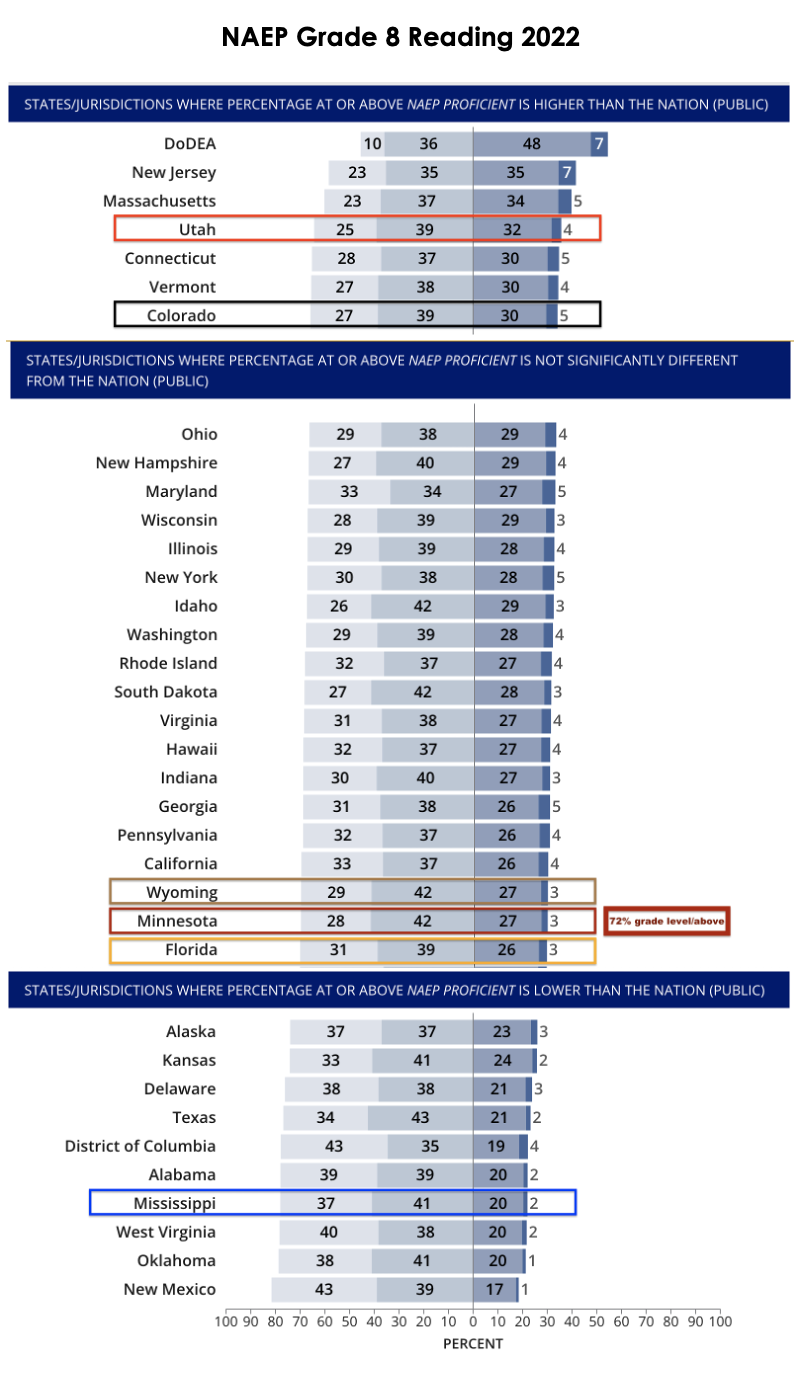
  2. The report notes MN’s stellar ACT scores and ignores that MN’s grade 8 NAEP reading scores (72% at/above grade level) are above Mississippi and comparable to FL, CO, UT, and WY while perpetuating SOR “miracle” myths. [See NAEP data below]
  3. Evidence in the report cites non-scientific sources (media) and cherry-picked research while making claims of a settled body of reading science that is never cited fully.[2]
  4. Analyses throughout the report treat correlation as causation, and thus, the analysis distorts the ambitious gathering of data through ideological claims.
  5. The report relies on outdated evidence (NRP) and endorses programs not supported by research (LETRS), for example, and thus does not practice the same standards the report expects of state reading policy decisions.
  6. Recommendations in the report are recycled approaches states have attempted for four decades without success, specifically calling for identifying effective reading programs and focusing on in-school-only reforms.
  7. Report authors have psychology and general education, not literacy, credentials: Kimberly Gibbons, Robert Richardson, Eskender Yousuf, Annie Goerdt, and Mahasweta Bose.

[1] Compton-Lilly, C.F., Mitra, A., Guay, M., & Spence, L.K. (2020). A confluence of complexity: Intersections among reading theory, neuroscience, and observations of young readers. Reading Research Quarterly, 55(S1), S185-S195. https://doi.org/10.1002/rrq.348; Mora, J.K. (2023, July 3). To cue or not to cue: Is that the question? Language Magazinehttps://www.languagemagazine.com/2023/07/03/to-cue-or-not-to-cue-is-that-the-question/

[2] See The Negative Legislative Consequences of the SOR Media Story: An Open-Access Reader