
International Literacy Educators Coalition
ILEC Vision: To promote literacy learning practices that enable all children and youth to realize their full potential as literate, thinking human beings.
Download a PDF of the response.
ILEC Response: Toward Addressing and Resolving Disparities in Reading Outcomes: A Statewide Database of Curriculum, Instruction, and Assessments in Minnesota (CAREI, University of Minnesota, June 2023), Kimberly Gibbons, Robert Richardson, Eskender Yousuf, Annie Goerdt, and Mahasweta Bose
The report asserts: “Minnesota is in dire need of comprehensive literacy reform,” raising reading crisis claims from the “science of reading” (SOR) movement. Framing reading achievement as “alarming,” the report offers an ambitious body of data related to reading programs in the state, correlations of reading achievement and curricula, assessments used for screening and monitoring, and interventions implemented.
This report on Minnesota provides a needed model for understanding reading instruction and achievement in all states, but is seriously compromised by bias related to an uncritical acceptance of SOR stories. Claims made fail standards for “scientific,” and the report relies on media stories and surveys, and selected evidence while making a narrow case for “scientific” reading preparation and instruction.
Positive Aspects of the Report:
- Data gathered on key aspects of reading instruction should be a model for all states.
- The report highlights the significant inequity challenges represented by reading achievement data.
ILEC Concerns:
- The report makes sweeping inaccurate claims using “crisis” rhetoric and repeating stories from the SOR movement not supported by research, specifically misrepresenting reading programs and instructional practices (such as three cueing)[1] as ineffective or not supported by SOR.
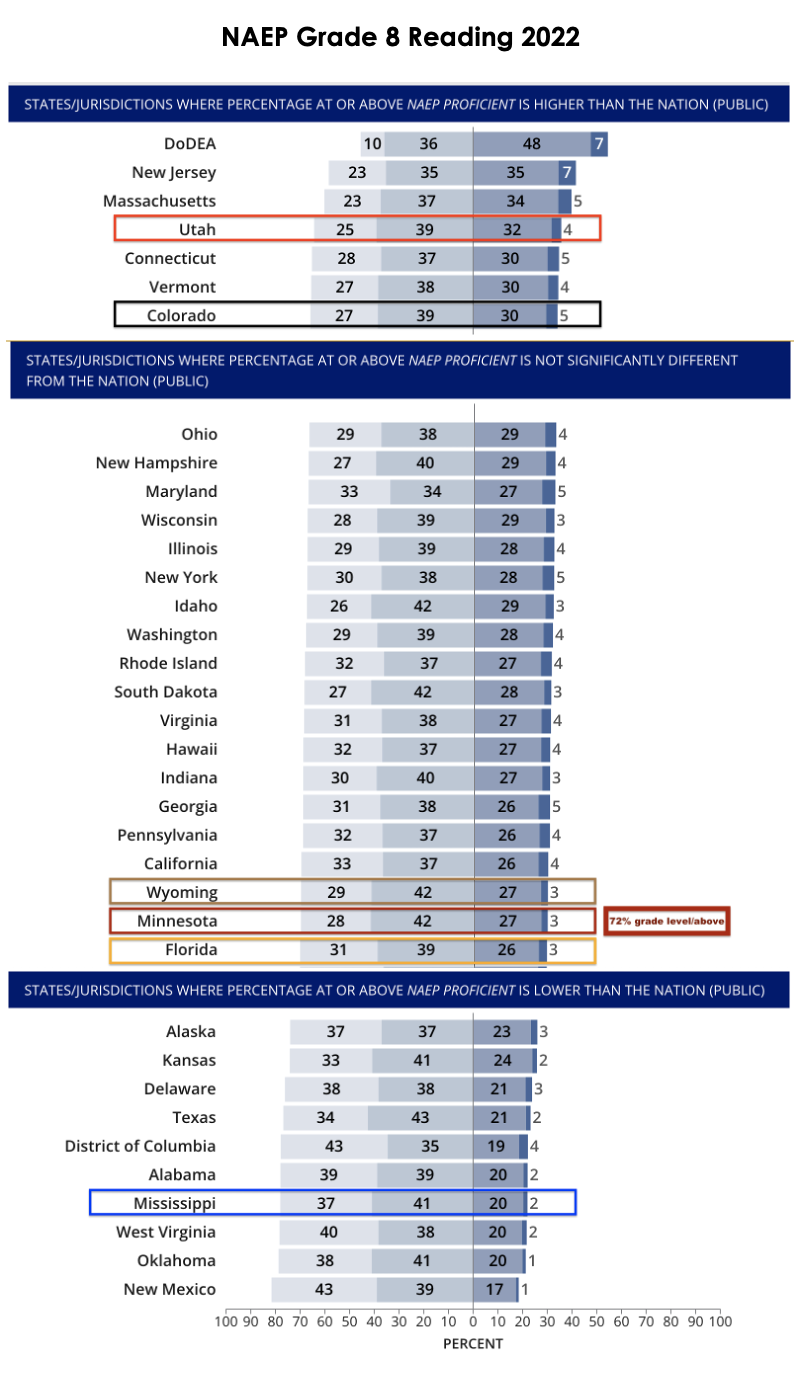
- The report notes MN’s stellar ACT scores and ignores that MN’s grade 8 NAEP reading scores (72% at/above grade level) are above Mississippi and comparable to FL, CO, UT, and WY while perpetuating SOR “miracle” myths. [See NAEP data below]
- Evidence in the report cites non-scientific sources (media) and cherry-picked research while making claims of a settled body of reading science that is never cited fully.[2]
- Analyses throughout the report treat correlation as causation, and thus, the analysis distorts the ambitious gathering of data through ideological claims.
- The report relies on outdated evidence (NRP) and endorses programs not supported by research (LETRS), for example, and thus does not practice the same standards the report expects of state reading policy decisions.
- Recommendations in the report are recycled approaches states have attempted for four decades without success, specifically calling for identifying effective reading programs and focusing on in-school-only reforms.
- Report authors have psychology and general education, not literacy, credentials: Kimberly Gibbons, Robert Richardson, Eskender Yousuf, Annie Goerdt, and Mahasweta Bose.
[1] Compton-Lilly, C.F., Mitra, A., Guay, M., & Spence, L.K. (2020). A confluence of complexity: Intersections among reading theory, neuroscience, and observations of young readers. Reading Research Quarterly, 55(S1), S185-S195. https://doi.org/10.1002/rrq.348; Mora, J.K. (2023, July 3). To cue or not to cue: Is that the question? Language Magazine. https://www.languagemagazine.com/2023/07/03/to-cue-or-not-to-cue-is-that-the-question/
[2] See The Negative Legislative Consequences of the SOR Media Story: An Open-Access Reader
 dr. p.l. (paul) thomas