

Although the “science of reading” (SOR) is now essentially the law of the land in the US—nearly every state has passed some form of reading legislation grounded in SOR—the Education Writers Association (EWA) has decided to double down on the media misinformation campaign about reading: Covering How Students Learn to Read: Tips to Get Started.
Not surprisingly, this brief overview for journalists relies heavily on the work of Emily Hanford (whose career was significantly boosted by EWA’s support for her relentless coverage of SOR) and repeats a number of claims in the SOR movement that have been discredited by scholars of literacy (see below).
The SOR education reform movement, however, is yet another neoliberal reform movement grounded in the “bad teacher” narrative (see the second excerpt below).
Education reform since the 1980s is mostly about creating churn and crisis for the benefit of media (sensational stories attract an audience for floundering outlets such as APM), the education marketplace (out with the old and in with the new—the same entities make money off Heinemann and the “new” structured literacy programs), and political grandstanding (despite none of the education reforms ever working).
Let me draw your attention to two passages from EWA and then offer a reader that dismantles the false stories and offers the full picture of what we know (and don’t know) about teaching reading):

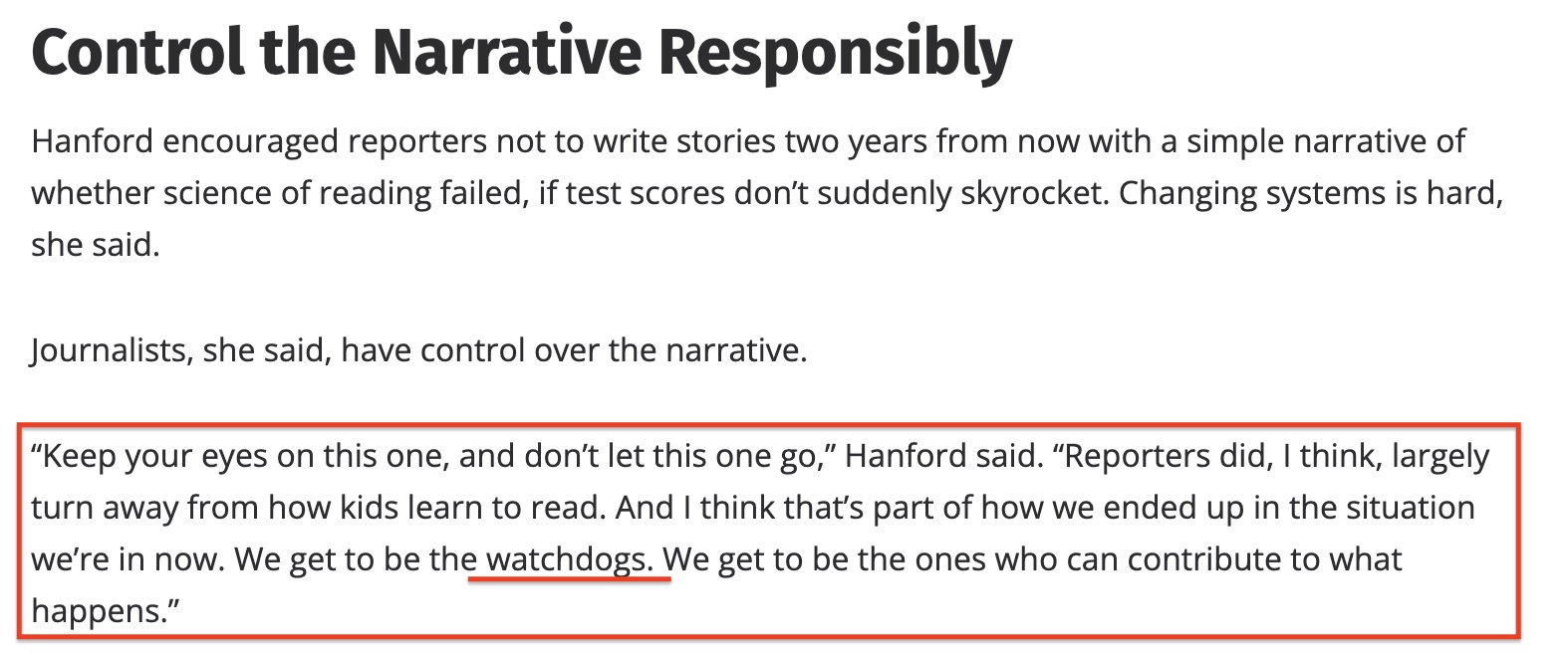
The research on reading is not in fact settled (see here) and this last passage exposes the fundamentally negative attitude (“watchdogs”) about teachers at the core of the SOR movement and its public and political appeal.
The media has been and seems determined to be irresponsible with their reporting about reading, students, and teachers.
For the full and complicated story, here are alternative texts:
- ILEC Response: Mainstream media coverage of reading proficiency, teachers of reading, NAEP scores, and teacher preparation
- Untangling the Debate Over Reading Instruction
- The Science of Reading and the Media: Is Reporting Biased?, Maren Aukerman
- The Science of Reading and the Media: Does the Media Draw on High-Quality Reading Research?, Maren Aukerman
- The Science of Reading and the Media: How Do Current Reporting Patterns Cause Damage?, Maren Aukerman
- Legislating Phonics: Settled Science or Political Polemics? David Reinking, George G. Hruby, and Victoria J. Risko
- Thomas, P.L. (2022). The Science of Reading movement: The never-ending debate and the need for a different approach to reading instruction. Boulder, CO: National Education Policy Center. http://nepc.colorado.edu/publication/science-of-reading
- On the latest obsession with phonics, David Reinking, Peter Smagorinsky and David Yaden
- To Cue or Not to Cue: Is That the Question? Jill Kerper Mora
Recommended
The Press: All the News about Public Schools They Feel Like Printing, Susan Ohanian
 dr. p.l. (paul) thomas