
[Header Photo by Ashni on Unsplash]
Education journalism has been deeply invested in telling negative stories about US public education for many decades. But media coverage of education has also had a long history of relying on sources that are disproportionately not educators or education scholars. [1]
As mainstream and traditional media has contracted, however, education journalism has increasingly become uncritical press-release journalism. Think tanks that are aggressive and produce slick reports that appear to be scholarly are very effective in having those reports —typically not peer reviewed—breathlessly covered by major media outlets.
Three recent reports that were not peer reviewed and are essentially advocacy with ideological agendas represent the current failure of press-release journalism:
- Long-Term Impacts of KIPP Middle and High Schools on College Enrollment, Persistence, and Attainment (Mathematica)
- As a Matter of Fact: National Charter School Study III 2023 (CREDO)
- Teacher Prep Review: Strengthening Elementary Reading Instruction (NCTQ)
The essential problem in this uncritical media coverage of think tank and ideological reports that have not been peer reviewed is that they typically make exaggerated and unsupported claims; and when external reviews fundamentally debunk or strongly caution against viewing the reports as credible, media fails to follow up.
In short, the counter evidence in external reviews do not receive the same sort of coverage from media as the original and flawed reports.
For example, consider the following reviews of those reports:
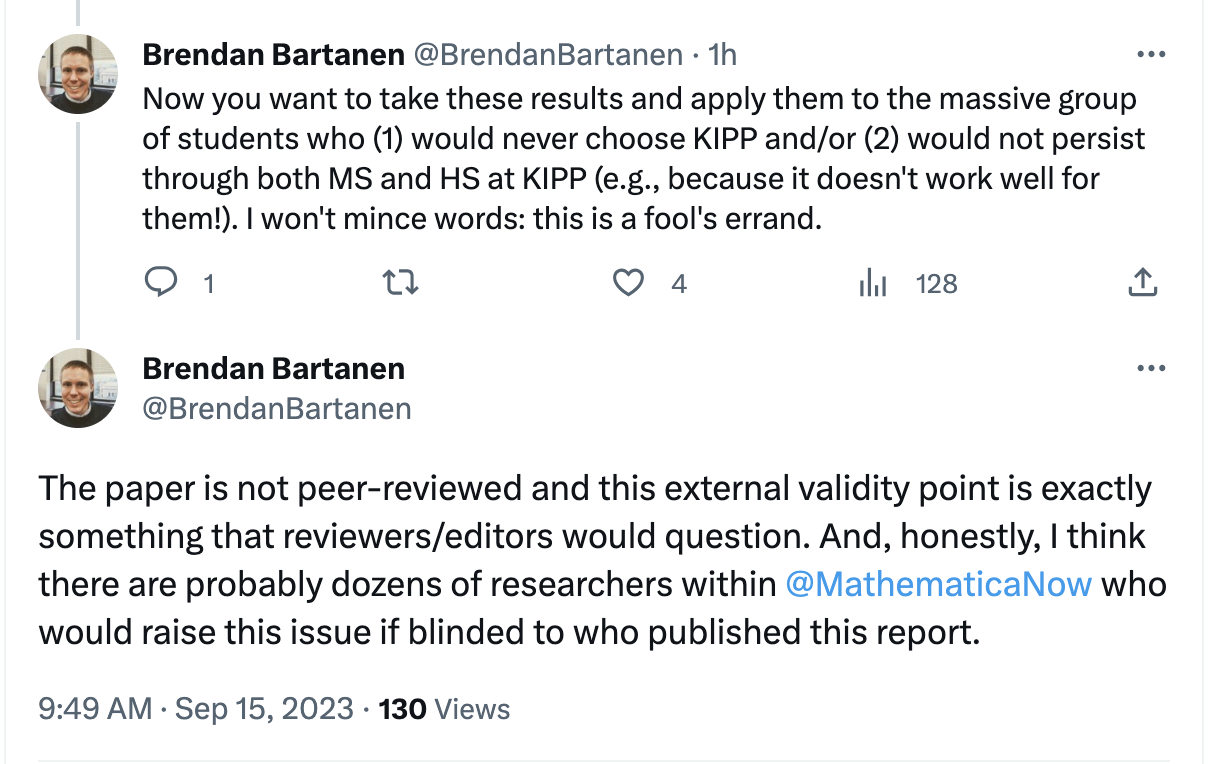
- Mathematica’s KIPP report is examined HERE by Brendan Bartanen:
- CREDO charter report reviewed here: Ferrare, J.J. (2023). NEPC review: As a matter of fact: National charter school study III 2023. Boulder, CO: National Education Policy Center. Retrieved [date] from http:// nepc.colorado.edu/review/charter-study
- NCTQ report reviewed here: Thomas, P.L. (2023, September). NEPC review: Teacher prep review: Strengthening elementary reading instruction. Boulder, CO: National Education Policy Center. Retrieved [date], from https://nepc.colorado.edu/review/teacher-prep
For those interested in fair and accurate research in education and education policy driven by evidence and not ideological agendas, we must begin to hold education journalism accountable for the careless press-release journalism that fails students, teachers, and the promise of universal public education.
[1] See Educational Expertise, Advocacy, and Media Influence, Joel R. Malin and Christopher Lubienski; The Research that Reaches the Public: Who Produces the Educational Research Mentioned in the News Media?, Holly Yettick; The Media and Educational Research: What We Know vs. What the Public Hears, Alex Molnar. And REPORT: Only 9 Percent Of Guests Discussing Education On Evening Cable News Were Educators
 dr. p.l. (paul) thomas