

[Header Photo by Ben White on Unsplash]
The “science of reading” (SOR) movement has now impacted reading practices and reading legislation in essentially every state in the US. While the SOR movement claims lack credibility, the essential template of the media narrative remains compelling for the public and politicians.
Some of the key claims in the SOR movement can now be interrogated, however, since several states have implemented SOR legislation since 2012; those key claims include the following:
- Mississippi has produced “miracle” results with SOR policy and should serve as a model for all states’ reading legislation.
- SOR practices, structured literacy, can produce 95% of students reading at grade level.
- SOR policy does not accept poverty as an “excuse.”
The following data from Mississippi on reading proficiency and grade retention exposes that these claims are misleading or possibly false:
2014-2015 – 3064 (grade 3) – 12,224 K-3 retained/ 32.2% proficiency
2015-2016 – 2307 (grade 3) – 11,310 K-3 retained/ 32.3% proficiency
2016-2017 – 1505 (grade 3) – 9834 K-3 retained / 36.1 % proficiency
2017-2018 – 1285 (grade 3) – 8902 K-3 retained / 44.7% proficiency
2018-2019 – 3379 (grade 3) – 11,034 K-3 retained / 48.3% proficiency
2021-2022 – 2958 (grade 3) – 10,388 K-3 retained / 46.4% proficiency
2022-2023 – 2287 (grade 3) – 9,525 K-3 retained/ 51.6% proficiency
2023-2024 – 2033 (grade 3) – 9,121 K-3 retained/ 57.7% proficiency
Literacy-Based Promotion Act Annual Reports


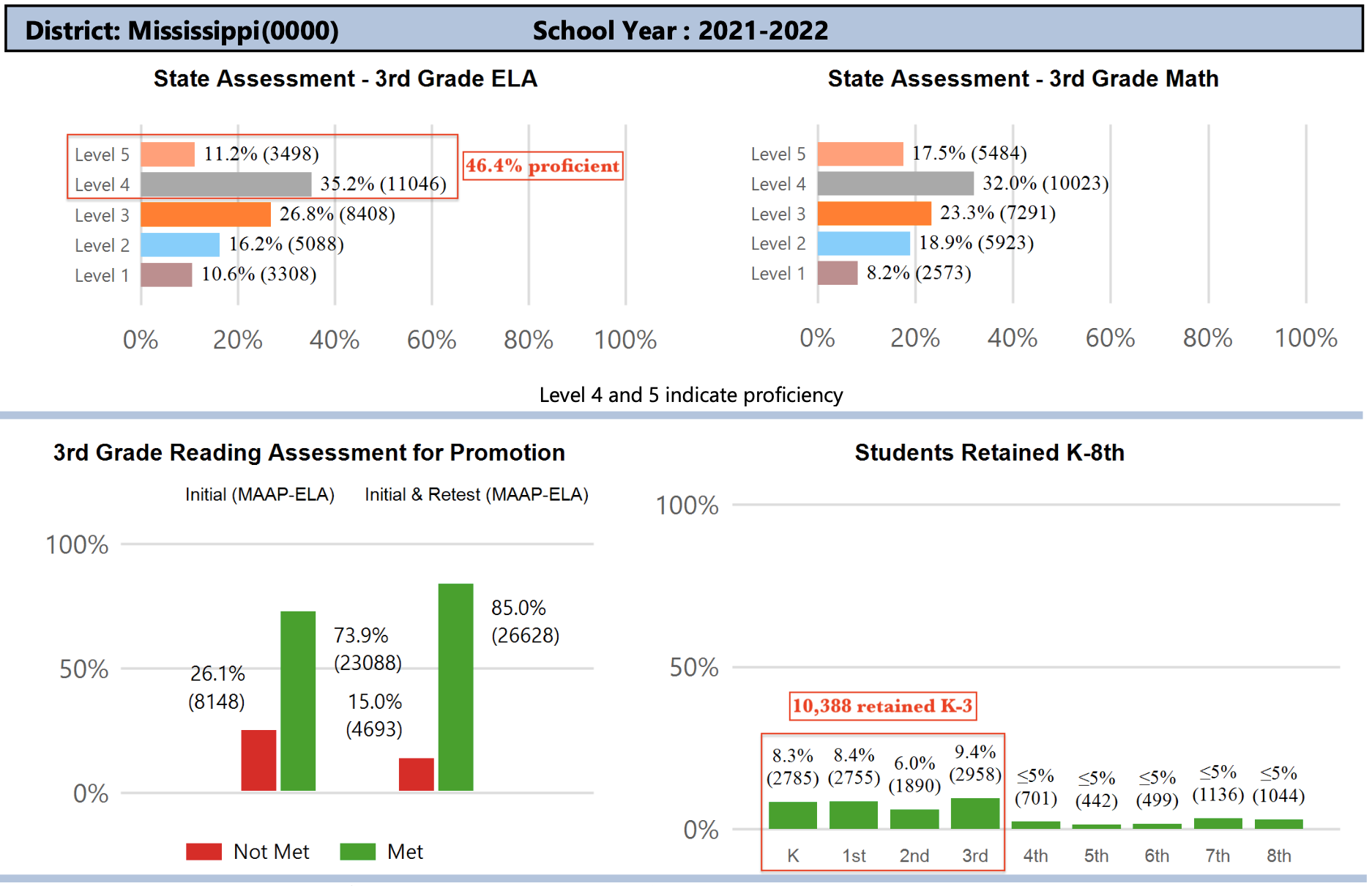

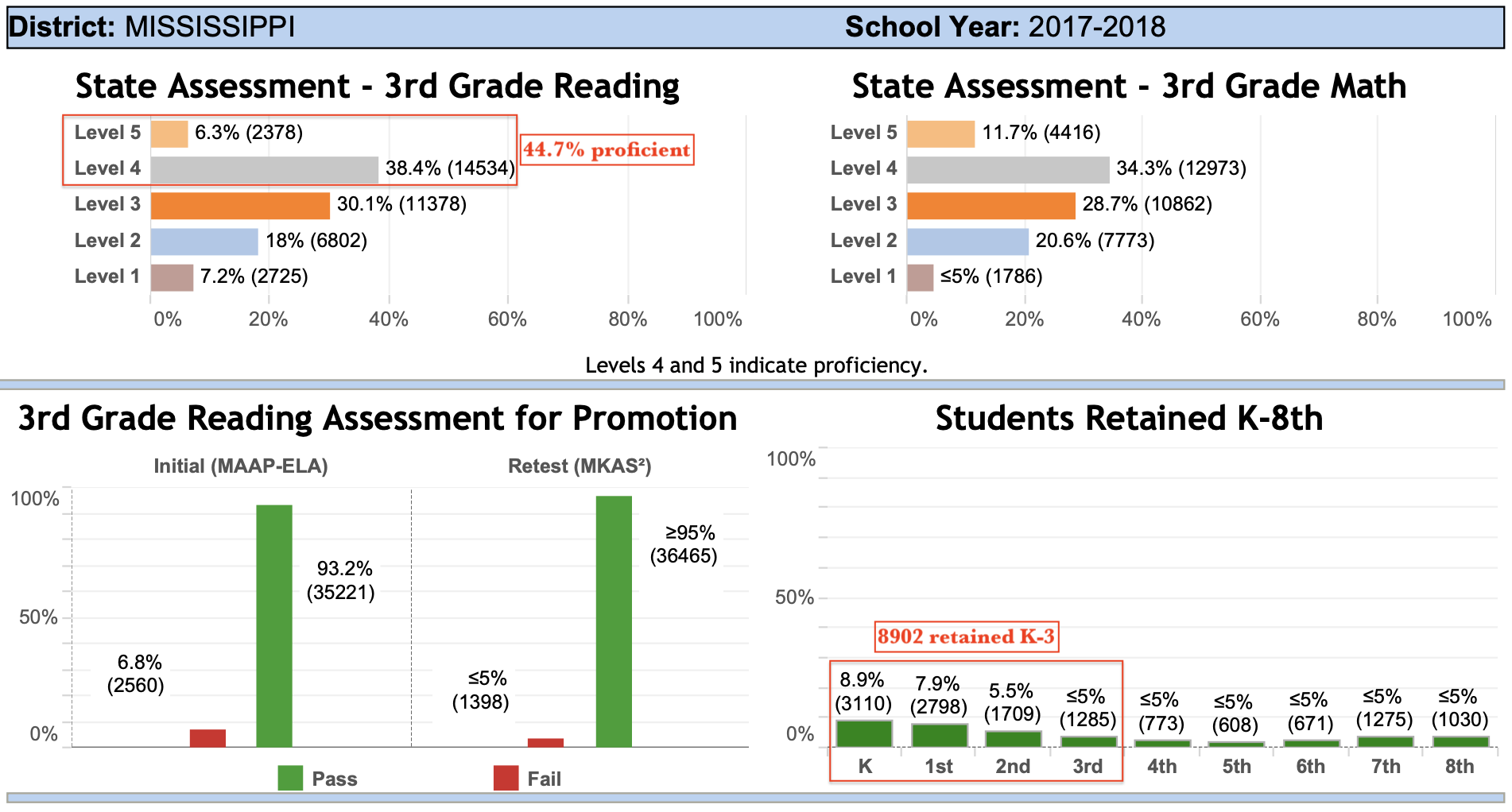
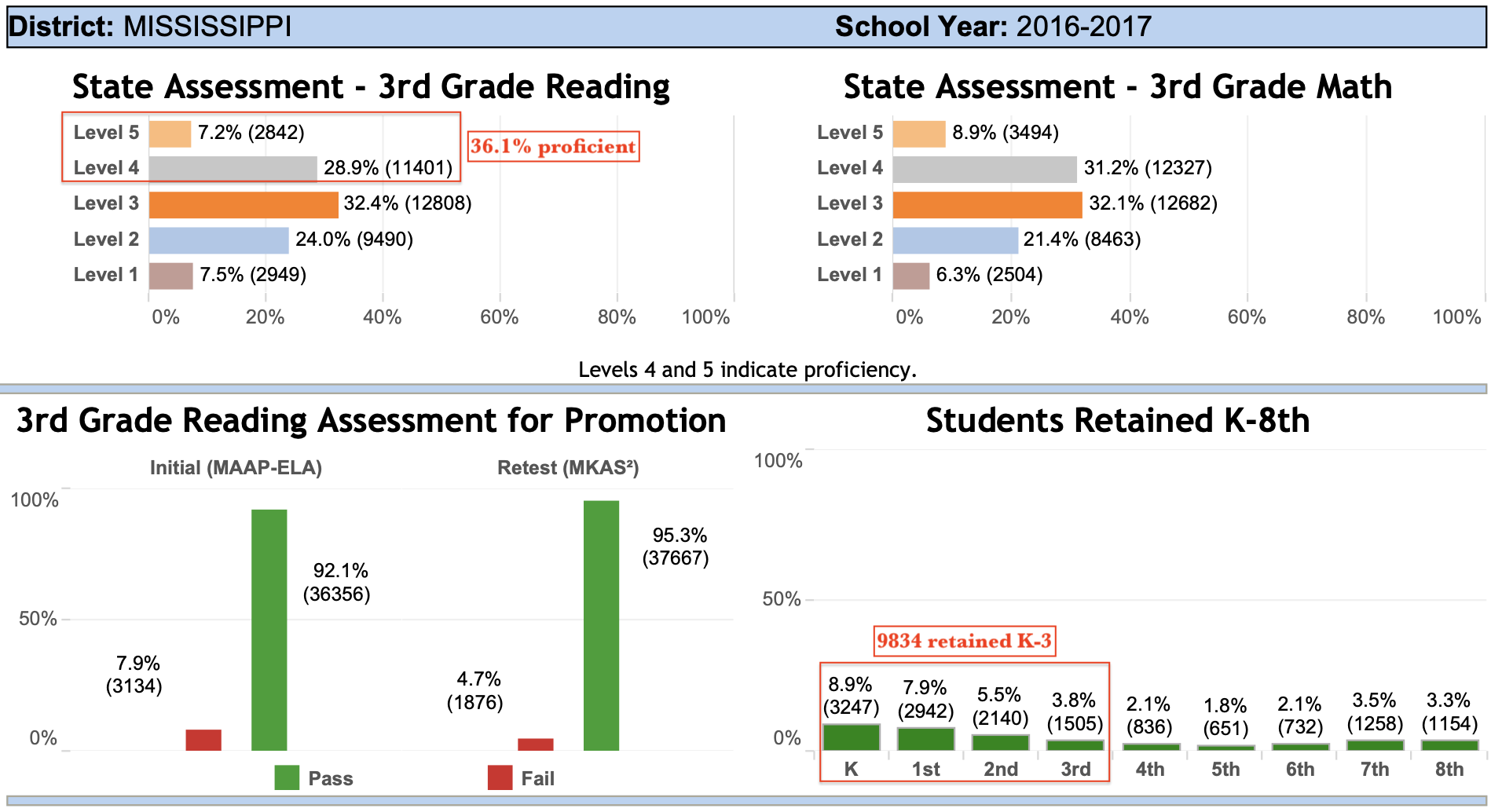

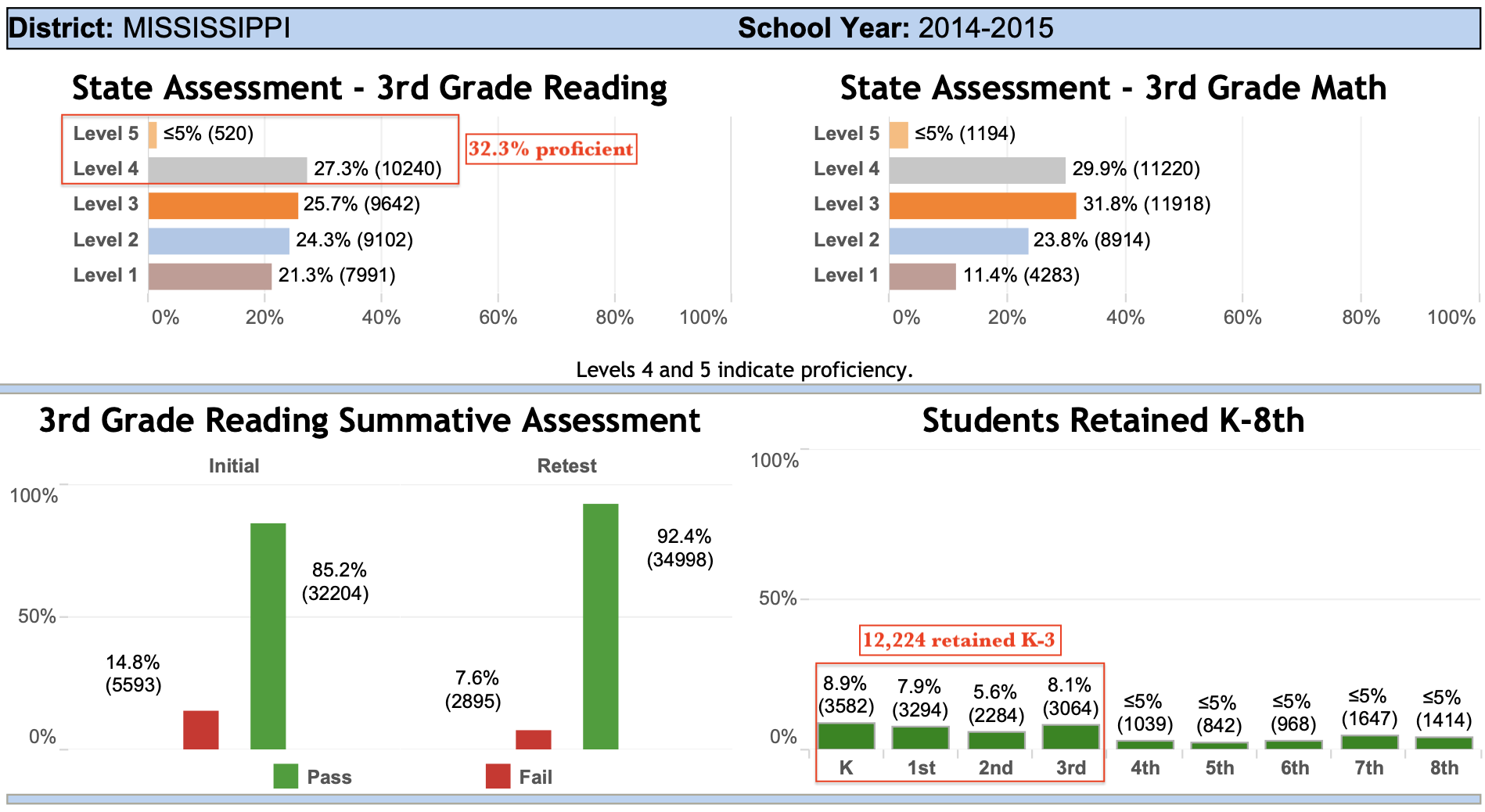
Some key concerns this data raises include the following:
- Proficiency is approaching nothing near 95%, but there is an increase, possibly notable in the highest level.
- Since early reading proficiency is strongly impacted at the birth month level, however, score increases may be (likely are) a reflection of older students being tested at grade levels with younger peers.
- Large numbers of students over four years of schooling (K-3) continue to be retained, calling into question how well SOR/SL actually works.
- States such as MS and FL that have seen NAEP scores and rankings increase at grade 4 have not seen a similar increase at grade 8, suggesting the score increases are a mirage, not a miracle. Grade 8 NAEP data suggests that, in fact, poverty and other out-of-school factors remain significant in terms of student achievement (poverty is not an excuse, but something that also should be addressed).
- Retention disproportionately impacts Black students and students in poverty:

SOR/SL are unlikely to have produced a miracle in MS or any other state (see Florida) , but grade retention is increasingly a political tool that harms children in order to corrupt test data to serve the needs of the education market place and politicians.
Recommended
A Critical Examination of Grade Retention as Reading Policy (OEA)
Grade Retention Advocacy Fails by Omission
Gaming the System with Grade Retention: The Politics of Reading Crisis Pt. 3
Beware Grade-Level Reading and the Cult of Proficiency
What Do We Really Know about Reading Proficiency in the US?
Understanding and Reforming the Reading Proficiency Trap

 dr. p.l. (paul) thomas