There is a story education journalists love to tell; it is so innocent and compelling that even Florida wouldn’t bother to ban it.
Here is the story:
For decades, reading teachers in the United States have been teaching children to read using balanced literacy.
Balanced literacy was created by the Three Evil Witches—Calkins, Fountas, and Pinnell.
Under the spell of balanced literacy, reading teachers use three-cueing on all the children. What is three-cueing?
Well, three-cueing is putting picture books in front of all the children and asking them to look at the pictures and guess at the words on the page!
Such fun!
Sadly, however, now only two-thirds of children can read proficiently!
Despite how many have eagerly believed this fairy tale, it is nearly entirely caricature, misinformation, and lies. But it works so well that almost every education journalist in the US has recycled the story to fit their area or state, pulling from the original holy text.
For example, the most recent retelling comes from Vermont: Too Many Vermont Kids Struggle to Read. What Went Wrong—and Can Educators Reverse a Yearslong Slide in Literacy?
Predictably, this retelling includes the usual list of misinformation and lies:
- The beginning of the article is a litany of misinformation about NRP, NAEP, and reading proficiency (see below about how this piece focuses on grade 4 but ignores grade 8).
- Throughout (see above), the article relies on the caricature of balanced literacy and guessing/three-cueing.
- NCTQ is cited as a credible source although the conservative think tank has never released a peer-reviewed report that meets even the minimum standards of valid research.
- Orton-Gillingham is referenced as moving toward “‘a more scientific approach'” although O-G (multisensory instruction) is not supported by the most recent scientific studies.
- The piece allows Moates to promote her own commercial product, LETRS, although, as with O-G, no scientific research exists showing that the program results in higher student reading proficiency.
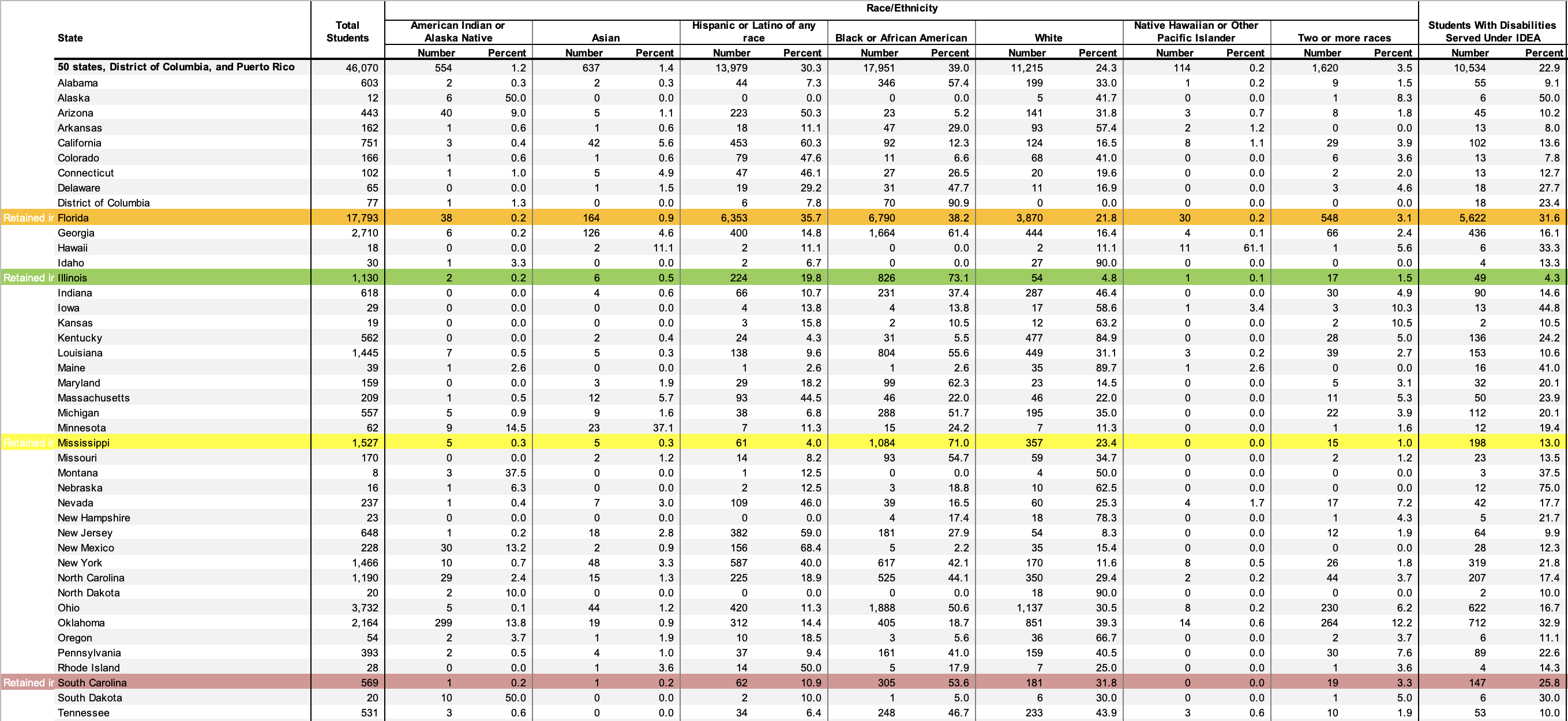
- And maybe most concerning, this piece again praises Mississippi as a model for reading reform in VT—although MS represents the problem with confusing higher test scores driven by grade retention with better reading instruction.
As I have noted, for at least 40 years, education reform has suffered under a crisis/miracle dichotomy that has failed students, teachers, and education.
The current crisis/miracle dichotomy is the manufactured reading proficiency crisis and the Mississippi “miracle.”
However, MS is based on the Florida model, which is now two-decades old.
Ironically, both FL and MS prove to be not models for reform but models for how political manipulation of education causes great harm to children (like the dark underbelly of fairy tales).
Yes, FL has found a process by which the state’s grade 4 reading scores on NAEP sit high in the national rankings; that “achievement” sacrifices almost 20,000 retained third graders a year (Black, MLL, and poor children disproportionately among those retained).
Here is the key problem not being fully addressed by media or reformers: FL also represents one of the states with the largest drop in achievement from grades 4 to 8, because the retention-driven grade 4 scores are mirages:
· Florida kids regress dramatically as they age in the system. Since 2003, Florida’s eighth grade rank as a state has never come close to its fourth grade rank on any NAEP test in any subject.
· The size of Florida’s regression is dramatic and growing, especially in math. Florida’s overall average NAEP state rank regression between fourth and eighth grade since 2003 is 17 spots (math) and 18 spots (reading). But since 2015, the averages are 27 spots (math) and 19 spots (reading).
Florida’s education system is vastly underperforming
MS has achieved its false “miracle” status by mimicking FL—retaining about 9,000-12,000 K through grade 3 students per year, again disproportionately minoritized students.
So what about VT? Well, despite the handwringing over VT’s grade 4 NAEP and reading proficiency, the state sits high in the national rankings of grade 8 reading on NAEP:

Florida is well behind VT in grade 8 reading:
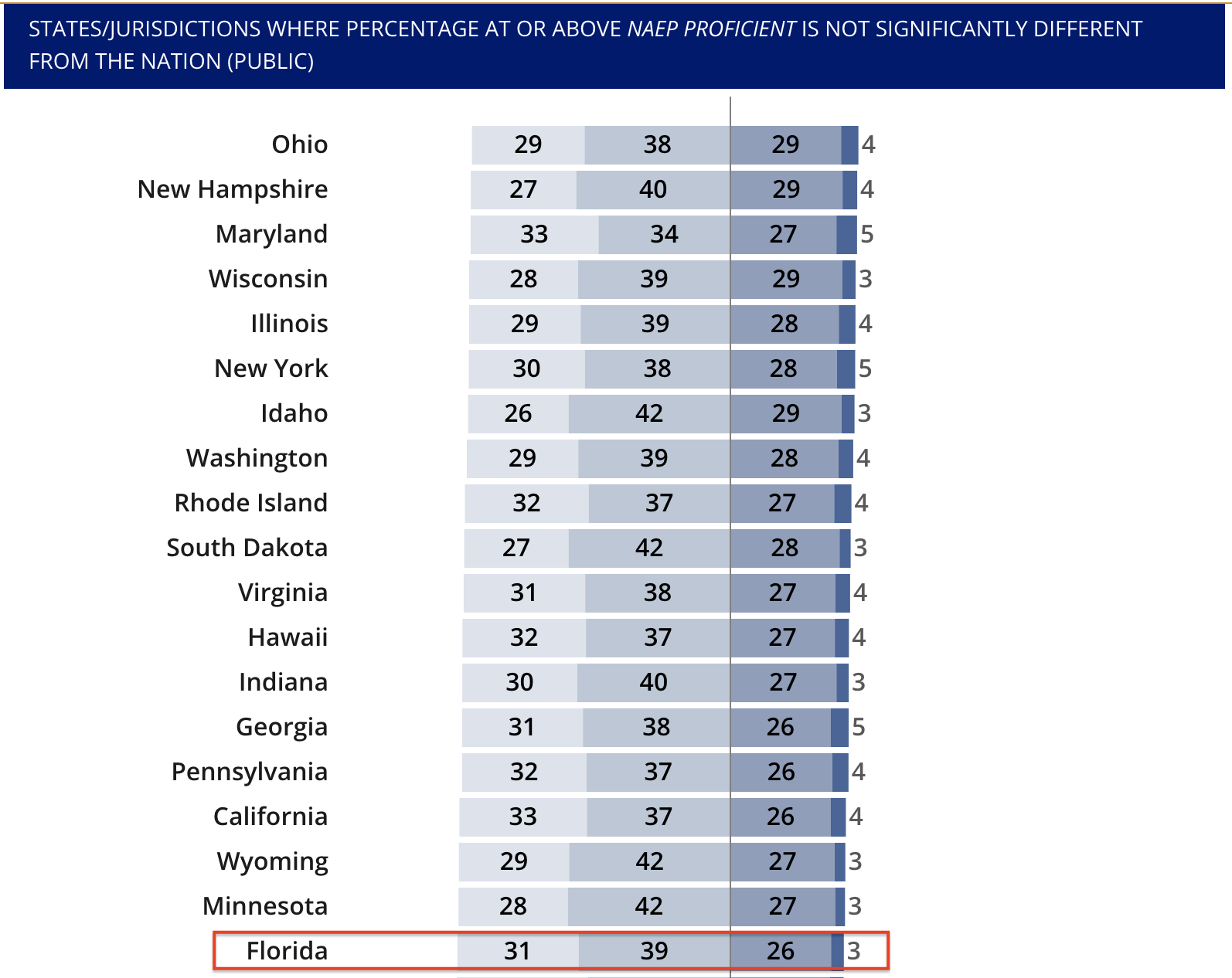
And MS remains at the bottom of grade 8 reading:

Like the entire US, VT simply is not experiencing a reading crisis. And certainly not because of the witches brew of balanced literacy stealing children’s ability to receive effective reading instruction.
VT may be, in fact, a better model for our need to add patience and nuance to our evaluation of reading proficiency, how we teach reading, how we measure proficiency, and when students need to reach our benchmarks as developing readers.
And thus, VT should not mimic MS since that would be throwing out the baby with the cauldron water.
 dr. p.l. (paul) thomas