
Consider how people would respond to the two following statements for a survey:
- About 2/3 of US students read below “proficient” on national testing.
- About 2/3 of US students read at or above “grade level” on national testing.
We don’t need to imagine, however.
Coverage in Education Week of a new survey on parents’ perceptions of reading reveals incredibly damning findings—damning not about reading achievement or teaching but about NAEP and media:
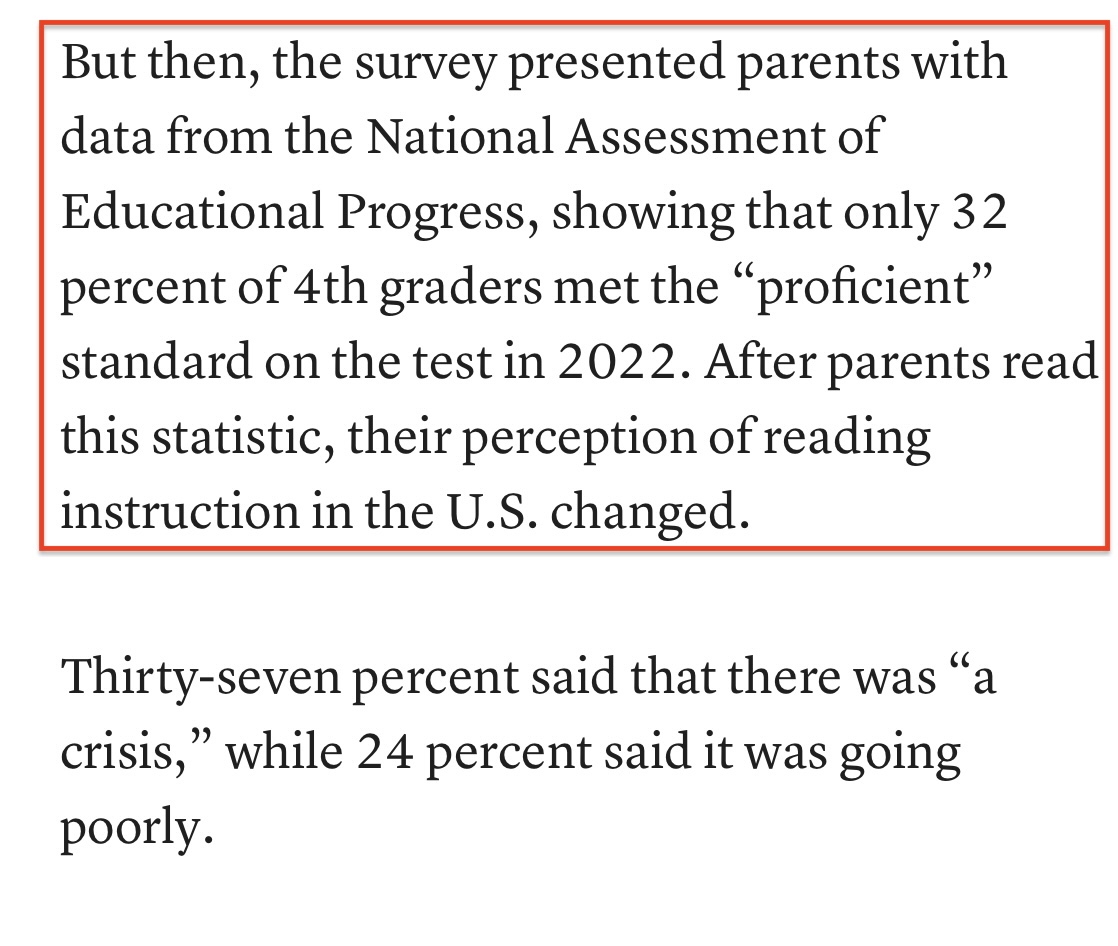
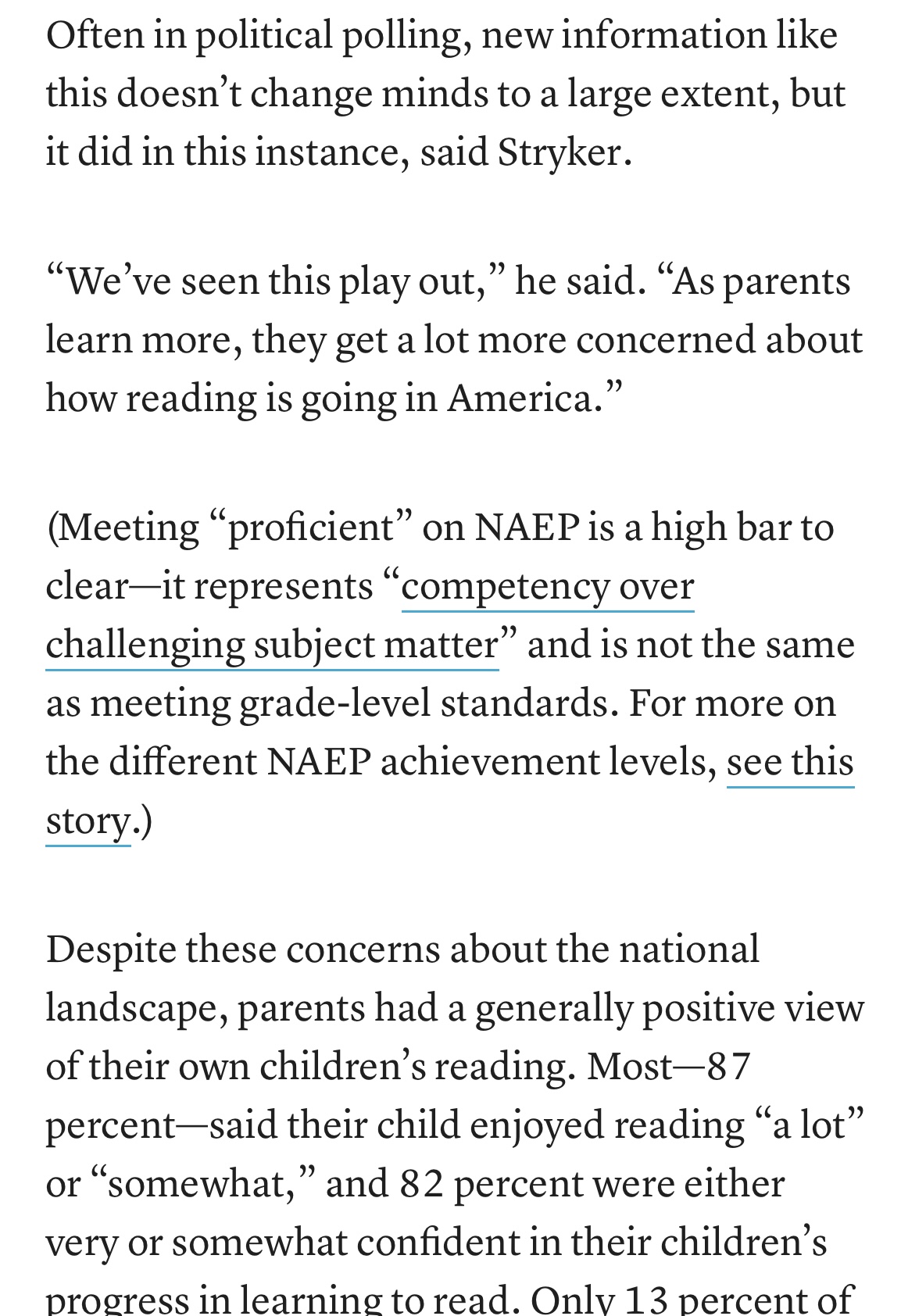
The survey’s findings reflect that damning dynamic:
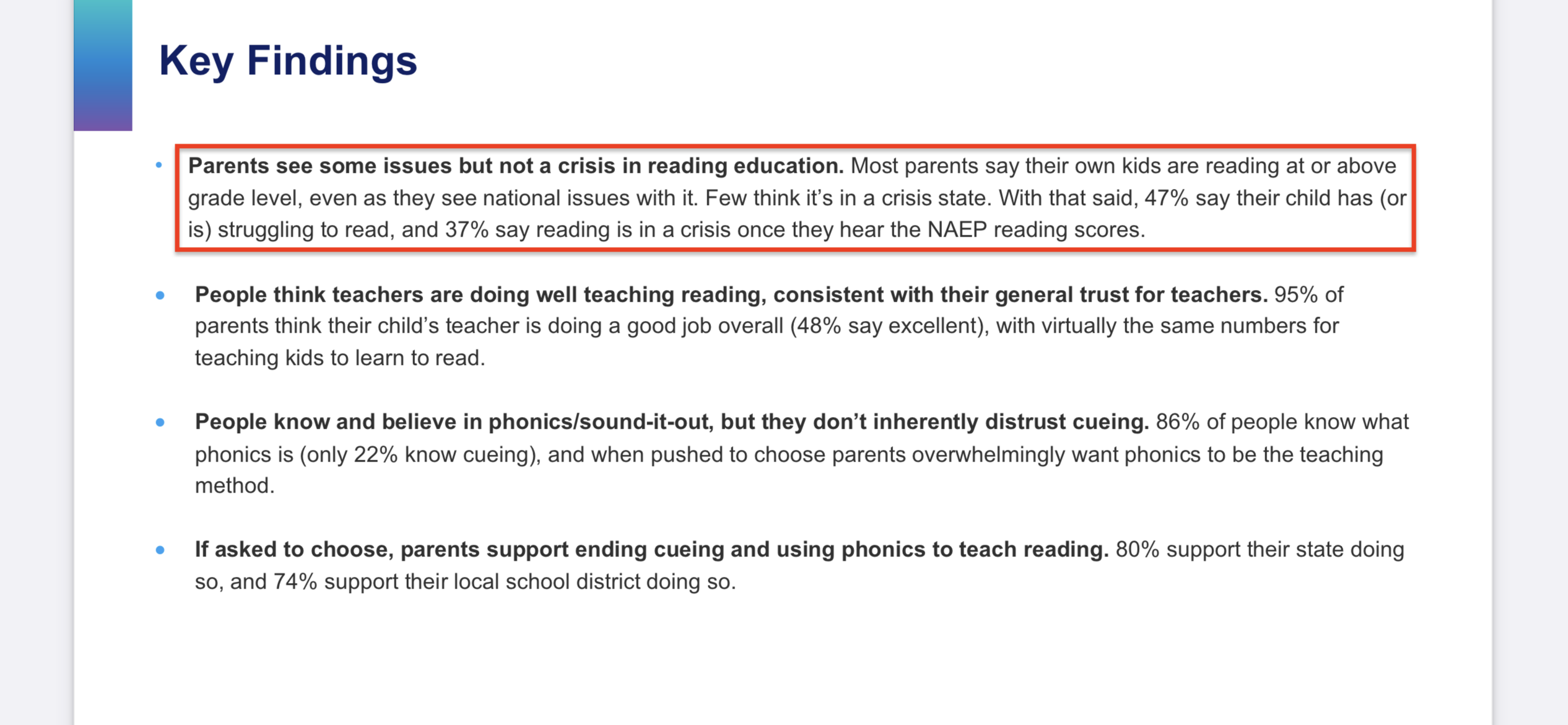

Yet, despite the misinformation about NAEP, these survey findings reflect decades of surveys showing parents generally have positive views of their children’s schools and teachers but believe public education nationally is failing:
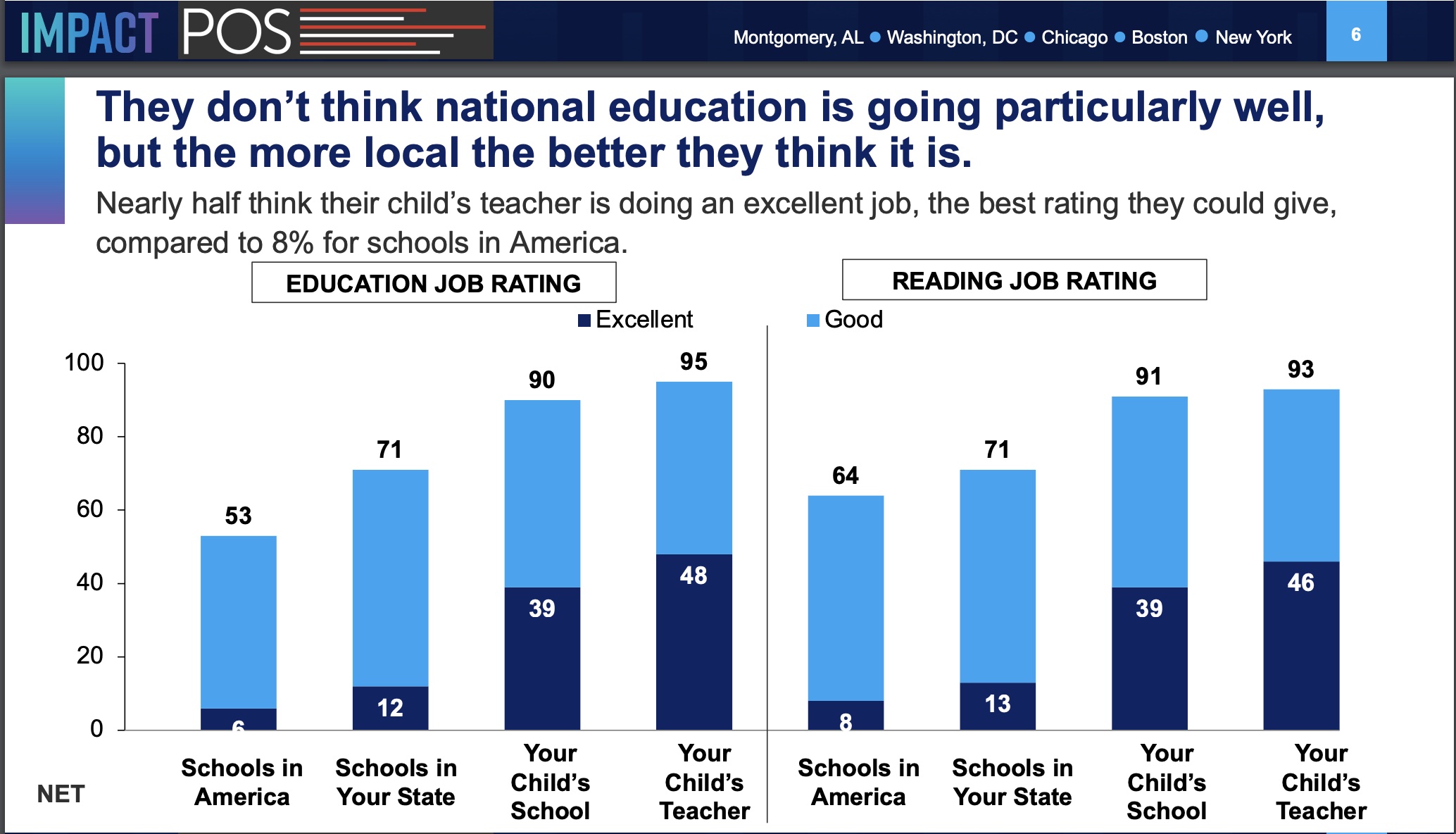
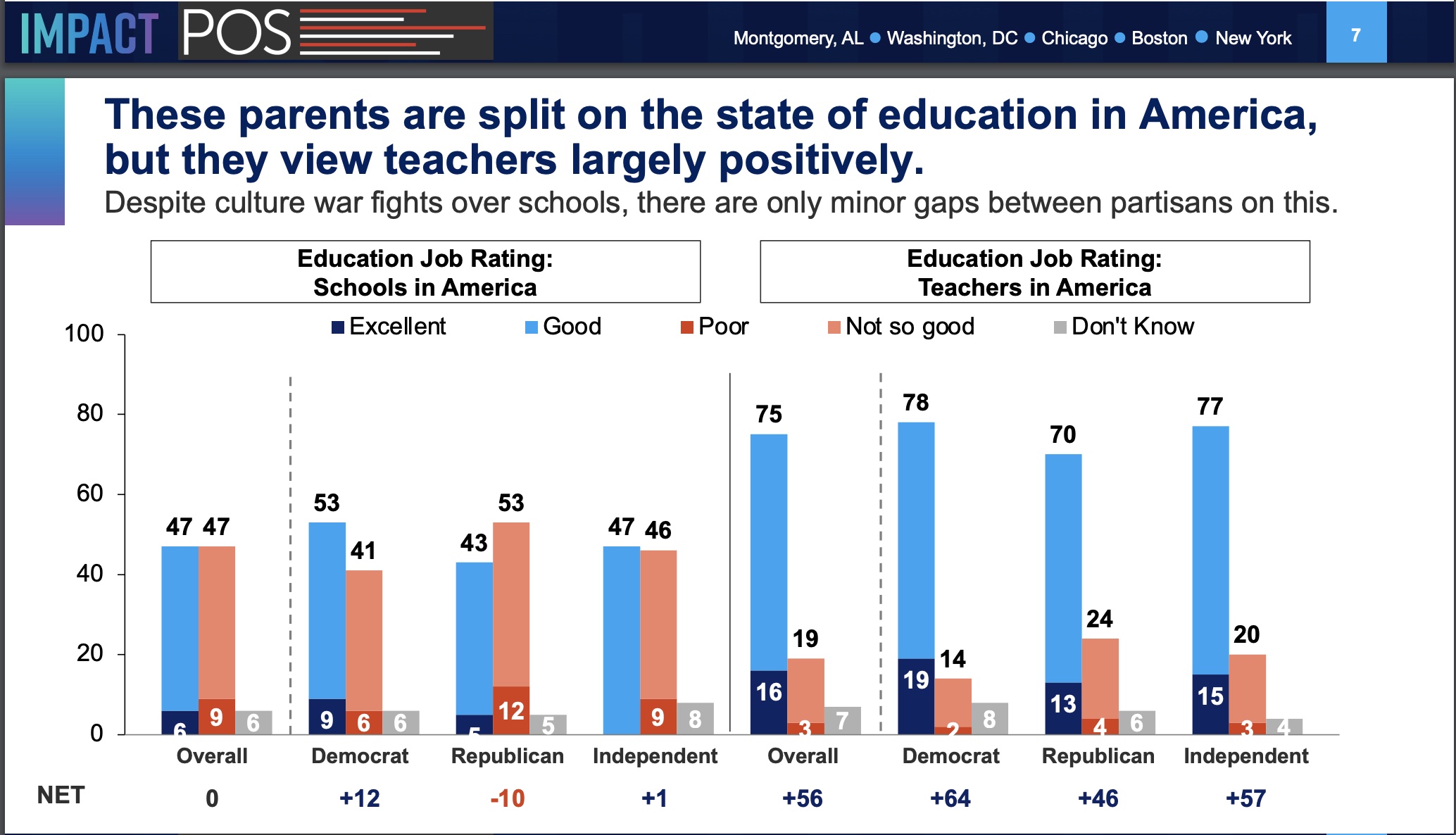
This survey, though, exposes the source of that disconnect—media coverage of NAEP data, which seems to be designed more to manufacture a crisis than to assess student reading achievement.
The opening two hypothetical statements show where the problem lies because the first is an accurate statement about NAEP and the second is an accurate statement about reading at grade level.
As NAEP explains and others have addressed for years (see below), NAEP “proficiency” is well above grade level and “basic” represents something close to grade-level proficiency. However, the larger problem is the US has no standard criteria for “grade-level proficiency” and states set their own levels with NAEP using terminology that is at least confusing if not intentionally misleading.
Another problem, as I have argued, is that “grade level” is likely a worse metric than “age level” since many states now implement grade 3 retention based on reading tests, corrupting populations of students being assessed since data show that student scores on early reading are strongly correlated with birth month.
See the following to better understand NAEP and media misinformation about reading proficiency:
- Scale Scores and NAEP Achievement Levels (NAEP)
- Loveless, T. (2016, June 13). The NAEP proficiency myth. Brookings. https://www.brookings.edu/blog/brown-center-chalkboard/2016/06/13/the-naep-proficiency-myth/
- Loveless, T. (2023, June 11). Literacy and NAEP proficient (Web log). https://tomloveless.com/posts/literacy-and-naep-proficient/
- ILEC Response: Mainstream media coverage of reading proficiency, teachers of reading, NAEP scores, and teacher preparation
- NAEP LTT 2023: A Different Story about Reading
- When Media Misinformation Becomes Conservative Education Legislation Over-Reach: Reading Proficiency Edition
- What Do We Really Know about Reading Proficiency in the US?
- Understanding and Reforming the Reading Proficiency Trap
- Even More Problems with Grade-Level Proficiency
The US has a long and troubling history of media and political leaders being more invested in a manufactured education crisis than actually investing in better public education.
As a result, parents and students are trapped between their own genuine appreciation and need for effective, responsive reading instruction and a media-fueled political campaign to misinform the public because a constant state of reading crisis benefits a contracting media and generates political capital.
The reading crisis in the US is that the public is reading misinformation about reading and teachers, grounded in a national testing program designed to manufacture crisis.
NOTE
The survey also shows how misinformation about three cueing and phonics misleads parents and distorts their perception of reading instruction:

The framing of the survey misrepresents both cueing and guessing; see the following:
- Compton-Lilly, C.F., Mitra, A., Guay, M., & Spence, L.K. (2020). A confluence of complexity: Intersections among reading theory, neuroscience, and observations of young readers. Reading Research Quarterly, 55(S1), S185-S195. https://doi.org/10.1002/rrq.348 [access HERE]
- Mora, J.K. (2023, July 3). To cue or not to cue: Is that the question? Language Magazine. https://www.languagemagazine.com/2023/07/03/to-cue-or-not-to-cue-is-that-the-question/
- Understanding MSV: The Types of Information Available to Readers
- Is Reading a “Guessing Game”?: Reading Theory as a Debate, Not Settled Science
 dr. p.l. (paul) thomas