re: Ohio Lawsuit Punches Back in Battle Over How to Teach Reading
In highlighting the big money spent by the Reading Recovery Council to influence state reading policy, the New York Times offers a slight variation on the same old meme of reading science vs reading catastrophe.
As a longtime reading teacher, I await an article on the billions spent by leading publishers to promote something called the science of reading so they can continue selling their textbooks and billions of pages of peripherals that accompany these texts. I mourn the hours children spend trudging through Big Business workbook pages traveling as “science.”
In “Ohio Lawsuit Punches Back in Battle Over How to Teach Reading,” readers are offered the 23-year-old National Reading Report as evidence of the validity of science of reading. The claims embedded in this report have been disputed by respected researchers since the day of publication. It’s time to scrap that old rolodex and expand the contact base. For starters, here’s a new report published in The Reading Teacher: “Stories Grounded in Decades of Research: What We Truly Know about the Teaching of Reading.”
Table 1 offers “Highly Respected Researchers Whose Research Challenges the Science of Reading,” Here are the names of 7 reading researchers New York Times reporters can contact the next time they decide to write about reading instruction in public schools.
Finally, I offer the evidence of a deaf child who entered public school in 3rd grade. Her residual hearing was helped by special equipment. she and I both wore. After some weeks of sobbing she couldn’t do it, this child triumphed. I attended her high school graduation, where she was on the honor roll. She contacted me 30 years later, telling me that she had graduated from college and enjoyed sharing Amelia Bedelia and knock-knock jokes with her children.
Thomas, P.L. (TBD). Haruki Murakami’s 7 stories: “It’s quite easy to become Men Without Women.” In J. Milburn (ed.), Haruki Murakami and philosophical concepts (pp. TBD). Palgrave.
Thomas, P.L. (TBD). Crisis as distraction and erasure: How SOR fails diversity and urban students. Journal of Literacy and Urban Schools.
Thomas, P.L. (2025). Navigating (another) reading crisis as an administrator: Rethinking the “science of reading” movement. Journal of School Administration, Research and Development, 10(1), 38-48. https://ojed.org/JSARD/article/view/6706
Compton-Lilly, C., Spence, L.K., Thomas, P.L. & Decker, S.L. (2023). Stories grounded in decades of research: What we truly know about the teaching of reading. Reading Teacher, 77(3), 392-400. https://doi.org/10.1002/trtr.2258
Thomas, P.L. (2023). The science of reading era: Seeking the “science” in yet another anti-teacher movement. Journal of Reading Recovery, 22(5), 5-17.
Thomas, P.L. (2023). The “science of reading,” education faddism, and the failure to honor the intellectual lives of all children: On deficit lenses and ignoring class and race stereotyping. Voices in the Middle, 30(3), 17-21.
That multi-genre unit was grounded in part on a war poetry unit I taught for many years, anchored by R.E.M.’s “Orange Crush.” Traditional poems found commonly in anthologies included the following:
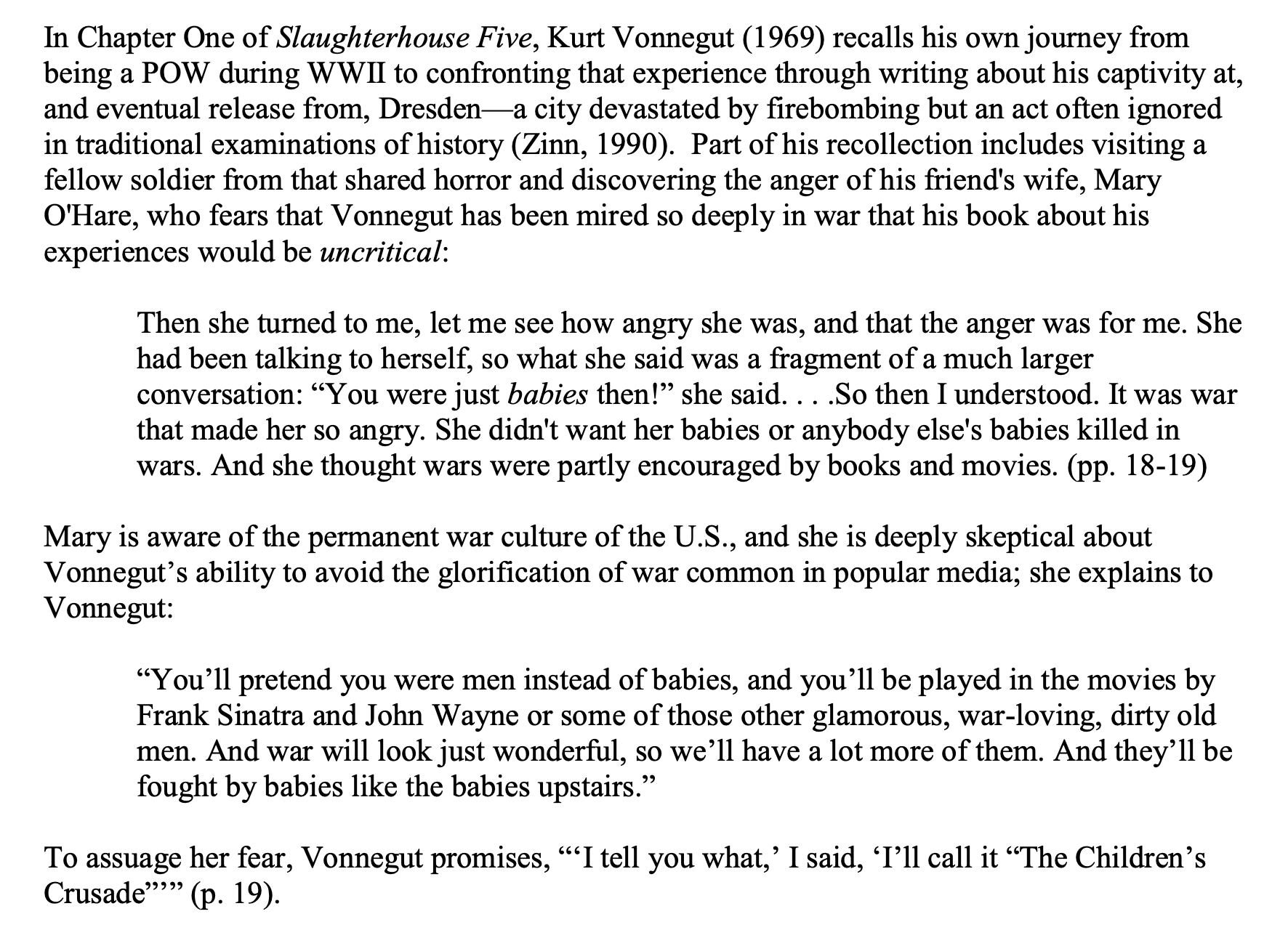
The unit on peace (click on the title above and the article begins on page 15) includes work by Howard Zinn, music by CAKE, and fiction by Kurt Vonnegut, specifically Vonnegut’s explanation of how he crafted his most recognized work, Slaughterhouse Five:
Also in 2023, there is a pervasive national narrative that K-12 teacher and professors in higher education are indoctrinating students with leftist/Marxist ideology. While this argument is old and inaccurate, almost no one is confronting the real ways in which traditional schooling indoctrinates children.
Most traditional approaches to history, in fact, portray war as normal, characterize the US as an ethical victor of war (freedom fighters), and offers almost no concession that peace is ever an option for violence and acts of terrorism and aggression.
I suspect that conservatives will consider a peace-oriented liberal indoctrination but will never admit traditional approaches to history are indoctrination.
If we care about academic freedom and humanity, then offering peace as an option seems to be the least we can do for children and all students.
Many years ago when I was teaching high school English in the Upstate of South Carolina, my hometown, I had a student turn in an essay about the legendary rock performer Pink Floyd.
Yes, this student wrote an entire essay praising Pink Floyd as an individual, not accurately as the group.
This sort of ignorant bravado was not uncommon for a teen, and was a bit funny—although I used that situation to send a clear message to the young man that ignorance wasn’t funny or impressive.
And then decades later, this:
And this ignorant bravado by the billionaire owner of the Social Media Site Formerly Known as Twitter prompted well deserved derision:
Decades after the nonsensical essay on Pink Floyd by a high school student , I suspect that my lesson was simply another adult lie, one grounded in the meritocracy myth.
You see, in the real world, ignorant bravado can lead to you being a billionaire.
And I guess, this reality is no different than a joke I often use in my classes—one that isn’t funny—when I cover citation and plagiarism.
I explain to students that academic citation is essential in college writing and that plagiarism will result in failure or even expulsion. But the good news is that plagiarism in the real world is a stepping-stone to being a senator (Rand Paul), First Lady (Melania Trump), or even president of the US (Joe Biden)!
The celebrity billionaires and millionaires (like Trump) are not smarter than most of us, are not more innovative, and are definitely not working harder.
Most of them have outsized privilege and then the sort of black heart that allows them to exploit their way to wealth.
Ethical people, we must admit, do not become billionaires; ethical people probably never get elected as well.
And you’ll notice that billionaires and people with enormous power are the ones leading the charge to deny that privilege exists, to promote above all else the meritocracy myth.
That’s because the denial and the myth serve their unearned power and wealth. Privilege, none the less, is a fact, but it isn’t a condemnation.
Simply considered, look at the NBA. Every player in the NBA is an elite athlete, and then there are the elite among the elite—Michael Jordan, LeBron James, and Larry Bird (an outlier heralded as a “hard worker” as a veneer for his whiteness).
Yes, Bird has white privilege, but his working-class roots complicate that status; however, the essential privilege Bird possessed was his height. Being 6’9″ allowed his other accomplishments, including the outcomes from being hard working.
At 5’5″, Bird would have never been known as an NBA elite.
Celebrity billionaires are almost all white, but also, they all had huge financial advantages that they did not create. Like Bird being 6’9″, they started with unearned advantages.
So we are left with the meritocracy myth that is at least an exaggeration, if not a lie.
Hard work matters, but so does work within an ethical and moral context.
Hard work matters, but that work may not see fruition in ways that people achieve through, mostly, the advantages of their privilege.
Let me end by returning to my early days of teaching high school.
A state college at the time was riding high with football success, and one of the players, a very large lineman who went on to NFL fame, was a bit of a celebrity.
On a segment of ESPN, that player did not represent himself or his education well with some garbled use of the English language.
When I made a joke about the university based on that player’s non-standard language usage (and I was actually just kidding), a student blurted out, “Yea, but he’s rich, richer than you.”
And there it was, a lesson by a student for his teacher.
Just get rich. Nothing else matters.
‘Merica.
educator, public scholar, poet&writer – academic freedom isn't free








 dr. p.l. (paul) thomas