

My journey across seven decades since the late 1960s as a student and then a teacher has included an overlap between the fields of English and math—which tend to constitute what we call the “basics” or “core” subjects in formal education.
While I always scored high on standardized tests as a student, by high school, I was firmly a math person since I achieved As in math and science courses, but stumbled to mostly Bs and a few As in English. In fact, I graduated high school committed to majoring in physics, possibly the most math of the sciences.
Those of you who know me may be anticipating that in the five years after graduating college, I stood in the same classroom once taught in by my favorite high school English teacher, Lynn Harrill, as a high school English teacher myself.
My teaching career has been exclusively literacy, teaching writing and doing public work on reading policy.
Since my doctoral program, I have also focused often on the history of education, and I routinely argue that we in education stumble into the history mistake cliche—repeating the same approaches and failing because we refuse to learn from history.
I also feel as if I am shouting down a well because we also have contemporary evidence for the reading war mistakes we are currently making: England/UK has been implementing phonics-centric reading legislation since 2006 (paralleling the “science of reading” [SOR] movement here in the US) with growing evidence that the strategy is not working (again, as it has never worked over 80 years in the US).
At the risk of yet more shouting down a well, consider the following two examples of what we persist in doing wrong in education reform and who that directly benefits.
First, nudging its way into the media spotlight where reading has been marathon dancing is the newest math war spurred by PISA and NAEP test data: The Divider (announces The Chronicle).
For those of us slogging through the current and a couple other reading wars over the past several decades, the coverage of the math war will sound disturbingly familiar; some snippets include social media fights, the obligatory and uncritical citing of A Nation at Risk, parent anger, and ideological/political divides over skills:
That “framework” is a policy document that will shape how math is taught in California and beyond, and Nelson, a computer-science professor at the University of California at Berkeley, had major problems with it — and with Boaler, too. He’d seen a series of tweets critical of her, and reposted one of them with his own scathing commentary. Now, Boaler was confronting him….
By the 1980s, Japan’s soaring tech sector was churning out video recorders and semiconductors, and America’s math students were still not doing well at either problem-solving or the “basics.” In a 1983 report titled “A Nation at Risk,” a U.S. panel of education experts warned: “Our once unchallenged preeminence in commerce, industry, science, and technological innovation is being overtaken by competitors throughout the world.” Students were dropping out of the math pipeline at staggering rates each year after ninth grade, Hispanic and Black students most of all….
But in the decade in between, traditionalists grew alarmed. California, early to embrace the “new new math,” was a breeding ground of dissent. When Palo Alto’s school district planned to align its program with the 1992 state framework, angry parents organized on the nascent internet under the name Honest Open Logical Debate. Other anti-reform groups followed, like Mathematically Correct and Q.E.D., and their opposition blossomed into a statewide movement backed by irate mathematicians and Republican lawmakers….
By the time Boaler was in graduate school, Britain was in a similar whiplash. It had adopted a national reform-oriented math curriculum, and upset Conservatives were pushing back. For her dissertation, Boaler compared two schools, one in each camp, and found that students using reform methods were better at thinking critically about math skills and applying them to unfamiliar problems. Stanford soon came calling.
The Divider, Stephanie M. Lee
With little imagination, one could imagine an AI bot cranking out this piece when prompted: “Write a piece on the math war based on the current reading war.”
The history and current reality of both the reading and math wars are basically the same story—one we are determined to repeat again in another decade or so.
A key thread in that recurring cycle of failure, I think, is personified by Jo Boaler, self-identified “warrior”:
In pursuit of that goal, Boaler is helping draft California’s latest math framework, a nonbinding guide for how public schools in the most populous state should teach math. It is expected to shape instruction not only in the Golden State — which flounders in math, despite being home to Silicon Valley — but also the rest of the country, which struggles with it, too. Some of the document’s key ideas are already reshaping math class, as well as admissions at some of the nation’s most selective colleges, much to Boaler’s delight. “Viva la Maths Revolution!” she often declares.
But Boaler can’t shake her critics, whom she sees as elite gatekeepers standing in the way of better lives for young people. Their resistance is merely an invitation to keep marching. “When doing the work of the warrior, it is important to remember this: You should expect and even welcome pushback,” she has written. “If you are not getting pushback, you are probably not being disruptive enough.”
The Divider, Stephanie M. Lee
Setting aside if Boaler is right or wrong, she is clearly driven by missionary zeal, the belief she is right and the determination to act on that belief.
If nothing else, the SOR movement is a collection of people with missionary zeal, wielding “science” as their broadsword in their crusade to bring reading proficiency to the students of the US.
Here, I want to pause and speak directly to the math folk reading: Please, for the love of learning, take a different approach, finally, or you’ll regret the missionary zeal, and most of all, the tremendous amount of time and money that will be wasted in your crusade.
So here you go, a little evidence if anyone cares:
In a January 2022 letter to CSDE, Fran Rabinowitz, the president of Connecticut Association of Public School Superintendents, said the new mandate [Connecticut’s “Right to Read” law] will cost districts collectively more than $100 million in the school year 2024-25. Cheshire Public Schools, for example, estimates that replacing its highly effective PreK-3 curriculum will cost $536,292 for licenses, texts, and supporting materials. The estimate does not include the cost of training. Wilton Public Schools puts the price tag at upwards of $1 million….
CSDE ordered the remaining 68 applicants to either augment their existing programs or replace them entirely. These districts include New Canaan Public Schools, where 83.2 percent of their students read proficiently. Darien, Westport Eastford, Wilton, Colebrook, Cheshire, Ridgefield, Bethany were also denied in part or all together, even though their third graders scored near or above the 80 percent level.
One objective of the Right to Read legislation was to “address systemic racial injustice by closing the literacy opportunity gap.” CSDE seems intent on closing the “literacy opportunity gap” by dismantling successful programs instead of demanding that underperforming schools do right by their students and fix theirs.
Cost of Reading Mandate Could Top $100 Million in 2024-5
That’s right, Connecticut has bought into the SOR mania, passed aggressive reading legislation that will cost taxpayers at least an extra $100 million, and even very successful schools with over 80% of students at or above reading proficiency must ditch effective reading programs to adopt the new mandated programs.
In the Reform Crusade, everybody has to reform, regardless.
And this is the basis of the reading crisis in CT?:
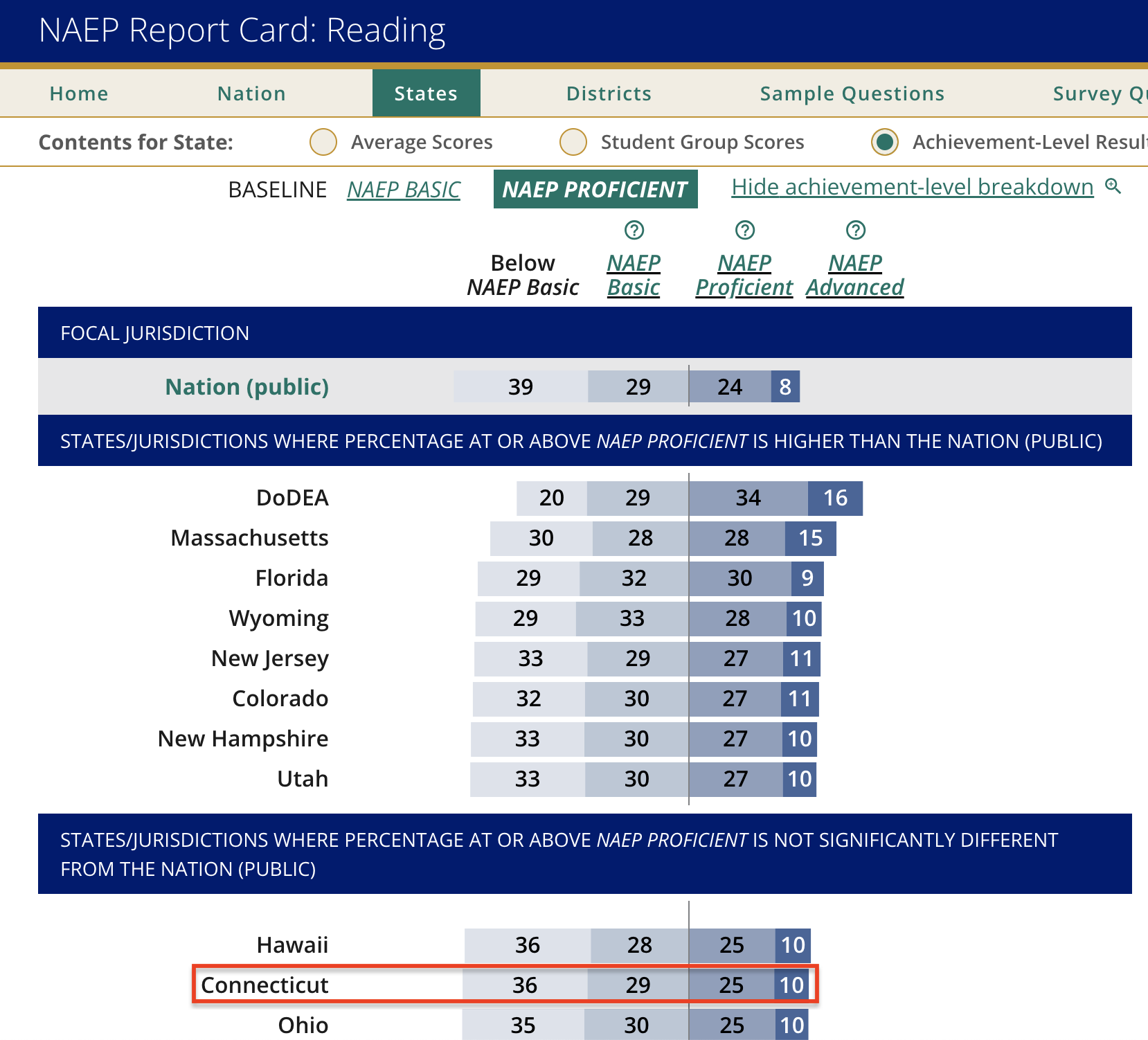
That’s also right, CT sits in the top quintile of grade 4 reading achievement on NAEP reading in 2022.
“Crisis” in education is mere rhetoric devoid of evidence, decontextualized from history, and driven by missionary zeal.
Math and reading have been in a state of manufactured crisis for as long as we have focused media and political attention on our schools. The US has not had a single moment in the last 100 years when anyone found math or reading achievement acceptable—always a crisis.
Math and reading have been in a state of perpetual reform since that other holy text of manufactured crisis, A Nation at Risk, from the early 1980s.
These cycles of crisis and reform have been driven by people with missionary zeal and the only profit from these crusades has been for commercial education interests eager to rebrand and sell you the next shiny promise that will be replaced by the next shiny promise in about a decade.
For the math folk out there still reading, something about all that doesn’t add up.
But why listen to me, I teach literacy.
 dr. p.l. (paul) thomas