Megan Chaffin, Holly Sheppard Riesco, Kathryn Hackett-Hill, Vicki Collet, Megan Yates Grizzle & Jacob Warren (25 Oct 2023): “Phonics Monkeys” and “Real Life Reading”: Heteroglossic Views of a State Reading Initiative, Literacy Research and Instruction, DOI: 10.1080/19388071.2023.2271085
Overwhelming whiteness: a critical analysis of race in a scripted reading curriculum, Amanda Rigell, Arianna Banack, Amy Maples, Judson Laughter, Amy Broemmel, Nora Vines & Jennifer Jordan (2022) Overwhelming whiteness: a critical analysis of race in a scripted reading curriculum, Journal of Curriculum Studies, 54:6, 852-870, DOI: 10.1080/00220272.2022.2030803
For many years I have been raising concerns about the use of “crisis” rhetoric around education [1], specifically challenging the default use of “crisis” and “miracle” in mainstream media.
The central role of “crisis” rhetoric in the accountability era of education reform has been characterized as a “manufactured” [2] crisis.
The current subset of education reform, the “science of reading” (SOR) movement, fits into the same patterns of the broader accountability era of education reform, I have argued.
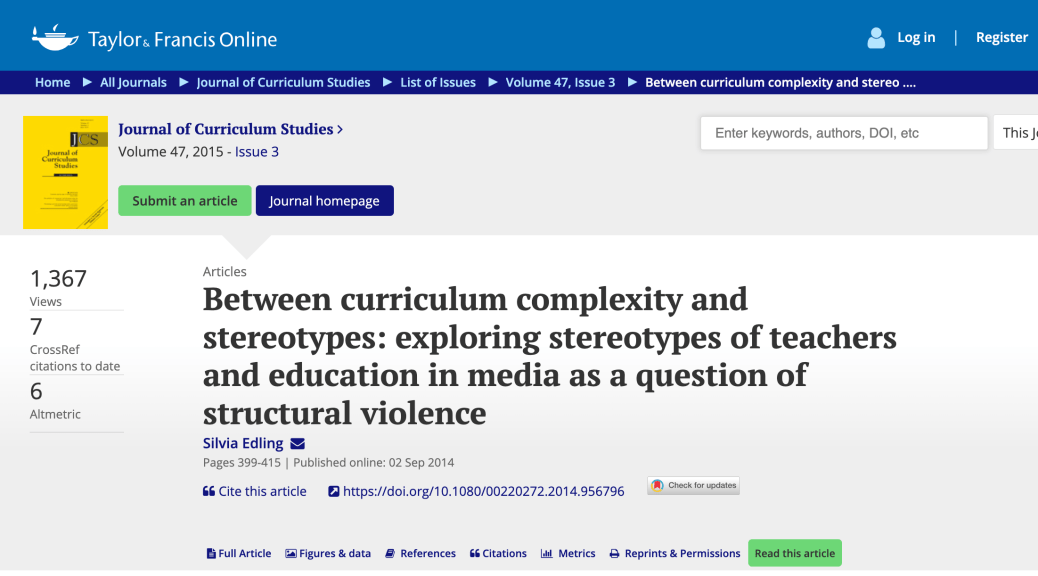
Here, I am using Edling excellent work on the relationship between mainstream media and education to reinforce the claims that SOR as a reform movement is both mainstream accountability reform and essentially conservative.
I want this overview to be accessible, but I also highly recommend reading the piece in it entirety (click title above for access).
Edling’s first sentence establishes: “What is of particular interest in this paper is how professional teachers repeatedly, although not always, seem to be pictured in a de-contextualized and non-relational manner by actors outside education, and especially how the media often fails to take educational complexity and practice into account.”
Media representations of education, then, are often overly simplistic. Note that a key aspect of the SOR movement [3] is the claim that reading science is simple (the simple view of reading) and settled, effectively erasing the complexity of reading science and of reading instruction.
Edling’s explanation about the relationship between media and education also describes well the story of reading found in the SOR movement:
Newspapers do not just write about education, they also represent to their readers what education is ‘about’ (p. 392, see also McLure, 2003; Thomas, 2004). Similarly, Fairclough (1995) stresses that the media has the power: ‘to shape governments and parties … influence knowledge, beliefs, values, social relations, social identities’ (p. 2). From this way of reasoning, the media can be seen as an important power source for the construction of certain ideologies that can either exclude or include (Fairclough, 1995, p. 14), depending on how they are positioned and what sets the agenda for what is to be framed as true or false in society (cf. Johnson-Cartee, 2005).
There is no doubt that critical analyses of education in general are necessary in order to improve quality. Education is here understood as a broad concept that includes institutions such as (pre)schools, teacher education and the ideas behind them (cf. Sa ̈fstro ̈m & Ekerwald, 2012). However, what is highlighted here is not criticism of the media itself, but how the media’s recurring simplifications and often negative images of education and teachers are understood and how they might affect people who are seen or define themselves as teachers. Moreover, teachers in teacher education and teachers at (pre)schools are dialectically interconnected, in that teacher education aims to educate teachers, who are capable of acting as professionals in various educational positions—not the least in (pre) schools. For that reason, the term teacher includes teachers at (pre) schools and teacher education (cf. Hallse ́n, 2013).
In the paper, four interrelated propensities are problematized concerning the media’s portrayals of teachers and education:
Viewing education as being in more or less permanent crisis
Taking the role as a spokesperson for teachers and on behalf of the field of education
Excluding the knowledge and experiences of teacher(s), educators and/or educational researchers in the public press
Simplifying the notion of being a good teacher through stereotypes and dualistic frameworks that overlook task and relational complexity.
The SOR movement is yet another reading crisis in a long line of similar reading crises reaching back to the 1940s. Also the SOR movement is being driven by journalists who are identified as literacy experts, and those journalists have repeatedly characterized teachers as ill-equipped to teach reading because the entire field of teacher education has failed those teachers.
As the fourth bullet point above notes, as well, the SOR movement depends on simplistic characterizations of balanced literacy and reading programs as well as cartoonish caricatures of “three cueing” and “guessing” as pervasive failures of reading instruction across the entire US.
Edling details next “educational crisis discourse”:
Although crisis in the media is generally pictured as having specific causes that can be limited to a certain time in history (Wiklund, 2006), research indicates that the notion of educational crisis has been used as a more or less constant image ever since the 1950s and 1960s, and can be associated with the progressive school vs. conservative school problematic…. [C]risis is something that originates in the clash between different world views. As it is reasonable to assume that different world views will exist as long as there are humans, it is equally reasonable to assume that crises—including educational crises—will too.
The repetition of the word crisis is closely related to ideas that teachers and teacher education are incapable of dealing with education in a proper way. Crisis is used as a blanket to cover the field of education and, as in a situation of social crisis, groups outside education feel the need to step in and take control. The phenomenon can be described as an outside-in vs. an inside-out professionalism (cf. Stanley & Stonach, 2013). It is argued that the way in which people from the outside have assumed the right to define what is good and bad education has created a systematic disbelief in teachers in ways that have reduced their professional autonomy (Ball, 2011; Beach & Bagley, 2012; Krantz, 2009; Lauder, Brown, & Halsey, 2009).
Other researchers point to how the media refers to teacher education and teachers as lacking the necessary qualities and blames them for the crisis in school without taking the purposes and contexts of education into account (cf. Cochran-Smith & Fries, 2008; MacLure, 2003; Thomas, 2004; Warburton & Saunders, 1996).
The SOR movement has manufactured a reading crisis (mostly from misrepresenting NAEP data) and then placing soft or indirect blame on reading teachers and direct blame on teacher educators.
Edling notes that blame for educational crises do vary across countries (Sweden, for example, portrays teachers as victims of the crisis as well as the authorities who can overcome that crisis, contrary to the SOR story of teacher blaming). However, Edling adds that in most crisis discourse about education “teacher educator(s) and educational researchers were degraded and silenced,” similar to the current SOR movement.
Broadly, Edling emphasizes “a tendency to repeatedly fixate the debate on education in a dualistic and simplified image that omits the task and relational complexity,” resulting in “[s]tructural violence”:
Structural violence is generated through social practice and law, and hence becomes closely entwined in a specific culture and the norms that govern it, which implies that people in general, including members of group who suffers from their consequences, risks upholding the norms in their every-day actions since the norms are taken for granted as true. From this sense, people or groups of people, such as teachers, are not neutral or simply passive victims but partakers in the weaving of social structures. Violence is produced as a recurring beat through endorsed ideals, speech, gestures, choice of focus and solutions to world problems. The violence that becomes materialized as a consequence of these structures does not necessarily have to do with ill-will, as in deliberately wanting to do harm. On the contrary, what characterizes these acts is that they appear to be normal, harmless and sometimes have the ambition to do good, whereas in reality, they make life difficult for certain groups of people (cf. Cudd, 2006, p. 127, Epp & Watkinsson, 1997, p. 6).
Here is a key point: Journalists and teachers do not need to be bad actors for the media stories and resulting consequences to be bad actions. Hanford and other journalists as well as elected officials likely see their work as good work even as their messaging and policy endorsements are oversimplified, misguided, and harmful (to teachers and students).
This helps explain why Hanford and other journalists have teacher support:
She argues that our identity is not just shaped by how we see ourselves, but also through the way others see us, and that seeing is often coloured by stereotypes and norms (Young, 1990, p. 46–47). In accordance with the associative model, teachers can choose to see themselves as part of the professional group of teachers, which research describes as complex and multidimensional. At the same time, the group affinity model helps to illuminate how teachers’ identity as a group is shaped from the outside based on stereotyped and simplified images of teachers and educational researchers. Hence, people can identify themselves as members of the group known as ‘teacher professionals’ that is associated with certain practices. At the same time, they may have to face contrasting images of a teacher created by the media.
Parallel to the role of NAEP in the media-manufactured reading crisis, the role of standardized tests is acknowledged by Edling: “In a sense, one could argue that reports such as TIMMS and PISA have presented evidence of the failure of education in many countries, which might suggest that the negative criticism of teachers and education is justified. The results in the reports have been used to motivate several reforms focusing on measurability, accountability and control.”
Ultimately the stories perpetuated by media are stereotypes: “Once people have become accustomed to stereotypical thinking, they may not be able to see individuals or situations for what they are. Accordingly, a problem with stereotypes is that they are used to judge and pigeonhole people, without really taking into account context and unique individuals.”
The crisis story of reading in SOR is a simplistic story of caricature about teachers, teacher educators, balanced literacy, and reading programs. the complexity of the real world of teaching and learning reading are erased. As Edling notes:
Parallel with the recurring waves of crisis that wash over the field of education and the recurring stereotyped images of teachers, the curriculum complexity of the purposes and practices of education generally goes unnoticed in the media debate on education. What is forgotten is that teachers are not free to do as they want, even though their profession often allows them some kind of freedom to judge. Indeed, as the teaching profession is politically defined, it is obliged to pay attention to a multitude of different policies (Ball et al., 2012) and curriculum purposes (Hopmann, 2007). In a sense, it is possible to assert that teaching in many countries have come to be restricted to a standard and accountability movement; and hence, rendered more mechanical and simplified than before—very much following the logic presented in media (cf. Apple, 2011; Berliner, 2013).
Consequently, Edling explains: “Rather than beginning the discussion with the various demands that are embedded in teachers’ professional assignments, there are tendencies within the media to portray the good teacher as someone who is capable of efficiently transferring knowledge to pupils, where the epistemology of knowledge stems from science rendering it equal with truth and fact about a world (Wiklund, 2006, p. 177).”
The weaponizing of “science” in the SOR movement, in fact, has begun to creep broader into the science of learning, the science of writing, and the science of math.
The great paradox of crisis rhetoric in media coverage of education is it insures failure:
The implication is that whatever they do, they will end up as failures in the sense of being unable to embrace the multitude of requirements at the same time. Hence, drawing on the task and relational complexity of teachers’ work, one might ask whether it is possible to be an impeccable teacher in the relational midst of education if a multitude of educational purposes and relational inconsistencies have to be taken into account. If it is not, perhaps there is a point in adhering to more nuanced judgements of teachers’ quality in accordance with curriculum content, purposes and the ways in which relations are played out in educational spaces.
Edling warns: “[T]he power of the media and the damaging consequences of repeatedly judging groups of people through a grid of stereo- types need nevertheless to be taken seriously,” concluding:
Consequently, when the media systematically define teachers as working in a field of crisis and need exterior help to sort things out, it automatically excludes the professional knowledge and experiences of teachers and educational researchers and their task and relational complexity, which are already present in their day-to-day work, from the debate.
In the light of these tendencies, research on structural violence helps to remind us that: (a) teachers are unwillingly forced into a paradoxical (in)visibility (even in Sweden, where it is pointed out that their voices need to be heard), (b) they are squeezed in-between two pressuring external demands, namely the complexities in their professional assignment that are politically steered and stereotypes of the good and bad teacher produced by, in this case, the media, (c) they risk wasting time and energy on addressing prejudices that have nothing to do with the specific work they are expected to do, and d) the logic of binary stereotypes is a power issue that brands teachers into a position of permanent failure.
While Edling is writing about media coverage of education in general, her examination matches exactly how the SOR movement works as well as how that movement is grounded in misinformation to the detriment of teachers, students, and democracy.
[3] See an overview of the story about reading now commonplace in media, grounded in Emily Hanford’s journalism, specifically her article “Hard Words.”
There is an incredibly powerful and frustrating dynamic about mainstream media in the US: While common knowledge claims mainstream media is liberal media, actual mainstream journalism in the US perpetuates as fact conservative ideology.
And the topic that suffers the most from that contradiction is education.
We are but 8 days into 2024, and the self-proclaimed Queen of US journalism, the New York Times, has offered up what may prove to be one of the classic examples of that liberal/conservative contradiction (see, for example, the NYT covering poverty at the level of The Onion).
Currently, media has renewed interest in college admissions, specifically using standardized tests such as the SAT or ACT for admissions. Progressive/liberal advocates call for not using SAT/ACT for admissions ; conservatives support maintaining standardized tests in admissions.
This college admissions/SAT example parallels the NYT piece on grocery shopping by people in poverty; the claims of the articles are driven by normative conservative ideology (poor people buy junk food and standardized tests measure merit) not empirical evidence.
Mainstream media misrepresenting education and educational research, then, is normal in the US. In fact, far more coverage of education is misleading or outright false than is credible.
One of the best examples of this problem is coverage of reading proficiency and the current reading crisis, specifically the “science of reading” movement.
Along with many others, I have documented that media coverage of reading is both “holy text” and significantly misleading.
Key elements of that misguided coverage include the following:
Misrepresenting “reading proficiency” based on misunderstanding NAEP achievement levels. Media makes the claim 1/3 of students are not proficient readers when, in fact, NAEP shows 2/3 of students read at grade level or above.
Misrepresenting balanced literacy, three cueing, guessing, and popular reading programs. Essentially, no evidence exists showing balanced literacy has created a reading crisis or that any sort of uniform approach to reading exists across the US since many programs and interpretations of reading co-exist now and throughout the history of the US.
Misrepresenting teacher knowledge and practice related to reading as well as broadly discrediting teacher education, primarily based on a think-tank (NCTQ) agenda and not empirical evidence.
Misrepresenting reading science by distorting conclusions from NRP and ignoring or cherry-picking from the two decades of research since NRP.
Claiming reading science is settled and asserting that brain research is also settled. Both reading and brain science are evolving, each ripe with debate and room for greater understanding.
Simultaneously narrowing the reading science to only experimental/quasi-experimental research while using as evidence anecdotes and endorsing practices (grade retention, systematic phonics instruction for all students) and programs (LETRS, Orton-Gillingham) lacking scientific support.
Aligning SOR with social justice agendas although a growing body of research shows SOR contradicts equity goals.
In short, reading proficiency and reading instruction deserve better than mainstream media is providing.
Education journalists need in 2024 to step back from the “holy text” template, re-engage with the full story and body of evidence, and then provide the sort of critical coverage students, teachers, and our democracy deserve.
Recent Research Challenging SOR Policy/Legislation
Elena Aydarova; “Whatever You Want to Call It”: Science of Reading Mythologies in the Education Reform Movement. Harvard Educational Review 1 December 2023; 93 (4): 556–581. https://doi.org/10.17763/1943-5045-93.4.556
Megan Chaffin, Holly Sheppard Riesco, Kathryn Hackett-Hill, Vicki Collet, Megan Yates Grizzle & Jacob Warren (25 Oct 2023): “Phonics Monkeys” and “Real Life Reading”: Heteroglossic Views of a State Reading Initiative, Literacy Research and Instruction. 10.1080/19388071.2023.2271085
Overwhelming whiteness: a critical analysis of race in a scripted reading curriculum, Amanda Rigell, Arianna Banack, Amy Maples, Judson Laughter, Amy Broemmel, Nora Vines & Jennifer Jordan (2022) Overwhelming whiteness: a critical analysis of race in a scripted reading curriculum, Journal of Curriculum Studies, 54:6, 852-870, 10.1080/00220272.2022.2030803
Compton-Lilly, C., Spence, L.K., Thomas, P.L., & Decker, S.L. (2023, November 2). Stories grounded in decades of research: What we truly know about the teaching of reading. The Reading Teacher. https://doi.org/10.1002/trtr.2258
Thomas, P.L. (2023). The “Science of Reading,” Education Faddism, and the Failure to Honor the Intellectual Lives of All Children: On Deficit Lenses and Ignoring Class and Race Stereotyping. Voices in the Middle, 30(3), 17-21. https://library.ncte.org/journals/vm/issues/v30-3/32439
Thomas, P.L. (2022). The Science of Reading movement: The never-ending debate and the need for a different approach to reading instruction. Boulder, CO: National Education Policy Center. http://nepc.colorado.edu/publication/science-of-reading
In the wake of the “science of reading” tsunami, most states have passed new or revised reading legislation over the past decade. Research on the outcomes of those flawed decisions are now being published and exposing a common theme—”unintended consequences.”
While I think for some these consequences are intended, the research is showing that once again, following a similar pattern of accountability reform since the 1980s, the SOR legislative reform movement is simply not fulfilling promised outcomes and is often causing more or different harm.
School systems around the world use achievement tests to assign students to schools, classes, and instructional resources, including remediation. Using a regression discontinuity design, we study a Florida policy that places middle school students who score below a proficiency cutoff into remedial classes. Students scoring below the cutoff receive more educational resources, but they are also placed in classes that are more segregated by race, socio-economic status, and prior achievement. Increased tracking occurs not only in the remedial subject, but also in other core subjects. These tracking effects are significantly larger and more likely to persist beyond the year of remediation for Black students.
II.
Elena Aydarova; “Whatever You Want to Call It”: Science of Reading Mythologies in the Education Reform Movement. Harvard Educational Review 1 December 2023; 93 (4): 556–581. https://doi.org/10.17763/1943-5045-93.4.556
Abstract
In recent years, a wave of science of reading (SOR) reforms have swept across the nation. Although advocates argue that these are based on science-based research, SOR remains a contested and ambiguous notion. In this essay, Elena Aydarova uses an anthropology of policy approach to analyze advocacy efforts that promoted SOR reforms and legislative deliberations in Tennessee. Drawing on Barthes’s theory of mythology, this analysis sheds light on the semiotic chains that link SOR with tradition, knowledge-build ingcurricula, and the scaling down of social safety nets. This deciphering of SOR mythologies under scores how the focus on “science” distorts the intentions of these myths to naturalize socioeconomic inequality and depoliticize social conditions of precarity. This study problematizes the claims made by SOR advocates and sheds light on the ways these reforms are likely to reproduce, rather than disrupt, inequities and injustices.
III. (Math research relevant to reading)
Clements, Douglas H., Renee Lizcano, and Julie Sarama. 2023. “Research and Pedagogies for Early Math” Education Sciences 13, no. 8: 839. https://doi.org/10.3390/educsci13080839
Abstract
The increasing interest in early childhood mathematics education for decades has increased the need for empirically supported pedagogical strategies. However, there is little agreement on how early math might best be taught. We draw from the empirical literature to paint a picture of research-based and research-validated pedagogical approaches and strategies for teaching early math. Most approaches share core characteristics, including concern for children’s interests and engagement and for working on content matched to children’s level of thinking. Learning trajectories are an especially useful organizing structure because they combine and integrate educational goals, development of children’s thinking, and empirically supported pedagogical strategies. Therefore, they help teachers interpret what the child is doing, thinking, and constructing, and offer instructional activities that extend children’s mathematical thinking. Simultaneously, teachers can see instructional strategies from the child’s perspective, offering meaningful and joyful opportunities to engage in learning.
In this commentary, we identify a phonics-first ideology and its polemical distortions of research and science to promote legislation that constrains and diminishes the teaching of reading. We affirm our own, and a majority of reading professionals’, commitment to teaching phonics. However, we argue that phonics instruction is more effective when embedded in a more comprehensive program of literacy instruction that accommodates students’ individual needs and multiple approaches to teaching phonics—a view supported by substantial research. After summarizing the politicization of phonics in the United States, we critique a legislated training course for teachers in Tennessee as representative of how a phonics-first ideology is expressed polemically for political purposes. We contrast it with a more collaboratively developed, balanced, nonlegislative approach in the previous governor’s administration. Specifically, the training course (a) makes an unfounded claim that there is a national reading crisis that can be traced to insufficient or inappropriate phonics instruction; (b) distorts, misrepresents, or omits relevant research findings and recommendations, most prominently from the report of the National Reading Panel; (c) inaccurately suggests that “balanced literacy instruction” is “whole language” instruction in disguise; and (d) wrongly claims that its views of phonics are based on a settled science of reading.
V.
Compton-Lilly, C., Spence, L.K., Thomas, P.L. and Decker, S.L. (2023), Stories Grounded in Decades of Research: What We Truly Know about the Teaching of Reading. Read Teach, 77: 392-400. https://doi.org/10.1002/trtr.2258
Abstract
The recent dissemination of selective research findings related to reading privileges a narrow body of reading scholarship and a singular, unproven solution—teaching phonics. We offer a research-based correction by presenting two compelling bodies of research to argue that reading instruction must be responsive to individual children. While this confluence of complexity does not deny the importance of phonics, it highlights the significant findings related to: (1) the brain and reading, and (2) the systematic observation of young readers. We argue that reductive and singular models of reading fail to honor the cultures, experiences, and diversity of children. This confluence of research findings reveals an unequivocal need for caution as states, universities, schools, and teachers adopt assumedly universal and narrow approaches to teaching reading.
Megan Chaffin, Holly Sheppard Riesco, Kathryn Hackett-Hill, Vicki Collet, Megan Yates Grizzle & Jacob Warren (25 Oct 2023): “Phonics Monkeys” and “Real Life Reading”: Heteroglossic Views of a State Reading Initiative, Literacy Research and Instruction, DOI: 10.1080/19388071.2023.2271085
Abstract
Framed by Bakhtinian theories of authoritative discourse and heteroglossia, this study examines perceptions of a Science-of-Reading- based state reading initiative five years into implementation. Using interview transcripts, researchers engaged in polyphonic analysis to bring the voices of teachers, reading interventionists, parents, administrators, and state department of education officials into created dialogue. Findings from this qualitative study suggest there were contrasting perspectives about reading and the SRI, that many participants felt the initiative narrowed reading instruction and constrained teachers’ agency, and that, overall, there have been limited opportunities for dialogue about the initiative. Findings demonstrate that a narrow view of reading research may silence and delegitimize some stakeholder voices. This state’s goal of sharpening the focus of reading instruction led to instruction that was perceived by some stakeholders as narrow, boring, and meaningless, unlikely to create the statewide culture of reading that was targeted. Implications for this and future state reading initiatives point to the value of dialogue among varied stakeholders, which might allow for the idiosyncrasies of the teaching and learning of reading and writing to be addressed.
School systems have taken on greater roles in guiding and supporting classroom instruction by redesigning their educational infrastructure—the coordinated resources, structures, and norms that support teachers’ work and drive instructional improvement. However, teachers often adapt or resist common instructional approaches, citing students’ unique needs. Drawing on data from a qualitative, comparative study, I examine how different types of public school systems (charter, suburban, and urban) redesigned their educational infrastructures and how teachers used system-provided educational infrastructure when constructing their practice. I found that teachers experienced their educational infrastructure as providing both affordances and constraints around their instructional decisions, particularly how they responded to their perceptions of students’ needs. Despite differences in each system’s educational infrastructure arrangements, teachers faced a common challenge related to differentiating instruction in diverse classrooms. Findings suggest the need for educational infrastructure redesign efforts to include professional learning around asset-based differentiation strategies and culturally responsive pedagogy.
X.
Overwhelming whiteness: a critical analysis of race in a scripted reading curriculum, Amanda Rigell, Arianna Banack, Amy Maples, Judson Laughter, Amy Broemmel, Nora Vines & Jennifer Jordan (2022) Overwhelming whiteness: a critical analysis of race in a scripted reading curriculum, Journal of Curriculum Studies, 54:6, 852-870, DOI: 10.1080/00220272.2022.2030803
Abstract
Teachers in the US are increasingly required to use scripted curricula. Such instructional materials often reflect the overwhelming whiteness of the publishing industry through a lack of representation of authors and protagonists outside of white, middle-class normative characters. Implementation of such curricula stands in direct contrast to studies finding that culturally relevant pedagogy and curricula benefit students across racial and ethnic groups. This paper describes a qualitative analysis of the scripted Wit and Wisdom English Language Arts curriculum for grades K-8 guided by the research question: How might the curriculum reproduce a white supremacist master script? Following a quantitative analysis of racial representation across all core and supplementary texts in the curriculum, the research team used guiding questions grounded in a critical discourse and anti-racist teaching framework to qualitatively analyse teacher-facing materials at each grade level. The findings of this study indicate that whiteness is centred at every level of the curriculum in text selection and thematic grouping of texts, as well as through discursive moves in teacher-facing materials (e.g. essential questions for learning modules). Based on the findings, the research team suggests mechanisms for individual and collective efforts to resist whiteness-centred curricula at the system, school, and classroom level.
XI.
Maroun, Jamil, and Christopher H. Tienken. 2024. “The Pernicious Predictability of State-Mandated Tests of Academic Achievement in the United States” Education Sciences 14, no. 2: 129. https://doi.org/10.3390/educsci14020129
Abstract
The purpose of this study was to determine the predictiveness of community and family demographic variables related to the development of student academic background knowledge on the percentage of students who pass a state-mandated, commercially prepared, standardized Algebra 1 test in the state of New Jersey, USA. This explanatory, cross-sectional study utilized quantitative methods through hierarchical regression analysis. The results suggest that family demographic variables found in the United States Census data related to the development of student academic background knowledge predicted 75 percent of schools in which students achieved a passing score on a state standardized high school assessment of Algebra 1. We can conclude that construct-irrelevant variance, influenced in part by student background knowledge, can be used to predict standardized test results. The results call into question the use of standardized tests as tools for policy makers and educational leaders to accurately judge student learning or school quality.
Rios, A., Matthews, S. D., Zentell, S. & Kogut, A. (2024). More being, different doing: Illuminating examples of culturally relevant literacy teaching. Journal of Adolescent & Adult Literacy, 67, 283–293. https://doi.org/10.1002/jaal.1329







 dr. p.l. (paul) thomas