
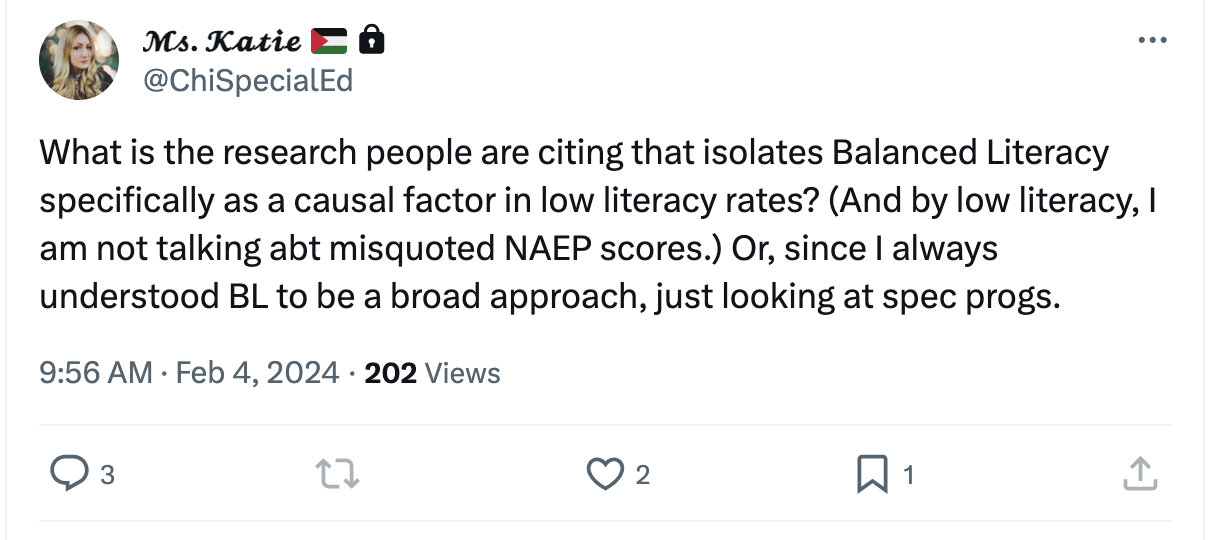
Let’s start with paired texts, one from X/Twitter and one from media:
With more than half of Connecticut’s third-graders failing to meet reading benchmarks, education stakeholders across the state agree that existing strategies must change in order to boost student scores.
How to go about that change is where the consensus ends.
State education officials are doubling down on their support of “Right to Read” legislation they believe will provide equal opportunity for all children learning how to read, despite local school leaders’ misgivings about the implementation of the law.
One of those critics is Westport Supt. of Schools Thomas Scarice, who after state officials refused to grant the town a waiver from the new program, expressed “disappointment as a result of the endless hours our faculty and leaders have spent on this waiver process.” He was responding to a request for comment from the Westport Journal in December.
In Westport, 73.8 percent of third graders achieved reading proficiency last year — 10 percentage points lower than the year before — but still among the highest in the state.
The state Department of Education “moved the goal posts throughout the process, and we continued to flex to meet those expectations,” Scarice contended.
“Programs do not teach kids. Materials do not teach kids. Highly skilled professional educators teach kids, and that is what we have in Westport,” he said.
State to Scarice: Criticism of new reading program a ‘myth’
In the midst of the reading program shuffle that the second text above is addressing, we must answer Katie’s question with a not-so-fun fact: “Science of Reading” (SOR) foundational claims that balanced literacy programs have cause a reading crisis in the US are not supported by science.
In fact, research for decades (including NRP reports) have shown that whole language, balanced literacy, and systematic phonics are about equally effective for student reading proficiency (comprehension); for example:
- Bowers, J.S. (2020). Reconsidering the evidence that systematic phonics is more effective than alternative methods of reading instruction. Educational Psychology Review, 32(2020), 681-705. https://link.springer.com/article/10.1007%2Fs10648-019-09515-y
- Wyse, D., & Bradbury, A. (2022). Reading wars or reading reconciliation? A critical examination of robust research evidence, curriculum policy and teachers’ practices for teaching phonics and reading. Review of Education, 10(1), e3314. https://doi.org/10.1002/rev3.3314
- Stephens, D. (2008). The federal government wants me to teach what? A teacher’s guide to the National Reading Panel report. National Council of Teachers of English. https://cdn.ncte.org/nctefiles/resources/newsletter/magazine/nrp_report.pdf
The really frustrating fact about the SOR movement is that “science” is the rhetoric of the advocacy and legislation, but anecdote is the primary evidence used to perpetuate essentially ideological claims:
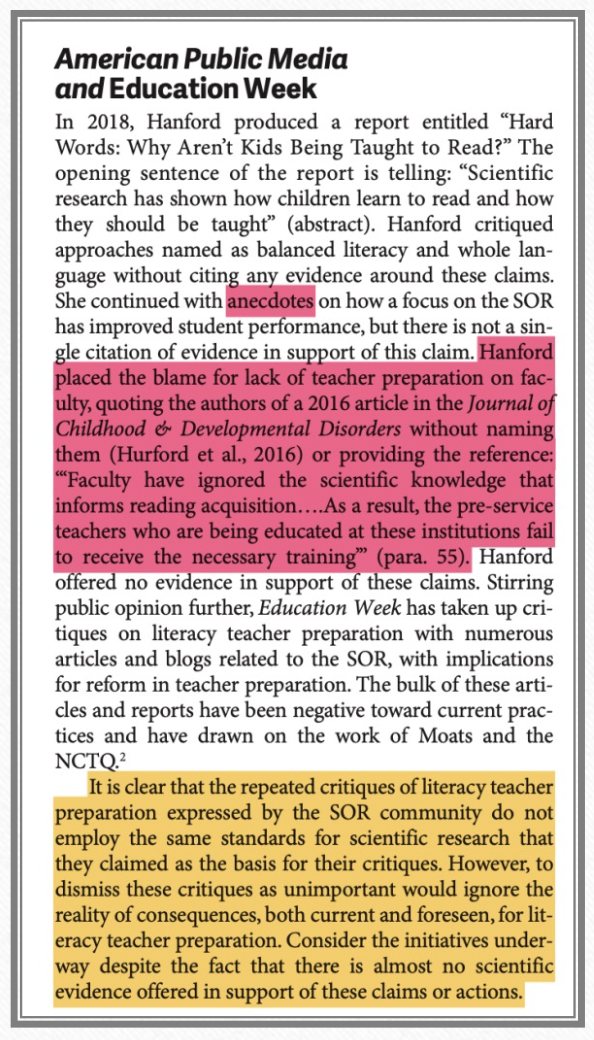
preparation. Reading Research Quarterly, 55(S1), S255–S266. https://doi.org/10.1002/rrq.353
Like CT, most states and notably NYC have passed legislation mandating districts and schools drop existing programs falsely labeled as “failing” and choose among a few reading programs falsely labeled SOR.
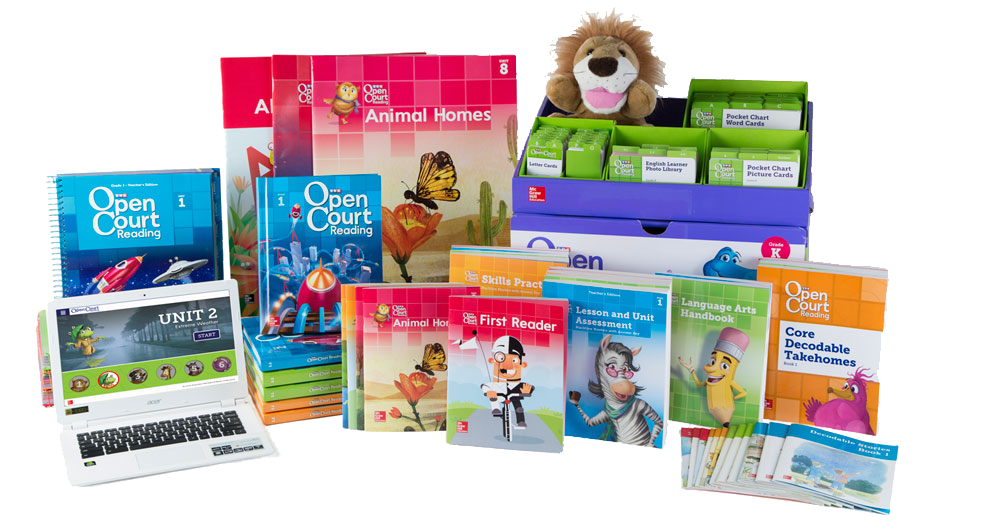
As one vivid example of this charade is the fate of the program Open Court, which has had a recent turn as program-of-the-day in the wake of the NRP/NCLB mandate that all programs had to be scientifically-based.
Although written in 2017, this overview of Open Court by McQuillan could have been written today, or sadly, several years from now:
Translation: Open Court does no better, and often worse, than the alternatives.
This most recent study is by no means the only evidence against phonics instruction or programs such as Open Court. The list of studies that show the failure of phonics is too long to repeat here, but you can whet your appetite by looking at what happened with the U.S. Department of Education’s spectacularly expensive and utterly ineffective Reading First program (here, here, and here, for starters).
Journalists and politicians get to move on to the next Great Cause, but the teachers and kids stuck in Open Court classrooms often have no such option.
Closing the Books on Open Court Reading
And thus, the really not-so-fun fact is that despite ample evidence to the contrary, some states have included Open Court in the new mandates!
Here is the real issue that is at the core of our obsession with manufacturing a reading crisis and then demanding the exact same reform strategies, again—mostly declaring some programs failures and mandating new programs instead: Reading programs have not caused a reading crisis, and different reading programs are not the reform solution regardless of our reading goals.
Since I have been making this argument literally for decades, I end here with a reader to emphasize that I endorse no reading programs—never have, never will:
- Reading Programs Always Fail Students and Teachers
- The Unnecessary Collateral Damage in the Misguided Reading Programs War
- Reading Programs Put Reading Last
- Teaching Reading and Children: Reading Programs as “Costume Parties”
- Missing the Forest for the Trees in Literacy Instruction: Resisting the Nonsense in Crisis-based Reading Reform (Again)
And it bears repeating: “’Programs do not teach kids. Materials do not teach kids. Highly skilled professional educators teach kids, and that is what we have in Westport,’ [Westport Supt. of Schools Thomas Scarice] said.”
 dr. p.l. (paul) thomas