
Entering the sixth year of detailing how the “science of reading” (SOR) movement uses “science” as a cover for claims that are primarily rhetorical and ideological, I once again must highlight that this misinformation campaign continues to be “holy text” in mainstream media.
Missouri kids are way behind. Making them guess at words doesn’t teach them to read, writes Emily Durig, National Director of Elementary Coaching for The Literacy Lab.
What remains stunning about the relentless misleading and factually wrong series of articles in mainstream media is the sheer absence of understanding about the topic of reading by those promoting SOR with missionary zeal.
SOR advocates lack scientific evidence for their claims and seem mostly driven by market/commercial or political/ideological agendas.
Durig’s misinformation is not only the exact same series of false claims you can find weekly since about 2018, but also a disturbingly careless recycling of Emily Hanford’s copycat misinformation articles initiated by “Hard Words” and then recycled into the melodramatic and misleading Sold a Story podcast.
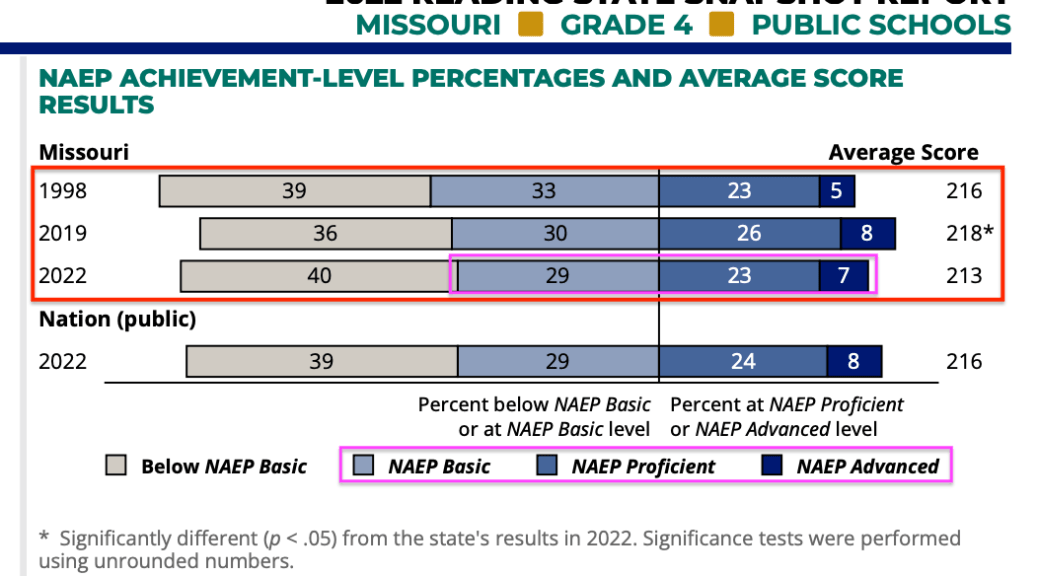
Durig begins with the NAEP Big Lie: “Missouri students are headed down a dangerous road. Only 30% of the state’s fourth-graders are reading at grade level.”
If you follow that link, you find a reference to MO’s NAEP grade 4 reading scores:

Using the exact same misinformation tactic as Hanford in 2018 and Nicholas Kristof in the NYT, Durig either doesn’t understand NAEP achievement levels or is being purposefully misleading; in either case, readers would be better served by not reading further since her argument is built on a lie.
NAEP “basic” is approximately grade level reading, and thus, 60% of MO students are reading at grade level or above, not 30%. [1]
One must ask, if you have to lie to make your case, do you have a case?
The follow-up claims—”The numbers are even more alarming for Black and Hispanic students in the state. They drop to 17% and 7%, respectively”—do not seem corroborated by the NAEP link, showing 31% of Black students at grade level or above and 56% of Hispanic students at grade level or above:
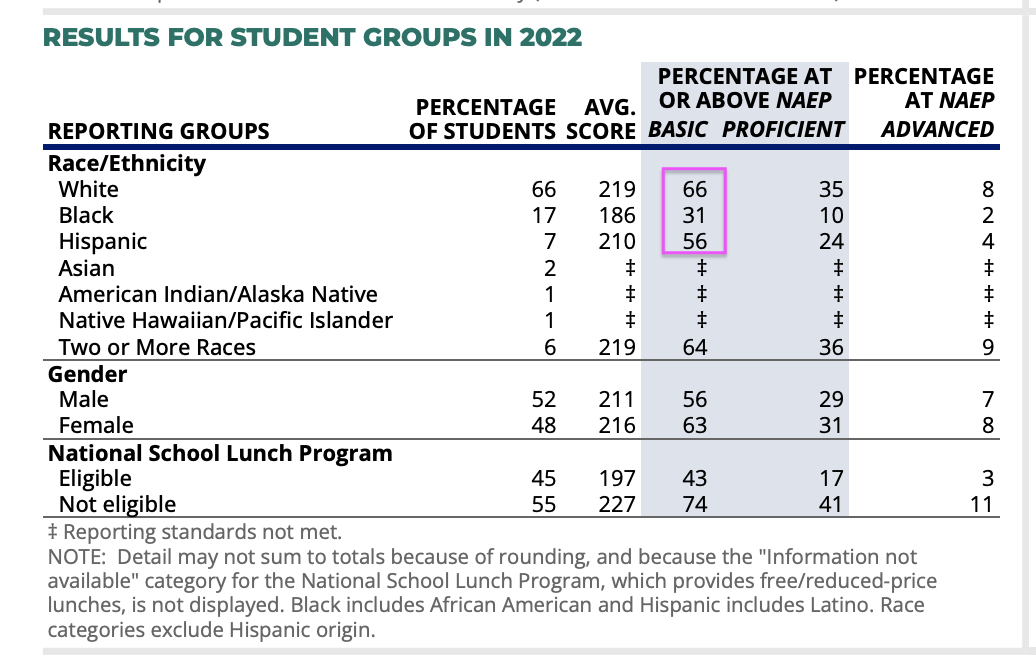
In the US, achievement inequity along racial lines is a historical failure of all achievement, not just reading. But again, if this is a serious issue, misinformation isn’t needed.
But it gets worse, if that is possible, because, Durig claims, “We are in the midst of a reading revolution. The way kids are taught to read in Missouri — and across the country — needs to be overhauled. And any rebuild should be based on the science of reading, including phonics.”
What is most disturbing is the lack of “science” in what follows, notably these well-worn but false series of claims and the links to anything except “science”:
Unfortunately, a lot of early reading teachers in the United States still practice what’s known as balanced literacy. That approach relies heavily on teacher choice and professional judgment. Teachers are taught to have many tools in their toolbox, and to use the methods that they think are most appropriate for their students.
One common practice in balanced literacy is guided reading, in which teachers coach students in a variety of comprehension strategies as they read a book matched to their level. Teachers encourage students who struggle over individual words to use pictures and context, in addition to looking at the letters, to guess at what the word could be.
But should kids be guessing at words when learning to read? There’s a ton of research that says no.
Missouri kids are way behind. Making them guess at words doesn’t teach them to read
Note that these claims include two hyperlinks—the first to NCTQ (which links to a blog post to prove the 90% claim), and the second to Education Week, more misinformation journalism, not science.
As many have demonstrated by conducting external peer-review, NCTQ is an ideologically conservative think tank founded by The Thomas B. Fordham Institute. NCTQ releases non-scientific reports that are not peer-reviewed. In other words, no NCTQ report meets even the minimum standards of “science,” and in fact, the reports have been shown to use shoddy methods to draw predetermined conclusions about teacher education. [2]
Durig also depends on the Balanced Literacy Big Lie, reducing BL to a caricature of guessing using pictures instead of decoding. Notably as well, Durig offers no links for the “ton of research” claim (because there is none).
The accurate claim about BL is that we have no scientific research to support claims of a reading crisis, no scientific research proving BL has failed, and no data proving any universal application of BL or reading programs. The media and political attacks on BL and reading programs are entirely rhetorical and ideological.
With this careless and misleading article, we find ourselves trapped in the sixth year of the Hanford SOR lie, and it seems too few people are willing to tell the real story of reading, the one that students deserve instead of using “science” to promote the same baseless reading war we have been waging since at least the 1940s.
[1] See:
- Scale Scores and NAEP Achievement Levels (NAEP)
- Loveless, T. (2016, June 13). The NAEP proficiency myth. Brookings. https://www.brookings.edu/blog/brown-center-chalkboard/2016/06/13/the-naep-proficiency-myth/
- Loveless, T. (2023, June 11). Literacy and NAEP proficient (Web log). https://tomloveless.com/posts/literacy-and-naep-proficient/
[2] Reviews of NCTQ reports:
Dudley-Marling, C., Stevens, L. P., & Gurn, A. (2007, April). A critical policy analysis and response to the report of the National Council on Teacher Quality (NCTQ). NCTE. https://ncte.org/resources/reports/critical-policy-analysis-response-nctq-report/
Benner, S. M. (2012). Quality in student teaching: Flawed research leads to unsound recommendations. Boulder, CO: National Education Policy Center. https://nepc.colorado.edu/thinktank/review-student-teaching
Fuller, E. J. (2014). Shaky methods, shaky motives: A critique of the National Council of Teacher Quality’s review of teacher preparation programs. Journal of Teacher Education, 65(1), 63-77. https://journals.sagepub.com/doi/10.1177/0022487113503872
Cochran-Smith, M., Stern, R., Sánchez, J.G., Miller, A., Keefe, E.S., Fernández, M.B., Chang, W., Carney, M.C., Burton, S., & Baker, M. (2016). Holding teacher preparation accountable: A review of claims and evidence. Boulder, CO: National Education Policy Center. http://nepc.colorado.edu/publication/teacher-prep
Thomas, P.L., & Goering, C.Z. (2016). Review of “Learning about Learning: What Every New Teacher Needs to Know.” Boulder, CO: National Education Policy Center. http://nepc.colorado.edu/thinktank/review-teacher-education
Cochran-Smith, M., Keefe, E.S., Chang, W.C., & Carney, M.C. (2018). NEPC Review: “2018 Teacher Prep Review.” Boulder, CO: National Education Policy Center. http://nepc.colorado.edu/thinktank/review-teacher-prep-2018
Burke, K. J., & DeLeon, A. (2020). Wooden dolls and disarray: Rethinking United States’ teacher education to the side of quantification. Critical Studies in Education, 61(4), 480-495. https://www.tandfonline.com/doi/abs/10.1080/17508487.2018.1506351
Stillman, J., & Schultz, K. (2021). NEPC Review: “2020 Teacher Prep Review: Clinical Practice and Classroom Management.” Boulder, CO: National Education Policy Center. http://nepc.colorado.edu/thinktank/teacher-prep
Thomas, P.L. (2023, September). NEPC review: Teacher prep review: Strengthening elementary reading instruction. Boulder, CO: National Education Policy Center. https://nepc.colorado.edu/review/teacher-prep
 dr. p.l. (paul) thomas