

It is hard for me to overemphasize the profound impact discovering irreverent humor had on me as a young human in the 1970s.
The list is long—George Carlin, Richard Pryor, The Firesign Theater, National Lampoon, Monty Python, Saturday Night Live, and so many films.
I was 13 when Blazing Saddles (1974) was released, now celebrating its 50th year anniversary. I came to love all of Mel Brooks’s films, but Blazing Saddles found a spot not only in my consciousness but also among my mother’s side of the family.

For many years our gatherings were punctuated with quotes from the movie followed by outbursts of laughter.
But witnessing how people have responded to the film over the years raises an important question: How can anything so misunderstood also be so beloved and enduring?
You see, the anniversary of Blazing Saddles has resurrected an utterly nonsensical response: Blazing Saddles at 50: the button-pushing spoof that could never get made today.
Just as conservatives and anti-woke warriors have misrepresented and dishonored George Carlin, claiming that the film could not be made today because of the woke mob completely misses that Blazing Saddles is a woke film (ironically, suggesting otherwise erases the brilliance of Black contributions to the film by Cleavon Little and Ricard Pryor).
And this leads to another question: When are misrepresentations of racism racism and when are they anti-racism?
We have ample literary evidence of this problem, also recently center stage in the rise of rightwing censorship: Adventures of Huckleberry Finn and To Kill a Mockingbird are excellent examples of representations of racism that offer extremely complicated ways to understand the texts and their appropriateness for exploring racism.
Both novels suffer from centering white characters, and TKAM is likely a poor text for examining racism since it perpetuates the white savior myth.
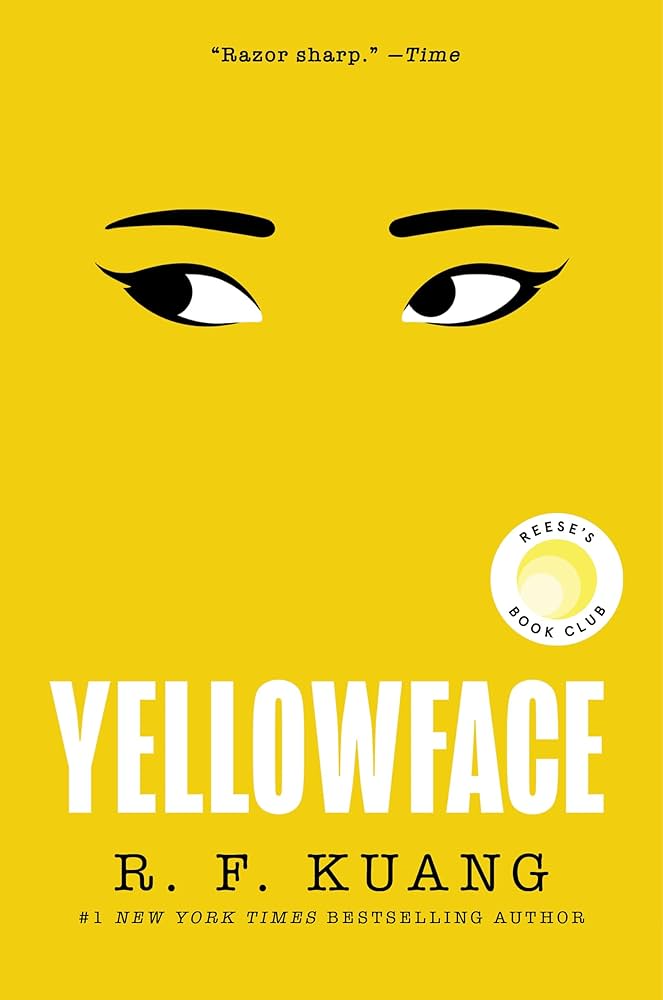
The reignited but jumbled public debate about Blazing Saddles comes in the wake of my first audiobook experience, Yellowface by R.F. Kuang.
Soon after that listening, I also sat mostly listening to a book club discussion among almost exclusively women.
One of the points brought up, and one of my central reactions, overlaps strongly with the Blazing Saddles/ Huck Finn/ TKAM issues noted above: How does a work become popular while being either misunderstood or not fully understood?
Broadly, I read Yellowface as a scathing satire of the publishing industry (and the insider’s view of MFA and creative writing programs) and a cautionary tale about the corrosive influence of capitalism/The Market on literary quality (sort of the myth that publishing is a meritocracy) as well as DEI commitments among publishers (the novel unmasks DEI as mostly marketing and tokenism).
I mentioned to my partner that I think much of that insider satire has to be lost on many readers in the same way I think Jeffrey Eugenides’s sort of English major perspective is missed by the average reader.
Regardless, Yellowface is incredibly rich and complex in terms of what we are experiencing and how readers might best navigate the storytelling.
First, I think storytelling is central to this work about writers, of course, but Kuang—like Twain and Lee—chooses to center a white character and her white voice (often one we find hard to feel any sympathy for) in order to interrogate storytelling and even story ownership in the context of race and racism.
Here, two important elements come to mind—the use of the unreliable narrator and the overlap between Yellowface and The Handmaid’s Tale by Margaret Atwood.
“Many of Edgar Allan Poe’s works include obsessed narrators who are plagued by their unconscious in order to discover their true selves,” Rachel McCoppin writes. And this description in many ways perfectly describes June Hayward, narrator of Yellowface.
June is relentlessly plagued by her Self to the exclusion of others and ultimately, it seems, to the exclusion of the Self she seems to be seeking.
Here, I must highlight Atwood’s The Handmaid’s Tale since, similar to Yellowface, the novel centers a white woman and her voice while also repeatedly disorienting the reader’s perception of that storytelling.
The narrator in HMT often tells an event and then confesses that version is wrong, only to tell it differently. Then, in the Historical Notes, we discover this story is a transcript recreated by a scholar from audio recordings.
Yellowface also significantly challenges the storytelling while also directly raising questions about who tells the stories as well as who should.
Does the scholar in HMT own the story simply by discovering the tapes? Does June have a right to Athena Liu’s manuscript that is also Liu’s retelling (claiming?) of the stories of Chinese laborers in WWI?
Whether intentional or not, I am also struck not only by the many names by which June Heyward goes (June Hayward, Juniper Song, Junie) but also how that mirrors the imposed name of June on the narrator of HMT:
When I first began “The Handmaid’s Tale” it was called “Offred,” the name of its central character. This name is composed of a man’s first name, “Fred,” and a prefix denoting “belonging to,” so it is like “de” in French or “von” in German, or like the suffix “son” in English last names like Williamson. Within this name is concealed another possibility: “offered,” denoting a religious offering or a victim offered for sacrifice.
Why do we never learn the real name of the central character, I have often been asked. Because, I reply, so many people throughout history have had their names changed, or have simply disappeared from view. Some have deduced that Offred’s real name is June, since, of all the names whispered among the Handmaids in the gymnasium/dormitory, “June” is the only one that never appears again. That was not my original thought but it fits, so readers are welcome to it if they wish.
Margaret Atwood on What ‘The Handmaid’s Tale’ Means in the Age of Trump
Atwood and Kuang invite readers to consider the importances of names, and these works are complex dramatizations of the complexity of not only storytelling but also the storyteller.
I have been a teacher and a literary critic for many decades so after my initial urge to connect Kuang’s novel to Poe’s unreliable narrator (and his foundational role in genre fiction such as horror), I was drawn to the many wonderful referential aspects of Yellowface.
Kuang masterfully blends and fictionalizes high-profile controversies in literature and publishing. [1]
Two are linked to Oprah Winfrey’s book club: A Million Little Pieces and American Dirt.
A Million Little Pieces sparked a public debate about the nature of genre since James Frey was accused of bogus claims in his published memoir (which began as a novel).
I use this debate often with students as a way to interrogate what we mean by genre, by fiction versus nonfiction, and by modes of expression. Among writers, teachers, and literary scholars, these lines are blurred, not distinct. But in the general public, there is little patience for anything other than black and white.
American Dirt, mentioned in the novel, is a recent and key publication that raised the questions many are exploring because of reading Yellowface—who has the right to a story and what constitutes appropriation (Jeanine Cummins’s novel was criticized as “brownface”).
The third reference is one of the most effective turns of Yellowface, when June discloses that Athena had co-opted a sexual assault situation experienced by June. This parallels the short story controversy around “Cat Person.”
While I struggle to feel compassion for June (or frankly any characters in the novel), the storytelling gradually reveals that Athena (and maybe all writers?) traffic in claiming other people’s stories as her own. One later scene involves June talking with Athena’s ex-boyfriend who directly confronts Athena’s willingness to use other people for her literary gain.
As I have continued to think and talk about Yellowface, I am more and more certain about what I don’t know for sure.
The end of the novel includes a revengeful character eventually (maybe?) bringing June’s charade to light, only to parlay that into her own book, Yelllowface.
Kuang has directly noted: “Who has the right to tell a story? It’s the wrong question to ask.”
For me, I am more fascinated by the storytelling than the storyteller. And Yellowface—again, like HMT—forces us through so many twist and turns that we are left unsure what story is true, or even if anything like the truth can exist.
[1] See:
- A Conversation with R.F. Kuang
- Rebecca F Kuang: ‘Who has the right to tell a story? It’s the wrong question to ask’
 dr. p.l. (paul) thomas