

[Header Photo by David Pupăză on Unsplash]
My midterm exam for first-year writing invites students to interview a professor in a discipline they are considering as a major. The discussion is designed to explore those professors as researchers and writers.
On exam day, we have small and whole-class discussions designed to discover the wide variety of activities that count as research in various disciplines, and more importantly, what writing as a scholar looks like across disciplines.
The outcomes of this activity are powerful since students learn that research and writing are context-based and far more complicated that they learned in K-12 schooling.
Two points that I often emphasize are, first, that many (if not most) of the professors confess that they do not like to write, and second, I help them see that a profoundly important distinction between their K-12 teachers and professors is that professors practice the fields they teach.
This brings me to two posts on Twitter (X):
First, Luther is confronting a foundational failure of K-12 writing instruction—students being taught the “4 Types/Genres of Writing” (narration, description, exposition, persuasion).
That framing is deeply misleading and overly simplistic, but that framing is grounded in two realities: most K-12 teachers who teach writing are not writers, and the so-called “4 Types/Genres of Writing” are rooted in the rise of state-level accountability testing of writing (not any authentic or research-based approach to teaching composition).
Second, so I don’t appear to be beating up unfairly on K-12 teachers (I was one for 18 years and love K-12 teachers), Dowell is then confronting the often careless and reductive ways in which “academic writing” is both taught and even practiced (academic norms of published writing ask very little of scholars as writers and even impose reductive templates that cause lifeless and garbled writing).
The 1980s and 1990s saw a rise in state accountability testing that asked very little of students. The “4 Types/Genres of Writing” quickly supplanted the gains made with authentic writing instruction grounded in writer’s workshop and the influence of the National Writing Project in the 1970s and 1980s.
Those writing tests prompted students to write narrative or expository essays (for example) that were only a few paragraphs long (likely the 5-paragraph essay). These were scored based on state-developed rubrics that teachers taught to throughout the year.
In other words, as Gerald Bracey warned, writing instruction became almost exclusively teaching to the test. And since K-12 teachers of writers were primarily not writers themselves, this reductive and mechanical way to teach and assess writing was rarely challenged.
Let’s be blunt. K-12 teachers not resisting this dynamic is a logical response to an impossible learning and teaching environment that is dominated by accountability and high-stakes testing.
My criticism is that teachers and students were (and are) put in this situation; I am not criticizing teachers and students, who are the victims of the accountability era of education reform.
Further, while students who move from K-12 to higher ed discover that their K-12 preparation in writing is inadequate and often deeply misleading for how they are expected to write in academia, this new situation is not some idealistic wonderland of authentic writing (as Dowell confronts).
The K-12 to higher ed transition makes students feel unfairly jerked around (many are exasperated when they find out they didn’t need to “memorize” MLA and may never use it again), but navigating academic expectations for writing is equally frustrating (one first-year student this spring noted that my first-year writing seminar is unique, they said, because I teach writing while other professors simply assign and grade writing).
Students deserve better at both the K-12 and higher ed levels so here I want to offer a few thoughts on how to move past the traps I have noted above about teaching writing.
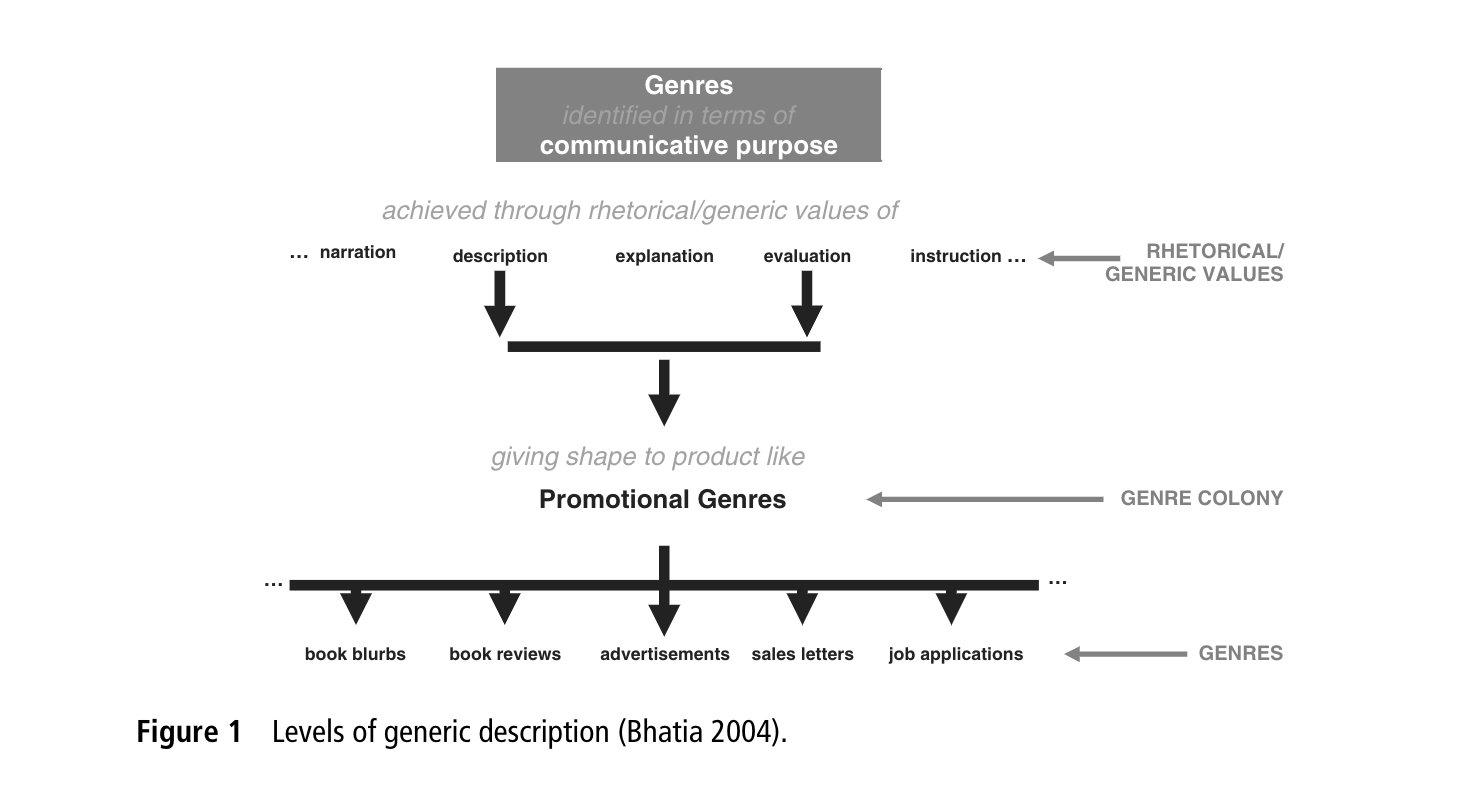
I highly recommend Genre awareness for the novice academic student: An ongoing quest by Ann Johns.
Johns argues for fostering “genre awareness” (addressing in complex and authentic ways Dowell’s concern) and not “genre acquisition” (for example, the reductive “4 Types/Genres of Writing” approach):
The first is GENRE ACQUISITION, a goal that focuses upon the students’ ability to reproduce a text type, often from a template, that is organized, or ‘staged’ in a predictable way. The Five Paragraph Essay pedagogies, so common in North America, present a highly structured version of this genre acquisition approach.
A quite different goal is GENRE AWARENESS, which is realized in a course designed to assist students in developing the rhetorical flexibility necessary for adapting their socio-cognitive genre knowledge to ever-evolving contexts. …After my many years of teaching novice tertiary students who follow familiar text templates, usually the Five Paragraph Essay, and who then fail when they confronted different types of reading and writing challenges in their college and university classrooms, I have concluded that raising genre awareness and encouraging the abilities to research and negotiate texts in academic classrooms should be the principal goals for a novice literacy curriculum (Johns 1997).
Genre awareness for the novice academic student:
An ongoing quest
Here I think is an outstanding graphic (Johns draws from Bhatia) of moving past confusing modes of writing (narration, description, exposition, persuasion) with genres of writing (OpEd, memoir, meta-analysis, literature review, etc.):
At both the K-12 and higher ed levels, then, teaching writing has been reduced to serving something other than students—either the mandates of high-stakes testing or the nebulous and shifting expectations of “academic writing,” which include very dangerous traps such as a maze of citation expectations among disciplines.
My first-year writing students and I are at midterm this spring, and we just held our conferences for Essay 2 with a scholarly cited essay looming once we return from spring break.
In those conferences, we have been discussing the huge learning curve they are facing since I ask them to choose their essay topic and thus develop their own thesis within a genre of writing.
They are making all the decisions writers do in authentic contexts.
Before my class, they have had most of their writing prompted, most of their thesis sentences assigned to them, and most of their genre experiences entirely reduced or erased.
So I explain this to them, assuring them that their struggles are reasonable and not a product of them failing or being inadequate.
These are new and complex expectations of young writers.
But is the only fair thing to offer them, this experience of becoming a writer as an act of them as humans and not as a performance for a test or to fill in a template.
Recommended
Investigating Zombi(e)s to Foster Genre Awareness
Thomas, P.L. (2019). Teaching writing as journey, not destination: Essays exploring what “teaching writing” means. Charlotte, NC: Information Age Publishing.
RECOMMENDED: John Warner’s “Why They Can’t Write”
RECOMMENDED: John Warner’s “The Writer’s Practice”

 dr. p.l. (paul) thomas