
Many years ago, I was unusually excited to hear the keynote speaker at the annual SCCTE conference on Kiawah Island, SC—Harvey Smokey Daniels.
For many years in my methods courses for secondary ELA certifiers and practicing teachers, I used Best Practice by Steven Zemelman, Daniels, and Arthur Hyde.
Daniels surprised the attendees by noting that he was moving away from the term “best practice” because it had become ubiquitous and thus meaningless. He warned that many, if not most, books being published with “best practice” in the title were anything except best practice.
The term had moved from careful scholarship (the book Daniels co-authored is a wonderful and cautious attempt to translate a wide body of research into classroom practice among the major disciplines) to branding.
And thus, as Daniels lamented, “best practice” was lost in the abyss that is educational marketing.
Much more quickly and recently, Common Core experienced a meteoric rise and sudden crash and burn. In the mean time, classrooms materials were quickly labeled “Common Core” even as the movement was hastily erased before some states even implemented the standards or the national tests (my home state of SC did exactly that as a knee-jerk Republican maneuver to reject Obama, they believed).
Spurred in early 2018 with the rise of the “science of reading,” the “science of” movement appears to be in full swing with the addition of the “science of learning,” the “science of writing,” and the “science of math”—mostly following frantic claims of crisis based on test scores (usually NAEP data).
You likely won’t have to wait long because the soar/collapse cycle is already in front of us as the state of Alabama was first included as one of the “soaring” Deep South states adopting the “science of reading” like Mississippi, and then this: Alabama reading scores drop in latest state test results. How many students can read?
While both media assessments lack credibility, the rhetoric itself harkens yet another education reform movement destined for the garbage bin. We seem unable to learn that the crisis/miracle reform cycle never works because the problems are always misrepresented and then the solutions are always mandates that will fail.
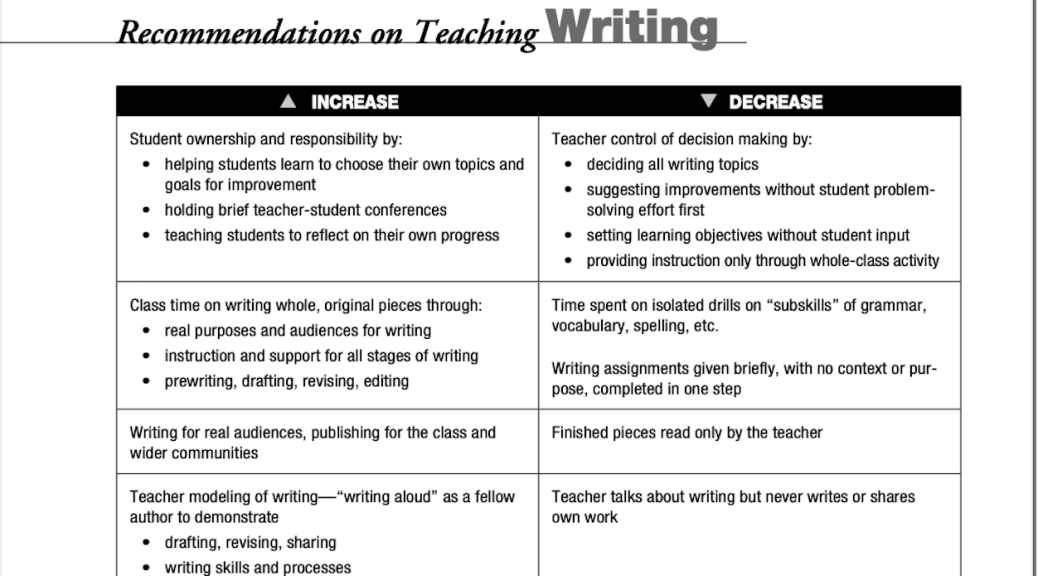
Let me note here that what made the original best practice approach a wonderful methods text is that the instructional practices were recommended as “increase” or “decrease”—not mandate or ban:

This helps show how the “science of reading” movement—grounded in media false stories and political mandates—is repeating the mistakes of dozens of reform movements before this “science of” nonsense.
The essential mistakes are framing “science of” as a mandate/ban or science/not science dichotomy.
Legislation across most states is now banning specific reading practices and programs while mandating other practices and programs.
While legislation should never ban or mandate specific practices in education, “science of reading” (SOR) legislation also fails by cherry-picking what counts as science/not science.
To be blunt, SOR legislation is driven by ideology and marketing, not science; the mandate/ban line is subject to cherry picking.
For example, many states are simultaneously banning three cueing as not scientific but mandating or funding decodable texts and multi-sensory approaches such as O-G phonics.
In The Science of Reading: A Literature Review (prepared for Connecticut), however, this literature review shows all of those practices lack scientific evidence:

Unlike the careful work done on best practice by Daniels and others, the “science of” movement suffers from ham-fisted mandates and essential failures to understand what “science” means for classroom practice.
The Reading League, for example, limits what counts as “scientific” to experimental/quasi-experimental research that is published in peer-reviewed journals. While this is a ridiculously narrow use of evidence and research, it also poses several problems.
First, as the literature review above notes, the science/not science dichotomy can include both practices/programs that have scientific research supporting or not the practice/program or practice/programs that do not yet have any or enough scientific evidence (such as the programs LETRS).
Next, and more importantly, many people fundamentally misunderstand what the science/not science distinction means for classroom practice.
If we use medicine as an analogy, once a medication is found to be effective, that means that medicine X under Y conditions will produce Z outcomes for most people (a generalization).
What is often ignored is that there are at least two outlier groups in that claim; one group will not experience the positive outcome, and one group can experience negative outcomes.
As a teen, I fell into that latter group with both Tylenol (a reaction that can be life threatening) and penicillin.
If we insist on using the science/not science distinction, then, for classroom practices we must not translate that into mandate/ban.
The “science of” movement could be effective if we did two things: (a) expand the use of research to include more than narrowly “scientific” evidence, and (b) replace mandate/ban with implement with confidence/implement with caution.
Let me end by briefly considering what implement with confidence/implement with caution should accomplish.
If we use research/evidence/science to drive implement with confidence, that means those practices and programs can be used to plan broadly (year-long and unit plans prepared before teaching and before having evidence from students to guide instruction).
Those practices and programs, like medication, can be trusted to work for most students under defined conditions—recognizing that there will be outliers and conditions can change, thus changing outcomes.
Practices and programs that can be implemented with caution augment those initial plans and can serve the outliers as well as when conditions change.
Here is the key that the “science of” movement is failing most significantly: This process must honor the autonomy of the teacher to serve the individual needs of students.
As the swing in rhetoric about Alabama reveals (see also the realities about Florida and Mississippi), the “science of” movement is doomed to fail, doomed by repeating the mistakes of reform cycles we have blindly followed for over four decades.

 dr. p.l. (paul) thomas