
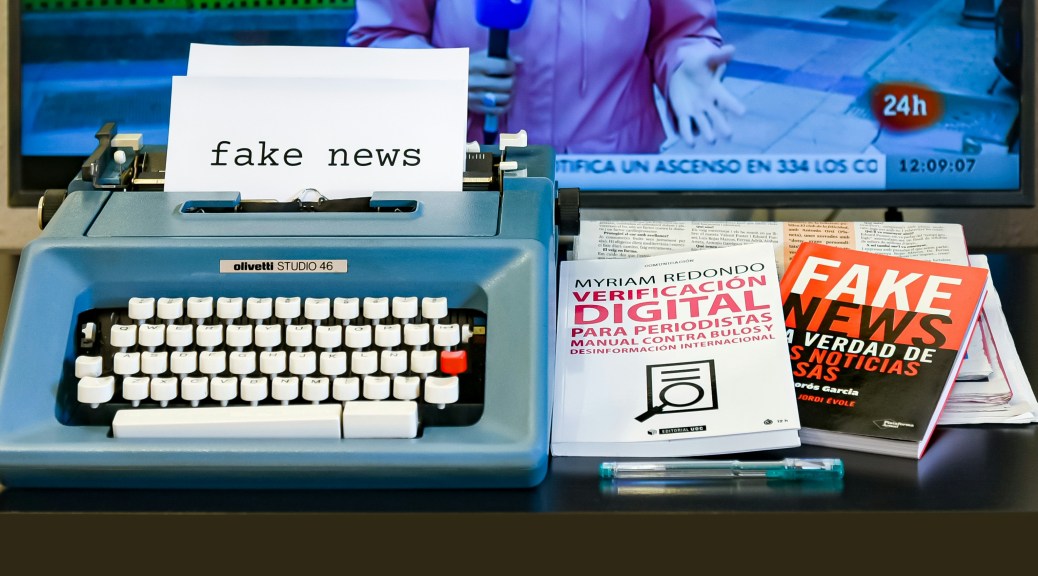
[Header Photo by Jorge Franganillo on Unsplash]
“Misinformation has received much public and scholarly attention in recent years,” write Ecker et al. in Why Misinformation Must Not Be Ignored, adding, “The fundamental question of how big a concern misinformation should be, however, has become a hotly debated topic.”
They argue and conclude, as noted in the abstract:
Here, we rebut the two main claims, namely that misinformation is not of substantive concern (a) due to its low incidence and (b) because it has no causal influence on notable political or behavioral outcomes. Through a critical review of the current literature, we demonstrate that (a) the prevalence of misinformation is nonnegligible if reasonably inclusive definitions are applied and that (b) misinformation has causal impacts on important beliefs and behaviors. Both scholars and policymakers should therefore continue to take misinformation seriously.
While this compelling examination of misinformation focuses broadly, their focus and conclusion are applicable to the current “science of reading” (SOR) movement that is grounded in misinformation, yet has proved to be highly compelling for the public and then has driven new and revised reading legislation across nearly every state in the US.
For example, a poll, Reading Education Messaging: Findings and Recommendations from an Online Poll of K-5 Parents in America, shows a disturbing pattern:
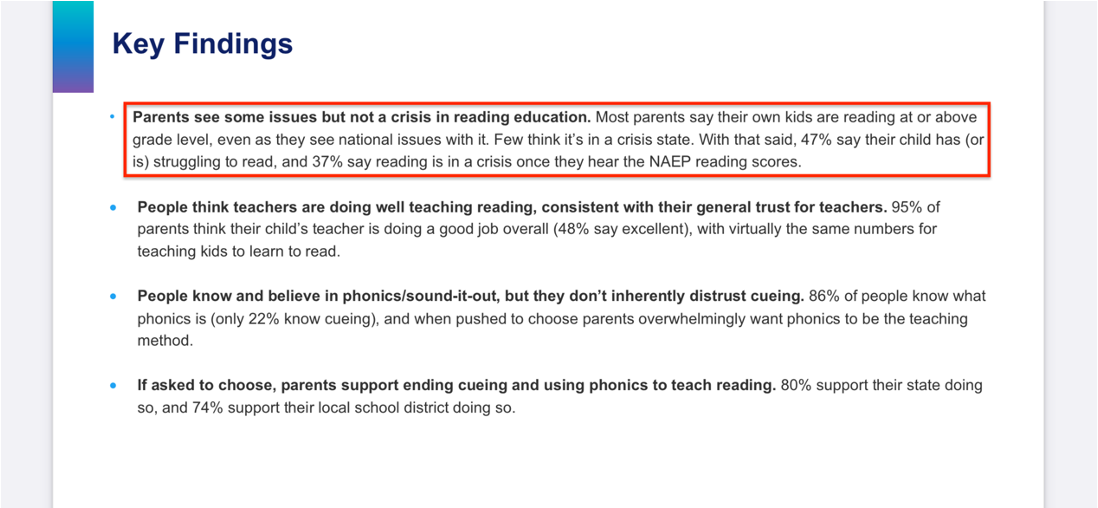
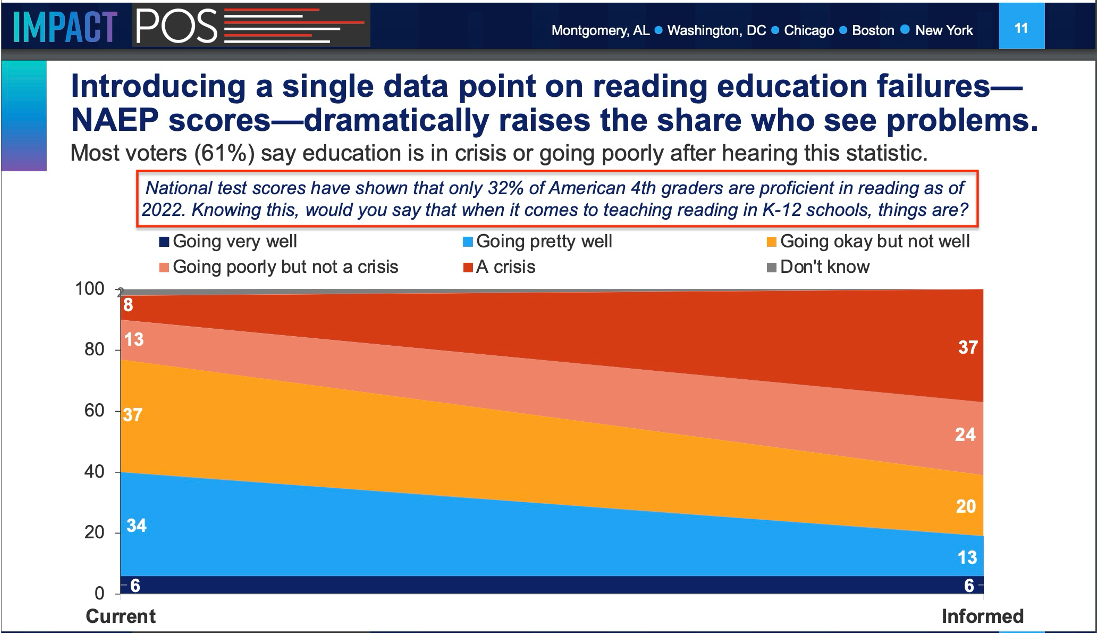
The misleading media claim about reading proficiency (because of the confusing categories in NAEP testing) actually changes parental opinion about reading achievement from positive to negative.
Although the SOR story about reading has become “holy text,” the foundational claims of a reading crisis and the causes of that supposed crisis are both false and mischaracterizations.
This influx of misinformation about reading proficiency and reading instruction has created a false story about reading teachers and teacher educators as “bad” teachers and imposed on students a one-size-fits-all and whitewashed set of reading reading
Further, this misinformation campaign about reading proficiency, reading instruction, and reading science is also a serious distraction from the real challenges facing learning and teaching reading.
The US is, as the authors propose, increasingly a misinformation nation, and that dynamic has reignited the corrosive “crisis” and reform cycles in US education, specifically in terms of reading and math.
The US is in a state of perpetual and manufactured crisis/reform in education that serves the interests of the media, political leaders, and the education market place, but harms teachers and students.
Here, then, is a reader that addresses that misinformation by offering a more nuanced and evidence-based examination of the outsized impact of out-of-school factors on student learning, the complicated facts about “reading proficiency” and NAEP testing, and the false stories driving the SOR movement:
- Big Lies of Education: Poverty Is an Excuse
- Big Lies of Education: Reading Proficiency and NAEP
- How Media Misinformation Became “Holy Text”: The Anatomy of the SOR Movement
- We Teach English in Times of Perpetual Crisis: Selling a Story of Reading (and Literacy) [Webinar Companion Post]
- Thomas, P.L. (2024, March). We teach English in times of perpetual crisis: The long (and tedious) history of reading crisis. English Journal, 113(4), 21-26. https://publicationsncte.org/content/journals/10.58680/ej2024113421
- Thomas, P.L. (2024, May). Teaching English in the “science of reading” era: We teach English in times of perpetual crisis: Selling a story of reading. English Journal, 113(5), 16-22. https://publicationsncte.org/content/journals/10.58680/ej2024113516 [Access HERE until open access at EJ]
- Thomas, P.L. (2024, September). We teach English in times of perpetual crisis: The media continue to misread teaching reading and literacy. English Journal, 114(1), 14-19. https://publicationsncte.org/content/journals/10.58680/ej2024114114 [Access HERE until open access at EJ]
- Thomas, P.L. (2024, November). We teach English in times of perpetual crisis: For all ELA teachers, “the time is always now.” English Journal, 114(2), 21-26. TBD
Note
Ecker, U. K. H., Tay, L. Q., Roozenbeek, J., van der Linden, S., Cook, J., Oreskes, N., & Lewandowsky, S. (2024). Why misinformation must not be ignored. American Psychologist. Advance online publication. https://dx.doi.org/10.1037/amp0001448
 dr. p.l. (paul) thomas