

[Header Photo by Diomari Madulara on Unsplash]
At the end of fall semester of year 41 as an educator, I can admit two things: (1) I may have learned more than my students (taught two new courses and continue to experiment with course grade contracts), and (2) I am excited about spring courses where I can implement what I learned (both about grade contracts and teaching students to write).
Since I entered the classroom in 1984, I am in my fifth decade as a teacher, much of that work dedicated to teaching writing to students but also using writing assignments as teaching and learning, not assessment.
Gradually and then at some point in the 1990s, I successfully eliminated traditional tests and assignment grades in my high school English courses. As a note of clarification, although I do not use tests or grades, I have always been required to assign grading period and course grades.
Thus, I have been seeking ways to better navigate a test/grade culture of traditional schooling (one my students have been conditioned to trust and even embrace) while practicing my critical philosophy that rejects both.
A few semesters ago, as part of that journey, I returned to the course grade contract, something I had tried in some fashion during my high school teaching years.
The problem I continued to have was that students were mostly unable to set aside their test/grade mentality, and thus, the absence of tests and assignment grades often negatively impacted student engagement and learning.
Initially, I envisioned course grade contracts would improve student engagement and lower stress and anxiety, thus improving learning.
Some non-traditional practices worked. I have students prepare for and participate in a class discussion for their midterm, for example. No memorization, no “cover your work,” and no exam stress.
This collaborative approach students both embraced and recognized as not assessment, but as learning experiences themselves.
However, particularly in courses that are not designated as writing courses (I do teach first-year writing and an upper-level writing/research courses), students tend to struggle significantly with the course structure and the use of a major writing assignments as an extended teaching and learning experiences (and not a way to grade them).
The first iteration of the course grade contract, then, focused on requiring students to submit, conference, and revise essays; I structured A and B course grades around minimum standards for the B-range (submit an acceptable essay, conference after receiving my feedback, and submit one acceptable revision that addresses the feedback) and additional revisions after more feedback for the A-range.
Despite the course grade being explicitly linked to minimum expectations for the process, students continue to see my feedback as negative and harsh, but also remain trapped in the possibility of submitting a perfect essay and never having to complete revisions.
In short, they see the essay assignment as a form of assessment and cannot fully engage in the submitting/revising process as individualized teaching and learning experiences.
Oddly, students continue to email me apologizing for their first submissions because they see the revision-oriented feedback, again, as negative or harsh—evaluative—and not a necessary part of essay assignment as teaching and learning.
The semester ending now, in fact, proved to me that using the course grade contract to shift assignments from forms of assessment to teaching/learning experiences (like the midterm exam period as a class discussion) needed another round of revision by me.
The problems I am still encountering include students struggling in content-focused courses (where they expect traditional tests and are not expecting to be challenged as thinkers and writers) because of the absence of tests/grades as well as the course structure that forefronts course content in the first half of the semester and mostly implements workshop the second half.
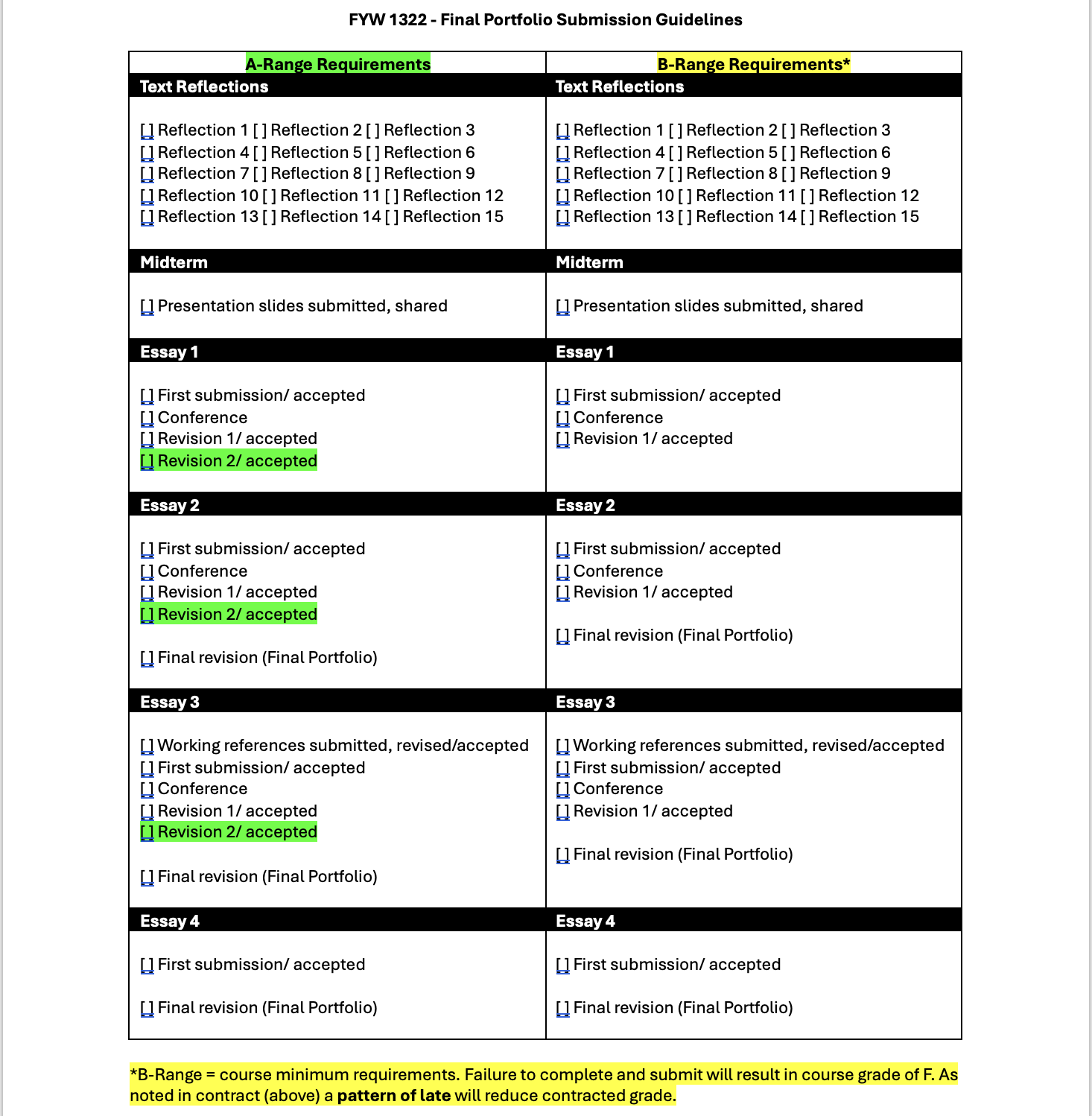
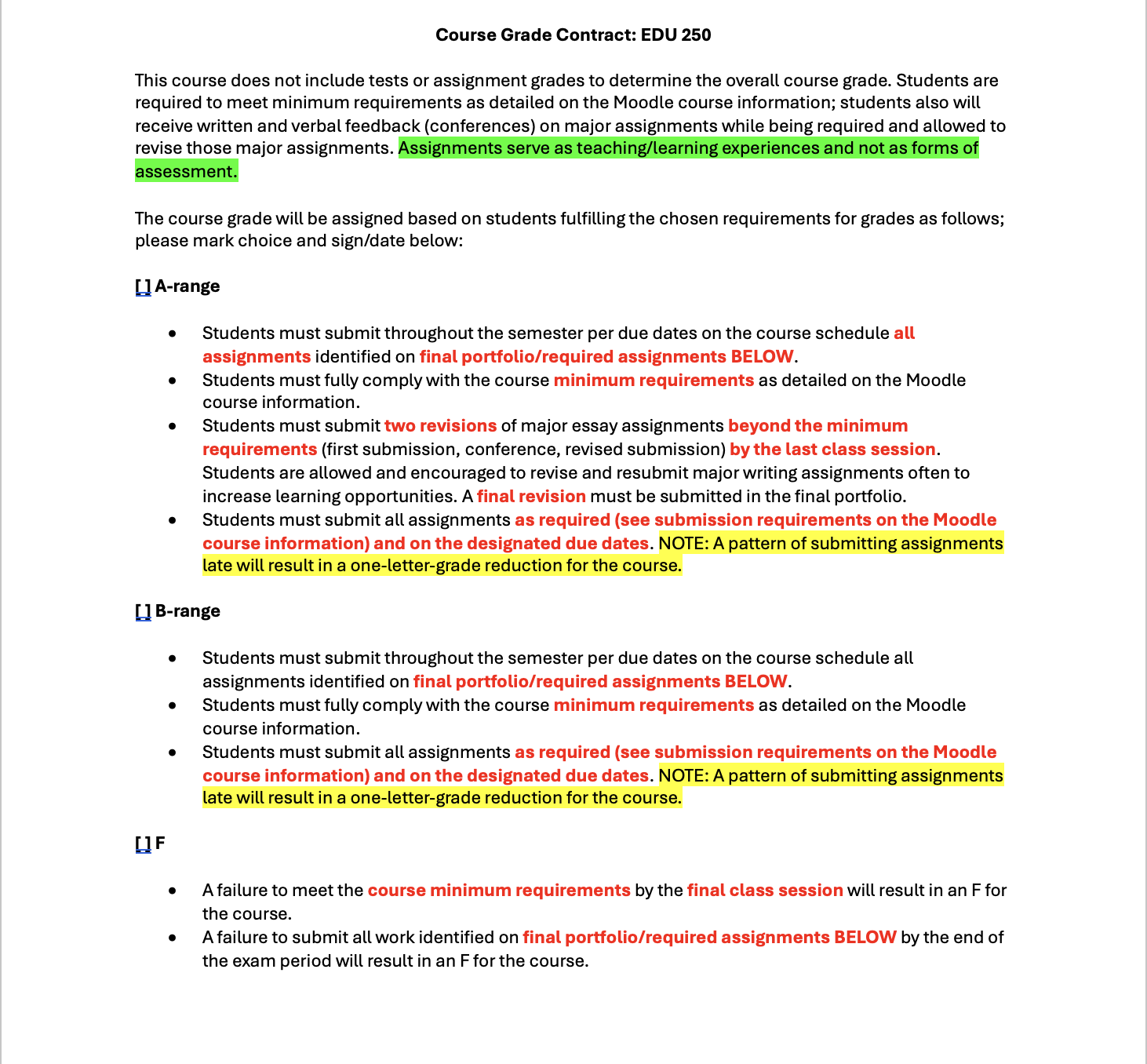
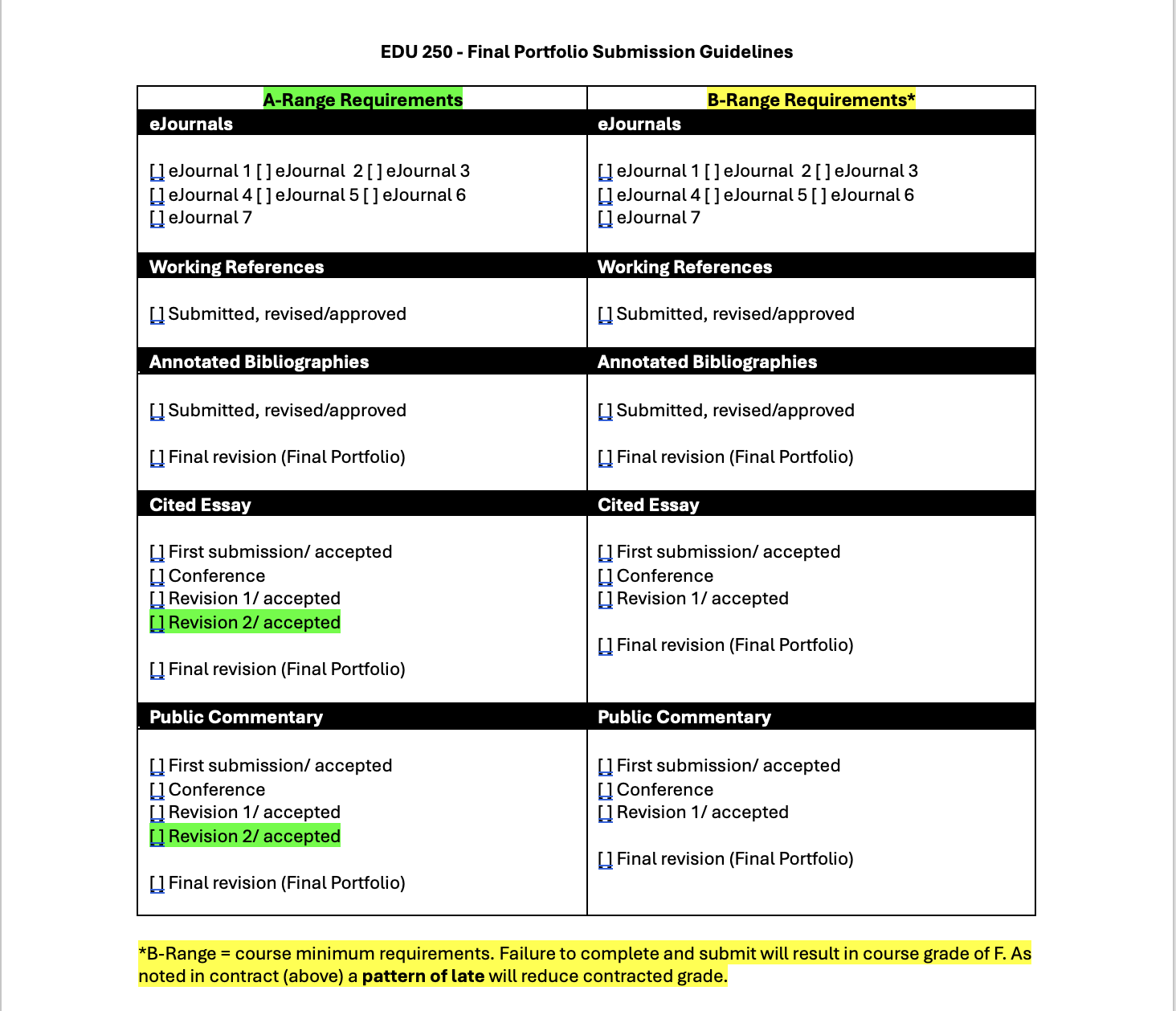
Here, then I want to share the new versions of those contracts to be implemented in spring. I have more explicitly included language about the purpose of the contract and added the final portfolio expectations in a format that also is more explicit about assignment expectations as well as fulfilling the contracted grade.
Here is the revised course grade contract for my first-year writing course:

And here is the revised course grade contract for my upper-level writing/research course:
The problem will remain, however, that I teach students conditioned for more than 2/3 of their lives in a culture of tests and grades, a culture that has taught them that assignments as by the teacher for evaluation and not for the student as teaching and learning.
I am seeking ways to shift the culture of teaching and learning as well as my students’ expectations for what it means to be a student and a teacher.
These are big asks for those students, but I am convinced they can make those shifts and benefit greatly from doing so.
 dr. p.l. (paul) thomas